

FILM · 2016 · USA
Doctor Strange
- Directed by
- Scott Derrickson
- Runtime
- 115 min
- Studio
- Marvel Studios
257 archived facts 7 topics 2 sources Last reviewed Nov 2026
After his career is destroyed, a brilliant but arrogant surgeon gets a new lease on life when a sorcerer takes him under her wing and trains him to defend the world against evil.

257 Interesting Facts About Doctor Strange
Interesting Facts (73)
- #001
George R.R. Martin met Dr. Strange co-creator Steve Ditko at the first Comic-Con in 1964, when Martin was 15. Martin wrote on his blog, "It might well have been the only [con] he ever attended [Ditko was notoriously reclusive]... but I got to talk to him, and tell him how much I loved his art. Especially on Dr. Strange. Ditko was reserved, maybe a bit shy, but genial enough. He told me that Dr. Strange was his favorite as well. Yes, even more than Spider-Man. He's still one of the best comic artists who ever picked up a pencil, in my not-so-humble opinion."
- #002
This is the fourth film in which Rachel McAdams plays a love interest to a man who can travel through (or otherwise manipulate) time; the others were The Time Traveler's Wife (2009), Midnight in Paris (2011), and About Time (2013). In none of these four movies does McAdams's character herself get to participate in these time travels or manipulations.
- #003
Both Chiwetel Ejiofor (Karl Mordo) and Benedict Wong (Wong) co-starred in The Martian (2015).
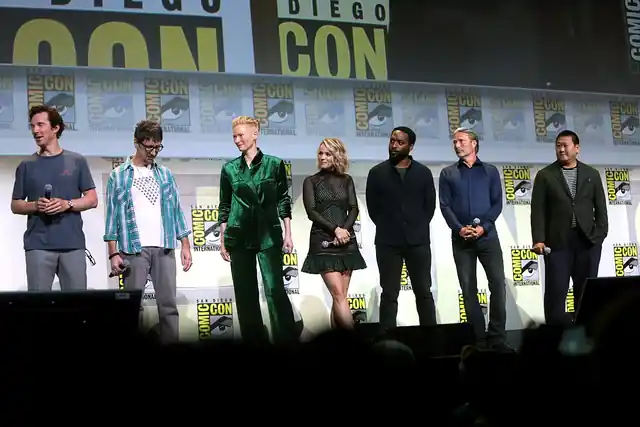
Doctor Strange (2016): Stephen Strange, Mordo and Christine PalmerImage: Wikimedia Commons · Gage Skidmore from Peoria, AZ, United States of America, CC BY-SA 2.0 - #004
Each "Doctor Strange" feature has starred a Star Trek actor: * Michael Ansara, who was the Klingon Kang in Star Trek (1966), voiced the Ancient One (in an uncredited role) in Dr. Strange (1978). * Jeffrey Combs, who has played various Star Trek roles, was Doctor Strange in Doctor Mordrid (1992) (a version with names changed). * George Takei, who was Hikaru Sulu in Star Trek (1966), was Wong in Sins of the Fathers Chapter 1: Doctor Strange (1996). * Paul Nakauchi appeared in The Homecoming (1993) and was Wong in Doctor Strange (2007). * Kevin Michael Richardson, who voiced several aliens in Star Trek Into Darkness (2013), was Baron Mordo in Doctor Strange (2007). * Benedict Cumberbatch, who was Khan Noonien Singh in Star Trek Into Darkness (2013), stars in this film as Strange. In addition, Michael Giacchino, although not an actor, composed the scores for this movie and the three Star Trek reboot movies.
- #005
- #006
- #007
- #008
- #009
Benedict Cumberbatch states that the spiritualism of Doctor Strange is what appeals to him the most about the role. "I'm very excited about that spiritual dimension. It's something that's been a huge part of my life. I meditate a lot, that's a huge tool in trying to calm myself, get away from the crazy circus of it all, have a focused mind as well as be a kinder, considerate person in the world," said Cumberbatch.
- #010
- #011
- #012
- #013
- #014
- #015
- #016
Originally, the film was to feature a prologue set in CERN (Conseil Européen pour la Recherche Nucléaire, aka the European Organization for Nuclear Research) and would feature a discussion on parallel dimensions. The filmmakers felt this was too scientific for a magic-based story, and removed it.
- #017
According to Kevin Feige, the concept of magic in the Marvel Cinematic Universe is inspired by The Matrix (1999) and the fantasy works of Stanley Kubrick and Hayao Miyazaki. "Have you watched the Cosmos (1980) series? That's magic, the quantum physics. If somebody knew how to tap into that stuff, what's the difference between that and magic? You don't get into it in Harry Potter, but if a scientist went to Hogwarts, he'd find out how some of that stuff is happening! We're not going to spend a lot of time on it, but there will be some of that, particularly for a character like Doctor Strange, who goes from a man of science to a man of faith and who traverses both worlds. And sometimes there won't be an answer! Sometimes he'll want an answer--'How is this happening?'--and nothing," said Feige.
- #018
- #019
Mads Mikkelsen described Kaecilius as an anti-hero from another dimension who is a villain in this dimension: "He believes that the Ancient One is just protecting her own power base and that the world may be better off if we were to allow some of these other things through. He's a man who believes in something else than the hero. He is the antagonist, of course, but he's not necessarily wrong. He wants to make the planet look wonderful and to save the world, but he has a different way of doing it."
- #020
Mordo repeatedly states that "the bill comes due." This comes from the 2016 Doctor Strange comics, where Dr Strange received constant warnings of "the bill coming due" for wielding magic; in consequence, he attracted the attention of the anti-magic scientists the Empirikul, who severely depowered the magicians of Earth.
- #021
(at around 47 mins) In a fight, Master Mordo has a relic that he calls the Staff Of The Living Tribunal. In the original comics, The Living Tribunal is the most powerful cosmic entity in all the Marvel universe, a floating three-headed over a golden body (he has no neck) which mission is keep the balance between the multiverse, judging cases of first category in the cosmic order.
- #022
- #023
(at around 55 mins) The building number seen in the portal to New York City was 177A Bleecker Street, the location of the Sanctum Sanctorum. This is actually the address of a townhouse apartment shared by Marvel comic book writers Gary Friedrich and Roy Thomas in the 60s, the latter of whom wrote several Doctor Strange stories, though not the 1963 issue of Strange Tales that revealed the address as 177A Bleecker.
- #024
One of the mages at Kamar-Taj is Tina Minoru (Linda Louise Duan). Tina is the mother of Nico Minoru, a member of the Runaway group of heroes, which is expected to be adapted into a TV series, Runaways (2017). Tina wields a staff in the film; this is the Staff of One, a powerful magical weapon that Nico eventually wields.
- #025
- #026
On multiple occasions, Doctor Strange corrects people who call him Mister. Had the character been English the opposite would in fact be true. Surgeons in the UK go by Mister instead of Doctor. This tradition dates back many years. Physicians went to university whilst Surgeons were barbers. So, a doctor of medicine had a degree and was titled Dr. But surgeons had no formal education and were titled Mr., and after becoming a qualified surgeon an individual will go from Doctor to Mister/Miss/Missus but with the letters MRCS or FRCS after their name. Many surgeons take offense at being called doctor and doctors take offence at being referred to as Miss/Mrs/Mr. This is actually true of all Surgical Specialists and unthinkable for anyone not part of a surgical based speciality. Consultants/GPs being a specialist doctor/surgeon no longer in post graduate training.
- #027
First Marvel Studios movie to feature the new Marvel Studios logo/fanfare composed by Michael Giacchino at the start of the film. Michael Giacchino also scored the film. Previous Marvel Studios films featured the original logo that can also be seen in other Marvel movies such as the X-Men series. This logo was sometimes accompanied by the fanfare composed by Brian Tyler, which was first heard in Thor: The Dark World (2013).
- #028
The devastating earthquake hit Nepal after they scouted and approved the locales but before they were scheduled to begin filming. It destroyed some of the locations they had planned on shooting. "There were piles of rubble everywhere," but he and Cumberbatch agreed that it would be beneficial to still shoot there as their tourism dollars could only help the local economy as did the hiring of locals as extras and crew members.
- #029
Strange's predecessor as the master of the New York Sanctum Sanctorum is named Daniel Drumm (Mark Anthony Brighton). Daniel is the twin brother (and later spirit assistant) of Jericho Drumm, known as the voodoo priest Brother Voodoo, who is the Sorcerer Supreme successor of Dr. Stephen Strange.
- #030
Scott Derrickson heard people say the big city folding scene is a ripoff of Inception (2010), but while they drew on it "I thought Inception was one of the most visually interesting movies of the last six or seven years, but it was seven years ago now that it came out and I felt like it was the tip of an interesting visual effects iceberg and I wanted to go crazy with the idea of spacial manipulation." He says he was building on Christopher Nolan's sequence the way Nolan was building on On Her Majesty's Secret Service (1969) for the climactic snow fight at the end. That's what we filmmakers do, we borrow from other sources."
- #031
(at around 10 mins) When Dr. Stephen Strange decides which watch to wear, the song "Interstellar Overdrive" by Pink Floyd is playing. On 28 September 2016, shortly before the release of this film, Benedict Cumberbatch joined Pink Floyd guitarist David Gilmour on stage at a Royal Albert Hall concert and sang co-lead vocals of their classic hit "Comfortably Numb". Furthermore, Pink Floyd's sophomore album "A Saucerful of Secrets" (1968) features superimposed images of Doctor Strange himself, from Strange Tales #158.
- #032
- #033
A Doctor Strange film had languished in development hell for some 30 years, with the likes of Alex Cox, Charles Band, Wes Craven, David S. Goyer, Guillermo del Toro, and Neil Gaiman attached at various stages. When Band's option for the rights expired, he changed the plot and character names and produced Doctor Mordrid (1992) instead. Gaiman described his and del Toro's vision, "So the idea is that he went through all of that and the training to become the world's greatest magician maybe in the early '30s, late '20s, and he's been living in Greenwich Village for 90 years looking the same in his place, and nobody really notices. We just sort of liked that idea, and he would have been sort of out of time. But other than that, it would have just been very sort of Steve Ditko because, you know, that's the best." Tom Selleck was considered to play Strange in the 1980s.
- #034
(at around 1h 26 mins) The Cloak Of Levitation is shown standing on its own in the corner of the operating room, to Christine Palmer's disbelief. Before germ theory and surgical hygiene were fully understood, the experience and seniority of a surgeon was often judged by how soiled and bloody their operating gown was, to the point where the most successful surgeons had gowns that stood up independently.
- #035
- #036
- #037
(at around 34 mins) When Dr. Strange is having his first lesson from The Ancient One, she creates a geometric pattern out of light energy. In the real world this is very similar to spiritual geometric patterns called Yantra. Yantra (Sanskrit) is a mystical diagram, mainly from the Tantric traditions of the Indian religions. Specific yantras are traditionally associated with specific deities. These energy centers create a spiritual portal or vortex to allow the energies, healing and mystic teachings of the various deities to come through and were also adopted by Tibetan and other forms of Buddhism.
- #038
Scott Derrickson stated activists for more Asian representation in film "have to be loud and angry and dogged and relentless because otherwise, no one will listen to them. Representation of Asian-Americans throughout Hollywood cinema is abysmal." His passion for the issue is clear, and while he previously explained his reasoning for casting Swinton "Whether you agree with it or not, I certainly did it with the best possible motives." he was adamant about balancing it with the Wong character. "I made sure that he was essential. The trick was to invert him from the comics. Instead of a manservant, he's a librarian. Instead of a sidekick, he's Strange's intellectual mentor."
- #039
Scott Derrickson spoke of Mads Mikkelsen, who plays Kaecilius, as "one of the most positive actors I've ever worked with, just constantly, perpetually positive in the best way. He was like a kid in a candy shop on this movie because he always wanted to be in a kung-fu movie." Derrickson recalls first explaining the role to him and detailing the character's motivation, "and he was very interested in all that, but when I told him he was going to have to train for the fight scenes" his excitement grew ten-fold saying "That's all you had to say, I'll do it, I'm in."
- #040
- #041
- #042
- #043
- #044
- #045
- #046
- #047
- #048
- #049
The scene where Mordo "starts to break" has Derrickson commenting that he thinks Mordo's right in his take on the situation regarding the Ancient One's duplicitous actions. It's meant to offer a legitimate counterpoint to her and Strange. "He's almost like a fundamentalist. He has the rules, the fixed way that things should be," and that's why he reacts so violently to these revelations.
- #050
(at around 10 mins) When Dr. Strange is getting ready to attend his speaking engagement, he selects a watch from many he owns. The watch is stored in an automatic watch winding case, which moves the watches so that they remain wound. The power reserve of the watch he selected (a Jaeger-LeCoultre Master Ultra Thin Perpetual) is 38 hours without motion.
- #051
Derrickson draws a comparison between Strange and Kaecilius saying both men found themselves in a downward spiral before finding new purpose through investigating possibilities. The latter is the villain, but his monologue to Strange (while entrapped in the Crimson Bands) makes sense, but "can it ever be a good thing for that passion and that intention to drive you to kill people." He makes the comparison to real-world zealots who accept collateral damage in the name of furthering religious belief.
- #052
- #053
(at around 47 mins) When Mordo talks to Dr. Strange about magic relics, he mentions Vaulting Boots of Valtorr that himself wears. In the original Marvel Comics, Valtorr is a giant armored serpent deity, being part of the group known as the Octessence. In addition, it's commonly attributed to a spell used by the own Strange, "Vapors of Valtorr".
- #054
Mordo's conclusion points to the complexities of these characters in relation to choosing the lesser of two evils. The character's final stance about consequences and having a price to pay contains a truth, "but it's too rigid. That's the nature of fundamentalism. That's the nature of closed-mindedness. In the end I believe in rules, I believe in truth versus falsehood, I believe in right and wrong, but I also believe that all things are relative to varying degrees depending on the circumstances."
- #055
- #056
(at around 29 mins) During Doctor Strange's introduction to the multiverse ("Open your eye") when he first arrives at Kamar-Taj, there's a brief sequence of movement that mirrors the wormhole travel effects in Contact (1997). In that movie, Doctor Arroway sights what she believes is a city on Vega and comments "They're alive", which is then followed with a warping/stretching effect, then a front view of her which tilts to 45° and follows with a second stretching effect looking down from above her head. Right after The Ancient One asks "Who are you in this vast multiverse, Mr. Strange?", the same sequence of effects is played.
- #057
Chiwetel Ejiofor, is probably the person co-writer and director Scott Derrickson spoke to most on-set, "because he knows everything. He is one of the most educated people you will ever meet, and when it comes to history he might be the most educated person I know." Derrickson watched 12 Years a Slave (2013) the morning before he met Ejiofor, "and I just couldn't speak without talking about" the film.
- #058
- #059
Hong Kong was chosen as one of the two Eastern cities "mostly for visual reasons just because of the look of that city." Kathmandu, Nepal was picked in part because when Derrickson visited he felt like Strange does, "overwhelmed disorientation at the stimulus of the place and the visual power and uniqueness of it."
- #060
- #061
Derrickson says he's felt since he was a child that the real world is bigger than what he can sense around him, and that view of the world as a mystical, spiritual place is part of what drew him to this character. "I think every artist feels that way to some degree. I think every scientist feels that way to some degree, people who explore and venture into discovery, we all feel that way. I think people who don't do that for a living feel that way and need things like art and science to show them what they don't understand or to give them a sense that the world is a wondrous and magical place."
- #062
(at around 43 mins) The second time that Strange goes into the library to request reading material on astral projection from Wong, he calls Wong "Beyoncé" and finds it hard to believe that Wong had never heard of her. A little later when Strange is opening gateways in the library in order to "borrow" more books, Beyoncé's song, "Single Ladies (Put a Ring on It)" can clearly be heard coming from Wong's headphones.
- #063
- #064
The "astral battle" in the hospital draws heavily on a Doctor Strange graphic novel called The Oath. This sequence is the one he wrote in advance, essentially on spec, to get the job directing the movie. It was a twelve-page scene that was part of his ninety-minute presentation to Marvel.
- #065
- #066
- #067
- #068
George R.R. Martin met Dr. Strange co-creator Steve Ditko at the first Comic-Con in 1964, when Martin was 15. Martin wrote on his blog, "It might well have been the only [con] he ever attended [Ditko was notoriously reclusive]... but I got to talk to him, and tell him how much I loved his art. Especially on Dr. Strange. Ditko was reserved, maybe a bit shy, but genial enough. He told me that Dr. Strange was his favorite as well. Yes, even more than Spider-Man. He's still one of the best comic artists who ever picked up a pencil, in my not-so-humble opinion."
- #069
- #070
Scott Derrickson said fellow Marvel director Joe Russo helped him get hired for this film. Derrickson is friends with Joel McHale, who worked with Russo on Community (2009), and McHale connected the two. Derrickson said, "Joe got in my corner, and gave me a little bit of the inside scoop on how Marvel works. We all support each other. Everybody's working together."
- #071
- #072
Contains a major spoiler — show
In the movie Kaecilius uses some pages from The Book of Cagliostro to contact Dormammu and extract power from the Dark Dimension. In the original comics The Book of Cagliostro is used by Baron Mordo to travel in time. In real life Cagliostro (1743-1795) was a well-known medicine man and alchemist.
- #073
Contains a major spoiler — show
(at around 51 mins) After Dr. Strange is caught by Mordo and Wong breaking the space-time, Mordo tells him "Temporal manipulations can create branches in time. Unstable dimensional openings, spatial paradoxes, time loops! You want to get stuck reliving the same moment over, and over, forever, or never having existed at all?" It foreshadows the final duel between Strange and Dormammu, when (at around 1h 36 mins) Strange traps Dormammu and himself in a time loop in the Dark Dimension to prevent Dormammu from conquering Earth.
Production Story (51)
- #074
- #075
In the comics, the Ancient One is an old man; in this film, the Ancient One is played by a woman. This was a deliberate decision as Scott Derrickson felt the Ancient One was a title rather than a person. Additionally, this was also intended to avoid the risk of portraying any negative racial stereotypes, as the appearance of the Ancient One in the comics is based on Tibetan monks.
- #076
Co-writer and director Scott Derrickson recorded the commentary the day before the film had its big premiere in LA. "So I'm doing this commentary track for better or for worse without knowing audience reactions, critical reactions, or box-office performance." He prefers it this way as his approach to film-making has grown into a "philosophical perspective about making a movie, about film-making in general." He says it's the only real way to do so as "you can't rely upon critical reactions or box office to tell you whether or not you did a good job."
- #077
The "astral battle" in the hospital draws heavily on a Doctor Strange graphic novel called The Oath. This sequence is the one he wrote in advance, essentially on spec, to get the job directing the movie. It was a twelve-page scene that was part of his ninety-minute presentation to Marvel.
- #078
- #079
According to Kevin Feige, the concept of magic in the Marvel Cinematic Universe is inspired by The Matrix (1999) and the fantasy works of Stanley Kubrick and Hayao Miyazaki. "Have you watched the Cosmos (1980) series? That's magic, the quantum physics. If somebody knew how to tap into that stuff, what's the difference between that and magic? You don't get into it in Harry Potter, but if a scientist went to Hogwarts, he'd find out how some of that stuff is happening! We're not going to spend a lot of time on it, but there will be some of that, particularly for a character like Doctor Strange, who goes from a man of science to a man of faith and who traverses both worlds. And sometimes there won't be an answer! Sometimes he'll want an answer--'How is this happening?'--and nothing," said Feige.
- #080
- #081
- #082
- #083
Tony Todd was considered for the role of Dormammu. The producers invited him into a studio for a six-hour voiceover session for the voice-work before ultimately deciding on going a different direction, which ended up seeing Benedict Cumberbatch voice the supervillain entity. Although Todd was understandably disappointed he didn't come away with the final role, he says he understood and is using the process as a motivational tool for himself. "I say this just to point out to everybody that you've got to roll and sway with all these punches and waves that come at you. Did I cry? No. I understood," reflected Todd. "I was disappointed at the value that I lose -people going, 'Dude, are you Dormammu?' [Laughs] But there'll be another Dormammu."
- #084
First Marvel Studios movie to feature the new Marvel Studios logo/fanfare composed by Michael Giacchino at the start of the film. Michael Giacchino also scored the film. Previous Marvel Studios films featured the original logo that can also be seen in other Marvel movies such as the X-Men series. This logo was sometimes accompanied by the fanfare composed by Brian Tyler, which was first heard in Thor: The Dark World (2013).
- #085
Scott Derrickson said fellow Marvel director Joe Russo helped him get hired for this film. Derrickson is friends with Joel McHale, who worked with Russo on Community (2009), and McHale connected the two. Derrickson said, "Joe got in my corner, and gave me a little bit of the inside scoop on how Marvel works. We all support each other. Everybody's working together."
- #086
According to the 2021 book 'The Story of Marvel Studios: The Making of the Marvel Cinematic Universe', Benedict Cumberbatch was originally offered the part of Malekith in Thor: The Dark World (2013). Despite being a fan of the MCU, he declined because the part did not thrill him enough, and he preferred to wait for "something a bit more juicy." He was later Marvel president Kevin Feige's first choice for the lead role of Stephen Strange, but he initially had to decline the offer due to his theater commitments playing William Shakespeare's Hamlet, which clashed with the film's proposed shooting date. Joaquin Phoenix was the studio's second choice for the lead role, but after a few months of deliberation, he eventually turned down the offer due to his reluctance to do a multi-picture deal that was required by the studio if he signed on. When the film's release date was pushed back from July 2016 to November 2016, Cumberbatch was finally able to commit to shooting.
- #087
- #088
- #089
- #090
A Doctor Strange film had languished in development hell for some 30 years, with the likes of Alex Cox, Charles Band, Wes Craven, David S. Goyer, Guillermo del Toro, and Neil Gaiman attached at various stages. When Band's option for the rights expired, he changed the plot and character names and produced Doctor Mordrid (1992) instead. Gaiman described his and del Toro's vision, "So the idea is that he went through all of that and the training to become the world's greatest magician maybe in the early '30s, late '20s, and he's been living in Greenwich Village for 90 years looking the same in his place, and nobody really notices. We just sort of liked that idea, and he would have been sort of out of time. But other than that, it would have just been very sort of Steve Ditko because, you know, that's the best." Tom Selleck was considered to play Strange in the 1980s.
- #091
Co-writer and director Scott Derrickson went through eight meetings with Marvel to get the job. "I remember counting them." As with many of the other applicants, he brought a specific vision to his pitch, and it clearly appealed to Kevin Feige and the others. Derrickson gives Feige credit for handing the keys of these massive films to directors like James Gunn and the Russo brothers saying most studios wouldn't have even considered them or him for the job. His only big-budget experience was The Day the Earth Stood Still (2008) which was less than half the budget of this one. "They respect passion, experience, and talent."
- #092
- #093
- #094
- #095
Off his own bat, Scott Derrickson did a 90-minute self-funded pitch to Marvel about why he should direct the film. This included as its centerpiece the scene where Christine Palmer fights to save Doctor Strange on the operating table while he has a fight with an assailant in the astral plane around her. After eight more meetings with Marvel, Derrickson finally landed the gig with that very centerpiece being included in the final film.
- #096
- #097
Scott Derrickson stated activists for more Asian representation in film "have to be loud and angry and dogged and relentless because otherwise, no one will listen to them. Representation of Asian-Americans throughout Hollywood cinema is abysmal." His passion for the issue is clear, and while he previously explained his reasoning for casting Swinton "Whether you agree with it or not, I certainly did it with the best possible motives." he was adamant about balancing it with the Wong character. "I made sure that he was essential. The trick was to invert him from the comics. Instead of a manservant, he's a librarian. Instead of a sidekick, he's Strange's intellectual mentor."
- #098
- #099
Originally, the film was to feature a prologue set in CERN (Conseil Européen pour la Recherche Nucléaire, aka the European Organization for Nuclear Research) and would feature a discussion on parallel dimensions. The filmmakers felt this was too scientific for a magic-based story, and removed it.
- #100
Origin stories face a problem of real estate running time making the decisions as to what should stay or go important ones. "That's why I left Clea out of the movie, a critical character in the comic books, we didn't have time to introduce here." Derrickson adds that he "thought about using Nightmare as the primary villain, but it would have taken too much time to develop him."
- #101
- #102
Derrickson met James Cameron on the set of Avatar (2009) as he was welcoming filmmakers to show them his camera/motion capture technology, "and I remember him saying that one of the lessons that he learned in doing The Abyss (1989) was that he had focused so much on these big giant visual effects sequences that what he was surprised by was that the best scene in the movie was two people and an air tank."
- #103
- #104
- #105
Hong Kong was chosen as one of the two Eastern cities "mostly for visual reasons just because of the look of that city." Kathmandu, Nepal was picked in part because when Derrickson visited he felt like Strange does, "overwhelmed disorientation at the stimulus of the place and the visual power and uniqueness of it."
- #106
- #107
- #108
Scott Derrickson wanted The Ancient One to be an Asian woman, but felt that it would be perceived as exploiting Asian fetish and "a fanboy's dream girl." He decided to cast a non-Asian actor in the role, but to still take the opportunity to cast "an amazing actress in a male role." He thus wrote the role of The Ancient One especially for Tilda Swinton, feeling that she was the obvious choice for such a mystical and mysterious role.
- #109
- #110
According to the 2021 book 'The Story of Marvel Studios: The Making of the Marvel Cinematic Universe', Benedict Cumberbatch was originally offered the part of Malekith in Thor: The Dark World (2013). Despite being a fan of the MCU, he declined because the part did not thrill him enough, and he preferred to wait for "something a bit more juicy." He was later Marvel president Kevin Feige's first choice for the lead role of Stephen Strange, but he initially had to decline the offer due to his theater commitments playing William Shakespeare's Hamlet, which clashed with the film's proposed shooting date. Joaquin Phoenix was the studio's second choice for the lead role, but after a few months of deliberation, he eventually turned down the offer due to his reluctance to do a multi-picture deal that was required by the studio if he signed on. When the film's release date was pushed back from July 2016 to November 2016, Cumberbatch was finally able to commit to shooting.
- #111
- #112
In the comics, the Ancient One is an old man; in this film, the Ancient One is played by a woman. This was a deliberate decision as Scott Derrickson felt the Ancient One was a title rather than a person. Additionally, this was also intended to avoid the risk of portraying any negative racial stereotypes, as the appearance of the Ancient One in the comics is based on Tibetan monks.
- #113
Scott Derrickson describes this film as enabling a Marvel Comics multiverse to exist: "What we've wanted from the beginning was to bring in these other dimensions and realities, which is something Dr Strange can do. Much like how the early Doctor Strange comics broke open the Marvel comic book universe into the Marvel multiverse, this film serves the same function. In the comics it ended up being decades of new stories and I think this movie will do the same thing."
- #114
- #115
- #116
- #117
Origin stories face a problem of real estate running time making the decisions as to what should stay or go important ones. "That's why I left Clea out of the movie, a critical character in the comic books, we didn't have time to introduce here." Derrickson adds that he "thought about using Nightmare as the primary villain, but it would have taken too much time to develop him."
- #118
Co-writer and director Scott Derrickson went through eight meetings with Marvel to get the job. "I remember counting them." As with many of the other applicants, he brought a specific vision to his pitch, and it clearly appealed to Kevin Feige and the others. Derrickson gives Feige credit for handing the keys of these massive films to directors like James Gunn and the Russo brothers saying most studios wouldn't have even considered them or him for the job. His only big-budget experience was The Day the Earth Stood Still (2008) which was less than half the budget of this one. "They respect passion, experience, and talent."
- #119
(at around 14 mins) Michael Giacchino wrote the music for both this film and the Star Trek movie that featured Benedict Cumberbatch as Khan: Star Trek Into Darkness (2013). In this movie, the soundtrack music playing just after Strange finds out about his injury, during the montage of his recovery, is similar to the music during the montage in Star Trek where Thomas Harewood's story of his sick daughter is shown, which leads to the introduction of Khan in that movie.
- #120
Off his own bat, Scott Derrickson did a 90-minute self-funded pitch to Marvel about why he should direct the film. This included as its centerpiece the scene where Christine Palmer fights to save Doctor Strange on the operating table while he has a fight with an assailant in the astral plane around her. After eight more meetings with Marvel, Derrickson finally landed the gig with that very centerpiece being included in the final film.
- #121
- #122
- #123
Contains a major spoiler — show
Having Tilda Swinton play the part of The Ancient One in Doctor Strange was a creative decision because Marvel wanted more women in the movie, for taking "ancient one" more as a title instead a personal name. The role of Wong was already written for the film and given to an Asian actor that would go on within the franchise, while The Ancient One was supposed to die. They gave the role to Swinton to 1) include more women in the film, and 2) to have a known actress take on the part.
- #124
Behind the Scenes (29)
- #125
- #126
- #127
- #128
Chiwetel Ejiofor, is probably the person co-writer and director Scott Derrickson spoke to most on-set, "because he knows everything. He is one of the most educated people you will ever meet, and when it comes to history he might be the most educated person I know." Derrickson watched 12 Years a Slave (2013) the morning before he met Ejiofor, "and I just couldn't speak without talking about" the film.
- #129
Derrickson loves the Stan Lee cameo: he's on a bus, reading Aldous Huxley's Doors of Perception but he didn't shoot it himself. James Gunn filmed it during the production of Guardians of the Galaxy: Vol. 2 (2017), and it's one of four that Lee took part in. One for Strange, one for Guardians 2. The other two were not named. He had yet to meet Lee in person.
- #130
- #131
The devastating earthquake hit Nepal after they scouted and approved the locales but before they were scheduled to begin filming. It destroyed some of the locations they had planned on shooting. "There were piles of rubble everywhere," but he and Cumberbatch agreed that it would be beneficial to still shoot there as their tourism dollars could only help the local economy as did the hiring of locals as extras and crew members.
- #132
- #133
- #134
- #135
One of director and co-writer Scott Derrickson's favorite scenes in the film is the bit where Christine visits Strange's apartment after the post-accident surgery. "Every time I would watch this scene cut together in the editing room I felt like I was looking at some indie film that we shot in an apartment in New York. It just has a quality of performance and drama that's not typical for comic book movies and event movies."
- #136
- #137
(at around 1h 18 mins) According to James Gunn, Stan Lee's cameo in the film is one of four Lee cameos that were filmed in one day. Gunn said that he filmed three, being this film, Guardians of the Galaxy: Vol. 2 (2017) and another title that he did not reveal. Several one-liners with Lee were filmed and considered, but the one in the film was chosen by Scott Derrickson himself.
- #138
- #139
- #140
- #141
- #142
- #143
The VFXperts at ILM developed a concept that the only other living things that can detect alternate dimensions besides humans are pigeons and cats. If you watch the film you can spot a few moments where cats and pigeons react based on Mirror Dimension events (eg one event has pigeons flying off of a twisting cathedral pillar twirling through the air).
- #144
- #145
- #146
(at around 1h 18 mins) According to James Gunn, Stan Lee's cameo in the film is one of four Lee cameos that were filmed in one day. Gunn said that he filmed three, being this film, Guardians of the Galaxy: Vol. 2 (2017) and another title that he did not reveal. Several one-liners with Lee were filmed and considered, but the one in the film was chosen by Scott Derrickson himself.
- #147
- #148
- #149
One of director and co-writer Scott Derrickson's favorite scenes in the film is the bit where Christine visits Strange's apartment after the post-accident surgery. "Every time I would watch this scene cut together in the editing room I felt like I was looking at some indie film that we shot in an apartment in New York. It just has a quality of performance and drama that's not typical for comic book movies and event movies."
- #150
Derrickson met James Cameron on the set of Avatar (2009) as he was welcoming filmmakers to show them his camera/motion capture technology, "and I remember him saying that one of the lessons that he learned in doing The Abyss (1989) was that he had focused so much on these big giant visual effects sequences that what he was surprised by was that the best scene in the movie was two people and an air tank."
- #151
Derrickson loves the Stan Lee cameo: he's on a bus, reading Aldous Huxley's Doors of Perception but he didn't shoot it himself. James Gunn filmed it during the production of Guardians of the Galaxy: Vol. 2 (2017), and it's one of four that Lee took part in. One for Strange, one for Guardians 2. The other two were not named. He had yet to meet Lee in person.
- #152
- #153
Characters & Cast (13)
- #154
Mads Mikkelsen described Kaecilius as an anti-hero from another dimension who is a villain in this dimension: "He believes that the Ancient One is just protecting her own power base and that the world may be better off if we were to allow some of these other things through. He's a man who believes in something else than the hero. He is the antagonist, of course, but he's not necessarily wrong. He wants to make the planet look wonderful and to save the world, but he has a different way of doing it."
- #155
Benedict Cumberbatch states that the spiritualism of Doctor Strange is what appeals to him the most about the role. "I'm very excited about that spiritual dimension. It's something that's been a huge part of my life. I meditate a lot, that's a huge tool in trying to calm myself, get away from the crazy circus of it all, have a focused mind as well as be a kinder, considerate person in the world," said Cumberbatch.
- #156
- #157
- #158
- #159
- #160
- #161
Scott Derrickson spoke of Mads Mikkelsen, who plays Kaecilius, as "one of the most positive actors I've ever worked with, just constantly, perpetually positive in the best way. He was like a kid in a candy shop on this movie because he always wanted to be in a kung-fu movie." Derrickson recalls first explaining the role to him and detailing the character's motivation, "and he was very interested in all that, but when I told him he was going to have to train for the fight scenes" his excitement grew ten-fold saying "That's all you had to say, I'll do it, I'm in."
- #162
- #163
- #164
Jessica Chastain was originally approached for the role of Dr. Christine Palmer before the casting of Rachel McAdams, but turned down the offer due to her insistence on portraying a character with superpowers. Chastain was previously considered for Maya Hansen and Hope van Dyne in Iron Man 3 (2013) and Ant-Man (2015) respectively.
- #165
Tony Todd was considered for the role of Dormammu. The producers invited him into a studio for a six-hour voiceover session for the voice-work before ultimately deciding on going a different direction, which ended up seeing Benedict Cumberbatch voice the supervillain entity. Although Todd was understandably disappointed he didn't come away with the final role, he says he understood and is using the process as a motivational tool for himself. "I say this just to point out to everybody that you've got to roll and sway with all these punches and waves that come at you. Did I cry? No. I understood," reflected Todd. "I was disappointed at the value that I lose -people going, 'Dude, are you Dormammu?' [Laughs] But there'll be another Dormammu."
- #166
Contains a major spoiler — show
Benedict Cumberbatch recommended that he play Dormammu during production, and Scott Derrickson liked the idea of Cumberbatch playing hero and villain: "That role was an ultra-inflated version of Strange, an ego run amok. There's something interesting about this confrontation of this tiny guy with the power of time and this monstrous conqueror. I couldn't think of anybody better to interact with Benedict than he, himself."
Easter Eggs & References (60)
- #167
(at around 47 mins) When Mordo talks to Dr. Strange about magic relics, he mentions Vaulting Boots of Valtorr that himself wears. In the original Marvel Comics, Valtorr is a giant armored serpent deity, being part of the group known as the Octessence. In addition, it's commonly attributed to a spell used by the own Strange, "Vapors of Valtorr".
- #168
- #169
Strange's predecessor as the master of the New York Sanctum Sanctorum is named Daniel Drumm (Mark Anthony Brighton). Daniel is the twin brother (and later spirit assistant) of Jericho Drumm, known as the voodoo priest Brother Voodoo, who is the Sorcerer Supreme successor of Dr. Stephen Strange.
- #170
Part of the first battle takes place in London, on a road called Great Scotland Yard. This is the same road that Mafalda Hopkirk (Sophie Thompson) can be seen walking down in Harry Potter and the Deathly Hallows: Part 1 (2010) before she is rendered unconscious by Harry, although this scene is shot from the other end of the road.
- #171
- #172
(at around 29 mins) During Doctor Strange's introduction to the multiverse ("Open your eye") when he first arrives at Kamar-Taj, there's a brief sequence of movement that mirrors the wormhole travel effects in Contact (1997). In that movie, Doctor Arroway sights what she believes is a city on Vega and comments "They're alive", which is then followed with a warping/stretching effect, then a front view of her which tilts to 45° and follows with a second stretching effect looking down from above her head. Right after The Ancient One asks "Who are you in this vast multiverse, Mr. Strange?", the same sequence of effects is played.
- #173
- #174
Mordo repeatedly states that "the bill comes due." This comes from the 2016 Doctor Strange comics, where Dr Strange received constant warnings of "the bill coming due" for wielding magic; in consequence, he attracted the attention of the anti-magic scientists the Empirikul, who severely depowered the magicians of Earth.
- #175
- #176
(at around 1h 18 mins) In Stan Lee's cameo, he is shown reading Aldous Huxley's book "The Doors of Perception", originally written in 1954 about Huxley's mescalin drug trip and the psychedelic world he saw (much like what viewers see in this movie). The movie credits acknowledge the 1954 version by Huxley and the 1982 version by his wife Laura Archera Huxley. The book has 3 eyes arranged vertically, with different images in the center circles, perhaps chosen because they are reminders of the 3 Sanctum Sanctorums of New York, London, and Hong Kong.
- #177
- #178
- #179
- #180
- #181
- #182
(at around 10 mins) When Dr. Strange is getting ready to attend his speaking engagement, he selects a watch from many he owns. The watch is stored in an automatic watch winding case, which moves the watches so that they remain wound. The power reserve of the watch he selected (a Jaeger-LeCoultre Master Ultra Thin Perpetual) is 38 hours without motion.
- #183
- #184
One of the mages at Kamar-Taj is Tina Minoru (Linda Louise Duan). Tina is the mother of Nico Minoru, a member of the Runaway group of heroes, which is expected to be adapted into a TV series, Runaways (2017). Tina wields a staff in the film; this is the Staff of One, a powerful magical weapon that Nico eventually wields.
- #185
- #186
(at around 47 mins) In a fight, Master Mordo has a relic that he calls the Staff Of The Living Tribunal. In the original comics, The Living Tribunal is the most powerful cosmic entity in all the Marvel universe, a floating three-headed over a golden body (he has no neck) which mission is keep the balance between the multiverse, judging cases of first category in the cosmic order.
- #187
Although this is Doctor Strange's first outing in an MCU solo movie, the character has been teased in earlier movies. In Thor (2011) the Orb of Agamotto can be seen among the treasures in Odin's treasure chamber. In Thor: The Dark World (2013), the Crossroads is among the various phrases written on Selvig's chalkboard; the Crossroads is an other-dimensional reality that has a prominent role in the "Doctor Strange" comics. In Captain America: The Winter Soldier (2014), Jasper Sitwell mentions Stephen Strange as one of the high-risk targets that HYDRA keeps under surveillance.
- #188
- #189
(at around 1h 18 mins) man on the bus reading "The Doors Of Perception" by Aldous Huxley. The book is a recounting of Huxley's experience taking psychedelic drugs, with particular mention of their use in perceiving art. Dr Strange comics have long been associated with psychedelic drugs because of their use of surreal images to portray magical dimensions and beings. Marvel has always insisted that drugs played no part in the creation of Dr Strange, which may be why Lee is laughing at the book.
- #190
- #191
(at around 55 mins) The building number seen in the portal to New York City was 177A Bleecker Street, the location of the Sanctum Sanctorum. This is actually the address of a townhouse apartment shared by Marvel comic book writers Gary Friedrich and Roy Thomas in the 60s, the latter of whom wrote several Doctor Strange stories, though not the 1963 issue of Strange Tales that revealed the address as 177A Bleecker.
- #192
(at around 10 mins) When Dr. Stephen Strange decides which watch to wear, the song "Interstellar Overdrive" by Pink Floyd is playing. On 28 September 2016, shortly before the release of this film, Benedict Cumberbatch joined Pink Floyd guitarist David Gilmour on stage at a Royal Albert Hall concert and sang co-lead vocals of their classic hit "Comfortably Numb". Furthermore, Pink Floyd's sophomore album "A Saucerful of Secrets" (1968) features superimposed images of Doctor Strange himself, from Strange Tales #158.
- #193
Fans have noticed the similarities between Dr. Strange and Iron Man: both men were incredibly narcissistic scientists until a major injury forces them to take instruction from a character of Asian descent. Fittingly, Robert Downey Jr. and Benedict Cumberbatch have both played Sherlock Holmes. This makes it even more fitting that Cumberbatch plays a doctor, since Holmes was modeled after a real-life doctor, Joseph Bell.
- #194
When Strange first arrives at Kamar-Taj, Mordo gives him the Wi-Fi password "shamballa". The term is a multiple homage: it homages the Doctor Strange comic "Ïnto Shamballa" it refers to Shambhala, a mystical hidden kingdom in Tibet. This hidden land is the inspiration for Kamar-Taj in the comics. it refers to Shambhala Buddhism, a doctrine that practices meditation and enlightenment.
- #195
(at around 11 mins) Dr. Strange is told about a "22 year-old woman with schizophrenia with an electronic implant in her brain struck by lightning." This is a reference to the superhero Madeline Joyce, also known as Miss America, who received superpowers when an experimental electrical device her uncle was testing was struck by lightning. In the comics Miss America is now the identity of another superhero called America Chavez, who inherits the original America's powers.
- #196
All three of the Hannibal Lecters who have appeared in a Marvel film have also made reference to the character. Magneto's escape in X2: X-Men United (2003) resembles Lecter's escape from The Silence of the Lambs (1991). In The Avengers (2012), Loki (foster son of Odin, played by Sir Anthony Hopkins) taunts Black Widow from within a glass cage. In this film, Kaecilius wears a face mask similar to Lecter's.
- #197
- #198
The spellbooks in the Ancient One's private collection that contain "forbidden practices" in Kamar-Taj's library are all strung up by chains. This is derived from chained libraries during the Middle Ages until the end of 18th Century where books were attached to bookcases by chains that were long enough to be allowed to be taken from their shelves and read, but not the libraries, which was done to prevent thievery from the libraries' materials. But, the chaining process was very expensive where it was mostly used for books that were considered valuable. And librarians of the Middle Ages would often invoke curses as well to keep said books from being stolen.
- #199
(at around 29 mins) When Benedict Cumberbatch expresses his doubt upon first arriving at Kamar-Taj, he is shown alternate dimensions by the Ancient One (Tilda Swinton), where he is seen traveling through a multi-colored wormhole. This is an obvious visual reference to Dave Bowman's space traveling sequence towards the end of 2001: A Space Odyssey (1968).
- #200
(at around 34 mins) When Dr. Strange is having his first lesson from The Ancient One, she creates a geometric pattern out of light energy. In the real world this is very similar to spiritual geometric patterns called Yantra. Yantra (Sanskrit) is a mystical diagram, mainly from the Tantric traditions of the Indian religions. Specific yantras are traditionally associated with specific deities. These energy centers create a spiritual portal or vortex to allow the energies, healing and mystic teachings of the various deities to come through and were also adopted by Tibetan and other forms of Buddhism.
- #201
- #202
(at around 26 mins) When Stephen Strange meets The Ancient One and they talk about cellular regeneration, The Ancient One removes the spoon of the cup that she has in the left hand and with the right hand moves the spoon in the air to indicate multiple possibilities of regeneration. Actually she is drawing the symbol of infinity in the air. One of the themes in the movie is the concept of infinity.
- #203
(at around 1h 26 mins) The Cloak Of Levitation is shown standing on its own in the corner of the operating room, to Christine Palmer's disbelief. Before germ theory and surgical hygiene were fully understood, the experience and seniority of a surgeon was often judged by how soiled and bloody their operating gown was, to the point where the most successful surgeons had gowns that stood up independently.
- #204
(at around 43 mins) The second time that Strange goes into the library to request reading material on astral projection from Wong, he calls Wong "Beyoncé" and finds it hard to believe that Wong had never heard of her. A little later when Strange is opening gateways in the library in order to "borrow" more books, Beyoncé's song, "Single Ladies (Put a Ring on It)" can clearly be heard coming from Wong's headphones.
- #205
- #206
- #207
When Strange first arrives at Kamar-Taj, Mordo gives him the Wi-Fi password "shamballa". The term is a multiple homage: it homages the Doctor Strange comic "Ïnto Shamballa" it refers to Shambhala, a mystical hidden kingdom in Tibet. This hidden land is the inspiration for Kamar-Taj in the comics. it refers to Shambhala Buddhism, a doctrine that practices meditation and enlightenment.
- #208
- #209
- #210
(at around 1h 18 mins) In Stan Lee's cameo, he is shown reading Aldous Huxley's book "The Doors of Perception", originally written in 1954 about Huxley's mescalin drug trip and the psychedelic world he saw (much like what viewers see in this movie). The movie credits acknowledge the 1954 version by Huxley and the 1982 version by his wife Laura Archera Huxley. The book has 3 eyes arranged vertically, with different images in the center circles, perhaps chosen because they are reminders of the 3 Sanctum Sanctorums of New York, London, and Hong Kong.
- #211
(at around 29 mins) When Benedict Cumberbatch expresses his doubt upon first arriving at Kamar-Taj, he is shown alternate dimensions by the Ancient One (Tilda Swinton), where he is seen traveling through a multi-colored wormhole. This is an obvious visual reference to Dave Bowman's space traveling sequence towards the end of 2001: A Space Odyssey (1968).
- #212
- #213
All three of the Hannibal Lecters who have appeared in a Marvel film have also made reference to the character. Magneto's escape in X2: X-Men United (2003) resembles Lecter's escape from The Silence of the Lambs (1991). In The Avengers (2012), Loki (foster son of Odin, played by Sir Anthony Hopkins) taunts Black Widow from within a glass cage. In this film, Kaecilius wears a face mask similar to Lecter's.
- #214
Contains a major spoiler — show
(at around 51 mins) After Dr. Strange is caught by Mordo and Wong breaking the space-time, Mordo tells him "Temporal manipulations can create branches in time. Unstable dimensional openings, spatial paradoxes, time loops! You want to get stuck reliving the same moment over, and over, forever, or never having existed at all?" It foreshadows the final duel between Strange and Dormammu, when (at around 1h 36 mins) Strange traps Dormammu and himself in a time loop in the Dark Dimension to prevent Dormammu from conquering Earth.
- #215
Contains a major spoiler — show
(Warning: spoiler for Infinity War) (at around 1h 23 mins) As she is dying, the Ancient One mentions that she had foreseen all of her possible futures which all lead to her death and no further; she then tells Strange that she also saw all the possibilities of his future. It is most evident that she had used the time stone to calculate the possible futures for herself and for Strange, for, in Avengers: Infinity War (2018), Strange himself used the time stone to foresee all the possible futures regarding their war against Thanos.
- #216
Contains a major spoiler — show
During his confrontation with Dr. Strange in the Sancta Santorum of New York City, Kaecilius mocks Strange for not knowing how to use the Brazier of Bom'Galiath that he has taken to attack him. In Doctor Strange in the Multiverse of Madness (2022), Christine Palmer from Earth-838 takes the Brazier in the Sancta Santorum from the Fallen Dimension to save Strange, revealing how to use it (closing the light of a candle to it for causing a great flame to destroy the enemies).
- #217
Contains a major spoiler — show
(at around 11 mins) Just before the car accident, Stephen is on the phone discussing potential patients. One patient mentioned is a US air force colonel who was injured testing some experimental armor. Despite the similarities, it is unlikely that this is a reference to the injuries sustained by James "War Machine" Rhodes in Captain America: Civil War (2016), due to the time differences. The director Scott Derrickson has confirmed that "by the time you've gone through his journey and you're into the second half of the movie, it's present day.", meaning that the incident mentioned must have taken place at least a year ago. Not to mention that James Rhodes is clearly a lot older than the 35 year old described. Some believe it is more likely that this refers to Justin Hammer's experiment in Iron Man 2 (2010), where Stark shows the videos of his competitor's armor research during the Senate hearing, and in Hammer's version the top half of the armor spins 180 degrees (Hammer states that the pilot survived) and Stephen Strange has a gold plate which reads "2016".
- #218
- #219
- #220
Contains a major spoiler — show
(at around 1h 40 mins) When Kaecilius and his zealots are dragged to the Dark Dimension, they are transformed. Their new form is dark and mottled, with light bursting from where their eyes once were, making them resemble the Mindless Ones, the creatures that populate Dormammu's Dark Dimension in the original comics.
- #221
Contains a major spoiler — show
(at around 1h 7 mins) When Dr. Strange appears in his astral body to Christine Palmer while she is operating in the hospital, it can be seen that all his blood and injuries of his physical body are removed of his astral body, pointing that any physical damage has no effect in the spirit. It's confirmed (at around 1h 23 mins) when Strange talks with The Ancient One in the balcony of the hospital while Christine operates her, where all the blood and injuries of her physical body also are removed of her astral body.
- #222
Contains a major spoiler — show
In the movie, it is explained that Agamotto, first Sorcerer Supreme, created three seals in order to preserve planet Earth from the Dark Dimension, which are represented by symbols in the skylights of the Sanctum Sanctorums (New York, London and Hong Kong) and in the doors that connect them with the temple of The Ancient One in Nepal. In the original comics, the symbol in the skylight of New York belongs to the Vishanti, union of the three powerful magical entities called Oshtur, Hoggoth and Agamotto. In the 1989 graphic novel "Triumph and Torment" is revealed that Oshtur, Hoggoth and Agamotto are the source to provide all the magic used not only by Dr. Strange but any human wizard, witch and sorcerer on planet Earth.
- #223
- #224
Contains a major spoiler — show
There is a disclaimer at the end of the closing credits warning viewers about the dangers of distracted driving. This is a reference to Strange's catastrophic car accident (which was caused by him looking at an electronic device while driving), but (as entertainment writer Bill Bradley pointed out in a piece for the Huffington Post) it is also a continuation of the joke that repeats several times throughout the movie about essential warnings appearing after (not before) instructions.
- #225
Contains a major spoiler — show
(at around 10 mins) As Steven Strange was getting ready on the night of his crash, the watch he placed on his wrist read Tuesday, February 2nd, 2016. February 2 is "Groundhog Day" in the US. In the movie of the same name (Groundhog Day (1993)), Bill Murray's character is trapped in February 2, doomed to live it over and over until he corrects wrongs in his life. Towards the end of the movie, when Dr. Strange is confronting the villain, he traps Dormammu in an endless loop of time until he agrees to his terms.
- #226
Deeper Meaning (29)
- #227
On multiple occasions, Doctor Strange corrects people who call him Mister. Had the character been English the opposite would in fact be true. Surgeons in the UK go by Mister instead of Doctor. This tradition dates back many years. Physicians went to university whilst Surgeons were barbers. So, a doctor of medicine had a degree and was titled Dr. But surgeons had no formal education and were titled Mr., and after becoming a qualified surgeon an individual will go from Doctor to Mister/Miss/Missus but with the letters MRCS or FRCS after their name. Many surgeons take offense at being called doctor and doctors take offence at being referred to as Miss/Mrs/Mr. This is actually true of all Surgical Specialists and unthinkable for anyone not part of a surgical based speciality. Consultants/GPs being a specialist doctor/surgeon no longer in post graduate training.
- #228
(at around 29 mins) When The Ancient One sends Dr. Strange throughout the Multiverse, he travels through a few dimensions before returning to planet Earth. In the MCU, these places are given names with a little overview for each one. Thesdorme dimensions (in order of appearance) are: * Actiniaria Dimension: "a rapidly blossoming reality, filled with large, gelatinous orbs that hold anemone-like structures that reverberate light from the orb's core. Bursts of light and energy emerge somewhere below these orbs as energy ripples out and dissipates within clouds of dust. Though somewhat dark, these phenomena are the only light sources within this dimension." * Flowering Incense Dimension: "an ever-evolving reality resembling incense that blooms from the inside-out, constantly releasing and swallowing its form. Patterns of smoke, dust and matter are released in waves that ripple out only to dissolve within itself. In the distance, light shines within the storms of this dimension." * Mandelibus Dimension: "an ever-shifting reality that resembles an unending cavernous tunnel that branched off into different tunnels. Light enters from an unknown source through openings above. The continuous shifting surreal landscape had the ability to cause continuous repeating fractal patterns to appear. At times, the fractals can appear as if they are made up of countless amalgamations of the faces of those who have traveled into the dimension." * Grass Jelly Dimension: "a vast reality that contains a seemingly endless number of icosahedron-like cubes floating in space. Each cube contains a sphere of light which radiates bright multi-colors. The cubes are transparent and have a green-blue tint to them as a result of the light within them. As a result, the dimension, which is void of other sources of light, has a green-blue glow to it. The spheres of light can take on a cube-like appearance due to the shape of their containment. As they floated in space, the cubes would rotate, causing the number of their sides to alternate. The dimension is uninhabitable and can only be visited in astral form." * Dark Dimension: "it exists in a void of time and the laws of physics. Any light there is cold; it can be seen, yet it does not radiate energy. The Dark Dimensions is a corruption of the original reality that was once found there, and an amalgamation of countless other dimensions that its master, Dormammu, has consumed."
- #229
Scott Derrickson describes this film as enabling a Marvel Comics multiverse to exist: "What we've wanted from the beginning was to bring in these other dimensions and realities, which is something Dr Strange can do. Much like how the early Doctor Strange comics broke open the Marvel comic book universe into the Marvel multiverse, this film serves the same function. In the comics it ended up being decades of new stories and I think this movie will do the same thing."
- #230
- #231
- #232
The scene where Mordo "starts to break" has Derrickson commenting that he thinks Mordo's right in his take on the situation regarding the Ancient One's duplicitous actions. It's meant to offer a legitimate counterpoint to her and Strange. "He's almost like a fundamentalist. He has the rules, the fixed way that things should be," and that's why he reacts so violently to these revelations.
- #233
- #234
The original Doctor Strange comics were an influence on the 1960s counterculture and hippie movements. Historian Bradford Wright wrote, "Steve Ditko [co-creator of Strange] contributed some of his most surrealistic work to the comic book and gave it a disorienting, hallucinogenic quality. Dr. Strange's adventures take place in bizarre worlds and twisting dimensions that resembled Salvador Dalí paintings. Inspired by the pulp-fiction magicians of Stan Lee's childhood as well as by contemporary Beat culture, Dr. Strange remarkably predicted the youth counterculture's fascination with Eastern mysticism and psychedelia." Marvel writer and editor Roy Thomas said, "People who read Doctor Strange thought people at Marvel must be heads [drug users] because they had had similar experiences high on mushrooms. But I don't use hallucinogens, nor do I think any artists do." However, Doctor Strange writers Steve Englehart, Jim Starlin, and Gerry Conway did in fact take drugs to help them write stories for the character in the 1970s. Strange was never one of Marvel's biggest hits, granting artists like Ditko, Gene Colan, and Frank Brunner more creative freedom to make something as a surreal as they wanted. One of Strange's biggest fans was author Ken Kesey, himself an avid LSD user. Art from Strange Tales #158 (Jul. 1967) was featured on the cover of Pink Floyd's album "A Saucerful of Secrets."
- #235
Scott Derrickson heard people say the big city folding scene is a ripoff of Inception (2010), but while they drew on it "I thought Inception was one of the most visually interesting movies of the last six or seven years, but it was seven years ago now that it came out and I felt like it was the tip of an interesting visual effects iceberg and I wanted to go crazy with the idea of spacial manipulation." He says he was building on Christopher Nolan's sequence the way Nolan was building on On Her Majesty's Secret Service (1969) for the climactic snow fight at the end. That's what we filmmakers do, we borrow from other sources."
- #236
Derrickson says he's felt since he was a child that the real world is bigger than what he can sense around him, and that view of the world as a mystical, spiritual place is part of what drew him to this character. "I think every artist feels that way to some degree. I think every scientist feels that way to some degree, people who explore and venture into discovery, we all feel that way. I think people who don't do that for a living feel that way and need things like art and science to show them what they don't understand or to give them a sense that the world is a wondrous and magical place."
- #237
Derrickson draws a comparison between Strange and Kaecilius saying both men found themselves in a downward spiral before finding new purpose through investigating possibilities. The latter is the villain, but his monologue to Strange (while entrapped in the Crimson Bands) makes sense, but "can it ever be a good thing for that passion and that intention to drive you to kill people." He makes the comparison to real-world zealots who accept collateral damage in the name of furthering religious belief.
- #238
Strange's Hippocratic oath as a doctor also guides his actions as a sorcerer/superhero in that his goal is to avoid doing harm. It's an interesting approach as it leaves him fighting "evil" along the lines of heroes who never kill their opponent and therefore continually fight the same fight.
- #239
- #240
Part of what appeals to Scott Derrickson about Strange is a character who's defined by expertise and success that he then loses through tragedy. "I really believe that tragedies and trauma are oftentimes the very things that are necessary in our lives to dislodge us from ourselves and to reckon who we really are."
- #241
- #242
- #243
(at around 26 mins) When Stephen Strange meets The Ancient One and they talk about cellular regeneration, The Ancient One removes the spoon of the cup that she has in the left hand and with the right hand moves the spoon in the air to indicate multiple possibilities of regeneration. Actually she is drawing the symbol of infinity in the air. One of the themes in the movie is the concept of infinity.
- #244
Part of what appeals to Scott Derrickson about Strange is a character who's defined by expertise and success that he then loses through tragedy. "I really believe that tragedies and trauma are oftentimes the very things that are necessary in our lives to dislodge us from ourselves and to reckon who we really are."
- #245
The spellbooks in the Ancient One's private collection that contain "forbidden practices" in Kamar-Taj's library are all strung up by chains. This is derived from chained libraries during the Middle Ages until the end of 18th Century where books were attached to bookcases by chains that were long enough to be allowed to be taken from their shelves and read, but not the libraries, which was done to prevent thievery from the libraries' materials. But, the chaining process was very expensive where it was mostly used for books that were considered valuable. And librarians of the Middle Ages would often invoke curses as well to keep said books from being stolen.
- #246
(at around 29 mins) When The Ancient One sends Dr. Strange throughout the Multiverse, he travels through a few dimensions before returning to planet Earth. In the MCU, these places are given names with a little overview for each one. Thesdorme dimensions (in order of appearance) are: * Actiniaria Dimension: "a rapidly blossoming reality, filled with large, gelatinous orbs that hold anemone-like structures that reverberate light from the orb's core. Bursts of light and energy emerge somewhere below these orbs as energy ripples out and dissipates within clouds of dust. Though somewhat dark, these phenomena are the only light sources within this dimension." * Flowering Incense Dimension: "an ever-evolving reality resembling incense that blooms from the inside-out, constantly releasing and swallowing its form. Patterns of smoke, dust and matter are released in waves that ripple out only to dissolve within itself. In the distance, light shines within the storms of this dimension." * Mandelibus Dimension: "an ever-shifting reality that resembles an unending cavernous tunnel that branched off into different tunnels. Light enters from an unknown source through openings above. The continuous shifting surreal landscape had the ability to cause continuous repeating fractal patterns to appear. At times, the fractals can appear as if they are made up of countless amalgamations of the faces of those who have traveled into the dimension." * Grass Jelly Dimension: "a vast reality that contains a seemingly endless number of icosahedron-like cubes floating in space. Each cube contains a sphere of light which radiates bright multi-colors. The cubes are transparent and have a green-blue tint to them as a result of the light within them. As a result, the dimension, which is void of other sources of light, has a green-blue glow to it. The spheres of light can take on a cube-like appearance due to the shape of their containment. As they floated in space, the cubes would rotate, causing the number of their sides to alternate. The dimension is uninhabitable and can only be visited in astral form." * Dark Dimension: "it exists in a void of time and the laws of physics. Any light there is cold; it can be seen, yet it does not radiate energy. The Dark Dimensions is a corruption of the original reality that was once found there, and an amalgamation of countless other dimensions that its master, Dormammu, has consumed."
- #247
Co-writer and director Scott Derrickson recorded the commentary the day before the film had its big premiere in LA. "So I'm doing this commentary track for better or for worse without knowing audience reactions, critical reactions, or box-office performance." He prefers it this way as his approach to film-making has grown into a "philosophical perspective about making a movie, about film-making in general." He says it's the only real way to do so as "you can't rely upon critical reactions or box office to tell you whether or not you did a good job."
- #248
- #249
(at around 27 mins) When Strange asks The Ancient One how she can heal him, she shows him a book with three illustrations that show the chakras, a map of acupuncture in a human body and a magnetic resonance. * Chakra: it's a word (Hindu for "wheel") that refers to a center of energy inside the human body. although the number of them oscillates depending of the source, it's commonly assumed to be seven chakras running all along the backbone in a straight line (as it is seen in the movie), associated not only with colors but petals of a flower around the energy center: Muladhara, the root chakra, located at the base of the spine (red, 4 petals); Svaddhisthana, the sacral chakra, located below the belly button (orange, 6 petals); Manipura, the solar plexus chakra, located in the stomach (yellow, 10 petals); Anahata, heart chakra, located in the heart (green, 12 petals); Vishuddha, the throat chakra, located in the neck (light blue; 16 petals); Ajna, third eye chakra, located on the forehead (dark blue, 2 petals); and finally Sahasrara, the crown chakra, located on the top of the head (purple or indigo, 1,000 petals). * Acupuncture: it's a method of traditional Chinese medicine (nicknamed TCM). Considered fraud or quackery by the modern health science and science itself, it appears in history in China around 600 BC, used to control a life force energy called qi, which is believed to flow from the body's primary organs to the superficial body including skin, muscles, tendons, bones, and joints through channels called meridians. The way to channel qi consists in inserting a little needle into specific body points along the meridians to heal diverse injuries, considered by TCM as a disharmony between physical body and spiritual body, in order to correct and restore the balance between them as between other energies named yin (dark), yang (light), xue (blood) and zang-fu (primary organs: heart, liver, kidneys, lungs and spleen). Since 2013, more of 1,500 randomized controlled trials about acupuncture were realized to verify its efficiency, but all the results have been inconclusive. * Magnetic resonance: it's a method to obtain an image of the human body from the inside to analyze bones and organs, checking for physical traumas and injuries or diseases like cancer. Its origin comes from Wilhelm Röntgen, who discovered x-rays in 1895. In the late 1940s, George Ludwig was the first to apply ultrasound for medical purposes. The computed tomographic scanner was conceived by Godfrey Hounsfield in 1967, while the first patient studies about resonance were performed in 1971. The term "magnetic resonance" appeared for the first time in a study published in 1972. Both Röntgen and Hounsfield were awarded the Nobel Prize in Physics for their discoveries: Röntgen in 1901 and Hounsfield in 1979, respectively.
- #250
Contains a major spoiler — show
Scott Derrickson describes Dr Strange as defined by loneliness and trauma: "He's a character who had gone through so much trauma and was placed into a position between our world and other worlds-other dimensions, literally. That's a lonely position. Strange transforms through suffering. He goes through this gauntlet of trauma and suffering, going all the way back to his childhood in the comics. But then he appropriates that suffering in a certain way that limits him. And then he goes through the loss of everything in a really painful, unbearable way. And eventually finds self-transcendence in something mystical."
- #251
Contains a major spoiler — show
Scott Derrickson explains the intention and purpose behind the ending. "I love the idea of Strange going into a dimension without time and bringing time into it. It seemed important that the ending dealt with time because time was so thematically present in the movie." He describes Dormammu as "this big, lumbering god-like being that is trapped by time. At this point he doesn't even get it, he doesn't even really understand what's happening to him because he doesn't understand the concept of time, he doesn't exist in a place where things age." The scene ultimately is meant to show that Strange has finally accepted that it's not all about him and that he has to make self-sacrifices.
- #252
- #253
Contains a major spoiler — show
Wounded in a battle, Dr Strange transports himself to a hospital, where he tells Dr Palmer, "cardiac tamponade" (also known as pericardial tamponade). The pericardium is a kind of sac around the heart; normally, a small amount of fluid between the heart and the pericardium provides lubrication, allowing the heart to beat without scraping against the other structures in the chest. Cardiac tamponade means an excess amount of fluid between the heart and pericardium (in this case blood leaking out of the heart through a wound). This can put pressure on the heart, preventing it from beating, which can be fatal. The immediate treatment is to stick a needle between the heart and pericardium to remove the excess fluid. It will also be necessary to close the wound in the heart.
- #254
Contains a major spoiler — show
(at around 1h 2 mins) When Dr. Strange talks with Kaecilius after trapping him in the Crimson Bands of Cyttorak, Kaecilius describes the Dark Dimension as a timeless place where Dormammu reigns, revealing his desire to give Earth and all the universe to Dormammu for preventing its extinction by Big Freeze (all stars and galaxies die and the universe freezes in absence of them). When (at around 1h 36 mins) Strange enters the Dark Dimension and meets Dormammu, the latter appears as a giant head fused with the Dark Dimension's outer space, and vertical lines crossing his face. These lines rise from the middle of his face as only one in a perfect vertical to split in two and move left and right at the same time continuously, symbolizing the present that moves to past and future at the same time, confirming the Dark Dimension as a timeless place where past, present and future are the same thing.
- #255
Life & Family (2)
Sources & editorial notes
Reference databases
- Wikipedia
- IMDb
Information from external sources is independently selected, consolidated and edited by Arka Evren. Sources are listed for verification and further reading. Encyclopedia text is used under its licence (CC BY-SA). How we work