
FILM · 2002 · UK
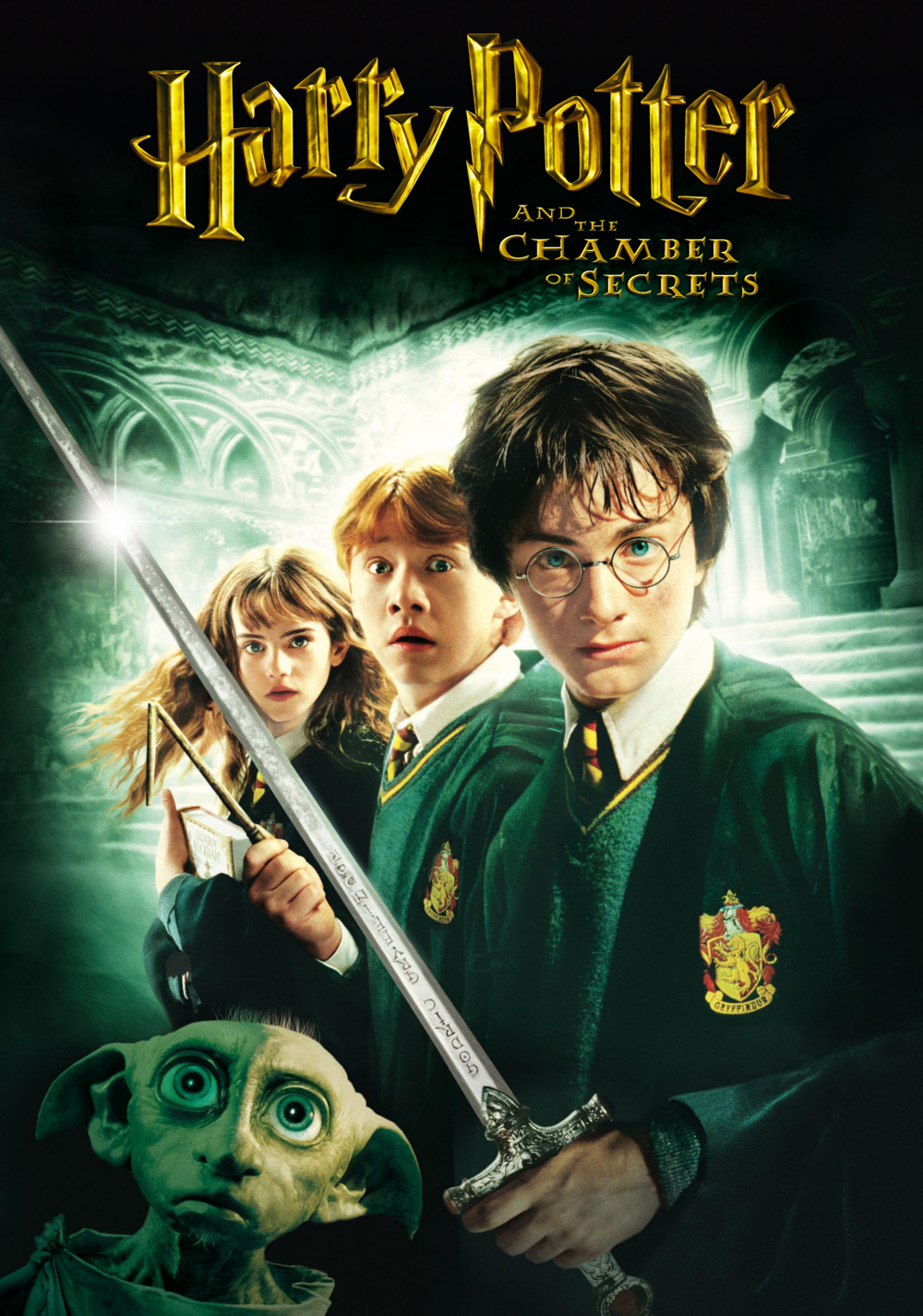
Harry Potter and the Chamber of Secrets
- Directed by
- Chris Columbus
- Runtime
- 161 min
- Studio
- Warner Bros. Pictures, Heyday Films, 1492 Pictures
121 archived facts 6 topics 2 sources Last reviewed Nov 2026
Cars fly, trees fight back, and a mysterious house-elf comes to warn Harry Potter at the start of his second year at Hogwarts. Adventure and danger await when bloody writing on a wall announces: The Chamber Of Secrets Has Been Opened. To save Hogwarts will require all of Harry, Ron and Hermione's magical abilities and courage.
121 Interesting Facts About Harry Potter and the Chamber of Secrets
Interesting Facts (76)
- #001
- #002
(At about 15 minutes in) The opal necklace that plays a significant role in Harry Potter and the Half-Blood Prince (2009) can be seen briefly inside a display case in Borgin and Burkes' shop in Knockturn Alley when Harry first enters.
- #003
- #004
- #005
- #006
(At about 2 hours 5 minutes) Foreign-language translations had to change Tom Marvolo Riddle's name so that a suitable anagram could be formed: in Spanish his name became "Tom Sorvolo Ryddle," which turns into "Soy Lord Voldemort." In French his name is "Tom Elvis Jedusor," which becomes "Je suis Voldemort." In Italian his name is "Tom Orvoloson Riddle," which forms "Son io Lord Voldemort." In German his name is "Tom Vorlost Riddle," which forms "Ist Lord Voldemort." In Dutch his name is "Marten Asmodom Vilijn," an anagram of "Mijn naam is Voldemort." In Turkish his name is "Tom Marvoldo Riddle," which forms "Adim Lord Voldemort." In Brazilian Portuguese his name is "Tom Servolo Riddle," which forms "Eis Lord Voldemort." In Swedish his name is "Tom Gus Mervolo Dolder," which forms "Ego sum Lord Voldemort" (which is actually Latin). In Danish his name is "Romeo G. Detlev, Jr.," which forms "Jeg er Voldemort." In Icelandic his name is "Trevor Délgome," which forms "Ég er Voldemort." In Hungarian his name is "Tom Rowle Denem," which forms "Nevem Voldemort."
- #007
- #008
(At about 2 hours 20 minutes) Initially, after hearing Dumbledore's implied accusations, Lucius Malfoy was to leave the office silently. However, Jason Isaacs felt his character needed to say something, so director Chris Columbus gave him permission to say anything. Isaacs then improvised "Let's us hope that Mr. Potter will always be around to save the day," and Daniel Radcliffe spontaneously ad-libbed "Don't worry. I will be," astonishing Isaacs.
- #009
(At about two hours and twenty-five minutes) When Lucius Malfoy finally tries to curse Harry, he mutters "Avada…" As mentioned in the fourth book, this is the beginning of the Unforgivable Curse known as "Avada Kedavra," the killing curse. This gives the impression that Malfoy is foolish enough to try to kill a child in the middle of a school full of students and teachers, with no way to escape. However, as Jason Isaacs explained in several interviews, the novel did not mention a specific spell he could use, and since he had only recently read the fourth book, this was the only curse he could remember. So in this scene it turns out that Dobby saved Harry's life.
- #010
- #011
- #012
Chris Columbus wanted the camera movement to be serpentine and to mirror the basilisk's movement through the castle. For this reason, some scenes were shot using handheld cameras, which allowed for smoother movement. At one point Columbus guided the camera operator by the shoulders so he could get the shots exactly as he wanted them.
- #013
The set for Dumbledore's office was the most expensive set built for cinema at the time it was made. Executive producer and director Chris Columbus and production designer Stuart Craig agreed that Dumbledore, as headmaster, should have the most detailed office possible. However, they were told that the design proposed to them would be far too expensive given its immense detail and eccentricities. The producers ultimately managed to secure the funds needed to build the set.
- #014
- #015
- #016
- #017
- #018
- #019
- #020
- #021
- #022
While writing "Harry Potter and the Deathly Hallows," J. K. Rowling seriously considered bringing back the Ford Anglia to save Ron from a pair of Death Eaters cornering him on the castle grounds. The car would emerge from the forest and crash into the Death Eaters against a castle wall, then its lights would slowly fade as if it had died. However, she abandoned the idea because she thought the Ford Anglia had lived in the forest too long and would most likely be gone, and the idea struck her as childish.
- #023
- #024
- #025
- #026
- #027
- #028
There is an inconsistency between the novel and film versions regarding the basilisk's size, with the latter indicating the snake is much larger than stated. At the end of the novel's sixteenth chapter, when Harry, Ron and Lockhart find the snake's skin, the narration states: "the creature that had shed it must have been twenty feet long at least." In the corresponding scene in the film, Ron says, "whatever shed this must be sixty feet long, or more." This is probably to make Harry's struggle with the basilisk more exciting and dangerous, since the size of a twenty-foot snake would be closer to that of the python Harry left at the zoo in the first film.
- #029
A theater manager in Stavanger, Norway reported that the film made its young customers sick. Apparently, many children who had eaten too much candy and popcorn vomited when Ron began throwing up giant slugs. "It is not a particularly fun task for our employees to have to wash away the sick," he said.
- #030
- #031
- #032
- #033
- #034
- #035
In the book, it is Professor Binns, not Professor McGonagall, who explains the origins of the Chamber of Secrets. In the books, Cuthbert Binns is the professor of History of Magic; his defining trait is his ability to make a potentially exciting subject extremely boring, and he is the only teacher at Hogwarts who is a ghost. Binns was deemed unnecessary for the films, so several of his plot-related actions were transferred to other characters.
- #036
- #037
- #038
- #039
- #040
- #041
In 2017, to celebrate the 20th anniversary of the "Harry Potter" series, arachnologists Anton A. Nadolny and Alireza Zamani named a new species of Iranian wolf spider (Lycosidae) Lycosa aragogi, after Aragog. The single specimen was collected on 26 April 2016, nearly nineteen years after 20 April 1997, the day Aragog is said to have died of old age in the books.
- #042
Aragog was accused by Tom Riddle of causing the petrifications of several students before Myrtle's death. Acromantulas are not known to cause petrification, which is pointed to as another failure of understanding in the Ministry of Magic's justice system, since they could not notice the inconsistency.
- #043
- #044
- #045
The depiction of the Chamber of Secrets differs between the book and the film. The former describes a full-body statue of Salazar Slytherin at the end of the chamber and carved snake-bodied columns supporting the ceiling, while the latter shows only a large head of Slytherin and his shoulders with snake heads lining both sides of the chamber hall in place of the columns. Rowling later reveals in the book Harry Potter Page to Screen: The Complete Filmmaking Journey that the Chamber was flooded centuries after its creation and that the water rose up to the statue's head support. This also explains why the Basilisk is seen emerging from the water near the statue when Harry tries to wake the nearly dead Ginny, and that the original chamber hall was flooded along with the original columns, which serve as the remains of the snake-headed statues.
- #046
- #047
- #048
- #049
- #050
- #051
When Harry arrives at the Burrow (the Weasley house) after being rescued from the Dursleys, Ginny comes downstairs and asks whether her mother has seen her jumper; Molly replies, "it's on the cat." Mrs. Weasley is not referring to a real animal; on the mantelpiece there is a cat-shaped ornament whose tail forms a kind of clothes hook. From this it can be assumed that the jumper had been freshly laundered and was hanging from this device, possibly drying, at the fireplace.
- #052
A fairly hidden nod to Home Alone 2: Lost in New York (1992): the scene in which Ron tries to warn Harry about the spiders around them mirrors the scene in which Marv tries to warn Harry about the pigeons preparing to attack them. Bonus points for both characters saying the name "Harry" in a similar irritated tone, for both films being sequels to their own predecessors, and finally for all four films being directed by Chris Columbus.
- #053
- #054
In the dinner with the Masons scene, a fine harbinger appears right after Uncle Vernon checks Harry's room. When Uncle Vernon leaves the bedroom, the house-elf emerges from Harry's cupboard and casually tosses aside one of Harry's socks that had accidentally become stuck on his shoulder. This foreshadows that Harry will eventually use a sock to free Dobby from slavery.
- #055
In a 2017 interview, Jason Isaacs explained how he came up with Lucius's drawling and ominous speaking voice. "It was a combination of a drama school teacher who constantly whispered, 'You'll amount to nothing, Isaacs. You will never work,' and the English art critic Brian Sewell," he revealed. "Director Chris Columbus would come up to me and say: 'So we had that take, it's great, but could we do one more where you pull back on the voice by about 80 to 90 percent?'".
- #056
- #057
Jason Isaacs explained that making the Harry Potter films was not much fun, saying: "Even though I was in the films, when I take godchildren or nieces and nephews [on the studio tour] and it comes up and suddenly you're in the Great Hall, I burst into tears every time," Isaacs said. "It's incredibly moving and overwhelming. There's some magic that happened in those stories." But while the finished product brings tears to his eyes, Isaacs also said: "It's a terrible confession to make: they weren't that much fun to make. It's quite boring making big special effects films. However the pleasures all come afterwards. I see and meet people for whom their lives were changed by it, and still people reading it and sharing it with their children. Some people say their lives were saved by it and I believe it." "Something happened, who knows why, when those ingredients came together and the soufflé rose and it created just love around the world and a sense of inclusion," he concluded.
- #058
Jason Isaacs was instrumental in creating the character's appearance and voice, namely the menacing aristocratic English accent. However, Columbus was not very keen on it. "I found a voice, I thought it was the most annoying voice I could think of, one that just makes you hear a syllable and want to punch him," Isaacs recalled. "I tried it at the first rehearsal and Chris Columbus said: 'Okay Jason, look… I'm American, but is there anyone in the world in England or anywhere who talks like that?' I said, 'No, but it is a film about wizards after all.'" Columbus was skeptical, until Daniel Radcliffe, who played the titular boy wizard, said, "God bless him, he said 'I think it's kind of cool, actually. I think people will do that in playgrounds,'" Isaacs said. "Chris said, 'Okay, let's go with it.' And for several years afterwards, on every take we did in the next few films, Chris would come over and say 'That's great. That's great. Let's do one more, [but] can you pull the accent back by about 80, 90 percent?'".
- #059
- #060
- #061
- #062
- #063
Building Aragog and operating it on set proved to be the most difficult task creature effects artist Dudman and his team were assigned for the production; the character alone required a crew of 97 people. The spider had a 3-metre body and an 18-metre leg span and was sculpted full-size by Gary Pollard. The body was sculpted separately from the legs.
- #064
Immediately after Dobby drops the pudding on Mrs Mason, a picture of a blond young boy can be seen on the table next to Harry. The boy in the picture looks very much like Kevin McCallister from Chris Columbus's Home Alone (1990).
- #065
- #066
- #067
- #068
Harry, Ron and Hermione discuss how they could use Polyjuice Potion to impersonate Crabbe and Goyle (which would allow them to get information out of Draco). They do this to find out whether Draco is the Heir of Slytherin. Hermione later goes to the library and takes out a book called "Most Potente Potions." To the right of the book she reaches for is another book with only "TOM" written on its spine. Voldemort regards Tom Riddle as a secondary, more insignificant identity ever since he became the Dark Lord.
- #069
Concept artist Adam Brockbank was given the task of designing Aragog for the film adaptation of Chamber of Secrets. After several iterations based on different spider species, the producers ultimately settled on what was essentially an enlarged Wolf Spider. Sculptural details were also added to increase Aragog's apparent age.
- #070
- #071
Aragog's face could perform a range of detailed movements to suggest talking motion. "Its eyes, its front hairy teeth, and other bits in his face moved," Dudman said, "they were all hooked up through a Gilderfluke computer-controlled system." The animatronic was programmed to deliver recorded dialogue (voice actor Julian Glover's lines) on set. "Everyone on set could hear the spider through a loudspeaker," Dudman said. "We could literally pause the dialogue to allow Harry to say his lines, then cut in with the spider's dialogue."
- #072
The Basilisk puppet was mounted on the same counterweighted seesaw beam with a pole arm that the team had built for Aragog. Depending on the requirements of the shot, the creature could be raised and lowered and could also be mounted on rails or a crane. For the fight scenes, the snake could slide off its track to approach Radcliffe. "It was a big rig, and it moved incredibly well," Nick Dudman said. "They used it ten times more than they ever thought they would."
- #073
While Harry is at the Burrow, the Weasley family home, Arthur tells him: "Now, Harry you must know all about Muggles, tell me, what exactly is the function of a rubber duck?", but Harry does not answer before the owls arrive from Hogwarts with the school-year requirements. Because Arthur comes from the Wizarding World and grew up among wizards, he is completely unfamiliar with Muggles and their customs, has a great passion for the subject and wants to know their way of life — hence the question about the plastic duck. This line was created specifically for the film, not taken from the book.
- #074
The digital spider sequences were provided by Mill Film, whose team started by scanning one of Dudman's spiders. The scan data after various processes was imported to Maya, where Burke and Ivor Middleton began experimenting with animation studies. Burke explained: "we had two different issues: little spiders and large spiders. With the little ones, we had to deal with adapting our flocking system to give us a new library of animation functions so we could tackle a large number of shots with flexibility and have them move on the surfaces of the set. For the large ones, we had to develop the aggressive nature of the spiders." Middleton led a team of 17 animators in creating animation libraries of varied walking cycles -- slow walking motions, creeping motions, rock climbing, running. TD supervisor Laurent Kermel developed a 'semi-procedural' Maya plug-in to perform crowd animation of the smaller spiders. The procedural system generated motion for a mass of particles which was then replaced with the spider models. Output from this simulation drove the animation of the spiders' legs. He explained: Qfirst, we'd set parameters in the system that controlled speed, force, how far they could see and so forth; and then we'd set parameters that controlled the way they reacted in particular situations -- for example, when they bumped into obstacles or got scared. We'd test this on a group of 10 to 20 spiders, and when we had their 'DNA' the way we liked it, we'd apply it either to create the entire mass of 1000 spiders or to a percentage. We could paint the areas where we wanted them to go or not go, place obstacles they would avoid or that might scare them to run away, or stop the simulation to a specific frame number to hand-animate a group of spiders, and then start it up again. Or an animator could pick one spider out of the group and animate it by hand. There were tons of tools." This system also created a starting point for the larger spiders, which would understandably need to be animated manually. Middleton explained: "for spiders closer in, an animator would start with the animation generated by the program and develop it further. The flocking software gave us spiders moving in a coherent fashion and helped us block out scenes -- but we still had to put a lot of work into getting the size and weight and look of the motion right for the larger ones.
- #075
The Basilisk animation drew on snakes, lizards and crocodiles. Animation supervisor Michael Eames explained: "We needed to see the snake in close-ups, and in those shots we had to drive the animation from the head. We also had to make it appear in long shots where it drags along the ground." Character rigger Felix Balbas designed a setup that allowed animators to switch from inverse kinematics to spline weighting or forward kinematics depending on the requirements of a given animation sequence. Eames continues: "For example, while the snake is chasing Harry its head is down and its body works along a path; then when it gets close to Harry its head comes up and its body starts to slow down. Obviously, part of the body is still in rigid contact with the ground. So we had a set of controls that reduced the influence fields from the neck towards the body in order to control the body parts independently." Crucial to the animation was the Basilisk's interaction with water, achieved with digital water elements (including flow maps of water dripping from the creature's skin) and practical water elements composited into the shots.
- #076
Aragog's legs were mechanized using aquatronics, hydraulic systems powered by water. Nick Dudman explained: "it created the gentle, quiet movement that spider legs have. It was quite creepy." Aragog's four front legs were puppeteered via mechanically jointed rods called waldos that mimicked movements made by controllers, while the back legs (whose tips were visible to the camera) were puppeteered manually by crew members in the pit.
Production Story (3)
- #077
During post-production, producer David Heyman visited Richard Harris in the hospital. Although Harris had grown very thin because of his illness, he insisted that the role of Dumbledore not be recast. Sadly, Harris died shortly before production on the next film began, which made a new casting necessary.
- #078
Aragog was initially to be portrayed with a digital model, but it was ultimately decided to build a full-size puppet, with most of the digital effects instead devoted to creating Aragog's children. This choice not only saved budget but also gave the young actors a real, full-size monster to react to. Nick Dudman, head of the creature effects team, said: "I believe you have to give everything you can to help the actors, especially the young actors, react correctly. This spider actually crawled out of a hole in front of the children and spoke to them, and they reacted accordingly."
- #079
Behind the Scenes (15)
- #080
Like his character, Rupert Grint has such a severe case of arachnophobia that he still has not watched the entire scene in which Ron and Harry are in Aragog's hollow. In that scene, Ron's frightened look and uneasy squirming are not acting but Grint's genuine reaction to the mere thought of spiders.
- #081
Executive producer and director Chris Columbus instructed cinematographer Roger Pratt to give the film a darker look to reflect the story's darker tone. The sets were therefore lit with softer light and the color palette's saturation was reduced somewhat. These changes would continue throughout the series, with each film growing darker and progressively less saturated.
- #082
The animatronic phoenix used to portray Fawkes looked so realistic that Richard Harris (Professor Albus Dumbledore) thought it was a real living bird the first time he saw it, despite phoenixes being legendary creatures. According to creature effects artist Nick Dudman, he recalls: "Richard Harris came up to me and my Fawkes chief Chris Barton at one point and told me how amazed he was at how well trained the bird was. I told Richard that Fawkes was actually a puppet, but he didn't believe me. So I pressed a control button and brought Fawkes to life. Richard was absolutely stunned. I don't think I could get more praise than that."
- #083
During production, Emma Watson often brought her pet hamster Millie to the film set. Unfortunately, Millie died shortly after filming began. The set department created a custom-made, velvet-lined hamster coffin with the name "Millie" engraved on it. "I don't think a hamster has ever had a better send-off," Watson said.
- #084
- #085
- #086
- #087
For later scenes, Fawkes was portrayed by a second adult animatronic -- with the same mechanics as the 'old' version -- which was combined in the Chamber scenes with a digital version provided by Framestore. The digital effects artists met more than one challenge. The Phoenix was manually built, instead of being a refined digital scan. The digital model had to match Dudman's practical Phoenix -- a problematic process, since the puppets had not been sculpted with regard to flight, as they only had to be seen standing or sitting on a perch. Dudman said: "we built a bird with wings that were folded or only opened halfway. In hindsight, we should have constructed it in flight, as well. The CG group had a lot of trouble with it." Using proportions from the animatronic proved to be unfeasible. "When we pulled the wings out, it looked like a turkey," said animation supervisor Michael Eames. "We had to devise a method to suck the body in and rescale the legs to make him more graceful. When he was in the air, we could proportion him any way we wanted; but there were shots where he landed, folded his wings, and then we cut directly to the animatronic -- so he had to be recognizable as the animatronic." A custom system in Maya allowed the digital model to be tweaked by enlarging or shrinking its body parts separately. Adam Lucas modelled and rigged the creature. "Changing shapes is normally simple," Eames explained, "but Fawkes is a bird, and anything we did in geometry affected the feathers -- so we had to scale the feathers independently." Justin Martin and a software team devised a system in Houdini to match the digital feathers with those found on the puppet versions. A 'guide hair' established the position of the feathers, which were then generated based on parameters assigned to the hairs. Sally Goldberg, part of the crew, related: "guide hairs in the front end represented where feathers would be, and Ben White used those to groom the bird to match the animatronic. The feathers were put onto the body like layered roof tiles. Each feather, on a frame-by-frame basis, was put onto the feather below so it never intersected. If the feathers were going around a concave bend, all would sit perfectly on each other; and on a convex bend, they would thin out nicely." Position of the feathers was calculated for each frame of animation. Visual effects animator Mark Hodgkins explained: "the custom software would manually lift each feather, one at a time, then, using collision avoidance, project the feather down, allowing individual feathers to move and slide over each other, giving it a more complex, feathery look. It wasn't that bad, actually. The bird was in ten sections so we could use ten machines for each frame." Rendering of the feathers took place in the final stages of the process; custom shaders endowed them with a subtle sheen replicating the appearance of the animatronic. Actual animation of the flying Phoenix was based on footage of real birds, in particular on the flying motion of a turkey vulture and a blue macaw.
- #088
The real Aragog animatronic had a steel armature covered with foam latex skin. Each of the spider's hairs was placed by hand; the finer hairs were broom bristles, while the larger ones were synthetic hair and feathers with a glittery coating. The body was built with a fibreglass supporting structure covering the steel armature and then covered with skin. Animatronic supervisor Chris Barton, with the help of animatronic engineers Simon Williams and Steve Wright, designed the mechanisms that brought the giant spider to life, while the electronics were handled by Tamzine Hanks.
- #089
To animate the spider, it was pushed out to give the impression of it crawling towards Harry and Ron. "Basically, the guys moved the spider around physically by pulling its legs and pushing its body along, and whatever they did was mirrored on the set," Nick Dudman explained. "The front legs had to give the impression they were pulling the body out even though it was really getting pushed out. We put a little radar unit at the tip of each leg so the performers would always know when the leg made contact with the ground. Holding that position made the spider look like it was taking weight on that leg. If a leg was coming within six inches of the ground, a green light came on and when it touched the ground a red light came on. The performers also had monitors at disposal, so that they could see where the legs were going on the set." Once the front legs rose from the hole and touched the ground, the crew had to lift up the body. The animatronic was mounted on a pole-armed teeterboard, which had a counterweight on the other end and was buried in a hole in the set. Dudman said: "the spider was on one end and on the other end was a quarter-ton of weight, so it was steered out of the hole a bit like a camera crane."
- #090
The design of Aragog's children was simply reverse-engineered from the parents' appearance. Nick Dudman's team built 12 full-size animatronics ranging from one metre to one and a half metres. One of the puppets had limited articulation and was used for an additional shot of a spider attacking Ron from outside the car. Most of them, however, were made only to serve as on-set reference for the CGI team. "By putting any of these 12 spiders into a sequence, they could see what the spiders would look like," Dudman said, "and what space they would take up. But the action of these spiders was too frenetic for animatronics."
- #091
The practical Basilisk was intercut with a fully digital version of the creature that appeared in most of the effects shots. A total of 45 visual effects sequences were designed by Framestore. The Basilisk's digital model was first obtained by scanning a small-scale Basilisk maquette and was then manually refined to match its animatronic appearance. For rendering and animation, the digital effects artists used Maya, Houdini and Renderman. The textures were painted in Photoshop by Jason Horley.
- #092
Dumbledore's phoenix is fittingly named Guy Fawkes, because of its life cycle, which periodically involves burning itself. Adam Brockbank was responsible for the design of the phoenix in the film adaptation of Chamber of Secrets in all three stages in which it appears (the dying adult, hatching and the reborn adult). Brockbank carefully researched classical drawings of phoenix birds as well as ample natural reference from real birds; large birds of prey, especially sea eagles and vultures, were used as the basis of the design. Brockbank also gave the creature an exaggerated, feathered crest to give it a sense of nobility. The vulture influence was applied most strongly in the old stage and the hatching stage, with an elongated neck and layered wrinkles. To determine Fawkes's feather arrangement and patterns, Brockbank was supplied with stock feathers from pheasants and other birds, rearranged into various compositions and layering schemes. In terms of colour scheme, Brockbank kept the design close to the book descriptions with fiery tones such as burnt oranges and dark reds. In another nod to real birds, Fawkes's underside is golden and bright while his upper side is darker. A burnt match was used for additional colour reference. Darker tones were used for the dying stage, and the hatching stage was created with a chick-like pink mixed with the grey of ashes. After the final design was chosen, Brockbank's drawings were handed over to Nick Dudman's special effects team. Three animatronic versions of the bird were designed, one for each stage of Fawkes's life cycle. Dudman explained the perceived importance of a physical puppet that can interact with the actors: "Computer-generated effects do the things we physically can't do, but what we do with practical effects is create a sense of interaction that can sometimes be lost with CG."
- #093
- #094
The main Basilisk puppet was an animatronic mechanized by Phil Ashton and Malcolm Evans. Because all of the Basilisk's shots before Fawkes's attack were planned to be digital, its eyes had already been carved out, which also spared the crew the effort of developing functional eyes. Like Aragog, the puppet used aquatronics instead of traditional hydraulics, allowing for smoother movements. The Basilisk animatronic had a fluid range of head and neck movement. The head was fully functional, moving its eyelids, nostrils and tongue as well as the jaw-opening mechanism. The creature's teeth were cable-controlled and could retract when the mouth was closed and move forward when it opened, a feature inspired by real snakes. The puppet's internal structure was specially designed with aluminum ladders: "when we looked at the design of the snake," Dudman told Cinefex, "we knew we had to build some kind of geodesic structure for its body. When I looked at the drawing of this structure on the computer I said 'it looks like stepladders to me.' I knew that using just stepladders for the bulk of the structure would save us a huge amount of machining, so that's what we did." This stepladder frame housed the internal mechanisms and was therefore reinforced to carry more weight. It was covered with a tubular armature, also made of aluminum to provide both lightness and durability, over which the Basilisk's skin was placed. The foam latex covering was painted by Astrig Akseralian (head painter and paint supervisor of the Basilisk models), Elaine Cartwright Best and Mel Lenihan.
Characters & Cast (10)
- #095
Lucius Malfoy was not originally meant to have long hair. When Jason Isaacs was cast in the role, however, he asked for longer hair so he could be distinguished from his son Draco. To keep his hair from falling in front of his face, Isaacs had to tilt his head back, which further heightened the character's snobbery and made him "look down his nose at everyone."
- #096
(At about 2 hours 25 minutes) The script initially said Hermione would hug Harry and Ron in the final scene. Because eleven-year-old Emma Watson was embarrassed to have to hug the boys in front of the whole cast, Chris Columbus let her change the scene, so that Hermione only hugged Harry, then started to hug Ron, but the two were embarrassed and settled for just shaking hands. Watson also said in a recent interview that she let Daniel Radcliffe go too fast, so the film was "frozen" for a few seconds to make the hug appear to last longer than it actually did. Her hesitation with Ron is also seen by fans as a harbinger of the relationship that would develop between the two characters.
- #097
- #098
Jason Isaacs initially auditioned for Gilderoy Lockhart, but Chris Columbus asked him to try for Lucius Malfoy as well. Isaacs did not want to, because it was too similar to the role of Captain Hook in Peter Pan (2003), but he was too polite to say no. When the role was offered to him, Isaacs nearly turned it down, but family members convinced him to take it.
- #099
- #100
In an interview in August 2021, Alan Cumming revealed that he was asked to screen test for the role of Gilderoy Lockhart, but that when he realised the producers were lying about the salary, he told them to "f--- off". He said, "They wanted me and Rupert Everett to do a screen test, and they said they couldn't pay me more than a certain amount, they just didn't have any more money in their budget. And Rupert and I had the same agent, who of course was going to be paid more. You're clearly lying, you're stupidly lying. Like, if you're going to lie, be smart about it." So, assuming Everett would get the role, he told them what to do with the role. But then they gave it to Kenneth Branagh, who Cumming said "came out of the shadows".
- #101
James McAvoy auditioned to play Tom Riddle and was eventually offered £40,000 for the role, more than he had earned at that point in his career. He recalled, "It was crazy, I'd barely done any work. And I think they wanted to put the other 10 actors or so, or something like that, on a retainer to keep us and then force a choice later. It was a really strange thing." His agent advised him to turn the offer down, because accepting the retainer would have meant he could not take any work for seven months.
- #102
The Basilisk in the film version was established as being 80 feet in length. Robert Bliss designed the beast, with real-life reference provided by an eight-foot long Burmese Python named Doris. Initial iterations maintained a relatively simple snake-like appearance, but the concepts progressively began implementing subtle characteristics of other reptiles -- such as monitor lizards and crocodiles -- resulting in the Basilisk taking on a more dragon-like appearance. The textures were based on snakes, but made "a little more exaggerated than say, a normal snake's," according to Chris Fitzgerald, part of the sculpting crew. The Basilisk's skin was endowed with osteoderms and other hard scales, and unlike real snakes, the creature was given functional eyelids -- closer to a lizard or a bird than a snake. A small-scale maquette was sculpted by Robert Bliss and Chris Fitzgerald to be scanned digitally. The original intention was to bring the Basilisk to the screen as a fully digital creation; only the shed skin of the Basilisk was to be built practically. Given that a full sculpture was needed to eventually mould the shed skin out of it, Dudman suggested to build a practical insert puppet of the Basilisk. The choice was sound on two fronts -- not only would it lessen the amount of needed digital effects sequences (thus save budget), but it would also provide the young Daniel Radcliffe with a physical monster to react to. Following the new direction, Dudman's crew needed to sculpt the Basilisk's head and neck. Gary Pollard led the creation of the full-size sculpture. The interior of the monster's mouth was sculpted and moulded separately from the rest of the body to increase its sculptural detail and ease the casting process. The sculpture was moulded to obtain both the skins for the full-size puppets as well as the shed skin found early on in the Chamber scenes. The shed skin was cast in urethane rubber for a translucent effect, with fiberglass inserts to enhance its organic quality.
- #103
Despite ranking third and appearing on posters and in trailers, Emma Watson's character Hermione Granger was reduced to a supporting role in this film. She first appears when Harry goes to Diagon Alley and disappears at the start of the final act. Hagrid takes on the third major character role in the film.
- #104
Shirley Henderson recalled auditioning for Moaning Myrtle: "The casting director said, 'Go for it - and don't mention your age.' When I was first asked for an audition, I didn't know who Harry Potter was. But my sister, who was staying with me, had read the books. Still, I wasn't convinced I could play a 14-year-old girl because I was in my 30s at the time. I went to the audition dressed as a schoolgirl - white shirt, black skirt, ponytail - thinking, 'This is ridiculous,' I did my wee bit for them and they thanked me. Months went by and I thought that was it, but then they phoned my agent, asked to see me again, and offered me the part... Myrtle is an old person in a young person's body and because she's ghostly, there's a kind of mistiness. You're not looking closely at my face, so we can get away with it."
Easter Eggs & References (6)
- #105
- #106
- #107
During the 1992-1993 school year, the second message left by the Heir of Slytherin when the Chamber of Secrets was opened read: 'Her skeleton will lie in the Chamber forever.' Although the message was intended to refer to Ginny Weasley, who had been taken into the Chamber, the Basilisk was in fact female. When Ron and Hermione went there in 1998 to destroy Helga Hufflepuff's Cup using its fangs, the skeleton was still present in the Chamber, which ironically fits the message.
- #108
The film's darker, sharper tone was already hinted at in the main title; in "Hedwig's Theme", after the crescendo as the Warner Brothers logo approaches, the theme reaches a brand-new, quieter arrangement as the Harry Potter logo appears, a notably more foreboding and ominous arrangement compared with the existing arrangements in Harry Potter and the Philosopher's Stone (2001). The moment the bass strings enter, the "and the Chamber of Secrets" subtitle also appears.
- #109
- #110
As in the first film, many scenes were shot at Gloucester Cathedral. A fake floor made of roofing felt and painted to match the rest of the stonework was used to protect the cathedral's real floor and to hide the many ledger stones (grave markers) from view. The scenes in which the trio discovers the writing on the wall and Mrs Norris is petrified, and later when Harry and Ron discover that Moaning Myrtle's girls' toilet has been flooded, were shot in the cathedral's East Cloister. Both scenes have puddles of water on the floor. Although a fake floor was used, the real floor underneath still suffered some water damage, and evidence of it can still be seen.
Deeper Meaning (11)
- #111
Filming began three days after the premiere of Harry Potter and the Philosopher's Stone (2001). This makes it the only film in the series to be produced and released within a year of its predecessor. Although Harry Potter and the Deathly Hallows: Part 1 (2010) and Harry Potter and the Deathly Hallows: Part 2 (2011) were released six months apart, they were shot as if they were a single film.
- #112
- #113
DIRECTOR_TRADEMARK(Chris Columbus): [children]: All four of Columbus's children appear in this film. Eleanor Columbus reprises her role as Susan Bones from Harry Potter and the Philosopher's Stone (2001); Brendan Columbus plays a boy in the study hall, Violet Columbus plays the little girl surrounded by flowers, and Isabella Columbus plays the little girl in the bookshop.
- #114
One of Chris Columbus's daughters struggled with reading until she read Harry Potter and the Philosopher's Stone in two days and opened her eyes to the world of books. After reading Chamber of Secrets, she asked her father to make films of them, but fifty other directors were already interested. Columbus also fell in love with the first two books and eventually went on to direct them.
- #115
- #116
Because Hermione used Polyjuice Potion with cat hair, she ends up in the Hospital Wing as a human/cat hybrid, and the potion cannot transform the user into a different species. Given that it is Hermione who says that "breaking about fifty school rules" is involved, it may seem strange that her actions are entirely exempt from any punishment. In the novel, it is implied that Madam Pomfrey keeps Hermione's unauthorized repair of the Polyjuice Potion a secret, because she is a practical sort who does not ask too many questions.
- #117
- #118
- #119
Wearing glasses does not protect a person from the deadly effect of the basilisk's gaze, because glasses allow a person's line of sight to connect directly and clearly with the snake's eyes, unlike looking at a mirror or a camera. That is why Moaning Myrtle died, and the reason Harry was safe was that Fawkes blinded it.
- #120
In this film, Argus Filch sits outside the Great Hall and waits for Harry and Ron to appear after they arrive by car. A similar situation occurred in the book version of Harry Potter and the Philosopher's Stone, where Filch caught Harry and Hermione after they helped Hagrid get rid of Norbert and even said the same lines about them being in trouble. The only difference is that in this film it is Ron who is in trouble.
- #121
Related pages
- Hogwarts Legacy — Harry Potter and the Chamber of Secrets comes up in the facts on that page
- Harry Potter and the Deathly Hallows: Part 1 — Harry Potter and the Chamber of Secrets comes up in the facts on that page
- Harry Potter and the Philosopher's Stone — Harry Potter and the Chamber of Secrets comes up in the facts on that page
Sources & editorial notes
Reference databases
- Wikipedia
- IMDb
Information from external sources is independently selected, consolidated and edited by Arka Evren. Sources are listed for verification and further reading. Encyclopedia text is used under its licence (CC BY-SA). How we work