

FILM · 2014 · USA
John Wick
- Directed by
- Chad Stahelski
- Runtime
- 101 min
- Studio
- 87Eleven, DefyNite Films, MJW Films
142 archived facts 6 topics 2 sources Last reviewed Nov 2026
Ex-hitman John Wick comes out of retirement to track down the gangsters that took everything from him.

142 Interesting Facts About John Wick
Interesting Facts (62)
- #001
- #002
- #003
- #004
(at around 24 mins) John Wick is referred to as the one who you send to kill "the boogeyman" but is also referred to as the "Baba Yaga". In Slavic lore, Baba Yaga is usually portrayed as a witch that lives in a house standing on chicken legs. She is often portrayed in a scary way, but tends to act more like a trickster. Even so, she has been known to be helpful to those who are pure of heart.
- #005
- #006
They had to fight for Wick to be bearded. "It's not normal for mainstream producer types to think you can cover up your lead actor's face in a beard," said Chad Stahelski, "but it's our little throwback to a '70s vibe." "It was one of those battles we fought for," added David Leitch, "and everyone responded to."
- #007
- #008
The directors credit Keanu Reeves' dedication and talent with his ability to do long takes during the fight scenes. "I think we really only cut for impact," said Chad Stahelski. "We didn't really cut to get around moves, we didn't cut to speed things up. We wanted you to see what happens before, during and after." "You're not using long lenses to hide bad action," added David Leitch.
- #009
- #010
- #011
During hand-to-hand combat scenes, John Wick shows himself to be a judoka, and use Japanese traditional jujutsu. Judo is a Japanese martial art emphasizing throws. Specifically, Wick repeatedly uses head throws and arm throws. On the other hand, his rival assassin, Ms. Perkins, uses Brazilian Jiu-jitsu (employing a Kimura shoulder lock, the crucifix position and her leather jacket as a gi to perform a wing choke in her fight against Wick in the hotel room).
- #012
- #013
- #014
The end fight was originally longer, but they acknowledged that Viggo shouldn't really pose a big physical threat to Wick, who we just watched kill dozens of far fitter bad guys. This is part of their belief that certain action elements should ring true -they kept count of their bullets, they refused to blow up cars that fell two stories -even as the world itself feels like it belongs in a comic.
- #015
John Wick smoothly transitions between several shooting styles depending on the situation. During close-quarters battles and while moving through tight hallways, he employs a Center Axis Relock stance. When moving and shooting at longer ranges, he changes into more traditional Weaver and Isosceles stances.
- #016
- #017
(at around 13 mins) They had two of the Mustang cars, and they weren't allowed to damage either of them. The scene with Wick driving aggressively around the airport is 85-95% Keanu Reeves behind the wheel. The final shot with the car stopping centimeters away from the trucks was left to a professional.
- #018
- #019
(at around 36 mins) It's set up to look like Marcus is fending off rivals for the bounty, but John never questions where these mysterious shots came from. Once he hears that the contract on John is open (as in, anyone can fill the contract), Marcus accepts it, telling Viggo, "Consider it done." That is, he only accepts once he learns that John could use some protection from other assassins.
- #020
- #021
- #022
Initially, the movie is almost a cool blue monotone, reflecting John's detachment and struggle to cope with his wife's death. As he crosses back into the violence, colors leak back into his world and become more intense. And then at the very end of the movie when he at least attempts to cross back over into the ordinary world, the colors become more subdued again, but also warmer.
- #023
John Wick's license plates reveal he's from New Jersey and the gas station convenience store has "NJ Lottery" in the window. John Wick pumps his own gas but all NJ gas stations are full service. It's technically illegal to pump your own gas in NJ, however, it is generally not enforced and it's not uncommon for people to pump their own gas anyway.
- #024
- #025
They originally wanted to have Perkins' nose broken after her big fight with Wick, but the studio suggested that would be going too far. "They're like, you have two women in the movie, one is dead," recalled David Leitch. "Do you really want to break her nose?" They did but were out-voted.
- #026
(at around 37 mins) There's also a foreshadowing signal in the soundtrack when Marcus is cleaning and assembling his sniper rifle. The song is "Killing Strangers" by Marilyn Manson, where one of the key and repeated lines is "We're killing strangers so we don't kill the ones that we love." This makes more sense later when the friendship between John and Marcus is revealed.
- #027
The scenes with Iosef Tarasov bringing Wick's car to Aurelio's shop and Wick's arrival afterwards were originally written in chronological order. They decided they didn't want Wick offscreen for too long, though, and instead intercut the two to maintain the tension. The same occurs during the scenes where Viggo tells the tale of the boogeyman and Wick recovers his weapon cache from beneath the cement floor.
- #028
- #029
- #030
- #031
- #032
- #033
- #034
- #035
- #036
- #037
This movie introduced Charlie (David Patrick Kelly) as the clean-up crew from the "Specialized Waste Disposal - Industrial & Commercial" service who took and disposed of all the dead bodies. This kind of service actually exists in real world where some criminal organizations do have their own body disposal crew. In an interview with people who work in that kind of business, they said their job is to make the bodies completely gone, not even a strand of DNA left to be identified by the police. They said their methods to do that involves the use of machines, chemicals, and fire.
- #038
After unenthusiastic early screenings of the film, Chad Stahelski and David Leitch asked filmmaker James Mangold, whom the duo had most recently worked with on The Wolverine (2013), to visit their editing room for a notes session. Mangold saw two cuts of the film and, according to Stahelski, gave them "[s]ome of the most complete notes" they got, which "led to a lot of structural changes".
- #039
- #040
The Continental's rules of not doing business are not unlike Constantine (2005)'s Papa Midnite's rule of neutrality in his club, making this the second Keanu Reeves movie to feature a neutral club.
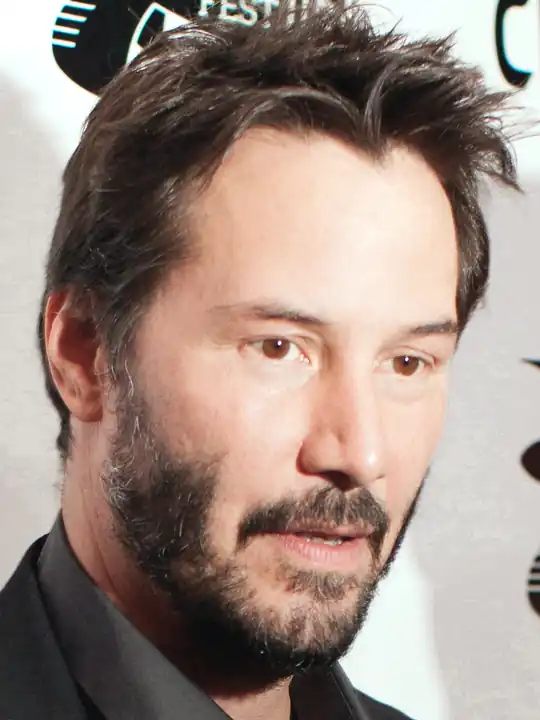
John Wick (2014): Keanu Reeves in a suit in close-upImage: Wikimedia Commons · anna Hanks, CC BY 2.0 - #041
The directors used a Marilyn Manson song as a temp track, and their music supervisor offered to introduce them to the performer who ultimately gave them a track off his new album to use in the film. "It was at [composer] Tyler Bates' house who we kind of wanted originally anyway," said Chad Stahelski. "And that's how we all met with a bottle of absinthe." The spot in the film was originally going to feature Johnny Cash's "God's Going to Cut You Down."
- #042
- #043
- #044
- #045
- #046
The directors credit over a decade spent with the Wachowskis (Lilly Wachowski & Lana Wachowski) on The Matrix films, Speed Racer (2008) and others for helping teach them composition over simply moving the camera from A to B.
- #047
- #048
the weapon cache John digs up in his basement; one side is various weapons, the other side has gold coins. We don't find out the significance of these coins until later, but twelve of them are enough to arrange "a dinner reservation for twelve" AKA disposing of twelve bodies. And Wick has a case full of them. Cases of the gold coins are shown in Viggo's personal safe, where he keeps his big black book of numbers (including John Wick's) and more are shown in the stash that John incinerates. They appear to be the universal currency of the underworld.
- #049
- #050
- #051
Wick shows a lot of traits that indicate that he was once a marine: using M-16 variant weaponry, driving Ford Mustang and tendency to shoot his enemies two times in the chest and one in the head, which is part of Table 2 Marine marksmanship training. Although these are training technique taught in many military branches.
- #052
- #053
- #054
After thieves breaks into John's house to steal his car, his alarm clock buzzes at 6:19 (Matthew 6:19 - "Do not store up for yourselves treasures on earth, where moths and vermin destroy, and where thieves break in and steal. 20 - But store up for yourselves treasures in heaven, where moths and vermin do not destroy, and where thieves do not break in and steal. 21 - For where your treasure is, there your heart will be also.
- #055
- #056
The movie John Wick (2014) has interesting similar elements with Pulp Fiction (1994) by Quentin Tarantino. In both movies there's a character named Winston (Winston the owner of Continental Hotel in John Wick and Winston Wolf the problem solver in Pulp Fiction), both have their offices in a hotel (Winston's in Continental Hotel's secret cocktail bar and Winston Wolf's in a casino hotel's bedroom), both also have connection to body disposal services (Winston in John Wick hired Charlie's Specialized Waste Disposal service to dispose of Perkins' body, Winston Wolf in Pulp Fiction hired Monster Joe's Auto & Trucks Dismantlers to dispose of Marvin's body).
- #057
- #058
- #059
John Wick's initials are JW, the same initials as John Woo best known for his hyper-kinetic Hong Kong action films like A Better Tomorrow (1986), A Better Tomorrow II (1987), The Killer (1989), Bullet in the Head (1990) and Hard Boiled (1992). The Killer in particular, is cited as an influence to the John Wick franchise.
- #060
Contains a major spoiler — show
(at around 11 mins) At their first meeting, the first words Iosef hears John Wick speak is "'69," in relation to what year his Ford Mustang was produced. If the IMDb kill count on the movie is accurate at 77, and the first SUV in the final fight scene has the same number of people in it as the second SUV (four), then Iosef is the 69th person John Wick kills in the movie.
- #061
Contains a major spoiler — show
As John Wick enters the church, the organist plays Beethoven's Ode to Joy. The church is then seen to contain a hidden vault. Ode to Joy is, famously, played in Die Hard as the thieves open the vault hidden at the bottom of Nakatomi Plaza. Like Die Hard, this film revolves around a main character called John who efficiently kills everyone around him in order to protect something he believes in and proves to be impossible to kill.
- #062
Contains a major spoiler — show
(at around 1h 17 mins) The car that Management gifts John as he's checking out of The Continental is a 2014 Dodge Charger. The gift is compensation for the "unfortunate incident" the night before: Perkins breaking House Rules and trying to kill John on hotel grounds.
Production Story (23)
- #063
- #064
- #065
- #066
Eva Longoria produced the film, and the directors are repeatedly asked about her involvement. "Never met her," they say, "but we thank her for writing a check."
- #067
- #068
- #069
In the original script, the character of John Wick was written with "a man in his mid-sixties" to play the role, given the title character's fabled reputation, ergo, the filmmakers had initially imagined an older actor. However, head of Thunder Road Pictures, Basil Iwanyk, decided against this, stating "Instead, we decided to look for someone who is not literally older, but who has a seasoned history in the film world."
- #070
- #071
The directors used a Marilyn Manson song as a temp track, and their music supervisor offered to introduce them to the performer who ultimately gave them a track off his new album to use in the film. "It was at [composer] Tyler Bates's house who we kind of wanted originally anyway," said Chad Stahelski. "And that's how we all met with a bottle of absinthe." The spot in the film was originally going to feature Johnny Cash's "God's Going to Cut You Down."
- #072
After unenthusiastic early screenings of the film, Chad Stahelski and David Leitch asked filmmaker James Mangold, whom the duo had most recently worked with on The Wolverine (2013), to visit their editing room for a notes session. Mangold saw two cuts of the film and, according to Stahelski, gave them "[s]ome of the most complete notes" they got, which "led to a lot of structural changes".
- #073
Writer Derek Kolstad originally wanted Clint Eastwood or Harrison Ford for the role of John Wick but Keanu Reeves got the role instead.
- #074
- #075
- #076
Eva Longoria has made over $12 million off this film and still gets checks ten years after her $6 million saved the movie. According to her, her only mistake was not doing the sequels. It was revealed that Longoria quietly stepped in to close the movie's $6 million financing gap less than 24 hours before production would've shut down entirely. Essentially, there'd be no "John Wick" franchise without Longoria's contribution that saved the original film.
- #077
- #078
- #079
- #080
The scenes with Iosef Tarasov bringing Wick's car to Aurelio's shop and Wick's arrival afterwards were originally written in chronological order. They decided they didn't want Wick offscreen for too long, though, and instead intercut the two to maintain the tension. The same occurs during the scenes where Viggo tells the tale of the boogeyman and Wick recovers his weapon cache from beneath the cement floor.
- #081
They had to fight for Wick to be bearded. "It's not normal for mainstream producer types to think you can cover up your lead actor's face in a beard," said Chad Stahelski, "but it's our little throwback to a '70s vibe." "It was one of those battles we fought for," added David Leitch, "and everyone responded to."
- #082
Contains a major spoiler — show
The first version of the script was titled "Scorn", and while similar, it was also a lot different from the final film. For example, John was originally a much older character, who was well into his 70s, he didn't have any dialogue for the first 25 pages, and his dog was originally eighteen years old. As in the final film, the dog was the last gift from his dying wife, and after it is killed, Wick goes on a revenge rampage. The body count was much lower - somewhere between six and twelve people died in this first draft.
- #083
Contains a major spoiler — show
According to the directors' commentary, their first cut of the movie was two hours and twenty minutes long. They didn't reveal much about approximately 39 minutes of footage that was cut out of the movie, but they did mention that the ending fight between John and Viggo was cut down after they acknowledged that Viggo shouldn't really pose a big physical threat to Wick. Also, David Leitch said how "There's a ton of great shots on the cutting room floor that's just Keanu Reeves walking in cool environments." Producer Basil Iwanyk said in an interview for Cinapse how twelve minute long opening scenes of the film were almost three times longer in the director's cut.
- #084
Contains a major spoiler — show
Chad Stahelski and David Leitch were concerned about how the audience would react to all of the death within the film (especially the puppy). So when casting the character of Iosef Tarasov, they wanted someone who looked like a complete "prick". Consequently, they met Alfie Allen, and thought he was perfect for the role (and also a very nice person).
- #085
Contains a major spoiler — show
In an interview for Screen Junkies on February 16, 2017, Chad Stahelski and David Leitch mentioned how there was an alternate ending for the film, which had John simply shooting Viggo and killing him, but they decided to use the other version of the ending, where the two men fight.
Behind the Scenes (27)
- #086
During hand-to-hand combat scenes, John Wick shows himself to be a judoka, and use Japanese traditional jujutsu. Judo is a Japanese martial art emphasizing throws. Specifically, Wick repeatedly uses head throws and arm throws. On the other hand, his rival assassin, Ms. Perkins, uses Brazilian Jiu-jitsu, employing a Kimura shoulder lock, the crucifix position and her leather jacket as a gi to perform a wing choke in her fight against Wick in the hotel room.
- #087
- #088
- #089
- #090
- #091
- #092
- #093
- #094
- #095
- #096
- #097
When the puppy runs behind a couch and a masked man follows him and appears to kick him, this scene was accomplished in two separate takes. In the first take one trainer let the puppy go at point A, and another trainer called the puppy to him at Point B. The dog ran from point A to point B, which was behind the couch. Then they cut and took the puppy out of the room. After the puppy was taken out of the room, they filmed the actor acting like he kicked the puppy behind the couch. The puppy was actually never there.
- #098
- #099
- #100
- #101
- #102
- #103
- #104
- #105
The directors credit Keanu Reeves's dedication and talent with his ability to do long takes during the fight scenes. "I think we really only cut for impact," said Chad Stahelski. "We didn't really cut to get around moves, we didn't cut to speed things up. We wanted you to see what happens before, during and after." "You're not using long lenses to hide bad action," added David Leitch.
- #106
- #107
According to a directors' interview, Chad Stahelski and David Leitch re-used quite a few of the stunt men several times throughout the film. In order to make them look like different people, they would change their hair. So scenes of the guards and henchmen with long hair and beards were shot first, and the scenes with bald men were most likely shot last.
- #108
According to a directors' interview, Chad Stahelski and David Leitch re-used quite a few of the stunt men several times throughout the film. In order to make them look like different people, they would change their hair. So scenes of the guards and henchmen with long hair and beards were shot first, and the scenes with bald men were most likely shot last.
- #109
- #110
- #111
- #112
Contains a major spoiler — show
Toby Leonard Moore said that his character was originally going to be drowned face down in a toilet. But given how complicated it would be to shoot around the toilet with a camera, they changed it to the sink. Moore said that he had lightly concussed his head off the marble sink. But given he had another scene to shoot that day, he followed through.
Characters & Cast (6)
- #113
- #114
John Wick smoothly transitions between several shooting styles depending on the situation. During close-quarters battles and while moving through tight hallways, he employs a Center Axis Relock stance. When moving and shooting at longer ranges, he changes into more traditional Weaver and Isosceles stances.
- #115
- #116
- #117
Contains a major spoiler — show
Chad Stahelski and David Leitch were concerned about how the audience would react to all of the death within the film (especially the puppy). So when casting the character of Iosef Tarasov, they wanted someone who looked like a complete "prick". Consequently, they met Alfie Allen, and thought he was perfect for the role (and also a very nice person).
- #118
Contains a major spoiler — show
In an interview with 'Rudy's Movie Reviews", Kevin Nash stated he was told the reason his character, Francis the bouncer, was allowed to live. Nash said that when Wick mentions he had lost some weight and Francis stated he had lost 20kg, Wick was asking in code how many hostiles were in the building. Francis' reply was 20. Because he provided the information to Wick, he was allowed to live.
Easter Eggs & References (19)
- #119
- #120
- #121
- #122
- #123
- #124
- #125
- #126
- #127
- #128
- #129
The security guard who waves Wick onto the airport runway is reading the 1970s thriller novel "Shibumi" by Rod Whitaker, under the pen name Trevanian, also about a retired master assassin dragged back into the game. The story Viggo tells about how Wick once killed three men "with a pencil" is describing a crucial scene from the same novel.
- #130
- #131
- #132
- #133
- #134
- #135
- #136
Wick's car plate number is XAB235, which reads "XABZES" in leetspeak; the word Xabze (roughly translated as "language of the universe") refers to the moral code or rules of the Circassian people (who was populating the North Caucasus area before being exterminated by the Russians). Wick's world is governed by a strict moral code.
- #137
Contains a major spoiler — show
As John Wick enters the church, the organist plays Beethoven's Ode to Joy. The church is then seen to contain a hidden vault. Ode to Joy is, famously, played in Die Hard as the thieves open the vault hidden at the bottom of Nakatomi Plaza. Like Die Hard, this film revolves around a main character called John who efficiently kills everyone around him in order to protect something he believes in and proves to be impossible to kill.
Deeper Meaning (5)
- #138
- #139
- #140
- #141
- #142
During the confrontation between Aurelio and Iosef, Iosef's lackeys declare Viggo won't like Aurelio punching Iosef and talking back at him. Aurelio counters that they don't know what Viggo would or wouldn't like, and that he'll tell Viggo "something he'll understand". After John leaves Aurelio's shop, Viggo calls for an explanation, and Aurelio plainly tells him it was because Iosef stole John Wick's car and killed his dog. As alluded to, Viggo is very understanding about the situation.
Related pages
- John Wick: Chapter 2 — John Wick comes up in the facts on that page
- Keanu Reeves — John Wick comes up in the facts on that page
Sources & editorial notes
Reference databases
- Wikipedia
- IMDb
Information from external sources is independently selected, consolidated and edited by Arka Evren. Sources are listed for verification and further reading. Encyclopedia text is used under its licence (CC BY-SA). How we work