

FILM · 1979 · USA
Kramer vs. Kramer
- Directed by
- Robert Benton
- Runtime
- 105 min
- Studio
- Columbia Pictures, Stanley Jaffe Productions
154 archived facts 5 topics 1 source Last reviewed Nov 2026
Ted Kramer is a career man for whom his work comes before his family. His wife Joanna cannot take this anymore, so she decides to leave him. Ted is now faced with the tasks of housekeeping and taking care of himself and their young son Billy.
154 Interesting Facts About Kramer vs. Kramer
Interesting Facts (17)
- #001
Dustin Hoffman planned the moment in the restaurant scene where he throws a wine glass against the wall while working with Meryl Streep. The only person he warned in advance to make sure it was caught on camera was the cameraman. Streep's shocked reaction was genuine, but she stayed in character long enough for writer-director Robert Benton to yell cut. In the documentary about the DVD, she recalls yelling at Hoffman as soon as the take ended for scaring her so badly.
- #002
Dustin Hoffman, who was going through a marital separation and divorced his first wife shortly after filming ended, contributed many personal moments and lines of dialogue. Writer-director Robert Benton offered him a shared screenplay credit, but Hoffman turned it down.
- #003
Meryl Streep asked for changes to her character because she felt the story depended on the audience understanding why Joanna left without letting Joanna speak for herself. She believed the character as written in both the screenplay and the book was too one-dimensional, an obvious villain whom Ted and Billy could not react to and change their lives around.
- #004
The stenographer in the courtroom scenes was a real stenographer. Between takes, Dustin Hoffman chatted with her and asked whether she had worked on many divorce cases. She said she used to, but had burned out on the experience because she found it so emotionally painful. She had moved on to murder cases instead, which she said were much easier to handle.
- #005
Meryl Streep wrote her courtroom speech herself after telling writer-director Robert Benton that she was not happy with how it had originally been written.
- #006
Dustin Hoffman worked extensively with Justin Henry on every scene and talked with him at length to put him at ease.
- #007
It was the highest-grossing film of 1979.
- #008
There was tension between Dustin Hoffman and Meryl Streep at first. Hoffman was hearing a great deal of publicity about the newcomer Streep and how she had mastered the role, and he felt overshadowed. When Streep wanted to change the dialogue in the restaurant meeting scene, Hoffman was furious. As Hoffman recalled, "I hated her guts. Yes, I hated her guts. But I respected her." He acknowledged that she was arguing for what was best for the film, not for what was best for her character.
- #009
Meryl Streep said that after Dustin Hoffman hit her to get into character, she decided she never wanted to work with him again.
- #010
The woman Ted Kramer (Dustin Hoffman) suddenly kisses at the party was former Miss Norway and Playboy Playmate Ingeborg Sørensen.
- #011
JoBeth Williams's fully nude scene was optically darkened for the film's theatrical release to avoid an R rating. The undarkened version is often seen in some television prints.
- #012
Néstor Almendros objected when he learned they planned to decorate Billy's room with Disney figures. It had nothing to do with the lighting and camera work, but he felt it would be intrusive. "I thought it would be like inviting a third character into the intimate scenes between the child and his mother and father," he said. He suggested painting clouds on the walls instead. Robert Benton liked the idea and approved it.
- #013
Meryl Streep was heavily pregnant during the final scene, which is why Joanna wears a raincoat.
- #014
The final scene, in which Joanna asks how she looks and Ted replies "Terrific," was in fact unscripted; it grew out of a moment between Streep and Hoffman as they prepared off camera. Benton observed it and decided to include it in the film.
- #015
Joanna (Meryl Streep) states in court that her salary in 1979 was 31,000 dollars, equivalent to roughly 111,000 dollars in 2020.
- #016
Al Pacino turned down the role of Ted Kramer.
- #017
Dustin Hoffman and Meryl Streep's restaurant scene was shot at J. G. Melon on East 74th Street and Third Avenue in Manhattan. A framed still from the film hangs on the wall beside the table where the scene was shot.
Production Story (60)
- #018
An important change was made for the finale of the courtroom scene: Joanna's monologue explaining why she left. Robert Benton was afraid of major delays, but Meryl Streep quickly put what she had in mind on paper. Benton said, "The scene turned out magnificent, I cut only two lines. What you see is entirely hers."
- #019
Dustin Hoffman was going through a marital separation during filming and divorced his first wife right after the film was finished; he brought many personal memories and lines of dialogue from that period into the film. Writer and director Robert Benton offered him a shared screenplay credit, but Hoffman declined.
- #020
When Meryl Streep said she was not satisfied with the original version of the courtroom speech, she wrote her own text at the suggestion of writer and director Robert Benton.
- #021
The highest-grossing film of 1979.
- #022
French director François Truffaut was asked to direct the film, and even his regular cinematographer had been hired in anticipation. However, Truffaut turned down the offer because he was busy with other projects, and suggested the film's screenwriter for the directing job.
- #023
The first cut was forty-three minutes longer than the final version.
- #024
From the moment producer Stanley R. Jaffe and writer and director Robert Benton first read Avery Corman's source novel, the only name on their minds for the lead role was Dustin Hoffman.
- #025
The film was released two years after the publication of Avery Corman's novel of the same name.
- #026
Kramer vs. Kramer was the film with the greatest box office success in 1979. It grossed a total of $160,260,000, surpassing every film released that year.
- #027
The film was presented at a special screening at the White House for President Jimmy Carter.
- #028
Dustin Hoffman had planned in advance the moment in the restaurant scene with Meryl Streep when he throws the wine glass against the wall. He told only the cameraman so that it would be caught on film. Streep's shocked reaction was genuine, but she stayed in character until director Robert Benton said 'cut.' In the documentary on the DVD, Streep says that as soon as the scene ended, she yelled at Hoffman for scaring her so badly.
- #029
The famous ice cream scene, in which Billy skips dinner and goes straight to dessert to defy his father, was played entirely improvised by Dustin Hoffman and Justin Henry. Writer-director Robert Benton liked the scene so much that he decided to keep it in the film.
- #030
The stenographer in the courtroom scenes was a real stenographer. While chatting with her between takes, Dustin Hoffman asked whether she had worked on many divorce cases. She said she used to, but that it was so emotionally draining that she burned out, so she switched to murder cases instead, which were much easier.
- #031
The scene in which JoBeth Williams is completely nude was optically darkened so that the film would not receive an R rating for its theatrical release. The undarkened version frequently appears in some television broadcasts.
- #032
Néstor Almendros objected when he learned that Billy's room was to be decorated with Disney figures. It had nothing to do with lighting or camerawork; he felt it would be like inviting a third character into the intimate scenes. He suggested painting clouds on the walls, and Robert Benton liked and approved the idea.
- #033
Meryl Streep was quite pregnant during the final scene, which is why Joanna wears a raincoat.
- #034
Writer-director Robert Benton advised cinematographer Néstor Almendros to base the film's look and color on the paintings of Piero della Francesca. Almendros also drew inspiration from the work of David Hockney and designed a realistic look using source lighting in interior spaces and natural light outdoors.
- #035
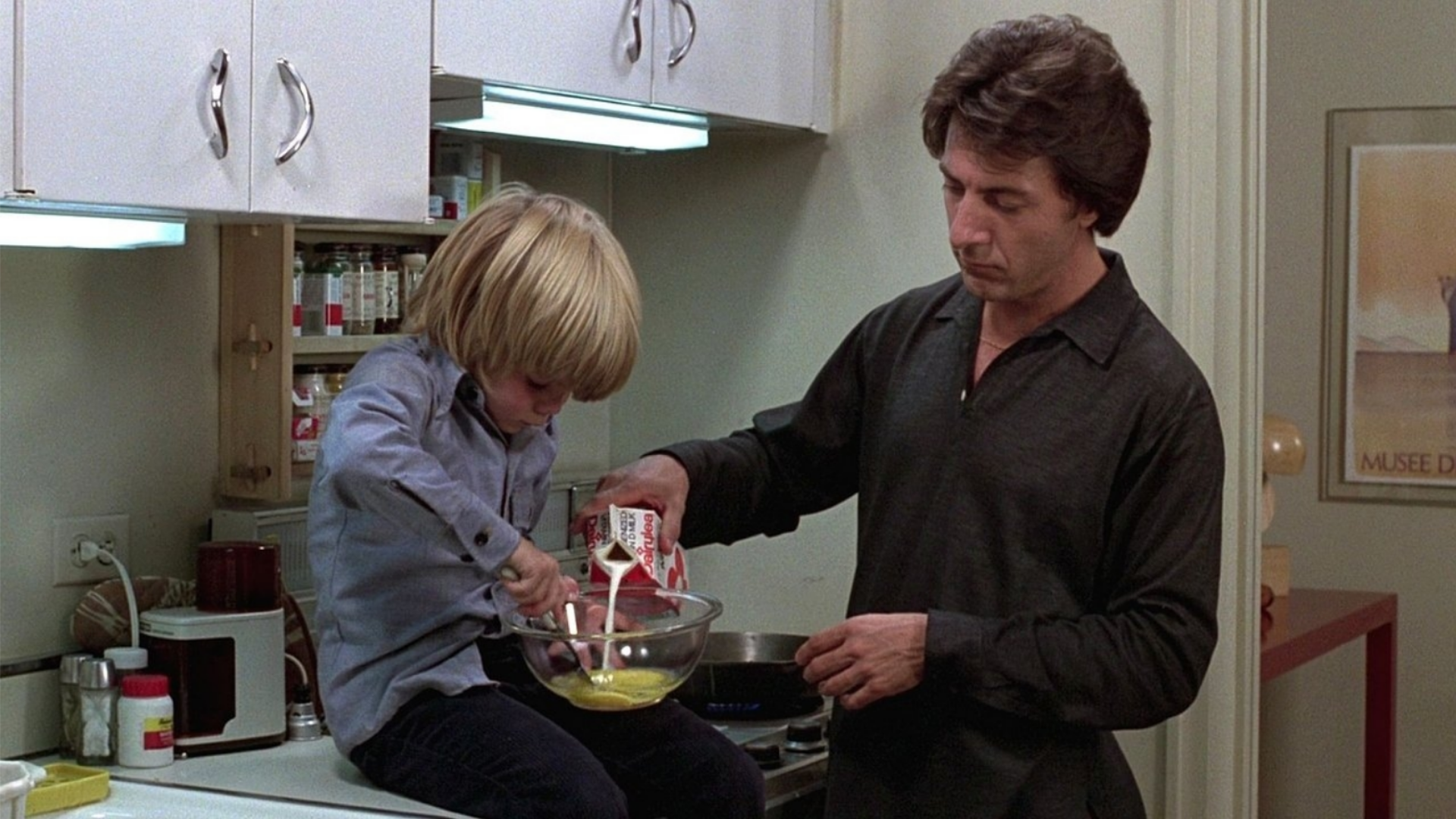
In the scene where Ted and Billy make French toast, Dustin Hoffman shows off his skill at cracking eggs one-handed.
- #036
The film was shot partly at the famous advertising agency Della Femina, Travisano & Partners. Much of the look of the agency's offices was inspired by reality, such as the neon signs bearing their names, antiques and other stylistic office items. Ron Travisano actually appeared in a scene with Dustin Hoffman, but the scene was cut from the final edit. They spent time around the agency to get a feel for the flow of that kind of office.
- #037
Meryl Streep felt that the character of Joanna was written too one-dimensionally in the script and the novel, as an obvious villain to whom Ted and Billy would react and change their lives. Believing that Joanna needed to express the reason for her departure in her own words, she demanded changes to her character.
- #038
When Justin Henry was nominated for the Academy Award for Best Supporting Actor at the age of eight, he became the youngest person ever nominated in that category and in any Oscar category. As of 2026, that record still stands.
- #039
Behind the impressive lead performances lay, in part, turmoil in the actors' personal lives. Dustin Hoffman was going through a complicated divorce, while Meryl Streep was mourning the death of her partner John Cazale.
- #040
Dustin Hoffman took care to put Justin Henry at ease, talking through every scene with him at length and working on it in detail.
- #041
Meryl Streep was initially cast as the woman with whom Ted has a one-night stand; the role was later played by JoBeth Williams. When Kate Jackson could not accept the role of Joanna because of her contract, the part was offered to Streep.
- #042
During the celebrations for the 1980 Oscar ceremony, Meryl Streep left the Oscar statuette she had just won for this film behind a toilet.
- #043
There was tension between Dustin Hoffman and Meryl Streep at first. Hoffman was hearing exaggerated praise about the newcomer Streep and felt overshadowed by her. When she wanted to change the dialogue in the restaurant scene, Hoffman was furious; however, he accepted that she was arguing for what was best for the film, not for her own character, and he respected her for it.
- #044
Meryl Streep said that after Dustin Hoffman slapped her to prepare her for the character, she never wanted to work with him again.
- #045
Dustin Hoffman and Meryl Streep would half-jokingly try to turn Justin Henry against each other. One day on set, Hoffman asked Henry who he would rather be with; when Henry said 'With her, she's nicer,' Hoffman replied, 'Oh yeah? Work with her for five weeks and see.'
- #046
The woman Ted suddenly kisses at the party was former Miss Norway and Playboy Playmate Ingeborg Sørensen.
- #047
Meryl Streep completed her scenes for Manhattan (1979) between takes on this film.
- #048
Dustin Hoffman said "I'd like to thank divorce" in his Oscar speech, because the film coincided with his own painful divorce and he drew on his personal pain while playing Ted Kramer.
- #049
Dustin Hoffman treated Meryl Streep badly on set. In addition to slapping her and the famous wine glass scene, he reportedly whispered the name of her boyfriend, John Cazale, in her ear to get a reaction out of her. Cazale had died of cancer in 1978, and Streep was still grieving during the shoot.
- #050
Kate Jackson was the first choice for the role of Joanna Kramer. She had to decline because of her commitment to the series Charlie's Angels (1976); however, another reason was also reported. It is said that Jackson might have had a career similar to Meryl Streep's had she taken the role. According to the book 'The Academy Awards: The Complete Unofficial History', Sherry Lansing of Columbia Pictures insisted on Streep over Kate Jackson.
- #051
JoBeth Williams, who came from a conservative Texas background, was hesitant about undressing, especially in the scene with young Justin Henry. "I was afraid my nudity would traumatize the little boy," she recalls. "I thought he might spend the rest of his life with a psychiatrist." But the little boy took one look and yawned, and the scene went on. It was not a devastating blow for Williams; relieved by the child's indifference, she played the scene flawlessly.
- #052
On Bravo's 'What Happens Live', Meryl Streep answered Andy Cohen's question "Out of Robert Redford, Robert De Niro and Dustin Hoffman, which one would you sleep with, which one would you marry, and which one would you kill?" with "Marry Redford, sleep with De Niro, kill Hoffman."
- #053
The other notable role Justin Henry played was Mike Baker, Samantha's (Molly Ringwald) younger brother, in the 1984 John Hughes classic Sixteen Candles.
- #054
Billy's crying scenes were real. Robert Benton asked Justin Henry to think of a sad memory before the shoot. According to rumors, Henry threw a tantrum when Ricky Schroder won the Best New Male Star of the Year award at the 37th Golden Globe Awards (1980).
- #055
The film's leads are two actors who have each won two Best Actor and Best Actress Oscars. Dustin Hoffman won the award for Rain Man (1988) and this film; Meryl Streep won it for Sophie's Choice (1982) and The Iron Lady (2011). Streep also won the Best Supporting Actress Oscar for this film.
- #056
The cast includes two Oscar-winning actors (Dustin Hoffman and Meryl Streep) and three Oscar nominees (Jane Alexander, Justin Henry and JoBeth Williams).
- #057
A significant change was made for the finale of the courtroom scene: the monologue in which Joanna explains why she left. Robert Benton feared major delays, but Meryl Streep quickly put what she had in mind on paper. Benton said, "The scene turned out magnificent, I cut only two lines. What you see is entirely hers."
- #058
Dustin Hoffman was going through a marital separation during the shoot and divorced his first wife right after the film was finished; he brought many personal memories and lines of dialogue from that period into the film. Writer-director Robert Benton offered him a shared screenplay credit, but Hoffman declined.
- #059
When Meryl Streep said she was not satisfied with the original version of the courtroom speech, she wrote her own text at the suggestion of writer-director Robert Benton.
- #060
French director François Truffaut was asked to direct the film, and even his regular cinematographer had been hired in anticipation. But Truffaut turned down the offer because he was busy with other projects, and suggested the film's screenwriter as director.
- #061
From the moment producer Stanley R. Jaffe and writer-director Robert Benton first read Avery Corman's source novel, the only name on their minds for the lead role was Dustin Hoffman.
- #062
Kramer vs. Kramer was the highest-grossing film of 1979. It took in a total of $160,260,000, surpassing every other film released that year.
- #063
In 1979, Joanna (Meryl Streep) states in court that her annual salary is $31,000; that figure is equivalent to roughly $111,000 in 2020.
- #064
The music that plays during the opening credits is Antonio Vivaldi's Mandolin Concerto.
- #065
Roger Ebert gave the film four stars, saying: "Kramer vs. Kramer would not have been this good, this intriguing and this gripping if it had taken sides. The film tells the story of a situation ripe for taking sides, such as divorce and a child custody battle; but what matters in such a story is not who is right, but whether people can act according to their own better natures."
- #066
It was among the 400 films on the American Film Institute's 1998 list of nominees for the 100 Greatest American Films of All Time.
- #067
As of 2018, it is the only production for which Meryl Streep both won an Oscar for her acting and saw the film take the Best Picture award.
- #068
This film is the first of two productions to win the Best Picture Oscar by focusing on interpersonal relationships and family ties; the following year the award went to "Ordinary People" (1980).
- #069
Many people saw this film as an unofficial sequel to "The Graduate" (1967); Katharine Ross (Elaine in The Graduate) was even considered for the role of Joanna Kramer.
- #070
While Ted is submitting his résumé to a new advertising agency, he mentions that early in his career he made a commercial for Volkswagen. Before he became famous, Dustin Hoffman had indeed appeared in a Volkswagen television commercial; in it, he tries to find the engine of a Type 3 fastback sedan.
- #071
The book Ted reads to Billy (after the scene in which Joanna watches them) is the English translation of "The Red Sea Sharks" from Hergé's "The Adventures of Tintin" comic series.
- #072
This film is part of a cycle in 1980s Hollywood dealing with divorce, which includes productions such as "Shoot the Moon" (1982), "The Champ" (1979), "Author! Author!" (1982), "Table for Five" (1983), "Heartburn" (1986), "Irreconcilable Differences" (1984), "Enemies, a Love Story" (1989), "The Good Mother" (1988), "The War of the Roses" (1989) and "The Last Married Couple in America" (1980).
- #073
It appears on the list "1001 Movies You Must See Before You Die," edited by Steven Schneider.
- #074
In a 2023 interview, Meryl Streep explained that when the film was released in China decades ago, the government used it as proof that American marriages and women were bad, but that when she visited the country in 2010, many Chinese women came up to her and told her how much they identified with the role.
- #075
That year it was the only film nominated for an Oscar in both the Best Supporting Actor and Best Supporting Actress categories.
- #076
The marriage of Ted and Joanna Kramer had lasted a little more than eight years.
- #077
In the opening scene, Joanna is wearing her wedding ring as she watches Billy sleep; in the final scene, as Joanna and Ted hug goodbye and Joanna goes upstairs to see Billy, she is not wearing the ring.
Behind the Scenes (18)
- #078
The famous ice cream scene, in which Billy skips dinner and goes straight for dessert to defy his father, was entirely improvised by Dustin Hoffman and Justin Henry. Writer-director Robert Benton liked the scene so much that he decided to keep it in the film.
- #079
Meryl Streep was pregnant during the filming of the movie.
- #080
Meryl Streep shot her scenes for Manhattan (1979) during filming.
- #081
Dustin Hoffman treated Meryl Streep very badly on set. Along with hitting her and the notorious wine glass scene, he reportedly whispered John Cazale's name to her to get a reaction. Streep's partner Cazale had died of cancer in 1978, and Streep was still grieving during the shoot.
- #082
French director François Truffaut was asked to direct the film, and a cinematographer was even hired in anticipation, but Truffaut was busy with other projects and turned the film down, suggesting that its screenwriter direct it.
- #083
Dustin Hoffman had planned the moment in the restaurant scene with Meryl Streep when he throws the wine glass against the wall. He only told the cameraman so that it would be caught on film. Streep's shocked reaction was genuine, but she stayed in character until director Robert Benton said 'cut.' In the documentary on the DVD, Streep says that as soon as the scene ended, she yelled at Hoffman for scaring her so much.
- #084
The famous ice cream scene, in which Billy skips dinner and goes straight to dessert to defy his father, was played entirely improvised by Dustin Hoffman and Justin Henry. Writer and director Robert Benton liked the scene so much that he decided to keep it in the film.
- #085
The stenographer in the courtroom scenes was a real stenographer. While chatting with her between takes, Dustin Hoffman asked whether she had worked on many divorce cases. She said she used to, but that she burned out because she found it emotionally draining, so she switched to murder cases instead, which were much easier.
- #086
The scene in which JoBeth Williams is completely naked was optically darkened so that the film would not receive an R rating for its theatrical release. The undarkened version frequently appears in some television broadcasts.
- #087
When Néstor Almendros learned that Billy's room would be decorated with Disney figures, he objected. It had nothing to do with the lighting and camerawork; he thought it would be like inviting a third character into the intimate scenes. He suggested painting clouds on the walls, and Robert Benton liked and approved the idea.
- #088
Meryl Streep was quite pregnant in the final scene, which is why Joanna wears a raincoat.
- #089
The final scene, in which Joanna asks how she looks and Ted says 'Great,' was not actually in the script; it was a real moment between Streep and Hoffman as they were preparing off camera. Benton observed it and decided to add it to the film.
- #090
The restaurant scene with Dustin Hoffman and Meryl Streep was shot at J.G. Melon's on East 74th Street and 3rd Avenue in Manhattan. A still from the film hangs on the wall next to the table where the scene was shot.
- #091
The apartment set was designed to match exactly the dimensions of the apartments in the building used for exterior shots.
- #092
Writer and director Robert Benton advised cinematographer Néstor Almendros to base the film's look and color on the paintings of Piero della Francesca. Almendros also drew inspiration from the work of David Hockney and designed a realistic look using source lighting in interior spaces and natural light outdoors.
- #093
Before the famous restaurant scene in which Ted throws his glass against the wall, Dustin Hoffman is reported to have laughed hysterically at an episode of the Muppets.
- #094
In the scene where Ted and Billy make French toast, Dustin Hoffman shows off his skill at cracking eggs with one hand.
- #095
The film was shot partly at the famous advertising agency Della Femina, Travisano & Partners. Much of the look of the agency's offices was inspired by reality, such as the neon signs with their names, antiques and other stylistic office items. Ron Travisano actually appeared in a scene with Dustin Hoffman, but that scene was cut from the final edit. They spent time around the agency to get a feel for the flow of that kind of office.
Characters & Cast (56)
- #096
The strength of the two leads' performances can be attributed, at least in part, to what was happening in their private lives at the time. Dustin Hoffman was in the middle of a complicated divorce, while Meryl Streep was still recovering after the death of her partner, John Cazale.
- #097
Meryl Streep was initially cast in the role of Ted's one-night stand, which was ultimately played by JoBeth Williams. When Kate Jackson could not take the role of Joanna because of a contract, the part was offered to Streep.
- #098
Meryl Streep felt that the character of Joanna was written in the script and the novel as too one-dimensional, a clear-cut villain whose departure Ted and Billy would react to and change their lives over. Believing that Joanna needed to explain her reasons for leaving in her own words, she demanded changes to her character.
- #099
When Justin Henry was nominated for Best Supporting Actor at the age of eight, he became the youngest person ever nominated in that category and in any Oscar category. That record still stands as of 2026.
- #100
The powerful performances in the lead roles were partly rooted in turmoil in the actors' personal lives. Dustin Hoffman was going through a complicated divorce, while Meryl Streep was mourning the death of her partner John Cazale.
- #101
Dustin Hoffman took care to put Justin Henry at ease, discussing and working through every scene with him at length and in detail.
- #102
Meryl Streep was initially cast as the woman Ted has a one-night stand with; the role was later played by JoBeth Williams. When Kate Jackson could not accept the role of Joanna because of her contract, the part was offered to Streep.
- #103
During the celebrations for the 1980 Oscar ceremony, Meryl Streep left the Oscar statuette she had just won for this film behind in a restroom.
- #104
There was tension between Dustin Hoffman and Meryl Streep at first. Hoffman was hearing exaggerated praise about the newcomer Streep and felt overshadowed by her. When she wanted to change the dialogue in the restaurant scene, Hoffman was furious; but he accepted that Streep was arguing for what was best for the film, not for her own character, and he came to respect her.
- #105
Meryl Streep said that after Dustin Hoffman slapped her to prepare her for the role, she never wanted to work with him again.
- #106
Dustin Hoffman and Meryl Streep would half-jokingly try to turn Justin Henry against each other. One day on set, Hoffman asked Henry who he would rather be with; when Henry said 'With her, she's nicer,' Hoffman replied, 'Oh yeah? Work with her for five weeks and see how you feel.'
- #107
The woman Ted Kramer suddenly kisses at the party was former Miss Norway and Playboy Playmate Ingeborg Sørensen.
- #108
Meryl Streep completed her scenes for Manhattan (1979) in between shooting this film.
- #109
In his Oscar speech, Dustin Hoffman said 'I'd like to thank divorce,' because the film coincided with his own painful divorce and he drew on his personal pain while playing Ted Kramer.
- #110
Dustin Hoffman treated Meryl Streep badly on set. In addition to slapping her and the famous wine glass scene, he was reported to have whispered the name of her partner John Cazale in her ear to get a reaction out of her. Cazale had died of cancer in 1978, and Streep was still grieving during the shoot.
- #111
At the Governor's Ball held after the 52nd Academy Awards (1980), Meryl Streep left the Best Supporting Actress Oscar she won for this film in the women's restroom.
- #112
Justin Henry, who played young Billy Kramer, quit acting and became a regional manager in media sales.
- #113
Justin Henry was encouraged to improvise so that his performance would feel more natural.
- #114
Dustin Hoffman offered the role of the woman Ted has a one-night stand with to Joan Lunden, then a news reporter, after seeing her on WABC Eyewitness News. Lunden turned down the offer when she learned the role required nudity.
- #115
The first choice for the role of Joanna Kramer was Kate Jackson. She had to decline because of her commitment to the series Charlie's Angels (1976); however, another reason was also reported. It is said that Jackson might have had a career similar to Meryl Streep's if she had taken the role. According to the book 'The Academy Awards: The Complete Unofficial History,' Sherry Lansing of Columbia Pictures insisted on Streep over Kate Jackson.
- #116
JoBeth Williams, who came from a conservative Texas background, was hesitant about undressing, especially in the scene with young Justin Henry. 'I was afraid my nudity would traumatize the little boy,' she recalled. 'I thought he might spend the rest of his life with a psychiatrist.' But the child took one look, yawned and carried on with the scene. It was not a devastating blow for Williams; relieved by the boy's indifference, she played the scene flawlessly.
- #117
On Bravo's 'What Happens Live,' when Andy Cohen asked Meryl Streep 'Out of Robert Redford, Robert De Niro and Dustin Hoffman, which one would you sleep with, which one would you marry, and which one would you kill?', she answered, 'Marry Redford, sleep with De Niro, kill Hoffman.'
- #118
The other notable role Justin Henry played was Mike Baker, Samantha's (Molly Ringwald) younger brother in John Hughes's 1984 classic Sixteen Candles.
- #119
Billy's crying scenes were real. Robert Benton asked Justin Henry to think of a sad memory before the take. According to rumors, Henry threw a tantrum when Ricky Schroder won the Best New Male Star of the Year award at the 37th Golden Globe Awards (1980).
- #120
Meryl Streep joked that she was sure Ted would send Billy back to Joanna once he hit puberty.
- #121
This film is the screen debut of both Justin Henry (Billy) and JoBeth Williams (Phyllis Bernard).
- #122
Susan Sarandon was among the names considered for the role of Joanna Kramer.
- #123
Diane Keaton was considered for the role of Joanna Kramer.
- #124
James Caan was offered the role of Ted Kramer, but he turned it down.
- #125
The film's lead roles are shared by two actors who have each won two Best Actor and Best Actress Oscars. Dustin Hoffman won the award for Rain Man (1988) and this film; Meryl Streep won it for Sophie's Choice (1982) and The Iron Lady (2011). Streep also won the Best Supporting Actress Oscar for this film.
- #126
This film is one of three Meryl Streep appeared in in 1979. The others are Manhattan (1979) and The Seduction of Joe Tynan (1979).
- #127
The film's cast includes two Oscar-winning actors (Dustin Hoffman and Meryl Streep) and three Oscar nominees (Jane Alexander, Justin Henry and JoBeth Williams).
- #128
This film is the first collaboration between Meryl Streep and writer-director Robert Benton. The second is Still of the Night (1982).
- #129
Robert Benton considered Roy Scheider for the role of Ted Kramer.
- #130
Dustin Hoffman and Jane Alexander had previously appeared together in All the President's Men (1976); this is their second collaboration.
- #131
This film contains the only performance for which Justin Henry was nominated for an Oscar.
- #132
"Kramer vs. Kramer" brings together two stars who have each appeared in three films that won the Best Picture Oscar: Meryl Streep ("The Deer Hunter" and "Out of Africa") and Dustin Hoffman ("Midnight Cowboy" and "Rain Man").
- #133
Joanna (Meryl Streep) states in court in 1979 that her annual salary is $31,000; that figure is equivalent to roughly $111,000 in 2020.
- #134
In June 2008, it ranked third on the American Film Institute's list of the top 10 films in the "Courtroom Drama" genre.
- #135
As of 2020, "Kramer vs. Kramer" is the only film among the Best Picture Oscar winners of the 1970s that has not yet been selected for the Library of Congress National Film Registry; however, like the others, it has been inducted into the Online Film & Television Association's Hall of Fame.
- #136
The music playing during the opening credits is Antonio Vivaldi's Mandolin Concerto.
- #137
Roger Ebert gave the film four stars and said: "Kramer vs. Kramer, if it had taken sides, could not have been this good, this intriguing, and this compelling. The film tells of a situation ripe for taking sides, such as divorce and a child custody battle; but what matters in such a story is not who is right, but whether people can act according to their own better natures."
- #138
It was among the 400 films on the American Film Institute's 1998 candidate list for the 100 Greatest American Films of All Time.
- #139
As of 2018, it is the only production for which Meryl Streep both won an Oscar for her acting and the film received the Best Picture award.
- #140
This film is the first of two productions to win the Best Picture Oscar while focusing on interpersonal relationships and family ties; the following year the award went to "Ordinary People" (1980).
- #141
Many people saw this film as an unofficial sequel to "The Graduate" (1967); it was even considered at one point to cast Katharine Ross (Elaine in The Graduate) for the role of Joanna Kramer.
- #142
While Ted is presenting his résumé to the new advertising agency, he mentions that early in his career he made a commercial for Volkswagen. Before he became famous, Dustin Hoffman had indeed appeared in a Volkswagen television commercial; in the ad, he tries to find the engine of a Type 3 fastback sedan.
- #143
The book Ted reads to Billy (after the scene where Joanna watches them) is the English translation of "The Red Sea Sharks" from Hergé's "The Adventures of Tintin" comic series.
- #144
This film is part of a cycle in 1980s Hollywood that dealt with divorce, including productions such as "Shoot the Moon" (1982), "The Champ" (1979), "Author! Author!" (1982), "Table for Five" (1983), "Heartburn" (1986), "Irreconcilable Differences" (1984), "Enemies, a Love Story" (1989), "The Good Mother" (1988), "The War of the Roses" (1989) and "The Last Married Couple in America" (1980).
- #145
It is included in the list "1001 Movies You Must See Before You Die," edited by Steven Schneider.
- #146
As of 2025, it is the oldest Best Picture Oscar-winning production whose lead actors are still alive.
- #147
In a 2023 interview, Meryl Streep explained that when the film was released in China decades ago, it was used by the government as proof that American marriages and women were bad, but that when she visited the country in 2010, many Chinese women came up to her and told her how much they identified with this role.
- #148
That year, it was the only film nominated for an Oscar in both the Best Supporting Actor and Best Supporting Actress categories.
- #149
In the novel, Joanna Kramer's maiden name is Joanna Stern.
- #150
Ted and Joanna Kramer's marriage had lasted a little more than eight years.
- #151
In the opening scene, Joanna puts on her wedding ring while watching Billy sleep; in the final scene, as Joanna and Ted hug and say goodbye and Joanna goes upstairs to see Billy, she is not wearing the ring.
Career & Awards (3)
- #152
When Justin Henry was nominated for Best Supporting Actor at the Academy Awards, Henry, then eight years old, became the youngest person ever nominated for that award as well as the youngest Oscar nominee in any category, a record that still stands today (2026).
- #153
Meryl Streep left the Oscar she won for the film behind in the restroom during the 1980 ceremonies.
- #154
At the Governors Ball held after the 52nd Academy Awards ceremony (1980), Meryl Streep left her Oscar for Best Actress in a Supporting Role, won for this film, in the women's restroom.
Sources & editorial notes
Reference databases
- Wikipedia
- IMDb
Information from external sources is independently selected, consolidated and edited by Arka Evren. Sources are listed for verification and further reading. Encyclopedia text is used under its licence (CC BY-SA). How we work