FILM · 2016 · USA
La La Land
- Directed by
- Damien Chazelle
- Runtime
- 129 min
- Studio
- Summit Entertainment, Gilbert Films, Impostor Pictures
305 archived facts 8 topics 1 source Last reviewed Sep 2026
Mia, an aspiring actress, serves lattes to movie stars in between auditions and Sebastian, a jazz musician, scrapes by playing cocktail party gigs in dingy bars, but as success mounts they are faced with decisions that begin to fray the fragile fabric of their love affair, and the dreams they worked so hard to maintain in each other threaten to rip them apart.
Summary: TMDB

12 Facts From Behind the Scenes of La La Land
- #001
According to composer Justin Hurwitz, all of the piano performances in the film were first recorded in pre-production by pianist Randy Kerber. Ryan Gosling then spent six days a week, two hours a day, in piano lessons memorizing the music. By the time shooting began, Gosling could play every piano sequence seen in the film without a hand double or CGI.
- #002
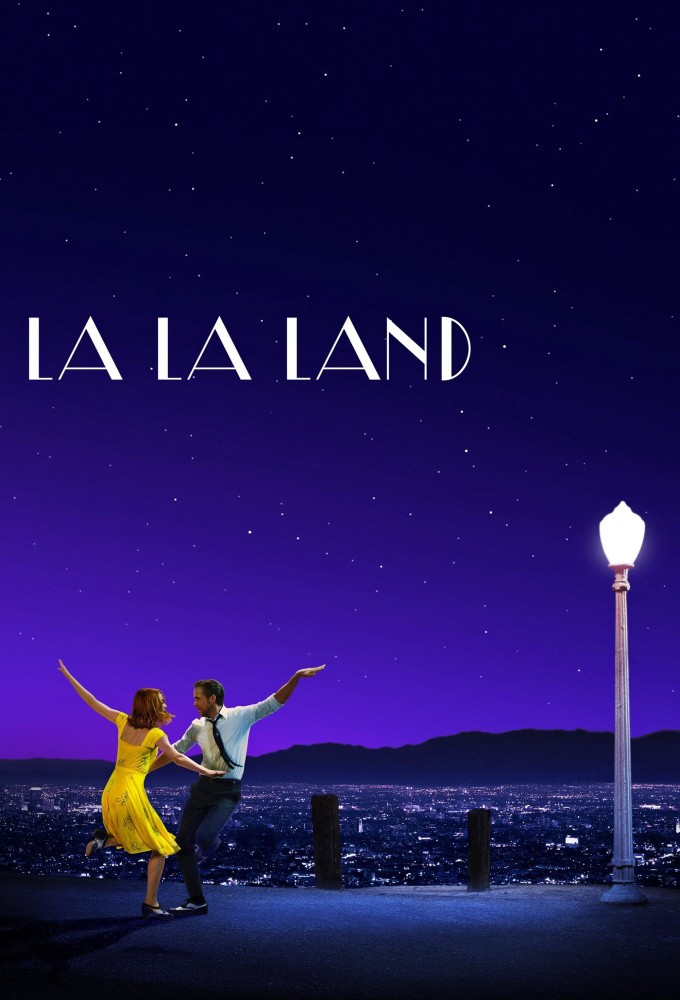
The crew had a limited 30-minute window to shoot the magic-hour, deep-purple-twilight Hollywood Hills dance scene over two days (cinematographer Linus Sandgren said the time was exactly between 19.20 and 19.50). According to Damien Chazelle, Emma Stone and Ryan Gosling managed to do five takes in two days; after each take they returned to the starting point while assistants wiped their sweat before they began the dance routine again. The fourth take is the one used in the final film.
- #019
The opening number "Another Day of Sun" was shot over two days in extreme heat of 109 degrees F (43 degrees C). Each performer had two spare sets of costumes kept in the cars and changed between takes. Choreographer Mandy Moore began rehearsals in May 2015 in the parking lot behind the production office to maximize shooting time. The sequence was mapped out with miniature model cars and Post-it notes. During filming, to avoid accidentally being caught by the camera on the hill, Moore hid under a car so she could direct the dancers.
- #033
As Sebastian and Mia walk through the studio lot, they pass two actors filming a romantic scene; those actors are actually Ryan Gosling's and Emma Stone's body doubles.
- #049
La La Land was shot entirely on film and was the first film since Inception (2010) to win the Oscar for Best Cinematography, taking the award six years after Inception did.
- #066
In the film's first 60 seconds, as the camera shows the gridlocked cars, dents can be seen on the hoods and roofs of many of them. These are probably the result of dancing during rehearsals and earlier filming.
- #129
According to costume designer Mary Zophres, Mia and Sebastian have more than fifty costume changes. Zophres worked in close collaboration with cinematographer Linus Sandgren and production designer David Wasco to create a world in which the costumes were in harmony with the film's overall design.
- #135
For how to move the camera in La La Land, director Chazelle used filmmaker Max Ophuls as a model. Ophuls is regarded as one of the masters of camera movement in cinema history. As Chazelle described it, "the idea is to have a camera that in itself feels melodic, feels like a dancer," a camera that "never gets in the way of the dancing onscreen but becomes part of the choreography nonetheless."
- #149
Linus Sandgren is the first Swedish cinematographer to win the Best Cinematography Oscar since Sven Nykvist, who won for Fanny and Alexander (1982).
- #153
Emma Stone spent two months before production rehearsing every day with choreographer Mandy Moore.
- #217
The dancers, choreographers and crew rehearsed the opening sequence for three months before shooting, and many cars had to be reinforced to support the dancers.
- #222
Damien Chazelle collaborated closely with cinematographer Linus Sandgren on the film. Sandgren is known for his work with David O. Russell on American Hustle and Joy. Jordan Hurwitz commented: "The camera had to have a very specific energy in this film… and we knew Linus had the skills to bring that." Sandgren notes: "Damien wanted to make an old-fashioned film in a very modern way where the camera is more fluid." There were many technical challenges. They shot on 4-perf anamorphic 35mm film. This meant the camera had to be reloaded with film every ten minutes. Moreover, Chazelle wanted to shoot the large production numbers, which Sandgren called "unbroken reality," in a single take.
Sources & editorial notes
Reference databases
Sources for the entries on this page
- IMDb IMDb
Information from external sources is independently selected, consolidated and edited by Arka Evren. Sources are listed for verification and further reading. Encyclopedia text is used under its licence (CC BY-SA). How we work