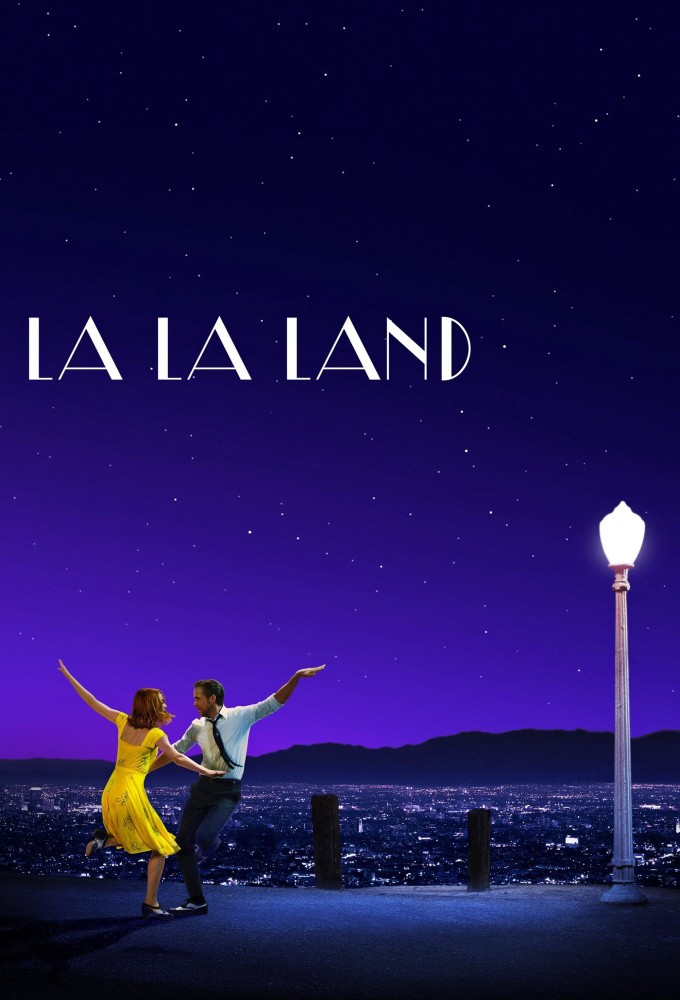
FILM · 2016 · USA
La La Land
- Directed by
- Damien Chazelle
- Runtime
- 129 min
- Studio
- Summit Entertainment, Gilbert Films, Impostor Pictures
305 archived facts 8 topics 1 source Last reviewed Sep 2026
Mia, an aspiring actress, serves lattes to movie stars in between auditions and Sebastian, a jazz musician, scrapes by playing cocktail party gigs in dingy bars, but as success mounts they are faced with decisions that begin to fray the fragile fabric of their love affair, and the dreams they worked so hard to maintain in each other threaten to rip them apart.
Summary: TMDB

226 Interesting Facts About La La Land
- #003
The line "that's L. A. They worship everything and they value nothing" that Sebastian says in the film was actually added by Ryan Gosling after he heard his real-life partner Eva Mendes mention it as a joke.
- #004
It was Gosling's idea that Sebastian wants to own his own club rather than become a successful jazz musician.
- #007
Emma Stone performed "Audition (The Fools Who Dream)" live. She decided when to move from dialogue into singing. There was no pre-recorded track that she lip-synced to. The song's composer, Justin Hurwitz, played piano into her ear from another room. Director Damien Chazelle said this was done so that Emma could have more control on set.
- #009
Contains a major spoiler — show
Sebastian never introduces himself to Mia, and Mia never addresses him by name at any point in the film.
- #010
Damien Chazelle is known for using long, unbroken takes in the film, but he also uses at least one scene played in reverse. In the final scene in the planetarium, Ryan Gosling and Emma Stone fall from the air and land perfectly in their seats, then kiss, and the camera moves in for a close-up before it goes dark. The sequence was shot backwards: it begins in black and pulls away toward the kiss, looks at two shots through the telescope, then goes to a wide shot, then Stone and Gosling are lifted out of their seats, and then the whole sequence is run in reverse. That is why they settle into their seats so perfectly and effortlessly: they never "land." They are already seated, the zoom-in is actually a zoom-out, and so on.
- #011
Emma Watson turned down the role of Mia due to scheduling conflicts with Beauty and the Beast (2017), while Ryan Gosling turned down the role of the Beast in that film in order to appear in this one. Coincidentally, both are musicals. Ironically, Emma Stone was later pulled from the role of Meg March in Little Women (2019) due to scheduling conflicts with the promotion of The Favourite (2018), and Watson was cast in her place.
- #012
Contains a major spoiler — show
Chazelle was also drawn to the concept of meeting someone in your life who transforms you, setting you on a path toward becoming the person you dream of being — yet you still have to travel that path alone. Chazelle found this concept beautiful and heartbreaking, and ultimately wanted the film to be about it.
- #014
Tom Hanks was so moved by the film that at the press conference for his film Sully he told all the reporters to go see it whenever they had the chance.
- #015
Contains a major spoiler — show
While Mia gives Sebastian a tour of the Warner Brothers backlot, she shows him a window used in Casablanca (1942). Much later, near the end of the film, when Mia and her husband visit Sebastian's club and Sebastian is stunned to see them, it is a clear homage to the famous scene in which Ilsa and Victor walk into Rick's Café Americain and Rick is stunned to see them.
- #016
Most of Mia's dresses have a vintage charm suited to the film's tone. Costume designer Zophres found some of the dresses Mia wears in the film at vintage clothing stores in the Los Angeles area.
- #017
Although the production team was allowed to film the interior exhibits of the Griffith Park Observatory, they were not permitted to shoot in the planetarium, so the planetarium was recreated on set. The vintage Minolta projector at the center of the planetarium was rented from the Planetarium and Projector Science Museum in Big Bear Lake, California, to complete the set.
- #018
Before filming, Damien Chazelle, Ryan Gosling and Emma Stone visited Gene Kelly's widow and had the chance to look through many of Kelly's film mementos, including a leather-bound copy of the script for Singin' in the Rain (1952). At the end of the visit Kelly's widow's dog ran off, and Chazelle and Gosling ran into traffic to rescue it. Chazelle told Gosling, "We will not kill Gene Kelly's widow's dog." He confirmed that they succeeded in saving the dog.
- #021
Contains a major spoiler — show
Emma Stone says: "Even though Mia has a happy marriage and a baby, this film celebrates the loves that came before and that they are at least as important as the love you have now."
- #022
Contains a major spoiler — show
"Using the tools that only a musical can use to flesh it out and run with it." Chazelle says: Emma Stone calls this finale an exploration of what could have been, "Let's give them the old-fashioned musical version of their story, in which there is no real conflict and we can leave it to them to think about — is this better than what actually happened? That's the question the audience can be left with." Chazelle continues, "This is a film about people growing up, and part of growing up is realizing that life does what it wants."
- #024
Actor Ryan Gosling on Emma Stone: "She's one of a kind and she brings that same quality to Mia. You feel Mia as someone working in Los Angeles, trying to catch a break, because you see how special and unique she is." Director Chazelle says of Stone, "Emma is very modern but there's also a timelessness to her."
- #025
The film was shot over eight weeks in the summer of 2015.
- #026
For the song "Audition," Emma Stone sang live on camera in a single take. It was the last song Justin Hurwitz composed from the score. He played the piano in the next room, connected to the actress through an earpiece. He let Emma lead the song, so he was reacting to her, and the piano often lagged slightly behind the vocal. She says she was nervous while playing the piano because it was such an important moment for her, and she knew there would be a lot of takes for her voice to hold up. Hurwitz said that because the song was so important narratively, he wanted to understand the rest of the score before tackling it.
- #027
Director Chazelle says of actress Emma Stone: "The level of her acting in the song and dance numbers and the way she expresses emotional transitions is incredible. I think she is one of the greatest actresses of our time and can create something without any dialogue, through only her face, her manner and her body language."
- #028
This dinner/argument scene is reported to be the most rewritten scene. Gosling and Stone also helped prepare the dialogue to create one of the most realistic scenes in a film full of fantastical scenes.
- #029
Contains a major spoiler — show
Producers Fred Berger, Jordan Horowitz and Damien Chazelle agreed that Seb and Mia would under no circumstances end up together at the end of the story.
- #031
Producer Marc Platt recounted that on the final day of shooting, as the sun was setting, Damien Chazelle postponed the film's announcement and instead grabbed a handheld camera to start filming the sunset. Platt realized Chazelle did not want production to end. As darkness fell, Platt went over to Chazelle and told him there was nothing left they could shoot without light, at which point Chazelle reluctantly agreed to wrap.
- #032
Contains a major spoiler — show
Director Damien Chazelle said of La La Land: "It was important to make a film about dreamers, about two people with giant dreams that drive them, that bring them together but also pull them apart." Chazelle says La La Land is about how you balance your relationship with your art against your relationships with other people.
- #034
The film's music was recorded in the same studio where the scores for Singin' in the Rain (1952), The Wizard of Oz (1939) and many other MGM musicals were made.
- #036
The sequence Moore called "dance independent of gravity" was made because, according to Chazelle, "we wanted the audience to feel that Sebastian and Mia had fallen into this beautiful waltz, because in that moment they have no choice but to dance." Chazelle said the pairing of Stone and Gosling was alchemical, adding, "There's a shorthand between Ryan and Emma, not just personally but on screen."
- #037
Damien Chazelle decided to cast Emma Stone in his film after seeing her as Sally Bowles in the 2014/15 Broadway production of "Cabaret."
- #038
Writer-director Damien Chazelle's girlfriend plays a customer in the cafe who asks for her money back for her pastries in the first half of the film.
- #039
The express-lane freeway ramp used for the opening number "Another Day of Sun" is the same stretch of freeway used in the iconic "bus jump" sequence in Speed (1994), where a 15-meter section of the ramp was digitally removed with CGI to create the gap the bus had to jump.
- #040
Neither Gosling nor Stone were professionally trained dancers. Moore trained both of them himself in his own personal boot camp before shooting.
- #041
At one point Miles Teller and Emma Watson were set to star. Teller was dropped from the project in favor of Ryan Gosling, while Watson left to pursue other projects. Teller had previously appeared in director Damien Chazelle's first feature film, Whiplash (2014).
- #043
In this film Chazelle wanted to explore how colors, sets, costumes and all the expressionistic elements of Old Hollywood filmmaking could tell a story set in the present day.
- #044
Emma Stone suggested the plot point in which her character creates the logo for Seb's club.
- #045
Emma Stone performed nine takes of the "Audition (The Fools Who Dream)" scene. Damien Chazelle chose the second take for the film.
- #046
Damien Chazelle's intention was to make a more grounded musical while maintaining respect for the classics.
- #047
The location at Warner Bros. where Mia tells Sebastian that she hates jazz is the exact shooting location of the cover of Pink Floyd's Wish You Were Here album.
- #048
Stone's rendition of "City of Stars" was performed live on set to keep her fully present and in the moment. Stone says, "It was challenging but it was also something I felt really strong about." The actress says she had done Cabaret on Broadway and had seen what a live performance adds. Even if your voice cracks or goes a little off-key, something irreplaceable is added to the performance.
- #050
Emma Stone points out that the goal in the dance numbers was not perfection. "Our characters are struggling artists, so were never asked to be incredibly brilliant dancers and singers." Damien Chazelle wanted Mia and Sebastian's relationship to feel alive and pure in a way, even though they are part of these cinematic dance numbers. He welcomed the small flaws and imperfections as a way of making it more real.
- #052
On the first day, Zophres and Chazelle walked through the film scene by scene, discussing their color palettes. For Sebastian, Zophres wanted to emphasize elegance with an unusual touch in his costumes. Zophres continues: "His look is definitely not fashionable. It's a look that you feel he has developed and curated. Sebastian is not a guy you see wearing T-shirts. Instead he has a very specific, subtle silhouette that expresses respect for tradition and formality."
- #054
While driving through downtown Los Angeles, Mia and Sebastian visit the food stalls at Grand Central Market (317 S. Broadway) and, among all the eateries, choose Sarita's Pupuseria. It is a real Salvadoran food stall. The scene, which lasts only 3 seconds, drew international attention to the small spot, now recognized as an unforgettable place in El Salvador.
- #055
For John Legend, the chance to work with Ryan Gosling was exciting. "Ryan is one of the best actors working right now, so I came into it with a real humility," he said. Legend says, "Gosling was very helpful and supportive. He really encouraged me to feel 'OK I can do this.'".
- #056
Chazelle wanted to make Los Angeles one of the film's main characters. In film history, Los Angeles has been the backdrop of film noir, a beach-and-bikini paradise and a dystopian setting… Chazelle, however, wanted to explore Los Angeles as a Muse, a moving canvas of inevitable encounters, endless traffic and ceaseless striving where everyone chases their dreams, sometimes in vain and sometimes transformatively. With all these qualities in mind, Chazelle calls Los Angeles a widescreen city. That is why he chose to shoot in widescreen and to make the city look as big and magnificent as a classic Hollywood musical.
- #057
Contains a major spoiler — show
The song "Someone in the Crowd" foreshadows Mia's ultimate success as an actress, because at Mia's one-woman show the casting director is "someone in the crowd."
- #058
Contains a major spoiler — show
The original ending followed Mia as she walked out and got into her car, then watched her drive off against the sunrise. They realized it was far more poignant to close on Sebastian's face as he begins to play the piano.
- #059
Contains a major spoiler — show
Costume designer Mary Zophres's designs for Mia began with brightly colored dresses to emphasize the character's youth. As Mia matures and focuses on her work, the color saturation decreases, and she wears black and white during her one-woman show.
- #060
Contains a major spoiler — show
The set that Mia and Sebastian walk past after meeting at the studio-lot cafe is the same film set where they dance in the dream sequence at the end of the film.
- #061
According to legend, Chazelle's main instruction for the song was to make "Start a Fire" something you could see as a single but that still carried a jazz influence and was fun. The legend goes: "Writing the song was like threading a needle, because you don't want it to be so bad that it's embarrassing, but you want it to be something Sebastian wouldn't want to do. You want it to be something he wouldn't be proud of."
- #062
Chazelle wanted the film's musical numbers to be shot 'top to bottom' and in a single take, like the famous musicals he admired from the 1930s.
- #065
Jason Fuchs, who plays the obnoxious writer at the pool party, is in fact a successful franchise writer. He is one of the names behind Ice Age: Continental Drift (2012) and Wonder Woman (2017).
- #068
Gosling says of his character Sebastian: "His heroes were born 70 years ago, and in this era a great pianist playing real jazz is condemned to work in bars where people don't even stop their conversations to listen to you. So how much do you compromise on being the artist you want to be?" Gosling continues that he thinks Sebastian struggles with the difference between being a purist and being a snob. "Ultimately," Gosling goes on, "Sebastian faces the question many creative people confront: should I keep doing this work that truly feeds me, or should I accept that it's just a job and I need to pay the bills?"
- #070
The production reopened two locations for filming: the Rialto Theatre in South Pasadena and the Angels Flight railway in downtown Los Angeles. The Rialto has been closed since 2007 because it could not sustain itself as a single-screen cinema. Angels Flight had been closed to the public since 2013 due to safety issues. The producers managed to get around this by noting that the railway was opened for service for one day while they secretly shot the scene as a private function. Angels Flight reopened for operation in 2017.
- #071
One of Emma Stone's favorite numbers in the film is "Duet." She says it is where their characters genuinely connect for the first time. Stone says she, Ryan and Chazelle felt it was important that you feel that joyful moment in which the pair are literally keeping step with each other.
- #072
It was shot in 70 different locations in Los Angeles, mostly on location rather than on sets. [Variety 2017].
- #073
A version of the Summit logo was created specifically for La La Land. It recalls those of Hollywood's golden age.
- #074
The murals on the observatory ceiling were made by muralist, filmmaker and novelist Hugo Ballin. The ceiling mural depicts the various stories people have used to explain what we see in the sky, from the zodiac signs to ancient Greek and Roman legends to a woman holding the Star of Bethlehem. The other murals show how science and engineering have changed throughout history, including aviation, navigation, metallurgy, time, geology and biology.
- #075
The opening scene (including the CinemaScope logo) continues for about 6 minutes without a noticeable cut. It is in fact three shots joined together with whip pans.
- #078
Chazelle says some of the difficulties of shooting the opening sequence included choreography that brought the dancers very close to the edge of the freeway ramp, the curved structure of the freeway, which differed from rehearsals of the opening sequence in a flat parking lot, and camera cranes that nearly hit the dancers.
- #079
Producer Marc Platt says: "La La Land is absolutely a love letter written to the city. The way the film brings two extremely modern people living modern lives together with all these iconic Hollywood locations is unique. You feel both the city's romantic fantasy and that it is based on real lives."
- #080
Many of Stone's costumes are copies of iconic dresses, such as the green dress Mia wears on her first date with Sebastian, which was modeled on Judy Garland's dress in A Star Is Born (1954). The black trousers recalled Audrey Hepburn's look in Funny Face (1957).
- #081
The futuristic keyboard Gosling used during the Messenger performances is a Seaboard Grand synthesizer invented in 2013 by Roland Lamb, founder of the UK music technology company ROLI. The Seaboard Grand lets the pianist play between the keys or notes of a normal piano, simulating the expanded palette a wind or string instrument can have. Instead of keys, the surface is silicone, and pressing harder lets the musician deepen the sound and bend the pitch. La La Land's executive music producer, Marius De Vries, knew the instrument and suggested that Sebastian use it in the Messenger performances.
- #082
Contains a major spoiler — show
The film literally enters "La La Land" at the very end. As Sebastian plays his and Mia's melody on the piano, both he and Mia imagine what their relationship could have been. The audience sees what the film would be like if it were a traditional, literal musical. The atmosphere is larger than life and dreamlike. Both potential customers get what they want (including each other). Everything is happy and perfect. When the melody ends, the audience returns to reality, reminded that the "epilogue" they have just witnessed is entirely a fantasy.
- #083
When the time came to present Best Picture (the ceremony's final award) at the Oscars (2017), presenters Warren Beatty and Faye Dunaway were mistakenly given the wrong envelope backstage. While introducing the Best Picture nominees, Beatty was holding a copy of the envelope for the Best Actress in a Leading Role category, which had been announced just minutes earlier and won by Emma Stone for La La Land (2016). When Beatty opened the envelope, he apparently realized the mistake and hesitated to announce the winner. He then handed the card to Dunaway, who declared the much-favored La La Land (2016) the Best Picture winner. As TV cameras cut to the cheering audience, Beatty could be heard telling Dunaway, "It says 'Emma Stone,'" and Dunaway replied, "What?" The film's three nominated producers, Jordan Horowitz, Marc Platt and Fred Berger, along with the entire cast and crew, took the stage. Horowitz thanked the Academy first, and then, during Platt's speech, the mistake was realized as the ceremony's producers searched the crowd on stage for the correct and incorrect envelopes. While accepting the award, Horowitz was revealed to have been handed the wrong envelope by Beatty, the one reading "Emma Stone, La La Land, Best Actress in a Leading Role," while the correct envelope announcing Moonlight (2016) as the Best Picture winner had to be brought to the stage from the wings and eventually given to Beatty. The crowd on stage gradually became aware of the mistake, and Berger, already aware that they would not win, still gave a speech thanking his family and ended it by saying, "By the way, we lost, but you know." Horowitz, who had also been told of the mistake, returned to the microphone and finally announced to the public that Moonlight (2016) had indeed won, showing the correct Best Picture card to the camera as well as the audience. Beatty also explained that he had been given the wrong envelope and announced that the Best Picture award went to Moonlight (2016). After this announcement, the cast and crew of La La Land (2016) gradually left the stage, and the three producers handed their awards to the Moonlight (2016) team, who were finally able to give their speeches. There had already been confusion among winners at the 1964 Oscars, when Sammy Davis Jr. announced the winners of two categories, Music Scoring (adaptation or treatment) and Music Score (substantially original), and was given the envelopes of the two categories swapped (John Addison was ultimately announced as the winner of the Best Music Score award even though he was not nominated in that category (the actual winner was André Previn, while Addison won in the Music Score category)). Beatty and Dunaway's snafu remains the only instance in Oscar history in which a person or film was announced as the winner but actually was not.
- #084
According to the film's producers, Stone gave the character of Mia a subtle Everywoman quality. Producer Jordan Horowitz says of Emma Stone: "She also brings the quality of a tremendous movie star, but at the same time she feels very human and authentic. It's very easy to fall in love with her and at the same time to see her feelings."
- #090
Producer Marc Platt says of Emma Stone's performance: "Not everyone dreams of becoming an actor, but the way Emma plays Mia goes beyond that. You feel that Mia's dreams could be anyone's dreams, whatever you want in life." Jordan Horowitz said of Stone: "She made everything about the character feel as if it were designed for her."
- #091
Ryan Gosling is a fan of the musical films of the Fred Astaire, Ginger Rogers and Gene Kelly era.
- #092
Justin Paul explains it this way: "In New York, you grind and grind to pursue your dreams and… get up the next day and it's muddy and gross." Paul says of Los Angeles: "You pursue your dream, you go to bed and you get up the next day and it's a gorgeous day. It encourages you one breath and refuses to acknowledge that you failed miserably the next."
- #094
The characters in both Whiplash (2014) and La La Land discuss Charlie Parker and the possible reason he was called "Bird."
- #095
Hurwitz composed "City of Stars" from an emotional place. He says he kept moving back and forth between a major cadence and a minor cadence because he thinks the song is about that. In life you have great moments and then you have less great moments.
- #096
Gosling says the costumes Zophres put him in helped him walk the line between the 1940s and a contemporary sensibility. For the big dance numbers Zophres focused on form, but she also focused on function, dressing the leads in clothes that looked all the more striking amid performances that involved swinging, spinning and flying high. While researching the film and watching Gene Kelly musicals, Zophres says she could see that the lining of the costumes changed to something lighter and less heavy once the performers got into the dance routines. To get ideas for the main character's costumes, Zophres turned to a huge magazine collection dating back to the 1930s that included titles such as Life and Vogue.
- #097
The dream sequence was shot in short fragments over the course of the eight-week shoot.
- #098
Chazelle believes so: "the musical as a genre is a great vehicle for expressing that balancing act between dreams and reality."
- #099
Nearly all of the clothes Ryan wears in the film were made to order for his costumes.
- #100
Justin Hurwitz says "City of Stars" is the first duet between Mia and Sebastian. When you record the vocals that way, you get the giggles and all the other nuances. When you record the vocals in a music studio months earlier and then have them lip-synced on set, you get all the little lip traces and things like that that you otherwise wouldn't.
- #101
Damien Chazelle's sister plays the casting director operating the camera when Mia is called back. She also appears as the hula-hooper on top of a car on the freeway in the film's opening number.
- #102
Damien Chazelle says the character of Sebastian was less likable on the page. "He was a complete jerk throughout, equally stupid but extra arrogant, and Ryan never softened that, but he manages to play it so warmly and sensitively that you can actually see the kid underneath who is in love with the music and the art."
- #103
Choreographer Mandy Moore calls the planetarium scene "the heart of the film." Moore said the sequence was originally planned to take place underwater before the decision was made to move it into the sky.
- #104
While Mia is writing her one-woman show, the script shows the main character's name as Genevieve. This is probably a nod to Catherine Deneuve's character in The Umbrellas of Cherbourg (1964), a film that was a major inspiration for this one.
- #105
For the opening dance number on the freeway, the filmmakers used both directions of the westbound carpool lane of the 105 to 110 freeway. On location, half of the cars were facing backwards.
- #107
The "City of Stars" scene at Hermosa Pier was nearly ruined when a large US warship, which had a limited window to shoot at sunset, suddenly sailed into the camera line. Producer Marc Platt disappeared for 10 minutes, and when he returned, the warship had moved in time for the cast and crew to shoot the scene.
- #108
When Mia comes to see Sebastian play with "The Messengers," band leader Keith wears a red leather jacket with a red guitar strap over his shoulder, recalling the 80s-style red leather George Michael jacket Sebastian wore at his earlier party concert. In both bands, Sebastian has to juggle a kitsch second keyboard (a key-tar at the party, a synthesizer with The Messengers) instead of focusing on the piano he loves. The implication is that the flashy stage band is just a better-paying gig that pulls him away from his dreams.
- #109
Damien Chazelle was in a band with D. A. Wallach, the actor who plays the 80s singer at the pool party.
- #112
Damien Chazelle rehearsed the opening number together with the dancers, recording the scene himself on his iPhone.
- #113
Costume designer Mary Zophres said her favorite garment worn by Emma Stone is the white dress seen toward the end of the film.
- #114
Regarding his dancing, Ryan Gosling told the director he felt like a 'slimy monkey.' "My extremities are everywhere; it's hard for me to control my body."
- #115
The jazz club scene was shot at The Lighthouse Café in Hermosa Beach, California. The cast and crew filmed there for four days in the summer of 2015. The Lighthouse has hosted jazz since it opened in 1949. Famous jazz musicians who have played there include Chet Baker, Miles Davis, Art Blakey and Cannonball Adderley. Howard Rumsey owned The Lighthouse Café and brought jazz there from 1949 to 1960 under the leadership of Howard Rumsey's Lighthouse All-Stars. The set designers left most of the interior unchanged. They added a stained-glass window to the front window and a circular stained-glass lighthouse image behind the piano.
- #116
"Epilogue" was shot at Hollywood Center Studios, where Hollywood stars such as Shirley Temple, Mae West and the Marx Brothers once worked. In the 1960s, the series Beverly Hillbillies, Green Acres and The Addams Family were shot there.
- #117
Damien Chazelle's love of That Thing You Do! (1996) led to Tom Everett Scott being cast as Mia's husband. "Growing up as a kid drummer, there are not many movies where the drummer is the hero." Stone and Gosling were equally in love with it and spent a lot of time quoting the film.
- #119
Damien Chazelle began working on La La Land (2016) in 2010 and stated that he was inspired by the French musical classic The Umbrellas of Cherbourg (1964). [Variety 2017].
- #120
Principal photography on the film began on August 10, 2015. Shooting took place at more than 60 locations in and around Los Angeles. Filming took 40 days to complete, and production wrapped in mid-September 2015.
- #121
La La Land was shot in widescreen format on celluloid film with Panavision equipment, but it was not true CinemaScope because that technology is no longer available.
- #125
Costume designer Mary Zophres saw Emma Stone on a red carpet wearing a yellow dress and thought she looked stunning. This led her to dress Mia in yellow for the film's signature "Duet" dance sequence.
- #126
During pre-production, they visited Gene Kelly's widow Patricia and had the pleasure of seeing the works and mementos left from her husband's career. "I'm a normal person so I bring a bottle of wine," Damien Chazelle said: "Emma is a normal person so she brings some flowers, our choreographer Mandy Moore is also a normal person so she brings another bottle of wine, and then Ryan Gosling shows up with a 25 lb apple pie." Apparently there is a place in Los Angeles that specializes in making these. Unfortunately, Chazelle does not reveal the name of the place for those of us who might be interested in such a thing.
- #127
Ryan Gosling on Emma Stone: "She's one of a kind and she brings that same quality to Mia. But you also see that Mia is a little different and not what these people in the entertainment world are looking for; here they usually want people who are interchangeable with each other. She isn't."
- #128
Both Emma Stone and Ryan Gosling were set to star in Focus (2015) but dropped out of the film. Their roles then went to Margot Robbie and Will Smith.
- #132
Chazelle felt there should be a naturalism to the dancing. He told choreographer Mandy Moore that in this film dancing, singing and acting were a single thing. Chazelle told Moore that "he wanted the audience to feel that Sebastian and Mia were real people who for a moment transcend the limits of everyday life."
- #133
Shortly before the freeway interchange opened to the public in 1993, a key scene from "Speed," starring Sandra Bullock and Keanu Reeves, was shot here. The E-Z pass ramp section of the freeway was closed on Saturday and Sunday in August 2015 to film the opening number titled "Traffic."
- #136
Emma Stone first met director Chazelle in 2014 while she was performing on Broadway in Cabaret. The actress had a cold on the night they met, when the director told her about the film idea. Stone felt confident because she was performing in Cabaret, and therefore felt she could handle the film's dance numbers. Stone accepted Chazelle's offer to play Mia because she was so passionate about the project.
- #138
"Gilmore Girls" fans will enjoy seeing some of the parts of the Warner Ranch used for the series. When Mia shows Seb the window that Bogart and Bergman look out of in "Casablanca," they are actually on the block called French Street, where a few minutes later they will walk directly in front of Miss Patty's Dance Studio and on toward the storefront used for Luke's Diner. The building facade used for the police station they watch in "Rebel Without a Cause" is just around the corner.
- #139
In this scene Mia passes by a mural titled "You Are the Star." In it, old Hollywood celebrities sit in a movie theatre watching passersby as if they were the stars of a film. The mural was made in 1983 by Thomas Suriya.
- #140
Director Damien Chazelle's first film was Guy and Madeline on a Park Bench. The film was a love story told through song and dance and a reimagining of the retro MGM musical. Chazelle made this film in 2009 as his Harvard thesis. The film's composer was his Harvard classmate Justin Hurwitz, who also composed the music for La La Land. Hurwitz also wrote the music for Whiplash, and Chazelle says he hopes Justin will write the music for everything he does.
- #141
Gosling had no experience playing the piano before this film. Because no hand model was used, he had to learn how to play all of the piano pieces in the film.
- #142
Emma Stone on the relationship between Mia and Sebastian: "I think Mia and Sebastian inspire each other to do things differently. They're both in a rut when they meet and feel creatively stuck. But the most beautiful thing Sebastian does for her is ask the question: 'Why aren't you creating your own stories to tell as an actor?' I think Mia needs that because she's even forgotten that she has that ability. Mia gives Sebastian the idea that he can expand and sustain his art in ways he hasn't explored before."
- #143
It is included in "1001 Movies You Must See Before You Die," edited by Steven Schneider.
- #145
The costume Sebastian wears while playing "I Ran (So Far Away)" is a very close copy of the outfit worn by Mike Score, the lead singer, keyboardist and guitarist of A Flock of Seagulls.
- #146
The very large pendulum seen in the observatory scene is a Foucault pendulum, named after the French physicist Léon Foucault. It is a simple device designed as an experiment to demonstrate the rotation of the Earth. The Earth's rotation had long been known, but the introduction of the Foucault pendulum in 1851 was the first simple proof of that rotation in an experiment that was easy to understand. Today Foucault pendulums are popular exhibits in science museums and universities.
- #147
The phrase "pis y caca," which Ryan Gosling says twice, means urine and feces in Spanish, so it is not important. Ryan Gosling's girlfriend, Eva Mendes, speaks Spanish.
- #148
Mia points Sebastian to the window where Ilsa and Rick part ways in Casablanca. The window was supposed to belong to their hotel in Paris. It is the first role she shot in Paris that causes Mia to leave Sebastian. Sebastian chooses to stay in Los Angeles, which also served as a stand-in for Casablanca in the film. Like Rick in the film, Sebastian comes to own a nightclub with a piano after they part ways.
- #150
The set they see being built in the soundstage scene also includes the painted backdrop that returns in the film's final scene. "so Ryan and Emma are literally peering into the movie that they're then going to be a part of."
- #151
The black sci-fi keyboard Sebastian plays at The Messengers' concert is actually quite expensive. It is a Roli Seaboard, priced at around $5,000.
- #152
This scene was shot on the Hermosa Beach pier, a few hundred meters from the Lighthouse Café. The street lamps were added to the pier for the shoot by the film's production design team. Because of the film's popularity, the City of Hermosa Beach is reviewing a plan to add the lights to the pier as a permanent fixture.
- #155
Chazelle says the dance movement in the opening sequence was influenced by the opening of Jacques Demy's The Young Girls of Rochefort, and that the athletic nature of the opening dance number drew inspiration from Michael Kidd's choreography in the classic MGM musical Seven Brides for Seven Brothers.
- #156
The same street lamps appear in many scenes, including the path Emma and Ryan walk in their first dance scene; the pier at Hermosa Beach; outside the soundstage as Mia and Seb walk through the movie theater (they are hidden outside the building, showing they are only set dressing); and again as Mia runs out of the restaurant where she ate with Greg, his brother and his wife and runs down the street toward the Rialto. The same light also features prominently on the film's poster.
- #158
Emma Stone's aerial dance was doubled by Emilie Goldblum.
- #159
Producer Fred Berger says of Gosling's character Sebastian: "Ryan portrays Sebastian as a man with real determination. That's what fuels his stubbornness about staying in Los Angeles and saying that he's going to make it here as a jazz artist on his own terms. Sebastian's stubbornness doesn't come from ego or any corrosive quality. It comes from real belief and passion that Ryan instilled in the character so beautifully."
- #160
April 25, 2017 was officially declared "La La Land" day in Los Angeles. A historic location plaque with the film's shooting dates and details was placed next to the Hermosa Beach pier.
- #163
The opening scene is in some ways modeled on Love Me Tonight (1932), which begins with a cacophony of street noises; Paris wakes at dawn, shutters open and people sweep the streets, and all these sounds gradually accumulate, becoming rhythmic and turning into a number.
- #164
This is Justin Hurwitz playing piano on stage at the end of the fantasy "what if?" sequence at Seb's.
- #166
Director Chazelle says: "Musicals… are a genre you can't enter with a protective shield. The scary side of the genre, the invigorating side, is that it forces you to wear your heart on your sleeve. One of the great pleasures of watching this film was watching (Emma) go to a deeper and darker place than we're used to."
- #167
The exterior used for Mia's parents' house in Nevada is actually located in Santa Clarita, California, 54 miles from Los Angeles.
- #168
Both La La Land and Gangster Squad (2013) have scenes featuring Emma Stone and Ryan Gosling at the Griffith Observatory.
- #170
Contains a major spoiler — show
Mia's play character is named Genevieve, a reference to the character played by Catherine Deneuve in "Umbrellas of Cherbourg."
- #171
The Smoke House restaurant's dining room hosted a long list of regulars, including The Captain and Tennille, The Drifters and The Ink Spots. Because of its proximity to the studios, the Smoke House became a meeting place for actors such as Errol Flynn, Humphrey Bogart, Judy Garland and Cary Grant. Producer George Schlatter discovered Laugh-In announcer Gary Owens when he came into the restaurant and remarked, "My, the acoustics are good in here."
- #172
Damien Chazelle felt sorry for the man who jumps into the pool at the party, because that shot was probably done about thirty-five times.
- #173
Justin Hurwitz ultimately made more than 1,900 variations on piano melodies to find what the main theme would be.
- #174
The film did not test well. After being told the studio's preferred minimum score was above 70, it came in at 65. After some work, they eventually reached 75.
- #176
The coffee shop where Mia works is located at Warner Bros. in Burbank.
- #177
Stone and Gosling pass by Stage 16, the area where scenes from Dunkirk and The Goonies were shot.
- #178
The opening scene featured more than 100 cars and more than 90 singers and dancers. During the first half of the prologue shoot the sky was cloudy, and the crew had to wait until the sun finally came out to film.
- #179
While talking about a stool at his home, Sebastian tells his sister that "The Baked Potato threw it away." The Baked Potato is a well-known jazz club in Los Angeles.
- #180
Production designer David Wasco and set decorator Sandy Reynolds-Wasco pitched Chazelle the idea of using a 1980s Buick Riviera convertible for Sebastian (a car that becomes a character in its own right).
- #181
Nedra Wheeler, who plays Seb's bassist, has performed not only jazz but also pop and R&B, and has shared the stage with a wide range of musicians including Stevie Wonder, Ella Fitzgerald and Bob Dylan. Clifton "Fou Fou" Eddie plays Seb's drummer, a role he also filled in Chazelle's Whiplash. Khirye Tyler plays Seb's pianist.
- #182
A hand double ready to play piano was kept in a nearby trailer, but Ryan Gosling proved unnecessary on the first day. "We let him go in one day." They knew Gosling could play, but his preparation and training always seemed slower than they needed. In the first week of production they realized they had struck gold.
- #183
Damien Chazelle received anxious questions and comments and was asked about his decision to light Sebastian's apartment with the green light outside the curtains. It is a "which I will defend to my dying day" choice, inspired by a recent viewing of Alfred Hitchcock's Vertigo.
- #184
La La Land's opening scene was shot at the 105/110 interchange in Los Angeles. Also known as the Judge Harry Pregerson Interchange, it is 130 feet tall. When this freeway was built it was the first to combine three different modes of transportation: one level for cars, one for buses and one for light rail trains.
- #185
Production designer David Wasco said of the number known as "Epilogue": "Damien wanted to go into this highly exaggerated fantasy world of L.A. and Paris on a studio backlot."
- #187
The retro Dairy Mart was actually based on an Alta Dena grocery store popular in the 1950s. Van Beek's Tapas and Tunes is in reality the original modern-style Magnolia Theatre in Burbank. It later became Evergreen Recording Studios, whose clients included Barbra Streisand, Neil Diamond and Frank Sinatra.
- #188
The venue where Mia performs her one-woman show was shot at the Hayworth Theatre on Wilshire Boulevard in Los Angeles. It opened in 1925 as the Masque theatre and was designed by the same architect who designed Los Angeles's El Capitan and Maya theatres. By 1950 the Hayworth was known as the Vagabond Theatre, an art house and revival theatre that screened many of the films that inspired Damien Chazelle to make La La Land.
- #190
La La Land is the second 2016 film to feature a cover version of A-ha's "Take On Me." The first was Sing Street (2016).
- #191
Chazelle wanted to explore this alternate-reality idea without dialogue, using only image, music and dance. Chazelle says the sequence was inspired by An American in Paris and Singin' in the Rain. He wanted to revive a tradition you used to see in musicals but no longer see at all.
- #192
A. O. Scott of The New York Times wrote: "The film succeeds as both a fizzy fantasy and a stubborn fable, a romantic comedy and a show-business melodrama, a work of extraordinary skill and poignant originality." Tom Charity of Sight & Sound wrote, "Chazelle has created something rare, a genuinely romantic comedy at the same time, a rhapsody in blue, red, yellow and green." Peter Bradshaw, writing for The Guardian, said La La Land is "a sun-drenched masterpiece."
- #193
In creating La La Land, director Chazelle wanted to see whether he could make a film that carried the magic and energy of the most poignant romantic French and American musicals of the Golden Age of filmmaking into our more complicated and weary era.
- #194
Chazelle says that before he wrote any dialogue, Justin was working on the film's musical theme. While Chazelle edited the film, Hurwitz was working on the music on the other side of the room.
- #195
Lyricists Benj Pasek and Justin Paul's previous theater work includes A Christmas Story, Dogfight and James and the Giant Peach. La La Land was their first chance to create a full-scale lyrical book for the screen. In most cases the melodies of the songs were determined before Pasek and Paul created their lyrics. Their aim was to reflect Sebastian and Mia's personalities in their songs.
- #196
Going directly from the Cinemascope logo to the bright Los Angeles sun before cutting to the cars was producer Fred Berger's idea, and Damien Chazelle fought it for two months, preferring to get lost inside the cars. "He wound up winning me over eventually." The trade-off here is that Berger was the one who stayed away from the idea that the opening number should be cut.
- #197
The post-party song and dance beneath the setting Los Angeles sun was shot over two nights to perfectly capture the sky, the performances and the camera work. To avoid losing any more light, everyone had to return to the starting point from the top after each take.
- #198
The theater where Mia and Sebastian have their movie date is the Rialto in Pasadena. It is a real theater but is no longer actually in use. They had to burn and dress it to make it look alive, though in the second scene later in the film it appears closed.
- #199
Mia's one-woman show was the most personal experience Chazelle could write about, because he had particularly endured hard times with audiences on his first film, Guy and Madeline on a Park Bench (2009). He recalls a Q&A where a man asked, "Are you happy with the movie?" and then followed up with "Why?"
- #201
Tom Everett Scott plays a jazz-loving musician in That Thing You Do! (1996).
- #202
Composer Justin Hurwitz describes the opening song as a way of establishing Los Angeles's personality: a city full of dreamers striving for a future "that may or may not happen." The lyricists of "Another Day of Sun," Benj Pasek and Justin Paul, say director Chazelle wanted them to capture the difference between Los Angeles and New York with the song.
- #203
Costume designer Mary Zophres explained that Emma's blue dress was inspired by the Atelier Versace dress the actress wore at the promotion of The Amazing Spider-Man 2.
- #204
Marius notes that Emma's song in the upcoming "Audition" musical number arrives "after a long musical silence in terms of production numbers." He points out how interesting it is that La La Land breaks with tradition in this respect, since the music sung or performed in La La Land generally does not appear by the third act up to that point. But Marius concludes: "it works because it tracks the curve of Sebastian and Mia's relationship, disappearing for awhile as things get dark." Marius thanks not only Emma Stone for her extraordinary vocal performances throughout, but also vocal coach Eric Vetro for keeping Emma 'in shape for the game' despite the competing demands of all the choreography and the several colds Emma had during production.
- #205
The observatory was built in 1935 and named after Griffith Jenkins Griffith. Griffith came to Los Angeles from Wales in 1881, and with the wealth he made from silver mining and real estate he donated the land and the money to realize his dream of making astronomy available to everyone. The Art Deco building was overseen by architects John Austin and Frederick Ashley.
- #206
Contains a major spoiler — show
Sebastian initially refuses to call his dream club anything other than "Chicken on a Stick" because Charlie Parker was known for eating chicken. Near the end of the film, Sebastian goes home and cooks chicken on the stove before heading to his new club.
- #207
CinemaScope, beginning in 1953, was the first anamorphic format used in basic photography and film projection. It was created by 20th Century Fox president Spyros P. Skouras.
- #208
The interiors of "Lipton's" were shot at The Smokehouse restaurant in Burbank. The Smokehouse was originally a restaurant called The Red Coach Inn, owned by actor Danny Kaye and located directly across from the Warner Bros. studio lot. It was purchased in 1955 by William Wagner and Wayne McAllister and rebuilt to reflect the rustic wood style in which it appears today. In 1956 Jack Paar broadcast The Tonight Show from the restaurant, and a plaque marks the favorite booth of famous patron George Clooney.
- #210
According to costume designer Mary Zophres, Mia's barista blouse is based on a photograph of Ingrid Bergman wearing something similar in the 1940s. Zophres has collaborated with the Coen Brothers on thirteen films, among them The Big Lebowski, Fargo and No Country for Old Men.
- #211
The Watts Towers were built between 1921 and 1955 by Italian immigrant Simon Rodia. Because he built the structure entirely on his own, he had no helpers, machines or scaffolding.
- #212
On this film, costume designer Mary Zophres and Chazelle focused on color as a tool of emotion, discussing how one scene might be neutral with yellow accents, while in another the men might be in dark colors and the women in bright ones. What they were after was a contemporary quality of present-day relevance. Color tone was key to Sebastian's look, from the sable brown suit at the opening to the dark blue blazer. Zophres was especially pleased with Sebastian's two-tone shoe choice. The shoes were popular in the 40s but seemed to convey a sense of quirkiness, lightness and love of life, and ultimately became Sebastian's signature because they carry his passion for the past into the present.
- #215
The reconstruction in the editing resulted in a continuity error involving Sebastian's shirt, but nobody called Damien Chazelle out on it. We see him in a brown shirt, arriving at his apartment to hang out with his sister in a blue shirt, then the girl leaves and he sits down at the piano in the brown shirt again. Now for him to point this out would be terribly distracting.
- #218
This is the Chateau Marmont on Sunset Boulevard in Los Angeles. All the exteriors and interiors of Mia's new apartment were shot there. Built in 1929, the Marmont has been a gathering place for celebrities over the years, including Rita Hayworth, Howard Hughes, Janis Joplin and Jimi Hendrix. Most of the first casting sessions for Rebel Without a Cause were held in a bungalow where director Nicholas Ray was living at the time.
- #219
Ryan Gosling's character Sebastian jokes in the film that his sister should set him up with a man who has a tattoo on his face. Coincidentally, his character in The Place Beyond the Pines (2012) has a tattoo on his face. He chose that tattoo for his character in TPBtP. After the first day of shooting, he asked for the tattoo to be removed because he was embarrassed by the choice he had made for the character, and the director told him "absolutely not."
- #220
In the montage of neon signs, several establishments from Hollywood's glamour era can be seen, including the Formosa Café, which was patronized by Humphrey Bogart and Clark Gable, because it is on the street across from Warner Bros. Musso & Frank Grill, which opened in 1919, is Hollywood's oldest restaurant. The Knickerbocker Hotel, whose history goes back to 1929, was where Graham Nash was living in 1968 when Cass Elliot introduced him to Stephen Stills and David Crosby. The Roxy Theatre in West Hollywood is where Paul Reubens introduced the Pee-Wee Herman character in 1981.
- #221
According to Hurwitz, the push and pull between the characters Sebastian and Mia was the driving force of his music. Hurwitz wove the exhilaration of romantic love and the unforgettable heartbreak of a life in the creative field into the music.
- #223
The pianist in the hat who replaces Sebastian at The Lighthouse is Randy Kerber. Throughout the film we hear the piano sound played by Ryan Gosling.
- #225
Sebastian drives a 1982 Buick Riviera convertible. Mia drives a Toyota Prius.
- #226
Director Damien Chazelle anticipated that the film's production numbers would reflect the imagination and narrative freedom associated with mid-century film musicals while also reflecting the energy and tempo that appeal to the iPhone and YouTube generation.
- #227
Charlie Parker (1920-1955), together with Dizzie Gillespie, invented a style of music called bop or bebop. According to legend, Charlie Parker got the nickname "Bird" because it was short for "Yardbird" and either a) he was as free as a bird or b) he accidentally hit a chicken (also known as a Yardbird) while touring with his band. The Birdland club in New York was named in Charlie Parker's honor. He gave his last public performance there a week before his death in 1955.
- #229
In his conversations with Chazelle, Hurwitz understood that "Audition" was optimistic about never giving up on your dreams but understood it with a bittersweet tone. When Hurwitz first composed the song, he began with notes that had specific pitches. While shaping the scene and talking with Chazelle, they realized that Emma had to move from spoken words into song, and therefore the beginning had to be without pitch.
- #231
Damien Chazelle wanted the CinemaScope opening to copy the expanding aspect ratio he remembered seeing in Frank Tashlin's The Girl Can't Help It (1956).
- #232
"City of Stars" was originally one of Mia's songs.
- #233
There were six years between the preparation of Damien Chazelle's first draft of the screenplay and the start of production.
- #235
The opening scene was shot over two hot days on the overpass of the 105/110 freeway in California.
- #238
This scene was shot on the Mount Hollywood road beside Griffith Park in Los Angeles. The crew had only half an hour each day for five days to film the scene at sunset. The actors managed five takes each night, with footage from all the nights used to cut the sequence. While filming this scene, Emma fell behind a bench in the park. She got right back up and continued the scene. "Damien didn't use that take," she reports, laughing.
- #239
Chazelle: "There are very few people who can still feel like a big movie star in the way the film needs and be that at the same time."
- #240
The interiors of Mia's apartment were shot at The Langham Apartments in Los Angeles. A 180-room apartment building, the Langham opened in 1927 and offers a restaurant, beauty salon, barber shop, billiard room and canteen. In 1927, the showpiece at the Langham was the country's first rooftop swimming pool.
- #241
The rehearsal sessions for the Messengers, including this scene, were shot at East-West Studios in Hollywood. The room where this scene was filmed is also the room where Brian Wilson and the Beach Boys recorded their classic album Pet Sounds. Other famous music recorded in this building includes The Mamas and the Papas' California Dreamin', The Beach Boys' California Girls, Marvin Gaye's Let's Get It On and U2's Rattle and Hum.
- #242
The first thing Emma Stone heard at her first meeting with Chazelle about the project was the demo of "Audition." The director believes one reason she agreed to do the film was to recreate that moment. Hurwitz comments, "This song is really special to me and I'm very proud of it. I think this scene and this song are exactly what we imagined."
- #243
The film's locations shift between the present and past eras. Chazelle's aim was to take advantage of the timelessness inherent in the city. Production designer David Wasco said they wanted to look at the city of Los Angeles again visually with a creative director.
- #244
The Warner Bros. backlot has served as the setting for many classic films and TV series, including the exterior of Central Perk in Friends. It was also where scenes from National Lampoon's Vacation, Blade Runner and Batman were shot.
- #245
The service station at the back of the film set was designed with inspiration from an Ed Ruscha painting.
- #246
In La La Land (2016), Sebastian plays piano in a jazz club while Mia dances. In Whiplash (2014), Fletcher conducts and Andrew plays the drum kit. In Guy and Madeline on a Park Bench (2009), Guy plays trumpet while a man dances in the next room.
- #248
The film's executive music producer, Marius de Vries, has worked on some of the most culture-defining records and scores of the last 20 years. Marius's music directed Baz Luhrmann's Moulin Rouge, which went on to win a GRAMMY®. Marius also composed the score for Stephan Elliott's The Adventures of Priscilla, Queen of the Desert.
- #249
La La Land had its world premiere at the Venice Film Festival on August 31, 2016. Lionsgate opened the film in five locations on December 9, 2016, and it became one of the 20 most profitable films of 2016.
- #250
In 2017, German comedians Klaas Heufer-Umlauf and Joko Winterscheidt played a joke on the jury of the "Golden Kamera Award 2017," who were posing as a celebrity management agency, telling them that their client Ryan Gosling would be in Germany and could appear on the show. The award's jury invited him and decided to present him with the "Best movie International" award for "La La Land" (according to the jury, they chose this category because the "Best Actor international" award had already been presented to Colin Farrell). A person who resembled Ryan Gosling appeared on the show (Ludwig Lehner, mostly a cook and also an employee who had resembled Gosling since 2014), accepted the award, thanked them for it with "dedicates… to Joko and Klaas," and quickly left the audience stunned. When the joke came to light, the jury demanded the award be returned. In the end, however, they decided to give it to "La La Land" anyway. The event became known in the German media as "Goslinggate." With this campaign, Joko and Klaas wanted to show how trivial some award shows are and how they create categories just to attract celebrities to their programs and inflate their importance.
- #252
The dance scene in the air draws inspiration from a wide range of films, including 2001, Wall-E and Sleeping Beauty.
- #254
The line "that's L. A. They worship everything and they value nothing," spoken by Ryan Gosling in the film, was actually added by Gosling himself, because it was a remark his wife Eva Mendes had said jokingly and he thought it suited the film.
- #255
The moment when Mia discovers Seb's love of and talent for the piano was shot at this popular steakhouse in Burbank, CA.
- #256
The scene in which Ryan Gosling dances alone in the City of Lights at dusk was shot at Hermosa Beach Pier.
- #258
The exterior of Mia's apartment was shot at the Rose Tower Apartments in Long Beach. The Rose Tower opened in 1928 as El Cordova, designed by architect George D. Riddle in the Spanish Colonial Revival style. In 2007, the owners of the Rose Tower fully restored it to its 1920s glory.
- #260
As Mia and Sebastien enter the sound stage, the streetlights that later adorn a scene on the Hermosa Beach pier can be seen.
- #261
The Rialto's marquee is decorated with classic film posters featuring some of Hollywood's brightest stars from their golden age, such as Gary Cooper and Helen Hayes in A Farewell to Arms.
- #262
The Messengers' performance was shot at the El Rey Theatre on Wilshire Boulevard in Los Angeles. It was built in 1936 and designed in the style known as Zig Zag Moderne. In the 1940s, the El Rey was part of the Fox West Coast theater chain. In the 1970s, the Chippendales Dancers took up residence there. The El Rey is currently a live music and special events venue.
- #263
The exterior of Club Fais Do-Do can be seen here. In the early 1960s it was a famous underground club where names such as John Coltrane, Sam Cooke and Billy Preston performed.
- #265
This was the second film to feature both Finn Wittrock and Ryan Gosling, who had previously appeared together in The Big Short (2015). As in that film, the two share no scenes together.
- #266
This part of the Mia-Sebastian fantasy sequence was shot at Orcutt Ranch Park, built in 1919 by William Orcutt for his family in the countryside. A small grove of oak trees on the property is over 700 years old, and branches from these trees were among the wood burned with limestone in a kiln to produce the mortar used in 1797 to build Los Angeles's first Spanish settlement.
- #267
Los Angeles has many nicknames as a city, including La La Land, the title of this film. The phrase "La-La Land" refers to a dreamlike detachment from reality, and its origin dates back to 1979. Other nicknames for the city include 'Tinseltown', 'City of Angels' and 'Entertainment Capital of the World'.
- #268
Emma Stone performed "Audition (The Fools Who Dream)" live on set. She decided when to move from dialogue into singing, while the song's composer, Hurwitz, played piano in another room where she could hear it. Director Damien Chazelle said this was done so that Stone could have more control over the scene and the heartbreaking song.
- #269
Chazelle and Hurwitz were in a band called Chester French while at Harvard. Years later, after Chazelle and Hurwitz moved to Los Angeles to pursue filmmaking, the band would go on to sign with Interscope Records.
- #271
The planetarium in the film is a replica built on a sound stage.
- #272
The film makes visual references to classic films such as the 1940 Broadway Melody, Singin' in the Rain and An American in Paris. Director Chazelle sees An American in Paris as an example of how bold classic musicals could be, and used it as a standard while making his film.
- #273
Chazelle: "They're doing something very difficult in this film; grounding the most ungrounded genres."
- #274
Director Damien Chazelle conceived the film with his Harvard classmate Justin Hurwitz while he was a student. He wrote the screenplay for La La Land in 2010 but could not immediately find a studio willing to finance the production without any changes. After his 2014 film Whiplash, Summit Entertainment took on the project.
- #275
Chazelle's original screenplay for La La Land was set in Boston, where the iconic Griffith Observatory scene took place at the Boston Museum of Science.
- #276
Chazelle storyboarded the entire film before pre-production began.
- #277
The opening sequence was cut from the film several times because they tested it both with and without it, and they ultimately decided to keep it in. There was also an opening overture that was cut. Damien Chazelle asked composer Justin Hurwitz which cut had broken his heart more, and he answered with this opening number. Fortunately, he and the audiences decided to add it back.
- #278
The Rialto Theatre is in Pasadena, California. Its grand opening on 17 October 1925 premiered the Universal comedy What Happened to Jones.
- #280
Mia eats and then walks in Los Angeles's New Chinatown, established in 1938. The original Chinatown was established about a mile away in 1870 and enjoyed its heyday between 1890 and 1910.
- #281
The film drew critical praise after its release. Diana Dabrowska of Cinema Scope said, "La La Land may resemble the world we imagine, but it also understands the cruelty that can arise from (or undermine) those dreams." The Boston Globe's Ty Burr said, "… the film conveys the bittersweet joy of valuing things that are vanishing, like the unrealized future imagined in a climactic dance number, or… like Hollywood musicals themselves."
- #282
This was the debut of Nicole Wolf and Olivia Hamilton.
- #283
The Griffith Observatory houses two telescopes, including a 12-inch Zeiss refracting telescope in the east dome and a three-beam coelostat (solar telescope) in the west dome. The planetarium theater was renovated in 1964 and a Mark IV Zeiss projector was installed. The planetarium features high-resolution video projected by a state-of-the-art laser system. Along with the night sky simulation, it also presents a 30-minute program.
- #284
La La Land was Emma Stone's first musical film.
- #285
Both Emma Stone and J. K. Simmons had previously appeared in a Spider-Man film: Stone played Gwen Stacy in The Amazing Spider-Man (2012) and The Amazing Spider-Man 2 (2014), while Simmons played J. Jonah Jameson in Sam Raimi's Spider-Man trilogy.
- #286
The film was screened at the White House for President Barack Obama.
- #287
The director states that actors like Ryan and Emma are needed to ground this story in real lives and make it human.
- #288
Emma Stone (Mia) and Sonoya Mizuno (Caitlin) also worked together on Maniac (2018), as Jules and Dr. Fujita respectively.
- #289
Emma Watson was set to play the role of Mia but dropped out due to her commitment to the musical adaptation of Beauty and the Beast.
- #292
In the opening song "Another Day of Sun," the sister of the film's director, Damien Chazelle, appears on screen for just a few seconds.
- #293
A line of dialogue in Hardbodies 2 (1986) refers to L.A. (Los Angeles) as "La La Land," and a character says they will return later in "La La Land." The actual feature film La La Land (2016) was released exactly thirty years later, on the 30th anniversary of Hardbodies 2 (1986).
- #294
A skateboarder and a parkour jumper were hired for the opening sequence.
- #295
Emma Stone had loved musicals since childhood, ever since she saw Les Misérables at the age of eight. Stone said, "bursting into song has always been a dream of mine." She says her favorite film is Charlie Chaplin's 1931 bittersweet comedy City Lights. Some of Emma Stone's earliest work was providing the voice of a dog on The Suite Life of Zach and Cody.
- #297
Gosling's character Sebastian plays the Christmas song "Deck the Halls" in the restaurant scene. The melody is Welsh and dates back to the 16th century, when it was part of a winter song called "Nos Galan." The lyrics are in English and date from 1862.
- #298
Chazelle has always liked drawing on film history without deriving from it, and he and Sandgren would say: "how can we push this idea as far as it can go? That's how they went to a place we haven't seen before."
- #300
All of the musicians seen in the film live in Los Angeles.
- #301
In a small bit of acting, when Sebastian overhears Mia having a stressful phone conversation with her mother, he absentmindedly starts tying his tie backwards.
- #302
Many prominent names in the film industry are fans of the film, including actors Simu Liu and Molly Ringwald and producers Jonathan Demme, Jay Duplass, Paul Feig, Chad Hartigan, Max Hechtman, Casper Kelly, Daniel Kwan, Rebecca Miller, Reed Morano, Christopher Nolan, James Ponsoldt and Nanfu Wang.
- #303
Following director Damien Chazelle's success with Whiplash, producer Jason Blum planned to produce this film as well, until he thought otherwise.
- #304
This building was originally the Broadlind Hotel, first built in 1928. It was named the Broadlind Hotel because it was built at the corner of Broadway and Linden. When the hotel opened, it mostly attracted male tenants, many of them naval officers docked in Long Beach.
- #305
Director Chazelle shot this scene in a single continuous take with no editing.
Sources & editorial notes
Reference databases
Sources for the entries on this page
- IMDb IMDb
Information from external sources is independently selected, consolidated and edited by Arka Evren. Sources are listed for verification and further reading. Encyclopedia text is used under its licence (CC BY-SA). How we work