

FILM · 1996 · USA
Mission: Impossible
- Directed by
- Brian De Palma
- Runtime
- 111 min
- Studio
- Paramount Pictures, Cruise/Wagner Productions
118 archived facts 7 topics 1 source Last reviewed Nov 2026
When Ethan Hunt, the leader of a crack espionage team whose perilous operation has gone awry with no explanation, discovers that a mole has penetrated the CIA, he's surprised to learn that he's the prime suspect. To clear his name, Hunt now must ferret out the real double agent and, in the process, even the score.

118 Interesting Facts About Mission: Impossible
Interesting Facts (48)
- #001
While filming the famous scene in which Tom Cruise drops from the ceiling and hovers inches above the floor, Cruise kept hitting his head on the ground until he came up with the idea of putting coins in his shoes to keep his balance.
- #002
This is not only the only film in the series in which Ethan Hunt does not fire a gun, it is also the only one with no gunfights.
- #003
The producers cast Ving Rhames as Luther because they felt he was the exact opposite of what a hacker normally looks like.
- #004
Contains a major spoiler — show
Dame Kristin Scott Thomas said of her role: "I die on page twenty-five. But I die in the arms of Tom Cruise, so it's worth it."
- #005
The scene in which the water tank bursts and Ethan Hunt escapes from the Aquarium restaurant was shot in two different places. The tank explosion and Hunt's jump through the restaurant window were filmed at Paramount Studios. The part where he runs into the street with water streaming behind him was actually shot in Prague's Old Town Square.
- #006
Director Brian De Palma convinced Tom Cruise to shoot the film's first act in Prague, a city rarely seen in Hollywood films at the time.
- #007
Alan Silvestri was originally hired to score the film and had written about twenty-three minutes of music before he left. He recycled the material he had written and used it for the score of Eraser (1996). Bootleg copies of the Mission: Impossible (1996) score are in circulation.
- #008
The trailer shows a shot of Ethan and Claire kissing passionately (and it also appears in the brief clips from the film at the beginning of the movie), but it is not in the film itself.
- #009
The CIA's main lobby. The headquarters in Langley was shot inside County Hall in London. The helipad next to Tower Bridge where Kittridge lands does not exist and was built specifically for this film and later removed. The site is a public park.
- #010
The bone-white look of the vault was influenced by 2001: A Space Odyssey (1968).
- #011
Contains a major spoiler — show
The opening title sequence gives away seven plot points from this film.
- #012
Dame Vanessa Redgrave's role was originally written for a man.
- #013
One reason Tom Cruise and producer Paula Wagner wanted to make this film was the gadgets. Cruise said: "I felt like I was ten years old again. I thought, What would be the coolest thing to see?"
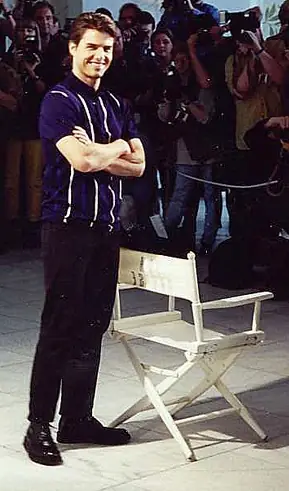
Mission: Impossible (1996): Ethan Hunt, behind the scenesImage: Wikimedia Commons · Hendrike, CC BY-SA 3.0 - #014
It was the first film to open in more than 3,000 theaters in the United States.
- #015
Contains a major spoiler — show
When Sarah dies, Ethan seems more troubled than he does by the killing of the other team members. When Jim receives the mission by video on the plane, each team member's profile reveals that Sarah is the only member of the team Ethan trained.
- #016
Contains a major spoiler — show
During the flashbacks showing how Jim Phelps dismantled his team, Ethan wonders whether there was another accomplice who blew up Hannah's car or whether Phelps triggered the mechanism. This film leaves it ambiguous who actually killed Hannah, unlike the other team members. However, the script had much more dialogue in the final confrontation on the train between Claire, Phelps and Ethan. This plot point was actually resolved by Claire confessing to Ethan that she blew up the car and killed Hannah.
- #017
The plot of this film is based on the potential exposure of the N.O.C. list. Traditionally, when a spy is captured, the spy's own country acknowledges that the person is a spy and gets them back by releasing a captured spy from the country holding them. An N.O.C. agent, or Non-Official Cover agent, is disavowed by their own country if captured, which effectively means they will be executed as an unauthorized spy. So this list falling into the wrong hands would result in the deaths of many spies. The concern over exposing the identity of such an agent is no longer a fantasy invented for a film. Valerie Plame Wilson was an N.O.C. agent, and her public exposure as a spy compromised many of the operations she worked on, as shown in Fair Game (2010).
- #018
According to Brian De Palma, there was initially a complex opening sequence establishing a love triangle between Phelps, his wife and Ethan Hunt, which was removed because it tested as "out of the genre" with test audiences.
- #019
This film entered pre-production without a script the producers wanted to use. Brian De Palma designed the action scenes, but neither David Koepp nor Robert Towne was satisfied with the story that would make those scenes work. Towne helped arrange a beginning, middle and end on which the story details would be hung, while De Palma and Koepp worked on the plot.
- #020
The Apple laptop Ethan uses was a product placement for a product not yet released, and not even functional. The screen shown belonged to an earlier model. In the shot where Ethan begins to fall asleep, a dark part of the screen becomes visible.
- #021
When Ethan decides he needs help and calls the disavowed I.M.F., the first person on the list of agents is Simon Staines, the computer graphics designer on this film.
- #022
Apple Computer had a $15 million promotion tied to this film that included a game, print advertisements and a television commercial featuring scenes from the television series turned into a feature film; retailer and in-cinema promotions; and the placement of Apple personal computers in this film. It was an attempt to improve Apple's image after it reported a $740 million loss in the second quarter of the fiscal year.
- #023
- #024
Contains a major spoiler — show
Wind machines blew winds of up to one hundred and forty miles per hour (two hundred and twenty-five kilometers per hour) into the faces of Tom Cruise and Jon Voight atop the train.
- #025
The disguise Claire wears while in the CIA building (long red dress, large black-framed glasses, hair in a tight bun) is identical to the disguise of Dana Lambert, the character played by Lesley Ann Warren who was frequently used in the original TV series.
- #026
As Jim Phelps carries out his mission on the plane, the team is shown one by one. The files contain aliases. The aliases are as follows: Emilio Estevez's (Jack Harmon) alias is "Tony Baretta," the character from the police show Baretta (1975). Sarah Davies's alias is "Sarah Walker." Hannah Williams's alias is Pauline Brady. And Ethan Hunt's alias is Phillipe Douchette.
- #027
U2 bandmates Larry Mullen Jr. and Adam Clayton were fans of the television series and knew the original theme music well, but they were nervous about redoing Lalo Schifrin's legendary theme song. Clayton put his version together in New York, and Mullen did his own version in Dublin on weekends between U2 recording sessions. The two musicians were influenced by Brian Eno and by the European dance club sound of the recently completed Passengers album. They let Polygram choose its favorite, and it wanted both. Within a month, two versions of the song and five remixes of it by DJs were made. All seven tracks appeared on promotional records and CD releases.
- #028
In the scene where Ethan Hunt studies Senator John Waltzer's television interview in order to later impersonate him, the person on the television screen is (of course) Tom Cruise. So, strictly speaking, Cruise can be said to have two roles in this film: Ethan Hunt and the real Senator.
- #029
It was the third highest-grossing film of 1996.
- #030
Contains a major spoiler — show
The team killed at the beginning of the film was meant to consist of the cast of Mission: Impossible (1966) reprising their roles, which would have meant passing the torch. Every original cast member turned down the offer. Only Greg Morris accepted the invitation to the film's premiere, and he walked out partway through because of the treatment of the character Jim Phelps.
- #031
The Channel Tunnel sequence contains 152 special effects shots for a scene that runs a little over 7 minutes.
- #032
The newspaper William Donloe reads at the CIA cafeteria is the May 24, 1995 issue of the Washington Post. Two partially visible headlines are "Intruder Is Shot At White House" and "Veto Aimed At Foreign Policy Bill".
- #033
The opening title sequence was influenced by the intro sequences of Gerry Anderson's television programs Thunderbirds (1965) and Space Precinct (1994).
- #034
As Donloe, Rolf Saxon speaks only three distinct lines: "Oh my God", "Can I get you anything?" (to his secretary) and his own name, which he says several times.
- #035
Jim Phelps's lighter is a Dunhill Rollagas. This lighter appeared in several James Bond films.
- #036
Contains a major spoiler — show
In the scene where Ethan catches the stabbed Sarah Davis hanging in the doorway, Ethan pulls the knife from Sarah's lifeless body. It is the same knife that Krieger later drops from the ventilation shaft onto the computer desk when entering the CIA vault scene.
- #037
The helicopter in the thrilling action scene is an MD Helicopters 520N NOTAR. NOTAR (an acronym derived from "no tail rotor") generates counter-torque thrust by creating laminar airflow around the tail boom instead of using a conventional tail rotor.
- #038
This is the only film in the Mission: Impossible series in which Tom Cruise's team (initially) includes three women. In all subsequent installments, Hunt's team had at most one woman, and some technically had none.
- #039
The name of computer systems coordinator Andrew Eio appears as an agent on the N.O.C. list.
- #040
Hannah, the first I.M.F. member, has only two lines of dialogue.
- #041
The phone number Max tries to transmit the N.O.C. list to on the train is 004940229713, a German number from the city of Hamburg.
- #042
When William Donloe emerges sick from the vault, the clock reads 9:51. When it reads 10:01, he returns.
- #043
Brian De Palma did not enjoy working with Robert Towne on the screenplay of Mission: Impossible (1996).
- #044
According to the NOC list, Ethan Hunt's code name is "Yankee."
- #045
The six-digit code of the vault containing the N.O.C. list is 789551.
- #046
It is the first and only film in the Mission: Impossible series to be shot and released in the 20th century.
- #047
Both Tom Cruise (Ethan Hunt) and Jon Voight (Jim Phelps) receive the new mission message on a British Airways flight, as can be seen from the flight attendant uniforms.
- #048
Former CIA officer Michele Assad said that Ethan Hunt's anger over the death of his team reflected the genuine feelings of a CIA officer.
Production Story (49)
- #049
Paramount Pictures owned the rights to the television series and spent years trying to make a film version but could not find a workable approach. Tom Cruise had been a fan of the series since his youth and thought it would make a good film. Cruise chose Mission: Impossible (1996) as the first project of his new production company and convinced Paramount Pictures to commit to an 80 million dollar budget.
- #050
Martin Landau, who played Rollin Hand in the original television series, expressed his disgust with this film. In an MTV interview in October 2009, Landau said: "When I was working on an early incarnation of the first one - the script they wound up doing was not it - they wanted the whole team destroyed, eliminated one by one, and I was against that. It was basically an action-adventure film, not Mission. Mission was a mind game. The ideal mission was getting in and out without anyone knowing we were there. So the whole texture changed. Why would we volunteer for our characters to commit suicide? I passed." He added, as a condemnation of the writers, "The script wasn't that good either."
- #051
It is said that while studio executives wanted to keep the budget in the $40-50 million range, Tom Cruise wanted a "big, showy action piece" that pushed the budget into the $80 million range.
- #052
While filming the famous scene in which Tom Cruise drops from the ceiling and hovers inches above the floor, Cruise's head was hitting the ground, until he came up with the idea of putting coins inside his shoes to keep his balance.
- #053
The disappearing/reappearing CD trick Tom Cruise (Ethan Hunt) uses to fool Jean Reno (Franz Krieger) is not a camera trick or any other visual effect, but a genuine sleight-of-hand trick.
- #054
Not only is this the only film in the series in which Ethan Hunt does not fire a gun, it is also the only one in which no armed shootouts take place.
- #055
Reza Badiyi, who was responsible for directing more episodes of the original Mission: Impossible (1966) television series than anyone else, was asked by the president of Paramount Pictures to be on set in an advisory and consulting capacity. Director Brian De Palma approached him and told him how much he had enjoyed the original series. He added that the film was nothing like the television series and that his presence on set would serve no purpose other than to make both of them uncomfortable. Badiyi thanked him for his honesty and left the set, never to return.
- #056
The producers cast Ving Rhames as Luther because they thought he was the exact opposite of what a hacker normally looks like.
- #057
A difficult task such as lighting Prague at night presented a complex logistical sequence for cinematographer Stephen H. Burum and his team. To evoke the old European atmosphere as well as possible, the two-mile stretch of riverbank on either side of Prague's historic Charles Bridge had to be lit largely from behind. Preparations alone took about two weeks before the twelve days of shooting on the banks of the Vltava River began. Eleven generators were used to power hundreds of lights, and the result was so impressive that amateur and professional Czech photographers turned out in groups, eager to capture their city's nightscape as it had never been seen before.
- #058
According to Martin Landau, the original plan at an earlier stage was to bring back the entire original cast of the television series, only to kill them all off in the first act. Each of the actors refused to take part.
- #059
Emilio Estevez was cast as Jack Harmon to create a sense of shock in the audience when he dies early in the film. The producers thought that casting such a well-known actor in the role would heighten the impact of Jack Harmon's death. Coincidence or not, this was Emilio's last appearance in a high-profile film for many years, as his acting career had already been in decline after the highly popular "Young Guns" films.
- #060
The scene in which the water tank bursts and Ethan Hunt escapes from the Aquarium restaurant was shot in two different locations. The tank explosion and Hunt's leap through the restaurant window were shot at Paramount Studios. The part where he runs into the street with water streaming behind him was actually shot in Prague's Old Town Square.
- #061
Alan Silvestri was initially hired to score the film and had written about twenty-three minutes of music before leaving. He recycled the material he had written and used it for the score of Eraser (1996). Bootleg copies of the Mission: Impossible (1996) score are in circulation.
- #062
The trailer shows a shot of Ethan and Claire kissing passionately (and this appears in the short clips from the film at the beginning of the film), but it is not in the film.
- #063
According to Emilio Estevez, the scene in which the IMF team discusses the film's opening mission was added on the suggestion of George Lucas, who said the film needed a "spaghetti scene" in which everyone sits around and discusses what happens next. The actors were brought back to shoot the scene during reshoots.
- #064
Although the TGV is an electric train running on overhead lines, no overhead power lines are visible in the train scene. Instead, for the film's needs, the TGV was pulled by a diesel locomotive, which made it possible to follow on the roof and fly behind the helicopter.
- #065
The only M. I. film in the series to do its trademark mask-removal scenes entirely with practical effects.
- #066
The first film Tom Cruise produced.
- #067
When Sarah dies, Ethan seems more troubled than by the killing of the other team members. When Jim receives the mission by video on the plane, each team member's profile reveals that Sarah was the only member of the team Ethan trained.
- #068
During the flashbacks showing how Jim Phelps took down his team, Ethan wonders whether there was another accomplice who blew up Hannah's car or whether Phelps triggered the mechanism. This film leaves it ambiguous who actually killed Hannah, unlike the other team members. However, the script had much more dialogue in the final confrontation on the train between Claire, Phelps and Ethan. This plot point was actually resolved by Claire confessing to Ethan that she blew up the car and killed Hannah.
- #069
The plot of this film is based on the potential exposure of the N. O. C. list. Traditionally, when a spy is captured, the spy's own country acknowledges that the person is a spy and gets them back by releasing a captured spy from the country holding them. An N. O. C. agent, or Non-Official Cover, is disavowed by their own country if captured, which effectively means they will be executed as an unauthorized spy. Therefore, this list falling into the wrong hands would result in the deaths of many spies. The concern about exposing the identity of such an agent is no longer just a fantasy invented for a film. Valerie Plame Wilson was an N. O. C. agent, and her public exposure as a spy compromised many of the operations she worked on, as shown in Fair Game (2010).
- #070
According to Brian De Palma, there was originally a complex opening sequence establishing a love triangle between Phelps, his wife and Ethan Hunt, and this sequence was removed because it tested "out of the genre" with test audiences.
- #071
One of the code names on the N. O. C. list is "Maverick," a reference to Tom Cruise's role in Top Gun (1986).
- #072
When Ethan decides he needs help and calls the disavowed I.M.F. agents' list, the first person on the list is Simon Staines, the computer graphics designer of this film.
- #073
Apple Computer had a $15 million promotion tied to this film, including a game, print advertisements and a television commercial featuring scenes from the television series turned into a feature film; dealer and in-cinema promotions; and placements of Apple personal computers in this film. This was an attempt to improve Apple's image after it reported a $740 million loss in the second quarter of the fiscal year.
- #074
Martin Landau, who played Rollin Hand in the original television series, expressed his disgust with this film. In an MTV interview in October 2009, Landau said: "When I was working on an early incarnation of the first one - not the script they ultimately did - they wanted the entire team destroyed, killed off one by one, and I objected. It was basically an action-adventure movie, not Mission. Mission was a mind game. The ideal mission was getting in and out without anyone knowing we were there. So the whole texture changed. Why would we volunteer for our characters to commit suicide? I passed." He added, as a condemnation of the writers, "The script wasn't that good either."
- #075
In the scene where Ethan Hunt studies Senator John Waltzer's television interview in order to later impersonate him, the person on the television screen is (of course) Tom Cruise. So, strictly speaking, it can be said that Cruise had two roles in this film: Ethan Hunt and the real Senator.
- #076
The exterior shots of the train scene supposedly set on the train in Kent (southeast England) were mostly filmed in Scotland.
- #077
After the break-in at the CIA, Kittridge orders William Donloe to be sent to a radar station in Alaska by the end of the day. Donloe resurfaces in Mission: Impossible - The Final Reckoning (2025), having spent all his time since at a radar station in Alaska.
- #078
The team killed at the start of the film was meant to consist of the cast of Mission: Impossible (1966) reprising their roles. It was meant to be a passing of the torch. Every original cast member turned down the offer. Only Greg Morris accepted the premiere invitation, and he walked out partway through because of the treatment of the character Jim Phelps.
- #079
Jean Reno, Kristin Scott Thomas and Emmanuelle Béart performed their on-camera roles in English and would later dub themselves for the French release.
- #080
The newspaper William Donloe reads at the CIA. The cafeteria is the May 24, 1995 Washington Post. Two partially visible headlines are "Intruder Is Shot At White House" and "Veto Aimed At Foreign Policy Bill".
- #081
The opening title sequence was influenced by the intro sequences of the Gerry Anderson television programs Thunderbirds (1965) and Space Precinct (1994).
- #082
Rolf Saxon says only three different lines as Donloe: "Oh my God", "Can I get you anything?" (to his secretary) and his own name, which he says several times.
- #083
In the scene where Ethan catches the stabbed Sarah Davis hanging in the doorway, Ethan pulls the knife from Sarah's lifeless body. It is the same knife Krieger later drops from the ventilation shaft onto the computer desk as he enters the CIA vault scene.
- #084
The only film in the M. I. series for Tom Cruise. The series in which Hunt is part of a team (initially) includes three women. In all subsequent installments, Hunt's team had at most one woman, and in some, technically none at all.
- #085
Computer systems coordinator Andrew Eio's name appears as an agent on the N. O. C. list.
- #086
The first I. M. F. member Hannah has only two lines of dialogue.
- #087
The phone number Max tries to pass on the N. O. C. list on the train is 004940229713, a German number from the city of Hamburg.
- #088
A comic book prequel was published by Paramount Comics, a short-lived imprint of Marvel. It was written by Marv Wolfman and drawn by Rob Liefeld. This is the only Mission: Impossible film to have a tie-in comic book.
- #089
The bus stop where Ethan meets Max's men does not exist in real life. However, the red and yellow sign is original and period-appropriate.
- #090
The security code Ethan gives over the phone after his team is killed is Bravo Echo One One, or BE11, a mirror image of 1138.
- #091
The hotel where Jim Phelps stayed during one of his "cushy recruitment assignments" was the Drake Hotel in Chicago. This was the hotel where Tom Cruise's character Joel Goodson in Risky Business goes to confront Lana, who stole his mother's crystal egg.
- #092
Emilio Estevez takes on his uncredited role as Jack Harmon. His real-life father, Martin Sheen, played Lieutenant Albert Brocke in the Live Bait (1969) episode of the original show twenty-seven years earlier.
- #093
When William Donloe comes out of the vault sick, the clock reads 9:51. When it reads 10:01, he returns.
- #094
Brian De Palma did not enjoy working with Robert Towne on the script for Mission: Impossible (1996).
- #095
The six-digit code of the vault containing the N. O. C. list is 789551.
- #096
Both Tom Cruise (Ethan Hunt) and Jon Voight (Jim Phelps) receive the new mission message on a British Airways flight, as can be understood from the flight attendant uniforms.
- #097
Former CIA officer Michele Assad said that yes, the anger Hunt feels over the death of his team is the real emotion of a CIA officer.
Behind the Scenes (7)
- #098
Reza Badiyi, who directed more episodes of the original Mission: Impossible (1966) television series than anyone else, was asked by the president of Paramount Pictures to be on set as an adviser and consultant. Director Brian De Palma approached him and told him how much he had enjoyed the original series. He added that the film was nothing like the television series and that Badiyi's presence on set would only make both of them uncomfortable. Badiyi thanked him for his honesty and left the set, never to return.
- #099
The difficult task of lighting Prague at night presented cinematographer Stephen H. Burum and his crew with a complex logistical challenge. To best evoke the old European atmosphere, the two miles of riverbank on either side of Prague's historic Charles Bridge had to be lit largely from behind. Preparation alone took about two weeks before the twelve days of shooting on the banks of the Vltava River began. Eleven generators were used to power hundreds of lights, and the result was so impressive that amateur and professional Czech photographers turned out in groups, eager to capture their city's nightscape as it had never been seen before.
- #100
Contains a major spoiler — show
The script Tom Cruise approved called for a final confrontation on top of a moving train. Cruise wanted to use the famous high-speed French TGV train, but railway officials did not want any part of the production shot on their trains. By the time that was no longer an issue, the train was not available. Brian De Palma visited railways on two continents to obtain permission. Cruise took the train owners out to dinner and the next day they were allowed to use the train. For the actual sequence, Cruise wanted wind strong enough to blow him off the train. Cruise had trouble finding the right machine to create a wind speed that would look visually accurate until he remembered the simulator he had used while training as a skydiver. The only machine of its kind in Europe was located and purchased. Cruise had it produce winds of up to one hundred and forty miles per hour (two hundred and twenty-five kilometers per hour) to distort his face. The exterior shots of the train were filmed on the Glasgow South Western Line between New Cumnock, Dumfries and Annan. However, most of the sequence was shot on set against a blue screen to be digitized later by Industrial Light & Magic's (ILM) visual effects team.
- #101
According to Emilio Estevez, the scene in which the IMF team discusses the film's opening mission was added on the suggestion of George Lucas, who said the film needed a "spaghetti scene" in which everyone sits around and discusses what will happen next. The actors were brought back during reshoots to film the scene.
- #102
The only film in the M.I. series to perform its trademark mask-removal scenes entirely with practical effects.
- #103
The scene set in a glass-walled restaurant with a large lobster tank in the middle and three large fish tanks above was Tom Cruise's idea. The tanks held sixteen tons in total, and there was concern that a great deal of glass would fly everywhere if they exploded. Brian De Palma tried the scene with a stunt double, but it did not look convincing, and he asked Cruise to do it despite the possibility that Cruise could have drowned.
- #104
The first scenes shot were the blue-screen scenes at the climax in the Channel Tunnel. Everything else was adapted backwards from that.
Characters & Cast (5)
- #105
According to Martin Landau, the original plan at an earlier stage was to bring back the entire original cast of the television series only to kill them all off in the first act. Each of the actors refused to take part.
- #106
Contains a major spoiler — show
Peter Graves, who played Jim Phelps in Mission: Impossible (1966), turned down the opportunity to reprise his role in the film after learning that his character would be killed at the end. He also declined the role because of the character's negative portrayal, which led other cast members of the original series to turn down guest appearances as well. Greg Morris, who played Barney Collier in the original series, walked out halfway through the film, citing his displeasure with the change to Jim Phelps's character and with the production in general.
- #107
John McTiernan was the first choice to direct.
- #108
Emilio Estevez takes on the role of Jack Harmon. His real-life father, Martin Sheen, had played Lieutenant Albert Brocke twenty-seven years earlier in the original show's episode Live Bait (1969).
- #109
The role of Claire was first offered to Juliette Binoche and Geneviève Bujold as well.
Easter Eggs & References (4)
- #110
Emilio Estevez appears in the film for quite a long time before his character is killed off at the beginning. He even has some fairly memorable lines of dialogue. Tom Cruise had previously played a similar role without being credited in Estevez's earlier film Young Guns (1988).
- #111
One of the code names on the N.O.C. list is "Maverick," a reference to Tom Cruise's role in Top Gun (1986).
- #112
The character name Alexander Golitsyn was a nod to the Soviet K.G.B. defector Anatoliy Golitsyn.
- #113
Brian De Palma often uses "borrows" from masters or other films to create important scenes in his movies. Accordingly, the wire-hanging scene was borrowed from Topkapi (1964).
Deeper Meaning (4)
- #114
Although the TGV is an electric train that runs on overhead lines, no overhead power lines are visible in the train scene. Instead, the TGV was pulled by a diesel locomotive to suit the film's needs, which made it possible to follow along the roof and fly behind the helicopter.
- #115
David Koepp was reportedly paid 1 million dollars to rewrite the original screenplay by Willard Huyck and Gloria Katz. According to a project source, there were problems with dialogue and story development. The basic plot, however, remained intact.
- #116
Contains a major spoiler — show
After Ethan's team is killed, the security code he gives over the phone is Bravo Echo One One, or BE11, which is 1138 mirrored.
- #117
One of Jim Phelps's "cushy recruitment assignments" had him staying at the Drake Hotel in Chicago. It was the same hotel where Tom Cruise's character Joel Goodson goes to confront Lana, who stole his mother's crystal egg, in Risky Business.
Career & Awards (1)
- #118
Contains a major spoiler — show
Emilio Estevez was cast as Jack Harmon to create a sense of shock in the audience when he dies early in the film. The producers felt that casting such a well-known actor in the role would heighten the impact of Jack Harmon's death. Coincidence or not, this was Emilio's last appearance in a high-profile film for many years, as his acting career had already been in decline after the highly popular "Young Guns" films.
Related pages
- Charlie's Angels: Full Throttle — Mission: Impossible comes up in the facts on that page
- Captain America: The Winter Soldier — Mission: Impossible comes up in the facts on that page
- Knight and Day — Mission: Impossible comes up in the facts on that page
Sources & editorial notes
Reference databases
- Wikipedia
- IMDb
Information from external sources is independently selected, consolidated and edited by Arka Evren. Sources are listed for verification and further reading. Encyclopedia text is used under its licence (CC BY-SA). How we work