

FILM · 2007 · USA
No Country for Old Men
- Directed by
- Joel Coen, Ethan Coen
- Runtime
- 122 min
- Studio
- Miramax, Paramount Vantage, Scott Rudin Productions
358 archived facts 8 topics 1 source Last reviewed Nov 2026
Llewelyn Moss stumbles upon dead bodies, $2 million and a hoard of heroin in a Texas desert, but methodical killer Anton Chigurh comes looking for it, with local sheriff Ed Tom Bell hot on his trail. The roles of prey and predator blur as the violent pursuit of money and justice collide.
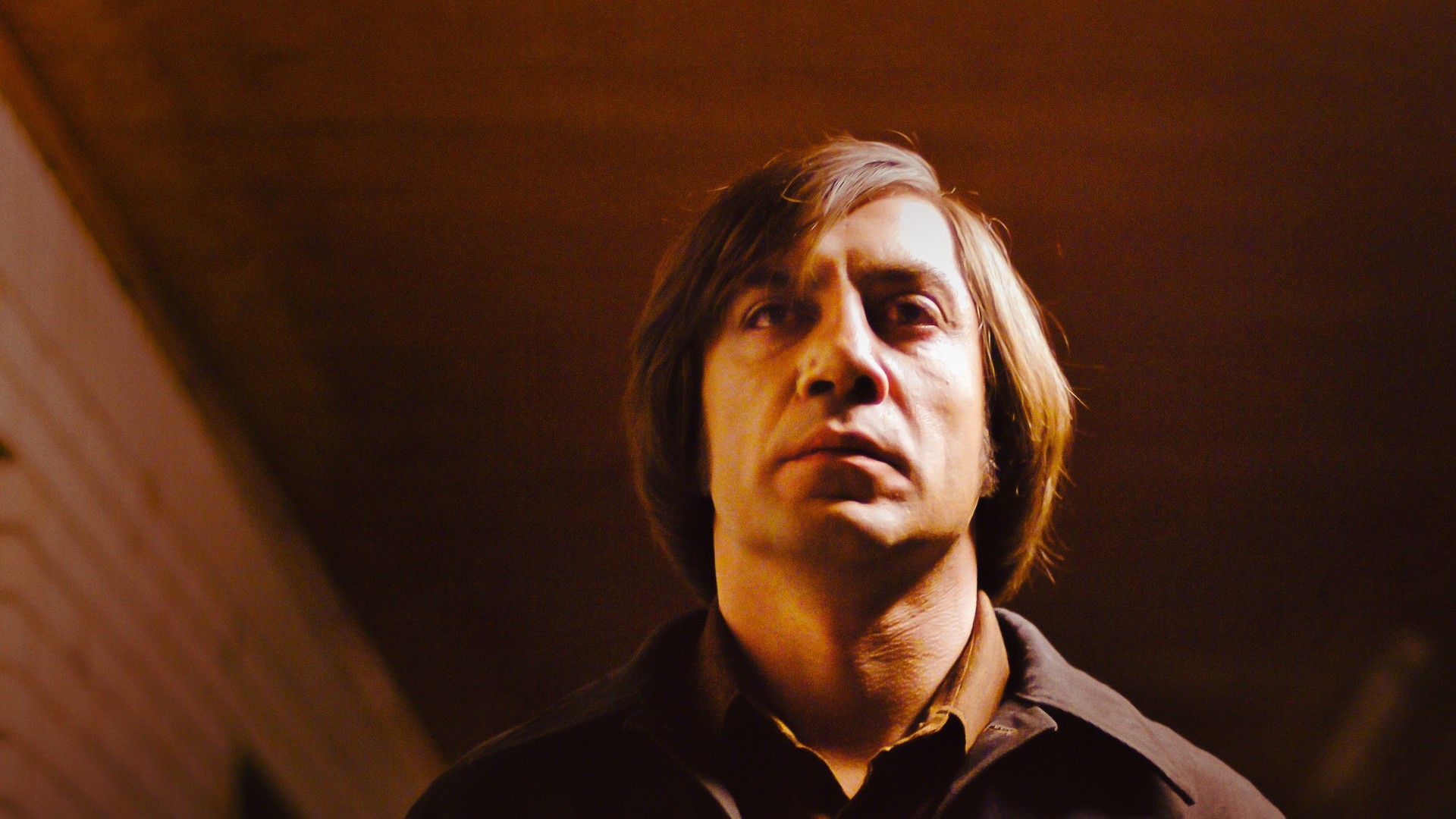
358 Interesting Facts About No Country for Old Men
Interesting Facts (25)
- #001
- #002
When Llewelyn Moss (Josh Brolin) crosses the border into Mexico, he becomes the first character in a Coen Brothers movie to set foot outside of the United States. With exception to their contribution to the anthology film Paris, Je T'aime (2006), no other film written and directed by the Coens takes place in a foreign country.
- #003
Although shotgun suppressors (silencers) that are both effective and practical had been considered impossible for a long time, commercially available models started to become available around the year 2014. With subsonic ammo, they provide a similar low noise level as the model shown in the film (albeit without the hissing sound). Suppressors for both 20 gauge and 12 gauge shotguns are available from major suppressor manufacturers like Banish, JK Armament, SilencerCo, and YHM. Since 2014 suppressor ownership has increased significantly among Americans, with them becoming increasingly popular with hunters, since they reduce both noise and recoil; as of 2025, the ATF reports over 4.5 million suppressors being registered to civilians. The main reason for their increased popularity is mainly due to information on the internet helping dispel the myth that suppressors are illegal for civilians to own or possess, and dispelling the myth that they make a gun totally silent and are only used by assassins and the military, as of 2026 there are only eight states where suppressors are illegal: California, Delaware, Hawaii, Illinois, Massachusetts, New Jersey, New York, and Rhode Island, as well as Washington D.C. In the other 42 states they are legal, although highly regulated by the ATF under the National Firearms Act of 1934 (NFA) and as Title II firearms under the Gun Control Act of 1968 (GCA), which also regulates destructive devices, machine guns, and short barreled rifles & shotguns, requiring prior ATF approval before building or purchasing a Title II firearm, which involves passing an enhanced background check, paying a $200 tax for machine guns and destructive devices, and having the firearm/suppressor registered to the owner. The ATF changing to online processing for applications, significantly decreasing processing time, and companies like Palmetto State Armory, Silencer Central, SilencerCo, and Silencer Shop selling suppressors online and assisting with NFA application filing has also greatly helped increase popularity.
- #004
- #005
- #006
Captive bolt pistols, as shown here, were only used for a very brief time. As knowledge of transmissible prion diseases like Mad Cow became public across Europe and the US, the use of devices which penetrate the skull of a living animal and circulate brain matter through the blood stream were shown to allow the disease spreading prions to contaminate the meat and any further animals used in quick succession.
- #007
In a August 5, 2024 video, former Kentucky State Trooper and firearms expert Scott DeShields Jr., host of the popular YouTube channel Kentucky Ballistics (2015), tested a captive bolt gun to see if it really is as versatile and effective as the movie depicts. Scott discovered that the bolt gun could indeed easily penetrate a person's skull by testing it on a lifelike ballistics dummy, although there was little doubt on this matter. However, a topic of contention has always been whether a captive bolt gun is actually capable of popping off deadbolts and door locks, or if this is just Hollywood fiction. In his testing, Scott discovered that the bolt gun is indeed capable of breaking both deadbolt locks and door knob locks out, in fact it blew the entire deadbolt completely through the door, it was also capable of putting a large hole into a concrete cinder block. It's also worth noting that the captive bolt gun tested in the video was propelled by a rimfire.22 Long Rifle blank cartridge, which is how they normally work, a bolt gun modified to use high pressure air like Anton's would actually be capable of producing even more force than one powered by a rimfire.22 blank.
- #008
- #009
While on-location in Marfa, Texas, the movie There Will Be Blood (2007) was shooting nearby. One day, while filming a wide shot of the landscape, directors Joel Coen and Ethan Coen had to halt shooting for the day when a gigantic cloud of dark smoke floated conspicuously into view. Paul Thomas Anderson was testing the pyrotechnics of an oil derrick set ablaze on the set of his film. The Coens resumed filming the next day, when the smoke finally dissipated. A year and a half later, both films were the leading contenders at the Academy Awards. Both were also bankrolled by the same two companies: Paramount Vantage (now-defunct) and Miramax (now owned by Vantage's parent studio).
- #010
- #011
Contains a major spoiler — show
Anton Chigurh says that the coin he flips in the gas station was dated 1958 and "it's been traveling 22 years to get here". Doing the math makes the movie set in 1980. Carla Jean's mother's headstone reads "1922 - 1980", basically the same math as with the coin, indicating that she was 58 years old.
- #012
- #013
- #014
An unforeseen expense on the film was the makeup department's purchase of fake blood costing more than $800 a gallon. Joel Coen understood why they had spent so much money when it came time to shoot the scene in which Llewelyn (Josh Brolin) comes upon several extras lying dead in the dust after a gunfight. Ordinary fake blood (made from sugar) would have meant the extras were covered in bugs and ants, and bugs are not interested in expensive things.
- #015
In Marfa, Texas, There Will Be Blood (2007) was being shot nearby. One day, while filming a wide shot of the landscape, directors Joel Coen and Ethan Coen had to stop shooting because a huge cloud of dark smoke drifted strikingly into view. Paul Thomas Anderson was testing the pyrotechnics for an oil derrick set on fire in his film. The Coens resumed shooting the next day, when the smoke had finally cleared. A year and a half later, both films were the leading contenders at the Academy Awards. Both were financed by the same two companies: Paramount Vantage (now defunct) and Miramax (now owned by Vantage's parent studio).
- #016
- #017
- #018
There is a strong visual clue that Anton Chigurh killed Carla Jean Moss. Chigurh apparently dislikes getting blood on himself; before shooting a man in the shower he pulls the shower curtain so that blood will not splatter on him, after killing the Mexicans at the motel he removes his socks, which are presumably bloodstained, and after killing Wells he lifts his feet off the floor. As he leaves Carla Jean's mother's house, he stops to check the soles of his boots.
- #019
- #020
- #021
- #022
Unlike most successful films adapted from books, much of the action in the film is taken word for word from Cormac McCarthy's novel and occurs in the same order. For example, Bell's final speech in the film appears on the last page of the book. However, unusually for Joel Coen and Ethan Coen (who are generally known for their extremely talkative characters), they significantly reduced the amount of dialogue found in the book in some scenes.
- #023
When Anton Chigurh takes change out of his pocket at the first hotel, one of the quarters is painted red. This was a common feature in pinball and video arcades in the late 1970s and early 1980s. It allowed arcade operators to identify non-revenue quarters given to customers when a normal quarter was "eaten" by a machine without credit.
- #024
- #025
Production Story (41)
- #026
- #027
Contrary to most successful films made from books, much of the film's action is taken word for word from Cormac McCarthy's novel, and occurs in the same order. For instance, Bell's final speech in the film is on the final page of the book. However, unusually for Joel Coen and Ethan Coen (usually known for their extremely loquacious characters), they decreased the amount of dialogue found in the book, substantially in some scenes.
- #028
- #029
- #030
- #031
Heath Ledger had been in talks to play Llewelyn Moss, but he withdrew to take some time off instead. Ledger would eventually portray a Chigurh-like sociopathic killer role, as The Joker in The Dark Knight (2008). His posthumous Oscar win for that film would succeed Javier Bardem's turn as Anton Chigurh for Best Actor in a Supporting Role.
- #032
- #033
- #034
While the source novel discusses Ellis quite a bit as a familial confidante of Sheriff Bell, there's no mention of his connection to Ellis in the dialogue, other than a few words that seem to allude to them being related. In the source novel, Ellis is Uncle Ellis and Bell makes numerous visits to reflect on the past and Ellis' condition.
- #035
The score music is used quite sparsely throughout the film, blending elusively into the background. Some can be heard during Ed Tom Bell's (Tommy Lee Jones') opening narration, during Anton Chigurh's (Javier Bardem's) quarter speech, when Bell shows up at the aftermath of the motel shoot-out towards the end of the film, and during the closing credits.
- #036
- #037
- #038
The credited editor for this film, Roderick Jaynes, is a pseudonym for Joel Coen and Ethan Coen, who have co-edited, co-directed and co-written all of their movies since Blood Simple (1984). New York Magazine reported that they devised the pseudonym when Guild membership rules would not allow two co-credited editors on the same film. Jaynes was nominated for an Oscar for editing Fargo (1996) and this movie, but he has never won one. Joel Coen told New York Magazine that if Jaynes had won the Oscar, the Academy would have required the award presenter to accept the award on "his" behalf, since they have not allowed proxies or third parties to accept Oscars "ever since Marlon Brando and Sacheen Littlefeather."
- #039
- #040
- #041
While finalizing the film's score, Josh Brolin and the Coen Brothers realized they "can't have any musical instruments." As a result, Burwell's musical score is buried in the final audio mix, and the soundtrack to this film is almost entirely diegetic (the source of every sound is visible or occurs on screen).
- #042
Josh Brolin was working on Grindhouse (2007) when he became drawn to the role of Moss in this film. He asked Grindhouse (2007) director Robert Rodriguez if he could borrow a video camera for his audition tape, and he ended up having his audition elaborately shot with the theatrical camera they were using, directed by Quentin Tarantino, and with Marley Shelton as Carla Jean. When the Coens saw Brolin's tape, their response was that they loved the lighting.
- #043
- #044
- #045
- #046
Tommy Lee Jones, himself a longtime friend of Cormac McCarthy, was previously attached to direct and star in a film adaptation of another McCarthy novel, Blood Meridian, in the late 1990s. However, like many adaptation attempts before and since, it was scrapped due to the story's violent content, and the novel has long been regarded as unfilmable. Jones went on to direct and star in The Sunset Limited (2011), based on McCarthy's play, and adapted for the screen by McCarthy himself.
- #047
Unlike most book adaptations, the film remains largely faithful to Cormac McCarthy's novel and proceeds in the same order. Bell's final speech in the film is taken from the last page of the book. However, although the Coen brothers are generally known for their excessively talkative characters, they significantly reduced the dialogue from the book, especially in certain scenes.
- #048
This film became the second in history for which two directors shared the Best Director Oscar. The first was the award won by Jerome Robbins and Robert Wise for West Side Story (1961). The Academy broke its usual rule of not nominating more than one director for a film by making an exception when they were an established duo. In 2022, Daniel Kwan and Daniel Scheinert became the third directing duo to share this honor, with Everything Everywhere All at Once.
- #049
- #050
- #051
- #052
- #053
- #054
- #055
Anton's body count: 13 or 14 (assuming the accountant died): Sheriff's Deputy (strangulation), driver on the road (captive bolt stunner), two men in suits in the desert (gunshot), three Mexicans at the motel (gunshot), Eagle Pass Hotel receptionist (probably gunshot), Carson Wells (gunshot), the driver Moss stops (gunshot), the man holding Wells (gunshot), the accountant (probably gunshot), the chicken truck driver (probably gunshot), Carla Jean Moss (probably gunshot).
- #056
- #057
- #058
- #059
When Llewelyn Moss (Josh Brolin) crosses the Mexican border, he became the first character to step outside the United States in a Coen Brothers film. Apart from their contribution to the anthology film Paris, Je T'aime (2006), no film written and directed by the Coens takes place in a foreign country.
- #060
- #061
- #062
- #063
- #064
- #065
Tommy Lee Jones was a longtime friend of Cormac McCarthy and had agreed in the late 1990s to direct and star in a film adaptation of another McCarthy novel, 'Blood Meridian.' However, like many previous and subsequent adaptation attempts, the project was shelved due to the story's violent content, and the novel has long been considered 'unfilmable.' Jones later directed and starred in The Sunset Limited (2011), adapted from McCarthy's play and written for the screen by McCarthy.
- #066
Behind the Scenes (38)
- #067
- #068
The same gas station where Javier Bardem's character flips a coin and tells the gas station attendant to call it was also used in the film Red Dawn (1984). In that scene Jennifer Grey's character sabotages Soviet soldiers with a bomb placed in a basket of food taken by the soldiers, in the ensuing chase through the field just south of the gas station Patrick Swayze, Charlie Sheen, and other characters ambush the pursuing Soviet soldiers.
- #069
- #070
- #071
- #072
Directors Joel Coen and Ethan Coen used a photo of a brothel patron taken in 1979 as a model for Anton Chigurh's hair style. When he first saw his new haircut, Javier Bardem said, "Oh no, now I won't get laid for the next two months." The Coens responded by happily high-fiving each other; Bardem's response meant Chigurh would look as creepy as they had hoped.
- #073
- #074
- #075
An unforeseen expense for the film was the make-up department buying expensive fake blood at $800 a gallon. Joel Coen realized why they were spending so much when it came time to film the scene where Llewelyn (Josh Brolin) stumbles across the aftermath of a shoot-out with lots of extras lying around dead in the dust. Ordinary, fake blood (made with sugar) would have meant the extras would have been crawling with bugs and ants, while the insects had no interest in the expensive stuff.
- #076
In an interview, Josh Brolin states he fought the directors for the right to include some dialogue in the scene where he opens the briefcase for the first time to find money. The directors initially had Moss appear silent, close the case, and leave. After being unable to find a suitable exclamation, they finally agreed to have Moss simply say, "huh," which they ended up recording several different ways. Brolin stated that at every screening of the film, you could always tell where the director was, because he would burst out laughing whenever the scene appeared with Moss's "huh."
- #077
- #078
While on location in Marfa, Texas, the movie There Will Be Blood (2007) was shooting nearby. One day, while filming a wide shot of the landscape, directors Joel Coen and Ethan Coen had to halt shooting for the day when a gigantic cloud of dark smoke floated conspicuously into view. Paul Thomas Anderson was testing the pyrotechnics of an oil derrick set ablaze on the set of his film. The Coens resumed filming the next day, when the smoke finally dissipated. A year and a half later, both films were the leading contenders at the Academy Awards. Both were also bankrolled by the same two companies: Paramount Vantage (now-defunct) and Miramax (now owned by Vantage's parent studio).
- #079
Contains a major spoiler — show
The dogs seen in the desert at the beginning of the movie and in the subsequent chase with Llewelyn are Presa Canarios. This breed is similar to the pit bull, except they are much larger, some weighing up to 200 lbs. They have a reputation for being ferocious and highly aggressive. Criminals of all sorts use these dogs for nefarious means, hence their appearances with the Cartel men.
- #080
While working on Grindhouse (2007), Josh Brolin became interested in the role of Moss in this film. He asked Grindhouse (2007) director Robert Rodriguez if he could borrow a video camera for his audition tape, and in the end the audition was carefully shot with the theater camera they were using, under Quentin Tarantino's direction, with Marley Shelton as Carla Jean. When the Coens saw Brolin's tape, their response was that they liked the lighting.
- #081
One of the film's unexpected expenses was the expensive fake blood, which the makeup department bought at $800 a gallon. While shooting the scene where Llewelyn comes upon the aftermath of a shootout filled with dust-covered dead extras, Joel Coen understood the reason for the cost: ordinary fake blood made from sugar attracts bugs, while the expensive kind keeps them away.
- #082
While filming in Marfa, Texas, 'There Will Be Blood' (2007) was being shot in the same area. During a wide landscape shot, the Coen brothers had to stop filming when a giant cloud of black smoke came into view. Paul Thomas Anderson was conducting a pyrotechnic test on his set by setting an oil derrick on fire. When the smoke cleared the next day, they continued shooting. A year and a half later, both films were leading contenders at the Academy Awards; they were also financed by the same two companies: Paramount Vantage (now defunct) and Miramax (now owned by Vantage's parent studio).
- #083
- #084
- #085
- #086
- #087
Roderick Jaynes, credited as the film's editor, is a pseudonym for Joel and Ethan Coen; the pair have edited, directed and written all their films together since 'Blood Simple' (1984). According to New York Magazine, they invented the pseudonym after union rules did not allow two editors to be credited together on the same film. Jaynes was nominated for an Oscar for 'Fargo' (1996) and for this film but never won. Joel Coen said that if Jaynes won the Oscar, the Academy would want the presenter to accept the award on 'his' behalf, because 'since Marlon Brando and Sacheen Littlefeather, proxies or third parties have not been allowed to accept an Oscar.'
- #088
While finishing the film's music, Josh Brolin and the Coen brothers realized they 'couldn't use any musical instruments.' As a result, Burwell's music remained buried in the final sound mix, and the sounds in the film are almost entirely diegetic (every sound's source is visible or occurs on screen).
- #089
- #090
- #091
Although effective and practical shotgun suppressors were long thought to be impossible, commercial models began to appear around 2014. With subsonic ammunition, they provide low noise levels similar to the model in the film (without the hissing sound). Suppressors for 20 gauge and 12 gauge shotguns are available from major manufacturers such as Banish, JK Armament, SilencerCo and YHM. Since 2014, suppressor ownership among Americans has increased significantly; they have become popular among hunters because they reduce both noise and recoil. As of 2025, the ATF reports that more than 4.5 million suppressors are registered to civilians. The main reason for their popularity is that the internet has dispelled the myths that suppressors are illegal for civilians and that they make a gun completely silent. As of 2026, only eight states ban suppressors: California, Delaware, Hawaii, Illinois, Massachusetts, New Jersey, New York and Rhode Island, along with Washington D.C. Although they are legal in the other 42 states, they are strictly regulated by the ATF as Title II weapons under the 1934 National Firearms Act (NFA) and the 1968 Gun Control Act (GCA); these laws also regulate destructive devices, machine guns and short-barreled rifles/shotguns. ATF approval is required before buying or manufacturing a Title II weapon; this includes an enhanced background check, payment of a $200 tax for machine guns and destructive devices, and registration of the weapon/suppressor to its owner. The ATF's processing of applications online has significantly reduced processing times, and companies such as Palmetto State Armory, Silencer Central, SilencerCo and Silencer Shop selling suppressors online and assisting with NFA applications have also increased their popularity.
- #092
The captive bolt guns shown here were used for only a very short time. With the public disclosure of infectious prion diseases such as mad cow disease in Europe and the US, it was shown that devices that pierce the skull of a live animal and introduce brain tissue into the bloodstream allow the disease-causing prions to contaminate the meat and, in turn, other animals used in succession.
- #093
The gas station where Javier Bardem's character flips a coin and tells the attendant to 'call it' was also used in the film 'Red Dawn' (1984). In that scene, Jennifer Grey's character sabotages Soviet soldiers with a bomb placed in a basket of food; during the chase in the field south of the station, Patrick Swayze, Charlie Sheen and other characters ambush the Soviet soldiers.
- #094
- #095
The dogs seen in the desert at the beginning of the film and chasing Llewelyn are Presa Canario. This breed resembles a pitbull but is much larger, with some reaching up to 200 pounds. They are known to be fierce and extremely aggressive; that is why they are seen alongside the cartel men.
- #096
In a video dated August 5, 2024, former Kentucky State Police officer and firearms expert Scott DeShields Jr. tested a captive bolt gun on the popular YouTube channel Kentucky Ballistics to examine whether it is as versatile and effective as the film shows. In his test on a realistic ballistic dummy, Scott discovered that the bolt gun could easily penetrate a human skull. However, whether a captive bolt gun can actually break through sliding bolts and door locks has always been a matter of debate. In his test, Scott discovered that the bolt gun could break both sliding bolts and door handle locks, even driving the sliding bolt completely through the door and making a large hole in a concrete brick. It should also be noted that the captive bolt gun tested in the video operates with a.22 Long Rifle blank cartridge; a bolt gun modified to use high-pressure air, similar to Anton's, could produce more power than one operating with a.22 blank.
- #097
- #098
Ellis (Barry Corbin) tells Sheriff Bell (Tommy Lee Jones) that their uncle Mac was shot on his own porch in 'Hudspeth County' in 1909. Although Hudspeth County was not established until 1917 (split off from El Paso County), this is not an error; Ellis may simply be referring to the current location of the crime scene.
- #099
- #100
- #101
- #102
- #103
Right after shooting the bird while crossing the bridge at night, the viewer sees a Dodge Ram hood ornament on the pickup truck Chigurh is driving. Because the story is set in 1980 and Dodge did not release vehicles with the distinctive ram hood ornaments until the 1981 model year, this is considered an error by some viewers. However, since 1981 model year vehicles were released in the fall of 1980, the Dodge Chigurh stole is not an anachronism.
- #104
When Anton Chigurh shoots the lock of the door leading to the hidden floor in the crime organization's building, the door handle is an ADA-compliant type: it can be used with one hand without grasping or squeezing. Such door handles were offered for commercial sale in the US after the passage of the Americans with Disabilities Act in 1990; that is ten years after 1980, when the film is set.
Characters & Cast (190)
- #105
- #106
- #107
- #108
- #109
- #110
The character Anton Chigurh was voted the most realistic psychopath in cinema history by a team of forensic psychiatrists, led by Dr. Samuel Leistedt. The team spent years watching over 400 films to diagnose the top psychopath. According to Leistedt, "Chigurh is a merciless killer who feels absolutely no remorse for blowing his victims apart with a shotgun. He's very determined, has no empathy for his victims, and is incapable of emotions like love or shame."
- #111
- #112
Despite Anton Chigurh being described in the novel by the central character Carson Wells (and other characters) as both a "peculiar man" and a "psychopathic killer", in his 30s, with "exotic-looking" features such as a dark-tanned complexion, with eyes as "blue as lapis. At once glistening and totally opaque. Like wet stones". Javier Bardem's portrayal is still a peculiar and psychopathic Spanish-American male in his 30s, but has been uniquely redepicted into having a 1960s-style dark-brown bowl-cut, a light-tanned complexion, and dark-brown eyes that shows both lack of sleep and barely any emotions.
- #113
- #114
Contains a major spoiler — show
Anton Chigurh kills or tries to kill almost every person to whom he speaks during the film. The only people he spares are the gas station proprietor, the woman who works in the trailer park office, the woman at the motel front desk and the two children at the end. It is unclear if he kills the man who is in the office when he executes the Businessman. He is unable to kill Llewelyn Moss, who instead is killed by the Mexicans. It is implied that he kills Carla Jean Moss when he checks the soles of his boots, presumably for blood, after he exits her house.
- #115
- #116
- #117
Contains a major spoiler — show
Anton's body count: 13 or 14 (depending on whether or not the accountant is presumed dead): * Sheriff's Deputy: strangulation. * Motorist on road: cattle bolt to the head. * Two men in suits in desert: gunshots. * Three Mexicans in motel: gunshots. * Eagle Pass Hotel clerk: presumed gunshot. * Carson Wells: gunshot. * Driver who Moss flagged down: gunshots. * Man who hires Wells: gunshot. * Accountant (may or may not have been killed): presumed gunshot. * Chicken truck driver: presumed gunshot. * Carla Jean Moss: presumed gunshot.
- #118
- #119
- #120
Josh Brolin broke his shoulder in a motorcycle accident two days after landing his role in this film. As he told NOW Magazine, while he was flying over the car that hit him, he thought, "Damn, I really wanted to work with the Coens." Fortunately, his character is also shot in the shoulder early in the film.
- #121
For Anton Chigurh's hairstyle, the Coens used a 1979 photograph of a brothel customer as a reference. When Javier Bardem first saw his new cut, he said, "Oh no, I won't be able to sleep with anyone for the next two months." The Coens happily high-fived each other; Bardem's reaction meant Chigurh would be as terrifying as they wanted.
- #122
When Josh Brolin became interested in the role of Moss on the set of Grindhouse (2007), he borrowed a camera from director Robert Rodriguez for his audition tape. He shot his audition under the direction of Quentin Tarantino and alongside Marley Shelton, using a theater camera. When the Coens watched the tape, they said they liked the lighting.
- #123
- #124
- #125
- #126
- #127
Anton Chigurh kills or tries to kill almost everyone he speaks to over the course of the film. He spares only the gas station owner, the trailer park employee, the woman at the motel front desk and two children. It is unclear what happens to the man in the office while he kills the businessman. He cannot kill Llewelyn Moss; the Mexicans kill him instead. As for Carla Jean Moss, it is implied that he killed her after leaving her house by checking the soles of his boots (presumably for blood).
- #128
A team of forensic psychiatrists led by Dr. Samuel Leistedt watched more than 400 films and chose Anton Chigurh as the most realistic psychopath in cinema history. According to Leistedt, "Chigurh is a determined, empathy-deficient killer who feels no remorse as he blows his victims apart with a shotgun, and who is devoid of emotions such as love or shame."
- #129
- #130
Josh Brolin fought the directors to add dialogue to the scene where he opens the case containing the money. The Coens initially wanted Moss to silently close the case and leave. Unable to find a suitable exclamation, they decided Moss would simply say "huh," and they recorded it in several different ways. Brolin said he suppresses the director's laughter every time this scene comes up in a screening.
- #131
- #132
- #133
- #134
- #135
- #136
- #137
- #138
In the novel, Anton Chigurh is described as "a strange man" and "a psychopathic killer," an exotic-looking man in his 30s with dark bronzed skin and eyes "blue as lapis lazuli, at once glinting and completely opaque." Javier Bardem's interpretation reshapes that description with a 1960s-style bowl cut, light bronzed skin and emotionless dark brown eyes.
- #139
- #140
- #141
- #142
- #143
- #144
- #145
- #146
- #147
- #148
- #149
Tommy Lee Jones (Sheriff Bell) and Barry Corbin (Retired Deputy Sheriff Ellis) had previously played lawmen together in the 1989 miniseries Lonesome Dove. Jones played Texas Ranger Captain Woodrow F. Call, and Corbin played Deputy Roscoe Brown. Like this film, Lonesome Dove was an adaptation of a novel, and Jones's character was once again pursuing a psychopathic serial killer.
- #150
- #151
Tommy Lee Jones had played psychopathic mass murderers in Eyes of Laura Mars (1978) and Batman Forever (1995). This time he is in the role of the hero, but we are expected to see him as the other side of Anton Chigurh, a man wounded by life and capable of easily turning to evil. Jones's calm demeanor and his history of villainous roles create a yin-yang situation; the coin-toss scene also emphasizes this duality.
- #152
- #153
- #154
- #155
- #156
Tommy Lee Jones, Barry Corbin and Diane Lane (who was then married to Josh Brolin) had appeared alongside Robert Duvall in the 1989 series Lonesome Dove. Tess Harper, who plays Jones's wife in the film, had previously played Duvall's wife in Tender Mercies (1983). Duvall also appeared in another Cormac McCarthy adaptation, The Road (2009).
- #157
Llewelyn tells the stern Immigration Officer he encounters at the border (Brandon Smith) that he served two tours in Vietnam, from August 7, 1966 to July 2, 1968. Tours in the Marine Corps lasted thirteen months; twelve months was sufficient for other branches, a matter of unit morale. Llewelyn's second tour must have been cut short because he was wounded in the field, which the officer notices and softens his manner accordingly. Had he not been wounded, he would have returned to the US on October 7, 1968.
- #158
In the novel, Sheriff Bell recounts that drug traffickers in San Antonio shot and killed a federal judge. This parallels a real-life event on May 29, 1979, when John Howland Wood, a United States District Judge for the Western District of Texas, was assassinated. Wood was the first federal judge killed in the 20th century; the killer was contract hitman Charles Harrelson, the father of Woody Harrelson. Harrelson had been hired by drug trafficker Jamiel Chagra, who feared the judge nicknamed "Maximum John." Harrelson had previously been charged with contract murder twice, was acquitted in 1970, convicted in 1973 and sentenced to 15 years, but was paroled five years later. In 1982 he was convicted of Wood's murder and received two consecutive life sentences, and he died at ADX Florence in 2007. His wife Jo Ann received 25 years for aiding him; Chagra was acquitted of the contract murder conspiracy but was sentenced to 30 years on drug charges and was paroled in 2003 after serving 24 years.
- #159
- #160
There is a strong visual clue that Anton Chigurh killed Carla Jean Moss. Chigurh dislikes blood splatter; he pulls the shower curtain before shooting a man in the shower, takes off his bloody socks after killing the Mexicans at the motel, and lifts his feet off the floor after killing Wells. As he leaves Carla Jean's mother's house, he pauses to check the soles of his boots.
- #161
- #162
When Anton Chigurh takes change from his pocket at the first hotel, one of the quarters is painted red. This was a common practice in pinball and video game arcades in the late 1970s and early 1980s: operators used this to identify non-revenue coins given to customers in exchange for a normal quarter that the machine had swallowed without giving credit.
- #163
The film's title is taken from the first line of William Butler Yeats's poem "Sailing to Byzantium": "That is no country for old men." The poem concerns an old man contemplating the afterlife as he approaches death. This theme is explored through the weary Sheriff Bell as he considers what his life will be like after leaving his life as a lawman.
- #164
- #165
Anton Chigurh's weapon is a pistol used to stun animals; it is generally used to stun cattle before slaughter and carries no risk of bullet splash. Chigurh has both practical and symbolic reasons for choosing this weapon. Using a tool designed for animal slaughter symbolizes that he sees his victims as animals rather than humans, while emphasizing the impersonal and cold nature of his killings; this is not revenge but a mechanical and inevitable act. Practically, it is extremely quiet and effective for opening locks, but it is more cumbersome to carry than a handgun and has a much shorter range.
- #166
Some viewers and critics have suggested that Sheriff Ed Tom Bell's closing monologue is a vision of his own death. The Coen Brothers rejected these theories. They said it shows the retired Sheriff recognizing his resemblance to his late father and to Ellis, both of whom retired from law enforcement under more troubled circumstances.
- #167
Carson Wells mentions to the man who hired him that a floor appears to be missing from a building. This may refer to the absence of the thirteenth floor, considered ominous in most buildings. The novel implies that the floor in question (the seventeenth floor) is not listed in the building directory for security reasons and is therefore "missing"; they may be using it to process their drugs.
- #168
- #169
- #170
- #171
- #172
- #173
- #174
- #175
In the final scene, Bell recounts two dreams he had about his late father. In the first dream, his father gives him money and he loses it; this symbolizes the guilt of failing to save Moss and the sense of inadequacy in the face of modern violence. In the second dream, Bell and his father are on horseback in a cold, dark mountain pass; his father rides ahead to make a fire. This expresses a longing for a simpler and more moral time and an acceptance that the "fire" (goodness/morality) is carried by the older generation. The film's last line is "and then I woke up"; this symbolizes his realization that the warmth and safety he seeks exist only in memories and that the world is no longer a place for the "old ways."
- #176
Another clue about Carla Jean Moss's fate at the end of the film is the clatter of the bicycles of two boys riding in the foreground as Anton Chigurh leaves the house; this is the same kind of clatter made by the mechanism lowering Carla Jean's mother's coffin into the grave in the previous scene.
- #177
While Sheriff Bell is reading the newspaper, he mentions that a couple was arrested in California for torturing and killing elderly boarding-house residents and then cashing their Social Security checks. This is based on the serial killer Dorothea Puente, who killed nine elderly residents in Sacramento between 1982 and 1988. Puente poisoned her victims and buried them around the house, cashing their checks. In 1993 she was convicted of three murders and sentenced to three consecutive life terms without parole, and she died in prison in 2011.
- #178
Anton Chigurh says the coin he tosses in the gas station is dated 1958 and that it took 22 years to get there. This clue indicates that the film is set in 1980. The inscription "1922 - 1980" on Carla Jean's mother's gravestone confirms the same calculation and reveals that the woman died at the age of 58.
- #179
- #180
- #181
It has been suggested that Carla Jean's ambiguous fate is revealed when Chigurh checks his boots for blood as he leaves the house. But this is questionable: while standing on the porch he has no visible weapon, and if he had strangled her, there would be no pooled blood for him to step in.
- #182
- #183
- #184
When Llewelyn first discovers the scene of the drug deal gone wrong, through his binoculars he sees a wounded black dog limping away through the tall grass in the distance. The dog pauses for a moment and, almost sensing Llewelyn, looks back at him over its shoulder, then limps away again. There is a symbolism between the dog and Chigurh; Chigurh is shown limping away from the car crash near the end.
- #185
At the end of the film, Anton Chigurh is seriously injured in a car crash and limps away with an open fracture in his arm and visible head trauma. Unlike his earlier localized shotgun wound (an injury that a highly disciplined person could stabilize with improvised field care), these injuries are far more dangerous. An open fracture carries a high risk of blood loss, shock and infection and usually requires surgical intervention. The film does not state whether he receives medical help afterward, and his survival is left uncertain. Despite the severity of his condition, Chigurh manages to get away before those around him can intervene. His ability to escape even while badly wounded reinforces the film's portrayal of him as a ruthless, almost mythical figure; rather than a conventional villain, he is a force of fate that continues beyond the limits of ordinary people. The uncertainty of his fate contributes to the film's bleak tone and its refusal to offer a conventional sense of closure or justice.
- #186
While examining the contents of the case, Moss finds that the bundle consists mostly of 1-dollar bills. However, he does not check whether the other bills in the case are also mostly 1-dollar bills. Why he does not do so is not explained. The bills in the briefcase Moss found were clearly 100-dollar bills, standard bank-issued bundles of 10,000 dollars. A viewer born in the late 1990s or later may be confused, because the design of the 1980 100-dollar bill was not as distinctive as modern redesigns. Between 1929 and 1996, the front of the 100-dollar bill was, in terms of letter/numeral size and typeface, the size and placement of the Franklin portrait and the border design, much more similar to the 1-dollar bill than modern banknotes are. In 1996, the 100-dollar bill underwent its first major design change in nearly 70 years; the font of the "100" was changed and the size of the numerals enlarged, the "100" in the lower right corner was printed in green textured ink, Franklin's portrait was enlarged and shifted slightly off center, and a watermark of his portrait was added. Then in 2013 the 100-dollar bill was redesigned into its quite different present form, with multicolored ink, a bell that disappears when the note is tilted, Franklin's quill pen as he signs the Declaration of Independence and phrases from the document added to the background, a 3D security strip and a large textured "100" printed vertically on the right side of the back.
- #187
- #188
In the novel, Sheriff Bell mentions that drug traffickers killed a federal judge in San Antonio. This is a reference to Judge John Howland Wood, who was assassinated on May 29, 1979. Wood was the first federal judge killed in the 20th century. The killer was Charles Harrelson, the father of actor Woody Harrelson. Harrelson had been hired by drug trafficker Jamiel Chagra. Previously charged twice with contract murder, Harrelson was acquitted in 1970, convicted in 1973 and served 15 years in prison, and was paroled five years later. In 1982 he was convicted of Wood's murder and received two consecutive life sentences. He died at ADX Florence in 2007. His wife Jo Ann received a 25-year prison sentence for aiding and abetting and perjury. Chagra was acquitted of conspiracy to commit murder for hire, but was sentenced to 30 years in prison on drug charges and was paroled in 2003 after serving 24 years.
- #189
- #190
An unexpected expense for the film was the makeup department's purchase of fake blood costing $800 a gallon. While shooting the scene where Llewelyn encounters the dead extras, Joel Coen understood why they had spent so much: if ordinary (sugary) fake blood had been used, the extras would have been swarming with bugs and ants, whereas the insects showed no interest in the expensive kind.
- #191
Two days after Josh Brolin got the role in this film, he broke his shoulder in a motorcycle accident. In an interview with NOW Magazine, he recalled thinking as he flew over the car that hit him, 'Damn. I really wanted to work with the Coens.' But his injury was not a problem, because his character is shot in the shoulder early in the film.
- #192
While filming in Marfa, Texas, There Will Be Blood (2007) was being shot nearby. One day, during a wide landscape shot, Joel and Ethan Coen had to stop filming when a giant cloud of black smoke came into view. Paul Thomas Anderson was conducting a pyrotechnics test on his set by setting an oil derrick on fire. The Coens resumed filming the next day, once the smoke had cleared. A year and a half later, both films were among the leading contenders at the Academy Awards. Both were financed by the same two companies: Paramount Vantage and Miramax.
- #193
For Anton Chigurh's hairstyle, Joel and Ethan Coen used a 1979 photograph of a brothel customer as a model. When Javier Bardem first saw his new haircut, he said, 'Oh no, now I won't be able to make love for two months.' The Coens happily high-fived each other; Bardem's reaction meant Chigurh would look as terrifying as they wanted.
- #194
Josh Brolin became interested in the role of Moss in this film while working on Grindhouse (2007). He borrowed a video camera from Grindhouse director Robert Rodriguez for his audition tape and eventually made a detailed audition with the theater camera they used, under the direction of Quentin Tarantino and with Marley Shelton in the role of Carla Jean. When the Coens saw Brolin's tape, they said they liked the lighting.
- #195
- #196
- #197
There is a strong visual clue that Anton Chigurh killed Carla Jean Moss. Chigurh dislikes getting blood on himself; before shooting a man in the shower, he pulls a shower curtain to prevent blood spatter, after killing the Mexicans in the motel he takes off his socks, which are presumed to have blood on them, and after killing Wells he lifts his feet off the floor. As he leaves Carla Jean's mother's house, he pauses to check the soles of his boots.
- #198
- #199
- #200
- #201
Unlike most successful films adapted from books, much of the film's action is taken word for word from Cormac McCarthy's novel and occurs in the same order. For example, Bell's final speech in the film appears on the last page of the book. However, unusually for the Coen Brothers, who are generally known for their excessively talkative characters, they significantly reduced the amount of dialogue from the book in some scenes.
- #202
When Anton Chigurh first pulls a coin from his pocket in the hotel, one of the quarters is painted red. This was a common feature of pinball and video game arcades in the late 1970s and early 1980s. It allowed arcade operators to identify non-revenue quarters given to customers when a normal quarter was 'swallowed' by the machine and no credit was given.
- #203
- #204
This film became the second production for which the Best Director Oscar was shared by two people; the first was Jerome Robbins and Robert Wise for West Side Story in 1961. The Academy is generally not very receptive to nominating more than one director, but it makes an exception for established duos. In 2022, Daniel Kwan and Daniel Scheinert added a third entry to that list with Everything Everywhere All at Once.
- #205
- #206
- #207
- #208
- #209
- #210
- #211
Anton Chigurh kills or tries to kill almost everyone he speaks to over the course of the film. The only people he spares are the gas station owner, the trailer park employee, the motel receptionists and the two children at the end. It is unclear whether he kills the man in the office while executing the businessman. Llewelyn Moss is killed by the Mexicans; Carla Jean Moss is implied to have been killed after he leaves her house, when he checks the soles of his boots.
- #212
- #213
The film's editor, Roderick Jaynes, is a pseudonym for Joel and Ethan Coen. The pair have edited all their films together since Blood Simple, but they invented the name because Guild rules do not allow two editors on the same film. Jaynes was nominated for an Oscar for Fargo and for this film but did not win. Joel Coen said that if Jaynes had won, the Academy would not accept a proxy.
- #214
- #215
- #216
- #217
- #218
- #219
- #220
- #221
- #222
- #223
- #224
Josh Brolin fought with the directors to add dialogue to the scene where Moss opens the case and finds the money. The directors wanted him to close the case silently and leave; unable to find a suitable exclamation, they decided Moss would simply say 'huh,' and they recorded it in several different ways. Brolin stated that at every screening of the film, the director bursts into laughter when this scene comes up.
- #225
- #226
- #227
- #228
- #229
Heath Ledger met for the role of Llewelyn Moss but was passed over because he had decided to "take a bit of a break." Ledger went on to play the Joker, a Chigurh-like sociopathic killer, in The Dark Knight (2008). His posthumous Oscar came after Javier Bardem had already won Best Supporting Actor.
- #230
- #231
- #232
- #233
- #234
- #235
Although effective and practical shotgun suppressors long seemed impossible, commercial models began appearing on the market around 2014. With subsonic ammunition, they provide a low sound level similar to the model in the film (without the hissing sound). Since 2014, suppressor ownership among Americans has risen significantly; they have become popular among hunters because they reduce both noise and recoil. As of 2025, the ATF reports that more than 4.5 million suppressors are registered to civilians. The main reason for their popularity is that the internet has dispelled the myths that suppressors are illegal for civilians and that they make guns completely silent. As of 2026, only eight states outlaw suppressors: California, Delaware, Hawaii, Illinois, Massachusetts, New Jersey, New York and Rhode Island, along with Washington, D.C. In the other 42 states they are legal but subject to strict regulation by the ATF under the National Firearms Act (NFA) of 1934 and the Gun Control Act (GCA) of 1968. These laws also regulate destructive devices, machine guns and short-barreled rifles; before buying a Title II firearm, ATF approval, an enhanced background check, payment of a $200 tax for machine guns and destructive devices, and registration of the weapon/suppressor to its owner are required. The ATF's move to online processing for applications has significantly reduced processing times, and companies such as Palmetto State Armory, Silencer Central, SilencerCo and Silencer Shop selling suppressors online and assisting with NFA applications have also increased their popularity.
- #236
- #237
- #238
Anton's body count: 13 or 14 (depending on whether the accountant dies): the deputy sheriff (strangulation), the driver on the road (shot in the head with the captive bolt pistol), the two men in suits in the desert (shot), the three Mexicans at the motel (shot), the Eagle Pass hotel receptionist (possibly shot), Carson Wells (shot), the driver Moss stops (shot), the man who hired Wells (shot), the accountant (may or may not have been killed, possibly shot), the chicken truck driver (possibly shot), Carla Jean Moss (possibly shot).
- #239
- #240
- #241
- #242
- #243
The station where Javier Bardem's character tosses a coin and tells the gas station attendant to call it was also used in Red Dawn (1984). In that scene, Jennifer Grey's character plants a bomb in the basket taken by Soviet soldiers; Patrick Swayze, Charlie Sheen and the others then set an ambush in the field to the south.
- #244
- #245
In the novel, Anton Chigurh is described as "a strange man" and a "psychopathic killer"; he is in his 30s, exotic-looking, with dark bronze skin and bright, opaque, lapis lazuli-blue eyes. Javier Bardem's portrayal, also in his 30s, was redesigned with a 1960s-style dark brown bowl cut, light bronze skin and sleepless, almost emotionless dark brown eyes.
- #246
- #247
- #248
- #249
- #250
- #251
The dogs chasing Llewelyn in the desert at the start of the film are Presa Canario. They resemble a Pitbull but are much larger, with some reaching up to 90 kilos. They are known for being fierce and aggressive; they are frequently used by criminals, which is why they are seen with cartel men.
- #252
On August 5, 2024, former Kentucky police officer and firearms expert Scott DeShields Jr. tested a stun gun on the Kentucky Ballistics channel. In his test on a realistic mannequin, he confirmed that the gun could easily pierce a human skull. He also showed that it could break deadbolt locks and door handle locks, and even that it could pass a deadbolt through a door and punch a hole in a concrete block. The gun tested runs on.22 Long Rifle blank cartridges, while it was noted that a modified version using high-pressure air similar to Anton's could be more powerful.
- #253
- #254
- #255
- #256
- #257
- #258
In the final scene, Bell recounts two dreams about his late father. In the first dream his father gives him money and he loses it; this symbolizes the guilt of failing to save Moss and the feeling of inadequacy in the face of modern violence. In the second dream, Bell and his father are on horseback in a cold, dark mountain pass; his father rides ahead to make a fire. This expresses a longing for a simpler, more moral time and the idea that the 'fire' (goodness) is carried by the older generation. The film's last line is 'and then I woke up'; this symbolizes his acceptance that the warmth he seeks exists only in memories and that even armed lawmen are powerless against a changing evil.
- #259
- #260
- #261
- #262
- #263
The news story Sheriff Bell reads in the newspaper is based on a real serial killer, Dorothea Puente. Between 1982 and 1988, Puente killed nine elderly residents at her boarding house in Sacramento, buried their bodies in the yard and cashed their Social Security checks. In 1993 she was convicted of three murders and sentenced to three consecutive terms of life imprisonment without parole, and she died in prison in 2011.
- #264
- #265
- #266
- #267
- #268
- #269
- #270
- #271
- #272
- #273
- #274
- #275
- #276
- #277
- #278
- #279
- #280
When Llewelyn first discovers the scene of the drug deal gone wrong, he sees through his binoculars a wounded black dog limping away through the tall grass in the distance. The dog pauses for a moment, almost sensing Llewelyn, looks back over its shoulder at him, and limps away again. There is a symbolism between the dog and Chigurh; Chigurh is also seen limping away from a car crash near the end.
- #281
- #282
Tommy Lee Jones is a longtime friend of Cormac McCarthy and in the late 1990s had agreed to direct and star in a film adaptation of another McCarthy novel, "Blood Meridian." However, like many adaptation attempts before and after it, it was shelved because of the story's violent content, and the novel has long been considered "unfilmable." Jones later directed and starred in The Sunset Limited (2011), adapted from McCarthy's play and written for the screen by McCarthy himself.
- #283
The film ends with Anton Chigurh limping away after being seriously injured in a car crash, with an open fracture in his arm and visible head trauma. Unlike his earlier localized shotgun wound — something a highly disciplined person could stabilize with improvised field care — these injuries represent a far more dangerous category. An open fracture carries a risk of heavy blood loss, shock and infection, and usually requires surgical intervention. The film does not state whether he receives medical help afterward, and his survival is uncertain. Despite the severity of his condition, Chigurh manages to get away before anyone around him can intervene. His ability to escape even while badly wounded reinforces the film's portrayal of him as a relentless, almost mythical figure; rather than a conventional villain, he is a force of fate that continues beyond the limits of ordinary people. The uncertainty of his fate contributes to the film's bleak tone and its refusal to offer a conventional sense of closure or justice.
- #284
Tommy Lee Jones also played a similarly psychopathic serial killer in Eyes of Laura Mars (1978) and Batman Forever (1995). This time he is in the role of the hero. Yet we are expected to see him as the other face of Anton Chigurh; another veteran wounded by life who has gone down a bad path, as Jones himself could easily have done. Jones's cold demeanor and his history of playing these villains suggest that this is a yin-yang situation. The coin flip also plays on the duality of these characters.
- #285
- #286
Tommy Lee Jones, Josh Brolin and Woody Harrelson have all played live-action villains in superhero films. Jones played Two-Face in the DC Comics film Batman Forever (1995). Brolin played Thanos in Disney's Marvel Avengers films, and Harrelson played Cletus Kasady/Carnage in Sony's Marvel Venom films.
- #287
- #288
- #289
- #290
Tommy Lee Jones, Barry Corbin and Diane Lane (then married to Josh Brolin) appeared alongside Robert Duvall in Lonesome Dove (1989). In this film, Tess Harper, who plays Jones's wife, played Duvall's wife in Tender Mercies (1983). Duvall appeared in The Road (2009), another Cormac McCarthy adaptation.
- #291
When Moss examines the contents of the bag, he finds that the bundle he looks at contains mostly $1 bills. However, he does not check whether the other bundles in the bag are also mostly $1 bills. The reason for this is not explained. The bills in the briefcase Moss found were clearly $100 bills, not $1 bills; they were in standard bank bundles of $10,000 stacks. A viewer born in the late 1990s or later might be confused, because the design of the $100 bill in 1980 was not as distinctive as modern redesigns. Between 1929 and 1996, the front of the $100 bill resembled the $1 bill far more than modern bills do in terms of letter/numeral size and typeface, the size and placement of Franklin's portrait, and the border design. In 1996, the $100 bill underwent its first major design change in about 70 years; the "100" typeface was changed and the numerals were enlarged, the "100" in the lower right corner was printed in green textured ink, Franklin's portrait was enlarged and shifted slightly off center, and a watermark of his portrait was added. Then in 2013, the $100 was redesigned into its highly distinctive present form, with multicolored ink, a bell that disappears when the bill is held at an angle, the quill pen Franklin used to sign the Declaration of Independence and phrases from the document added to the background, a 3D security ribbon, and a large textured "100" printed vertically on the right side of the back.
- #292
Right after he shoots the bird while crossing the bridge at night, the viewer sees a Dodge Ram hood ornament on the pickup truck Anton Chigurh (Javier Bardem) is driving. Because the story is set in 1980 and Dodge did not release vehicles with the distinctive ram hood ornaments until the 1981 model year, this is regarded by some viewers as a mistake, but since 1981 model year vehicles were released in the fall of 1980, it is not an anachronism, even though the Dodge Chigurh stole would have to be nearly brand new.
- #293
At the border, Llewelyn tells the stern INS Officer (Brandon Smith) that he served two tours in Vietnam, from August 7, 1966 to July 2, 1968. (Marine Corps tours in the Vietnam War lasted thirteen months; this was a morale matter, as the other service branches required only twelve months.) Llewelyn's second tour must have been cut short because he was wounded in the field; the INS Officer must have noticed this, which softened his attitude toward him. Had he not been wounded, Llewelyn would have returned to the US on October 7, 1968.
- #294
When Anton Chigurh (Javier Bardem) shoots out the lock on the door leading to the hidden floor in the crime organization's building, the door handle he shoots is a type of door handle that is ADA-compliant and can be operated without grasping or pinching with one hand. This type of door handle went on commercial sale in the US a decade after the Americans with Disabilities Act was passed in 1990, after the period in which this film is set.
Easter Eggs & References (32)
- #295
- #296
- #297
- #298
- #299
- #300
Tommy Lee Jones, Barry Corbin, and Diane Lane (then married to Josh Brolin) appeared together in Lonesome Dove (1989) with Robert Duvall. Tess Harper, who plays Jones's wife in this film, played Duvall's wife in Tender Mercies (1983). Duvall appeared in another Cormac McCarthy adaptation, The Road (2009).
- #301
- #302
- #303
In Fargo (1996), another film directed by Joel Coen and Ethan Coen, about one million dollars in a leather case gets buried in a snowbank, apparently never to be found. In No Country for Old Men (2007), about two million dollars in a leather case is sought. In both movies, the leather case used is the type usually used by airplane pilots to carry their charts and maps.
- #304
Tommy Lee Jones (Sheriff Bell) and Barry Corbin (retired Deputy Ellis) both appeared in the mini-series Lonesome Dove (1989), with both of their characters also being lawmen; Jones played Texas Ranger Captain Woodrow F. Call and Corbin played Deputy Roscoe Brown from the Ft. Smith, Arkansas Sheriff's Office. Like this film, Lonesome Dove was also an adaptation of a novel, being based on the Larry McMurtry novel of the same name. As in this film, Jones's character in Lonesome Dove also pursues a psychopathic serial killer.
- #305
- #306
While reading a newspaper, Sheriff Bell mentions a couple in California who were just arrested for torturing and killing the elderly residents of their boarding house, and then cashing their Social Security checks. This is somewhat loosely based on a real life serial killer that was operating in California at the time, known as the Killer Landlady or the Death House Landlady. Her real name was Dorothea Puente, she was tried for murdering 9 elderly residents of her Sacramento, California boarding house between 1982-1988, although she was suspected in other deaths prior to this, and had been previously convicted of fraudulently cashing Social Security checks in 1978. She would convince various elderly and mentally disabled people to stay at the boarding house she ran, killing some of them, typically by poisoning, before burying their bodies around the residence and then cashing their Social Security checks. Puente was arrested on November 16, 1988, after authorities uncovered the bodies during the investigation into the disappearance of one of her victims. In 1993 she was indicted on nine counts of murder in the first degree, however she was only convicted of three counts, with the jury deadlocking in the other six counts. Puente was sentenced to three consecutive terms of life in prison without the possibility of parole on December 10, 1993, and was imprisoned at the Central California Women's Facility until her death in 2011 at the age of 83.
- #307
In the novel, Sheriff Bell mentions that drug traffickers once "shot and killed a federal judge" in San Antonio. This parallels a real event that occurred shortly before the story's 1980 setting by Cormac McCarthy: On May 29, 1979, Judge John Howland Wood of the U.S. District Court for the Western District of Texas was assassinated in San Antonio, becoming the first federal judge murdered in the 20th century. The killer was Texas contract hitman Charles Harrelson, father of actor Woody Harrelson (who plays Carson Wells in the film). Harrelson was hired by drug trafficker Jamiel Chagra, who feared Judge Wood's reputation for harsh sentencing, earning him the nickname "Maximum John." Before the assassination, Harrelson had twice faced murder-for-hire charges—acquitted in 1970 and convicted in 1973, receiving a 15-year sentence but being paroled after five years. Harrelson was convicted of Judge Wood's murder in 1982 and received two consecutive life sentences without parole. He died in 2007 while incarcerated at ADX Florence Supermax in Colorado. His wife, Jo Ann Harrelson, received a 25-year sentence for conspiracy and perjury related to assisting him. Chagra was acquitted of conspiracy to commit murder for hire but was convicted on his original drug-trafficking charges in 1979. He was sentenced to 30 years in federal prison and was paroled in 2003 after serving 24 years.
- #308
Carson Wells (Woody Harrelson), speaking of Anton Chigurh (Javier Bardem), tells the Man Who Hires Wells (Stephen Root) "Yeah, he's a psychopathic killer, but so what? There's plenty of them around." In real life, Harrelson's father was Charles Harrelson, a contract killer who was convicted of assassinating a federal judge in Texas, an event referred to by the Sheriffs in the film.
- #309
- #310
When Moss examines the contents of the satchel, he finds mostly $1 bills in the stack he examines. Yet he does not examine the rest of the bills in the bag to see if they, also, are mostly $1 bills. Why he doesn't is not clarified or explained. The bills in the briefcase Moss finds were clearly $100 bills, not $1; they were standard bank-issued $10,000 stacks. Although someone watching this who was born in or after the late 1990s might be confused, as the design of the $100 bill in 1980 was not as distinctive as the modern redesigns. From 1929 to 1996, the front of the $100 bill bore a much closer resemblance to the $1 bill in terms of letter and number size and font, Franklin's portrait size and placement, and border design, compared to modern bills. In 1996 the $100 bill underwent its first major design change in almost 70 years, with the font of the "100" being changed and the size of the numbers increased, the bottom right "100" was printed in a green textured ink, Franklin's portrait was enlarged and moved slightly off-center, and a watermark of his portrait was added. Then in 2013 the $100 was redesigned again to its current highly distinct form with multi-color ink, a bell that disappears if held at an angle, Franklin's quill from signing the Declaration of Independence and phrases from the document added to the background, the addition of a 3D safety stripe, and a large textured "100" printed vertically on the rear right side.
- #311
- #312
Right after he shoots the bird while crossing the bridge at night, the audience sees a Dodge Ram hood ornament on the truck Anton Chigurh (Javier Bardem) is driving. Because the story takes place in 1980 and Dodge didn't release any vehicles with those pronounced ram hood ornaments until the 1981 model year, this is taken as a mistake by some viewers, but the 1981 model year vehicles were released in the fall of 1980, so while the vehicle would have to have been nearly brand new, Chigurh's stolen Dodge is not an anachronism.
- #313
Ellis (Barry Corbin) tells Sheriff Bell (Tommy Lee Jones) about how their Uncle Mac was gunned down on his own porch "over in Hudspeth County" in 1909. Hudspeth County was not formed until 1917 (split from El Paso County, named after a senator), but this is not necessarily a mistake by the writers; Ellis can simply be referring to the present locale of the scene of the crime.
- #314
- #315
- #316
When Anton Chigurh (Javier Bardem) shoots the lock off the door to the secret floor in the criminal outfit's building, the door handle he shoots is an ADA-compliant type of door handle that can be operated with one hand without grasping or pinching. This type of door handle was not introduced for commercial sale in the U.S. until after the Americans with Disabilities Act was passed in 1990, ten years after this film is set.
- #317
At the border, Llewelyn tells the gruff INS Official (Brandon Smith) that he served two tours in Vietnam, from August 7, 1966 to July 2, 1968. (Marine tours in the Vietnam War lasted thirteen months each, a matter of esprit de corps since other services only required a twelve-month commitment.) Llewelyn's second tour must have been cut short because he was wounded in the field, which the INS Official must have recognized since those dates clearly softened his attitude toward him. Had he not been wounded, Llewelyn would have rotated home to the U.S. on October 7, 1968. Those dates also indicate that Llewelyn fought in and survived the first two phases of the Tet Offensive.
- #318
- #319
- #320
- #321
- #322
Contains a major spoiler — show
Llewelyn Moss is killed in room number 114, and there is crime scene tape in front of the door, yielding CRM-114 (CRM from the repeated word CRiMe printed on the tape and 114 from the room number) - an homage to Kubrick who referenced CRM-114 in two of his films.
- #323
Contains a major spoiler — show
When Anton Chigurh pulls the change from his pocket in the first hotel, one of the quarters is painted red. This was a common feature at pinball and video arcades in the late 1970s and early 1980s. It allowed the arcade operators to identify non-revenue quarters given out to customers when a regular quarter was "eaten" by the machine without credit.
- #324
- #325
Contains a major spoiler — show
Carson Wells (Woody Harrelson) mentions to the man who hires Wells (Stephen Root) that one floor in a building seems to be missing. This may refer to the fact that most buildings do not have a thirteenth floor, which many consider an unlucky number. Building owners often rename the floor "14," or give the floor some other use, and rename it with a letter. The novel implies that the floor in question, the seventeenth, is not listed in the building's directory for security purposes, and is thus "missing." It is possible they use this "missing" floor to process their drugs.
- #326
Contains a major spoiler — show
After he blows up the car, Anton Chigurh enters the Mike Zoss Pharmacy. This is a reference to Mike Zoss Drugs, a Minneapolis pharmacy where the Coen Brothers spent time in their youth. The Coen Brothers also named their production company Mike Zoss Productions.
Deeper Meaning (10)
- #327
The title is part of the first line from William Butler Yeats' poem "Sailing to Byzantium." The full line is, "That is no country for old men." The poem is about an old man, and as he nears death, he wonders what it might be like in the afterlife. This theme is somewhat explored by the world of weary Sheriff Bell, who ponders what his life will be like after he leaves his "life" as a lawman.
- #328
Tommy Lee Jones played a similarly psychopathic mass murderer in Eyes of Laura Mars (1978) and also in Batman Forever (1995). This time he's the hero. But we're supposed to see him as the flip side of Anton Chigurh, another veteran scarred by life, who went bad just as easily as Jones could have. Jones' cold demeanor and his acting history playing these villains shows us how this is a yin and yang situation. The coin flipping is also supposed to play on the duality of these characters.
- #329
Some viewers and critics speculated that Sheriff Ed Tom Bell's closing monologue was a vision of his own death—either by suicide or of natural causes as he slept. The Coen Brothers publicly dismissed these theories. They said it was indicative of the retired Sheriff recognizing his similarities to his late father and Ellis, both of whom retired from law enforcement under more fraught circumstances.
- #330
Several contributions have suggested that Carla Jean's ambiguous fate is revealed by Chigurh checking his boots for blood as he leaves the house. This is questionable, as he has no visible weapon as he stands on the porch and, if he had strangled her, there would not have been any pooled blood for him to step into.
- #331
At the beginning of the movie, the seemingly unstoppable Chigurh is inexplicably in the custody of a deputy. This is explained in the book during a lengthy conversation he has with Carson Wells. He tells Wells that he allowed himself to be arrested after killing a man outside a diner to see if he could extricate himself from custody.
- #332
Anton Chigurh's (Javier Bardem's) weapon is a captive bolt pistol. It is commonly used to stun cows before slaughter without the risk of flying bullets. Chigurh choosing this weapon has both practical and symbolic reasons. Using a tool specifically designed to slaughter livestock symbolizes Chigurh's view of his victims as animals rather than human beings, while emphasizing the impersonal and cold nature of his killings, showing it is not about a personal vendetta, but a mechanical, inevitable action. It also has the practical effect of being an extremely quiet weapon, and a quiet effective tool for bypassing locks. It may be much more bulky to carry than a gun, with a much shorter range, however firearms equipped with a suppressor (silencer) are not nearly as quiet as most movies depict them as being, they reduce the noise of a gunshot significantly to hearing safe levels, but they are far from silent.
- #333
The ending shows Anton Chigurh seriously injured after a car accident, limping away with a compound fracture in his arm and visible head trauma. Unlike his earlier, localized shotgun wound—something a highly disciplined person could stabilize with improvised field care—these injuries represent a far more dangerous category. A compound fracture carries a high risk of blood loss, shock, and infection, and typically requires surgical treatment. The film does not indicate whether he receives medical help afterward, leaving his survival uncertain. Despite the severity of his condition, Chigurh manages to walk away before bystanders can intervene. His ability to escape, even while badly wounded, reinforces the film's portrayal of him as a relentless, almost mythic figure—less a conventional villain than a force of fate that persists beyond normal human limits. The ambiguity surrounding his fate contributes to the film's bleak tone and its refusal to offer a traditional sense of closure or justice.
- #334
There is a strong visual clue that Anton Chigurh did kill Carla Jean Moss. Chigurh apparently does not like to get blood on himself; he draws a shower curtain before shooting a man in a shower to prevent blood spattering on him, after he kills the Mexicans in the motel, he takes off his socks which presumably have blood on them, and after killing Wells, he lifts his feet off the floor. As he exits Carla Jean's mother's house, he pauses to check the soles of his boots.
- #335
Contains a major spoiler — show
In the final scene, Bell describes having two dreams about his late father, both of which symbolize his struggle to reconcile with a changing, increasingly violent world and his feelings of inadequacy as a lawman. They represent his guilt over failing to stop the bloodshed, a yearning for the simpler more moral times of the past, and a final acceptance of his own mortality and retirement. Bell's first dream was about his father giving him money, which he loses. This symbolizes his guilt over failing to save Moss, his sadness that many people think money is worth killing over and risking death to obtain, and his feeling that he is "outgunned" by modern, senseless violence. In the second dream Bell and his father are on horseback in a cold, dark mountain pass. His father rides ahead to build a fire, representing a return to a simpler, more moral time. This signifies his quiet hope and longing for the comfort of his father's generation, and an acknowledgment that the "fire" (goodness/morality) is often carried by the older generation (old men). The final line of the film is "and then I woke up", symbolizing that the warmth and safety he seeks are just memories or dreams, and he must exist in the cold reality of the present where lawmen, even with guns, are rather impotent in the changing face of evil in the nation (this is "no country" for them) and accept his aging, inevitable death, and realize that the world is no longer a place for the "old ways".
- #336
Contains a major spoiler — show
According to a theory, when Sheriff Bell visits the motel at night where Llewelyn Moss was killed, as he opens the door [anticipating "something inside which he doesn't understand" (his monologue at the beginning of the film)], Chigurh must be in the room next door, because Moss and the Mexican gang hired adjacent rooms beside each other. It underlines the concept of Chigurh's coin toss (50/50), just like door 1 or door 2 is a 50/50 situation. So, Sheriff Bell chose the one in which Chigurh is not present. If one examines in which way Chigurh's hiding behind the door and the way door opens, it's the other door.
Career & Awards (21)
- #337
- #338
- #339
- #340
- #341
- #342
- #343
- #344
- #345
- #346
- #347
This was the second film in history to share the Academy Award for Best Director between two directors. The first was between Jerome Robbins and Robert Wise for West Side Story (1961). The reason why this is so rare is because the Academy normally has strict rules against nominating more than one person per film as director, in order to prevent actors and producers from claiming directorial credits. The Academy can make an exception when the co-directors are an established duo. In 2022, another directing duo became the third pair to share Best Director when Daniel Kwan and Daniel Scheinert earned the honor for Everything Everywhere All at Once (2022).
- #348
- #349
- #350
- #351
- #352
- #353
- #354
- #355
- #356
This was the second film in history to share the Best Director Oscar between two directors. The first was between Jerome Robbins and Robert Wise for West Side Story (1961). This is so rare because the Academy normally has strict rules against designating more than one person as director per film, in order to prevent actors and producers from claiming directing credit. The Academy can make an exception when the co-directors are an established duo. In 2022, when Daniel Kwan and Daniel Scheinert received the honor for Everything Everywhere All at Once (2022), another directing duo became the third pair to win the Best Director award.
- #357
Life & Family (1)
- #358
Josh Brolin broke his shoulder in a motorcycle accident two days after getting the part in this film. In an interview with NOW Magazine, he recalled thinking, "Fucking shit. I really wanted to work with the Coens," as he flew over the car that hit him. His injury, however, turned out to be a non-issue since his character is shot in the shoulder very early in the film.
Sources & editorial notes
Reference databases
- Wikipedia
- IMDb
Information from external sources is independently selected, consolidated and edited by Arka Evren. Sources are listed for verification and further reading. Encyclopedia text is used under its licence (CC BY-SA). How we work