

FILM · 2019 · CHINA
Once Upon a Time in... Hollywood
- Genre
- Comedy, Drama
- Release date
- July 26, 2019
- Runtime
- 161 min
- Directed by
- Quentin Tarantino
- Written by
- Quentin Tarantino
- Country
- United States, United Kingdom, China
- Language
- English, Italian, Spanish, German
- Filmed in
- Los Angeles, California, USA · Simi Valley, California, USA · Tustin, California, USA
- Stars
- Leonardo DiCaprio, Brad Pitt, Margot Robbie, Emile Hirsch
- IMDb rating
- 7.6 / 10 (986,737 votes)
- Awards
- 148 wins, 526 nominations (Oscar: 2 wins, 10 nominations)
- Budget
- 90,000,000 USD
- Box office
- 409,096,804 USD
- Rated
- R
- Studio
- Heyday Films, Columbia Pictures, Bona Film Group
331 archived facts 8 topics 1 source Last reviewed Nov 2026
Los Angeles, 1969. TV star Rick Dalton, a struggling actor specializing in westerns, and stuntman Cliff Booth, his best friend, try to survive in a constantly changing movie industry. Dalton is the neighbor of the young and promising actress and model Sharon Tate, who has just married the prestigious Polish director Roman Polanski…

331 Interesting Facts About Once Upon a Time in... Hollywood
Interesting Facts (88)
- #001
On Saturday, February 8, 1969, the lunch with Schwarz is featured. The next day Sunday, shooting for the Lancer (1968) pilot at Columbia Pictures takes place. It is common for pilots to shoot on the weekends as so not to interfere with active series slotted for regular weekday shooting schedules. The entire film encompasses about 48 hours; 36 hrs. in February, 12 hrs. in August.
- #002
The producers had some initial difficulties convincing Hollywood Boulevard vendors to allow their premises to be fitted with period facades to better reflect the 1960s. However, after the production wrapped that section of the shoot, most of these same people asked if they could leave the facades in place, since they now much more preferred that period 'look.'
- #003
When Sharon goes to a showing of her movie The Wrecking Crew (1968), the filmmakers chose to use the actual film rather than recreating the scenes with Robbie. The real Sharon Tate briefly appears on screen.
- #004
Margot Robbie, who portrays Sharon Tate, wears some of Sharon Tate's real jewelry, provided by Tate's sister Debra Tate.
- #005
China refused the film a certificate for release in the country, strongly hinting that the issue was the way the film portrayed Bruce Lee and that an edit which eliminated the Lee-related material would get approval for release. Quentin Tarantino responded by publicly stating he would not edit any of the film to ensure its release in China.
- #006
In an unprecedented film production move, a section of L.A.'s Hollywood Freeway (US-101) was completely shut down from 12pm to 2pm for a sequence populated with period cars. No VFX were used to create this sequence.
- #007
While scouting for locations, Quentin Tarantino visited Lee Van Cleef's home. While there, he noticed a giant poster of Van Cleef's face hanging in his garage. Tarantino thought this was both funny and strange, and decided to give Rick Dalton the same thing on his driveway.
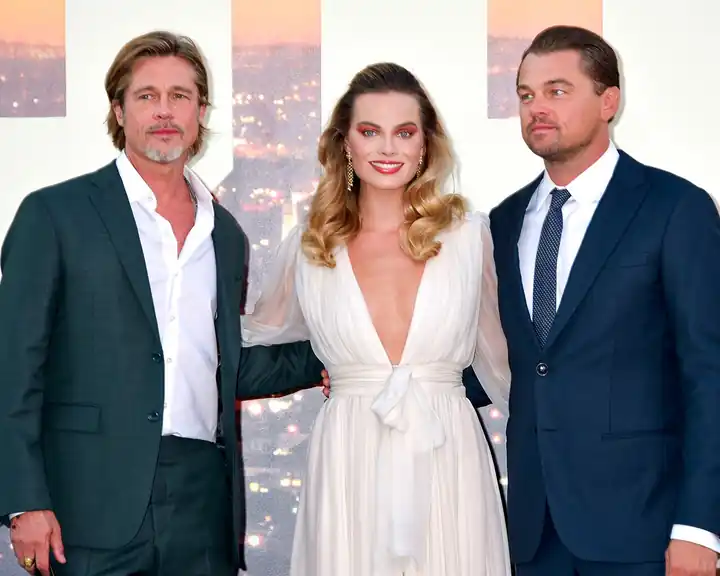
Once Upon a Time in... Hollywood (2019): Rick Dalton, Sharon Tate and Cliff Booth at the eventImage: Wikimedia Commons · Toglenn, CC BY-SA 4.0 - #008
On Sunday night, Rick and Cliff sit down to watch "Rick's episode" of The F.B.I. (1965). The audience is later told that the episode is All the Streets Are Silent (1965). That is a real episode of the television show, and the ensuing clip is the actual opening to that episode, with one important difference - Rick Dalton has been edited into the place of the guest star villain, "Michael Murtaugh." In reality, the role of Murtaugh in the episode was played by Burt Reynolds, who was known for open-mouthed gum-chewing, which is a likely reason why Rick and Cliff refer to the gum chewing as "strong".
- #009
As the Tate party enters the El Coyote restaurant for dinner, Sharon Tate and Jay Sebring discuss a movie premiere they can see taking place further down Beverly Blvd at an erotic movie theatre. "They have premieres for dirty movies?" asks Sharon. The theatre in question is the Eros, a real adult theatre of the time. The building still exists, though it is now a repertory cinema called The New Beverly, and it is owned by Quentin Tarantino.
- #010
Sharon Tate puts her feet up on a seat in the theater while watching The Wrecking Crew (1968). If one looks closely you can see that her feet are rather dirty. In real life, Tate hated wearing shoes and would take any possible opportunity not to wear any in public unless the situation absolutely called for it. Tate would even go as far as wearing rubber bands on her feet to give the illusion of wearing sandals while out eating at restaurants.
- #011
Before the film's world premiere at the Cannes Film Festival, Quentin Tarantino begged of Cannes crowds to avoid spoilers for later audiences in a statement made on social media; "I love cinema, You love cinema. It's the journey of discovering a story for the first time. I'm thrilled to be here in Cannes to share 'Once Upon A Time...in Hollywood' with the festival audience. The cast and crew have worked so hard to create something original, and I only ask that everyone avoids revealing anything that would prevent later audiences from experiencing the film in the same way. Thank you."
- #012
In addition to his on-screen role, Kurt Russell provides the voice of the off-screen narrator.
- #013
Quentin Tarantino told the crew that he wanted the Spahn Movie Ranch sequence to feel like the early scenes in The Texas Chain Saw Massacre (1974), particularly in terms of sound design and production design.
- #014
As Sharon Tate is trying to convince the movie theater cashier that she's Sharon, the cashier mentions Valley of the Dolls (1967) which visibly makes her wince. In real life, Tate hated the novel and the script, thinking they were terrible. She only accepted the role of Jennifer North because she knew that it would bring her nationwide attention and boost her career.
- #015
The real life sister of Sharon Tate was so moved by Margot Robbie's portrayal of Tate she claimed she "cried real tears, I had a big wet patch of tears down the front of my shirt. It was like having my sister back again, after 50 years."
- #016
It allegedly cost Tarantino more to purchase the brief clip from Teenage Monster (1957) seen in the film than it did to make the movie in 1957.
- #017
Margot Robbie accidentally took home one of Quentin Tarantino's "on-the-day" shot lists from one of her days of filming. She discovered it months later and was afraid to say anything in case Quentin asked for it back. When she revealed this to Quentin, he told her he practically throws them away when he's done with them, and offered her many more.
- #018
The TV at George Spahn's house has one of the earliest unwired remote controls, the Zenith "Space Command" remote. Rather than using infrared or similar technology from later years, it uses ultrasonic sound. The remote uses hammers that strike metal rods. Each rod produces a different pitch, all of which are inaudible. On one four-button model, one button changed the channel up and another changed it down. As each button press makes a loud click, many people simply referred to the device as a "clicker". A rather humorous failing of this system is that if you jingled your car keys it could cause the TV to turn on.
- #019
After Rick and Cliff leave the bar in the beginning of the movie, a news bulletin can be heard coming from the car radio. It is about Sirhan Sirhan, who murdered Senator Robert F. Kennedy who won the Democratic primary in California in 1968 and was shot after giving his victory speech. The events in the scene play on February 8, 1969, two days before Sirhan's lawyers moved to enter a guilty plea to first-degree murder.
- #020
Car coordinator Steven Butcher found the actual 1959 Ford Galaxie used in the Tate murders, found another and then set it up to resemble the original as it would have looked in 1969.
- #021
For Quentin Tarantino, Sharon Tate has an angelic presence throughout the movie. He even considers Tate an angelic ghost on earth, with Tarantino's own words, "to some degree, she's not in the movie, she's in our hearts".
- #022
The final version of the film is slightly longer than the cut that premiered at the Cannes Film Festival. Most notably, the scene where Rick Dalton appears in a clip from The Great Escape (1963) (which required the use of digital effects and thus could not be completed in time for Cannes) and the mid-credits Red Apple commercial were absent at the world premiere.
- #023
During the mid-credits Red Apple Tobacco commercial, Rick Dalton says, "Take a bite and feel all right." Quentin Tarantino previously used this phrase in his published screenplay for From Dusk Till Dawn (1996); it is spoken by Seth Gecko (George Clooney) during that film's climactic fight, but was not included in the final cut.
- #024
The song that Sharon plays is Good Thing by Paul Revere & The Raiders from their album, Spirit of '67. Raiders singer and producer Mark Lindsay was good friends with record producer Terry Melcher and for a while the two shared a house; a place that was ideal for parties. After Melcher moved out, this was the house where Tate would live and which, because of Melcher, was targeted for attack by Charles Manson. It is possible that Tate knew that the record she was playing was sung by Mark Lindsay and produced by Terry Melcher, both former residents of her home.
- #025
This film was originally scheduled to be released on August 9, 2019, the 50th anniversary of the murder of Sharon Tate and friends by members of Charles Manson's "Family," before Sony moved it up two weeks to July 26. In her collection of essays titled "White Album," Joan Didion theorized that August 9, 1969 was the day the "Hippie" movement, the free love era, and the 1960s as a whole came to an abrupt end as a result of these murders.
- #026
The fictional "Red Apple" brand of cigarettes is a brand that Tarantino uses in many of his movies. In the Rick Dalton commercial the art on the pack has been changed to give the worm a cowboy hat. As Rick Dalton says at the end of the Red Apple shoot during the end credits, these are truly awful cigarettes.
- #027
Quentin Tarantino wrote the role of fictitious Hollywood agent Marvin Schwarz specifically for Al Pacino. Tarantino admitted that he was "nervous" on his first day working with Pacino.
- #028
Rick Dalton is portrayed as a Steve McQueen wannabe. Rick Dalton starred in the fictional 1950s western TV series "Bounty Law," while Steve McQueen starred in the actual 1950s western TV series, Wanted: Dead or Alive (1958), which was about a bounty hunter. In his final film The Hunter (1980), McQueen played real-life bounty hunter Ralph Thorson.
- #029
In the scene where Cliff Booth gathers tools from Rick Dalton's work-shed in order to repair Rick's fallen antenna, the flamethrower can be seen on the floor, leaning against the wall.
- #030
The scenes of DiCaprio's character in the The Great Escape (1963) digitally inserted. Tarantino is known not to be a lover of CGI effects but this was the only practical way to accomplish this famous scene as there was no realistic way to recreate it due to the age of the film and death of all the original actors in the scene.
- #031
Cliff feeds his dog Wolf's Tooth dog food, with the slogan Good Food for Mean Dogs. Specifically, he feeds it one can of Rat flavor and one can of Raccoon flavor. Other flavors seen in the cabinet are Bird flavor and Lizard flavor. .
- #032
At the beginning of the film's third act, Rick Dalton is served a cocktail on a flight by a Pan Am stewardess. This stewardess is played by Margot Robbie, but only her hands, arms, and part of her uniform are shown. Margot Robbie also starred in the TV series Pan Am (2011).
- #033
Dalton questions Wanamaker about how the public will recognize him as villain Caleb DeCoteau due to the disguise created for him. The scene recalls Once Upon a Time in the West (1968), but in that film Henry Fonda, who played the villain, arrived on set with dark contact lenses and facial hair, a look Leone rejected.
- #034
WILHELM SCREAM: The movie opens with a clip from the fictional Rick Dalton series "Bounty Law." A man is shot and falls off a roof, at which point he lets out a big Wilhelm scream, an inside joke in the movie industry which pops up in several other Tarantino films.
- #035
When considering Sharon's taste in men, Steve McQueen remarks 'I never stood a chance.' This is paralleled by Rick describing the role Steve McQueen accepted in 'The Great Escape' saying 'I didn't get it, McQueen did it. Frankly, I never had a chance'. This illustrates the seemingly unattainable dreams of both the upper and lower echelon of the Hollywood film industry.
- #036
In one scene Sebring brags about his income (the 2022 equivalent of $8,121 a day). While most haircuts would cost between $1 and $2, he would charge $50 ($400 in 2022 dollars). After meeting a friend of Frank Sinatra at a party, he flew to Las Vegas to give him and trim and from that point on he was the barber to the stars, with clients ranging from Paul Newman to Jim Morrison. Jay Sebring was the one who introduced the combination of shampoo, scissor cut, blow dry and hairspray - a technique that, other than mousse vs hairspray, is now the industry standard. At the time the standard was electric clippers and Brylcreem hair cream.
- #037
Not counting the 'archive footage' interview on the set of Bounty Law at the beginning, Cliff Booth's first and last lines in the 'present' 1969 portion of the film are the same - "I try." In both instances, it is in response to someone telling him he is a good friend to Rick.
- #038
The movie makes the death of Cliff Booth's wife Billie ambiguous. Rick Dalton believes that her death (she was torn in half by a speargun firing) was an accident, while most other characters in the film believe Cliff murdered her in cold blood and got away with it. In the Tarantino-written novelization, though, it's confirmed that Cliff shot Billie intentionally because she was screaming at him and tried to slap him in the face. He got away with it because the police just accepted his false story it was an accident, and Billie was so widely disliked that no one ever tried to reopen the case and get Cliff charged with murder.
- #039
Rick stutters in "real life" when stressed, but never when acting.
- #040
In the scene where the Manson murderers are confronted by Rick Dalton, the sound of the car was dubbed from the same sound as the car from the movie Christine when Arnie drove it into the garage. The owner even called Christine a "mechanical asshole", which was the same name Rick called the murderers car.
- #041
Quentin Tarantino was so determined to avoid the typical clichés of a sixties period piece that he even considered shooting the film in black & white.
- #042
Steven Spielberg claimed he visited the set on the day of filming the scene of Trudi Fraser meets Rick Dalton, and after watching her performance he left the set determined to cast Julia Butters in a movie someday. He did in The Fablemans.
- #043
Tex tells the girls to split up afterwards and find their own ways back. For the LaBianca murders, Manson did the driving, then left them behind with the same instructions.
- #044
Margot Robbie said in a Vogue interview on YouTube that her character carries a black Chanel purse in the film because when Robbie talked to Sharon Tate's sister, she told her that she always had that purse, she loved that purse.
- #045
When Sharon goes to the Bruin theatre to see the film she is in, a poster of The Mercenary (1968) can be seen. "The Mercenary" starred Franco Nero, who stood alongside Jamie Foxx at the bartop in Django Unchained (2012). Franco Nero was the original Django.
- #046
The Trudi Fraser (Julia Butters) character bears a strong resemblance in appearance and professionalism to child actor Margaret O'Brien, who took her craft very seriously and displayed the same level of maturity.
- #047
In one part of the movie, Sharon Tate (Margot Robbie) goes to see her own movie in the theater. When the cast was asked in an interview if they've ever done the same thing, Director Quentin Tarantino revealed he has. He admitted to once taking a date out to see True Romance (1993), which he wrote the screenplay for. Ironically, Tarantino revealed he has also gone to the Bruin Theater, the same place Sharon Tate goes to in the movie.
- #048
When Cliff Booth drives home from Rick Dalton's, the camera goes over a "Drive-In Theatre" while Keith Mansfield's "Funky Fanfare" is heard on the soundtrack, which is the music used behind the "Our Feature Presentation" clip seen in several other Quentin Tarantino films. This music can be heard at the start of every movie at all Alamo Drafthouse Theaters.
- #049
Throughout the scene where Cliff and Bruce Lee do their "friendly" fight contest, about once per second a high-pitched chirping noise can be heard. That is the sound of a bird: the California Tow-Hee; a sound that could have been edited out but instead was retained - perhaps to preserve that authentic California studio lot atmosphere and feel.
- #050
In the scene where Cliff drives pussycat to Spahn ranch, and the hippies are inside the house observing, faintly on the TV you can hear Happening 68 by Paul Revere and the Raiders. This song was a theme to the variety show Happening 68.
- #051
Cliff Booth is suspected of killing his wife, while KHJ "boss jock" Humble Harve Miller, who is heard on the car radio in several scenes, actually did kill his wife in 1971.
- #052
Rick Dalton's car, chauffeured by Cliff, is a 1966 Cadillac Coupe de Ville, a mid level model in the Cadillac lineup. The car he crashes while driving drunk was a red convertible 1959 Cadillac Eldorado, a the top of the line model and a lot more glitzy. This shows the juxtaposition of his career and financial status.
- #053
Brad Pitt has said before that he spent time with Bruce Lee's son Brandon Lee not too long before he died. In Fight Club (1999) he also did an impression of Bruce Lee's fighting stance.
- #054
Cocoa powder and pencil lead were applied to the bottom of Margaret Qualley's feet in order to make them look realistically dirty during the car scene.
- #055
KHJ radio advertisements are spread throughout the movie. When Cliff picks up Dalton from the day of shooting on Lancer (1968) the building seen in the background is the former headquarters of KHJ radios. It is now part of the Paramount Studios Complex.
- #056
Quentin Tarantino described Leonardo DiCaprio and Brad Pitt as "the most exciting star dynamic duo since Robert Redford and Paul Newman." The age differences between the two sets of men are practically the same. Pitt is a month shy of 11 years older than DiCaprio. Newman was 11 1/2 years older than Redford.
- #057
When Cliff picks up Rick Dalton from Columbia Studios, the building itself is an entrance to a Studio Tour for the public at Paramount Studios.
- #058
Clifton Collins Jr., who plays the Lancer (1968) ranch hand, has a strong connection to Hollywood of the fifties and sixties. His grandfather was character actor Pedro Gonzalez Gonzalez who was discovered by John Wayne when he was an inadvertently hilarious guest on the game show You Bet Your Life (1950) and who subsequently played supporting roles in a number of Wayne's movies.
- #059
Charles Manson would use young girls to use sex to lure young men to the ranch and in into his group of followers, as is seen in this film with Pussycat and Cliff. One of these was a motorcycle gang member named Danny Decarlo. Although he was considered dangerous as a member of the "Straight Satans" gang, he became so afraid of Charlie Manson that he left the ranch and became a witness for the prosecution in the Helter Skelter murder trial. It may be noted in passing that Pussycat is a fictional character, as is Cliff.
- #060
The Cannes premiere of the film made such a splash that a large number of people, including film executives, weren't able to get in. Journalists queued for two hours before the film's 4:30 p.m. press screening. When the attendants came to the entrance barrier at the theater at about 3:50 p.m. to start admitting attendees, a round of applause went up from some in the crowd. The crush and jostle to get in became such a heaving mess of sharp elbows that the staffers had to admonish people not to push their way into the theater.
- #061
At one point, a theater marquee can be seen advertising a movie which is Rated "M," The original MPAA ratings for film content, which would have come into effect not long before the time the film is set, were G (General Audiences, still in use today), M, (Mature - parental discretion advised) R (Restricted, still in use today), and X (Adults Only). As the M rating confused audiences (they didn't know if an M or an R movie was stronger in its content), the M rating was eventually changed to GP, and not long thereafter, to PG (Parental Guidance Suggested), which is still in use today.
- #062
While Quentin Tarantino sent Roman Polanski a letter regarding his plans to make this film, and showed an unidentified close friend of the disgraced directing legend the entire shooting script just before he began production, he did not have any contact with Polanski during or after filming.
- #063
When Cliff gets home from Dalton's house the first night, he's watching Death in a Minor Key (1969) which originally aired February 8, 1969.
- #064
Margot Robbie said in a Vogue interview on YouTube that Quentin Tarantino gave her the first edition copy of Tess of the d'Urbervilles after the day's shooting where it was used, and told her, "you keep that."
- #065
When Cliff Booth and Bruce Lee square off for their fight, they are being watched by many crew members and studio workers. After Cliff throws Bruce into the blue car, all the observers have mysteriously disappeared, illustrating the unreliability of Cliff's memory of how the event really happened.
- #066
Quentin Tarantino stated on Joe Rogan's podcast that he thinks Shannon Lee has the right to be offended by the depiction of Bruce Lee because it is her father, but nobody else does.
- #067
Rick Dalton is shown in a clip singing "What's Behind the Green Door?" It's later revealed Rick Dalton's front door is green.
- #068
Music from The Day the Earth Stood Still (1951) can be heard, while Cliff is walking back to see George Spahn in room, to make the scene more tense.
- #069
On June 12, 2018, moviegoers were surprised to see that scheduled 70mm screenings of 2001: A Space Odyssey (1968) inside the legendary Cinerama Dome appeared to suddenly been replaced by another film from that period, Krakatoa: East of Java (1968). In fact, 2001 had been relocated to another screen inside the ArcLight Hollywood, and the marquees for Krakatoa: East of Java were part of the second unit work required for this film to recreate the look of 1969 Los Angeles.
- #070
Sharon Tate (Margot Robbie) is playing an album by Paul Revere & The Raiders. The album was produced by Terry Melcher, who previously occupied the house where Tate and Roman Polanski lived and was the original target, along with his girlfriend Candace Bergen, of Charles Manson and his family.
- #071
Another song by The Mamas and the Papas, "Twelve Thirty" ("young girls are coming to the canyon") is heard later in the film. This song is about Laurel Canyon, where a lot of '60s musicians lived, including Jim Morrison, Carole King, Joni Mitchell, and Peter Tork, as well as Crosby, Stills, and Nash. There are, of course, a lot of young girls in this film. The Tate/Polanski house was in Benedict Canyon, but another massacre, the Wonderland murders, took place in Laurel Canyon in 1981.
- #072
In the promo for Bounty Law, Rick Dalton says anyone who tries to bring in a bounty alive, when dead is an option, is an idiot. This directly contrasts with Kurt Russell's character in The Hateful Eight (2015): a bounty hunter who prides himself on bringing in his bounties alive, so as not to cheat the hangman.
- #073
After Cliff Booth comes back from walking Brandy and orders her onto the couch, he waves his finger, and begins to feel the effects of the acid cigarette. If you turn up the volume, there is a strange sound effect as Cliff whips his finger around.
- #074
In the opening scene, the names of actors Di Caprio and Pitt are displayed over the other person's head, showing that their lives are intertwined and connected.
- #075
In the film, when Sharon purchases the first edition of Tess of the d'Urbervilles, she would likely be purchasing the American first edition published by Harper & Brothers in 1892. The actual first edition was published in three volumes by Osgood in London in 1891. In reality, Sharon bought the book for Roman while they were in Europe working on a film and it is unlikely she purchased the three volume Osgood edition and would likely have bought him the Macmillan & Co. Ltd, London 1926 edition. Either way, it would be the last gift she ever gave Roman and the last time he saw her as she returned to America shortly after giving him the book never to fulfill Roman's wish for her to play Tess.
- #076
During the scene in which George Spahn is struggling to identify Cliff Booth, he mishears his name as John Wilkes Booth. John Wilkes Booth shot President Abraham Lincoln on April 14, 1865; Lincoln died the next day. The woman who questions Cliff before allowing him to enter, and sitting one room away from this exchange, is the notorious Charles Manson acolyte Lynette 'Squeaky' Fromme. On September 5 1975, Fromme made an unsuccessful attempt to assassinate President Gerald Ford. Interestingly, Lincoln was assassinated in Ford's Theatre in Washington DC, and Fromme's attempt on Ford was in Capitol Park after he had entered from Lincoln Street in Sacramento, California.
- #077
The trailer for the fictional "Bounty Law" that is seen at the beginning of the film is modeled after one for the real Steve McQueen show, "Wanted: Dead or Alive" (1958-1961). It even has a similar shot of the star ripping a "wanted" poster off its posted position, although in the original trailer, McQueen approaches the posters from the left and uses his left hand to rip the poster down.
- #078
One of the Mexican restaurants featured in the movie is Casa Vega. It was a famous Los Angeles restaurant around the time the movie is set, and it shares the name Vega with Vincent Vega, one of the main characters in Pulp Fiction (1994).
- #079
Rick Dalton's fictional filmography includes a B-movie titled "Drag Race, No Stop." When Quentin Tarantino was trying to get his start in the film industry, he convinced people he appeared in a non-SAG film by the same name. The movie "Drag Race, No Stop" was never real.
- #080
The scar on Cliff Booth's forehead has the same shape and location as the scar on Ernest Hemingway's forehead.
- #081
Rick Dalton frequently scratches himself. Itchy skin is a symptom of chronic heavy alcohol use due to high liver enzymes in the blood.
- #082
Actress Taylour Paige revealed in a 2021 interview with Interview Magazine that, while under-the-radar as an actress, she did PA work on pre-production for Once Upon A Time in Hollywood, before booking her breakout role in Zola (2020), directed by Janicza Bravo.
- #083
The second scene featuring Sharon Tate reveals a hint of the second-rate nature of the film, The Wrecking Crew (1968). At one point, at the lower center of the shot you can see the upper back of a control console, which is supposedly against the wall. Other shots in that film, not shown here, reveal the entire back of the console making it seem like the wall is invisible.
Once Upon a Time in... Hollywood (2019): Sharon Tate in an interview settingImage: Wikimedia Commons · QUE TAL UM CINEMINHA?, CC BY 3.0 - #084
Rick Dalton's address in the film is Cielo Drive. As the street is a bit uphill one can say that when Rick gets home he figuratively 'goes up to heaven' (Cielo is Spanish word for Heaven).
- #085
After the camera follows a Pan Am stewardess up the spiral staircase of a 747, the first appearance of Margot Robbie shows her dancing in the upstairs lounge of the jetliner. Robbie portrayed a Pan Am stewardess in the TV series Pan Am (2011).
- #086
At the beginning scene of Rick and Cliff's return to the states from Italy on the 747, Rick is served a drink which is presented in the form of photographer William Eggleston's famous "Untitled" (Glass on Plane, 1965-1974) of a jewel-like mixed drink being stirred in front of a sunny jet cabin window.
- #087
On his flight home from Italy, Rick (Leonardo DiCaprio) flies the airline PanAm. In the film The Aviator (2004), this was the nemesis of Howard Hughes and TWA. Hughes was also played by DiCaprio.
- #088
In second bar scene while shooting Lancer, Johnny Madrid enters the bar and Trudy Frazer's character calls him Scott. Scott Lancer is the brother of Johnny Madrid's character in the TV show Lancer (1968).
Production Story (44)
- #089
Of all the actors in the film, the one who was most familiar with the Hollywood of the day was Kurt Russell. In addition to his years as a child actor in films and guest starring on TV shows in the 1950s and 1960s, his father Bing Russell had also spent many years guest starring on shows, as well as playing a repeating role as a deputy sheriff in Bonanza (1959). Bing was an actor who was never lucky enough to have his own series like Rick Dalton but he found his niche and hung in there, largely in roles as film extras. This makes Kurt Russell the ideal person to cast as the narrator of this film.
- #090
Editor Fred Raskin's first assembly of the film was four hours, 20 minutes.
- #091
Multiple studios were interested in acquiring the project. Sony, Universal Pictures, Annapurna, Lionsgate and Warner Bros all bid for the script. 20th Century Fox pulled out of consideration while Warner Bros went so far as to decorate the studio in late 1960s regalia when Tarantino visited the studio for a meeting.
- #092
The ending was deliberately omitted from copies of scripts in order to keep it secret from everyone including the studio. The only persons who really knew the ending right at the beginning of production apart from Quentin Tarantino were the lead actors themselves and a close friend of Roman Polanski whom Tarantino showed the entire script. Robert Richardson said that he and other main crew members were only told of it two months prior to filming the climax. Others knew much later into filming or during post-production; an example would be that Margaret Qualley only found out through Brad Pitt while filming at the Spahn Ranch set.
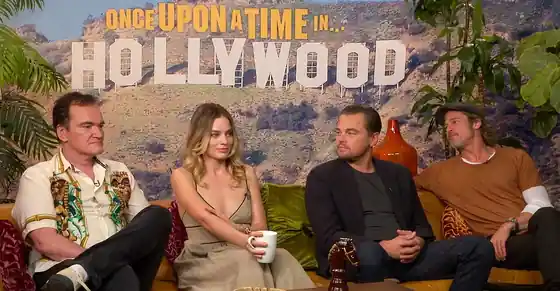
Once Upon a Time in... Hollywood (2019): Sharon Tate and Cliff Booth on a couchImage: Wikimedia Commons · Que Tal Um Cineminha?, CC BY 3.0 - #093
In an interview with Empire, Quentin Tarantino, said that when writing Once Upon A Time In Hollywood the central dynamic between an actor and his stunt-double, was inspired by British film Mindhorn (2016). Which also featured a washed up actor and his relationship with his stuntdouble. Tarantino explained that the scene of Cliff repairing the TV aerial was a direct homage of the scene in Mindhorn where Clive (Simon Farnaby) gardens topless.
- #094
Nicholas Hammond got word from a friend that Quentin Tarantino had screened a restored 35mm print of the The Amazing Spider-Man (1977) TV pilot at his New Beverly Cinema, of which Hammond portrayed the title character. Touched, Hammond had his manager pass word onto Tarantino that he was grateful to hear about the screening and if he were back in Los Angeles next time, he'd love to meet the director. Tarantino responded with "Come see me." and they eventually met with Tarantino asking Hammond if he knew who Sam Wanamaker was, which Hammond did. Tarantino gave Hammond a DVD of the show Lancer (1968), whose pilot Wanamaker directed, and told him to watch it when he got home. Hammond was surprised to get a call from his manager to notify him that Tarantino was offering him the role of Wanamaker in this film. Hammond said "I owe it all to Peter Parker." (Spider-Man's alter ego).
- #095
Bruce Lee's line about Cliff being pretty for a stuntman was suggested by Burt Reynolds during a script reading. Tarantino said "had the line not been Burt's, it never would've made it in the film. Brad doesn't like characters pointing out how good looking he is. But because Burt suggested it, how could he say no to including it?"
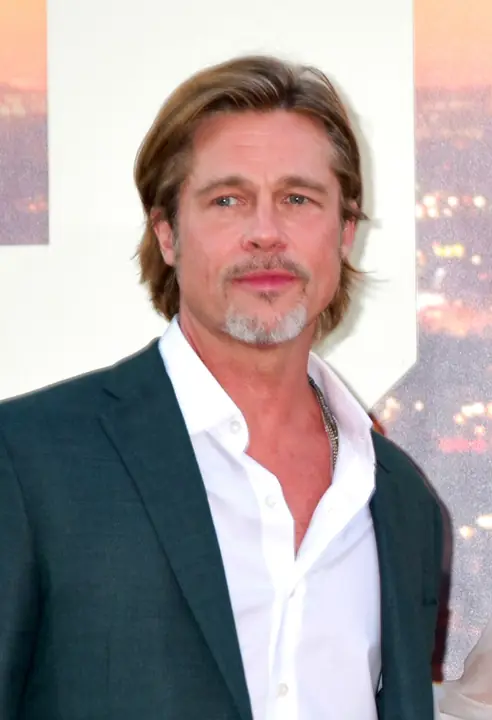
Once Upon a Time in... Hollywood (2019): Cliff Booth at an event in a white shirt and black jacketImage: Wikimedia Commons · Toglenn, CC BY-SA 4.0 - #096
Quentin Tarantino stated on Joe Rogan's podcast that he thinks Shannon Lee has the right to be offended by the depiction of Bruce Lee because it is her father, but nobody else does.
- #097
Originally skeptical of the project, Sharon Tate's sister Debra Tate gave the film and Margot Robbie's portrayal of Sharon her blessing after Debra was embraced by Quentin Tarantino himself and she became aware of how her sister would be represented within the film. Debra referred to Margot as a "dedicated craftsman" and praised the actress's research of Sharon prior to meeting with her.
- #098
Quentin Tarantino did not approach Roman Polanski, he admitted at the press conference in Cannes. But Tarantino asked for and received help from Sharon Tate's sister Debra Tate, who is thanked in the credits. He also gave Debra Tate a script to read early on, went to visit her in Santa Barbara and spent a weekend with her. She even came on set when the Bruin [Theatre in Westwood] sequence was being shot.
- #099
China refused the film a certificate for release in the country, strongly hinting that the issue was the way the film portrayed Bruce Lee and that an edit which eliminated the Lee-related material would get approval for release. Quentin Tarantino responded by publicly stating he would not edit any of the film to ensure its release in China.
- #100
When the casting calls went out in L.A., it was listed as 'Magnum Opus', but no other information was given.
- #101
While scouting for locations, Quentin Tarantino visited Lee Van Cleef's home. While there, he noticed a giant poster of Van Cleef's face hanging in his garage. Tarantino thought this was both funny and strange, and decided to give Rick Dalton the same thing on his driveway.
- #102
It allegedly cost Tarantino more to purchase the brief clip from Teenage Monster (1957) seen in the film than it did to make the movie in 1957.
- #103
The final version of the film is slightly longer than the cut that premiered at the Cannes Film Festival. Most notably, the scene where Rick Dalton appears in a clip from The Great Escape (1963) (which required the use of digital effects and thus could not be completed in time for Cannes) and the mid-credits Red Apple commercial were absent at the world premiere.
- #104
British Chinese martial arts actor and choreographer J. Cheung was offered the role of Bruce Lee, but turned it down, citing its lack of respect to Bruce Lee and his spirit. Cheung had previously turned down the role of Bruce Lee in Birth of the Dragon (2016) for similar reasons.
- #105
Quentin Tarantino considers himself one of the luckiest directors in the history of Hollywood for being able to cast Leonardo DiCaprio and Brad Pitt at the same time.
- #106
Leonardo DiCaprio was courted for several months to take on one of the two primary characters in the film. The role was revealed to be the character of Rick Dalton, a washed up former television western star, for which DiCaprio would eventually be convinced to sign on for his second collaboration with Quentin Tarantino, their first being Django Unchained (2012).
- #107
Quentin Tarantino was so determined to avoid the typical clichés of a sixties period piece that he even considered shooting the film in black & white.
- #108
In the actual Lancer (1968) TV series, Murdoch Lancer's ward Teresa was played by Elizabeth Baur, who was 21 years old at the time and who was supposed to provide sexual tension between the two half-brothers. Tarantino took a creative approach by casting nine-year-old Julia Butters. On the one hand, this made the threat by Dalton's character more serious. On the other hand, this allowed Tarantino to give a nod to Margaret O'Brien. who was perhaps the greatest child actor in history, upon whom his version of the Teresa character was obviously based.
- #109
Charlie Day was asked to audition for the role of Charles Manson but turned down the opportunity in order to continue work on his own feature film 'El Tonto'.
- #110
This film was originally scheduled to be released on August 9, 2019, the 50th anniversary of the murder of Sharon Tate and friends by members of Charles Manson's "Family," before Sony moved it up two weeks to July 26. In her collection of essays titled "White Album," Joan Didion theorized that August 9, 1969 was the day the "Hippie" movement, the free love era, and the 1960s as a whole came to an abrupt end as a result of these murders.
- #111
Burt Reynolds was originally cast as George Spahn, the ranch owner, but he died before he was scheduled to shoot his scenes. Bruce Dern replaced him in the role. Additionally, the role of James Stacy was originally written for Bill Paxton, who unfortunately passed away while the script was being written. Paxton's role would instead go to Timothy Olyphant.
- #112
Quentin Tarantino was scheduled to make the film for The Weinstein Company but severed the ties when the sexual assault allegations against co-chairman Harvey Weinstein were revealed in the press. To avoid a repeat of the script leak incident that almost cost him The Hateful Eight (2015), he wrote a memo to all theatrical studios, summoning them to send one representative to his agent's (The William Morris Endeavor) office in Beverly Hills to read his Manson script in person at an arranged time and date. The memo also mandated that each representative was required to sign a heavy non-disclosure agreement, read the script in person (they were not allowed to copy or take the script back), and present the list of demands and conditions to the studio management. This project was already one of the most anticipated and promising projects on the board at the time. After reading the script, Warner Bros., Universal Pictures, Sony Pictures, Paramount Pictures, Annapurna Pictures, and Lionsgate were welcome to make a bid for the theatrical rights before a second round of bids pitched to Tarantino himself. Sony won the theatrical rights in the bidding war, outbidding its closest rival Warner Bros., making it the first David Heyman production not to be distributed by Warner.
- #113
The song that the Manson girls sing on their garbage run at the beginning of the film was an actual song that Charlie and the girls wrote. Several of Manson's songs, with and without the girls, were recorded as demos by Terry Melcher in his bid to possibly get Charlie a recording contract. They were not successful. Nor were these recordings made public for many years, and were in fact not known to even exist for the most part. But the coming of the digital age eventually allowed them to be exhumed and widely disseminated. Manson's rage about the shelving of these tapes, and Melcher's disappearance from Charlie's acquaintance, was the point in the story that turned his family of peaceniks into mass murderers.
- #114
Austin Butler turned down the role of Rooster in Top Gun: Maverick (2022) in favor of this film.
- #115
Quentin Tarantino compared Brad Pitt and Leonardo DiCaprio to Paul Newman and Robert Redford. DiCaprio and Redford both played Jay Gatsby in The Great Gatsby (2013) and The Great Gatsby (1974), respectively.
- #116
The Columbia Pictures Release intro at the beginning of the film is authentic for the 1960s. It was recycled from an unknown Columbia Pictures film from the same period and wasn't even remastered in order for it to keep its scratched, slightly faded look. The only nod to modernity is the (digital) addition of the Sony name at the bottom of the screen (Sony acquired Columbia Pictures in 1989). As an additional piece, Columbia Pictures television arm of the era, Screen Gems, is also name-checked in the film.
- #117
While Quentin Tarantino sent Roman Polanski a letter regarding his plans to make this film, and showed an unidentified close friend of the disgraced directing legend the entire shooting script just before he began production, he did not have any contact with Polanski during or after filming.
- #118
Quentin Tarantino based the Dalton / Booth relationship on that of a real life duo. During one interview, while not revealing who it was, Tarantino said that he got the idea when watching the interaction of an actor with his stuntman. While Kurt Russell's name as been put forward as the inspiration for Dalton, the strongest argument is for Burt Reynolds and his long-time stuntman, Hal Needham. Before making a huge impact in Smokey and the Bandit (1977), Reynolds had spent many years kicking around in TV shows, mostly playing villains and his career was going nowhere. Tarantino based his film on his experience growing up in Los Angeles in the sixties and seventies. Reynolds did not leap from obscurity until Tarantino was 14 years old. It is interesting that Dalton played the bad guy role in the featured episode of The F.B.I. (1965) - a role that was actually played by Burt Reynolds.
- #119
The character Flowerchild (Maya Hawke), who is shown having cold feet on going through with the murders, and who flees the scene in the 1959 Ford Galaxie, is based on Linda Kasabian, who became a witness for the prosecution in the murder trial of Tex Watson, Patricia Krenwinkel, and Susan Atkins. In real life Kasabian was ordered by Tex Watson to wait in the car, during which she heard the murders inside the Tate residence take place and witnessed the murder of Wojciech Frykowski outside the house. Kasabian claimed she wanted to drive away, but was too scared.
- #120
Burt Reynolds was originally cast as George Spahn, the ranch owner, but he died before he was scheduled to shoot his scenes. Bruce Dern replaced him in the role. Additionally, the role of James Stacy was originally written for Bill Paxton, who unfortunately passed away while the script was being written. Paxton's role would instead go to Timothy Olyphant.
- #121
Quentin Tarantino was scheduled to make the film for The Weinstein Company but severed the ties when the sexual assault allegations against co-chairman Harvey Weinstein were revealed in the press. To avoid a repeat of the script leak incident that almost cost him The Hateful Eight (2015), he wrote a memo to all theatrical studios, summoning them to send one representative to his agent's (The William Morris Endeavor) office in Beverly Hills to read his Manson script in person at an arranged time and date. The memo also mandated that each representative was required to sign a heavy non-disclosure agreement, read the script in person (they were not allowed to copy or take the script back), and present the list of demands and conditions to the studio management. This project was already one of the most anticipated and promising projects on the board at the time. After reading the script, Warner Bros., Universal Pictures, Sony Pictures, Paramount Pictures, Annapurna Pictures, and Lionsgate were welcome to make a bid for the theatrical rights before a second round of bids pitched to Tarantino himself. Sony won the theatrical rights in the bidding war, outbidding its closest rival Warner Bros., making it the first David Heyman production not to be distributed by Warner.
- #122
Margaret Qualley's character 'Pussycat' is based on Manson Family member Ruth Ann Morehouse (nickname "Ouisch").
- #123
British Chinese martial arts actor and choreographer J. Cheung was offered the role of Bruce Lee, but turned it down, citing its lack of respect to Bruce Lee and his spirit. Cheung had previously turned down the role of Bruce Lee in Birth of the Dragon (2016) for similar reasons.
- #124
The ending was deliberately omitted from copies of scripts in order to keep it secret from everyone including the studio. The only persons who really knew the ending right at the beginning of production apart from Quentin Tarantino were the lead actors themselves and a close friend of Roman Polanski whom Tarantino showed the entire script. Robert Richardson said that he and other main crew members were only told of it two months prior to filming the climax. Others knew much later into filming or during post-production; an example would be that Margaret Qualley only found out through Brad Pitt while filming at the Spahn Ranch set.
- #125
The song that the Manson girls sing on their garbage run at the beginning of the film was an actual song that Charlie and the girls wrote. Several of Manson's songs, with and without the girls, were recorded as demos by Terry Melcher in his bid to possibly get Charlie a recording contract. They were not successful. Nor were these recordings made public for many years, and were in fact not known to even exist for the most part. But the coming of the digital age eventually allowed them to be exhumed and widely disseminated. Manson's rage about the shelving of these tapes, and Melcher's disappearance from Charlie's acquaintance, was the point in the story that turned his family of peaceniks into mass murderers.
- #126
Quentin Tarantino based the Rick Dalton character on a number of actors of the era. The most obvious influence is Steve McQueen who, like Dalton, found early success on the 1950s western series Wanted: Dead or Alive (1958). Unlike Dalton, McQueen made a successful transition from television to films and would remain an A list star throughout the 1960s. Other influences were Edd Byrnes, Ty Hardin, whom Tarantino referred to as "a poor man's Steve McQueen", and Pete Duel. Like Dalton, Duel was the star of a western television series, Alias Smith and Jones (1971), had issues with alcohol and had his driver's license revoked after arrests for drunk driving. Similar to Cliff Booth (Brad Pitt), Duel's stand-in, Harold 'Hal' Frizzell, acted as Duel's chauffeur. There are also notable parallels between the Dalton character and Clint Eastwood's career. Eastwood starred in the TV western "Rawhide", then found himself in a career slump that ended after he starred in a trio of Sergio Leone's spaghetti westerns.
- #127
One of the westerns Rick Dalton stars in (Red Blood, Red Skin) is based on the novel "The only good Indian is a dead Indian" by Floyd Wilson. Floyd Wilson is the boxer killed in the fight with Butch in Pulp Fiction.
- #128
Dalton is listening to the 1966 song Snoopy vs. the Red Baron by the Royal Guardsmen. In the mid-sixties, a recurring element in the Peanuts comic strip was of the dog Snoopy fantasizing about being a World War I fighter pilot battling the German ace Baron von Richthofen. This novelty song was based on that theme. It made it all the way to number two on the charts, right below I'm a Believer by the Monkees.
- #129
The term "bounty killer" is lifted directly from the wording used in Sergio Leone spaghetti westerns. In American westerns they have always been known as bounty hunters. It is worth noting that TV censors would never approve that term. Regardless of the anti-hero concept, the notion that the "good guy" would be a professional killer would go directly against the standards of the day.
- #130
Danny Strong was cast as Dean Martin, who co-starred with Sharon Tate in The Wrecking Crew (1968), but he was cut from the final film.
- #131
Contains a major spoiler — show
In the movie's novelization, written by the director himself, the ending of the movie is briefly told in the first half of the book. The actual ending of the novel is a scene that was actually shot but cut from the movie where Rick and Trudi rehearse their lines from Lancer (1968) during a phone call.
- #132
Contains a major spoiler — show
This is the first of Quentin Tarantino's films in which Michael Madsen plays a character who doesn't die. Madsen claimed that after filming The Hateful Eight (2015) he jokingly complained to Tarantino about how every character he has him play ends up dying. Tarantino gave him a brief role in this film as a response.
Behind the Scenes (48)
- #133
To portray a hippie follower of the Manson Clan, Margaret Qualley let her underarm hair grow out over the course of the shoot for her 'Pussycat' character.
- #134
Very rare for a Quentin Tarantino film, some scenes contained improvisation, particularly when Rick Dalton forgets his lines when filming Lancer (1968) and afterwards rants to himself privately in his trailer. Leonardo DiCaprio had a very difficult time playing the scene as Dalton, rather than as how he himself would, especially since Dalton is supposed to be an actor of limited range. DiCaprio suggested that Dalton forget his lines mid-scene, ironically, to help him stay in character as Dalton. The subsequent scene in the trailer was also unscripted.
- #135
Throughout the scene where Cliff and Bruce Lee do their "friendly" fight contest, about once per second a high-pitched chirping noise can be heard. That is the sound of a bird: the California Tow-Hee; a sound that could have been edited out but instead was retained - perhaps to preserve that authentic California studio lot atmosphere and feel.
- #136
Cliff is wearing a life size replica of the GI Joe Frogman costume (vintage 1966) when he allegedly kills his wife.
- #137
In an unprecedented film production move, a section of L.A.'s Hollywood Freeway (US-101) was completely shut down from 12pm to 2pm for a sequence populated with period cars. No VFX were used to create this sequence.
- #138
Music from The Day the Earth Stood Still (1951) can be heard, while Cliff is walking back to see George Spahn in room, to make the scene more tense.
- #139
Margot Robbie, who portrays Sharon Tate, wears some of Sharon Tate's real jewelry, provided by Tate's sister Debra Tate.
- #140
The producers had some initial difficulties convincing Hollywood Boulevard vendors to allow their premises to be fitted with period facades to better reflect the 1960s. However, after the production wrapped that section of the shoot, most of these same people asked if they could leave the facades in place, since they now much more preferred that period 'look.'
- #141
Quentin Tarantino told the crew that he wanted the Spahn Movie Ranch sequence to feel like the early scenes in The Texas Chain Saw Massacre (1974), particularly in terms of sound design and production design.
- #142
On June 12, 2018, moviegoers were surprised to see that scheduled 70mm screenings of 2001: A Space Odyssey (1968) inside the legendary Cinerama Dome appeared to have suddenly been replaced by another film from that period, Krakatoa: East of Java (North American premiere: 1969). In fact, 2001 had been relocated to another screen inside the ArcLight Hollywood, and the marquees for Krakatoa: East of Java were part of the second unit work required for this film to recreate the look of 1969 Los Angeles.
- #143
Scenes on the plane were filmed on a aviation collectors' actual recreation of a Pan Am jet interior. As can be seen on a recent episode of Collector's Call Meet Anthony Toth (2023).
- #144
As mentioned in 'The Rewatchables' podcast, Quentin Tarantino describes how the Spahn ranch sequence was influenced by the Robert Duvall helicopter scene in Apocalypse Now (1979). Once Coppola introduces this scene with the helicopters, every subsequent scene before they head up the river needed to include helicopters in the background of each shot for it to work thematically. Quentin does the same for the Spahn ranch scene, but instead uses dogs. The aim for Tarantino in this sequence was to make sure that dogs can be seen in every shot at Spahn ranch wandering around.
- #145
Cocoa powder and pencil lead were applied to the bottom of Margaret Qualley's feet in order to make them look realistically dirty during the car scene.
- #146
Margot Robbie accidentally took home one of Quentin Tarantino's "on-the-day" shot lists from one of her days of filming. She discovered it months later and was afraid to say anything in case Quentin asked for it back. When she revealed this to Quentin, he told her he practically throws them away when he's done with them, and offered her many more.
- #147
Steven Spielberg claimed he visited the set on the day of filming the scene of Trudi Fraser meets Rick Dalton, and after watching her performance he left the set determined to cast Julia Butters in a movie someday. He did in The Fablemans.
- #148
Award-winning cinematographer Robert Richardson has said that one of the most gratifying experiences for him on the shoot was filming Al Pacino for the very first time. He'd seen all Pacino's films, but having the rare opportunity to shoot him with Brad Pitt and Leonardo DiCaprio in the same space was a milestone in his career.
- #149
Cliff and Rick watch an episode of The F.B.I. (1965) in which an Army truck is hijacked. A producer went to a local source for film vehicles searching for a similar truck to recreate the scene and, to his surprise, he was taken to the actual truck used in the TV show. They cleaned it up, gave it a fresh coat of paint and used it in this movie.
- #150
After Cliff Booth comes back from walking Brandy and orders her onto the couch, he waves his finger, and begins to feel the effects of the acid cigarette. If you turn up the volume, there is a strange sound effect as Cliff whips his finger around.
- #151
The scenes of DiCaprio's character in the The Great Escape (1963) digitally inserted. Tarantino is known not to be a lover of CGI effects but this was the only practical way to accomplish this famous scene as there was no realistic way to recreate it due to the age of the film and death of all the original actors in the scene.
- #152
The scene in which Dalton as DeCoteau blows his lines, then throws a fit in his trailer was suggested by Leonardo DiCaprio. Quentin Tarantino wanted to shoot straight western scenes but DiCaprio wanted to emphasize Dalton's fading star and asked if he could intentionally blow the lines. Tarantino was initially resistant and shot it both ways, but after seeing DiCaprio's performance with those lines, Tarantino was sold. He agreed that this was important, as it demonstrated the "drunken has-been" theme of the Dalton character.
- #153
The brief scene with Bruce and Jay was filmed at 9810 Easton Drive, in Beverly Hills, CA. This was the very home in which Jay Sebring lived at the time. Prior to the end of their relationship, Sharon Tate lived at the residence with Jay Sebring.
- #154
The reason why the scene in which Rick Dalton talks to himself in his trailer is presented in jump cuts is so Leonardo DiCaprio could improvise his lines freely in every take without worrying about continuity.
- #155
When Sharon goes to a showing of her movie The Wrecking Crew (1968), the filmmakers chose to use the actual film rather than recreating the scenes with Robbie. The real Sharon Tate briefly appears on screen.
- #156
Car coordinator Steven Butcher found the actual 1959 Ford Galaxie used in the Tate murders, found another and then set it up to resemble the original as it would have looked in 1969.
- #157
Margot Robbie said in a Vogue interview on YouTube that Quentin Tarantino gave her the first edition copy of Tess of the d'Urbervilles after the day's shooting where it was used, and told her, "you keep that."
- #158
QT said on Reel Blend podcast that Rebecca improvised her name of Natalie and she named her own character on the spot.
- #159
Brad Pitt ad-libbed the line, "You're Rick fucking Dalton! Don't you forget that." Pitt based that line on an actor who told him the same thing when he was a budding actor in the early nineties.
- #160
Margot Robbie said in a Vogue interview on YouTube that her character carries a black Chanel purse in the film because when Robbie talked to Sharon Tate's sister, she told her that she always had that purse, she loved that purse.
- #161
Very rare for a Quentin Tarantino film, some scenes contained improvisation, particularly when Rick Dalton forgets his lines when filming Lancer (1968) and afterwards rants to himself privately in his trailer. Leonardo DiCaprio had a very difficult time playing the scene as Dalton, rather than as how he himself would, especially since Dalton is supposed to be an actor of limited range. DiCaprio suggested that Dalton forget his lines mid-scene, ironically, to help him stay in character as Dalton. The subsequent scene in the trailer was also unscripted.
- #162
Quentin Tarantino did not approach Roman Polanski, he admitted at the press conference in Cannes. But Tarantino asked for and received help from Sharon Tate's sister Debra Tate, who is thanked in the credits. He also gave Debra Tate a script to read early on, went to visit her in Santa Barbara and spent a weekend with her. She even came on set when the Bruin [Theatre in Westwood] sequence was being shot.
- #163
Bruce Lee's line about Cliff being pretty for a stuntman was suggested by Burt Reynolds during a script reading. Tarantino said "had the line not been Burt's, it never would've made it in the film. Brad doesn't like characters pointing out how good looking he is. But because Burt suggested it, how could he say no to including it?"
- #164
The casting of Kurt Russell and Zoë Bell as the man and wife stunt coordinators on The Green Hornet (1966) is a double inside joke to Tarantino's films. Russell previously played "Stuntman Mike" in Death Proof (2007), in which Bell, a real-life stunt performer, also appeared playing herself. Zoë Bell served as Uma Thurman's stunt double in Kill Bill, and Kill Bill: Vol. 1 (2003) featured the theme to The Green Hornet on its soundtrack.
- #165
Quentin Tarantino forbade the actors to use smartphones between takes on set, to preserve the period feel.
- #166
The design on the wall in the airport is identical to the design on the wall in the airport shown in the opening scene of Jackie Brown (1997). Both scenes were shot at Los Angeles International Airport.
- #167
There are strong indicators that Cliff Booth was based on Hal Needham. As the highest paid stuntman in the world, Needham broke 56 bones, broke his back twice, punctured a lung, and knocked out a few teeth. His career included work on 4,500 television episodes and 310 feature films as a stuntman, stunt coordinator, 2nd unit director and ultimately, director. One of the major films he directed was Smokey and the Bandit (1977), which starred Burt Reynolds who was the actual actor in the episode of The F.B.I. (1965) that Rick Dalton supposedly played.
- #168
In the scene at Spahn Ranch the name Randi Starr can be seen as a sign on the main street buildings. Starr was a real ranch hand and stunt man who worked at the ranch. He died during the Tate La Bianca trial.
- #169
Quentin Tarantino based the Dalton / Booth relationship on that of a real life duo. During one interview, while not revealing who it was, Tarantino said that he got the idea when watching the interaction of an actor with his stuntman. While Kurt Russell's name has been put forward as the inspiration for Dalton, the strongest argument is for Burt Reynolds and his long-time stuntman, Hal Needham. Reynolds had spent many years kicking around in TV shows, mostly playing villains. Before making a huge impact in Smokey and the Bandit (1977), he had already starred in the box office hit The Longest Yard (1974). Tarantino based his film on his experience growing up in Los Angeles in the sixties and seventies. It is interesting that Dalton played the bad guy role in the featured episode of The F.B.I. (1965) - a role that was actually played by Burt Reynolds.
- #170
Quentin Tarantino and Brad Pitt based Cliff Booth on Tom Laughlin's portrayal of Billy Jack, first appearing in The Born Losers (1967), and Cliff's "double denim" outfit is a copy of Billy Jack's outfit from that film. The novelization revealed that Cliff did stunt work on The Born Losers, and that the denim outfit was gifted to him after filming wrapped.
- #171
Cliff is wearing a life size replica of the GI Joe Frogman costume (vintage 1966) when he allegedly kills his wife.
- #172
As mentioned in 'The Rewatchables' podcast, Quentin Tarantino describes how the Spahn ranch sequence was influenced by the Robert Duvall helicopter scene in Apocalypse Now (1979). Once Coppola introduces this scene with the helicopters, every subsequent scene before they head up the river needed to include helicopters in the background of each shot for it to work thematically. Quentin does the same for the Spahn ranch scene, but instead uses dogs. The aim for Tarantino in this sequence was to make sure that dogs can be seen in every shot at Spahn ranch wandering around.
- #173
The reason why the scene in which Rick Dalton talks to himself in his trailer is presented in jump cuts is so Leonardo DiCaprio could improvise his lines freely in every take without worrying about continuity.
- #174
Scenes on the plane were filmed on a aviation collectors' actual recreation of a Pan Am jet interior. As can be seen on a recent episode of Collector's Call Meet Anthony Toth (2023).
- #175
Margot Robbie said in a Vogue interview on YouTube that in the scene in the theatre where she takes off her white go-go boots and you can see that her feet are dirty, Robbie's feet had been dirty that day because she had been walking around barefoot on set, but when someone came to clean off her feet, Tarantino said "keep it, it's real." In fact, Sharon Tate was a big fan of going around barefoot, so the happy accident was that it was, in fact, real to the character Robbie was playing.
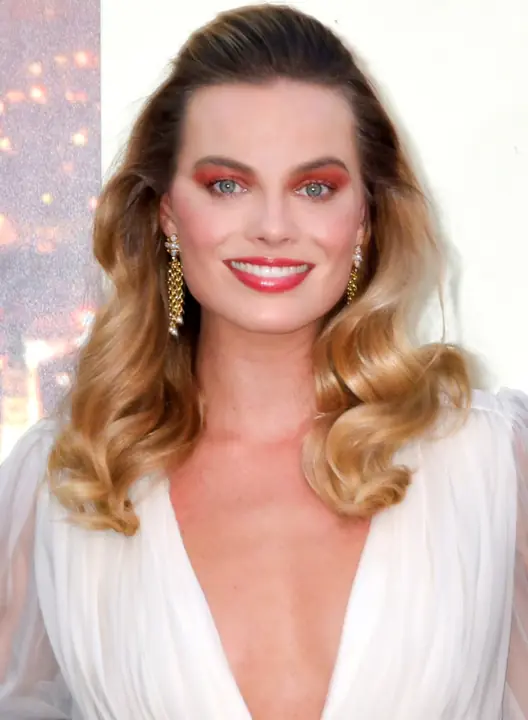
Once Upon a Time in... Hollywood (2019): Sharon Tate smiling in a white dressImage: Wikimedia Commons · Toglenn, CC BY-SA 4.0 - #176
The brief scene with Bruce and Jay was filmed at 9810 Easton Drive, in Beverly Hills, CA. This was the very home in which Jay Sebring lived at the time. Prior to the end of their relationship, Sharon Tate lived at the residence with Jay Sebring.
- #177
Randy Miller (Kurt Russell) refuses to work with a stuntman due his history of domestic violence. During the filming of Executive Decision (1996), Russell refused to work with Steven Seagal after accusations began to surface of him abusing his wife. Seagal was consequentially fired and written out of the rest of the script by abruptly killing his character.
- #178
When Margaret Qualley puts her feet on the dashboard, there are visible signs of discoloration and damage to her feet. This is because she trained as a ballet dancer when she was younger.
- #179
QT said on Reel Blend podcast that Rebecca improvised her name of Natalie and she named her own character on the spot.
- #180
Contains a major spoiler — show
A flashback shows Rick Dalton training to use a flamethrower, and recoiling from the heat it generates. This was Leonardo DiCaprio's genuine reaction to the flamethrower. Tarantino thought it was funny, and left it in the movie.
Characters & Cast (24)
- #181
Quentin Tarantino and Brad Pitt based Cliff Booth on Tom Laughlin's portrayal of Billy Jack, first appearing in The Born Losers (1967), and Cliff's "double denim" outfit is a copy of Billy Jack's outfit from that film. The novelization revealed that Cliff did stunt work on The Born Losers, and that the denim outfit was gifted to him after filming wrapped.
- #182
Margaret Qualley's character 'Pussycat' is based on Manson Family member Ruth Ann Morehouse (nickname "Ouisch").
- #183
Quentin Tarantino based the Rick Dalton character on a number of actors of the era. The most obvious influence is Steve McQueen who, like Dalton, found early success on the 1950s western series Wanted: Dead or Alive (1958). Unlike Dalton, McQueen made a successful transition from television to films and would remain an A list star throughout the 1960s. Other influences were Edd Byrnes, Ty Hardin, whom Tarantino referred to as "a poor man's Steve McQueen", and Pete Duel. Like Dalton, Duel was the star of a western television series, Alias Smith and Jones (1971), had issues with alcohol and had his driver's license revoked after arrests for drunk driving. Similar to Cliff Booth (Brad Pitt), Duel's stand-in, Harold 'Hal' Frizzell, acted as Duel's chauffeur. There are also notable parallels between the Dalton character and Clint Eastwood's career. Eastwood was still starring in the TV western "Rawhide" when he appeared in A Fistful of Dollars (1964), the first of the three spaghetti westerns he made with Sergio Leone.
- #184
The real life sister of Sharon Tate was so moved by Margot Robbie's portrayal of Tate she claimed she "cried real tears, I had a big wet patch of tears down the front of my shirt. It was like having my sister back again, after 50 years."
- #185
The portrayal of Sam Wanamaker is of an extremely arty, imaginative man, which is very much like Wanamaker was in real life. Being strongly influenced by his many years playing Shakespeare characters on the British stage, he tended to be overly-theatrical. In the pilot episode of Lancer (1968), a fair amount of this weirdness shows through. The opening scenes show two good guys responding to a late-night horse theft and riding off without cowboy hats, making the audience wonder if this was present-day. Presumably Wanamaker rationalized this hatless aspect as depicting haste, yet he forgot about how this might be interpreted by an audience. Also, they were both wearing plaid shirts, with was also odd. Plus much of the camera work, angles, sudden zooms and the like were very strongly influenced by TV detective shows of the day. These were reflections of Wanamaker's personality, which no doubt were noted by Quentin Tarantino when scripting and directing the Wanamaker portrayal. It might also be noted that Leonardo DiCaprio's scruffy, shaggy-haired, mustachioed hippie-villain in this film was very closely modeled on the look that Wanamaker designed for the original actor, Joe Don Baker.
- #186
Rick stutters in "real life" when stressed, but never when acting.
- #187
There are strong indicators that Cliff Booth was based on Hal Needham. As the highest paid stuntman in the world, Needham broke 56 bones, broke his back twice, punctured a lung, and knocked out a few teeth. His career included work on 4,500 television episodes and 310 feature films as a stuntman, stunt coordinator, 2nd unit director and ultimately, director. One of the major films he directed was Smokey and the Bandit (1977), which starred Burt Reynolds who was the actual actor in the episode of The F.B.I. (1965) that Rick Dalton supposedly played.
- #188
Considering the FBI episode featuring Rick Dalton as a guest star actually featured Burt Reynolds in the role, Dalton's character is an amalgam of Reynolds and other actors. Although Reynolds never starred in his own TV western, he did appear on 50 episodes of Gunsmoke (1955) and he did star in two police detective series, Hawk (1966) and Dan August (1970). During the sixties and early seventies he guest starred on a number of series, usually as the bad guy, and did not reach serious stardom until the blockbuster film Smokey and the Bandit (1977). As for spaghetti westerns, Dalton is most closely related to Clint Eastwood, whose career seemed to have peaked as a regular on Rawhide. During the summer break before the final season, he flew to Spain to film the iconic film A Fistful of Dollars (1964). As with Eastwood, Dalton's spaghetti westerns appear to have turned his career around.
- #189
Maya Hawke, who plays 'Flowerchild', is the real life daughter of Uma Thurman, who previously starred in three of Tarantino's films.
- #190
Madisen Beaty, who plays Patricia Krenwinkel (Katie) in this movie, previously played the same role on the TV series Aquarius (2015).
- #191
In one scene Sebring brags about his income (the 2022 equivalent of $8,121 a day). While most haircuts would cost between $1 and $2, he would charge $50 ($400 in 2022 dollars). After meeting a friend of Frank Sinatra at a party, he flew to Las Vegas to give him and trim and from that point on he was the barber to the stars, with clients ranging from Paul Newman to Jim Morrison. Jay Sebring was the one who introduced the combination of shampoo, scissor cut, blow dry and hairspray - a technique that, other than mousse vs hairspray, is now the industry standard. At the time the standard was electric clippers and Brylcreem hair cream.
- #192
Shannon Lee, daughter of legend Bruce Lee, was most disappointed with the way her father was portrayed by actor Mike Moh under Quentin Tarantino's direction. She felt he was sorely misrepresented as an arrogant blowhard who was full of hot air.
- #193
Clifton Collins Jr., who plays the Lancer (1968) ranch hand, has a strong connection to Hollywood of the fifties and sixties. His grandfather was character actor Pedro Gonzalez Gonzalez who was discovered by John Wayne when he was an inadvertently hilarious guest on the game show You Bet Your Life (1950) and who subsequently played supporting roles in a number of Wayne's movies.
- #194
One of the Italian films in which Rick stars is said to be directed by an Antonio Margheriti. In "Inglourious Basterds (2009)," "Antonio Margheriti" is the alias used by Donny Donowitz to sneak into the premiere of "Nation's Pride."
- #195
Roman Polanski calls his dog 'Dr. Sapirstein'. This was the name of a character in Rosemary's Baby (1968), his latest film at the time.
- #196
Nicholas Hammond got word from a friend that Quentin Tarantino had screened a restored 35mm print of The Amazing Spider-Man (1977) TV pilot at his New Beverly Cinema. Hammond portrayed the title character in the pilot. Touched, Hammond had his manager pass word onto Tarantino that he was grateful to hear about the screening and if he were back in Los Angeles next time, he'd love to meet the director. Tarantino responded with "Come see me." and they eventually met with Tarantino asking Hammond if he knew who Sam Wanamaker was, which Hammond did. Tarantino gave Hammond a DVD of Lancer (1968), whose pilot Wanamaker directed, and told him to watch it when he got home. Hammond was surprised to get a call from his manager to notify him that Tarantino was offering him the role of Wanamaker in this film. Hammond said "I owe it all to Peter Parker." (Spider-Man's alter ego).
- #197
In reality, Bruce Dern, who portrays George Spahn, guest starred as the bad guy in nearly every TV show mentioned by both Rick Dalton and Marvin Schwarz. Among many others, these include Bonanza (1959), The F.B.I. (1965), Land of the Giants (1968), and The High Chaparral (1967). He also played a villain in both the first and second seasons of Lancer (1968). After his character killed John Wayne's character in The Cowboys (1972) he became the most notorious villain in the history of westerns.
- #198
In one of the scenes, when everyone is leaving the set after filming Lancer (1968), James Stacy, played by Timothy Olyphant, rides away on a period-correct Triumph Bonneville. In real life, a drunk driver hit Stacy and his girlfriend while he was riding the same type of motorcycle in 1973. The accident ultimately killed his girlfriend and caused Stacy's left arm and leg to be amputated.
- #199
The ticket seller at the movie theater, played by Kate Berlant, uses a plastic Kodak Instamatic camera. Rather than using film on rolls, the film is loaded into a plastic cassette that the user can drop into the camera, give the lever a couple of cranks and be ready to shoot. It also uses a disposable plastic flash cube. This contains four small flash bulbs and is designed to rotate 90º with each film advance. This system was wildly popular in the late sixties and early seventies.
- #200
The billboard outside Pantages theater announces the movie Three in the Attic (1968) starring Yvette Mimieux. This is the last name used by Shoshanna Dreyfus for her disguise as theater owner Emmanuelle in Tarantino's Inglourious Basterds (2009) .
- #201
The fictional character's name "DeCoteau", thought to be pronounced Dakota by Rick, is actually also wrongly pronounced by other characters as it should be "Duh-Koe-Toe" from the French "Of the Hillside".
- #202
The television series 'Bingo Martin' and its star Scott Brown referenced in the meeting between Rick Dalton, played by Leonardo DiCaprio, and Marvin Schwarz, played by Al Pacino, never existed; both the TV show and star were created for the movie.
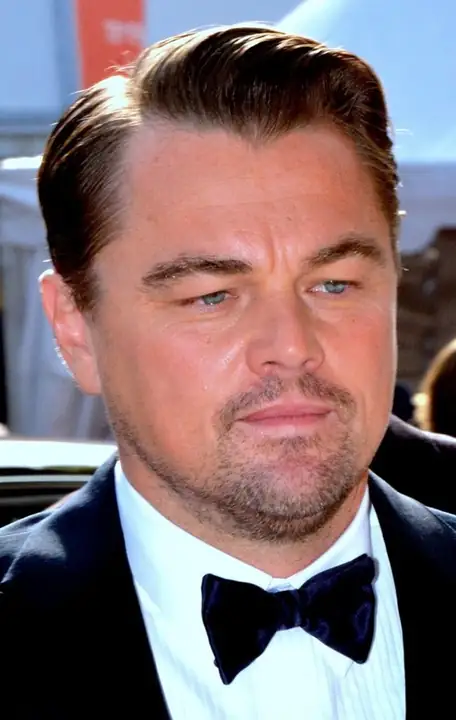
Once Upon a Time in... Hollywood (2019): Rick Dalton in a tuxedo and bow tie looking seriousImage: Wikimedia Commons · Georges Biard, CC BY-SA 3.0 - #203
Contains a major spoiler — show
The character Flowerchild (Maya Hawke), who is shown having cold feet on going through with the murders, and who flees the scene in the 1959 Ford Galaxie, is based on Linda Kasabian, who became a witness for the prosecution in the murder trial of Tex Watson, Patricia Krenwinkel, and Susan Atkins. In real life Kasabian was ordered by Tex Watson to wait in the car, during which she heard the murders inside the Tate residence take place and witnessed the murder of Wojciech Frykowski outside the house. Kasabian claimed she wanted to drive away, but was too scared.
- #204
Contains a major spoiler — show
The movie makes the death of Cliff Booth's wife Billie ambiguous. Rick Dalton believes that her death (she was torn in half by a speargun firing) was an accident, while most other characters in the film believe Cliff murdered her in cold blood and got away with it. In the Tarantino-written novelization, though, it's confirmed that Cliff shot Billie intentionally because she was screaming at him and tried to slap him in the face. He got away with it because the police just accepted his false story it was an accident, and Billie was so widely disliked that no one ever tried to reopen the case and get Cliff charged with murder.
Easter Eggs & References (97)
- #205
During the mid-credits Red Apple Tobacco commercial, Rick Dalton says, "Take a bite and feel all right." Quentin Tarantino previously used this phrase in his published screenplay for From Dusk Till Dawn (1996); it is spoken by Seth Gecko (George Clooney) during that film's climactic fight, but was not included in the final cut.
- #206
One of the westerns Rick Dalton stars in (Red Blood, Red Skin) is based on the novel "The only good Indian is a dead Indian" by Floyd Wilson. Floyd Wilson is the boxer killed in the fight with Butch in Pulp Fiction.
- #207
In one of the scenes, when everyone is leaving the set after filming Lancer (1968), James Stacy, played by Timothy Olyphant, rides away on a period-correct Triumph Bonneville. In real life, a drunk driver hit Stacy and his girlfriend while he was riding the same type of motorcycle in 1973. The accident ultimately killed his girlfriend and caused Stacy's left arm and leg to be amputated.
- #208
In reality, Bruce Dern, who portrays George Spahn, guest starred as the bad guy in nearly every TV show mentioned by both Rick Dalton and Marvin Schwarz. Among many others, these include Bonanza (1959), The F.B.I. (1965), Land of the Giants (1968), and The High Chaparral (1967). He also played a villain in both the first and second seasons of Lancer (1968). After his character killed John Wayne's character in The Cowboys (1972) he became the most notorious villain in the history of westerns.
- #209
In the scene where the Manson murderers are confronted by Rick Dalton, the sound of the car was dubbed from the same sound as the car from the movie Christine when Arnie drove it into the garage. The owner even called Christine a "mechanical asshole", which was the same name Rick called the murderers car.
- #210
Rick Dalton is shown in a clip singing "What's Behind the Green Door?" It's later revealed Rick Dalton's front door is green.
- #211
WILHELM SCREAM: The movie opens with a clip from the fictional Rick Dalton series "Bounty Law." A man is shot and falls off a roof, at which point he lets out a big Wilhelm scream, an inside joke in the movie industry which pops up in several other Tarantino films.
- #212
Dalton questions Wanamaker about how the public will recognize him as villain Caleb DeCoteau due to the disguise created for it. It's loosely inspired by Once Upon a Time in the West (1968), where Henry Fonda, as the villain, was given unusually dark makeup in order to distance himself from the familiar and friendly person that was so well known to the audience..
- #213
Not counting the 'archive footage' interview on the set of Bounty Law at the beginning, Cliff Booth's first and last lines in the 'present' 1969 portion of the film are the same - "I try." In both instances, it is in response to someone telling him he is a good friend to Rick.
- #214
In one scene, a framed issue of MAD Magazine (dated October 1965) is visible in Dalton's apartment, with a drawing of Dalton himself on the cover. Longtime MAD artist Tom Richmond was recruited to draw the cover. As a tie-in with the movie, the October 2019 issue of MAD Magazine was billed as a "Special Tarantino Time-Warp Issue" with a 1960s style contents page, the first 12 pages in black and white, a parody of "Bounty Law" and Rick Dalton on the front cover (different from the cover seen in the movie).
- #215
Sharon Tate puts her feet up on a seat in the theater while watching The Wrecking Crew (1968). If one looks closely you can see that her feet are rather dirty. In real life, Tate hated wearing shoes and would take any possible opportunity not to wear any in public unless the situation absolutely called for it. Tate would even go as far as wearing rubber bands on her feet to give the illusion of wearing sandals while out eating at restaurants.
- #216
When Cliff Booth drives home from Rick Dalton's, the camera goes over a "Drive-In Theatre" while Keith Mansfield's "Funky Fanfare" is heard on the soundtrack, which is the music used behind the "Our Feature Presentation" clip seen in several other Quentin Tarantino films. This music can be heard at the start of every movie at all Alamo Drafthouse Theaters.
- #217
In one scene, Roman Polanski walks to his car sporting a blue velour suit with ruffled white cravat. Django wears almost the exact same Fauntleroy outfit in Quentin Tarantino's earlier film Django Unchained (2012), created by costumer Sharen Davis as a tribute to Thomas Gainsborough's painting "The Blue Boy." This was a nod to the British mod look which was in part brought to the States by The Who. By 1969 the look was out.
- #218
Randy Miller (Kurt Russell) refuses to work with a stuntman due his history of domestic violence. During the filming of Executive Decision (1996), Russell refused to work with Steven Seagal after accusations began to surface of him abusing his wife. Seagal was consequentially fired and written out of the rest of the script by abruptly killing his character.
- #219
The ticket seller at the movie theater, played by Kate Berlant, uses a plastic Kodak Instamatic camera. Rather than using film on rolls, the film is loaded into a plastic cassette that the user can drop into the camera, give the lever a couple of cranks and be ready to shoot. It also uses a disposable plastic flash cube. This contains four small flash bulbs and is designed to rotate 90º with each film advance. This system was wildly popular in the late sixties and early seventies.
- #220
One of the Mexican restaurants featured in the movie is Casa Vega. It was a famous Los Angeles restaurant around the time the movie is set, and it shares the name Vega with Vincent Vega, one of the main characters in Pulp Fiction (1994).
- #221
The arrival at Playboy Mansion is accompanied by "Hush" with Deep Purple. Deep Purple performed this on Playboy After Dark in one of their first TV appearances.
- #222
After the camera follows a Pan Am stewardess up the spiral staircase of a 747, the first appearance of Margot Robbie shows her dancing in the upstairs lounge of the jetliner. Robbie portrayed a Pan Am stewardess in the TV series Pan Am (2011).
- #223
When Sharon goes to the Bruin theatre to see the film she is in, a poster of The Mercenary (1968) can be seen. "The Mercenary" starred Franco Nero, who stood alongside Jamie Foxx at the bartop in Django Unchained (2012). Franco Nero was the original Django.
- #224
Another song by The Mamas and the Papas, "Twelve Thirty" ("young girls are coming to the canyon") is heard later in the film. This song is about Laurel Canyon, where a lot of '60s musicians lived, including Jim Morrison, Carole King, Joni Mitchell, and Peter Tork, as well as Crosby, Stills, and Nash. There are, of course, a lot of young girls in this film. The Tate/Polanski house was in Benedict Canyon, but another massacre, the Wonderland murders, took place in Laurel Canyon in 1981.
- #225
The trailer for the fictional "Bounty Law" that is seen at the beginning of the film is modeled after one for the real Steve McQueen show, "Wanted: Dead or Alive" (1958-1961). It even has a similar shot of the star ripping a "wanted" poster off its posted position, although in the original trailer, McQueen approaches the posters from the left and uses his left hand to rip the poster down.
- #226
The director of Rick Dalton's film Operazione Dyn-O-Mite, Antonio Margheriti, wasn't just the name of an alias used previously in Inglourious Basterds (2009). Antonio Margheriti was actually a real Italian filmmaker who did most of his directing in the 1960s and 1970s.
- #227
The TV at George Spahn's house has one of the earliest unwired remote controls, the Zenith "Space Command" remote. Rather than using infrared or similar technology from later years, it uses ultra high frequency sound. The remote features four buttons, each of which trips a spring-loaded hammer that strikes a metal rod. Each rod produces a different inaudible pitch. As each button press makes a loud click, many people simply referred to the device as a "clicker". A rather humorous failing of this system is that if you jingled your car keys it could cause the TV to turn on.
- #228
The casting of Kurt Russell and Zoë Bell as the man and wife stunt coordinators on The Green Hornet (1966) is a double inside joke to Tarantino's films. Russell previously played "Stuntman Mike" in Death Proof (2007), in which Bell, a real-life stunt performer, also appeared playing herself. Zoë Bell served as Uma Thurman's stunt double in Kill Bill, and Kill Bill: Vol. 1 (2003) featured the theme to The Green Hornet on its soundtrack.
- #229
In the scene at Spahn Ranch the name Randi Starr can be seen as a sign on the main street buildings. Starr was a real ranch hand and stunt man who worked at the ranch. He died during the Tate La Bianca trial.
- #230
Rick references the "3 Georges'" while relating his audition tale for The Great Escape (1963). George Maharis was the star of Route 66 (1960) who left the successful show before it's final season to pursue a film career (sound familiar?). George Chakiris is the Oscar winning actor from West Side Story (1961) and George Peppard starred in Breakfast at Tiffany's (1961). All three actors were at their prime/hottest at the time The Great Escape (1963) was being cast.
- #231
At the beginning scene of Rick and Cliff's return to the states from Italy on the 747, Rick is served a drink which is presented in the form of photographer William Eggleston's famous "Untitled" (Glass on Plane, 1965-1974) of a jewel-like mixed drink being stirred in front of a sunny jet cabin window.
- #232
On his flight home from Italy, Rick (Leonardo DiCaprio) flies the airline PanAm. In the film The Aviator (2004), this was the nemesis of Howard Hughes and TWA. Hughes was also played by DiCaprio.
- #233
In the promo for Bounty Law, Rick Dalton says anyone who tries to bring in a bounty alive, when dead is an option, is an idiot. This directly contrasts with Kurt Russell's character in The Hateful Eight (2015): a bounty hunter who prides himself on bringing in his bounties alive, so as not to cheat the hangman.
- #234
The fictional "Red Apple" brand of cigarettes is the brand that Tarantino uses in every movie. In the Rick Dalton commercial the art on the pack has been changed to give the worm a cowboy hat. As Rick Dalton says at the end of the Red Apple shoot during the end credits, these are truly awful cigarettes.
- #235
On the flight back from Italy, the passenger next to Cliff Booth is reading Time Magazine from August 8, 1969, with John Wayne on the cover.
- #236
One of the Italian films in which Rick stars is said to be directed by an Antonio Margheriti. In "Inglourious Basterds (2009)," "Antonio Margheriti" is the alias used by Donny Donowitz to sneak into the premiere of "Nation's Pride."
- #237
Sharon Tate (Margot Robbie) is playing an album by Paul Revere & The Raiders. The album was produced by Terry Melcher, who previously occupied the house where Tate and Roman Polanski lived and was the original target, along with his girlfriend Candace Bergen, of Charles Manson and his family.
- #238
In second bar scene while shooting Lancer, Johnny Madrid enters the bar and Trudy Frazer's character calls him Scott. Scott Lancer is the brother of Johnny Madrid's character in the TV show Lancer (1968).
- #239
In the scene where Cliff Booth gathers tools from Rick Dalton's work-shed in order to repair Rick's fallen antenna, the flamethrower can be seen on the floor, leaning against the wall.
- #240
The Champion spark plugs T-shirt was definitely a familiar item during the time in which this film was set. High performance street cars were extremely popular at the time and drag racing was at its absolute peak of popularity. The most popular T-Shirt designs, however, were Ford (Mustang) and Chevy (Camaro) T-shirts, with Pontiac (Firebird) and Dodge (Charger) just behind them. At the time, the average car enthusiast was very much in either the Ford camp or the Chevy camp. Culturally, it was the Windows vs Mac rivalry of its day.
- #241
The cream Cadillac Brad Pitt drives belongs to Michael Madsen. It also appeared in Reservoir Dogs (1992) driven by Madsen. Also, Pitt and Madsen both appeared in Thelma & Louise (1991) as the title characters' lovers.
- #242
The music for final scene of Dalton meeting his neighbours is a homage to Sergio Leone's finale music from Once Upon a Time in the West.
- #243
After Rick and Cliff leave the bar in the beginning of the movie, a news bulletin can be heard coming from the car radio. It is about Sirhan Sirhan, who murdered Senator Robert F. Kennedy who won the Democratic primary in California in 1968 and was shot after giving his victory speech. The scene takes place on February 8, 1969, two days before a motion to enter a guilty plea to first-degree murder was made in Sirhan's case.
- #244
Roman Polanski calls his dog 'Dr. Sapirstein'. This was the name of a character in Rosemary's Baby (1968), his latest film at the time.
- #245
This movie is full of references to the late '60s culture some of which are so subtle most people may not even realize it. One of these is when Cliff Booth at the ranch goes to talk to George Spahn only to be blocked by Lynette 'Squeaky' Fromme. When she finally gives up and lets him into the house she goes and watches TV. On the TV is a commercial for Noxema's Cover Girl Makeup (which featured the famous tag line, "You never know, the next boy you meet may be the one. Better be ready!"). The significance of this commercial is that it featured a then unknown Susan Dey, who got so much recognition from it she was asked to audition to play Laurie in The Partridge Family (1970), which led to later success in L.A. Law (1986), where she was nominated for three Emmys and five Golden Globes.
- #246
When Cliff Booth and Bruce Lee square off for their fight, they are being watched by many crew members and studio workers. After Cliff throws Bruce into the blue car, all the observers have mysteriously disappeared, illustrating the unreliability of Cliff's memory of how the event really happened.
- #247
As Cliff roughs up Clem at the Spahn Ranch over the tire slashing incident, Gypsy sends for Tex (riding horseback out on the trail). The time to get to Tex and back to the ranch could be as much as 45-60 minutes; enough time to have the tire on the Cadillac changed and Cliff to be on his way.
- #248
Rumer Willis plays Joanna Pettet, fellow actor and friend of Sharon Tate. Her father, Bruce Willis, starred in Pulp Fiction (1994), also directed by Tarantino.
- #249
Photos on the wall in George Spahn's house include Zorro and The Lone Ranger and Tonto. Both series used Spahn's ranch for filming locations some fifteen years earlier.
- #250
In one part of the movie, Sharon Tate (Margot Robbie) goes to see her own movie in the theater. When the cast was asked in an interview if they've ever done the same thing, Director Quentin Tarantino revealed he has. He admitted to once taking a date out to see True Romance (1993), which he wrote the screenplay for. Ironically, Tarantino revealed he has also gone to the Bruin Theater, the same place Sharon Tate goes to in the movie.
- #251
As the Tate party enters the El Coyote restaurant for dinner, Sharon Tate and Jay Sebring discuss a movie premiere they can see taking place further down Beverly Blvd at an erotic movie theatre. "They have premieres for dirty movies?" asks Sharon. The theatre in question is the Eros, a real adult theatre of the time. The building still exists, though it is now a repertory cinema called The New Beverly, and it is owned by Quentin Tarantino.
- #252
The song that Sharon plays is Good Thing by Paul Revere & The Raiders from their album, Spirit of '67. Raiders singer Mark Lindsay was good friends with record producer Terry Melcher and for a while the two shared a house; a place that was ideal for parties. After Melcher moved out, this was the house where Tate would live and which, because of Melcher, was targeted for attack by Charles Manson. It is possible that Tate knew that two former residents of her home were connected to the record she was playing: it was by Mark Lindsay's band and produced by Terry Melcher.
- #253
Dalton is listening to the 1966 song Snoopy vs. the Red Baron by the Royal Guardsmen. In the mid-sixties, a recurring element in the Peanuts comic strip was of the dog Snoopy fantasizing about being a World War I fighter pilot battling the German ace Baron von Richthofen. This novelty song was based on that theme. It made it all the way to number two on the charts, right below I'm a Believer by the Monkees.
- #254
The Comanche Uprising poster in Rick's driveway is an homage to the Burt Reynolds western Navajo Joe (1966).
- #255
Sam Wanamaker is portrayed by Nicholas Hammond. The films producer David Heyman worked with Zoë Wanamaker (who is the daughter of the real Sam Wanamaker) in Harry Potter and the Sorcerer's Stone (2001).
- #256
The billboard outside Pantages theater announces the movie Three in the Attic (1968) starring Yvette Mimieux. This is the last name used by Shoshanna Dreyfus for her disguise as theater owner Emmanuelle in Tarantino's Inglourious Basterds (2009) .
- #257
The scar on Cliff Booth's forehead has the same shape and location as the scar on Ernest Hemingway's forehead.
- #258
In the film, when Sharon purchases the first edition of Tess of the d'Urbervilles, she would likely be purchasing the American first edition published by Harper & Brothers in 1892. The actual first edition was published in three volumes by Osgood in London in 1891. In reality, Sharon bought the book for Roman while they were in Europe working on a film and it is unlikely she purchased the three volume Osgood edition and would likely have bought him the Macmillan & Co. Ltd, London 1926 edition. Either way, it would be the last gift she ever gave Roman and the last time he saw her as she returned to America shortly after giving him the book never to fulfill Roman's wish for her to play Tess.
- #259
The second scene featuring Sharon Tate reveals a hint of the second-rate nature of the film, The Wrecking Crew (1968). At one point, at the lower center of the shot you can see the upper back of a control console, which is supposedly against the wall. Other shots in that film, not shown here, reveal the entire back of the console making it seem like the wall is invisible.
- #260
The design on the wall in the airport is identical to the design on the wall in the airport shown in the opening scene of Jackie Brown (1997). Both scenes were shot at Los Angeles International Airport.
- #261
On Sunday night, Rick and Cliff sit down to watch "Rick's episode" of The F.B.I. (1965). The audience is later told that the episode is All the Streets Are Silent (1965). That is a real episode of the television show, and the ensuing clip is the actual opening to that episode, with one important difference - Rick Dalton has been edited into the place of the guest star villain, "Michael Murtaugh." In reality, the role of Murtaugh in the episode was played by Burt Reynolds, who was known for open-mouthed gum-chewing, which is a likely reason why Rick and Cliff refer to the gum chewing as "strong".
- #262
Cliff Booth is suspected of killing his wife, while KHJ "boss jock" Humble Harve Miller, who is heard on the car radio in several scenes, actually did kill his wife in 1971.
- #263
In the scene where Cliff drives pussycat to Spahn ranch, and the hippies are inside the house observing, faintly on the TV you can hear Happening 68 by Paul Revere and the Raiders. This song was a theme to the variety show Happening 68.
- #264
Walton Goggins narrated a commercial for Old Chattanooga Beer, a fictional beer that was previously featured in Death Proof (2007), but it was only included in the extended edition. This is the third consecutive collaboration between Goggins and Quentin Tarantino, after Django Unchained (2012) and The Hateful Eight (2015).
- #265
There is a scene in the movie where Rick is worried about his future and says to Cliff (Brad Pitt) his line that ends with "by then I'll know if I have a career or not, if I'm a solid Los Angeles citizen like Eddie O'Brien says or if I'm one step closer to going back to Missouri." This is funny because Brad Pitt was from Springfield, Missouri before he became a movie star.
- #266
When Rick Dalton makes blended margaritas at the end of the film, he rocks his blender back and forth in the exact same motion Melanie does in Tarantino's earlier film Jackie Brown (1997).
- #267
At one point, a theater marquee can be seen advertising a movie which is Rated "M," The original MPAA ratings for film content, which would have come into effect not long before the time the film is set, were G (General Audiences, still in use today), M, (Mature - parental discretion advised) R (Restricted, still in use today), and X (Adults Only). As the M rating confused audiences (they didn't know if an M or an R movie was stronger in its content), the M rating was eventually changed to GP, and not long thereafter, to PG (Parental Guidance Suggested), which is still in use today.
- #268
Rick Dalton's fictional filmography includes a B-movie titled "Drag Race, No Stop." When Quentin Tarantino was trying to get his start in the film industry, he convinced people he appeared in a non-SAG film by the same name. The movie "Drag Race, No Stop" was never real.
- #269
Sharon Tate (Margot Robbie) visits a book store to pick up a copy of "Tess of the d'Urbervilles." The real Sharon Tate gave husband Roman Polanski a copy of the book while in Europe, just before she returned to the US, saying that it would make a great film in which she herself would love to star. This was the last time Polanski saw Tate alive. He would later adapt the book as Tess (1979), dedicated to his murdered wife.
- #270
During the scene in which George Spahn is struggling to identify Cliff Booth, he mishears his name as John Wilkes Booth. John Wilkes Booth was the man who assassinated president Abraham Lincoln on April 15 1865. The woman who questions Cliff before allowing him to enter, and sitting one room away from this exchange, is the notorious Charles Manson acolyte Lynette 'Squeaky' Fromme. On September 5 1975, Fromme made an unsuccessful attempt to assassinate President Gerald Ford. Interestingly, Lincoln was assassinated in Ford's Theatre in Washington DC, and Fromme's attempt on Ford was in Capitol Park after he had entered from Lincoln street in Sacramento, California.
- #271
In the final segment of the movie, Voytek is reading a TV Guide with Andrew Duggan on the cover. Duggan played the title character in the real TV show Lancer (1968), in which the fictional Rick Dalton guest-starred in the Pilot.
- #272
When Charles Manson goes to the Polanski house and Jay tells him that Terry and Candy aren't there, he was talking about Doris Day's son, record producer Terry Melcher and his then girlfriend, actress Candice Bergen. Manson also mentions Beach Boys drummer Dennis Wilson. Dreaming of a career in music, Manson had played and sung some of his songs to Wilson and one of them ended up being recorded by the Beach Boys. The song, originally entitled Cease to Exist, appeared under the name Never Learn Not To Love on the B-side of a single.
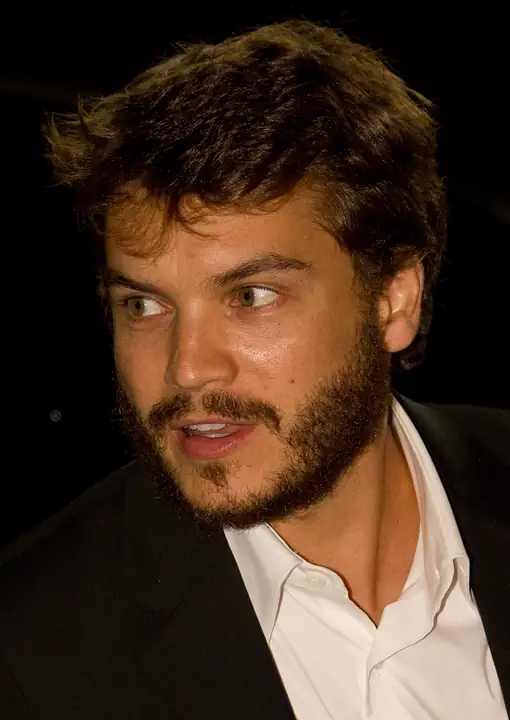
Once Upon a Time in... Hollywood (2019): Jay Sebring speakingImage: Wikimedia Commons · Tabercil, CC BY-SA 2.0 - #273
The Manson Family murdered Sharon Tate shortly after midnight on August 9, 1969. Less than 24 hours earlier in London, The Beatles were photographed crossing Abbey Road for the cover of their album Abbey Road. Charles Manson was obsessed with the Beatles, particularly their "White Album," and he told his followers that their songs contained hidden messages. The prosecutors of the Mansons argued that the murders were inspired by Manson's prophesied apocalyptic race war called "Helter Skelter," after the song from the "White Album."
- #274
Cliff feeds his dog Wolf's Tooth dog food, with the slogan Good Food for Mean Dogs. Specifically, he feeds it one can of Rat flavor and one can of Raccoon flavor. Other flavors seen in the cabinet are Bird flavor and Lizard flavor. .
- #275
The thug played by in the episode of The F.B.I. (1965) was played by Burt Reynolds in the actual TV episode. IThe episode of Lancer (1968) with Rick Dalton as DeCoteau is directed by Sam Wanamaker. In real life Wanamaker directed Reynolds in the pilot episode of Reynolds'short-lived TV detective show Hawk (1966).
- #276
KHJ radio advertisements are spread throughout the movie. When Cliff picks up Dalton from the day of shooting on Lancer (1968) the building seen in the background is the former headquarters of KHJ radios. It is now part of the Paramount Studios Complex.
- #277
Tex tells the girls to split up afterwards and find their own ways back. For the LaBianca murders, Manson did the driving, then left them behind with the same instructions.
- #278
Shorty Shea was a ranch hand employed by George Spahn. He had tried to warn Spahn about the dangerous nature of the Manson family. At some point he was jumped and then killed. One of the killers was Steve Grogan, "Clem" the hippie who knifes the tire and is confronted by Cliff. As he starts to change the tire you can see a cowboy in a corral in the background. The cowboy in the shot may have been Shorty. Shea's remains were found near the ranch in 1977, after Clem agreed to tell police where to look.
- #279
In one scene, a framed issue of MAD Magazine (dated October 1965) is visible in Dalton's apartment, with a drawing of Dalton himself on the cover. Longtime MAD artist Tom Richmond was recruited to draw the cover. As a tie-in with the movie, the October 2019 issue of MAD Magazine was billed as a "Special Tarantino Time-Warp Issue" with a 1960s style contents page, the first 12 pages in black and white, a parody of "Bounty Law" and Rick Dalton on the front cover (different from the cover seen in the movie).
- #280
When Sharon is shouting over 'Hungry' by Paul Revere & The Raiders, to Jay Sebring, about him preferring the Doors music and his friend Jim Morrison; Sebring's friends included many top celebrities including Morrison. Jay was responsible for Morrison's infamous hairstyle (on the Doors album cover) as well as Roman Polanski's, Steve McQueen's, Bruce Lee's and most of men's "new look" in hair styling during this era.
- #281
The Lancer (1968) episode being filmed within the movie appears to be The High Riders (1968) with DiCaprio's character in the part played by Joe Don Baker, complete with long mustache. This episode was indeed directed by noted Shakespearean actor Sam Wanamaker (hence the reference to Hamlet).
- #282
Photos on the wall in George Spahn's house include Zorro and The Lone Ranger and Tonto. Both series used Spahn's ranch for filming locations some fifteen years earlier.
- #283
Of all the actors in the film, the one who was most familiar with the Hollywood of the day was Kurt Russell. Kurt began his career as a child actor on television in 1962. His father, Bing Russell, had also spent many years guest starring on shows, as well as playing a recurring role as a deputy sheriff in Bonanza (1959). Bing was an actor who was never lucky enough to have his own series like Rick Dalton but he found his niche and hung in there, largely in roles as film extras. This makes Kurt Russell the ideal person to cast as the narrator of this film.
- #284
The Columbia Pictures Release intro at the beginning of the film is authentic for the 1960s. It was recycled from an unknown Columbia Pictures film from the same period and wasn't even remastered in order for it to keep its scratched, slightly faded look. The only nod to modernity is the (digital) addition of the Sony name at the bottom of the screen (Sony acquired Columbia Pictures in 1989). As an additional piece, Columbia Pictures television arm of the era, Screen Gems, is also name-checked in the film.
- #285
In the actual Lancer (1968) TV series, Murdoch Lancer's ward Teresa was played by Elizabeth Baur, who was 21 years old at the time and who was supposed to provide sexual tension between the two half-brothers. Tarantino took a creative approach by casting nine-year-old Julia Butters. On the one hand, this made the threat by Dalton's character more serious. On the other hand, this allowed Tarantino to give a nod to Margaret O'Brien. who was perhaps the greatest child actor in history, upon whom his version of the Teresa character was obviously based.
- #286
In the final segment of the movie, Voytek is reading a TV Guide with Andrew Duggan on the cover. Duggan played the title character in the real TV show Lancer (1968), in which the fictional Rick Dalton guest-starred in the Pilot.
- #287
The Comanche Uprising poster in Rick's driveway is an homage to the Burt Reynolds western Navajo Joe (1966).
- #288
Tarantino's final homage to the time period is an audio of Batman and Robin (Adam West and Burt Ward) promoting their television show (1966-68) and became, for a time, a massive hit. (although it had actually already been canceled by the time of the events in the film). The promotion centered on encouraging listeners to guess the Bat-phone secret number, and consisted of ten clues to the answer, given on different nights. The term "bat-phone" itself originated with the Batman television series, in which Police Commissioner Gordon used a red phone to summon Batman in emergencies. On Batman's side, there was a phone in his study, the Batcave, and the Batmobile. Since that time, the term has evolved far and wide to mean almost any kind of special telephone or telephony system used for a direct, immediate connection between two or more individuals where there is an emergency or priority situation. This includes, in business, private telephone numbers that have higher priority than a number that is more "public," or a second mobile phone reserved for a dedicated purpose, or for specific callers.
- #289
On the flight back from Italy, the passenger next to Cliff Booth is reading Time Magazine from August 8, 1969, with John Wayne on the cover.
- #290
When Rick Dalton makes blended margaritas at the end of the film, he rocks his blender back and forth in the exact same motion Melanie does in Tarantino's earlier film Jackie Brown (1997).
- #291
In one scene, Roman Polanski walks to his car sporting a blue velour suit with ruffled white cravat. Django wears almost the exact same Fauntleroy outfit in Quentin Tarantino's earlier film Django Unchained (2012), created by costumer Sharen Davis as a tribute to Thomas Gainsborough's painting "The Blue Boy." This was a nod to the British mod look which was in part brought to the States by The Who. By 1969 the look was out.
- #292
Given the nostalgic references to Hollywood lore threaded throughout the film, the suggestion that Cliff Booth killed his wife, Billie Booth, during a quarrel on a boat could be read as a reference to the death of Natalie Wood in 1981, which is often speculated to have been caused by her actor husband Robert Wagner under similar circumstances. Tarantino has stated that this scene is in no way a reference to the late Wood.
- #293
In an interview with Empire, Quentin Tarantino, said that when writing Once Upon A Time In Hollywood the central dynamic between an actor and his stunt-double, was inspired by British film Mindhorn (2016). Which also featured a washed up actor and his relationship with his stuntdouble. Tarantino explained that the scene of Cliff repairing the TV aerial was a direct homage of the scene in Mindhorn where Clive (Simon Farnaby) gardens topless.
- #294
The music for final scene of Dalton meeting his neighbours is a homage to Sergio Leone's finale music from Once Upon a Time in the West.
- #295
Contains a major spoiler — show
The music after Cliff and Rick kill the intruders, the police arrive and Rick goes to meet Sharon Tate is from The Life and Times of Judge Roy Bean (1972) directed by John Huston and starring Paul Newman in the title role. It's appropriate because the title card at the beginning of that movie is "Maybe this isn't the way it was... it's the way it should have been."
- #296
Contains a major spoiler — show
When Cliff goes into Rick's shed to get the tools to fix Rick's TV antenna, the flamethrower from The 14 Fists of McCloskey can be seen leaning against the wall right inside the door. That is why Rick can find it so fast when he needs it to torch Sadie from the Manson Family.
- #297
Contains a major spoiler — show
At the end of the movie when Rick Dalton was meeting Sharon Tate and her guests in the driveway, there's a car parked at the top of the screen. That could possibly be representation of Steven Parent visiting the property. Steven Parent was among the actual murder victims.
- #298
Contains a major spoiler — show
Many Tarantino films have featured Mexican standoffs (scenes where characters point guns at each other at the same time). This film has one too, but with a twist: Tex points his revolver at a stoned Cliff, who responds by making a mock gun with his hand and pointing it back at Tex.
- #299
Contains a major spoiler — show
Shorty Shea was a ranch hand employed by George Spahn. He had tried to warn Spahn about the dangerous nature of the Manson family. At some point he was jumped and then killed, with various body parts being buried around the ranch. One of the killers was Steve Grogan, "Clem" the hippie who knifes the tire and is confronted by Cliff. As he starts to change the tire you can see a cowboy in a corral in the background. As Shorty was the only ranch hand, this would have been him in the shot. His body was not found until 1977 when Clem agreed to show the police where the remains could be found.
- #300
Contains a major spoiler — show
Near the end of the film, the Italian spy film that Rick Dalton stars in, Operazione Dyn-O-Mite!, is directed by Antonio Margheriti. This is the same name used by one of the inglorious basterds in the film of the same name when they are undercover during the plot line to blow up the cinema. Incidentally, Antonio Margheriti really was an Italian filmmaker.
- #301
Contains a major spoiler — show
When Cliff recognizes the Manson Family members from his visit to the Spahn Ranch, he can't remember Tex Watson's name. Tex responds saying, "I'm the Devil. And I'm here to do the Devil's business." The real-life Tex Watson is reported to have said something similar to one of the victims at Sharon Tate's house.
Deeper Meaning (18)
- #302
Rick Dalton frequently scratches himself. Itchy skin is a symptom of chronic heavy alcohol use due to high liver enzymes in the blood.
- #303
Rick Dalton's address in the film is Cielo Drive. As the street is a bit uphill one can say that when Rick gets home he figuratively 'goes up to heaven' (Cielo is Spanish word for Heaven).
- #304
The sound of the milk carton placed on the pick up truck bed represents the Chinese gong, meaning the fight is on.
- #305
When considering Sharon's taste in men, Steve McQueen remarks 'I never stood a chance.' This is paralleled by Rick describing the role Steve McQueen accepted in 'The Great Escape' saying 'I didn't get it, McQueen did it. Frankly, I never had a chance'. This illustrates the seemingly unattainable dreams of both the upper and lower echelon of the Hollywood film industry.
- #306
For Quentin Tarantino, Sharon Tate has an angelic presence throughout the movie. He even considers Tate an angelic ghost on earth, with Tarantino's own words, "to some degree, she's not in the movie, she's in our hearts".
- #307
Charles Manson would use young girls to use sex to lure young men to the ranch and in into his group of followers, as is seen in this film with Pussycat and Cliff. One of these was a motorcycle gang member named Danny Decarlo. Although he was considered dangerous as a member of the "Straight Satans" gang, he became so afraid of Charlie Manson that he left the ranch and became a witness for the prosecution in the Helter Skelter murder trial. It may be noted in passing that Pussycat is a fictional character, as is Cliff.
- #308
Rick's use of "beaner" as a derogatory term for Mexicans is not anachronistic. The term first appeared in print in 1965 and is said to date back to the '40s. Of course, it would be anachronistic for the TV show Lancer (1968) (set in the Old West) to feature the word, but such shows were often filled with historical inaccuracies.
- #309
When Sharon comes to the door and sees Charles Manson, that door represents the door on which the word "pig" would, in real life, be written in Sharon's blood. The actual door was taken and replaced in 1993 by a later resident of the Tate/Polanski house, Nine Inch Nails frontman Trent Reznor. It then served as the front door of what was once Reznor's recording studio on Magazine Street in New Orleans. The door later belonged to Chris Moore, a collector of rarities and oddities, and was sold at auction.
- #310
The term "bounty killer" is lifted directly from the wording used in Sergio Leone spaghetti westerns. In American westerns they have always been known as bounty hunters. It is worth noting that TV censors would never approve that term. Regardless of the anti-hero concept, the notion that the "good guy" would be a professional killer would go directly against the standards of the day.
- #311
In the opening scene, the names of actors Di Caprio and Pitt are displayed over the other person's head, showing that their lives are intertwined and connected.
- #312
Rick Dalton's car, chauffeured by Cliff, is a 1966 Cadillac Coupe de Ville, a mid level model in the Cadillac lineup. The car he crashes while driving drunk was a red convertible 1959 Cadillac Eldorado, a the top of the line model and a lot more glitzy. This shows the juxtaposition of his career and financial status.
- #313
Originally skeptical of the project, Sharon Tate's sister Debra Tate gave the film and Margot Robbie's portrayal of Sharon her blessing after Debra was embraced by Quentin Tarantino himself and she became aware of how her sister would be represented within the film. Debra referred to Margot as a "dedicated craftsman" and praised the actress's research of Sharon prior to meeting with her.
- #314
The scene in which Dalton as DeCoteau blows his lines, then throws a fit in his trailer was suggested by Leonardo DiCaprio. Quentin Tarantino wanted to shoot straight western scenes but DiCaprio wanted to emphasize Dalton's fading star and asked if he could intentionally blow the lines. Tarantino was initially resistant and shot it both ways, but after seeing DiCaprio's performance with those lines, Tarantino was sold. He agreed that this was important, as it demonstrated the "drunken has-been" theme of the Dalton character.
- #315
Quentin Tarantino curated and presented a "Swinging Sixties Movie Marathon" of films that influenced Once Upon a Time in Hollywood, which was broadcast on TV in 80 countries in the run up to the film's release. Tarantino said, "Sony Pictures made their Columbia Pictures catalogue available to me so that I could select a series of films representative of the era in which Once Upon a Time in Hollywood is set, The Swinging Sixties. I'm thrilled to host these movies so we can enjoy them together." The ten films included were: Bob & Carol & Ted & Alice (1969), Cactus Flower (1969), Easy Rider (1969), Model Shop (1969), Battle of the Coral Sea (1959), Getting Straight (1970), The Wrecking Crew (1968), Hammerhead (1968), Gunman's Walk (1958), and Arizona Raiders (1965). (Not all films were shown in all countries.)
- #316
When Sharon comes to the door and sees Charles Manson, that door represents the door on which the word "pig" would, in real life, be written in Sharon's blood. The actual door was taken and replaced in 1993 by a later resident of the Tate/Polanski house, Nine Inch Nails frontman Trent Reznor. It then served as the front door of what was once Reznor's recording studio on Magazine Street in New Orleans. The door later belonged to Chris Moore, a collector of rarities and oddities, and was sold at auction.
- #317
The portrayal of Sam Wanamaker is of an extremely arty, imaginative man, which is very much like Wanamaker was in real life. Being strongly influenced by his many years playing Shakespeare characters on the British stage, he tended to be overly-theatrical. In the pilot episode of Lancer (1968), a fair amount of this weirdness shows through. The opening scenes show two good guys responding to a late-night horse theft and riding off without cowboy hats, making the audience wonder if this was present-day. Presumably Wanamaker rationalized this hatless aspect as depicting haste, yet he forgot about how this might be interpreted by an audience. Also, they were both wearing plaid shirts, with was also odd. Plus much of the camera work, angles, sudden zooms and the like were very strongly influenced by TV detective shows of the day. These were reflections of Wanamaker's personality, which no doubt were noted by Quentin Tarantino when scripting and directing the Wanamaker portrayal. It might also be noted that Leonardo DiCaprio's scruffy, shaggy-haired, mustachioed hippie-villain in this film was very closely modeled on the look that Wanamaker designed for the original actor, Joe Don Baker.
- #318
The sound of the milk carton placed on the pick up truck bed represents the Chinese gong, meaning the fight is on.
- #319
Boots Riley criticized Quentin Tarantino for downplaying the Manson Family's white supremacist beliefs, saying, "The Manson Family were overt white supremacists who tried to start a race war [nicknamed 'Helter Skelter'] with the goal of killing black folks. They weren't 'hippies' spouting left critiques of media. They were right-wingers. This fact flips Tarantino's allegory on its head."
Career & Awards (8)
- #320
Actress Taylour Paige revealed in a 2021 interview with Interview Magazine that, while under-the-radar as an actress, she did PA work on pre-production for Once Upon A Time in Hollywood, before booking her breakout role in Zola (2020), directed by Janicza Bravo.
- #321
The Cannes premiere of the film made such a splash that a large number of people, including film executives, weren't able to get in. Journalists queued for two hours before the film's 4:30 p.m. press screening. When the attendants came to the entrance barrier at the theater at about 3:50 p.m. to start admitting attendees, a round of applause went up from some in the crowd. The crush and jostle to get in became such a heaving mess of sharp elbows that the staffers had to admonish people not to push their way into the theater.
- #322
Retired NBA superstar Kareem Abdul-Jabbar strongly criticized the film for what he felt was an offensive and insulting portrayal of Bruce Lee. Abdul-Jabbar and Bruce Lee worked together on Game of Death (1978) and remained friends up to the time Lee died.
- #323
Considering the FBI episode featuring Rick Dalton as a guest star actually featured Burt Reynolds in the role, Dalton's character is an amalgam of Reynolds and other actors. Although Reynolds never starred in his own TV western, he did appear on 50 episodes of Gunsmoke (1955) and he did star in two police detective series, Hawk (1966) and Dan August (1970). During the sixties and early seventies he guest starred on a number of series, usually as the bad guy, and did not reach serious stardom until the blockbuster film Smokey and the Bandit (1977). As for spaghetti westerns, Dalton is most closely related to Clint Eastwood, whose career seemed to have peaked as a regular on Rawhide. During the summer break before the final season, he flew to Spain to film the iconic film A Fistful of Dollars (1964). As with Eastwood, Dalton's spaghetti westerns appear to have turned his career around.
- #324
There is a scene in the movie where Rick is worried about his future and says to Cliff (Brad Pitt) his line that ends with "by then I'll know if I have a career or not, if I'm a solid Los Angeles citizen like Eddie O'Brien says or if I'm one step closer to going back to Missouri." This is funny because Brad Pitt was from Springfield, Missouri before he became a movie star.
- #325
Mikey Madison expressed her gratitude to Quentin Tarantino for launching her career with this film, "I really credit Quentin and his trust, which meant other directors and other people see something different in me. Doors that had been kind of shut to me were, I think, cracked open after working on 'Once Upon a Time... in Hollywood.'"
- #326
Rick references the "3 Georges'" while relating his audition tale for The Great Escape (1963). George Maharis was the star of Route 66 (1960) who left the successful show before it's final season to pursue a film career (sound familiar?). George Chakiris is the Oscar winning actor from West Side Story (1961) and George Peppard starred in Breakfast at Tiffany's (1961). All three actors were at their prime/hottest at the time The Great Escape (1963) was being cast.
- #327
This movie is full of references to the late '60s culture some of which are so subtle most people may not even realize it. One of these is when Cliff Booth at the ranch goes to talk to George Spahn only to be blocked by Lynette 'Squeaky' Fromme. When she finally gives up and lets him into the house she goes and watches TV. On the TV is a commercial for Noxema's Cover Girl Makeup (which featured the famous tag line, "You never know, the next boy you meet may be the one. Better be ready!"). The significance of this commercial is that it featured a then unknown Susan Dey, who got so much recognition from it she was asked to audition to play Laurie in The Partridge Family (1970), which led to later success in L.A. Law (1986), where she was nominated for three Emmys and five Golden Globes.
Life & Family (4)
- #328
In the special features interviews Kurt Russell refers to the film illustrating the Hollywood that he knew when he was growing up. During the time that this movie takes place, Russell was featured in a number of movies as well as guested on a number of TV shows. Meanwhile, his father Bing Russell was also guesting or playing a recurring character on various highly popular TV westerns and other shows. When Rick is talking with Trudy he says that in fifteen years she would be washed up as well as him. Kurt Russell was one of an extremely small number of child stars who continued to have a strong career through adulthood. In fact, he was the only one to end up with high-profile roles into his senior years, having made this particular film at the age of 68.
- #329
As Sharon Tate is trying to convince the movie theater cashier that she's Sharon, the cashier mentions Valley of the Dolls (1967) which visibly makes her wince. In real life, Tate hated the novel and the script, thinking they were terrible. She only accepted the role of Jennifer North because she knew that it would bring her nationwide attention and boost her career.
- #330
When Sharon is shouting over 'Hungry' by Paul Revere & The Raiders, to Jay Sebring, about him preferring the Doors music and his friend Jim Morrison; Sebring's friends included many top celebrities including Morrison. Jay was responsible for Morrison's infamous hairstyle (on the Doors album cover) as well as Roman Polanski's, Steve McQueen's, Bruce Lee's and most of men's "new look" in hair styling during this era.
- #331
Steve McQueen, played in the film by Damian Lewis, had reportedly planned to visit Sharon Tate on the evening she was killed but ultimately didn't.
Once Upon a Time in... Hollywood — Cast
Leonardo DiCaprio plays Rick Dalton and Brad Pitt plays Cliff Booth, with Margot Robbie as Sharon Tate. The cast also includes Al Pacino (Marvin Schwarz), Bruce Dern (George Spahn), Mike Moh (Bruce Lee) and Damian Lewis (Steve McQueen). IMDb lists 242 credited cast members.
| Actor | Character |
|---|---|
| Leonardo DiCaprio | Rick Dalton |
| Brad Pitt | Cliff Booth |
| Margot Robbie | Sharon Tate |
| Emile Hirsch | Jay Sebring |
| Margaret Qualley | Pussycat |
| Timothy Olyphant | James Stacy |
| Julia Butters | Trudi Fraser |
| Austin Butler | Tex Watson |
| Dakota Fanning | Squeaky Fromme |
| Bruce Dern | George Spahn |
| Mike Moh | Bruce Lee |
| Luke Perry | Wayne Maunder |
| Damian Lewis | Steve McQueen |
| Al Pacino | Marvin Schwarz |
| Nicholas Hammond | Sam Wanamaker |
| Samantha Robinson | Abigail Folger |
| Rafal Zawierucha | Roman Polanski |
| Lorenza Izzo | Francesca Capucci |
| Costa Ronin | Voytek Frykowski |
| Damon Herriman | Charlie |
| Lena Dunham | 'Gypsy' |
| Madisen Beaty | 'Katie' |
| Mikey Madison | 'Sadie' |
| James Landry Hébert | 'Clem' |
| Maya Hawke | 'Flowerchild' |
| Victoria Pedretti | 'Lulu' |
| Sydney Sweeney | 'Snake' |
| Harley Quinn Smith | 'Froggie' |
| Dallas Jay Hunter | 'Delilah' |
| Kansas Bowling | 'Blue' |
Once Upon a Time in... Hollywood — Crew
Quentin Tarantino directed and wrote the film and is also one of its producers, alongside David Heyman and Shannon McIntosh. Robert Richardson was the cinematographer, Fred Raskin the editor and Barbara Ling the production designer. Columbia Pictures, Bona Film Group, Heyday Films and Visiona Romantica are the production companies.
- Executive producer
- Jeffrey Chan, Georgia Kacandes, Dong Yu
- Producer
- William Paul Clark (Associate producer), David Heyman, Shannon McIntosh, Daren Metropoulos (Associate producer), Quentin Tarantino
- Director
- Quentin Tarantino
- Writer
- Quentin Tarantino
- Cinematographer
- Robert Richardson
- Editor
- Fred Raskin
- Casting director
- Victoria Thomas
- Production designer
- Barbara Ling
- Production company
- Columbia Pictures, Bona Film Group, Heyday Films, Visiona Romantica
Once Upon a Time in... Hollywood — Plot
The film is a comedy and drama set as Hollywood's Golden Age is winding down.
A television actor and his stunt double try to achieve lasting success.
Once Upon a Time in... Hollywood — Filming Locations
IMDb lists 42 filming locations, including Musso & Frank Grill on Hollywood Boulevard, the Playboy Mansion and the Bruin Theatre in Westwood. Other sites include Corriganville in Simi Valley, the Paramount Drive-In Theatres and Los Angeles International Airport.
| Location |
|---|
| Cielo Drive & Bella Drive, Los Angeles, California, USA |
| Corriganville, Ray Corrigan Ranch, Simi Valley, California, USA |
| Tustin, California, USA |
| Musso & Frank Grill, Hollywood, Los Angeles, California, USA |
| Studio City, California, USA |
| Casa Vega, 13301 Ventura Blvd, Sherman Oaks, California, USA |
| Vine Theater, Hollywood, Los Angeles, California, USA |
| Cameron Nature Preserve, Malibu, California, USA |
| Toluca Lake, California, USA |
| Playboy Mansion, Holmby Hills, Los Angeles, California, USA |
| Paramount Drive-In Theatres, Paramount, California, USA |
| Los Angeles International Airport, Los Angeles, California, USA |
| Melody Ranch, Newhall, California, USA |
| Frolic Room, Los Angeles, California, USA |
| Excelsior High School, Norwalk, California, USA |
| Bruin Theatre, Westwood, Los Angeles, California, USA |
| Earl Carroll Theatre, Hollywood, Los Angeles, California, USA |
| Hollywood, California, USA |
| Santa Clarita, California, USA |
Once Upon a Time in... Hollywood — Box Office
The film had a budget of 90,000,000 USD and a worldwide gross of 409,096,804 USD. It was released on July 26, 2019.
- Budget
- 90,000,000 USD
- Box office
- 409,096,804 USD
Once Upon a Time in... Hollywood — Awards
The film received 148 wins from 526 nominations in total on IMDb, including 2 Oscar wins from 10 nominations. At the 2019 Cannes Film Festival it won the Palm Dog, and the National Board of Review named it one of its Top Ten Films. Brad Pitt won Best Supporting Actor from several critics groups, and Quentin Tarantino won Best Director from the National Board of Review.
| Year | Award | Category | Result |
|---|---|---|---|
| 2019 | Cannes Film Festival (Palm Dog) | — | Won |
| 2019 | Golden Trailer Awards | Best Teaser | Won |
| 2019 | Hollywood Music In Media Awards (HMMA) | Outstanding Music Supervision - Film — Mary Ramos | Won |
| 2019 | Atlanta Film Critics Circle (AFCC Award) | Best Supporting Actor — Brad Pitt | Won |
| 2019 | National Board of Review, USA (NBR Award) | Best Director — Quentin Tarantino | Won |
| 2019 | National Board of Review, USA (NBR Award) | Best Supporting Actor — Brad Pitt | Won |
| 2019 | National Board of Review, USA (NBR Award) | Top Ten Films | Won |
| 2019 | Satellite Awards | Best Motion Picture, Comedy or Musical | Won |
| 2019 | New York Film Critics Circle Awards (NYFCC Award) | Best Screenplay — Quentin Tarantino | Won |
| 2019 | New York Film Critics, Online (NYFCO Award) | Top Films of the Year | Won |
| 2019 | Los Angeles Film Critics Association Awards (LAFCA Award) | Best Production Design — Barbara Ling | Won |
| 2019 | San Diego Film Critics Society Awards (SDFCS Award) | Best Supporting Actor — Brad Pitt | Won |
| 2019 | San Diego Film Critics Society Awards (SDFCS Award) | Best Use of Music in a Film | Won |
| 2019 | Detroit Film Critics Society Awards (DFCS Award) | Best Ensemble | Won |
| 2019 | Detroit Film Critics Society Awards (DFCS Award) | Best Use of Music | Won |
| 2019 | Toronto Film Critics Association Awards (TFCA Award) | Best Supporting Actor — Brad Pitt | Won |
| 2019 | St. Louis Film Critics Association, US (SLFCA Award) | Best Film | Won |
| 2019 | St. Louis Film Critics Association, US (SLFCA Award) | Best Director — Quentin Tarantino | Won |
| 2019 | St. Louis Film Critics Association, US (SLFCA Award) | Best Supporting Actor — Brad Pitt | Won |
| 2019 | St. Louis Film Critics Association, US (SLFCA Award) | Best Supporting Actress — Margot Robbie | Won |
| 2019 | St. Louis Film Critics Association, US (SLFCA Award) | Best Original Screenplay — Quentin Tarantino | Won |
| 2019 | St. Louis Film Critics Association, US (SLFCA Award) | Best Editing — Fred Raskin | Won |
| 2019 | St. Louis Film Critics Association, US (SLFCA Award) | Best Production Design — Barbara Ling | Won |
| 2019 | St. Louis Film Critics Association, US (SLFCA Award) | Best Soundtrack | Won |
| 2019 | St. Louis Film Critics Association, US (SLFCA Award) | Special Merit (for best scene, cinematic technique or other memorable aspect or moment) | Won |
| 2019 | Philadelphia Film Critics Circle Awards (PFCC Award) | Best Supporting Actor — Brad Pitt | Won |
| 2019 | Philadelphia Film Critics Circle Awards (PFCC Award) | Best Soundtrack/Score | Won |
| 2019 | Washington DC Area Film Critics Association Awards (WAFCA Award) | Best Supporting Actor — Brad Pitt | Won |
| 2020 | Golden Globes | Best Motion Picture - Musical or Comedy | Won |
| 2020 | Golden Globes | Best Performance by an Actor in a Supporting Role in a Motion Picture — Brad Pitt | Won |
| 2020 | Golden Globes | Best Screenplay - Motion Picture — Quentin Tarantino | Won |
| 2020 | Actor Awards | Outstanding Performance by a Male Actor in a Supporting Role — Brad Pitt | Won |
| 2020 | BAFTA Awards | Best Supporting Actor — Brad Pitt | Won |
| 2020 | Academy Awards | Best Performance by an Actor in a Supporting Role — Brad Pitt | Won |
| 2020 | Academy Awards | Best Achievement in Production Design — Barbara Ling, Nancy Haigh | Won |
| 2020 | AFI Awards, USA | Movie of the Year | Won |
| 2020 | Critics Choice Awards | Best Picture | Won |
| 2020 | Critics Choice Awards | Best Supporting Actor — Brad Pitt | Won |
| 2020 | Critics Choice Awards | Best Original Screenplay — Quentin Tarantino | Won |
| 2020 | Critics Choice Awards | Best Production Design — Barbara Ling, Nancy Haigh | Won |
Once Upon a Time in... Hollywood — FAQ
Who is in the cast of Once Upon a Time in... Hollywood?
The main cast includes Leonardo DiCaprio (Rick Dalton), Brad Pitt (Cliff Booth), Margot Robbie (Sharon Tate), Emile Hirsch (Jay Sebring), Margaret Qualley (Pussycat), Timothy Olyphant (James Stacy), Julia Butters (Trudi Fraser) and Austin Butler (Tex Watson).
Who directed Once Upon a Time in... Hollywood?
Quentin Tarantino directed the film and also wrote it.
Where was Once Upon a Time in... Hollywood filmed?
Filming locations include Cielo Drive and Bella Drive in Los Angeles, Corriganville and Ray Corrigan Ranch in Simi Valley, 14232 Newport Avenue in Tustin, and Musso & Frank Grill on Hollywood Blvd. in Hollywood, Los Angeles, California.
What is the IMDb rating of Once Upon a Time in... Hollywood?
The film has an IMDb rating of 7.6/10 from 986,737 votes.
How long is Once Upon a Time in... Hollywood?
The film runs 161 minutes.
What awards did Once Upon a Time in... Hollywood win?
It won 148 awards out of 526 nominations in total, including 2 Oscar wins out of 10 nominations. Wins include the Palm Dog at the 2019 Cannes Film Festival and Best Director for Quentin Tarantino at the 2019 National Board of Review.
What was the budget and box office of Once Upon a Time in... Hollywood?
The budget was 90,000,000 USD and the worldwide gross was 409,096,804 USD.
When was Once Upon a Time in... Hollywood released?
It was released on July 26, 2019, by Sony Pictures Releasing in the United States.
Sources & editorial notes
Reference databases
- Wikipedia
- IMDb
Information from external sources is independently selected, consolidated and edited by Arka Evren. Sources are listed for verification and further reading. Encyclopedia text is used under its licence (CC BY-SA). How we work