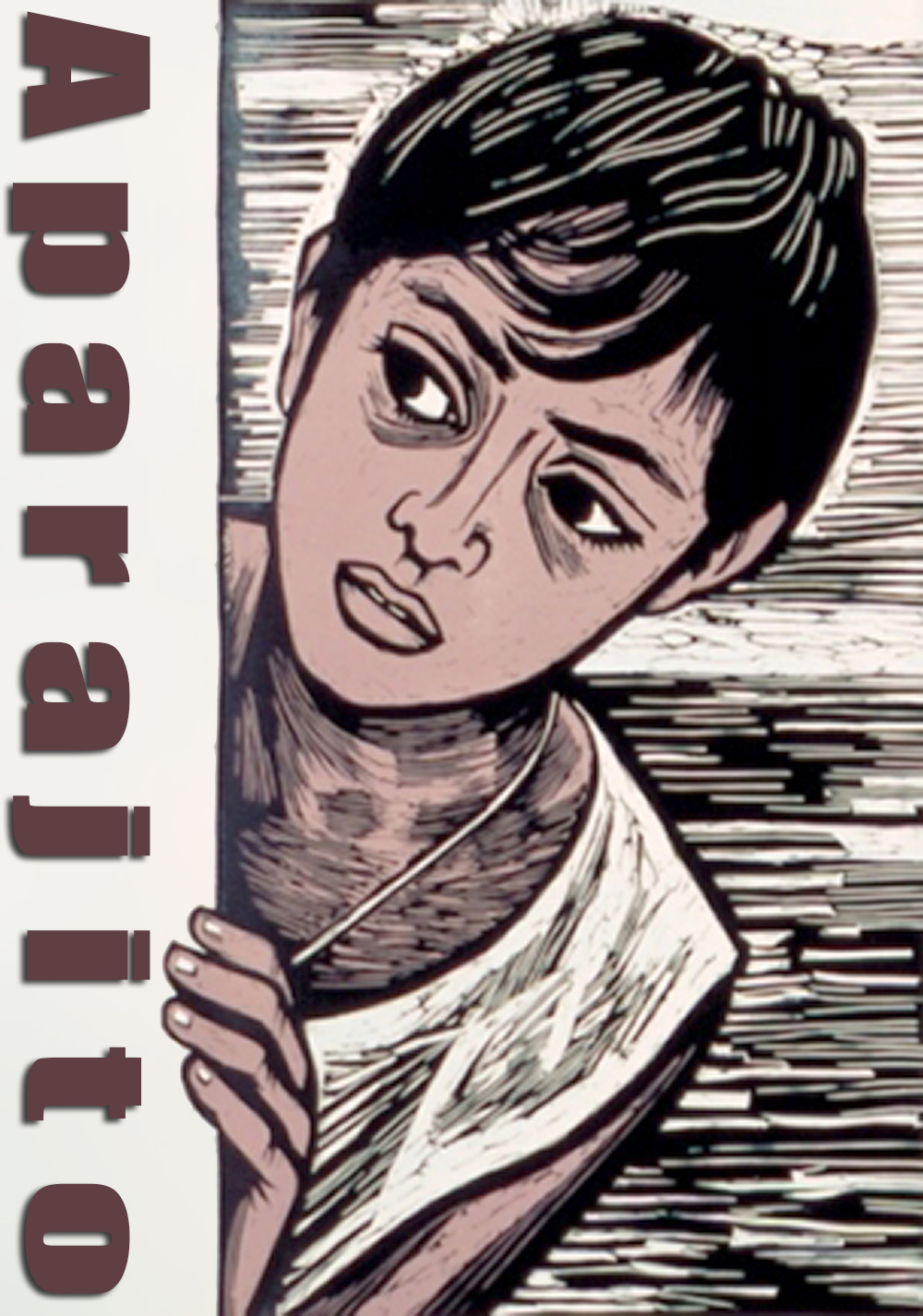
FILM · 1956 · INDIA
অপরাজিত
- Directed by
- Satyajit Ray
- Runtime
- 110 min
- Studio
- Epic Productions, Satyajit Ray Productions
23 archived facts 4 topics 1 source Last reviewed Oct 2026
Apu and his family have moved away from the country to live in the bustling holy city of Benares. As he progresses from wide-eyed child to intellectually curious teenager, eventually studying in Kolkata, we witness his academic and moral education, as well as the growing complexity of his relationship with his mother.
Summary: TMDB
All facts (23)
- #001
Aparajito was the first Indian film to win the Golden Lion at the Venice Film Festival. Ray, who attended the festival, was greatly surprised, feeling that the film contained some serious flaws.
- #002
Filming the scene in which Sarbajaya sees fireflies just before she dies posed a technical difficulty, because even the fastest film stock available could not capture the light emitted by the fireflies. Ray and his team overcame the problem with a homegrown solution. In his book My Years with Apu, Ray recounts: "We picked the strongest members of our crew, dressed them in black shirts and trousers and allowed each to carry a torch bulb, some wire and a battery. The bulbs were held aloft in their right hands, with the wires connected and disconnected from the bulbs alternately, while they went through the rotating movements of the fireflies in a dance…".
- #003
Although the Apu films exist as a consistent trilogy, Satyajit Ray never set out to make a series of three films. In fact, even after completing Aparajito, he was not sure whether there was enough material to guarantee a third film.
- #004
Much of Apu's story here is in fact autobiographical, drawn from Satyajit Ray's own personal experiences. When Apu goes to Calcutta and finds work and lodging next to a printing press, Ray is directly reliving his youth, when he lived above his grandfather's printing press.
- #005
This adaptation of Bibhutibhushan Bannerjee's work uses the final section of the novel Pather Panchali and the first section of its sequel, Aparajito.
- #006
Subrata Mitra, the cinematographer of the Apu Trilogy, introduced his first technical innovation on this film: the use of reflected lighting with large-scale diffusers to match studio sets with location shooting. According to the Internet Encyclopedia of Cinematographers: "The fear of the monsoon rain had forced art director Bansi Chandragupta to abandon the original plan of building the inner courtyard of a typical Benares house in the open, and the set was built inside a studio in Calcutta. Mitra recalls arguing in vain with both Chandragupta and Ray about the impossibility of simulating shadowless diffused overhead light. But this led him to make an innovation that later became his most important idea. The tool - bounce lighting. Mitra placed a framed white cloth resembling a piece of sky over the set and positioned the studio lights downward to reflect off the fake sky."
- #007
In 2005, Time magazine named it among the 100 best films of all time.
- #008
The reviews this film received encouraged Ray to make another sequel, Apur Sansar (1959), which was received just as well and, as Roger Ebert later noted, thus concluded one of the most critically acclaimed film trilogies of all time: "The three films… won the top prizes at Cannes, Venice and London, and created a new cinema for India, whose prolific film industry had traditionally stayed within the narrow confines of splashy musical romances. Never before had one man had such a decisive impact on the films of his own culture."
- #009
The Japanese director Akira Kurosawa had a major film in competition at that year's festival, Throne of Blood (Kumonosu-jo), but it lost to Ray's film. Years later, however, Kurosawa's daughter compiled a list of 100 films he liked, which noted that he endorsed the jury's choice as "Absolutely right" (though she misidentified the winning film as Pather Panchali).
- #010
In the novels on which the film is based, there was a female character named Leela who contributed to Apu's estrangement from his mother while he lived in Calcutta. Ray rejected two candidates, then found an actress to play the character, but her fiancé would not allow her to appear in the film. In the end Ray reluctantly cut the character from the screenplay. Ray later said he thought Leela, with whom Apu had an understated relationship, was a strong reason behind Apu's interest in Calcutta, and that without Leela's presence in the film Apu's attachment to Calcutta might seem somewhat artificial. "I'm never sure," he said, "whether Apu's attachment to the city without the element of a girlfriend is strong enough; the pull the city exerts is a bit abstract." When he watched the film later, however, he did not feel Leela's absence.
- #011
There is a classroom scene in which the teacher asks Apu about a lesser-known figure of speech, the word synecdoche. Apu Sansar - Apu's world - is itself a kind of syntax, and this may be why Satyajit Ray chose that word for use in the classroom scene.
- #012
The film is included in Roger Ebert's "Great Movies" list.
- #013
It won the Golden Lion and the Critics' Award at the Venice Film Festival, becoming the first film to win both.
- #014
Smaran Ghosal, who played the 14-year-old adolescent Apu, made only one more film, also by Ray: the documentary Rabindranath Tagore (1961), in which he portrayed the young Rabindranath Tagore. Smaran died in Calcutta in 2008 at the age of 64.
- #015
Unlike his previous attempt, which stayed faithful to the novel, Ray here made some bold artistic decisions, such as depicting the relationship between Apu and his mother very differently from the book. As a result, unlike the previous film, this one was not well received locally; Ray recalled that "as for the suburban audience, it was shocked by the portrayal of the mother-son relationship, which sharply contradicted the traditional concept of mutual sweetness and devotion."
- #016
This film is part of spine number 784 of the Criterion Collection.
- #017
According to A. Robinson, Satyajit Ray's biographer, Aparajito is the closest of the three films of the Apu Trilogy to its literary source. Banerjee's depiction of the mother-son relationship fascinated Ray. Robinson writes: "Their relationship had for him some echoes on a purely psychological plane." Ray was particularly struck by Banerjee's "daring and profound revelation": "Some time after Sarbajaya's death Apu grew used to a strange feeling… His immediate reaction was one of pleasure, like a wave of relief… a pleasure at the snapping of ties… there was no doubt that he had loved his mother, but the news of her death had at first given him pleasure - he could not escape the facts."
- #018
Filmmakers around the world, including Martin Scorsese, James Ivory, Abbas Kiarostami, Elia Kazan and Wes Anderson, were influenced by the Apu Trilogy.
- #019
In 2005, the Apu Trilogy was included in Time magazine's list of the 100 best films of all time.
- #020
This film is among the Top 250 Narrative Feature Films on Letterboxd.
- #021
In the 1950s, 10 rupees (10 Rs) could buy a substantial amount of goods, such as kilograms of rice, sugar, or a week's worth of basic household necessities.
- #022
Veteran filmmaker Mrinal Sen said the film was one of the best Indian films he had ever seen.
- #023
In 1992, Sight & Sound, the film magazine of the British Film Institute, ranked the Apu Trilogy 88th in its Critics' Poll of the greatest films of all time, while Aparajito itself placed separately at 127th on the same list. In 2002, Sight & Sound's combined list of critics' and directors' poll results included Aparajito in the top 160.
Continue through the archive

Sources & editorial notes
Reference databases
Sources for the entries on this page
- IMDb IMDb kaydı
Information from external sources is independently selected, consolidated and edited by Arka Evren. Sources are listed for verification and further reading. Encyclopedia text is used under its licence (CC BY-SA). How we work