
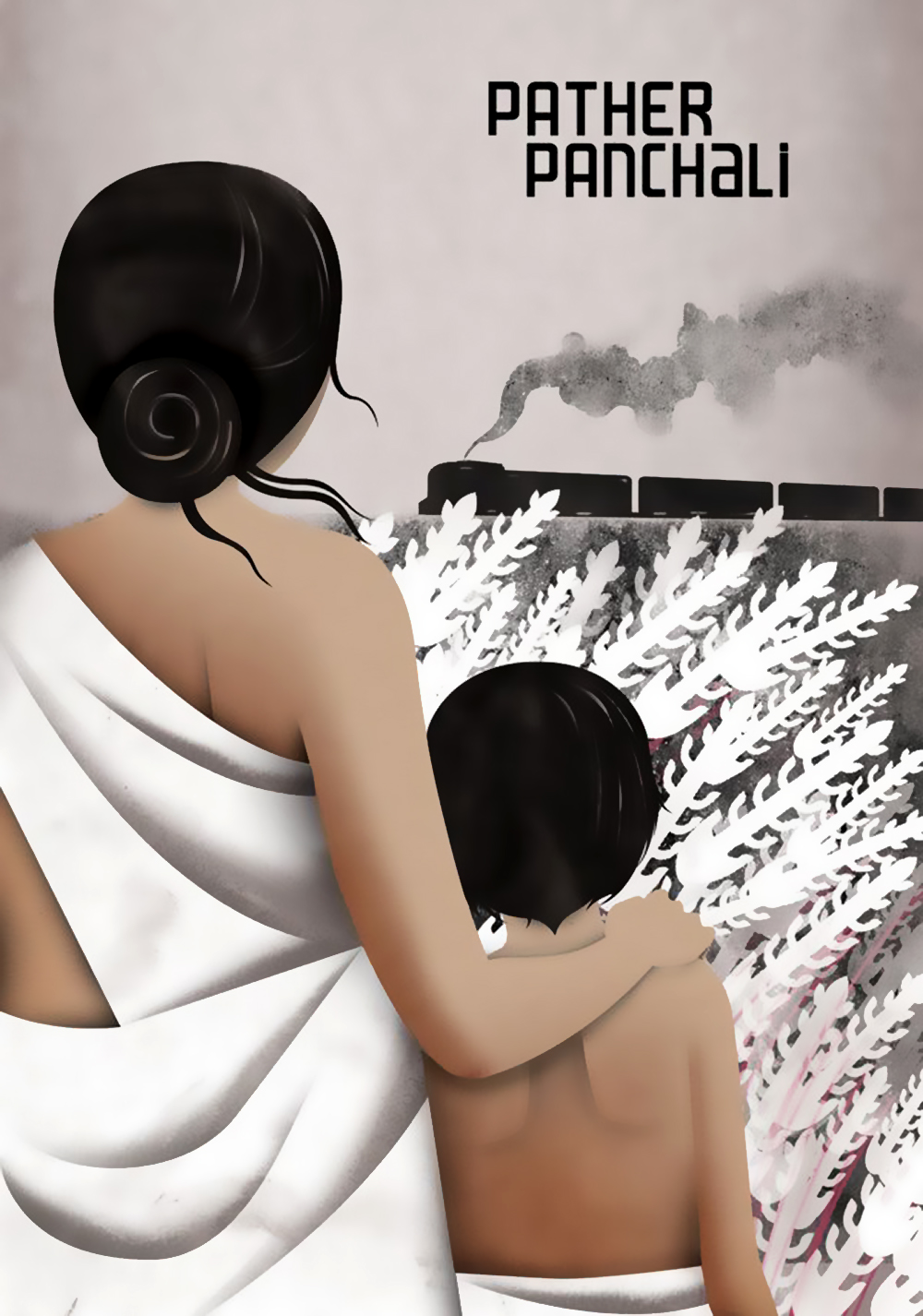
FILM · 1955 · INDIA
পথের পাঁচালী
- Directed by
- Satyajit Ray
- Runtime
- 125 min
- Studio
- Government of West Bengal
80 archived facts 7 topics 1 source Last reviewed Nov 2026
Impoverished priest Harihar Ray, dreaming of a better life for himself and his family, leaves his rural Bengal village in search of work. Alone, his wife, Sarbojaya, looks after her rebellious daughter, Durga, and her young son, Apu, as well as Harihar's elderly aunt Indir. The children enjoy the small pleasures of their difficult life, while their parents suffer the daily indignities heaped upon them.
80 Interesting Facts About পথের পাঁচালী
Interesting Facts (20)
- #001
The film's original negative was destroyed in a fire in 1993. Remarkably, the negative was rehydrated and restored, then scanned at 4K resolution to repair the damaged film.
- #002
According to legend, on the first day of shooting Satyajit Ray did not direct a single scene, his cinematographer Subrata Mitra did not shoot a single frame, and none of the child actors had even been screen-tested for their roles.
- #003
The international success of "Pather Panchali" allowed Ray to leave his job at the advertising agency where he worked and devote himself to filmmaking, literature and art.
- #004
The film never had a complete script. The actors took most of their cues from Ray's drawings and notes.
- #005
After the film's great success, Ray managed to obtain a grant from the West Bengal government and was able to complete his intended trilogy at the behest of the then Prime Minister of India.
- #006
A rough cut was seen by John Huston, who brought the film to Hollywood's attention.
- #007
According to the extras on the disc, Anne "Sarbojaya Ray" - Karuna Bannerjee (credited as Karuna Bandopadhyay) and young "Durga" - Runki (Shampa) Banerjee (credited as Runki Bandopadhyay) are a real mother and daughter.
- #008
Satyajit Ray's directorial debut.
- #009
Because Bibhutibhushan Bandyopadhyay had died, Satyajit Ray had to obtain permission from his widow to make the film.
- #010
Apu was spotted by the director's wife while sitting on a neighbour's terrace.
- #011
In 2005 it was named by Time magazine among the 100 best films of all time.
- #012
Pather Panchali appears on Roger Ebert's "Great Movies" list.
- #013
Runki Banerjee, who played little Durga, is the biological daughter of Karuna Banerjee, who played her mother on screen.
- #014
After his death, it was listed as one of Akira Kurosawa's 100 favorite films.
- #015
Director Christopher Nolan has named it one of his favorite films.
- #016
In a 2018 critics' poll conducted by the BBC, it ranked as the 15th best non-English-language film.
- #017
It is the first film in Ray's Apu trilogy.
- #018
The film is part of spine number 783 in the Criterion Collection.
- #019
The film is included among the Top 250 Narrative Feature Films on Letterboxd.
- #020
In 1915, 24 rupees (the father's three months' salary) would be worth roughly 750 to 850 rupees in today's purchasing power. 750 rupees is worth about eight US dollars.
Production Story (23)
- #021
It was made on such a tight budget that Satyajit Ray sold some of his much-loved records and his life insurance policy, while his wife Bijoya was persuaded to pawn her jewellery.
- #022
The film's original negative was burned to ashes in a fire in 1993. Miraculously, the damaged negative was rehydrated, restored and scanned at 4K resolution.
- #023
According to legend, on the first day of shooting Satyajit Ray had never directed a scene, cinematographer Subrata Mitra had never shot a film, and none of the child actors had even auditioned for their roles.
- #024
The delays over a production that lasted roughly three years drove Satyajit Ray to fear he would never finish his film. Attributing his success to three miraculous events, Ray said, referring to his characters' names: 'One, Apu's voice didn't break. Two, Durga didn't grow up. Three, Indir Thakrun didn't die.'
- #025
According to the disc extras, Karuna Bannerjee, who plays the mother 'Sarbojaya Ray', and Runki (Shampa) Banerjee, who plays young 'Durga', are mother and daughter in real life.
- #026
The character of Apu was discovered by the director's wife while she was sitting on a neighbour's terrace.
- #027
Runki Banerjee, who plays young Durga, is the biological daughter of Karuna Banerjee, her on-screen mother.
- #028
Midway through shooting, Satyajit Ray ran out of money. The Government of West Bengal lent him money to complete the film; the loan was recorded in official documents as 'road improvement', a reference to the film's translated title. After the film's great success, Ray received a grant from the government and completed the trilogy at the request of the then Prime Minister of India.
- #029
Although Ray was given a verbal promise of payment for directing after the West Bengal Government took over the production, he received no fee for his work, which lasted nearly three years and was often financed out of his own pocket. Ray took a philosophical view of the situation, stating that he preferred international fame to financial reward. The film was completed with shooting in fragments spread over five years, frequently halted for lack of money.
- #030
For the film, which was shot on a limited budget, Satyajit Ray sold his beloved records and his life insurance, and his wife Bijoya was persuaded to pawn her jewellery.
- #031
After watching a rough cut of the film, John Huston brought the production to Hollywood's attention.
- #032
Interestingly, the film's premiere was held on 3 May 1955 at the Museum of Modern Art (MOMA) in New York, concurrently with the museum's 'Indian Textile and Decorative Arts' exhibition. The film, which opened in Calcutta later that same year, reached a wide audience in the US only three years later, on 22 September 1958.
- #033
Ray's adaptation of Bibhutibhushan Bandyopadhyay's semi-autobiographical novel differs significantly from the source text. Ray restructured the story from scratch and removed elements he considered unnecessary.
- #034
Pather Panchali is the first film of independent Indian cinema to make a great international impact. It won India's National Film Award for Best Film in 1955 and was awarded the Best Human Document prize at Cannes the following year.
- #035
The film's title means 'song of the little road', and this poetic name reflects the modest yet profound spirit of the story.
- #036
Roger Ebert included the work in his own selection, the 'Great Movies' list.
- #037
Director Christopher Nolan cites Pather Panchali as one of his favourite films.
- #038
It also found a place on Akira Kurosawa's list of his 100 favourite films, published after his death.
- #039
It is listed by the Toronto International Film Festival among the 100 essential films that every film lover should see.
- #040
It also appears in the book '1001 Movies You Must See Before You Die', edited by Steven Schneider.
- #041
It has confirmed its importance in cinema history by being included in the Criterion Collection with spine number 783.
- #042
It finds a place on Letterboxd's official Top 250 Narrative Feature Films list.
- #043
In 1915, the father's monthly salary of 24 rupees is equivalent in today's purchasing power to roughly 750-850 rupees; that amount is about eight US dollars today.
Behind the Scenes (8)
- #044
Most of the film's music was composed by Ravi Shankar. Shankar was able to see only half of the film while creating the music. He recorded most of the film's music in an 11-hour session. Subrata Mitra, the film's cinematographer, who like Shankar played the sitar, provided additional music for the remainder.
- #045
Cinematographer Subrata Mitra was in fact a still photographer whose work Ray admired. Mitra learned his craft in film photography by borrowing a 16 mm camera.
- #046
The film's original negative was reduced to ashes in a fire in 1993. Miraculously, the damaged negative was rehydrated, restored and scanned at 4K resolution.
- #047
Legend has it that on the first day of shooting, Satyajit Ray had never directed a scene, cinematographer Subrata Mitra had never shot a film, and none of the child actors had even auditioned for their roles.
- #048
The delays over a production that lasted nearly three years drove Satyajit Ray to fear he would never finish his film. Attributing his success to three miraculous events, Ray said, referring to his characters by name: 'One, Apu's voice did not break. Two, Durga did not grow up. Three, Indir Thakrun did not die.'
- #049
The film never had a complete script. The actors derived most of their lines from Ray's drawings and notes.
- #050
Ravi Shankar composed most of the film's music. Shankar was able to watch only half of the film and completed most of the recordings in a single 11-hour session. Cinematographer Subrata Mitra, like Shankar, played the sitar, and he added the remaining music.
- #051
Cinematographer Subrata Mitra was in fact a photographer whose work Ray admired. Mitra learned to shoot film with a 16mm camera he had borrowed.
Characters & Cast (13)
- #052
According to the extras on the disc, Karuna Bannerjee, who played the mother 'Sarbojaya Ray', and Runki (Shampa) Banerjee, who played little 'Durga', are mother and daughter in real life.
- #053
The director discovered the actor for Apu while his wife was sitting on a neighbour's terrace.
- #054
Runki Banerjee, who played little Durga, is the biological daughter of Karuna Banerjee, her on-screen mother.
- #055
Midway through shooting, Satyajit Ray ran out of money. The Government of West Bengal lent him funds to complete the film; this loan was recorded in official documents as "road improvement," a reference to the film's translated title. After the film's great success, Ray received a grant from the government and completed the trilogy at the request of the then Prime Minister of India.
- #056
After the Government of West Bengal took over the production, Ray was verbally promised payment for directing, yet he received no fee for his work, which lasted nearly three years and during which he often spent from his own pocket. Ray took a philosophical view of the situation; he stated that he preferred international fame to financial reward. The film was completed through fragmented shooting spread over five years, frequently halted due to lack of money.
- #057
The international success of Pather Panchali enabled Ray to leave his job at the advertising agency where he worked and devote himself entirely to cinema, literature and art.
- #058
For the film, shot on a limited budget, Satyajit Ray sold his beloved records and his life insurance; his wife Bijoya was persuaded to pawn her jewellery.
- #059
John Huston, after watching the rough cut of the film, brought the production to Hollywood's attention.
- #060
Interestingly, the film's premiere was held on 3 May 1955 at the Museum of Modern Art (MOMA) in New York, concurrently with the museum's "Indian Textile and Decorative Arts" exhibition. The film, which opened in Calcutta in the later months of the same year, reached a wide audience in the US only three years later, on 22 September 1958.
- #061
Satyajit Ray first encountered Bibhutibhushan Bandyopadhyay's novel in 1945, when he was assigned to illustrate the children's edition of the book.
- #062
Because Bibhutibhushan Bandyopadhyay had passed away, Satyajit Ray had to obtain permission to make the film from the author's widow.
- #063
Satyajit Ray's first directorial effort.
- #064
Ray's adaptation of Bibhutibhushan Bandyopadhyay's semi-autobiographical novel differs significantly from the source text. Ray restructured the story from the ground up and removed elements he deemed unnecessary.
Easter Eggs & References (1)
- #065
Because of the many delays during the nearly three years it took to make the film, director Satyajit Ray grew increasingly worried that an event might occur that could prevent him from finishing it. Indeed, he attributed his success to three miraculous events (or rather, non-events), referring to his cast by their character names: "One, Apu's voice did not break. Two, Durga did not grow up. Three, Indir Thakrun did not die."
Deeper Meaning (14)
- #066
Although Satyajit Ray was reportedly given a verbal promise of payment from the Government of West Bengal for his work as director after taking over the making of this film, he in fact received absolutely no compensation, despite working on it for nearly three years (mostly at his own expense). Ray took a philosophical view of this, preferring the international fame the film brought him to any monetary reward.
- #067
Pather Panchali is the first film of independent Indian cinema to create a major international resonance. It won India's National Award for Best Film in 1955, and the following year was honored with the Best Human Document award at Cannes.
- #068
The film's name means 'song of the little road,' and this poetic title reflects the modest yet profound spirit of the story.
- #069
In 2005, Time magazine listed the film among the 100 best films of all time.
- #070
Roger Ebert included this work in his own selection, the 'Great Movies' list.
- #071
Director Christopher Nolan cites Pather Panchali as one of his favorite films.
- #072
It also found a place on the list of Akira Kurosawa's 100 favorite films, published after his death.
- #073
In the BBC's 2018 critics' poll, it ranked 15th among the best non-English-language films.
- #074
The Toronto International Film Festival lists it among the 100 essential films that every movie lover should see.
- #075
It also appears in the book '1001 Movies You Must See Before You Die,' edited by Steven Schneider.
- #076
It is the first film of Satyajit Ray's Apu trilogy and brought the director worldwide recognition.
- #077
It is included in the Criterion Collection with spine number 783, confirming its importance in cinema history.
- #078
It finds a place on Letterboxd's official Top 250 Narrative Films list.
- #079
In 1915, the father's monthly salary of 24 rupees would be equivalent to roughly 750-850 rupees in today's purchasing power; that amount is about eight US dollars today.
Career & Awards (1)
- #080
It appears on the Toronto International Film Festival's Essential 100 list of films every cinephile should see.
Sources & editorial notes
Reference databases
- Wikipedia
- IMDb
Information from external sources is independently selected, consolidated and edited by Arka Evren. Sources are listed for verification and further reading. Encyclopedia text is used under its licence (CC BY-SA). How we work