FILM · 2012 · USA
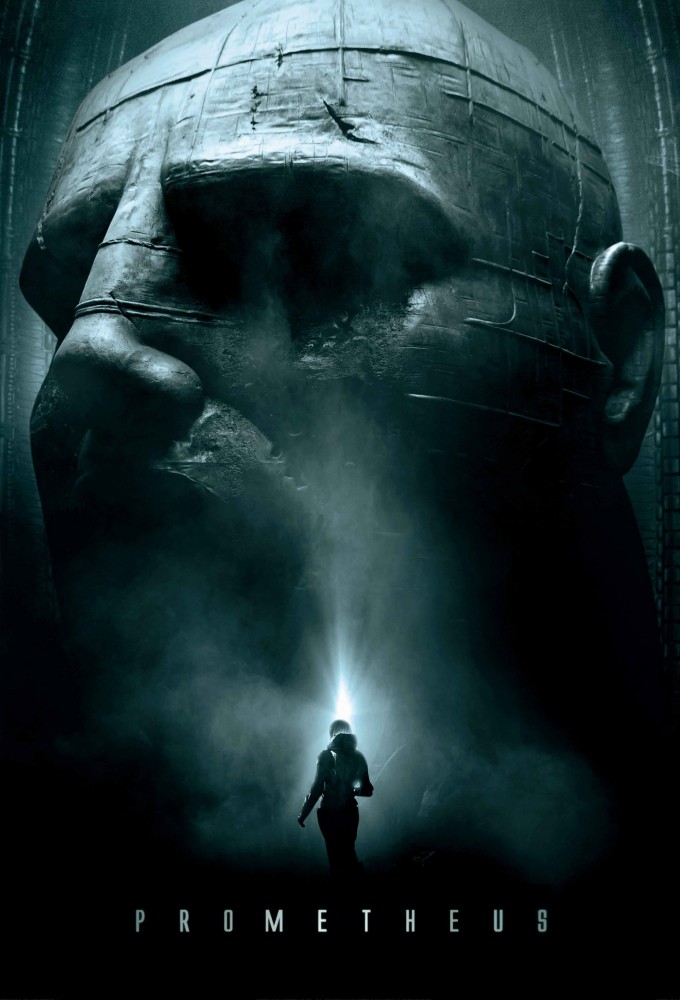
Prometheus
- Directed by
- Ridley Scott
- Runtime
- 124 min
- Studio
- Dune Entertainment, 20th Century Fox, Brandywine Productions
197 archived facts 7 topics 1 source Last reviewed Sep 2026
A team of explorers discover a clue to the origins of mankind on Earth, leading them on a journey to the darkest corners of the universe. There, they must fight a terrifying battle to save the future of the human race.
Summary: TMDB

12 Facts From Behind the Scenes of Prometheus
- #002
Contains a major spoiler — show
(Around 1 hour 16 minutes) For the scene in which Vickers sets the infected Holloway on fire, Charlize Theron used a real flamethrower that produced real fire. She was excited to act out the scene when she read the script, but began to have second thoughts when she realized she would actually be setting a stuntman on fire. She ultimately agreed to do the stunt, and her shocked look as she set him alight was her genuine reaction. The take was kept in the film because the producers felt the crack in the character was a good reaction for the normally cold and emotionless Vickers.
- #007
Contains a major spoiler — show
(Around 1 hour 10 minutes in) Sir Ridley Scott repeatedly told the crew not to tell the actors certain things or let them see story outlines, so that he could get more genuine responses. In particular, for the scene in which the Hammerpede bursts out of Millburn's body, Scott did not tell Kate Dickie what would happen in the scene, so her scream was a real reaction. This trick for authenticity went one step further than what Scott did while shooting Alien's (1979) notorious chestburster scene, where the actors knew something would come out of the body but did not know they would be sprayed with blood.
- #009
Contains a major spoiler — show
During production, Sir Ridley Scott kept the use of computer-generated imagery (CGI) as low as possible; Scott recalled the advice visual effects supervisor Douglas Trumbull had given him on the set of Blade Runner (1982: "If you can do it live, do it live") and also argued that practical visual effects were more cost-effective than digital ones. Monster effects such as the Deacon and the Hammerpede were done practically wherever possible; CGI was used only for complex shots that genuinely could not be done for real. The giant Trilobite facehugger was a full-size model used in several shots and served as a reference for the computer-generated version used in other shots. In total Weta Digital and Moving Picture Company provided 1,300 CG shots for the film, mostly for digital landscapes, space scenes and adding texture and fluidity to the practical effects.
- #013
Contains a major spoiler — show
(Around 1 hour 23 minutes) For the scene of Elizabeth Shaw's abdominal surgery, Noomi Rapace was fitted with a fake silicone body from the shoulders down. The small Trilobite inside the amniotic sac removed from her fake body was an animatronic creature wrapped in a condom filled with fake blood. A crew member punctured the condom with a razor blade so the amniotic sac would burst violently (this was removed in post-production). To secure the R rating they first experimented with an amber, milky fluid, but in the end they were allowed to use a red, bloody version. Stapling the wound afterwards was director Sir Ridley Scott's idea.
- #034
Sir Ridley Scott suggested during the first shoot that the actors could effectively sleep by "living" on the Prometheus interior set, but this did not happen due to health and safety regulations.
- #080
Contains a major spoiler — show
Fifield's appearance after being mutated by the black liquid was initially very different. The creature he transformed into had a translucent cowl covering its elongated head, immediately notable for its resemblance to the translucent dome covering the skull of Xenomorph Drones. Sir Ridley Scott described it as a hybrid between the Deacon (which emerges from the Engineer) and the Hammerpede (the snake-like alien), and the creature slowly decayed like the Engineer's head earlier in the film. The scene was shot practically with Sean Harris and stunt performers, with additional CGI effects and textures later replacing Harris's performance (though 90% of the flames were real). However, this design was changed late in production due to a desire to move away from the official original Alien (1979) film and because Scott felt the monster's appearance needed to be more "grounded." The special effects for the original version were nearly complete when the sequence was changed, and a nearly finished version is included among the deleted scenes on Prometheus home video releases. In Jon Spaihts's original script for Prometheus (titled Alien: Engineers), Fifield's transformation was even more extreme: he actually transforms into a Xenomorph form with an elongated skull, dorsal tubes emerging from his suit and large clawed talons growing from his hands.
- #085
During the on-location shoot in Iceland (the film's opening sequence), Noomi Rapace, who partly grew up there, had the opportunity to visit her family.
- #091
Cinematographer Dariusz Wolski convinced Sir Ridley Scott that it was possible to shoot the film in 3D with the same ease and efficiency as a typical film shoot. The 3D company 3ality Technica provided some of the hardware and equipment to facilitate 3D shooting and trained the film crew on how to operate it properly. Because 3D films require high lighting levels on set, the traditional dark, shadowy atmosphere of the Alien films was added during post-production grading processes, while the 3D equipment was based on post-Avatar (2009) technology.
- #116
Achieving the birth sequence was difficult. Noomi Rapace, who had prior experience with oriental dance and a degree of digital enhancement, initially simulated the creature's movements inside her belly. A dummy was built for the lower part of her body; as in the chestburster scene in Alien, Rapace sat on a chair beneath the set so that only her head and neck were visible. Scanlan's team placed the Trilobite animatronic inside the dummy and maneuvered it from below to create the impression of the creature writhing inside Elizabeth Shaw's body. When the creature is finally removed, the shot includes the computer-generated creature, the machines and the incisions. Real caesarean sections were used as reference for the scene. "While it's in the placenta sack," Hill said, "it's completely digital. There was a model of the placenta with a baby inside, but the internals weren't articulated and we wanted it to shake as it was pulled out, which meant we had to do a lot of spreading work on the image to make sure all the volumetric information was working on the blood and goo inside the placenta sack."
- #156
Ridley Scott felt the initial approaches to the creatures, including the Deacon, seemed "too monstrous" and far from reality; so he decided to soften them to keep them within the "realm of reality." Once the idea of the creature and its many aspects were determined, it is worth noting that the concepts (among other creatures) were shown to H. R. Giger, who designed his own version of the Deacon, which was ultimately not considered for the film. After Messing's design was chosen, it was turned into a full-size sculpture, which served as the basis for the Deacon puppets and the digital model. For the creature's horrific birth scene, a hollow puppet of the dead Engineer was created and filled with internal organs and a puppet of the Deacon squeezed into a one-meter-diameter latex embryonic sac. The Engineer puppet was operated from under the set to shake and make the Deacon burst out and fall to the ground. In this sequence, the Deacon was a combination of a rod puppet with digital enhancement and a fully computer-generated creature. Scanlan added, "We sculpted the Deacon quite late in the day," "we practically knew how to do it, but artistically we still weren't sure, so we started making a full-size creature sculpture. It was about one and a half meters long, and it was one of the things that made ideas start flowing in 3D once we got on the right track. Ridley came and we worked with him for a few hours on Saturday and Sunday and pushed the sculpture until everyone, especially Ridley, felt it should look like this. Very smooth, metallic [sic]. Full of mercury-like materials, silvers and metallics." Huante commented on the final Deacon's iridescent, dark blue skin, reportedly an incidental addition: "Why was it blue? I don't know. The illustration was blue to emphasize its whiteness in a navy environment, and I was following some inspiring paintings of a man's head by a contemporary Russian painter that Arthur sent me from Ridley. The creatures were all supposed to be albino. They were supposed to look simple, beautiful and ghostly, like a Beluga whale in dark Arctic water." Weta strengthened the digital Deacon's muscles and joints to make them feel more natural and realistic. Because of the creature's unique pearlescent skin, a special shader designed specifically for the project was used to create how it reacts to light, along with layers of blood and mucus. The lighting was done by Florian Schroeder and Adam King.
- #189
Although the Trilobite's main influence is cephalopods, Neville Page did not intend it to look directly like an octopus. "The fact that it had seven tentacles, that was a struggle [for] me for quite a while," he said: "Because we didn't just want to make an octopus - and there were a few photographs early on where it looked like an octopus. But in the end, it was about a single pose that would give it a single sense of movement and make it seem as if there were strength and power in those tentacles that would really lift it off the ground." The Trilobite's movements were also based on various mollusks. The creature designers were also influenced by illustrations the artist Jean Giraud made for the comic book The Long Tomorrow, written by Dan O'Bannon and published in 1975. In particular, the inspiration was an 'Arcturian,' an extraterrestrial shapeshifting entity that had previously disguised itself as a woman and attacked one of the characters in a series. The struggle between the Engineer and the Trilobite is somewhat similar, but the outcome is not as bright for the pale humanoid. Scanlan commented on the Trilobite's design: "[Page] sent in a design where you could see the origins of the human on it. You could see where it came from, the prehistoric elements, and yet the alien-like qualities of the character." The special effects team built a full-scale animatronic with complex head and mouth mechanisms and enormous tentacles.
- #191
The newborn monster initially looked like a cephalopod very similar to its adult counterpart. Neville Page designed the final creature, described as an embryonic form. Its tentacles are initially fused, but they gradually grow and split into more tentacles as the creature grows. Neal Scanlan Studio built a full-scale animatronic used when the creature is seen being held by the retaining arm of the health capsule; the sculpture was made by Ivan Manzella, built by Simon Williams, Andy Colquhoun and Joshua Lee, and puppeteered through a performance system designed by Matt Denton. The creature's slithering movements were achieved with a multi-section animatronic spine. The cables controlling the creature were hidden in the clamp arm on it so that it could easily be filmed from every angle.
Sources & editorial notes
Reference databases
Sources for the entries on this page
- IMDb IMDb
Information from external sources is independently selected, consolidated and edited by Arka Evren. Sources are listed for verification and further reading. Encyclopedia text is used under its licence (CC BY-SA). How we work