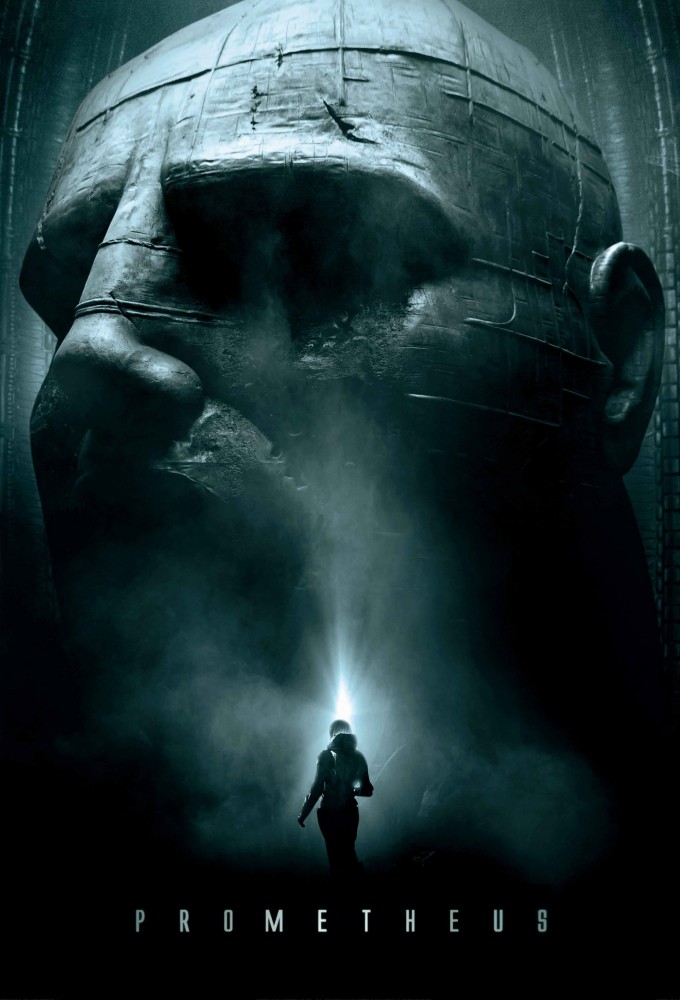
FILM · 2012 · USA
Prometheus
- Directed by
- Ridley Scott
- Runtime
- 124 min
- Studio
- Dune Entertainment, 20th Century Fox, Brandywine Productions
197 archived facts 7 topics 1 source Last reviewed Sep 2026
A team of explorers discover a clue to the origins of mankind on Earth, leading them on a journey to the darkest corners of the universe. There, they must fight a terrifying battle to save the future of the human race.
Summary: TMDB

All facts (197)
- #001
Composer Marc Streitenfeld had the orchestra play the score backwards, then digitally reversed the compositions for the final film. This made the music unusual and unsettling, which he felt was right for the film.
- #002
Contains a major spoiler — show
(Around 1 hour 16 minutes) For the scene in which Vickers sets the infected Holloway on fire, Charlize Theron used a real flamethrower that produced real fire. She was excited to act out the scene when she read the script, but began to have second thoughts when she realized she would actually be setting a stuntman on fire. She ultimately agreed to do the stunt, and her shocked look as she set him alight was her genuine reaction. The take was kept in the film because the producers felt the crack in the character was a good reaction for the normally cold and emotionless Vickers.
- #003
Sir Ridley Scott named the film "Prometheus" because he felt the name suited its themes: "It's the story of creation; the gods and the man who stood against them." In Greek mythology the Titan Prometheus was an immortal servant of the gods; he stole the fire of the gods and gave it to humanity, an immeasurable benefit that changed the human race forever (for better or worse). He made humanity dangerous to the gods.
- #004
Director Sir Ridley Scott instructed the design team to aim for a look for the alien planet, creatures and technology that could logically precede the original Alien (1979), and therefore not to rely too heavily on Swiss artist H. R. Giger's famous original planet and Xenomorph designs. Nevertheless, almost all of the team's drawings ended up containing subconscious "Gigeresque" flourishes, and they also drew inspiration from several Giger designs that had gone unused for Alien. In the end it was decided to invite Giger himself, who approved the use of his old ideas and contributed further by reverse-engineering his original designs for the new film. More inspiration was drawn from the work of Russian 3D artist Gutalin (Alex Kozhanov). Giger died in 2014 from injuries sustained in a fall, and this was the last film related to the Alien series that he worked on.
- #005
Both the "Beginning of time" sequence at the start of the film and the collision sequence near the end were shot over two weeks in Iceland, after both Wadi Rum (Jordan) and Morocco were deemed too politically unstable at the time. Iceland's volcanic Hekla valley was used as the surface of the planet LV-223; rocks were placed in the landscape and computer-generated imagery (CGI) was used to provide the planet's otherworldly backdrop. The Engineer's sacrifice in the opening scene was shot at Dettifoss waterfall, a location so remote and hard to reach that the crew had to build roads to get there.
- #006
To prepare for the role of the android David, Michael Fassbender watched Blade Runner (1982) (another Sir Ridley Scott film), The Man Who Fell to Earth (1976) (for David Bowie's androgynous performance), The Servant (1963) and Lawrence of Arabia (1962) (which Peter Weyland mentions). Fassbender also studied Olympic diver Greg Louganis and drew on Louganis's physicality for David's walk.
- #007
Contains a major spoiler — show
(Around 1 hour 10 minutes in) Sir Ridley Scott repeatedly told the crew not to tell the actors certain things or let them see story outlines, so that he could get more genuine responses. In particular, for the scene in which the Hammerpede bursts out of Millburn's body, Scott did not tell Kate Dickie what would happen in the scene, so her scream was a real reaction. This trick for authenticity went one step further than what Scott did while shooting Alien's (1979) notorious chestburster scene, where the actors knew something would come out of the body but did not know they would be sprayed with blood.
- #008
Contains a major spoiler — show
The squid-like alien offspring that resembles a giant Facehugger and attacks the Engineer was named the Trilobite by the producers. The snake-like creatures were named Hammerpedes.
- #009
Contains a major spoiler — show
During production, Sir Ridley Scott kept the use of computer-generated imagery (CGI) as low as possible; Scott recalled the advice visual effects supervisor Douglas Trumbull had given him on the set of Blade Runner (1982: "If you can do it live, do it live") and also argued that practical visual effects were more cost-effective than digital ones. Monster effects such as the Deacon and the Hammerpede were done practically wherever possible; CGI was used only for complex shots that genuinely could not be done for real. The giant Trilobite facehugger was a full-size model used in several shots and served as a reference for the computer-generated version used in other shots. In total Weta Digital and Moving Picture Company provided 1,300 CG shots for the film, mostly for digital landscapes, space scenes and adding texture and fluidity to the practical effects.
- #010
Contains a major spoiler — show
In the original script, the awakened Engineer is said to have taken a child from Earth to his own world so his kind could learn its values, and then sent him back to Earth to stop humanity's growing aggression, but the child was later crucified; the implication is that he was Jesus of Nazareth. However, Scott felt this would be too overt a religious allegory for the film. There are nevertheless subtle hints of it in the film: Shaw's cross, Prometheus landing on LV-223 on Christmas Day, and the Engineers' plan to attack Earth and destroy humanity roughly 2,000 years ago, shortly after Jesus's death.
- #011
Charlize Theron was originally cast as Elizabeth Shaw but had to turn the role down because of a scheduling conflict. A later change to the schedule allowed Theron to make the film, so she was allowed to take the role of Meredith Vickers, with Noomi Rapace taking on Shaw.
- #012
Sir Ridley Scott instructed Charlize Theron to stand in corners and make concealed movements in order to emphasize Vickers's distant, enigmatic nature.
- #013
Contains a major spoiler — show
(Around 1 hour 23 minutes) For the scene of Elizabeth Shaw's abdominal surgery, Noomi Rapace was fitted with a fake silicone body from the shoulders down. The small Trilobite inside the amniotic sac removed from her fake body was an animatronic creature wrapped in a condom filled with fake blood. A crew member punctured the condom with a razor blade so the amniotic sac would burst violently (this was removed in post-production). To secure the R rating they first experimented with an amber, milky fluid, but in the end they were allowed to use a red, bloody version. Stapling the wound afterwards was director Sir Ridley Scott's idea.
- #014
According to Sir Ridley Scott, he was determined to show appropriately advanced 21st-century technology for Prometheus and its science team, such as slimmed-down spacesuits, holographic images and video screens inside fully spherical helmets. These helmets were inspired by the story of Steve Jobs building an office entirely out of industrial-strength glass: "If I'm in 2083 and I'm going into space, I want something where I have 360 vision. By then glass will be light and you won't be able to break it with a bullet." In behind-the-scenes documentaries Scott acknowledged that this creates an obvious inconsistency with the low-tech state seen in Alien (1979), explaining it by the fact that the Nostromo crew were blue-collar workers who had to work with a decades-old ship, old machines and hand-me-down bulky spacesuits.
- #015
Sir Ridley Scott decided that the original Xenomorph (the creature the film series is named after) would not appear in the film, saying "the sequels squeezed him dry, he did very well… and no way am I going back there." Instead, since this is an indirect prequel to Alien (1979), he decided to feature an ancestor/parent of a Xenomorph. However, after the film's release, criticism from fans complaining about the absence of the famous creature changed Scott's mind and led him to include the creature in the sequel Alien: Covenant (2017).
- #016
(Around 16 minutes in) In the sequence where the holographic Peter Weyland addresses the Prometheus crew, the musical underscore quotes the original Alien (1979) theme written by Jerry Goldsmith but never used in the 1979 film.
- #017
Contains a major spoiler — show
Sound designer Ann Scibelli recorded the sounds of her pet parrot over several weeks. The recordings were then used in the film as beeps, alarms and the screams of Shaw's alien offspring.
- #018
Sir Ridley Scott described the Engineers as "tall, elegant dark angels." Some early designs made them look more elephant-like to match the appearance of the dead Space Jockey in Alien (1979), but it was later decided that this look was their exoskeleton suits and that the Engineers looked more humanoid inside them. Concept designers Neville Page and Carlos Huante used classical statues of Greco-Roman gods, J. W. Turner (a painter whose trademark was luminosity) and William Blake (a painter who used religious symbolism), the Statue of Liberty, Michelangelo Buonarroti's statue of David and Elvis Presley as visual influences on the design of the Engineers.
- #019
(Around 7 minutes in) When Prometheus approaches the alien solar system, it is stated to be 3.27 x 10^14 (327,000,000,000,000) kilometres from Earth. That is 34.6 light-years, or 10.4 parsecs.
- #020
Sir Ridley Scott was determined from the start that Michael Fassbender would play the role of David, even though his agents demanded a very high fee.
- #021
The names of the androids in the Alien films follow an alphabetical order: Ash in Alien (1979), Bishop in Aliens (1986) and Alien3 (1992), Call in Alien: Resurrection (1997), and David in this film.
- #022
(Around the 1-hour mark) One of the script drafts for Alien (1979) included a sex scene between Ripley and Dallas showing how crew members simply had casual sex to satisfy their needs during long space voyages. Sir Ridley Scott never shot the scene, but the idea was reused for this film in the exchange between Vickers and Janek.
- #023
In 2002, James Cameron discussed ideas for a fifth Alien film with Sir Ridley Scott, intending that Cameron would produce the film and Sigourney Weaver would return as Ripley. However, when he discovered that 20th Century Fox was developing the crossover film Alien vs. Predator (2004), Cameron halted all work on the project, believing the crossover would "kill the validity of the franchise." Although Cameron stated he would never work on the Alien series again, Scott eventually decided to turn his ideas into this film.
- #024
(At roughly 42 minutes) In the intense scene where the crew returns to the Prometheus with the Engineer's fossilized head (and David carrying the Black Liquid), the camera shows that the upper part of the dome-shaped structure has a skull-like face. It resembles the artwork H. R. Giger created for Baron Harkonnen's castle on Giedi Prime in Alejandro Jodorowsky's Dune.
- #025
The Orrery was one of the most complex visual effects, containing between eighty and one hundred million polygons and taking several weeks to create as a single full shot.
- #026
Contains a major spoiler — show
(At about 1 hour 55 minutes) The final Alien-like creature that bursts from the Engineer's body was named the "Ultramorph" in the script, but it was called the "Deacon" because of its pointed head, which gives it the look of a Catholic mitre. It was a practical effect: a rod puppet operated by several crew members, with the slime and goo added later in CGI. In the shooting script, after emerging from the Engineer it was to bite through its own umbilical cord and charge at Shaw and David, but it barely misses them as they board another Engineer ship and leave. The final shot would have been the Deacon screaming at the sky. In the end, all of this was omitted.
- #027
The Weyland company's three-triangle logo (visually similar to the real Weinstein Group's, though) was meant as a cross between the hieroglyph-like title in the opening title sequence of Alien (1979) and the Weyland-Yutani logo seen on the wall in Aliens (1986), which itself was based on an early Ron Cobb design for the original film. The logo can also be seen as part of David's fingerprint. The colorful rainbow-like ship uniform patches worn by the Nostromo crew in the original film were replaced with much darker equivalents on the Prometheus uniform to emphasize that Prometheus is a "fallen angel."
- #028
Charlize Theron found herself struggling in the action scenes because of her smoking habit, particularly the parts that required her to run in sand in boots weighing thirty pounds (fourteen kilos).
- #029
An innovative viral campaign consisting of several videos depicting the film's near-future world was used to promote the film. The first was a fake TED Talk given by Peter Weyland (played by Guy Pearce), titled The Peter Weyland Files: TED Conference, 2023 (2012). Later, two different versions of a commercial introducing the David 8 android (played by Michael Fassbender) and a video message from Earth to the Engineers (stated at the beginning of the film to have been sent but never answered) were released. These viral videos were designed by Sir Ridley Scott and Damon Lindelof and directed by Scott's son, Luke Scott.
- #030
Contains a major spoiler — show
On May 7, 2012, Guillermo del Toro announced that his long-proposed adaptation of "At the Mountains of Madness" was postponed indefinitely because he felt it was extremely similar to the approach Sir Ridley Scott had taken for his film, H. P. Lovecraft's novella, "to the point of having nearly identical scenes. Both films seem to share the same pieces and ultimately the same big reveal."
- #031
Sir Ridley Scott said he shot "the most aggressive film he could" without regard for MPAA ratings, and that he had the support of 20th Century Fox CEO Tom Rothman, who addressed Alien (1979) fans by saying he was "very aware of their concern" about such a bold move: "They can accept that the film will not compromise either way. So if that means the film is R, then it's R. If it's PG-13, then it will be a PG-13, but there will be no compromise." Scott pre-visualized and shot the film with both adult-oriented R and more accessible PG-13 content, so that when certain cuts were requested, more adult-oriented footage could be removed without harming the general presentation. In the end, the film was rated "R for Sci-Fi violence including some intense images, and brief language" and was released without any cuts.
- #032
(At about 6 minutes) The first frame of the cave paintings showing a horse in motion at the start of the film comes from the Chauvet Cave in southern France, the subject of Werner Herzog's documentary Cave of Forgotten Dreams (2010), which was also shot in 3D.
- #033
Noomi Rapace took the role of Elizabeth after a planned meeting with producer Michael Costigan in Los Angeles turned into an unexpected meeting with Sir Ridley Scott. When Scott explained that he had watched The Girl with the Dragon Tattoo (2009) three times and was very eager to work with her, Rapace immediately accepted the offer. However, since Rapace was not yet a major star, the studio first insisted on a screen test. An old warehouse was quickly redesigned to look like the interior of a futuristic ship, and Rapace did her test for the role of Shaw opposite Rafe Spall, who was originally cast as the Englishman Holloway (later recast as the American Millburn). After that, she was hired for the role.
- #034
Sir Ridley Scott suggested during the first shoot that the actors could effectively sleep by "living" on the Prometheus interior set, but this did not happen due to health and safety regulations.
- #035
(At about 25 minutes) As the Prometheus approaches the landing site, straight lines can be seen on the ground that closely resemble the Nazca lines in the Nazca Desert of southern Peru. The Nazca lines have been interpreted by a small number of fringe scientists/archaeologists as the runways of an ancient airfield used by extraterrestrial beings. This idea was popularized by the Swiss author Erich von Däniken and is generally considered pseudoscience. One of the more common and accepted theories suggests that the lines were part of the local people's religious practices. Other theories give them astronomical, cosmological or topographic significance.
- #036
Contains a major spoiler — show
The film was initially intended to be a true prequel to Alien (1979), and the first draft of Jon Spaihts's original script (titled 'Alien: Engineers') contained far more elements from the Alien series. For example, it may have taken place on LV-426, the original planetoid of 'Alien' featuring a mysterious pyramid. It has containers holding earlier forms of Facehuggers (proto-Facehuggers), one of which 'impregnates' Holloway (Logan Marshall-Green). Unaware of what has happened, he returns to the Prometheus and, while having sex with Shaw (Noomi Rapace), a tentacled chestburster tears away from him and slowly pulls itself out of his chest. David (Michael Fassbender) is a much more malevolent character in this draft; he hates his human creators so much that he even plans to help the Engineers kill them all. Shaw tries to stop him, but David ties her up and leaves a Facehugger on her, impregnating her with an Alien as well. This creature is surgically removed without tearing through her chest, but it escapes from the medical device and, while Shaw recovers within a few hours, the creature grows and begins killing people. Shaw would finally fight the Xenomorph Ultramorph emerging from the dead Engineer, and the film would end more ambiguously with Shaw and David's remains stranded on the planet. The mutagenic black compound that turns Fifield (Sean Harris) into a raging monster and David's death were part of Spaihts's original treatment. According to Spaihts, 20th Century Fox studio executives demanded that recognizable elements be softened to make the film more standalone and give it its own mythology, so major rewrites were done by Damon Lindelof.
- #037
(At about 1 hour 16 minutes) The scene in which Vickers refuses to allow the infected crew member aboard the ship is almost identical to the scene in Alien (1979), of which this film is a prequel, where Ripley refuses to let the crew bring the infected Kane aboard, including some of the same dialogue.
- #038
Contains a major spoiler — show
(At about 1 hour 55 minutes) Shaw's final message at the end of the film is the same as Ripley's final log entry at the end of Alien (1979). Both messages include an indication that it is a "final log entry," an explanation of the fate of the respective crews of their ships, and a description of themselves as the "last surviving crew member of the (Nostromo/Prometheus)."
- #039
Ann Scibelli created the sound of glistening ice forming on stone cylinders by applying Pop Rocks (carbonated candy) to materials such as wet metal and stone and then spraying water on the materials to produce the "popping, cracking" sound.
- #040
Contains a major spoiler — show
Sir Ridley Scott initially wanted Max von Sydow for the role of the elderly Peter Weyland. However, Scott and Damon Lindelof later devised a scene in which the android David (Michael Fassbender) would interface with Weyland while he was in hypersleep and, because Weyland was obsessed with immortality, would see Weyland imagining himself as a younger man. In the dream, Weyland was a handsome playboy on a luxury yacht surrounded by sexy women, jet skis and sports cars. The sequence was storyboarded, designed and prepared to be shot in Alicante, Spain, but Scott objected to it in order not to spoil the surprise that the elderly Weyland was always in Prometheus. Because the scene was cut late in production and never filmed, Guy Pearce had already been cast for the role and had therefore undergone extensive makeup to appear old. Fortunately, Pearce was also allowed to appear as the young Peter Weyland in The Peter Weyland Files: TED Conference, 2023 (2012), giving a TED Talk in one of the film's promotional clips. A longer version of this clip is available as a bonus feature on the home video release. Pearce would later appear briefly as the young Weyland in Alien: Covenant (2017).
- #041
Contains a major spoiler — show
(Around 13 minutes) When Meredith Vickers comes out of hypersleep, she wants to learn from David whether anyone died during the journey from Earth to the Engineer installation. She was most likely wondering whether Weyland had died during the journey.
- #042
Contains a major spoiler — show
(Around 8 minutes in) While the rest of the crew is in hypersleep, the character David is introduced as he roams around the ship. This is meant to quietly hint to the audience that he is in fact an android without yet saying so directly. This was actually an idea director Sir Ridley Scott had for the android Ash (Sir Ian Holm) in Alien (1979), but it was not used at the time. Incidentally, Lance Henriksen admitted during an interview about Aliens (1986) that James Cameron had considered introducing the character Bishop in a similar way and wanted Bishop working on the Sulaco while the Marines were in hypersleep. The idea was abandoned and Cameron instead decided to film the famous knife-trick scene as a way of showing the audience that Bishop was an android.
- #043
Before the film's release, Sir Ridley Scott said he was open to the possibility of an extended Director's Cut, similar to several of his films for which he created altered versions. There were also previews of several deleted scenes that would clarify some of the questions raised by the theatrical version. However, shortly before the DVD and Blu-ray release, Scott stated that he had turned down the studio's offer to let him make a longer version, because he considered the theatrical version to be his preferred cut of the film. Instead, thirty minutes of deleted scenes were included on the film's home video release. These include several moments seen in the trailers but not in the film; most notably, the mutated Fifield attack scene was much longer and was planned to take place at a different point in the film (right as Weyland, Ford and the mercenaries set off toward the structure).
- #044
Contains a major spoiler — show
(Around 1 hour 21 minutes) The fact that the medical pod in Vickers's living quarters is programmed for men is a clue that Weyland is alive and aboard the ship. If the pod were intended for Vickers's use, it would at least have been programmed for both male and female anatomy; the fact that it is specifically programmed for men indicates that it is for Weyland.
- #045
Contains a major spoiler — show
Jon Spaihts's original script contained many more recognizable elements from Alien (1979), as well as several scenes and an ending that were removed or completely rewritten in later versions. Peter Weyland (Guy Pearce) appears only at the beginning and does not appear again. His obsession is not eternal life but the desire to retrieve the Engineers' profitable terraforming technology. Millburn (Rafe Spall) is still killed by a Hammerpede that later bursts out of his body and kills another crew member with its acid spit; Janek (Sir Idris Elba) and the others kill it with axes. Fifield (Sean Harris) is affected by the black liquid from the ampules and transforms into a Xenomorph-like creature; it is Shaw (Noomi Rapace) who runs him over with a vehicle. The mortally wounded Janek teaches Shaw how to operate the Prometheus so that she can fly it into the Engineer's ship (called the "Juggernaut"); after setting a collision course, she launches the escape pods along with Vickers (Charlize Theron). The Ultramorph/Deacon that emerges from the Engineer originally had a much larger role: after the Juggernaut crashes, it emerges from the wreckage and chases Shaw to Vickers's suite, where it kills her. Shaw, stranded on the planet, explores different regions of the planet and finds other underground corridors and rooms. The film would have ended with Shaw discovering a frozen underground lake beneath which lay a vast garden and a terraforming chamber.
- #046
Applying the makeup used to age Guy Pearce took five hours, and removing it took one hour.
- #047
The design of the Hammerpede was inspired by translucent sea creatures with visible arteries/veins/organs, and by cobras.
- #048
Swedish actress Noomi Rapace, who plays the English character Shaw, worked with a dialect coach on set to help her achieve the closest accent she could manage. Coincidentally, Sir Idris Elba, who plays Janek, is actually English, but plays Janek with a South American accent.
- #049
Prometheus was initially conceived as a prequel to Sir Ridley Scott's Alien (1979), but Scott announced his decision to turn it into an original film with Noomi Rapace, who was already planned for the lead, still in the cast as one of five main characters. Some time later it was confirmed that the film would take place in the same universe as Alien and reference that film heavily, but would be mostly an original film and not a direct prequel.
- #050
According to Sir Ridley Scott, the film's subject was inspired by Erich von Däniken's writings on ancient astronauts: "Both NASA and the Vatican agree that it's almost mathematically impossible that we would be where we are today without a little help along the way. That's what we're looking at: we're talking about gods, engineers, space engineers. Were the aliens designed as a form of biological warfare, or a biology that would come in and clean up? The planet?"
- #051
The moving slime effect on the vases was achieved by placing a mixture of corn oil and alcohol on a speaker hidden inside the liquid, which created movement in the fluid.
- #052
In the original concept art for Alien (1979), the Facehuggers were also squid-like but much smaller than a Trilobite. The Trilobite is still referred to as "Paradise" in the original Prometheus alphabet, while the name "Troglybyte" was given to it. Paradise refers to the Engineers' home planet, since it is made clear that LV-223 is not their home and that they came from somewhere else. Also, in this script the creature does not escape the MedPod and remains trapped inside until Shaw releases it.
- #053
This is not Ian Whyte's only connection to the Alien (1979) films; Whyte, who plays the Last Engineer, also played the Predators in Alien vs. Predator (2004) and Aliens vs. Predator: Requiem (2007).
- #054
(Around 16 minutes) The early drafts of the script had different opening scenes. In the first, the mission begins after alien hieroglyphs are found during an underwater excavation on Earth. In another, they are at an excavation site on Mars, where Peter Weyland (Guy Pearce) has created a large habitable colony. Other scenes showed his Earth office in Amsterdam as well as his biosphere in space, resembling a large wheel containing buildings. Although concept art for these ideas was completed, all these scenes were never filmed due to budget and pacing reasons, and were replaced by Shaw and Holloway's introduction on the Isle of Skye. The only remnant of Weyland's terraforming colony on Mars can be seen in the background of the hologram message aboard the Prometheus.
- #055
Costume designer Janty Yates gave the characters unique outfits to represent their natures: Vickers wears a futuristic corporate suit resembling icy silver silk fuzz, symbolizing her icy nature. David's clothing was given finer lines to give it a more linear look and emphasize his robotic nature. Holloway wears a hoodie, cargo pants and flip-flops to look relaxed and comfortable; Janek wears a canvas-oiled jacket to represent his long career at a ship's helm. Yellow hair and elegant, feminine clothing were tried for Elizabeth Shaw, but were ultimately replaced with a flight suit and brown hair because they looked best on Noomi Rapace.
- #056
Contains a major spoiler — show
The "Yutani" part of the Weyland-Yutani Corporation (often mentioned in the Alien series) is never used in this film, indicating that at this point they have not yet merged with Weyland Corporations. However, in The Peter Weyland Files: Quiet Eye, Elizabeth Shaw (2012), a Blu-Ray disc feature, there is a clip in which Elizabeth Shaw makes her science proposal to Peter Weyland, and the words "Yutani Corporation" can be seen overlaid on it several times. In the text accompanying this video, Peter Weyland implies that he took and analyzed this "Yutani" video before passing it on to Weyland. Weyland also mentions that "Yutani's new ECIU software" deciphered an extraterrestrial signal. This suggests that Yutani's company was a subsidiary or partner of Weyland's companies involved in data analysis before the companies merged. However, the novel 'Alien: Covenant - Origins' (a prelude to Alien: Covenant (2017)) explains that Yutani Corporation bought Weyland Corp during a hostile takeover 6 years after Weyland's death; the "Weyland" part was kept in the name for marketing reasons.
- #057
In 1979, Sir Ridley Scott got into a fierce fight with 20th Century Fox executives over the inclusion of the space jockey in Alien (1979). Ironically, this character forms the core of the plot of Prometheus and its sequel Alien: Covenant (2017).
- #058
(Around 11 minutes) The clip David watches, showing a man extinguishing a burning match with his fingertips and saying "The trick, William Potter, is not minding that it hurts," features Peter O'Toole and comes from Lawrence of Arabia (1962). In Peter Weyland Files: TED Conference, 2023 (2012), the promotional video for the film set 70 years earlier, Peter Weyland actually opens his TED Talk by recounting precisely this scene.
- #059
The film was initially envisioned as a direct prequel to Alien (1979) through a script written by Jon Spaihts (in high demand because his previous script had landed on Hollywood's unofficial "black list" of best unproduced screenplays). Spaihts was actually asked to write an Alien prequel by Sir Ridley Scott's production company Scott Free while discussing other projects with him. He immediately felt it should be about the creature called the "Space Jockey," the giant dead creature in the chair seen in Alien, and how its race figured in the history and evolution of both humans and the Xenomorphs. After Spaihts's first drafts (titled "Alien: Engineers"), the studio insisted on a more experienced writer to rein in the many elements that made it a recognizable Alien film (including being set on LV-426, the location of the Derelict Ship in the first two films) and to focus more on the Engineers. Scott then contacted Damon Lindelof to get advice on the script and make the film more original. This, combined with Spaihts supposedly constraining Scott's vision, led to Lindelof being hired to rewrite the script. It took four more drafts (and over a year of pre-production) to bring the script to a point everyone was happy with, and even then the cast and crew (as evident from their comments in the Blu-ray materials) seemed convinced they were making a prequel to the original film.
- #060
The film takes place in the years 2089 and 2093. A large portion of the film takes place 29 years before Alien (1979).
- #061
Contains a major spoiler — show
In the extended, deleted version of the final confrontation scene between Shaw and the apparent Last Engineer on the planet, footage of the video transmission Holloway had previously sent to establish first contact with the Engineers' planet can be seen; primarily showing images of a young Shaw playing the violin. After entering the lifeboat, the Engineer appears fascinated by the video, with an almost impressed expression on his face, perhaps implying that the Engineers did not expect humanity to be such advanced beings.
- #062
Contains a major spoiler — show
The Last Engineer seen in the climax scene is different in appearance from the Engineer who sacrifices himself at the beginning of the film. Not only does he wear different clothing (an armored spacesuit with a design very similar to H. R. Giger's) but he also has gill-like growths on his neck. The Sacrifice Engineer required almost full-body makeup that took 7 hours to apply; transforming Ian Whyte into the Last Engineer took 'only' 5 hours because of the spacesuit.
- #063
The holographic star map scene was inspired by the painting "A Philosopher Lecturing on the Orrery" by the English painter Joseph Wright of Derby (1734-1797).
- #064
According to Sir Ridley Scott, the decision to shoot in 3D added 10 million dollars to the film's budget.
- #065
Producers Walter Hill and David Giler rejoin Sir Ridley Scott for the first time in more than thirty years since they first worked together on Alien (1979). However, they are said to be only nominally attached to the film because their company Brandywine Productions still held the production rights to the series at the time. Hill and Giler have not been actively involved in the series since Alien³ (1992).
- #066
(Around the 17th minute) As stated in the film, the original Prometheus was a character from Greek mythology. He was a Titan (an immortal, elder god) who gave humans the gift of fire, which belonged to the gods. For this, Prometheus was punished by being bound to a rock in the Caucasus, where an eagle, Zeus's emblem, was sent each day to feed on his liver, which grew back each night only to be devoured again. In some stories, Prometheus is eventually freed by the hero Herakles (Hercules) as one of his Twelve Labors. Among the ancient Greeks, Prometheus was revered as a god. Prometheus may be derived from the Greek for "forethinker" or from the Proto-Indo-European for "thief"; Prometheus also tricked the gods, which is relevant to this film.
- #067
At roughly the 51-minute mark, in close-up, the Weyland Corp logo is an element of David's fingerprint.
- #068
Because the producers could not decide which name to use, the company's CEO Tom Rothman had to give the film the title Prometheus (one of his earlier suggestions had been "Paradise"). "Alien: Paradise" was later proposed as the title of the sequel before it was renamed Alien: Covenant (2017).
- #069
Shaw and Holloway discussing their worldwide findings at the conference aboard the Prometheus was originally meant to be their introduction scene; a new introduction showing them during one of their excavations was shot months after production wrapped on the Isle of Skye in Scotland. In Prometheus, the words "Eilean a' Cheo" can be seen in the background. This means "The Island of Mist" in Scottish Gaelic and is the nickname of the Isle of Skye, whose full name is "An t-Eilean Sgitheanach."
- #070
Contains a major spoiler — show
At roughly the 19-minute mark, during the briefing aboard the ship, Holloway and Shaw do a great deal of work on hieroglyphs from different civilizations, depicting an invitation for the Engineers to eventually come and find them. It is also possible that the Engineers were initially trying to warn humanity to stay away from the planet where the Black Liquid was released; much like the message in Alien (1979), this was not an SOS signal but a warning. However, many fans have disputed this view: not pointing the way to a place the Engineers wanted humans to stay away from would have been more effective, since the odds of accidentally finding such a distant place would be astronomical. Moreover, the Black Liquid disaster occurred about 2,000 years ago, and since all the hieroglyphs are much older than that, the Engineers could not yet have known about the outbreak. Most likely, the hieroglyphs were a genuine invitation from a time when the Engineers were still enlightened and benevolent, but their nature has since changed greatly for the worse, which explains the Last Engineer's violent outburst against Weyland's team.
- #071
Contains a major spoiler — show
A promotional video set in Prometheus's fictional universe (included on the Blu-Ray), Peter Weyland Files: Quiet Eye, Elizabeth Shaw (2012), contains a text from Peter Weyland co-written and approved by Sir Ridley Scott and writer Damon Lindelof. In it, Weyland mentions that the moon LV-223 is Elizabeth Shaw's "primary site of interest" (possibly because it is the only moon capable of sustaining life). Weyland also notes, however, that his science division has detected a very faint transmission coming from the neighboring moon LV-426 that promises "great risk" (this would of course be the 'warning signal' the Nostromo receives in Alien (1979)). Weyland goes on to explain that David was brought onto the Prometheus mission to "address and exploit whatever assets we secure on [LV-]223" and that David will conceal the information about the LV-426 signal from the entire crew (including Vickers) "until the time is right." In Alien, the system clearly consisted of a ringed gas giant and three small moons; the hologram seen at the start of Prometheus shows the gas giant, LV-223 and a small planet, but LV-426 is strangely absent. When scanned, it may be behind the gas giant (which would easily explain why Prometheus does not receive its signal), or the Company may have deliberately left it out so as not to draw the expedition's attention. Needless to say, after the failure of the mission on LV-223, David is in no position to check the signal on LV-426.
- #072
The Deacon's jaw closely resembles that of a goblin shark, which drew media attention upon its discovery because of a bite that reminded people of the original Alien.
- #073
At around the 1-hour mark, while talking with Vickers, Janek mentions that his accordion belonged to Stephen Stills. Stills is a singer, a former member of Buffalo Springfield and Crosby, Stills, Nash & Young, and the composer of "Love the One You're With," which Janek frequently sings.
- #074
Contains a major spoiler — show
Among the Blu-Ray special features titled 'Peter Weyland Archives' (the film's promotional videos, including the David commercial), there is a clip titled Peter Weyland Files: TED Conference, 2023 (2012) and a text screen in which Peter Weyland mentions 'a mentor and a long-departed rival' while promoting a corporate merger between his own company and Weyland's company. The document describes the mentor as a man who ran his company "like a God on top of a pyramid overlooking a city of angels" and who tried to replicate the power of creation unoriginally by copying organic humans instead of robotics. Weyland also mocks the mentor's use of fake memory implants to control "genetic abominations," something that "literally blew up in the old man's face." This entire document, written by Blu-Ray producer Charles de Lauzirika, is a clear reference to Dr. Tyrell and the Tyrell Corporation from Blade Runner (1982, also directed by Sir Ridley Scott), who created organic Replicants to be sold off-world as cheap slave labor but was ultimately killed by one of his own creations, which crushed his skull. Although this suggests that the Alien and Blade Runner series exist in the same fictional universe, De Lauzirika stated that these bonus features are meant as hidden references rather than actual canonical information. Nevertheless, since the information itself came from Scott and writer Damon Lindelof, and Scott himself approved these bonus features, they can be considered canon. Scott later stated that he actually believed both universes were connected.
- #075
With this film's premiere, Sir Ridley Scott became the first person (and, as of 2024, the only one) to direct more than one film in the Alien series.
- #076
Contains a major spoiler — show
At roughly the 54-minute mark, Millburn and Fifield discover a pile of Engineer corpses, all with holes in their heads indicating that something burst out of them. Later, when the crew finds Millburn, a Hammerpede bursts out of his head and falls into the pool of black liquid.
- #077
Contains a major spoiler — show
Director Sir Ridley Scott had Prometheus create its own backstory for Alien (1979), thereby decanonizing the events of Alien vs. Predator (2004) (and, by extension, Aliens vs. Predator: Requiem (2007)), which he greatly disliked. Fans have since speculated that he may have reimagined Alien vs. Predator and shaped it according to his own preferred vision, given the notable similarities between the two films: both involve a secret expedition to unknown regions based on archaeological clues from many civilizations on Earth; both expeditions find evidence of an advanced alien culture that influenced early human development; and they encounter a second alien species hostile to both humans and the advanced aliens, turning the expedition into a struggle for survival. In both films, an ailing company CEO named "Weyland" appears to secure his company's legacy, but his death comes at the hands of one of the advanced aliens (in both cases played by Ian Whyte, who portrayed both the lead Engineer and the lead Predator). In both films, the expedition is led by a female protagonist who has lost her father and desperately begs her crewmates to prevent the alien creatures from reaching (and thus destroying) Earth's civilization, only to end up having to defend herself against a giant alien creature that awakens from dormancy. There are also many examples of similar scenes, such as expedition members listening to presentations aboard the ship; a scientist and a crew member debating the wisdom or madness of bringing a weapon on a scientific expedition; people searching dark corridors with flashlights while translating ancient texts; a hostile relationship between a meek scientist and a tough crew member who ultimately disappears with him; and, in the final moments, a hostile alien creature being born from one of the advanced aliens and letting out an ominous scream.
- #078
The original plan was to shoot the exterior scenes in Morocco, but the plan was moved to Iceland because the Arab Spring uprisings in North African Arab countries made matters unpredictable.
- #079
Principal photography lasted 82 days and included the use of eight sound stages at Pinewood Studios outside London. Two weeks of shooting took place in Iceland, and three months of interior shooting took place in Alicante, Spain.
- #080
Contains a major spoiler — show
Fifield's appearance after being mutated by the black liquid was initially very different. The creature he transformed into had a translucent cowl covering its elongated head, immediately notable for its resemblance to the translucent dome covering the skull of Xenomorph Drones. Sir Ridley Scott described it as a hybrid between the Deacon (which emerges from the Engineer) and the Hammerpede (the snake-like alien), and the creature slowly decayed like the Engineer's head earlier in the film. The scene was shot practically with Sean Harris and stunt performers, with additional CGI effects and textures later replacing Harris's performance (though 90% of the flames were real). However, this design was changed late in production due to a desire to move away from the official original Alien (1979) film and because Scott felt the monster's appearance needed to be more "grounded." The special effects for the original version were nearly complete when the sequence was changed, and a nearly finished version is included among the deleted scenes on Prometheus home video releases. In Jon Spaihts's original script for Prometheus (titled Alien: Engineers), Fifield's transformation was even more extreme: he actually transforms into a Xenomorph form with an elongated skull, dorsal tubes emerging from his suit and large clawed talons growing from his hands.
- #081
There is an alternative, extended version of mutant-Fifield's violent attack in the cargo section, showing that the Black Liquid turned him into a human-Xenomorph hybrid rather than a Neanderthal-like creature.
- #082
Contains a major spoiler — show
At roughly 1 hour 25 minutes, before Fifield's attack, the Prometheus crew finds him folded up on the ground outside the ship, at which point he 'unfolds' and begins his rampage. This scene may be a reference to a scene cut from Alien (1979), in which Ripley would encounter a strange box-like shape in one of the Nostromo's corridors, only for the shape to open and reveal itself as the Alien.
- #083
Contains a major spoiler — show
At roughly 1 hour 35 minutes, the schematic of the Engineer's ship shows a layout almost identical to the Derelict discovered by the crew in the original Alien (1979). In this film, the ship is called "The Juggernaut" by the crew; it was originally going to be a complete circle, but in the end it was made only slightly rounder than its equivalent in Alien so that it could move more convincingly on the ground. Large sections of the ship were built to scale at Pinewood Studios in London, where 007 was also shot. The studio hangar, originally 300 ft (90 meters) long, had to be expanded by a third to 400 ft (135 meters) so it could accommodate the entire Juggernaut set.
- #084
Contains a major spoiler — show
At roughly the 56-minute mark, while printing her notes, Elizabeth wonders whether the Engineers suffered some kind of epidemic. A minute later Charlie comes in. As he hands her the rose, the projected image of the dead Engineer stands upright within it, and he holds the rose to his chin, making him look as if he is inside a coffin. Of course, several hours have passed since David infected him with the alien seed.
- #085
During the on-location shoot in Iceland (the film's opening sequence), Noomi Rapace, who partly grew up there, had the opportunity to visit her family.
- #086
Contains a major spoiler — show
(Around 19 minutes) The name of the moon in the film (LV223) is an unmistakable reference to the biblical verse Leviticus 22:3 — "Say to them: 'If any man among all your descendants throughout your generations approaches the holy gifts that the sons of Israel dedicate to the LORD, while he has an uncleanness, that person shall be cut off from before Me; I am the LORD.'" (New American Standard Bible). This foreshadows the events of the film, including the fate of the crew.
- #087
Sir Ridley Scott initially chose Carl Rinsch to direct, but 20th Century Fox was strongly opposed. They were only prepared to move forward on the project with Scott at the helm.
- #088
As soon as the film was greenlit, Sir Ridley Scott set up an office next to the production design team. Scott, himself a storyboard artist, produced many drawings (nicknamed "Ridleygrams") that he sent to the designers, and the convenient proximity to the team meant a constant exchange of ideas, allowing Scott to discuss and approve his designs quickly.
- #089
Contains a major spoiler — show
Although David states that he feels no emotion or desire, he clearly does feel. His resentment toward his human creators is evident in the rejection he receives from his "father" and "sister" (Peter Weyland and Meredith Vickers) and in the abuse he suffers at the hands of Doctor Holloway, who treats him quite badly. David's psychotic behavior in Alien: Covenant (2017) likely stems from the abuse he suffered from Holloway and Weyland.
- #090
Prometheus marks Sir Ridley Scott's first venture into 3D filmmaking and is his third science fiction film, after Alien (1979) and Blade Runner (1982).
- #091
Cinematographer Dariusz Wolski convinced Sir Ridley Scott that it was possible to shoot the film in 3D with the same ease and efficiency as a typical film shoot. The 3D company 3ality Technica provided some of the hardware and equipment to facilitate 3D shooting and trained the film crew on how to operate it properly. Because 3D films require high lighting levels on set, the traditional dark, shadowy atmosphere of the Alien films was added during post-production grading processes, while the 3D equipment was based on post-Avatar (2009) technology.
- #092
Contains a major spoiler — show
(Around the 39th minute) During the sequence in which Shaw, Ford, David and Holloway explore the interior of the room in the Giant Head chamber, they see various things inside the room. In a very brief shot, when David points out the "beautiful pictures," the wall paintings can be seen to contain animal-like shapes resembling horses. The wall painting resembles the one Holloway and Shaw found on the Isle of Skye at the beginning of the film.
- #093
(Around 1 hour 45 minutes) Although many viewers mock the depiction of Shaw and Vickers fleeing directly along the path of the rolling ship, it is quite accurate: while moving out of the ship's path would be smarter for them, many people in a state of violent panic experience an irresistible urge to flee directly away from the danger, with little or no ability to think or strategize. A solution that seems painfully obvious to an outside observer may not occur to the person in that situation. Contrary to popular belief, Shaw and Vickers do not see the ship's shadow overtaking them until it is too late to run sideways.
- #094
Prometheus (originally called 'Magellan,' after the famous 16th-century Portuguese explorer) was designed to resemble a cross between an oil platform and a giant walking insect. The large, directional, wraparound front windows are the insect's eyes, and the downward-descending hangar bay resembles eggs carried beneath its belly. The exterior was created with visual effects overlaid with textures resembling the Nostromo from Alien (1979). The hangar and garage were physically built on the backlot of Pinewood Studios in England, and the ship's interior was built entirely inside the studio across a two-level structure; the front window and the "floating" crew positions projecting toward it were recycled from original unused designs for the Nostromo's bridge. The rest of the interior is in fact a relatively faithful copy of the Nostromo's layout, but compared with the low-tech, cramped Nostromo — a mere tug filled with old technology — it is far more modern and spacious, befitting the Company's scientific flagship. Vickers' quarters were designed to represent her high status aboard the ship and were furnished with modern and futuristic elements such as Swarovski chandeliers and a Fazioli piano. Other sections of the ship (especially the Mess Hall) were rearranged for these quarters, and the breakfast table was replaced with the Med-Pod.
- #095
Contains a major spoiler — show
In an alternative version of the scene in which Shaw and Holloway argue about the dead Engineer (available as a deleted scene on the Blu-Ray version), Holloway mockingly suggests that Shaw came all the way to the planet "to ask God why he traded you for your mum," implying that Shaw's mother died giving birth to her.
- #096
Although it is never stated explicitly, LV-223, where most of the film's action takes place, is the neighbouring planet of LV-426 from Alien (1979). LV-233 and LV-426 are two of three planetoid moons orbiting the ringed gas giant Calpamos; in Alien, Calpamos and its rings can be seen in the sky when the Nostromo focuses on the mysterious signal from the Derelict and lands on one of the moons. LV-426 is also the planet where the Hadley's Hope colony in Aliens (1986) is established several decades later. In Prometheus, Holloway's system hologram clearly shows Calpamos, LV-223 and a smaller planetoid, but LV-426 is strangely missing (possibly missed because it was behind Calpamos when the scan was made). In the first draft of Prometheus, Calpamos was named 'Epsilon' and the action was to take place on LV-426, but this was later changed to LV-223.
- #097
The Trilobite shares its name with a type of extinct marine arthropod known for its extensive fossil record; this namesake stems from the fact that the first designs for the creature in Prometheus were based on the Dicranurus trilobite species, a vertebrate with two horn-like extensions on its 'head'. However, the final design seen in the film has nothing to do with real-world creatures. The creature's pale skin was inspired by the flaky, pale tones of dead organisms preserved in formaldehyde.
- #098
Contains a major spoiler — show
(At about 46 minutes) During the first exploration of the pyramid's interior, Elizabeth Shaw and her team discover a decapitated Engineer corpse in the Giant Head room. When Shaw tries to 'revive' the body's head in the lab, she behaves in a completely unprofessional and reckless manner for a scientist of her calibre, but the theatrical film offers no real explanation for why she acts this way. However, in the extended and alternate scenes on the film's Blu-Ray and Digital releases, a severely drunk and angry Holloway confronts Shaw in his room about her obsession with talking to the Engineers instead of getting an answer from God. He considers a range of options such as the meaning of life and the forgiveness of his sins, but most importantly expresses his anger at God for taking his parents from him at a young age. Similarly, viewers questioned Millburn's (Rafe Spall) poor judgement when he approaches the Hammerpede and even touches it (at about the 63rd minute); a deleted scene that was meant to come earlier shows him finding small creatures (actually small worms in the process of turning into Hammerpedes). He immediately picks them up and starts talking to them, suggesting that Millburn is a hands-on, Steve Irwin-like biologist whose enthusiasm quickly overrides his logic.
- #099
(At about 8 minutes) Patrick Wilson, who briefly appears as Shaw's father in her dream, shot his scene in a single day in a small African village built just outside London.
- #100
Contains a major spoiler — show
Given the number of crew members aboard the Prometheus when Peter Weyland is discovered on the ship, it is possible that only Shaw and Holloway do not know the mission's true purpose and are being directed by Weyland and Vickers. This closely resembles the original Alien (1979), in which Ash explains the mission's true purpose: to bring the Xenomorph back for experiments by the Weyland-Yutani Corporation.
- #101
In a 2012 interview promoting the film, Charlize Theron said she has no problem being naked on camera. In addition to a brief semi-nude scene in Prometheus, she has also been naked in many films. She also showed not the slightest body-image hang-up while describing how comfortable she is shooting sex scenes. "It depends on who you're doing the sex scene with. I don't have issues being naked," she said. "That sounds very slutty. What I mean is, I'm not hung up on my body, and I've been lucky to work with people I'm really comfortable with."
- #102
Contains a major spoiler — show
(At about 40 minutes) After Elizabeth Shaw explores the rooms full of Black Liquid canisters and the giant head, she notices that the murals in the room have changed, as if something in the room's environment has affected them. It cuts almost immediately to show the silica storm beginning to stir, implying that the storm is an ancient booby trap used to prevent the Engineers' enemies from stealing their weapons secrets.
- #103
It was the 15th highest-grossing film of 2012 and the highest-grossing film in the Alien series (not adjusted for inflation).
- #104
Contains a major spoiler — show
In scenes deleted from the Digital and Blu-Ray releases, there is a long dialogue sequence in the climactic confrontation between the Engineer and Peter Weyland, in which Weyland explains his reasons for wanting more life. He uses David as an example of how he has become a god, and therefore believes he is entitled to eternal life, saying he wants to perfect his own creation and thus implying that David is merely a stepping stone to something better. David most likely uses this in Alien: Covenant (2017) as motivation to begin his experiments creating Xenomorphs from Shaw's body. This also potentially explains why the Engineer is so horrified by David and Weyland, decapitating the former and using his head as a weapon against the latter: the Engineers were probably an arrogant race that did not want their creations to put themselves on an equal footing by copying them and creating new life, so his attacking David first is meant to break Weyland psychologically before the killing blow.
- #105
(At about 8 minutes) When Prometheus is first shown, its distance from Earth is stated as 3.27x10^14 km, which means 327 trillion kilometres (203 trillion miles) or 34.56 light years. The planet they travel to, LV-223, is said to be a moon of a gas giant in the Zeta Reticuli System. Zeta Reticuli is a real binary star system located 39.3 light years from Earth. As of 2017, no evidence has been found that it has any planets, although there is some evidence of a debris disc orbiting the stars, and it is thought to be similar to our own solar system's Kuiper Belt, consisting mostly of frozen methane, ammonia and water bodies and small asteroids made of rock and metal.
- #106
When the remaining Prometheus crew find Millburn's body, the Hammerpede bursts out and dives back into the liquid; it is never seen again. On the set of Alien, Ridley Scott had not told the actors, except John Hurt, exactly what would happen in that exciting scene. The director used a similar trick for the scene in which the Hammerpede bursts out of Millburn's dead lips, giving Kate Dickie (Ford) only vague information. Scanlan commented: "Ridley had indicated something was going to happen. We attached the Hammerpede to the end of a monofilament wire, loaded it onto a rolled-up Milburn dummy. When we pulled it out, it was a huge shock for her. The screams are real. I think she stumbled backwards and fell, and that's real too." Rafe Spall added: "I think Kate Dickie still has nightmares about it."
- #107
Contains a major spoiler — show
In one of the first drafts, the Company was named the Weyland-Tyrell Corporation, suggesting a merger between Peter Weyland's firm and the Tyrell Corporation from Blade Runner (1982) and confirming that both Alien and Blade Runner take place in a shared universe. Roy Batty (played by Rutger Hauer in Blade Runner) was even to appear in Prometheus as one of Peter Weyland's secret bodyguards.
- #108
Contains a major spoiler — show
The original script explicitly stated that the action took place on LV-426, the same planetoid as in Alien (1979) and Aliens (1986). This idea actually persisted through many rewrites of the script and even during shooting. Director Sir Ridley Scott initially wanted to shoot the scenes of LV-426's surface in Wadi Rum in Jordan or in the Moroccan desert, but due to political unrest in the regions the shoot was moved to Iceland. Scott wanted to explain the contrast between LV-426's clear appearance in this film and its dark appearance in Alien by the periodic electrical storms and volcanic eruptions that severely affected visibility on the planet's surface in the original film. In the end, it was decided during post-production to change the planet to LV-223, the neighbouring planet of LV-426 within the same system.
- #109
(At about 13 minutes) When Vickers first wakes from cryosleep, she asks David how long they have slept, and David says two years and four months. Prometheus is stated to be about 34.5 light years from Earth, which means the Prometheus travels at roughly 15 times the speed of light.
- #110
With this film, the Alien series' global box office gross passed 1 billion dollars. It was the first horror series to gross 1 billion dollars worldwide.
- #111
Contains a major spoiler — show
(At about 1 hour) The revelation that Vickers is Weyland's daughter once again foreshadows the fact that she and David (whom Weyland had earlier called "closest thing he had to a son") could easily be seen as brother and sister. Janek even asks Vickers whether she is an android, because her and David's temperaments are similar.
- #112
(At about the 41st minute) Charlie Holloway says a line similar to one spoken by Corporal Dwayne Hicks in Aliens (1986). Prometheus: "David, we are leaving!" Aliens: "Drake, we are leaving!"
- #113
(At about 5 minutes) The film can claim one of the largest time jumps in mainstream cinema. Assuming the opening scene takes place on a primordial Earth before early life began to develop, it is implied to be around 4 billion BC. After this scene, the film jumps to 2089 AD. This surpasses the time jump of 2001: A Space Odyssey (1968), which begins somewhere around 3.4 million BC and then jumps to 1999 or 2000 AD.
- #114
Contains a major spoiler — show
Whether Vickers is human or another android like David, even a more advanced model, is frequently debated among fans. Evidence that she is human: Vickers sleeps in a cryo chamber at the beginning of the film, something unnecessary for an android since it does not need sleep. Vickers is later seen doing push-ups to shake off the disorientation caused by hypersleep. When Janek informs some crew members on the Engineer ship about an approaching storm, Vickers can briefly be seen in the background blowing cigarette smoke, showing that she smokes. In one scene Vickers is implied to have sex with Janek, but this is never mentioned again. Footage was initially shot of Vickers saying "You were a really bad thing, by the way" to Janek before heading to the escape module when Janek chooses to ram the Prometheus, but it was removed from the final cut. Vickers constantly expresses emotions such as anger and shock and also expresses fatigue in more physical scenes; David shows no emotion or fatigue. Vickers voices her jealousy when Peter Weyland says David is the closest thing to a son. Vickers calls Weyland her father. Vickers and Weyland constantly argue over the ownership of Weyland Corp, as stated in the film. When Holloway asks David why he is wearing a spacesuit, David says it is to fit in with humans, implying it is not necessary for androids. If that were the case, Vickers would not have bothered wearing a spacesuit while escaping the Prometheus. Prometheus co-writer Damon Lindelof said Vickers is not an android. Evidence that she is an android: Janek jokingly raises the possibility that Vickers is an android, and the scene ends with the two turning to the implied sex (as noted above), something that is never referred to again. Although David is an android, both Vickers and David refer to Weyland as their father. The MedPod seen in the film is only capable of performing surgery on men, which is quite odd considering it is thought to have been used for Vickers. However, the MedPod is likely actually meant for Weyland. When Weyland dies, she expresses no emotion at the news. However, this could be a result of her deep hatred for him. Despite the fact that Vickers sleeps in a cryo chamber, it is worth noting that in Alien (1979) Ash also sleeps in a cryo chamber to conceal the fact that he is an android; the same could apply to Vickers if she is an android. Regarding the possibility that Vickers is an android, some fans have theorised that Vickers may not be aware that she is an android and may have spent her whole life believing she is human. If Meredith Vickers really is an android, this would make her the second female android seen on screen in the series; the first is Annalee Call from Alien: Resurrection (1997).
- #115
Contains a major spoiler — show
Creating a working replica of the Engineer's chair from Alien (1979) posed significant difficulties. The original plans by H. R. Giger had been lost, so designers had to work from old models and screenshots from the original film. The new chair also needed many moving parts that the original design had not accounted for, forcing the team to find ways to move the chair as the film required while preserving Giger's original design.
- #116
Achieving the birth sequence was difficult. Noomi Rapace, who had prior experience with oriental dance and a degree of digital enhancement, initially simulated the creature's movements inside her belly. A dummy was built for the lower part of her body; as in the chestburster scene in Alien, Rapace sat on a chair beneath the set so that only her head and neck were visible. Scanlan's team placed the Trilobite animatronic inside the dummy and maneuvered it from below to create the impression of the creature writhing inside Elizabeth Shaw's body. When the creature is finally removed, the shot includes the computer-generated creature, the machines and the incisions. Real caesarean sections were used as reference for the scene. "While it's in the placenta sack," Hill said, "it's completely digital. There was a model of the placenta with a baby inside, but the internals weren't articulated and we wanted it to shake as it was pulled out, which meant we had to do a lot of spreading work on the image to make sure all the volumetric information was working on the blood and goo inside the placenta sack."
- #117
(Around 13 minutes) The scene in which Meredith Vickers (Charlize Theron) does push-ups was shot two different ways, one in which she wears underwear and one in which she is completely naked. Some early cuts shown at test screenings included the nude version, and footage was shown at San Diego Comic Con during the film's promotion, where it drew great interest; even Sir Ridley Scott confirmed in an interview that the scene was in the film. For some reason, however, the underwear version was used in the final film, and the nude version was never released. It has also been said that another nude scene with Vickers was scripted and perhaps even filmed but deleted, though no further details about this scene are known, aside from some saying it was supposed to be "very much like shuttle scene in ending of Alien (1979)" — apart from the famous scene Scott initially wanted to shoot with Ripley completely naked as she hides from the sexually aroused Alien watching her through the shuttle window. This may also be a reference to an earlier draft that had a similar last-minute horror scene in which a nude Vickers, aboard the lifeboat with Shaw, is attacked by a creature similar to the film's Trilobite and undresses to prepare for the encounter. She was reportedly seen taking off her dress in early trailers, though this could have been from another scene.
- #118
The legend of Prometheus is a creation myth: Prometheus shaped man from clay and Athena gave him life.
- #119
Sir Idris Elba is called a master of the American accent. His Stringer Bell in The Wire (2002) was so specific that some refused to believe he was actually British. In this film, however, his southern accent is not very specific; it is a bit Texas, Tennessee and possibly Alabama. This is either because of a Smokey and the Bandit (1977) effect, in which Jackie Gleason did the Dick Van Dyke equivalent of a southern accent, or because the South will one day become a single shapeless region.
- #120
Contains a major spoiler — show
(Around 1 hour 30 minutes) Much criticism has been aimed at Dr. Elizabeth Shaw being able to run without tearing her fresh abdominal incision. However, a close view of Dr. Shaw's abdomen shows post-surgical staples, and it is clearly visible that the incision itself has already healed and faded significantly. This indicates that these staples not only serve as stitches but also promote wound healing (though they appear to have little effect on post-operative pain).
- #121
Throughout the film, the character David frequently quotes and references Sir David Lean's Lawrence of Arabia (1962). Lean was the first choice to direct an adaptation of Frank Herbert's Dune; the project was taken over by Alejandro Jodorowsky, who brought in the Swiss artist H. R. Giger and many other influential artists as concept artists. After Jodorowsky's Dune fell apart, the film was bought by the De Laurentiis Company, and Sir Ridley Scott was set to direct. Instead, with the help of Giger, who designed the iconic creature and served as art director, and other artists, he made Alien (1979).
- #122
Screenwriter Jon Spaihts wrote the first script during many conversations with director Sir Ridley Scott, and often had to change the value of the writing when Scott proposed a new idea. While trying to follow Scott's wishes for the story, Spaihts created a kind of board game with wooden pieces representing the locations in the film and the characters he could move around.
- #123
Damon Lindelof's contribution to the script lasted about eight months.
- #124
Contains a major spoiler — show
David idolizes the British First World War hero T. E. Lawrence. In the First World War, the British Army, including Lawrence, used a machine gun called the Vickers. Peter Weyland, who also quotes Lawrence of Arabia (1962), is David's inventor and synthetic father, as well as Meredith Vickers's biological father.
- #125
(Around 15 minutes) The hologram message Weyland sends to the crew bears a striking resemblance to the series of hologram messages Hari Seldon sends to the people of Terminus in Isaac Asimov's Foundation. Seldon is also physically diminished, reveals the true secret nature of their mission and secretly manipulates people from beyond the grave — although in Seldon's case he is actually dead.
- #126
Contains a major spoiler — show
(Around 1 hour 19 minutes) Shortly after it is revealed that Shaw is pregnant with an alien fetus, David says that Shaw feels her god has abandoned her, since Holloway died under circumstances similar to her father's death, and it was later revealed that her father died of Ebola. Depending on how you look at the scene, it can be implied either that her father died of Ebola or that he contracted Ebola and was sacrificed like Holloway to prevent an outbreak.
- #127
During pre-production, a script titled "Alien: Harvest" leaked online. Although it was attributed to screenwriter Jon Spaihts, he immediately debunked it as a fake script.
- #128
(Around 1 hour 17 minutes) Dr. Shaw refers to the structure as a "pyramid" for the first time; in the original script of Alien (1979), the Alien eggs were found inside a pyramid native to the planetoid, but this idea was abandoned during later rewrites and replaced with the Derelict Spaceship. In the first drafts of the Prometheus script, the crew could find only one of the Engineers' abandoned outposts until the pyramid was reintroduced at Sir Ridley Scott's request. A pyramid was also the setting for much of the action in Alien vs. Predator (2004).
- #129
(Around 18 minutes) During Shaw and Holloway's explanation about the Engineers, the constellation Orion is visible on the holographic star map. It appears to Shaw's left.
- #130
Logan Marshall-Green described the role of Charlie Holloway as "an ESPN X-Games (1994) scientist" who jumps before he looks.
- #131
(Around 10 minutes) David's basketball ability resembles Ripley's in Alien: Resurrection (1997) (except that David makes an impossible shot while riding a bicycle).
- #132
The Engineer ship seen in the opening scene required a different design, because this ship would predate the famous horseshoe-shaped ship from Alien (1979) by millions of years and looked quite different. A pyramid shape was briefly considered before a saucer-shaped design was settled on.
- #133
The film went through many script drafts and many titles, beginning with "Untitled Alien Prequel" and going through "Alien: Engineers," "Alien: Genesis" and "Alien: Origins." Because over time the focus shifted to the Engineers and the Aliens increasingly became a footnote, other titles such as "Alien: Tomb of the Gods," "LV-426" and "Paradise" were also devised. The final title, "Prometheus," was a surprise to many because it had never come up before. However, the mythology of the Greek god Prometheus, who helped humans by giving them fire, neatly summarized the theme of the Engineers creating humanity and guiding it. The ship in the film was initially named "Magellan" (after the 16th-century Portuguese explorer) but was later renamed "Prometheus."
- #134
One of the elements that survived from Spaihts's version to the final film was the Hammerpede, a snake-like creature that derives from ordinary worms (portrayed in the film by mealworms) being exposed to the black liquid. The creature's first idea — as designed by Carlos Huante — belonged to a precursor of the Facehugger; the artist envisioned a creature with centipede-like anatomy, complete with numerous grasping limbs. The creature was named by the production team because of the strange hammer-like shape of its head and the initial impression of a centipede. As the design process progressed, the Hammerpede's appearance increasingly abandoned arthropod-like limbs in favor of a softer, limbless and more worm-like configuration. The final design was realized digitally by Martin Rezard. As seen in the film, the Hammerpede was inspired by translucent deep-sea animals, with distinct "arteries and veins and organs sitting below the surface of the skin," as special effects supervisor Neal Scanlan noted.
- #135
When Milburn tries to touch the creature, the Hammerpede bites him, coils around his arm and then breaks it. A special Hammerpede model was used to wrap around the actor's arm; off-screen it was a Ridley Scott puppet. As the creature tightened its coils around Milburn's arm, MPC also added muscle strain. The broken arm was achieved with a prosthetic mechanical arm mounted on Rafe Spall's shoulder and another special Hammerpede puppet. When Fifield tries to cut off the creature's head, the head instantly regenerates; a radio-controlled Hammerpede head and neck section was used along with the computer-generated regrowing head. The creature then proceeds to violate Milburn's mouth; a digital shot.
- #136
Spaihts's original version of the story featured various Aliens and Alien-like creatures. Both Scott and Spaihts always wanted strange, new kinds of Aliens in the film. "[Scott] was always trying to find a way that Alien biology could evolve. That way we tried different paths. We imagined there could be eight different variations on the Xenomorphs, eight different kinds of Alien eggs you could encounter, eight kinds of slightly different Xenomorph creatures that could come out of them. And there could even be a rapid evolutionary process still going on in these Alien laboratories where these Xenomorphs are developed. So Ridley and I were looking for ways to make Xenomorphs. New."
- #137
This was the first Alien film to be specially formatted for IMAX.
- #138
Many famous actresses were considered for the role of Shaw, among them Abbie Cornish, Angelina Jolie, Anne Hathaway, Charlize Theron (who ultimately played another character) and finally Natalie Portman. 20th Century Fox executives initially wanted Portman to play Shaw. However, after watching Noomi Rapace's intense performance in the original 2009 version of The Girl with the Dragon Tattoo, Sir Ridley Scott made her his only choice and pushed to cast Rapace as the lead instead.
- #139
In one of the viral videos, Peter Weyland Files: Quiet Eye, Elizabeth Shaw (2012), several names briefly circulate over the image of Dr. Elizabeth Shaw, including Lisbeth. This was the name of Noomi Rapace's character in The Girl with the Dragon Tattoo (2011).
- #140
The cast includes one Oscar winner, Charlize Theron, and two Oscar nominees, Michael Fassbender and Guy Pearce.
- #141
Counting the two crossovers Alien vs. Predator (2004) and Aliens vs. Predator: Requiem (2007), this is the seventh film in the Alien series. However, the film deliberately establishes a new background that ignores the events of the two AvP films; those events have since been almost entirely de-canonized and go unmentioned in most official Alien-related media. For this reason, most people consider Prometheus the fifth film in the series.
- #142
The Vatican's official newspaper L'Osservatore Romano gave the film a negative review, saying it "mishandled the delicate questions raised by the eternal battle between good and evil."
- #143
Sir Ridley Scott told Michael Fassbender to watch Dirk Bogarde in The Servant (1963) to prepare for his role in this film.
- #144
Max von Sydow and Rutger Hauer were considered for the role of Weyland before the story requirements changed (temporarily) and Guy Pearce was later cast.
- #145
David is a model 8, resembling Ripley 8, the clone from Alien: Resurrection (1997).
- #146
(At about 1 hour 21 minutes) The automated document nearly says "Please state the nature of the medical emergency," the standard greeting of the Emergency Medical Hologram (or Holographic Doctor) in Star Trek: Voyager (1995).
- #147
Michelle Yeoh and Angelina Jolie were initially considered for the role of Meredith Vickers.
- #148
Gemma Arterton, Carey Mulligan, Olivia Wilde, Anne Hathaway, Abbie Cornish and Natalie Portman were considered for the role of Elizabeth Shaw.
- #149
Contains a major spoiler — show
There is an extended version of the scene between Vickers and Weyland that adds much more depth to their final moments and shows why Vickers is so interested in her last breath on camera. It also nearly confirms that Meredith Vickers is Weyland's human child rather than an android like David.
- #150
James Franco was considered for the role of Holloway. He later played Captain Branson in the sequel Alien: Covenant (2017).
- #151
The Hammerpede was made by Waldo Mason and Martin Rezard. The design actually contained various 'layers,' from the outer skin to the internal organs and muscles. Each 'layer' was sculpted and molded separately and then combined into the final model, which incorporated the mechanical features by Jim Sandys and Steve Wright. The Hammerpede's skin was molded in translucent silicone. Scanlan commented: "In the end the detail comes from this beautiful skeletal structure with muscle underneath that we painted with lots of pearlescent paint and strong color tones. Plus we created a very light-textured, very clear skin, and in the right light you could see inside the creature and really see something quite interesting. The first impression was something smooth, muscular and powerful, like the body of a cobra."
- #152
Among the drafts, the Fifield mutant, another survivor, was initially going to be a much more monstrous character; later he was played by an actor with somewhat deformed makeup. Huante initially thought the mutation would cause Fifield's body to revert to an embryonic form, a concept called 'Babyhead'; the design ancestor of this concept was an unused alien concept proposed by Huante himself for Steven Spielberg's War of the Worlds. Eventually the design moved toward a more monstrous iteration with Fifield's recognizable tattoo on his forehead. Weta's digital animation referenced aggressive animals such as big cats and gorillas. Despite the efforts, it was ultimately decided to cut the design from the film, and practical makeup was applied to the actor Sean Harris instead. Fifield's mutation as shown in the film came from skin deformity and a swollen head.
- #153
In Spaihts's draft, Holloway was infected by a proto-Facehugger creature and later died in the middle of intercourse when a tentacled Chestburster burst from his body. In the new version, Holloway was deliberately infected with the black liquid by David, and his mutated seed caused Shaw to become 'pregnant' with the Trilobite. This new dynamic combined the Trilobite with another Chestburster, which was what Shaw initially had to surgically remove. Although it was one of the first 'final' designs of the production, the baby Trilobite went through many different incarnations until the creature's final appearance was approved.
- #154
Noomi Rapace had not yet been born when Alien (1979) was released.
- #155
Contains a major spoiler — show
(At about 1 hour 16 minutes) In the scene where Vickers burns Holloway, there are many reasons Vickers does not want Holloway on the ship. Besides following quarantine procedures, the main reason Vickers does not let Holloway onto the ship and, more importantly, into the Pauling Med-Pod, is her concern that the black liquid infecting Holloway may be contagious and could infect her father, Peter Weyland. When Weyland speaks with Shaw, he reveals he has less than a week to live.
- #156
Ridley Scott felt the initial approaches to the creatures, including the Deacon, seemed "too monstrous" and far from reality; so he decided to soften them to keep them within the "realm of reality." Once the idea of the creature and its many aspects were determined, it is worth noting that the concepts (among other creatures) were shown to H. R. Giger, who designed his own version of the Deacon, which was ultimately not considered for the film. After Messing's design was chosen, it was turned into a full-size sculpture, which served as the basis for the Deacon puppets and the digital model. For the creature's horrific birth scene, a hollow puppet of the dead Engineer was created and filled with internal organs and a puppet of the Deacon squeezed into a one-meter-diameter latex embryonic sac. The Engineer puppet was operated from under the set to shake and make the Deacon burst out and fall to the ground. In this sequence, the Deacon was a combination of a rod puppet with digital enhancement and a fully computer-generated creature. Scanlan added, "We sculpted the Deacon quite late in the day," "we practically knew how to do it, but artistically we still weren't sure, so we started making a full-size creature sculpture. It was about one and a half meters long, and it was one of the things that made ideas start flowing in 3D once we got on the right track. Ridley came and we worked with him for a few hours on Saturday and Sunday and pushed the sculpture until everyone, especially Ridley, felt it should look like this. Very smooth, metallic [sic]. Full of mercury-like materials, silvers and metallics." Huante commented on the final Deacon's iridescent, dark blue skin, reportedly an incidental addition: "Why was it blue? I don't know. The illustration was blue to emphasize its whiteness in a navy environment, and I was following some inspiring paintings of a man's head by a contemporary Russian painter that Arthur sent me from Ridley. The creatures were all supposed to be albino. They were supposed to look simple, beautiful and ghostly, like a Beluga whale in dark Arctic water." Weta strengthened the digital Deacon's muscles and joints to make them feel more natural and realistic. Because of the creature's unique pearlescent skin, a special shader designed specifically for the project was used to create how it reacts to light, along with layers of blood and mucus. The lighting was done by Florian Schroeder and Adam King.
- #157
The film contains approximately 1,300 digital visual effects shots.
- #158
(At about 42 minutes) The head outside the ship closely resembles the newborn in Alien: Resurrection (1997).
- #159
Elizabeth Shaw is also the name of the Third Doctor's scientific assistant in Season 7 of Doctor Who (1963). Sir Ridley Scott was offered the chance to design the Daleks in 1963, but the offer was not possible.
- #160
(At about 53 minutes) A screen on the Prometheus's bridge shows a diagram featuring a series of rectangles mapping the flight path, similar to the similar screen seen when the Nostromo begins its descent to the planetoid in Alien (1979).
- #161
(At about 15 minutes) The briefing scene in Prometheus resembles the briefing in Aliens (1986), including that most of the crew were not told the purpose of the mission before going into hypersleep. In Aliens, this was because a communications disruption meant the Sulaco had to be sent to LV-426 as quickly as possible; in this film, the highly classified nature of the mission to LV-233 was probably the reason the crew were not informed in advance, to prevent them from sharing their destination with others.
- #162
The aliens' POV cameras from Aliens (1986) reappear. And just as in that film, the team disables themselves with disastrous results.
- #163
The birth scene that brought the Trilobite to the screen for the first time was deliberately designed to be especially chilling; Martin Hill himself was surprised by how sensational the scene was meant to be. "When the initial pitch came in for this, our jaws hit the floor and we couldn't believe they wanted to do something that uncensored," he said. "Then when we called them, it was, 'Really? You want it that open?' The whole sequence is very similar to the chestburster sequence."
- #164
Messing's concept art was mainly based on horse foals being born; the Deacon's skin was in fact designed after a horse's placenta. "Foals are gangly and ungraceful but have to grow quickly," Scanlan explained. "A foal or a giraffe, if they're born in the wild, out in the open, they have to get up on their feet and walk very quickly. They're ungainly but they develop fast, and that's what we wanted, so that was the Deacon's strategy. Steve managed to achieve that -- something between terrifying and beautiful, with the quality of the surface treatment. It had a kind of iridescent quality. We really wanted that, so it was very beautiful and very frightening." In keeping with the series' tradition, the designers also tried to imbue the creature with human elements. Like the original idea for the Alien, the Deacon included feminine elements in its design because of its 'genetic cocktail'. "It came from Shaw and Holloway, which then produced the Trilobite," said Neal Scanlan. "We tried to hold on to some Shaw, some femininity. It was born of a female before being born of a male."
- #165
(Around 11 minutes in) Early in the film, David is seen imitating the actor Peter O'Toole in order to copy his accent. In fact, his entire performance style resembles Laurence Olivier.
- #166
Millburn and Holloway's names may have been inspired by two characters in the 1959 science fiction film The Atomic Submarine (1959), which has a somewhat similar plot.
- #167
A total of 15 models of the Hammerpede were produced, each with different purposes. These included a cable-controlled model with full head movement (including the cobra-like opening and closing of the 'hood'), a puppet that could coil around Millburn's arm, and another puppet that could break the prosthetic arm. The puppets had cable-operated understructures made of several vertebra-like pieces that allowed for quite fluid movement. "We used every conceivable combination to enable Ridley to do as much practically as possible," said Scanlan. "And I also shot clean passes to allow for a few shots that could be realized in CG." Some shots required MPC's digital Hammerpede (for example, the head replacement). Shots used either a fully digital Hammerpede or a digital extension of the practical puppet. The CG model was sculpted in zBrush by Martin Rezard. The Hammerpede's 'layered' structure was faithfully reproduced for the creature's digital copy. Visual effects supervisor Charles Henley added: "[The practical Hammerpede] had a translucent skin. To get a translucent look they had built an inner muscle layer and a second silicone layer. We scanned both layers and created a displacement map for the muscle tissue. We re-created it in CG with a two-layer system and got all the light scattering based on the prosthetic, and looked at how that worked."
- #168
Holloway's Chestburster became a pale white Alien conceived by Carlos Huante with a pointed, bulbous Beluga-like head. Three other Aliens that were supposed to resemble Giger's original were also meant to appear on screen; and at the end of the film, the Engineer is killed when an Ultramorph bursts from his chest (a remnant of the accident that destroyed the Engineers at the military facility). The Ultramorph was then fought by Shaw and killed with a diamond-tipped saw. Ultimately the Aliens were cut from the script, and Holloway's Alien and the Ultramorph (whose big final fight was also removed) were merged into the Deacon. "The genesis of that character came after a conversation I had with Ridley," Huante said, "about the progression of the creatures' design toward the xenomorph in the first film. I went home and thought about it but continued with Gigeresque Ultramorphs. Then, while working, I thought, 'wouldn't it be great if these Aliens, born of humans and not yet genetically mixed with the Engineers, looked more human and less biomechanical' -- of course that was for a different version of the script, but that's exactly where the Deacon (or Bishop, as it was originally called) later became an Ultramorph, and after I left the series, as the script changed somewhat, it eventually turned into that thing."
- #169
There is no confirmation that the planet at the opening of the film is Earth.
- #170
Contains a major spoiler — show
(Around 1 hour 16 minutes in) Charlie Holloway's fate -- being sacrificed and killed in Prometheus to prevent him from infecting Peter Weyland -- was carried out with a flamethrower. The flamethrower is a fire-breathing weapon, the ancient technology given to humanity by the Greek Titan Prometheus.
- #171
Patrick Wilson, who plays Elizabeth Shaw's father, is only six years older than Noomi Rapace.
- #172
Contains a major spoiler — show
(Around 1 hour 27 minutes in) When Peter Weyland is awakened from hypersleep, an ACL TOP coagulation analyzer is visible in the background.
- #173
Contains a major spoiler — show
(Around 1 hour 20 minutes in) Just before Shaw removes her unconventional fetus by cesarean section, she pretends to be under the influence of drugs and tricks Ford and another crew member into thinking she is unconscious. Before Shaw attacks them and goes to take the fetus to the Med-Pod, Ford says, "prepare her." Most likely David wanted the fetus removed from Shaw's body in order to study the creature inside her.
- #174
Contains a major spoiler — show
Charlie Holloway, who closely resembles Dallas from the production of the original Alien (1979), gives little or no importance to the plot, yet he is portrayed as significant in the promotional materials.
- #175
The Deacon's jaw structure was based on the goblin shark, a real abyssal species with a unique 'extendable' jaw. This feature was initially attributed to the Holloway Alien and was later inherited by the final Deacon. "There is a shark," Scanlan said, "that Ridley showed us as a reference from the very beginning; it has a completely new jaw that opens from inside the skull, so that the jaw opens and a secondary jaw comes out. If someone told me I'd think that was pure fantasy, but when you see the real creature, it's magnificent. Ridley also cited an anglerfish, which has a light in front of its head, and that too is a wonderful thing to see." Huante had based his first designs on the same shark; however, according to the concept artist, these were quite different from the final result. "[The Deacon has] some of the mouth structure from the goblin shark," he said, "or at least the concept of how its mouth juts out. The goblin is very delicate, and my creatures weren't delicate. I wanted them to be elegant but terribly powerful." Huante later added: "I really thought they were going to make my Deacon, but for a really strange reason they chose what was on the storyboards, which wasn't my character or my design. The board artist illustrated it for storytelling purposes for the story outlines, but not as a design. I had done that. I made a few attempts at the open mouth for the documentary, but those were for an even different version, so after the Deacon, when I thought about making the creature even more human, the real Deacon's design was abandoned."
- #176
Mary Shelley's novel is Frankenstein; or, The Modern Prometheus. In androids, humans appear to be imitating their Engineer predecessors.
- #177
Janek acknowledges his radio communication with the crew using the phrase "copy that." The term dates back to the mid-19th century, when the first telegraph operators had to write "copy" or "copy" for their coded messages. In the era of audio signals it became widespread with radios, CBs, two-way and shortwave radios: message received and understood. The film slyly suggests that this old-fashioned term survived more than 200 years of technological evolution.
- #178
Elizabeth Shaw's original name was Elizabeth Watts, but it was changed out of fear that Emma Watts, President of Production at 20th Century Fox, would be confused.
- #179
Unlike the other films in the Alien series, Prometheus was the first to be rated 14A, the Canadian equivalent of PG. Given the amount of disturbing scenes in the film, this is quite surprising.
- #180
Numerous white Stelton vacuum jugs are visible in various interior shots of the Prometheus ship, including the ship's laboratory and Shaw's bedroom.
- #181
At one point the captain paraphrases a line from a song in Finian's Rainbow.
- #182
(Around 1 hour 21 minutes in) The Med-Pod has at least three emergency stop buttons. Two of them are INSIDE the pod.
- #183
This is the first film to feature two actors who both played Edward Rochester, the character created by Charlotte Brontë, in two different literary adaptations with the same cast. Rafe Spall played Edward Rochester in Wide Sargasso Sea (2006), and Michael Fassbender took on the same role in Jane Eyre (2011).
- #184
Many of the actors in this film also appeared in comic book adaptations. Michael Fassbender appeared in the X-Men series, Charlize Theron appeared in Hancock (2008) and Æon Flux (2005), Sir Idris Elba appeared in the Thor films and Ghost Rider: Spirit of Vengeance (2011), Guy Pearce in Iron Man 3 (2013), Patrick Wilson in Watchmen (2009), and Benedict Wong in Kick-Ass 2 (2013). And Doctor Strange (2016).
- #185
After Alien: Resurrection (1997) and Aliens vs. Predator: Requiem (2007), this is the third Alien film to fail to open at number one in domestic box office revenue.
- #186
It is Sir Ridley Scott's fourth highest-grossing film worldwide, after The Martian (2015), Gladiator II (2024) and Gladiator (2000).
- #187
(At about 58 minutes in) Shaw and Holloway talk aboard the ship when they return from the first expedition to the structure. Holloway takes care to ask Shaw whether her inability to have children stems from her faith. She later learns she is pregnant, but it is not a conventional fetus.
- #188
In fact, the production features three actors from Game of Thrones (2011). Besides Kate Dickie's character, one of the private security officers working for Weyland, Ford, is Vladimir 'Furdo' Furdik, who played the supernatural villain known as the Night King in later seasons of the HBO fantasy epic. Emun Elliot also appeared in the series.
- #189
Although the Trilobite's main influence is cephalopods, Neville Page did not intend it to look directly like an octopus. "The fact that it had seven tentacles, that was a struggle [for] me for quite a while," he said: "Because we didn't just want to make an octopus - and there were a few photographs early on where it looked like an octopus. But in the end, it was about a single pose that would give it a single sense of movement and make it seem as if there were strength and power in those tentacles that would really lift it off the ground." The Trilobite's movements were also based on various mollusks. The creature designers were also influenced by illustrations the artist Jean Giraud made for the comic book The Long Tomorrow, written by Dan O'Bannon and published in 1975. In particular, the inspiration was an 'Arcturian,' an extraterrestrial shapeshifting entity that had previously disguised itself as a woman and attacked one of the characters in a series. The struggle between the Engineer and the Trilobite is somewhat similar, but the outcome is not as bright for the pale humanoid. Scanlan commented on the Trilobite's design: "[Page] sent in a design where you could see the origins of the human on it. You could see where it came from, the prehistoric elements, and yet the alien-like qualities of the character." The special effects team built a full-scale animatronic with complex head and mouth mechanisms and enormous tentacles.
- #190
Standing about one and a half meters tall immediately after its horrific birth, the Deacon was described by the producers as the ancestor of Giger's Alien. Most of the artists involved in the creature designs for Prometheus tried to imagine the creature, and Huante led the creative team. The creature takes its name from the pointed shape of the back of its head. "It looks like a bishop's mitre," Max said: "the evil deacon's pointed hat." All of the concept artwork retained a long head configuration with a pointed rear end. "First impressions are usually the best. When we joined the project, I remember there was a drawing by [Neville Page] of a fairly silvery, metallic-looking Deacon - Deacon being the description of the pointed back of the head - that still hadn't been approved. It was quite impressionistic, but it was wonderful," said Neal Scanlan. The final design was the result of a long brainstorming process that included Neville Page, Carlos Huante, David Levy and Steve Messing, whose work had the greatest influence on the final design.
- #191
The newborn monster initially looked like a cephalopod very similar to its adult counterpart. Neville Page designed the final creature, described as an embryonic form. Its tentacles are initially fused, but they gradually grow and split into more tentacles as the creature grows. Neal Scanlan Studio built a full-scale animatronic used when the creature is seen being held by the retaining arm of the health capsule; the sculpture was made by Ivan Manzella, built by Simon Williams, Andy Colquhoun and Joshua Lee, and puppeteered through a performance system designed by Matt Denton. The creature's slithering movements were achieved with a multi-section animatronic spine. The cables controlling the creature were hidden in the clamp arm on it so that it could easily be filmed from every angle.
- #192
The creature's 'adult' stage was designed by Neville Page after a lengthy design process that also included contributions from Carlos Huante and other artists. At this point in its growth, the creature effects team initially wanted to combine features of a real trilobite, and so labeled the character with that nickname. Producer Arthur Max explained, "One of the things I came across and thought was appropriate was a creature called a Trilobite from the Cambrian period, of which you can buy a petrified version online; it's actually a very ancient arthropod. This particular species had antennae and a kind of bad patina because it was petrified, and it was a sort of inspiration." The specific trilobite species Max mentioned was Dicranurus, a genus of these ancient arthropods that has two curved horn-like protrusions. One of Neville Page's concept art pieces showed the influence of these ancient creatures most clearly. However, the creature's appearance would gradually abandon real trilobite-like features and move toward cephalopods. Although the creature is the 'ancestor' of the Facehugger, the designer did not want the Trilobite to be an obvious representation of the second creature in the Alien series. Page said: "We weren't going to do the Facehugger and we weren't going to do any metaphor for the first film, but at the same time this Trilobite creature became in a way the uber metaphor of the Facehugger, because it was very tentacled, it carried sexuality in the same way. And honestly, when I was done with its 'face,' if it has such a face, it has the most vulva I've ever put into a design! It was a vulva celebration that really seemed appropriate." Earlier concept artwork also included crustacean-like features that ultimately did not match the design used on screen. The creature that appears in the film was mainly based on cephalopods. In particular, the octopuses and squids in formaldehyde were thought interesting by Ridley Scott because of their rotted skins, which were used as reference for the multiple and manifold structure of the adult Trilobite, the layers of skin resembling invertebrates. "There's something about formaldehyde that makes everything pale," explained Neal Scanlan. "Very bland. So it lost its color, and this milky-white creature crammed into a jar left a lasting impression on everyone, including Ridley." Arthur Max added: "There was a giant squid in yellow formaldehyde in a huge glass jar, and I showed Ridley the photos and he said, 'That's it, that's the quality I want in this creature.'".
- #193
In the final film, a digital counterpart of the Trilobite was used in most of the scenes featuring the creature. It was animated by Mike Cozens's team. The number of tentacles and parts that had to be animated simultaneously, and the synchronization required with Ian Whyte's performance, made the digital Trilobite shots a difficult job. Hill said, "With a tentacled creature, it's always a big challenge to build an animation rig that doesn't collapse or twist but still gives the animator full control over where the tentacles go. Also, making sure the stretching is even along the tentacle and that one section around it isn't stretched more than the others challenges the creature's flexibility and causes it to look unnatural. Beyond that, a tentacle wraps around the Engineer or is pinned to the ground. It needs to be fixed there, but it also needs to be able to compress and deform against the surface it touches. Our Creature Supervisor used a layered deformer approach that makes muscles taut and relaxes them under pressure. This was then passed to a solver that would wrinkle the skin where it was compressed further. The same tension and compression properties were also passed to the shading system when the skin was taught. And when it's taut it becomes lighter and brighter, the folds of the wrinkles become harder and darker. Beyond that, there was a secondary peeling/blistering skin that sat on top of the other deformers and was anchored at the base of the underlying structure's peeling skin, but was not stretched by the main tentacle movement."
- #194
Charlize Theron and Patrick Wilson had previously appeared together in Young Adult (2011). In this film, however, they do not share a single scene.
- #195
This is the second science fiction film, after A.I. Artificial Intelligence (2001), to feature a main robot character named David.
- #196
Michael Fassbender also appeared as Magneto in X-Men: First Class (2011). The role had previously been played by Ian McKellen. McKellen also appeared in The Lord of the Rings: The Fellowship of the Ring (2001) and The Lord of the Rings: The Return of the King (2003) alongside Ian Holm, who appeared in Scott's original Alien (1979).
- #197
It is the first Alien film to be nominated for an Oscar since Alien³ (1992).
Sources & editorial notes
Reference databases
Sources for the entries on this page
- IMDb IMDb
Information from external sources is independently selected, consolidated and edited by Arka Evren. Sources are listed for verification and further reading. Encyclopedia text is used under its licence (CC BY-SA). How we work