

FILM · 2001 · USA
Shrek
- Directed by
- Andrew Adamson, Vicky Jenson
- Runtime
- 90 min
- Studio
- Pacific Data Images, DreamWorks Animation, DreamWorks Pictures
211 archived facts 8 topics 1 source Last reviewed Nov 2026
It ain't easy bein' green -- especially if you're a likable (albeit smelly) ogre named Shrek. On a mission to retrieve a gorgeous princess from the clutches of a fire-breathing dragon, Shrek teams up with an unlikely compatriot -- a wisecracking donkey.

211 Interesting Facts About Shrek
Interesting Facts (67)
- #001
After Neil Diamond went to see the DreamWorks animated hit, he heard a group of giggling youngsters singing "I'm a Believer" in the lobby of the theater. "I couldn't resist. I went over and joined in, and we just sang the song together," the 61-year old singer-songwriter revealed in December 2002. "They had no idea that I had written it, or who I was. I was just some weird guy who wanted to join in on the singing."
- #002
- #003
The principal actors never met each other. They all read their parts separately, with a reader feeding them the lines. John Lithgow later admitted that, while he enjoyed playing Lord Farquaad, he was a little disappointed that he never actually worked directly with Mike Myers, Cameron Diaz, or Eddie Murphy.
- #004
(at around 2 mins) The song "All Star" by Smash Mouth, heard in the opening credits, was only a placeholder for test screenings until a new song could be found. But test audiences loved it, and the producers kept it in. When the producers decided to keep "All Star" they decided to let the band perform the last song in the movie, "I'm a Believer."
- #005
After Neil Diamond went to see the DreamWorks animated hit, he heard a group of giggling youngsters singing "I'm a Believer" in the lobby of the theater. "I couldn't resist. I went over and joined in, and we just sang the song together," the 61-year old singer-songwriter revealed in December 2002. "They had no idea that I had written it, or who I was. I was just some weird guy who wanted to join in on the singing."
- #006
- #007
- #008
- #009
- #010
- #011
- #012
- #013
- #014
- #015
(at around 10 mins) William Steig, the writer of Shrek, also wrote a children's book called "Sylvester and the Magic Pebble" in which a donkey has a magic pebble and, scared of a lion, wishes himself to be a boulder for protection. This is referenced in Shrek in Donkey's famous quote "I like that boulder, that is a nice boulder."
- #016
- #017
- #018
The intent with Fiona was to create the most photorealistic CGI depiction of a human. Prior to this, people animated through CGI had a certain stiffness and the facial features remained a little blank. To this end, the animation team brought in a leading Hollywood beautician to tell them how she applied make-up to A-lister stars.
- #019
- #020
- #021
John Lithgow was asked whether or not the adult jokes in the movie would've been too inappropriate for kids, he responds: "No, as long as it's done correctly. One of the things I always loved about British Theater was the Annual Christmas British pantomimes, which are these corny old fairy tales that are put on as musicals. The principal boy is played by a girl and the ugly sisters are played by guys in drag. "Peter Pan" the musical was very much in that tradition. It is a particular tradition developed over centuries, this ability to put on a show for the entire family, where the adults and the children are laughing at the same time, at the same jokes, for completely different reasons. And the adults like it, particularly, because they realize that the kids are oblivious to what's so funny about it. It's a huge, electric moment when these jokes pay off, and that's what "Shrek" is all about. It's very rare. In a way, that's what we were always trying to achieve on "3rd Rock," appealing to lots of different audience constituencies at the same moment."
- #022
After Mike Myers completed his dialogue in his own voice and Shrek's animation was being completed, Myers decided he wanted to give Shrek a Scottish accent. "Once I saw the whole picture, I saw I needed to dig even deeper. And in having Shrek be Scottish, I was able to tap into a certain energy." When his mother, who is from Liverpool, read him books like Babar or Curious George she often gave British dialects to the characters. "It was a happy memory of my childhood, and in Scottish I was able to connect to that." When Mike Myers begged to be allowed to redo Shrek's voice, Jeffrey Katzenberg and his partner Steven Spielberg agreed after hearing a demo, although the decision required the ogre to be reanimated from scratch. "That incident cost us about $5 million," said Katzenberg. "But it's Mike's total creation, and honestly, it made the movie so much better."
- #023
- #024
- #025
- #026
- #027
- #028
- #029
- #030
- #031
- #032
- #033
- #034
- #035
Shrek was almost made in stop-motion animation, but early tests proved too costly and executives weren't pleased with the overall look and lack of facial expression in the main character. After live-action miniatures and motion-capture graphics also proved unsatisfactory, the studio went with computer-generated animation.
- #036
Fiona originally was planned to be so real, she looked human. But next to an ogre and a chatty donkey, a too-human-looking princess in peril seemed out of place. In an interview with Jeffrey Katzenberg, he said "When we had placed Fiona in the movie, which is a fairy-tale world, it looked completely wrong. It stood out. It didn't fit. It looked bad... It looked like we made a mistake." Co-director Andrew Adamson added "With a talking donkey, you've got leeway because no one's ever seen one. Fiona had to be a little bit stylized so she fit into this somewhat surreal, illustrative world."
- #037
In August 2022, animation tests made in 1996 depicting Shrek's original design were uploaded on YouTube. They involve Shrek dancing down the streets of a town and coming across a mugger who tries to rob him, only for him to be frightened by his appearance and being thrown up into the air by Shrek.
- #038
(at around 24 mins) Director Andrew Adamson chose to replace the earlier tournament scene with the WWF spoof because to add the wrestling sequence to the already scripted competition would have made the scene too long: "If you're doing comedy and parody, you want to stick to one idea to keep it clean," Adamson said. "We felt like that sequence worked best as mainly a WWF parody. [Before], it was basically just a whole lot of gags around traditional tournament ideas; guys coming out jousting and Shrek grabbing the jousting pole and flipping them over. He would have still done the thing where he knocked the spigot out of the ale keg and turned the whole field to mud, and we had him waterskiing, or mudskiing, behind one of the horses holding onto the horse's tail. It's an aesthetic choice you make as you're going."
- #039
- #040
Producer John H. Williams got the idea to adapt Shrek from his sons, who were then of preschool age. "It came to me like a Nickelodeon-type project. They were very successful at the time because kids want iconoclastic things. I had never done that before or since, but I immediately and effectively greenlit Shrek by telling Jeffrey Katzenberg it would work. I had other options; Miramax was also interested in it and wanted to use Henry Selick, who directed The Nightmare Before Christmas (1993). And James and the Giant Peach (1996). Henry had a special deal with Miramax and I knew he was an impressive, talented man, but DreamWorks immediately said 'We're going to make this movie.' You know what? The process started right away. We began creating characters simultaneously with our first work on the draft with the writers. To me it was also the greatest process, because there were so many voices, including story draft artists and animators, who weighed in on the evolution of the process and had a big impact. In a way it was a much more collaborative endeavor than a live-action film. All of the named writers made important, notable contributions, but the storyboard artists also made a huge and unrecognized contribution to the story…".
- #041
- #042
- #043
- #044
- #045
- #046
(at around 1h 9 mins) When Shrek, Donkey and Fiona are isolated from each other, John Cale's 1991 cover of "Hallelujah" by Leonard Cohen plays. Before choosing "Hallelujah," directors Andrew Adamson and Vicky Jenson tried several other sad songs. Upon settling on "Hallelujah," they eventually decided that Cale's version was the best fit for the scene. However, rock musician Robbie Robertson, who was one of the people in charge of the film's soundtrack, forbade the usage of Cale's version on the soundtrack, due to Cale having no affiliation with DreamWorks Records. Instead, DreamWorks recording artist Rufus Wainwright was drafted to record the song for the soundtrack, but Cale's version was kept in the film itself, because Adamson considered Wainwright's version "too full" and "too rich," and felt that "the rawness of John Cale's version seemed to suit the character of Shrek a little better."
- #047
- #048
During early development, Shrek would've stumbled on a witch to help him guide him through his journey. She would've had Donkey as a slave that Shrek would've possibly rescued or she would let him follow Shrek. In later drafts, instead there was supposed to be a scene later on where Shrek, Fiona, and Donkey go through an enchanted forest and end up at a witch's gingerbread house to meet the witch from the Hansel and Gretyl story named Dama Fortuna. Her whole front lawn was completely booby trapped with lasers and sticks that come out of the ground. Shrek had to dive through all these things. Cute little bunnies would jump up and shoot blow darts at him as he tried to do a military jump and tumble to get into the house and save Fiona and Donkey. He ends up getting trapped himself and the three of them are hanging near a cauldron while this witch is mixing a brew and the three of them sort of work together to turn her spell back on her. It was cut due to being too long of a sequence. This character went as far as being designed through maquettes, concept arts and was supposed to be voiced by Linda Hunt, who would've been added with the main four stars in the marketing.
- #049
- #050
The filmmakers also cut a lot of cameos from famous fairy tale characters from the early storyboard scripts. In the beginning of the movie when Shrek scares off a gang of ogre hunters, he was originally supposed to encounter Mary searching for her lost lamb. Vicky Jenson said Mary got cut to simplify the introduction of the fairy tale subplot and establish Shrek as a loner nobody wanted to meet.
- #051
(At about 25 minutes) After Shrek and Donkey defeat the knights in the tournament, Shrek turns to the crowd and says, "Try the veal." The line is part of what Sollozo says to Captain McClusky when they meet Michael Corleone in The Godfather (1972). Both lines come just before a major character experiences a life-changing moment.
- #052
After working on the film for five years, co-director Kelly Asbury left the production to go work on Spirit: Stallion of the Cimarron (2002). He was replaced by Vicky Jenson.
- #053
- #054
By 1997, the project was then completely re-tooled: director Ron Tippe was replaced by Kelly Asbury, who would soon move on to Spirit: Stallion of the Cimarron (2002) and Andrew Adamson, John Garbett stepped down as producer and writer Aron Warner was hired. The first act of the movie was re-written, and an all-star cast convinced to join the project. The troubled movie then seemed to quickly rise from its own ashes. Once Mike Myers came on board, Andrew Adamson admitted "we went back to the drawing board to tailor it to Mike's talents. Suddenly, with Mike in the lead, the ogre character came to have a Scottish accent. The out-takes are hysterical. It's really too bad this could only be a 90-minute movie."
- #055
- #056
The pre-production on Shrek started in 1995. Dreamworks first hired a motion capture company to develop it, wasting a year and a lot of money. Then, a small crack team took a couple of months to develop a 15-minute 3D demo, using the voices of actors Chris Farley and Janeane Garofalo: very disappointed by the results he saw in the summer of 1997, Jeffrey Katzenberg felt the project did not justify the very high CGI costs. He unsuccesfully shopped the project around to various studios, before hiring PDI (Antz (1998)) to do most of the character work as well as miniatures for backgrounds.
- #057
In November 1998, it was announced that DreamWorks was seriously considering releasing the movie, not only to Widescreen theaters, but also to IMAX theaters in an IMAX format that would require rerendering (and assembling) the entire animated film. It would give Shrek a true 3D look and put DreamWorks in the record book with the first fully 3D animated feature for IMAX. But in a surprising move in February 1999, Disney invested in IMAX and scheduled Fantasia 2000 (1999) to be released on IMAX screens beginning January 1, 2000.
- #058
- #059
- #060
- #061
- #062
- #063
- #064
- #065
- #066
- #067
Contains a major spoiler — show
The film borrows a few ideas from Disney films. Examples include: * (at around 49 mins) Fiona singing with a blue bird, which is a parody of Snow White and the Seven Dwarfs (1937). * (at around 46 mins) Shrek and Donkey gazing at the stars is a parody of The Lion King (1994), where Simba is taught about the great kings of the past. * (at around 1h 20 mins) Fiona becoming a permanent ogre via mist is a parody of Beauty and the Beast (1991) where Beast returns human. * (at around 6 mins) Donkey flying is a parody of Peter Pan (1953) and Dumbo (1941).
Production Story (57)
- #068
- #069
In November 1998, it was announced that DreamWorks was seriously considering releasing the movie, not only to Widescreen theaters, but also to IMAX theaters in an IMAX format that would require rerendering (and assembling) the entire animated film. It would give Shrek a true 3D look and put DreamWorks in the record book with the first fully 3D animated feature for IMAX. But in a surprising move in February 1999, Disney invested in IMAX and scheduled Fantasia 2000 (1999) to be released on IMAX screens beginning January 1, 2000.
- #070
By 1997, the project was then completely re-tooled: director Ron Tippe was replaced by Kelly Asbury, who would soon move on to Spirit: Stallion of the Cimarron (2002) and Andrew Adamson, John Garbett stepped down as producer and writer Aron Warner was hired. The first act of the movie was re-written, and an all-star cast convinced to join the project. The troubled movie then seemed to quickly rise from its own ashes. Once Mike Myers came on board, Andrew Adamson admitted "we went back to the drawing board to tailor it to Mike's talents. Suddenly, with Mike in the lead, the ogre character came to have a Scottish accent. The out-takes are hysterical. It's really too bad this could only be a 90-minute movie."
- #071
The filmmakers also cut a lot of cameos from famous fairy tale characters from the early storyboard scripts. In the beginning of the movie when Shrek scares off a gang of ogre hunters, he was originally supposed to encounter Mary searching for her lost lamb. Vicky Jenson said Mary got cut to simplify the introduction of the fairy tale subplot and establish Shrek as a loner nobody wanted to meet.
- #072
Shrek was almost made in stop-motion animation, but early tests proved too costly and executives weren't pleased with the overall look and lack of facial expression in the main character. After live-action miniatures and motion-capture graphics also proved unsatisfactory, the studio went with computer-generated animation.
- #073
Chris Farley was originally cast as Shrek and even recorded almost all of the dialogue. However, after his death, the role was given to fellow Saturday Night Live (1975) performer Mike Myers. Shrek's "air quotes" in the film is an homage to Farley, whose character Bennett Brauer also used air quotes. A story reel featuring a sample of Farley's recorded dialogue was leaked to the public in August 2015.
- #074
- #075
- #076
Radio Disney was told not to allow any ads for the film to air on the station, stating, "Due to recent initiatives with The Walt Disney Company, we are being asked not to align ourselves promotionally with this new release Shrek. Stations may accept spot dollars only in individual markets." The restriction was later relaxed to allow ads for the film's soundtrack album onto the network.
- #077
- #078
- #079
Robin Williams was going to have a role in the film, but he refused to work with producer Jeffrey Katzenberg again. The reason was that years prior, during the production of Aladdin (1992), Williams had a bitter falling out with Katzenberg, who was the chairman of Disney when that film was made.
- #080
- #081
Nicolas Cage was initially offered the role of Shrek but he turned it down because he did not want to look like an ugly ogre. In 2013, Cage admitted that he regrets the decision, and explained: "When you're drawn, in a way it says more about how children are going to see you than anything else, and I so care about that." Cage would later appear in The Croods movies which are also distributed by Dreamworks.
- #082
(at around 2 mins) The song "All Star" by Smash Mouth, heard in the opening credits, was only a placeholder for test screenings until a new song could be found. But test audiences loved it, and the producers kept it in. When the producers decided to keep "All Star" they decided to let the band perform the last song in the movie, "I'm a Believer."
- #083
- #084
- #085
In August 2022, animation tests made in 1996 depicting Shrek's original design were uploaded on YouTube. They involve Shrek dancing down the streets of a town and coming across a mugger who tries to rob him, only for him to be frightened by his appearance and being thrown up into the air by Shrek.
- #086
- #087
- #088
(at around 24 mins) Mike Myers was hesitant about succeeding the role of Shrek from Chris Farley, due to them being friends and believing it was disrespectful to do so. But after thinking it over and the producers all telling Myers: "Can't we just settle this over a pint?," he decided to take on the role. And that line was eventually used in the final cut of the film.
- #089
- #090
Eddie Murphy and Jeffrey Katzenberg have known each other since the beginning of their film careers. They promised that one day, they would do an animated film together, which culminated with this film. Katzenberg even recommended Murphy for the part of Donkey, and no-one else. He thinks its Murphy's best work.
- #091
- #092
Jeffrey Katzenberg first approached Mike Myers about starring in Shrek after they attended the premiere of Saving Private Ryan (1998), another DreamWorks production. When Myers first heard the title, he responded, "Well, that's the worst fucking title I've ever heard in my life. It's the sound you make after drinking too many Molson Canadians. 'Agh! Shreck!'"
- #093
(at around 24 mins) Director Andrew Adamson chose to replace the earlier tournament scene with the WWF spoof because to add the wrestling sequence to the already scripted competition would have made the scene too long: "If you're doing comedy and parody, you want to stick to one idea to keep it clean," Adamson said. "We felt like that sequence worked best as mainly a WWF parody. [Before], it was basically just a whole lot of gags around traditional tournament ideas; guys coming out jousting and Shrek grabbing the jousting poll and flipping them over. He would have still done the thing where he knocked the spickett out of the ale keg and turned the whole field to mud, and we had him waterskiing, or mudskiing, behind one of the horses holding onto the horse's tail. It's an aesthetic choice you make as you're going."
- #094
- #095
- #096
- #097
- #098
During early development, Shrek would've stumbled on a witch to help him guide him through his journey. She would've had Donkey as a slave that Shrek would've possibly rescued or she would let him follow Shrek. In later drafts, instead there was supposed to be a scene later on where Shrek, Fiona, and Donkey go through an enchanted forest and end up at a witch's gingerbread house to meet the witch from the Hansel and Gretyl story named Dama Fortuna. Her whole front lawn was completely booby trapped with lasers and sticks that come out of the ground. Shrek had to dive through all these things. Cute little bunnies would jump up and shoot blow darts at him as he tried to do a military jump and tumble to get into the house and save Fiona and Donkey. He ends up getting trapped himself and the three of them are hanging near a cauldron while this witch is mixing a brew and the three of them sort of work together to turn her spell back on her. It was cut due to being too long of a sequence. This character went as far as being designed through maquettes, concept arts and was supposed to be voiced by Linda Hunt, who would've been added with the main four stars in the marketing.
- #099
- #100
The film's story originally followed the adventures of a teenage ogre who just didn't want to lurk around the swamp and frighten people. Shrek (who was basically a sweet, well intentioned soul) wanted to do good. His ultimate dream was to become a knight and rescue fair damsels in distress. In this version of the film, Princess Fiona was voiced by rather gruff, sarcastic female comic Janeane Garofalo. The princess was the one who didn't trust people, and it was Shrek's sweetness, kind heart and good nature that eventually caused Fiona to open her eyes and learn that it was wrong to judge a person just based on how they looked. According to Jim Hill Media, "Were you to ask the folks at Dreamworks, they'd probably still tell you that the Chris Farley version of Shrek would have been infinitely better than the Michael Myers/Cameron Diaz version that the studio eventually released in May of 2001," but in December 1997, the tragic passing of Chris Farley caused a ripple effect, because he was no longer available to record the rest of his dialogue for Shrek's title character, Dreamworks had no choice but to chuck everything that they'd done up until that point and start the movie from scratch. This mean recasting the role. But Chris's fellow SNL-er Mike Myers seemed incapable of playing a sweet, sincere character, which meant that the ogre's part in the picture was going to have to be radically rewritten to play to Myers's strengths. Which is how the gruff, emotionally remote version of the film's title character came in being. Of course, given that the title character of Shrek was now going to be sarcastic and nasty, that meant that the role of Princess Fiona would have to be rewritten as well. Which is why Garofalo suddenly found herself out on the street while Cameron Diaz was brought in to play the kinder, gentler version of Fiona.
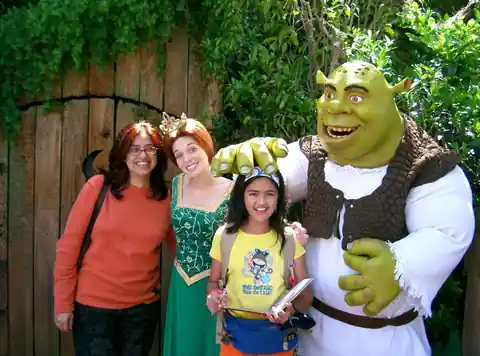
Shrek (2001): The Shrek character and Princess Fiona pose with visitorsImage: Wikimedia Commons · Arun Katiyar from Bangalore, India, CC BY-SA 2.0 - #101
- #102
- #103
- #104
Co-director Andrew Adamson frequently found himself at loggerheads with Jeffrey Katzenberg over the film's adult jokes. Katzenberg thought that some of the more adult material was inappropriate for an animated film, Adamson disagreed. Adamson could be perceived as winning the argument as many critics liked the film for the fact that it didn't just pander to under-age audiences.
- #105
- #106
Producer John H. Williams got the idea to adapt Shrek from his then pre-school aged sons. "To me it smacked of being a Nickelodeon type project. At the time they were very successful because kids want stuff that is iconoclastic. I've never had it before or since, but Shrek was effectively given a greenlight on the spot by Jeffrey Katzenberg who said that he was going to make it. I had other options, Miramax had been interested in it also and had wanted to use Henry Selick who [directed] The Nightmare Before Christmas (1993) and James and the Giant Peach (1996). Henry entered an exclusive deal with Miramax and I knew that he was an impressive, talented guy, but DreamWorks on the spot said, 'We will make this movie.' You know what? The process began immediately. We started doing character creation simultaneously with the earliest work on the outline with the writers. To me, it was the coolest process too, because there were so many voices that weighed in and made a huge impact in the evolution of it, which included storyboard artists and animators. It was much more of a collaborative enterprise than a live action film in a way. The credited writers all made an important, significant contribution, but the storyboard artists also made a huge and unrecognized story contribution..."
- #107
(at around 1h 9 mins) When Shrek, Donkey and Fiona are isolated from each other, John Cale's 1991 cover of "Hallelujah" by Leonard Cohen plays. Before choosing "Hallelujah," directors Andrew Adamson and Vicky Jenson tried several other sad songs. Upon settling on "Hallelujah," they eventually decided that Cale's version was the best fit for the scene. However, rock musician Robbie Robertson, who was one of the people in charge of the film's soundtrack, forbade the usage of Cale's version on the soundtrack, due to Cale having no affiliation with DreamWorks Records. Instead, DreamWorks recording artist Rufus Wainwright was drafted to record the song for the soundtrack, but Cale's version was kept in the film itself, because Adamson considered Wainwright's version "too full" and "too rich," and felt that "the rawness of John Cale's version seemed to suit the character of Shrek a little better."
- #108
- #109
Shrek was adapted into a stage musical in 2008 with music by Jeanine Tesori and lyrics by David Lindsay-Abaire. The original cast included Brian d'Arcy James as Shrek, Sutton Foster as Princess Fiona, Daniel Breaker as Donkey and Christopher Sieber as Lord Farquaad. A high definition recording of Shrek the Musical (2013) was released on DVD/Blu-Ray and on streaming in 2013.
- #110
- #111
- #112
Chris Farley was originally cast as Shrek and even recorded almost all of the dialogue. However, after his death, the role was given to fellow Saturday Night Live (1975) performer Mike Myers. Shrek's "air quotes" in the film is an homage to Farley, whose character Bennett Brauer also used air quotes. A story reel featuring a sample of Farley's recorded dialogue was leaked to the public in August 2015.
- #113
- #114
- #115
- #116
- #117
The film's story originally followed the adventures of a teenage ogre who just didn't want to lurk around the swamp and frighten people. Shrek (who was basically a sweet, well intentioned soul) wanted to do good. His ultimate dream was to become a knight and rescue fair damsels in distress. In this version of the film, Princess Fiona was voiced by rather gruff, sarcastic female comic Janeane Garofalo. The princess was the one who didn't trust people, and it was Shrek's sweetness, kind heart and good nature that eventually caused Fiona to open her eyes and learn that it was wrong to judge a person just based on how they looked. According to Jim Hill Media, "Were you to ask the folks at Dreamworks, they'd probably still tell you that the Chris Farley version of Shrek would have been infinitely better than the Michael Myers/Cameron Diaz version that the studio eventually released in May of 2001," but in December 1997, the tragic passing of Chris Farley caused a ripple effect, because he was no longer available to record the rest of his dialogue for Shrek's title character, Dreamworks had no choice but to chuck everything that they'd done up until that point and start the movie from scratch. This mean recasting the role. But Chris's fellow SNL-er Mike Myers seemed incapable of playing a sweet, sincere character, which meant that the ogre's part in the picture was going to have to be radically rewritten to play to Myers's strengths. Which is how the gruff, emotionally remote version of the film's title character came in being. Of course, given that the title character of Shrek was now going to be sarcastic and nasty, that meant that the role of Princess Fiona would have to be rewritten as well. Which is why Garofalo suddenly found herself out on the street while Cameron Diaz was brought in to play the kinder, gentler version of Fiona.
- #118
- #119
Radio Disney was told not to allow any ads for the film to air on the station, stating, "Due to recent initiatives with The Walt Disney Company, we are being asked not to align ourselves promotionally with this new release Shrek. Stations may accept spot dollars only in individual markets." The restriction was later relaxed to allow ads for the film's soundtrack album onto the network.
- #120
- #121
(at around 1h 22 mins) The line, "God bless us, every one," said by the Gingerbread Man (walking on a crutch) during the song "I'm a Believer," at the ending is originally from Charles Dickens' book, "A Christmas Carol," spoken by Tiny Tim (who also used a crutch). It also ends nearly every movie adaptation of the book.
- #122
Contains a major spoiler — show
(at around 1 min) The opening storybook sets up the appearance of Fiona, as well as where she is being held and her curse, as well as, in a freeze-frame bonus after Shrek tears the page out, the wedding at the end. Both of them, actually--Fiona and Farquaad's, then Shrek and Fiona's.
- #123
Contains a major spoiler — show
(at around 1h 3 mins) The original script had Princess Fiona born an ogre to the late King and Queen of Duloc. They had her locked in the tower under the lie that she was "of such rare beauty" she was kidnapped. They died, and the kingdom was left under the rule of an ambitious regent (implied to be Farquaad). When she 'became of age' to ascend the throne she escaped the tower and encounters a witch named Dama Fortuna - who has narrated the entire sequence through her tarot cards. She gave Fiona a potion which would make her beautiful; but warned her the potion had a side effect - she would change between her human and ogress form until she found her true love. Later she was whisked away by her dragon guardian and returned to the tower. This storyline was not adapted to keep the story simple, but is mentioned through the "witch" Fiona tells Donkey about.
- #124
Behind the Scenes (21)
- #125
- #126
- #127
- #128
- #129
- #130
- #131
The principal actors never met each other. They all read their parts separately, with a reader feeding them the lines. John Lithgow later admitted that, while he enjoyed playing Lord Farquaad, he was a little disappointed that he never actually worked directly with Mike Myers, Cameron Diaz, or Eddie Murphy.
- #132
(at around 23 mins) The line "You're on your way to a smacked bottom" was improvised by Mike Myers after he got annoyed at one of the directors. He had also used this line a few years earlier while playing his Austin Powers character in the popular music video of Madonna's song 'Beautiful Stranger.'
- #133
The intent with Fiona was to create the most photorealistic CGI depiction of a human. Prior to this, people animated through CGI had a certain stiffness and the facial features remained a little blank. To this end, the animation team brought in a leading Hollywood beautician to tell them how she applied make-up to A-lister stars.
- #134
- #135
- #136
One of the most difficult parts of creating the film was making Donkey's fur flow smoothly so that it didn't look like a Chia Pet's fur. This fell into the hands of the surfacing animators who used flow controls within a complex shader to provide the fur with many attributes (ability to change directions, lie flat, swirl, etc.) It was then the job of the visual effects group, led by Ken Bielenberg, to make the fur react to environment conditions. Once the technology was mastered, it was able to be applied to many aspects of the Shrek movie including grass, moss, beards, eyebrows, and even threads on Shrek's tunic. Making human hair realistic was different from Donkey's fur, requiring a separate rendering system and a lot of attention from the lighting and visual effects teams.
- #137
- #138
- #139
- #140
- #141
(at around 23 mins) The line "You're on your way to a smacked bottom" was improvised by Mike Myers after he got annoyed at one of the directors. He had also used this line a few years earlier while playing his Austin Powers character in the popular music video of Madonna's song 'Beautiful Stranger.'
- #142
- #143
One of the most difficult parts of creating the film was making Donkey's fur flow smoothly so that it didn't look like a Chia Pet's fur. This fell into the hands of the surfacing animators who used flow controls within a complex shader to provide the fur with many attributes (ability to change directions, lie flat, swirl, etc.) It was then the job of the visual effects group, led by Ken Bielenberg, to make the fur react to environment conditions. Once the technology was mastered, it was able to be applied to many aspects of the Shrek movie including grass, moss, beards, eyebrows, and even threads on Shrek's tunic. Making human hair realistic was different from Donkey's fur, requiring a separate rendering system and a lot of attention from the lighting and visual effects teams.
- #144
- #145
Characters & Cast (13)
- #146
- #147
Fiona originally was planned to be so real, she looked human. But next to an ogre and a chatty donkey, a too-human-looking princess in peril seemed out of place. In an interview with Jeffrey Katzenberg, he said "When we had placed Fiona in the movie, which is a fairy-tale world, it looked completely wrong. It stood out. It didn't fit. It looked bad... It looked like we made a mistake." Co-director Andrew Adamson added "With a talking donkey, you've got leeway because no one's ever seen one. Fiona had to be a little bit stylized so she fit into this somewhat surreal, illustrative world."
- #148
- #149
- #150
- #151
- #152
- #153
- #154
(at around 24 mins) Mike Myers was hesitant about succeeding the role of Shrek from Chris Farley, due to them being friends and believing it was disrespectful to do so. But after thinking it over and the producers all telling Myers: "Can't we just settle this over a pint?," he decided to take on the role. And that line was eventually used in the final cut of the film.
- #155
Eddie Murphy and Jeffrey Katzenberg have known each other since the beginning of their film careers. They promised that one day, they would do an animated film together, which culminated with this film. Katzenberg even recommended Murphy for the part of Donkey, and no-one else. He thinks its Murphy's best work.
- #156
(at around 6 mins) When everyone is lining up with their magical creatures for sale, the woman that has Donkey is voiced by Kathleen Freeman. At one point she says "No! No!" This is said exactly the same in the film The Blues Brothers (1980) where she plays a nun, and Jake offers to get her money to save the orphanage and she says "No! No! I will not take your..."
- #157
- #158
Jeffrey Katzenberg first approached Mike Myers about starring in Shrek after they attended the premiere of Saving Private Ryan (1998), another DreamWorks production. When Myers first heard the title, he responded, "Well, that's the worst fucking title I've ever heard in my life. It's the sound you make after drinking too many Molson Canadians. 'Agh! Shreck!'"
Easter Eggs & References (41)
- #159
- #160
- #161
- #162
Near the beginning of the film the fairy tale creatures are captured and "the three bears" are shown in a cage. Later, daddy bear and baby bear are seen in the background crying. This is followed by a scene where Lord Farquaad is shown relaxing in bed and there is a bearskin carpet in his room made from mama bear.
- #163
Farquaad sending Shrek to save Fiona for him to get his swamp back could be a parody of the Wizard of Oz, as Oz would only grant Dorothy and her friend's wishes by killing the Witch of the West. Unlike the Wizard, Farquaad was honest as he got the swamp cleared for Shrek as agreed, although he threatened to change his mind.
- #164
- #165
- #166
- #167
- #168
(at around 25 mins) After Shrek and Donkey defeat the knights at the tournament Shrek turns to the crowd and says, "Try the veal." This line is part of the line spoken by Sollozo to Captain McClusky when they met with Michael Corleone in The Godfather (1972). Both lines come before a major character undergoes a life-changing moment.
- #169
- #170
(at around 1h 22 mins) The line, "God bless us, every one," said by the Gingerbread Man (walking on a crutch) during the song "I'm a Believer," at the ending is originally from Charles Dickens' book, "A Christmas Carol," spoken by Tiny Tim (who also used a crutch). It also ends nearly every movie adaptation of the book.
- #171
(at around 10 mins) William Steig, the writer of Shrek, also wrote a Children's book called "Sylvester and the Magic Pebble" In which, a donkey has a magic pebble and, scared of a lion, wishes himself to be a boulder for protection. This is referenced in Shrek in Donkey's famous quote "I like that boulder, that is a nice boulder."
- #172
- #173
- #174
- #175
- #176
(at around 14 mins) When the fairytale creatures arrive at Shrek's swamp, you can see Papa Bear comforting Baby Bear at a fire. Later in Lord Farquaad's castle (at around 49 mins), as he watches Fiona on the mirror you see Mama Bear as a rug, skinned and laying on the floor. Her ultimate fate, however, seems to be OK: she re-appears in the Video/DVD Karaoke scene, dancing with Papa and Baby Bears.
- #177
- #178
- #179
- #180
- #181
- #182
- #183
- #184
- #185
- #186
- #187
- #188
- #189
(at around 6 mins) When everyone is lining up with their magical creatures for sale, the woman that has Donkey is voiced by Kathleen Freeman. At one point she says "No! No!" This is said exactly the same in the film The Blues Brothers (1980) where she plays a nun, and Jake offers to get her money to save the orphanage and she says "No! No! I will not take your..."
- #190
- #191
- #192
- #193
- #194
- #195
Near the beginning of the film the fairy tale creatures are captured and "the three bears" are shown in a cage. Later, daddy bear and baby bear are seen in the background crying. This is followed by a scene where Lord Farquaad is shown relaxing in bed and there is a bearskin carpet in his room made from mama bear.
- #196
- #197
- #198
Contains a major spoiler — show
The ending where Shrek and Donkey race to Duloc to stop the wedding because Shrek realizes he's in love with Fiona. He stops the wedding and tells Fiona that Lord Farquaad is only trying to marry her to become king and tells her that he loves her. It's related to the scene of another Mike Myers movie Wayne's World 2 (1993) when Bobby was trying to have Cassandra move to Los Angeles to keep her from Wayne so he can have her to himself and he also tried to marry her but Wayne races to the wedding and stops it and Cassandra realizes she loves Wayne and she flees with him.
- #199
Contains a major spoiler — show
(at around 29 mins) When climbing up the fiery mountain to rescue Princess Fiona, Donkey says "My mouth was open and everything" when Donkey thought Shrek passed wind. Eddie Murphy (Donkey) had used the same line in his stand-up comedy movie Eddie Murphy: Delirious (1983) when he mentioned "You could fart in your friend's face while watching the game, he don't care..."
Deeper Meaning (6)
- #200
- #201
- #202
John Lithgow was asked whether or not the adult jokes in the movie would've been too inappropriate for kids, he responds: "No, as long as it's done correctly. One of the things I always loved about British Theater was the Annual Christmas British pantomimes, which are these corny old fairy tales that are put on as musicals. The principal boy is played by a girl and the ugly sisters are played by guys in drag. "Peter Pan" the musical was very much in that tradition. It is a particular tradition developed over centuries, this ability to put on a show for the entire family, where the adults and the children are laughing at the same time, at the same jokes, for completely different reasons. And the adults like it, particularly, because they realize that the kids are oblivious to what's so funny about it. It's a huge, electric moment when these jokes pay off, and that's what "Shrek" is all about. It's very rare. In a way, that's what we were always trying to achieve on "3rd Rock," appealing to lots of different audience constituencies at the same moment."
- #203
- #204
- #205
Contains a major spoiler — show
(at around 56 mins) The film also foreshadows Fiona's identity as something other than a normal human princess. For instance, at one point the trio walk through a bug-infested field, and Fiona uses a cobweb stretched between two branches to ensnare the bugs. She wraps the web up into a candyfloss-esque snack, which she passes to Shrek to eat. After she does this, she licks her fingers, hinting she shares Shrek's appetite for gross food not usually edible for humans. Later, she says his weed rat recipe is delicious and digs into it.
Career & Awards (5)
- #206
- #207
This film was the first winner for the inaugural Best Animated Feature category of the Academy Awards in 2002, beating out Jimmy Neutron: Boy Genius (2001) and Monsters, Inc. (2001). The actual Oscar itself is now on display at the Academy Museum in Los Angeles, donated by the recipient, producer Aron Warner.
- #208
- #209
In just over four weeks, the film became the best-selling DVD of all-time. With more than 5.5 million DVDs sold to consumers in North America, the big green Ogre surpassed the previous record-holder Gladiator (2000) (which has sold over 5 million units in one year). Retail has purchased a total of 7.3 million Shrek DVDs and DreamWorks had to continue manufacturing new copies in an effort to avoid selling out of the product prior to the Holidays. "This unprecedented rate of sale confirms that the Shrek DVD is sought after by not only the DVD collector, but also by the wide range of Shrek movie fans including families with kids, teenagers, adults and everyone in between," commented Kelley Avery, worldwide head of DreamWorks Home Entertainment.
- #210
Life & Family (1)
Continue through the archive

Sources & editorial notes
Reference databases
- Wikipedia
- IMDb
Information from external sources is independently selected, consolidated and edited by Arka Evren. Sources are listed for verification and further reading. Encyclopedia text is used under its licence (CC BY-SA). How we work