

FILM · 1960 · USA
Spartacus
- Directed by
- Stanley Kubrick
- Runtime
- 197 min
- Studio
- Bryna Productions, Universal Pictures
95 archived facts 8 topics 1 source Last reviewed Nov 2026
The rebellious Thracian Spartacus, born and raised a slave, is sold to Gladiator trainer Batiatus. After weeks of being trained to kill for the arena, Spartacus turns on his owners and leads the other slaves in rebellion. As the rebels move from town to town, their numbers swell as escaped slaves join their ranks. Under the leadership of Spartacus, they make their way to southern Italy, where they will cross the…

95 Interesting Facts About Spartacus
Interesting Facts (3)
Production Story (37)
- #004
- #005
- #006
Dalton Trumbo and Stanley Kubrick didn't agree on the screenplay, but as Trumbo (who was blacklisted for his left-wing sympathies) wasn't allowed on the set, Kubrick could order re-writes without much opposition. However, Trumbo still got his way: he was reportedly being smuggled into the studio several times under a blanket so that he could attend screenings of a rough cut of the movie. This early version was deemed a disaster, and Trumbo made elaborate notes of what he perceived to be the problem with it. These notes were subsequently used to re-edit the film into its final form, which was well received.
- #007
Kirk Douglas noted in his autobiography that original director Anthony Mann seemed overwhelmed by the scale of the project. It later appeared that he got over that rather quickly as the next year he made an equally large production in shape of El Cid (1961).
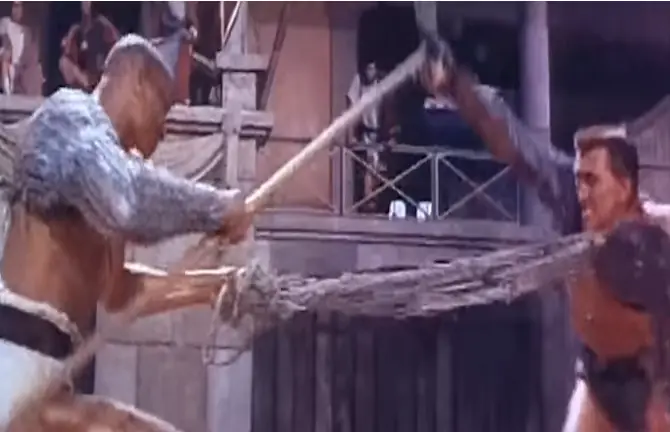
Spartacus (1960): Kirk Douglas in an armed clash in the arenaImage: Wikimedia Commons · Universal International, Public domain - #008
- #009
In order to get so many big stars to play supporting roles, Kirk Douglas showed each a different script in which their character was emphasized. Writer Dalton Trumbo reportedly got so fed up with writing all these different versions that he threatened to walk off the project, until Douglas promised to give him full screen credit (which wasn't officially allowed because Trumbo was blacklisted in Hollywood for perceived communist sympathies). When director Otto Preminger, who was also working with Trumbo on Exodus (1960), learned of this, he publicly credited Trumbo for that movie before Douglas could, much to the latter's chagrin.
- #010
After extensive research of music of the period, Composer Alex North gathered a collection of antique instruments that, while not authentically Roman, provided a strong dramatic effect. These instruments included a sarrusophone, Israeli recorder, Chinese oboe, lute, mandolin, Yugoslav flute, kythara, dulcimer, and bagpipes. North's prize instrument was the ondioline, similar to an earlier version of the electronic synthesizer, which had never been used in a movie before.
- #011
- #012
Stanley Kubrick wanted to shoot this movie in Rome with cheap extras and resources, but Edward Muhl, President of Universal Pictures, wanted to make an example of this movie and prove that a successful epic could be made in Hollywood and "stem the flood of 'runaway' producers heading for Europe."
- #013
- #014
- #015
Sir Laurence Olivier jokingly suggested to Kirk Douglas that he, Olivier, should play Spartacus. Douglas was not amused.
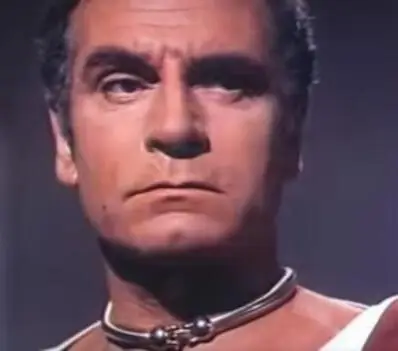
Spartacus (1960): Close-up of Marcus Licinius Crassus with a serious expressionImage: Wikimedia Commons · Стэнли Кубрик, Public domain - #016
- #017
The filming was plagued by the conflicting visions of director Stanley Kubrick and openly communist screenwriter Dalton Trumbo. Kubrick complained that the character of Spartacus had no faults nor quirks, and was completely interchangeable with any other slave gladiator. He later distanced himself from the movie.
- #018
Steven Spielberg gave his backing to the restoration effort, and recommended that Stanley Kubrick be informed of the project. Kubrick, who had disowned the movie, had nothing to do with the actual physical restoration, though he gave his approval to the effort, and the producers wanted his final approval of their work.
- #019
- #020
- #021
The soundtrack album runs less than forty-five minutes and is not very representative of the score. There were plans to re-record a significant amount of the music with Alex North's friend and fellow composer Jerry Goldsmith, but the project kept getting delayed. Goldsmith died in 2004. Numerous bootleg recordings have been made, but none has good sound quality.
- #022
Kirk Douglas had an unhappy time for most of the production. After a major falling out with original director Anthony Mann, he asked Stanley Kubrick, with whom he had collaborated well three years previously on Paths of Glory (1957), to direct. However, he had an equally difficult time working with Kubrick, as the men had frequent clashes about many artistic choices. The disagreements got so bad that both men reportedly went into therapy together. After the production, Douglas claimed he would not collaborate with Kubrick again if he was given the opportunity and, in his memoirs, called Kubrick "a talented shit". Douglas often said he regretted having Mann fired from the movie, and also that, when he was offered The Heroes of Telemark (1965), he agreed to take that role, on condition that Mann be hired as director. However, in reality, Mann was already attached to the project and had originally approached Anthony Perkins to play what became Douglas's part.
- #023
At first, the studio did not want to give the blacklisted openly communist Dalton Trumbo screen credit for his work. Stanley Kubrick said he would accept the credit. Kirk Douglas later said he was so appalled by Kubrick's attempt to claim credit for someone else's work that he used his clout to make sure Trumbo received his due credit, effectively ending the Hollywood blacklist. Trumbo had already been credited as the writer of Exodus (1960), although a delay caused that movie to be released two months after this one. Trumbo's family publicly disputed Douglas' version of the story, as did producer Edward Lewis and the children of writer Howard Fast (supposedly, Douglas didn't want Trumbo to receive credit out of fear for his own career; Lewis made that happen, and Douglas later agreed when it all worked out fine). In any case, the blacklist had been greatly undermined when Cecil B. DeMille hired Edward G. Robinson for The Ten Commandments (1956), reviving Robinson's career after he had been nearly blacklisted for his past political activism.
- #024
Kirk Douglas wanted to play the title hero in Ben-Hur (1959), but director William Wyler wanted Charlton Heston to play the role. Douglas was then offered the antagonist role of Messala, which was eventually given to Stephen Boyd, but refused to play second banana. In later years, Douglas admitted that he made this movie as to show William Wyler and his company that he could make a Roman epic that could match "Ben-Hur." He once said, "That was what spurred me to do it in a childish way, the 'I'll show them' sort of thing."
- #025
Kirk Douglas was unsure about casting Jean Simmons as Varinia, as she was an English actress. American actors and actresses had been cast as the slaves, and British actors and actresses had been cast as the Romans. Douglas actually wanted German actress Sabine Bethmann to play Varinia (her actual portrayal in the Howard Fast novel), but Stanley Kubrick disagreed, claiming that Bethmann lacked the talent to display emotion. To prove this, Kubrick called her to his office and told her she was fired; her lack of dramatic response also persuaded Douglas to a re-cast. Since none of the other German actresses were pretty enough, he decided to go with Simmons.
- #026
- #027
Universal Pictures trimmed several action scenes, along with political content that was deemed subversive. Apparently, the studio feared that if this movie had a chance of winning, viewers would perceive it as Communist, especially after using openly Communist screenwriter Dalton Trumbo, who was unabashed in his political views, and even wrote a book about them.
- #028
- #029
Film preservationist Robert A. Harris said that by 1991, the camera negative for this movie was completely faded and unusable. Nothing could be done to produce any printing material from that element. Color separation elements made on black-and-white film in the early 1960s were used instead.
- #030
- #031
- #032
Kirk Douglas, Sir Laurence Olivier, Charles Laughton, and Sir Peter Ustinov all made re-writes to the script to improve their characters' roles. Some were kept in the movie, but most were scrapped, to the consternation of the actors who constantly jostled with each other throughout the movie.
- #033
In August 1958, Alciona Productions announced plans to produce a movie titled "Spartacus and the Gladiators' with Yul Brynner as star, Martin Ritt as director, and United Artists as distributor. Kirk Douglas' agent Lew Wasserman suggesting he try having his movie produced for Universal Pictures. With openly Communist Dalton Trumbo's screenplay being completed in two weeks, Universal and Douglas won the "Spartacus" race.
- #034
Writer Howard Fast felt that Spartacus' hamstringing the guard with his teeth and drowning the trainer in a vat of soup were Kirk Douglas' ideas, and would never be done by Spartacus, who Fast portrayed as a gentle, compassionate figure. Douglas justified the violence as necessary for a rebel leader, and claims he tried to show the tough and gentle sides of Spartacus equally in the movie.
- #035
The original version included a scene where Marcus Licinius Crassus (Sir Laurence Olivier) attempts to seduce Antoninus (Tony Curtis). The Production Code Administration and the Legion of Decency both objected. At one point Geoffrey Shurlock, representing the censors, suggested it would help if the reference in the scene to a preference for oysters or snails was changed to truffles and artichokes. In the end the scene was cut, but it was put back in for the 1991 restoration. However, the soundtrack had been lost in the meantime and the dialogue had to be dubbed. Curtis was able to redo his lines, but Olivier had died. Dame Joan Plowright, his widow, remembered that Sir Anthony Hopkins had done a dead-on impression of Olivier and she mentioned this to the restoration team. They approached Hopkins and he agreed to voice Olivier's lines in that scene. Hopkins is thanked in the credits for the restored version.
- #036
- #037
In July 1959, Hollywood Reporter announced that the budget had "spiralled" from $5,000,000 to $9,000,000, and according to studio press materials, the final budget was $12,000,000. Some sources stated that the massive production was the most expensive in movie history to that point. However, the budget for Ben-Hur (1959) exceeded $15,000,000. The April 1991 New York Times article points out that this amount equalled more than Universal Pictures was worth at the time of the movie's production, when the studio was purchased by MCA for $11,250,000.
- #038
- #039
Contains a major spoiler — show
Approximately four minutes of this movie are lost, because of Universal Pictures' mishandling of its prints in the 1970s. These scenes relate to the character of Gracchus, including a scene where he committed suicide. The audio tracks of these scenes have survived.
- #040
Behind the Scenes (39)
- #041
- #042
- #043
The scene where Varinia (Jean Simmons) is surprised by Spartacus (Kirk Douglas) whilst swimming in a pond (filmed on an obvious studio set) took several takes a the actress was actually topless - except for Band Aids covering her nipples. The water level is noticeably and deliberately very low and it took about a dozen takes to get the shot just right and for Simmons to be standing on exactly the right spot to show just the right amount of cleavage without the Band Aids being visible.
- #044
- #045
- #046
- #047
- #048
- #049
- #050
When Nina Foch, during the "method acting" era, asked Stanley Kubrick, during a scene where she was sitting with Laurence Olivier waiting for the gladiators to come out, what her character's motivation was, Kubrick replied: "You're sitting here with Larry waiting for the gladiators to come out."
- #051
Cinematographer Russell Metty walked off the set, complaining that director Stanley Kubrick was not letting him do his job. Metty was used to directors allowing him to call his own shots with little oversight, while Kubrick was a professional photographer who had shot some of his previous movies by himself. Subsequently, Kubrick did the majority of the cinematography work. Metty complained about this up until the release of the movie and even, at one point, asked to have his name removed from the credits. However, because his name was in the credits, when this movie won the Academy Award for Best Cinematography, it was given to Metty, although he actually didn't shoot most of it.
- #052
- #053
- #054
According to producer James B. Harris, director Stanley Kubrick would repeatedly see Charles Laughton, Sir Peter Ustinov, and Sir Laurence Olivier seemingly whispering to each other. Afraid they were gossiping about him, Kubrick leaned in to hear what they were saying, and each was just reading the script aloud again and again to themselves.
- #055
Stanley Kubrick spent $40,000 on the over-ten-acre gladiator camp set. On the side of the set that bordered the freeway, a 125-foot asbestos curtain was erected in order to film the burning of the camp, which was organized with collaboration from the Los Angeles Fire and Police Departments. Studio press materials state that 5,000 uniforms and seven tons of armor were borrowed from Italian museums, and that every one of Hollywood's 187 stuntmen was trained in the gladiatorial rituals of combat to the death. Modern sources note that the production utilized approximately 10,500 people.
- #056
The movie was filmed using the 35mm Super 70 Technirama format, and then blown up to 70mm film. This was a change for director Stanley Kubrick, who preferred using the standard spherical format. This process allowed him to achieve ultra-high definition, and to capture large panoramic scenes, including one with 8,000 Roman soldiers (who were actually active-duty soldiers from the Spanish Army).
- #057
- #058
Kirk Douglas was very hesitant to perform the shot of Spartacus lopping off a Roman soldier's arm. Although the arm was fake (attached to an amputee), the sword blade was real and Douglas had to hit exactly the right mark. After successfully performing the stunt once, Douglas refused a second take.
- #059
- #060
- #061
- #062
- #063
- #064
- #065
- #066
- #067
- #068
The intimate scenes were filmed in Hollywood, but Stanley Kubrick insisted that all battle scenes be filmed on a vast plain outside Madrid. Eight thousand trained troops from the Spanish army were used to double as the Roman infantry. Kubrick directed the armies from the top of specially constructed towers. However, he eventually had to cut all but one of the gory battle scenes, due to negative audience reactions at preview screenings. So precise was Kubrick that even in arranging the bodies of the slaughtered slaves he had each "corpse" assigned with a number and instructions.
- #069
- #070
The intimate scenes were filmed in Hollywood, but Stanley Kubrick insisted that all battle scenes be filmed on a vast plain outside Madrid. Eight thousand trained troops from the Spanish army were used to double as the Roman infantry. Kubrick directed the armies from the top of specially constructed towers. However, he eventually had to cut all but one of the gory battle scenes, due to negative audience reactions at preview screenings. So precise was Kubrick that even in arranging the bodies of the slaughtered slaves he had each "corpse" assigned with a number and instructions.
- #071
- #072
- #073
Contains a major spoiler — show
Of the 167 days it took Stanley Kubrick to shoot this movie, six weeks were spent directing an elaborate battle sequence in which 8,500 extras re-created the clash between the Roman troops and Spartacus' slave army. Several scenes in the battle drew the ire of the Legion of Decency, and were therefore cut. These include shots of men being dismembered (dwarfs with false torsos and an actor with only one arm (Bill Raisch, the "One-Armed Man" of The Fugitive (1963) fame) with a phony breakaway limb as a Roman soldier who has his arm cut off in battle were used to give authenticity). Seven years later, when the Oscar-winning movie was re-issued, an additional 22 minutes were cut out, including a scene in which Varinia watches Spartacus writhe in agony on a cross. Her line, "Oh, please die, my darling" was excised, and the scene was cut to make it appear that Spartacus was already dead.
- #074
- #075
- #076
Contains a major spoiler — show
When Crassus (Sir Laurence Olivier) issues the order "Crucify him!" after Spartacus has killed Antoninus, the two figures who move out of shot behind Kirk Douglas, ostensibly Olivier and John Gavin, are in fact a couple of brightly-lit extras of similar build and height.
- #077
- #078
Contains a major spoiler — show
Draba (Woody Strode) is killed in the ring after attacking one of the Senators. His body is hung upside down in the gladiators' quarters as a warning. Originally, this was going to be a replica of Strode, but when the effect wasn't satisfactory, he hung upside-down, ropes tied around his ankles. As the gladiators slowly file past his dangling body, Strode doesn't flinch or twitch. According to his son Kalai Strode, the unused replica hung inside the entrance to Universal Studios' prop room for several years.
- #079
Contains a major spoiler — show
When director Stanley Kubrick originally removed close-ups of Spartacus' crucifixion during the finale, Kirk Douglas (by his own account) grew so angry that he attacked Kubrick with a folding chair, because the filming of said close-ups had been so long and difficult.
Characters & Cast (2)
- #080
Kirk Douglas as Spartacus and John Ireland as Crixus played devoted companions and friends in this film, in sharp contrast to their roles in Gunfight at the O.K. Corral (1957), where as Doc Holliday and Johnny Ringo they were fierce rivals and fought each other in the final shootout. In both films, they played actual historical persons.
- #081
Easter Eggs & References (2)
- #082
Charles Laughton was the first actor to portray Agatha Christie's Hercule Poirot, originating the role on stage in the 1928 play Alibi. Sir Peter Ustinov later played Poirot on screen, notably in Death on the Nile (1978). Here in Spartacus (1960) they share scenes despite both having portrayed the same iconic detective in their respective careers.
- #083
Contains a major spoiler — show
This movie is often mistakenly cited as the uncredited movie debut of George Kennedy. It is not Kennedy, but rather stuntman and actor Bob Morgan, who slightly resembles Kennedy (although his voice is different), as one of the rebel soldiers who announces "I'm Spartacus!" toward the end of the movie. Kennedy had no association with this movie.
Deeper Meaning (4)
- #084
The character of Gracchus played by Charles Laughton is an anachronism since the tribune Tiberius Sempronius Gracchus died in 133 b.c., long before the time of Spartacus (his less famous brother Gaius who also was a tribune and shared his goals died in 121 b.c.). He also wasn't a senator. However, the film obviously wants to contrast the would-be dictator Crassus with a character who is closer to modern ideas of a democratic politician.
- #085
- #086
This movie parallels 1950s American history, specifically the House Committee on un-American Activities hearings and the civil rights movement. The hearings, where witnesses were ordered under penalty of imprisonment to "name names" of supposed Communist sympathizers, closely resembles the climactic scene when the slaves, asked by Crassus to give up their leader by pointing him out from the multitude, each stand up to proclaim, "I am Spartacus". Howard Fast, who wrote the book on which this movie was based, was jailed for his refusal to testify, and wrote the novel "Spartacus" while in prison. The comment of how slavery was a central part of American history is pointed to in the beginning in the scenes featuring Draba and Spartacus. Draba, who denies the friendship of Spartacus claiming "gladiators can have no friends", sacrifices himself by attacking Crassus rather than killing Spartacus. This scene points to the fact that Americans are indebted to the suffering of black slaves, who played a major role in building the country (a fact until fairly recently that was little, if at all, mentioned in U.S. history books). The fight to end segregation and to promote the equality of African-Americans is seen in the mixing of races within the gladiator school, as well as in the army of Spartacus, where all fight for freedom.
- #087
Contains a major spoiler — show
The famous "I am Spartacus" scene is pure fiction. The real Spartacus is believed to have been killed in battle, not crucified. His men were not crucified because they refused to hand him in. The Romans had planned to kill them all as a very clear example to deter further revolts.
Career & Awards (5)
- #088
- #089
- #090
- #091
Despite this movie being a huge box-office success, gaining four Oscars and being considered to rank among the very best of historical epics, director Stanley Kubrick disowned the movie and did not include it as part of his canon. Although his personal mark is a distinct part of the final movie, his contract did not give him complete control over the filming, and he frequently clashed with the studio and star/producer Kirk Douglas, making this the only occasion on which he did not exercise such control over one of his movies.
- #092
Cinematographer Russell Metty walked off the set, complaining that director Stanley Kubrick was not letting him do his job. Metty was used to directors allowing him to call his own shots with little oversight, while Kubrick was a professional photographer who had shot some of his previous movies by himself. Subsequently, Kubrick did the majority of the cinematography work. Metty complained about this up until the release of the movie and even, at one point, asked to have his name removed from the credits. However, because his name was in the credits, when this movie won the Academy Award for Best Cinematography, it was given to Metty, although he actually didn't shoot most of it.
Life & Family (3)
Sources & editorial notes
Reference databases
- Wikipedia
- IMDb
Information from external sources is independently selected, consolidated and edited by Arka Evren. Sources are listed for verification and further reading. Encyclopedia text is used under its licence (CC BY-SA). How we work