
FILM · 2004 · USA
Spider-Man 2
- Directed by
- Sam Raimi
- Runtime
- 127 min
- Studio
- Marvel Enterprises, Laura Ziskin Productions, Columbia Pictures
220 archived facts 8 topics 1 source Last reviewed Sep 2026
Peter Parker is going through a major identity crisis. Burned out from being Spider-Man, he decides to shelve his superhero alter ego, which leaves the city suffering in the wake of carnage left by the evil Doc Ock. In the meantime, Parker still can't act on his feelings for Mary Jane Watson, a girl he's loved since childhood. A certain anger begins to brew in his best friend Harry Osborn as well...
Summary: TMDB
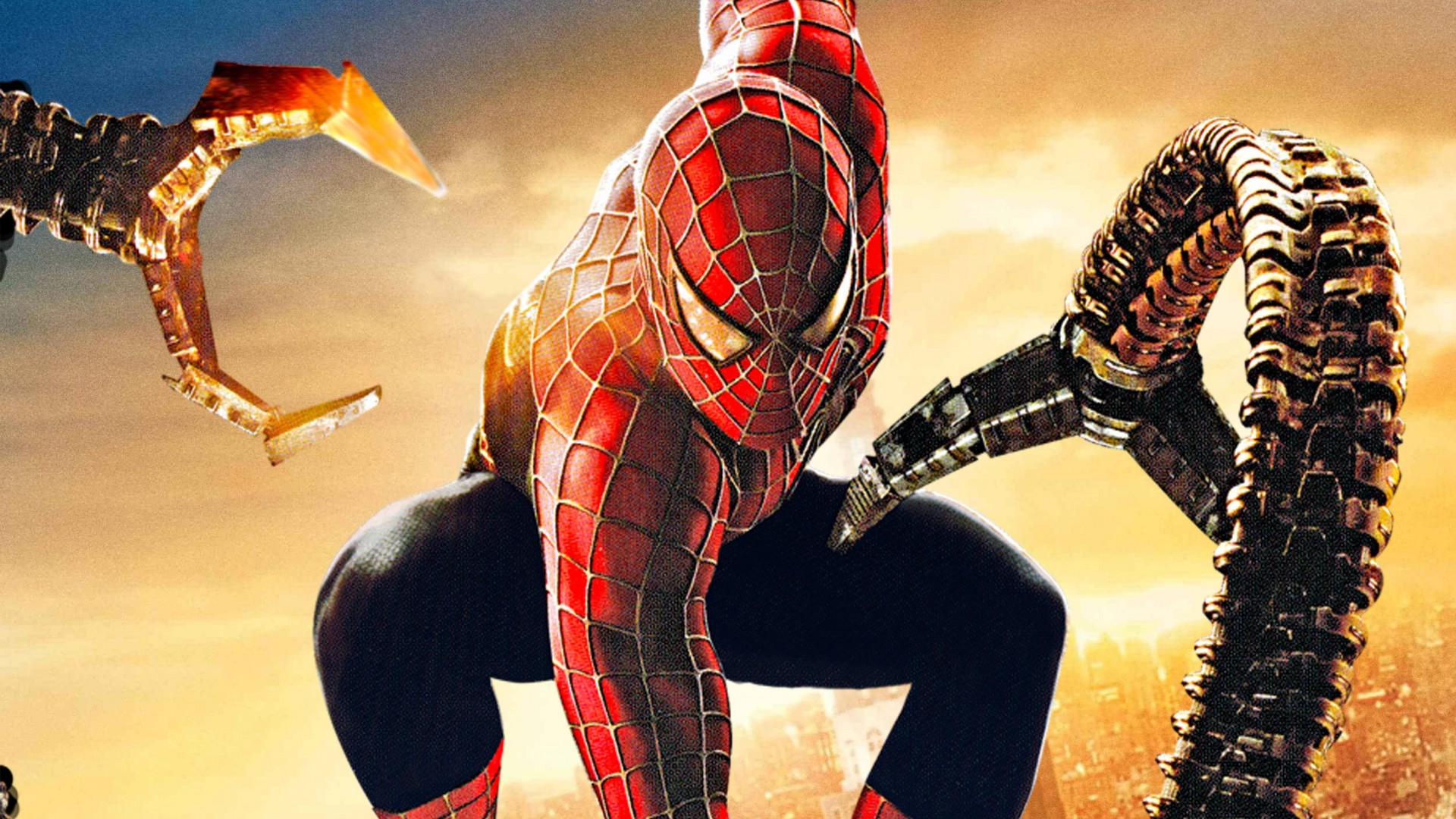
172 Interesting Facts About Spider-Man 2
- #002
The train fight between Doc Ock and Spider-Man was director Sam Raimi's idea and was the first major scene shot for the film.
- #004
Rosemary Harris performed the action scenes herself in the sequence where Aunt May is taken hostage and later helps Spider-Man.
- #005
If you look closely in Peter's apartment, you can see the photo Mary-Jane took just before she was bitten by the genetically modified spider. It was meant to represent the last moment of innocence in Peter's life before it changed forever.
- #006
Alfred Molina, who played Dr. Octopus, actually named his four mechanical tentacles Larry, Harry, Flo and Moe. Flo was the upper-right tentacle, because it was operated with a female grip and was the most motherly; it took off his sunglasses and gave him sips of his drink.
- #008
At around the 5-minute mark, Stan Lee first filmed the cameo of a man shouting, "Whoa! He stole that guy's pizza!" But due to problems with the shoot, the scene was refilmed with Donnell Rawlings, and Lee was given a different cameo, playing a pedestrian pulling a woman out of the path of falling debris during a battle between Spider-Man and Doc Ock.
- #011
At around 1 hour 40 minutes, the two children who give Spider-Man his mask back on the train are Tobey Maguire's stepbrothers.
- #014
At around 1 hour 3 minutes, the alley where Peter throws away his Spider-Man costume is meant to be the same one where he kissed MJ upside down in the first film.
- #015
While filming this movie, Alfred Molina was playing Tevye in the play "Fiddler on the Roof." During one of the wall-climbing scenes he hummed "If I Were a Rich Man" to himself, and the puppeteers overheard him and moved the tentacles in time with the song.
- #016
Two more villains from the comics appear in the film. John Jameson (J. Jonah Jameson's son) is the Werewolf, and Dr. Curt Connors is the Lizard. Both are tragic Jekyll-and-Hyde-type villains, since they are good-hearted men who periodically transform into sterile, animal-based alter egos against their will.
- #018
According to Stan Lee, Spider-Man wears a mask so that his enemies cannot see his fear.
- #019
Contains a major spoiler — show
At around 1 hour 50 minutes, the extreme close-up of Dr. Octopus sinking into the water is entirely digital. The SFX team praised it as the most detailed rendering (for its time) of a fully CG human face.
- #021
It took the record for the highest single-day Wednesday opening from The Lord of the Rings: The Return of the King (2003).
- #022
When Peter throws the Spider-Man costume into a trash can, it is a recreation of a panel from The Amazing Spider-Man issue 50, "Spider-Man No More." As in the film, the suit is found and brought to J Jonah Jameson, then retrieved by Spider-Man, who leaves a note similar to the one in the film.
- #024
Alfred Molina considered the crew of Spider-Man 2 (2004) the hardest-working group of people he had ever worked with.
- #025
For the hospital scene, the production team had to build tentacles 13 feet long. Looking at the finished scene, the designers could not tell what was CGI and what was a puppet; the combined effects were too seamless to be seen with the naked eye. The designers were especially proud that the tentacles and their appearance were not leaked to the press before the film came out, which made them all the more surprising for audiences. The tentacles were also expensive and inadequate, so security on the film set was tight to prevent anyone from stealing them.
- #026
Near the beginning of the film, at around the 9th minute, Peter drops his books while on campus. As he bends down to pick them up, two backpacks hit him in the head. Raimi, whose face is not seen, was the second "student" to hit him.
- #027
At around 1 hour 9 minutes, the man beaten in the alley Peter walks away from was meant to be the man who showed the Spider-Man costume that was thrown at Jameson. The bag the thugs try to steal contained the suit, but this is not made explicit in the film.
- #029
Peter's landlord, Mr. Ditkovitch, takes his name from Steve Ditko, the co-creator of Spider-Man.
- #030
Tobey Maguire's manager asked Columbia Pictures for 25 million dollars or 10% of the gross (whichever was greater), and was refused.
- #031
Danny Elfman, who composed the music for this and many of Sam Raimi's other films, had some kind of disagreement with the director throughout this film and was reported to have said: "Seeing such a deep negative change in a person was almost enough to make me feel I no longer wanted to make films." Raimi and Elfman did reunite nine years later for Oz the Great and Powerful (2013).
- #032
The band Dashboard Confessional agreed to write a song for the end title sequence if they could attend an early screening of the film. The studio agreed. After seeing the film, the lead singer wrote "Vindicated" in ten minutes.
- #033
Contains a major spoiler — show
In the original script, Rosie was killed by the energy emitted by the ball Octavius created.
- #034
The original title of this second outing was "The Amazing Spider-Man"; that title was eventually used when the series was rebooted with The Amazing Spider-Man (2012).
- #035
EASTER EGG: On the DVD's second disc, go to "Making the Amazing," and the up arrow and the upper-right tentacle (Flo) will light up. This leads to a short segment in which director Sam Raimi found someone to give Alfred Molina "tips" on how to behave like Doc Ock. They go to the tentacles and ask the "acting" Doc Ock inside how the role should be played — the person giving the tips is Willem Dafoe. Alfred laughed a great deal at this.
- #036
The opening sequence features artwork by Alex Ross summarizing the events of Spider-Man (2002).
- #037
In a deleted scene at the men's club, John Jameson introduces Mary-Jane to his father. He is initially a little suspicious of her because he knows she has been dating Harry Osborn; he even wonders whether Harry is paying her way. MJ and Jameson argue about Spider-Man's pros and cons. Jameson thinks he operates above the law and does best the work left to professionals, while MJ says he makes the world a better place.
- #038
Filming the finale took 8 days.
- #039
Shooting was halted for eight weeks to build Doc Ock's pier hideout. Building the collapsed set took 15 weeks in total.
- #040
The violinist who serenades Spider-Man throughout the film had another scene that was cut from the film. When Harry heard him from the balcony of his father's mansion, he poured a glass of whiskey over him.
- #041
When Doctor Octopus carries his tentacles, that is a practical effect. When the tentacles carry the Doctor, that is computer-generated imagery; to achieve this effect, a 6-meter-tall rig held Alfred Molina so he could glide around it, and the CGI tentacles were added afterward. However, because it saved money, using Edge FX's puppets was always preferred, and every scene was always shot with them first to see whether CGI was really necessary.
- #043
Contains a major spoiler — show
When J. Jonah Jameson needs a name for Doctor Octavius, one of Hoffman's suggestions is the title Doctor Strange, and Jameson notes that the name is already taken. Doctor Strange is another major co-creation of Stan Lee and Steve Ditko and a sorcerer superhero who is usually an ally of Spider-Man. Years later, Spider-Man would work alongside Dr. Strange in Avengers: Infinity War (2018), and Sam Raimi would be hired to direct Doctor Strange in the Multiverse of Madness (2022).
- #044
The film was sent to cinemas under the title "Spray Paint" to avoid attracting the attention of pirates.
- #045
Putting blades inside Doc Ock's tentacles was Sam Raimi's idea and had never appeared in the comics. Raimi called it the 'death blade'.
- #046
(At around the 41st minute) The nurse dragged along the ground by one of Doctor Ock's tentacles scraping against it as she is pulled backward was achieved by a simple method such as making the floor out of wax.
- #047
(Around 1 hour 17 minutes) The man in the apartment fire who tells Peter that someone is still trapped on the second floor (played by Michael Edward Thomas) is the same man from the first film who started throwing trash at the Green Goblin during their fight on the bridge.
- #048
Kirsten Dunst dyed her hair red for the film instead of wearing a wig, as she had in the first film.
- #049
Contains a major spoiler — show
In the script: Peter rents a place above a television repair shop. He no longer lives with Harry since Norman's death, and Harry returns to his father's mansion. Harry's obsession with Spider-Man was more than Peter could bear; that is why he gets angry at Harry at the birthday party. Doctor Ock had tapped Peter's phone lines, which is how he knew he would find him with Mary-Jane at a cafe. The scene with the burning building was much shorter. MJ is so upset about missing Peter's play because she was the one who encouraged his acting talent. Harry wonders whether Quest, Oscorp's biggest rival, hired Spider-Man to discredit his company. According to the script, Hoffman is the Daily Bugle's advertising manager, which explains why Jameson constantly asks him to patent the names of the supervillains the Bugle invents. Betty Brant makes sure the bum is paid more for the Spider-Man costume than Jameson wanted to pay. In a scene cut from the film, the Bugle's night staff say that Jameson wears a suit and strikes fake heroic poses even though he thinks no one is watching; he even walked to his desk and stuck paper clips to a lamp as if he were making a web. The district attorney's office also wants to confirm the lawsuit is real, but Jameson will not hear of it. MJ confesses to Louise that she married John to prove something to her father and to show Peter what he is missing. The planetarium party Jameson hosts is held to raise money for the new science library. One of the things fueling Harry's depression was that the scientists who witnessed the failed fusion experiment considered suing Harry, since it was financed with Oscorp's money. Seeing MJ with another man like Peter also disturbs him.
- #050
The precious substance Doc Ock uses to power the fusion device, tritium, actually exists in real life.
- #051
(Around the 59th minute) On the Daily Bugle's front page, on close inspection, alongside "Spidey and Ock Rob Bank!" there is a news teaser reading "Can chronic back pain lead to brain shrinkage?", a possible nod to Tobey Maguire's real-life back problems.
- #052
Each of Doc Ock's tentacles is controlled by four people, who rehearsed every scene together with Alfred Molina to achieve a more natural sense of movement. To complete the illusion that the tentacles are part of Doc Ock's body, the sound designers chose not to use servo sound effects.
- #053
EASTER EGG: On the DVD's second disc, go to the Gallery section and press the up key. A Spider-Sense will appear around Spider-Man's head. Click on it to access a hidden film of Doc Ock performing "Fiddler On The Roof", played by Alfred Molina.
- #055
In the first film, Harry Osborn and Peter Parker moved into a spacious apartment paid for by Norman Osborn, who was described as wealthy. But for this film, in which Peter lives alone, Tobey Maguire gave Sam Raimi suggestions on how Peter's apartment should look, based on his own observations of friends living in cramped, run-down New York apartments.
- #056
Michael Chabon submitted a script draft about a younger Doc Ock falling in love with Mary Jane. In Chabon's script, Octavius is the creator of the genetically altered spider that bites Peter Parker. Producer Avi Arad rejected the script, largely because he disliked the idea of another love triangle.
- #057
One of the things that drew Alfred Molina to the character of Doctor Octopus was his twisted, mocking sense of humor.
- #058
(Around 27 minutes) One of the posters for Mary Jane's production of "The Importance of Being Earnest" reads "J. Frazier is especially effective!", a nod to John Frazier, the film's special effects supervisor.
- #059
The production team was unusually lucky given that such a large film was shot in so many exterior locations, because it never rained.
- #060
A special camera system called Spydercam was built, allowing the film to create the effect of 50-story falls and high-speed pass-through shots. The system had actually been invented for the first film but was used only in the final shot.
- #061
Although Dr. Curt Connors appears in this film, the character of Otto Octavius here is actually closer to Connors in the comics: a sensitive, intelligent mentor driven mad by an experiment gone wrong and transformed into a monstrous villain (Connors becomes the Lizard, Octavius becomes Doc Ock).
- #062
(Around the 41st minute) The shot Raimi called "Octovision", showing Dr. Octopus's tentacles attacking the doctors operating on him.
- #063
Peter rides a 1977 Puch Newport moped. The film's Picture Car Coordinator, Cyril O'Neil, managed to find 12 motorcycles, providing enough parts to build 7 working models. Three of them were destroyed by being crushed in the second-act chase scene, when the bike is recovered. Later, when Peter is shown dragging his moped home, it is actually one of these wrecked production motorcycles.
- #064
(Around the 23rd minute) As Peter runs down the stairs to escape his Russian landlord, the landlord says in Russian, "Idiot! Why are guys like that even born?"
- #065
Joe's Pizza's address is given in the comics as the address of Spider-Man's ally Doctor Strange.
- #066
In the early stages, while preparing to design Doc Ock's tentacles, the puppeteers had to practice with vacuum hoses. The real ones each weighed about 60 pounds.
- #067
Motorcycle chains and piano wires produce the sound of Doc Ock's tentacles. In the scene where he tears open a bank vault, the sound is made by scraping a hubcap along the ground.
- #068
The sound heard when a web touches something (a wall, Doctor Octopus, etc.) was made by striking tape from a cassette and leather strips on the ground.
- #069
Contains a major spoiler — show
According to Michael Chabon, early drafts of the script before his involvement featured Doc Ock, Black Cat, The Lizard and Harry as the new Green Goblin. Reducing the number of "costumed characters" to just Doc Ock and Spider-Man was his suggestion. The film also featured Dr. Curtis Connors, played by Dylan Baker, who never became the Lizard. That did not happen until The Amazing Spider-Man (2012), in which Rhys Ifans played Dr. Curtis Connors/The Lizard. The character Felicia Hardy eventually appeared in The Amazing Spider-Man 2 (2014), played by Felicity Jones, but the character never used the Black Cat nickname or was portrayed as a cat burglar.
- #070
At around 55 minutes, the lines of poetry Peter recites to MJ ("Day by day he gazed upon her / Day by day he sighed with passion") are from Henry Wadsworth Longfellow's poem "The Four Winds."
- #071
One of the Daily Bugle newspapers features a headshot photo of Spider-Man; the image is actually taken from a promotional image for the mini-comic series Marvels (1994), created by Alex Ross (who drew the summary images in this film's main title sequence).
- #073
At around 1 hour 4 minutes, Tobey Maguire is a vegetarian, so in the scene where he is presumed to be eating a hot dog as police cars approach, he is actually eating a tofu hot dog.
- #074
If you look carefully, Dr. Curt Connors has only one arm. He lost his arm in a war zone abroad. Before the accident he was a surgeon who treated soldiers. He was briefly mentioned but never seen in Spider-Man (2002). He fired Peter for always being late. In the comics, he becomes the Lizard when he tries to grow a new arm by combining lizard DNA with his own.
- #075
Like Spider-Man (2002), the DVD release of this film includes a "Spider Sense" subtitle track that provides information about the film, characters, actors and so on while the film plays.
- #076
Harry is seen wearing a green bow tie at the wedding that ultimately fails. This detail echoes the Thanksgiving scene in the first film, where Peter wore the Green Goblin's colors and Norman wore Spider-Man's.
- #077
Focus group tests were conducted to help determine the film's title; at one point the titles under consideration were "Spider-Man: No More," "Spider-Man 2 Lives" and "Spider-Man: Unmasked."
- #078
One of the tombstones in the background of the cemetery scene bears the name of Production Designer Neil Spisak.
- #079
The screenwriter of Sam Raimi's Evil Dead II (1987) is the man trying to eat a slice of pizza on the balcony.
- #080
On June 30, 2004, the film broke the record for the highest single-day Wednesday opening: $40,442,604.
- #081
The hospital scene was meant to be more violent and bloody but was toned down to keep the PG-13 rating. In the novelization, however, the violence is described in considerable detail. Some doctors and nurses are disemboweled.
- #083
Gwen Stacy, one of Peter's girlfriends in the comics, is believed to be one of the students in Peter's class. We will meet her later in Spider-Man 3 (2007).
- #086
Doctor Ock's pier laboratory is believed to be an old building slowly sinking into the river (exterior shots show that one end has already partially collapsed). On the interior set, the floor and ceiling were tilted at skewed angles to each other, which is highly unusual and difficult to build safely.
- #087
All of the visual effects shots were completed in 16 weeks.
- #088
Sam Raimi himself and many fans, including Tobey Maguire, prefer this film over the first or third.
- #089
Each of Doc Ock's tentacles was 13 feet long when fully extended. They were also fully articulated.
- #090
It takes place 2 years after the events of the first film.
- #092
(At about 33 minutes) The laboratory where Doc Ock has his first accident is actually Anthology Film Archives, one of New York's most famous avant-garde cinemas, founded by legendary filmmaker Jonas Mekas.
- #093
Contains a major spoiler — show
It was Neil Spisak's idea to use a collapsed pier as Doc Ock's hideout, reflecting a distorted version of Dr. Octavius's old laboratory and evoking the work of Fritz Lang and The Cabinet of Dr. Caligari (1920) to express how his life has collapsed and become more horrifying. The set measured 60 by 120 feet and stood 40 feet high, and took 15 weeks to build. A quarter-scale miniature was made for its collapse.
- #094
Contains a major spoiler — show
The film ends with Peter and Mary Jane finally coming together. In the comics, M. J. says, using her pet name for Peter: "Go get'em, tiger."
- #095
During the fight between Doc Ock and Spider-Man after the bank robbery, a blonde woman sees Doc Ock, runs toward the camera, stands in front of it, looks directly at him and screams. This is a common device in Raimi's films, especially his horror films, for conveying fear.
- #096
(Around 1 hour 14 minutes) Before Doctor Ock approaches Harry about the tritium, Harry is looking at pictures of Spider-Man. There are two pictures on the board Harry hits. The one on the left is Alex Ross's recreation of Spider-Man's first appearance from "Amazing Fantasy."
- #097
The rig Alfred Molina's character had to wear weighed 75 pounds.
- #099
100 small changes were made to the Spider-Man costume since the first film. A total of 35 suits were made for the film.
- #100
Filming was originally scheduled for February 2003, but Tobey Maguire injured his arm, causing filming to be delayed by two months.
- #101
For the Chicago Loop fight between Spider-Man and Doc Ock, the production team actually bought a train car from the Chicago authorities.
- #102
An additional fight scene between Spider-Man and Doctor Octopus on a collapsing water tower was prepared in storyboards but was never used in the finished film.
- #103
(Around 1 hour 25 minutes) While trying to get his powers back, Peter says he needs to get a "strong focus," but he lands on a passing car without falling and getting hurt. The car's make and model was a 2000 Ford 'Focus.'.
- #104
Veteran screenwriter Alvin Sargent, who was 73 when the film was shot, was brought in to polish the script as a personal favor to his friend, producer Laura Ziskin.
- #106
In the script, Doctor Octopus is not very happy about what has happened to him, but when his old self re-emerges, the tentacles are quick to seize control again. For example, they force him to rob the bank not only to finance his experiments but also to test the tentacles. They can also distract people, like a snake charmer, though this is not explicitly stated in the film.
- #107
The coins in the vault (Saint-Gaudens) are said to have been found on a sunken ship and to be nearly a century old.
- #108
Sam Raimi cast Alfred Molina after watching Raimi's wife Frida (2002).
- #109
It was the third highest-grossing film of 2004, behind Shrek 2 (2004) in first and Harry Potter and the Prisoner of Azkaban (2004) in second.
- #110
Composer Christopher Young was called in at the last minute to redo the film's score.
- #111
(Around 1 hour 10 minutes) Raimi's 1973 Oldsmobile Delta 88, nicknamed The Classic, is parked in Aunt May's driveway.
- #112
(Around the 9th minute) On the director's commentary, Sam Raimi noted that Tobey Maguire genuinely looked angry in the scene where Peter is beaten by various students at Columbia University.
- #113
(Around 29 minutes) The man who meets Spider-Man in the elevator (and compliments him on the Spider suit) is "Michael Novotny" from Queer as Folk (2000), a gay man obsessed with comic books and superheroes who always dreamed of meeting one of them on the show. An alternative version of this scene was used in the Spider-Man 2.1 cut of the film (around 32 minutes).
- #114
Filming began before the official screenplay was completed.
- #115
Donna Murphy appears in only two scenes but still commands a notable fee.
- #116
(At around 34 minutes) Real needles were used in the scene where Dr. Octavius first attaches the tentacles to his body.
- #117
For the chase in the second act, director Sam Raimi wanted the crooks to drive a convertible with a wide, flat trunk that Spider-Man could land on while in motion. Several cars meeting the requirements were brought to the Sony lot for him to choose from; he picked a 1967 Lincoln Continental. Six of them were found and painted to match each other.
- #118
Mary Jane's performance in "The Importance of Being Earnest" was staged and filmed at the Ivar Theatre in Hollywood.
- #119
Sam Raimi initially intended the film to keep the 1.85:1 aspect ratio of Spider-Man (2002). But when he realized that to put Dr. Octopus and Spider-Man in the same shot the frame would have to be wider to accommodate Dr. Octopus's mechanical arms, Raimi raised the ratio to 2.39:1, though he shot most of the film in the Super 35 format.
- #120
Doctor Ock's power comes from his arms, but it is never explained how he can withstand superhuman punches to his chest from Spider-Man or a table.
- #121
Roughly 54 million dollars was spent on digital effects alone.
- #123
Five different video games were developed and released for "Spider-Man 2." Rather than being tie-ins to a single main game, these were designed and developed independently (though all were published by Activision), resulting in games with very different concepts, stories, artwork/graphics, gameplay, objects, villains and features. Each version of the game was designed for different game systems: * Treyarch Invention's Spider-Man 2 (2004) (GameCube, Xbox and PlayStation 2) is an open-world 3D action game. * Fizz Factor's Spider-Man 2: The Game (2004) (PC) is an on-rails 3D game. * Backbone Entertainment's Spider-Man 2 (2004) (Nokia N-Gage) is a mix of a 2D platform game and 3D time trials. * Digital Eclipse's "Spider-Man 2" (Game Boy Advance) is a 2D platform game. * Vicarious Visions' Spider-Man 2 (2005) (PlayStation Portable) is a linear 3D game.
- #124
Production on the sequel began immediately after Spider-Man (2002) was completed.
- #125
Sam Raimi officially signed on to direct on April 1, 2002, more than a month before Spider-Man (2002) opened.
- #126
Contains a major spoiler — show
(At around 1 hour 30 minutes) The car Doc Ock throws into the deli is a 2004 Saturn Ion Quad Coupe. Saturn provided four for the production; three were used and thrown within 30 yards of the building. Director Sam Raimi was reportedly very impressed by the vehicle's durability.
- #127
During pre-production, Sam Raimi had 12 storyboard artists working for him.
- #128
Contains a major spoiler — show
(At around 40 minutes) The hospital scene contains many homages to the Evil Dead films. Among the most notable are the POV shots of the tentacles (meant to represent a force) and a mini chainsaw used to attack them. Director Sam Raimi also directed the Evil Dead trilogy (The Evil Dead (1981), Evil Dead II (1987) and Army of Darkness (1992)), the film series that put him on the map.
- #129
The high-speed web balls Spider-Man fires at his enemies in this film are known to comic book fans as Web Balls and were first used to detonate a bomb planted by Doc Ock in issue 53 of October 1967.
- #130
(At around 16 minutes) In a line of dialogue cut from the finished film, when MJ tells Peter she is seeing someone, Peter initially assumes it is a therapist.
- #133
The first story idea put forward was that Harry would put a bounty on Spider-Man's head.
- #135
Roughly 1 hour and 55 minutes in, near the end of the film, it was said to be notable that The Punisher (2004) is based on a supporting character from the Spider-Man comic books. This turned out to be false and to be merely someone who resembles Thomas Jane. It is a complete coincidence; the filmmakers never intended him to be the Punisher.
- #136
When it was released in 2004, its 4,152 theaters made it the second-widest release of all time, right behind Shrek 2 (2004).
- #137
It took the record for the biggest opening day of all time from its predecessor Spider-Man (2002), with 40.4 million dollars.
- #139
It was shot in more than 100 sets and locations.
- #141
In Alfred Gough and Miles Millar's first draft of the script, Spider-Man fought Doctor Octopus, the Lizard and Black Cat.
- #142
Ivan Raimi made some uncredited script changes on this film.
- #144
According to an interview with Kirsten Dunst, Black Cat was featured as a main character in the first story. This was confirmed in the 2-disc DVD commentaries.
- #145
The alcohol producer's sign appears in most of Raimi's films.
- #146
The train sequence alone required over 100 visual effects.
- #147
Contains a major spoiler — show
When Doctor Ock visits the attic, one of the Spider-Man pictures Harry looks at is a recreated version of the cover of Amazing Fantasy Vol. 1 #15 (August 1962). This image, by Alex Ross, appeared as the cover of Hero Illustrated #6 (December 1993) and was included in the Marvels (1994) trade paperback.
- #148
Pre-production, scriptwriting and the entire cast were completed within a year after the first film's release.
- #149
Production designer Neil Spisak and the art department had to decorate more than 100 sets and locations for the film.
- #151
(At about 47 minutes) The bank used in the big action scene where Spidey fights Doc Ock is the same bank robbed by the Wilson Heights Gang in Police Academy 6: City Under Siege (1989).
- #152
(About 15 minutes later) In one scene Peter asks Mary Jane whether she is still in the village. Kirsten Dunst left The Village (2004) and Elizabethtown (2005) to make this film.
- #153
The interior of Aunt May's house uses the same sets built for the first Spider-Man (2002) film.
- #154
(At about the 17th minute) Mr. Ditkovich's line 'If promises were crackers my daughter would be fat' was actually 'If promises were crackers I'd be fat.'.
- #155
Contains a major spoiler — show
The film's extended cut includes a scene in which Peter draws a picture of half his own face covered by the Spider-Man mask. This image has been used countless times in the comics, mostly to indicate Peter's spider-sense; 'The Uncanny Threat of the Terrible Tinkerer!' (The Amazing Spider-Man Vol. 1 #2, May 1963).
- #158
Contains a major spoiler — show
Alfred Molina reprised his character for the MCU film Spider-Man: No Way Home (2021), 17 years after this film.
- #160
(At about the 27th minute) Violinist Elyse Dinh begins playing the old theme song from Spider-Man (1967). When she sings the song a second time (at about 1 hour 9 minutes), new lyrics are added to the melody ('Where have you gone to Spider-Man?').
- #161
Contains a major spoiler — show
In the original script, a man named Jack Albright kidnaps Otto Octavius inside a giant robot. He is rescued by Spider-Man. Albright wanted to learn more about Otto's experiments. He then set himself on fire with flammable cigars and fell to his death over a ledge.
- #162
Sam Raimi wanted the film to take place in an "idealized" New York City, including elevated trains. The scenes showing a fight on the exterior of a commuter train amid a cluster of skyscrapers were shot in Chicago, Illinois, most likely on the famous elevated Loop that replaced the IRT Ninth Avenue Line (demolished in 1940, with its routes transferred to underground subway lines). Although the Chicago L trains, particularly the 2200-series cars (recognizable by their blinker-type doors), and the building shots belong to Lexington Avenue in Manhattan — including the balcony bridge connecting parts of Hunter College on the Upper East Side served by the IRT Lexington Avenue Line (4, 5 and 6 trains) — they were designed to appear as R-train cars with MTA New York City Subway stickers and destination signs reading "Bay Ridge" (4, 5 and 6 trains).
- #163
Contains a major spoiler — show
The first instance of Peter losing his powers was 'Masked by Doctor Octopus!', a story Sam Raimi said influenced the film. In that case Peter suffered from an illness that drained his strength and made it difficult for him to cling to walls. The untimely onset of these symptoms coincided with Doc Ock's return, just as the loss of powers does in the film.
- #164
Although Spider-Man first fought the Chameleon in the comics, Sam Raimi was committed to the idea of Spider-Man fighting the Green Goblin in Spider-Man (2002) and wanted to include Doc Ock in a sequel.
- #166
Another of Spidey's trademarks in the comics is the homemade tracking device he can attach to people, and although it was mentioned in the script, it did not appear in a Spider-Man film until Spider-Man: Homecoming (2017).
- #167
Comic book artist Alex Ross provided illustrations summarizing the events of Spider-Man (2002), similar to how the opening titles of Richard Lester's Superman II (1980) summarized the events of Superman (1978). The lenses on the costume in his illustrations do not match the designs in the trilogy. This is because Ross was not a fan of the way the costume was designed, so he redesigned the eyes to be closer to the original comics.
- #168
In the early stages of the film's pre-production, there was great fan demand for Venom to appear in the sequel. Sam Raimi responded: "I need to read more Spidey comics to understand why Venom hates Peter so much. I didn't use it in the first two films because I didn't know much about Venom." While Spider-Man 3 (2007) was in development, Raimi still had not fully understood the character, but at that point he did not want to use a character he knew little about.
- #170
The band 3 Doors Down wrote the song "Let Me Go" to serve as the main song helping promote the film. It was shot at the last minute and the band included it on their third album, "Seventeen Days." The lyrics are heavily influenced by Peter Parker's struggle with his feelings for MJ and his belief that if they became an item, Spider-Man's enemies would exploit it and endanger his life. This is echoed in the chorus: "And you love me but you don't know who I am. I'm caught between this life I live and where I stand. And you love me but you don't know who I am. So let me go, let me go."
- #171
According to the novelization, David Koepp contributed to the screenplay but is not among the film's credits. Coincidentally, Alvin Sargent rewrote Spider-Man (2002), but only Koepp was credited.
- #173
Contains a major spoiler — show
Early in the film, Peter tries to sell some pictures to J. Jonah Jameson, but the editor ignores all his photos that are not directly related to Spider-Man. Jameson showed a similar disdain for Peter's work in the comics, as seen in the panel 'Man on a Rampage!' (The Amazing Spider-Man Vol. 1 #32, January 1966). Peter is fired by Jameson, then immediately rehired once the editor learns he has new photos of Spider-Man. This exchange was probably inspired by a similar scene in 'In the Clutches of the Kingpin!' (Amazing Spider-Man Vol. 1 #51, August 1967), the issue that immediately followed 'Spider-Man No More!'.
- #175
With a cost of $200 million, it was the most expensive film of 2004. It was also the second film in history, after Titanic (1997), to cost $200 million.
- #176
The train fight between Spider-Man and Doc Ock was shot in Chicago because that city still has extensive elevated trains running through its downtown, whereas in New York City most of the elevated lines in Manhattan were replaced by subways in the 1950s (elevated tracks are prominent only in the outer boroughs).
- #177
As with Spider-Man (2002), much of the inspiration came from the original 1960s Silver Age stories and the Ultimate Spider-Man series popular at the time the film was made. Sam Raimi specifically cited 'Masked by Doctor Octopus!' (The Amazing Spider-Man Vol. 1 #12, May 1964) and 'Spider-Man No More!' from Amazing Spider-Man Vol. 1 #50 (July 1967) as the main story influences. The film's depiction of Doctor Octopus also owes a debt to the character's first story in Ultimate Spider-Man Vol. 1 #14-21 (December 2001-June 2002).
- #178
While writing the first film, David Koepp had actually planned his own trilogy. Each was to have a different tone in each film. He wanted to tell the Gwen Stacy/Harry Osbourne story but ordered everything differently. The sequel, "The Amazing Spider-Man," was planned to have a budget of $75-80 million and a shorter running time. It involved Peter Parker learning that his parents did not die in a random plane crash but secretly worked for the government and were killed by their colleague Otto Octavius, who would soon become Doctor Octopus. It was described as having a rougher, sharper, almost R-rated (if not R-rated) tone. One example was Doc Ock killing Captain Stacy, who was referred to by the Daily Bugle as "COP KILLER." According to Koepp, it also introduced Gwen Stacy, who dies in the middle of the film, which "follows sort of The Empire Strikes Back model." Finally, the third film, titled "The Spectacular Spider-Man," was to have completely different villains (though we do not know who was planned), but making each film for a specific audience could have helped make it more family friendly. The first was for children and adults, the second for adults, and the third entirely for small children.
- #180
Rosemary Harris later appeared alongside one of her successors as Aunt May Parker, Marisa Tomei, in the film Before the Devil Knows You're Dead (2007).
- #182
Sam Raimi initially wanted Kingpin to appear alongside Doc Ock, but this was impossible because Kingpin had been used in Daredevil (2003) by another studio, 20th Century Fox. He did, however, appear in an episode of Spider-Man: The New Animated Series (2003), voiced by the same actor, Michael Clarke Duncan, in the year the film was released.
- #184
Both this film and The Incredibles (2004) are 2004 superhero films in which the main character stops a moving train.
- #188
Contains a major spoiler — show
The film's main villain is Otto Octavius, also known as Doctor Octopus, who first appeared in the comics in 'Spider-Man Versus Doctor Octopus' (Amazing Spider-Man Vol. 1 #3, July 1963). His film costume, consisting of sunglasses and a brown trench coat, reflects one of the outfits he wears in the Ultimate Spider-Man series. In the original Earth-616 timeline, Peter did not meet Octavius until he became Doctor Octopus, but in the Ultimate Spider-Man timeline they had already met before Otto became a villain, which is what happens in the film. In both stories Peter is introduced to Otto by Harry Osborn, as is clearly seen in 'Growing Pains' (Ultimate Spider-Man Vol. 1 #2, December 2000). The film versions of Peter and Otto achieve a harmony that reflects Stan Lee and Steve Ditko's original concept for the Doc Ock character. At the end of the film, it is their ability to connect with each other that allows Peter to reason with Octavius by appealing to his sense of intellectual responsibility. Otto's cinematic version has a wife named Rosie, played by Donna Murphy, whose tragic death is a major factor in his turn to crime. Rosie was created for the film, but she somewhat resembles another character, Mary Alice Anders, who first appeared in 'An Obituary for an Octopus' (Spider-Man Unlimited Vol. 1 #3, November 1993). Mary was a scientist who had a romantic relationship with Otto before he became Doc Ock; Otto's mother sabotaged the relationship, which deeply saddened her son and drove him toward villainy.
- #189
Contains a major spoiler — show
The scene in which Mary Jane refuses to answer the phone when Peter calls and he imagines her telling him that she knows he is Spider-Man resembles a scene from 'The Sinister Secret of Spider-Man's New Costume!' (Amazing Spider-Man Vol. 1 #258, November 1984). That issue was part of the 'Alien Costume Saga', which Sam Raimi continued to adapt in Spider-Man 3 (2007).
- #190
Tobey Maguire, Kirsten Dunst and Alfred Molina reprised their roles in the tie-in video game Spider-Man 2 (2004).
- #191
Doctor Strange is the other Marvel Comics superhero besides Spider-Man to be named in a film produced by Columbia Pictures and Marvel Enterprises and distributed by Sony Pictures Releasing. Eighteen years later, Sam Raimi directed Doctor Strange in the Multiverse of Madness (2022), a film produced by Marvel Studios and distributed by Walt Disney Studios Motion Pictures.
- #192
The first reaction to Alfred Molina's casting as Doc Ock was negative. Molina recalled: "I logged onto one of these [fan] websites and the first message was someone saying: 'How good that Sam Raimi stuck to his plan of hiring an experienced stage actor to play the villain. It worked the first time, so it's all a good sign, obviously a good idea.' It was a very positive message. I thought that was good and I kept scrolling down and the second message said something like: 'Who is Alfred Molina, I've never heard of him?!?' And the third was: 'He was that fat guy in Frida (2002).' Then they got progressively worse and less friendly. I quickly logged off and stayed away from fan sites after that. But ultimately what you see on screen is what it is and I think it's quite reasonable. And of course the fans enjoy it, which is great."
- #193
Director Sam Raimi felt he had to thematically explore Peter's inner conflict between his personal desires and his responsibility, the positive and negative sides of the path he chooses, and how he ultimately decides he can be happy as a heroic figure. Raimi noted that the story was partly influenced by Superman II (1980), which also explores the protagonist giving up his responsibilities. The sequel's story was mainly taken from the comic-book arc The Amazing Spider-Man No. 50, "Spider-Man No More!" According to Raimi, Peter Parker's story is about "a life out of balance." Peter is caught between a life in which he tries to help people as his Spider-Man alter ego and atones for his uncle's death, and a life in which he tries to balance his studies, his profession as a photographer, and his relationships with family and friends. Peter accepts that he cannot be with Mary Jane without putting her in danger because of his Spider-Man alter ego; he feared that if his enemies learned his true identity they would target his loved ones. As a result, Peter distances himself from Mary Jane, but in the end, after learning of her double life and the difficulties she faces, he revives his relationship with her.
- #194
Contains a major spoiler — show
Harry Osborn believes Spider-Man killed his father, creating a widening rift between him and Peter, just as in comics such as 'The Dark Wings of Death!' (The Amazing Spider-Man Vol. 1 #127, December 1973). Peter also learns that after Uncle Ben's death Aunt May is in financial difficulty, as also happened in comics such as 'Spider-Man' (The Amazing Spider-Man Vol. 1 #1, March 1963).
- #196
Contains a major spoiler — show
The DVD's tie-in comic also includes the cover of 'The Commuter Cometh!' (The Amazing Spider-Man Vol. 1 #267, August 1985), which may have been a visual influence on the train fight. The cover of 'The Molten Man Breaks Out!' (The Amazing Spider-Man Vol. 1 #133, June 1974) depicts Spider-Man fighting the Molten Man atop a fast-moving train, similar to the Doc Ock fight in the film (which does not actually happen in the story). The inspiration for the train fight was probably the aforementioned Spectacular Spider-Man Peter Parker #79, which featured a scene in which Spider-Man and Doc Ock fight on a railway line. In the film's extended cut, the moment Doctor Ock holds Spider-Man in front of an oncoming train is adapted directly from that story. The train fight also parallels the sequence in the previously mentioned 'Unmasked by Doctor Octopus!' issue, where Spider-Man goes to rescue Betty from Octavius. In both stories their fight ends with Spider-Man being defeated by Octavius and his mask coming off. Sam Raimi confirmed that this issue had a major influence on the film, so these similarities are almost certainly intentional. Octavius delivers the unconscious Spider-Man to Harry, and Harry finally learns that the man he holds responsible for his father's death is Peter. Harry discovered that Peter was Spider-Man in the comic 'Danger is a Man Named… Tarantula' (The Amazing Spider-Man Vol. 1 #134, July 1974), after seeing him stocking web fluid in their apartment.
- #197
Tobey Maguire was paid $17.5 million, more than four times his $4 million salary for Spider-Man (2002). It was also the highest salary paid to an actor playing a superhero, surpassing the $15 million paid to Sylvester Stallone for Judge Dredd (1995).
- #198
In David Koepp's original 1999 script for Spider-Man (2002), Doc Ock was intended to play a major role. Although many said he should team up with the Green Goblin to fight Spider-Man, in Koepp's script Dr. Otto Octavius worked at Oscorp but his project involving mechanical arms was delayed and he was fired by Norman Osborn; Octavius attacked him, and when he was electrocuted (causing his chest harness to melt into his now-burned flesh), the green gas simultaneously affected Norman Osborn. During the parade scene, Doctor Ock watches the fight with Spider-Man on his television and discovers that Norman has put on the costume he took from the lab and wants revenge. Instead of the Green Goblin asking Jamison who took the photos of Spider-Man, it is Doc Ock, and he tells Peter to find Spider-Man and kill Norman for him. The climax was completely different from the film; set on a foggy winter morning, Spider-Man chased the Green Goblin, who had kidnapped MJ, to the Brooklyn Bridge, where Doc Ock followed to watch. During the fight on the bridge, MJ wedges a pumpkin bomb into the glider's chute before the Green Goblin leaves and detonates it in mid-air, where Spider-Man catches it in his web. Norman did not die initially but was arrested and exposed by the FBI, and Doc Ock, hiding from the police, was set up as the sequel's main villain, promising to kill Spider-Man. At the time, Robert De Niro was one of the actors considered, and designs for the character were worked on for three months before he was cut from the script. He was removed from the script by Sam Raimi because two villains were considered too many for the first film.
- #200
Contains a major spoiler — show
The scene in which Doc Ock lights a cigar resembles a panel in 'Turning Point' (The Amazing Spider-Man Vol. 1 #11, April 1964).
- #202
Contains a major spoiler — show
Peter and the newly renewed Doctor Ock reconciled at the climax of Spider-Man: No Way Home (2021) and became friends again in the mentor/mentee manner in which they began.
- #203
The film featured the following characters, adapted from the comics: * Peter Benjamin Parker/Spider-Man, referred to on screen as Peter Parker or Spider-Man. He first appeared in the comic story "Spider-Man!" in Amazing Fantasy #15 (June 1962), written by editor/writer Stan Lee and writer/artist Steve Ditko. * Mary Jane "MJ" Watson first appeared in the comic story "Captured by J. Jonah Jameson!" She appeared in a small role in The Amazing Spider-Man #25 (June 1965) and then appeared fully in the comic story "The Birth of a Super-Hero!" in The Amazing Spider-Man #42. The character was created by editor/writer Stan Lee and artist John Romita Sr. * Harold Theopolis "Harry" Osborn, referred to on screen as Harry Osborn. He first appeared in the comic story "If This Be My Destiny…!" in The Amazing Spider-Man #31 (December 1965), by editor/writer Stan Lee and writer/artist Steve Ditko. * Dr. Otto Gunther Octavius/Doctor Octopus, or Doc Ock for short, referred to on screen as Dr. Otto Octavius, Doctor Octopus or Doc Ock. He first appeared in the comic story "Spider-Man Versus Doctor Octopus" in The Amazing Spider-Man #3 (July 1963), by writer Stan Lee and writer/artist Steve Ditko. * Peter's Aunt Maybelle "May" Parker, referred to on screen as Aunt May or May Parker. She first appeared in the comic story "Spider-Man!" in Amazing Fantasy #15 (June 1962), written by editor/writer Stan Lee and writer/artist Steve Ditko. * John Jonah Jameson, Jr., referred to on screen as J Jonah Jameson. He first appeared in the comic story "Spider-Man" in The Amazing Spider-Man #1 (March 1963), written by editor/writer Stan Lee and writer/artist Steve Ditko. * John Jonah Jameson III (referred to on screen as John Jameson. He (like his father) first appeared in the comic story "Spider-Man" in The Amazing Spider-Man #1 (March 1963), written by editor/writer Stan Lee and writer/artist Steve Ditko. * Dr. Curtis "Curt" Connors, who becomes the Lizard in the comics and is referred to on screen as Curt Connors. From "Face to Face… with the Lizard!" in The Amazing Spider-Man #6 (November 1963), by writer Stan Lee and writer/artist Steve Ditko. * Norman Virgil Osborn/The Green Goblin, referred to on screen as Norman Osborn or the Green Goblin, appears to his son as a hallucination. He first appeared as the Green Goblin in the comic story "The Grotesque Adventure of the Green Goblin" in The Amazing Spider-Man #14 (July 1964), and also first appeared as Norman Osborn in the comic story "The Amazing Spider-Man" in The Amazing Spider-Man #23 (April 1965), "The Goblin and the Gangsters." The character was created by editor/writer Stan Lee and writer/artist Steve Ditko. * Peter's Uncle Benjamin Franklin "Ben" Parker, referred to on screen as Uncle Ben or Ben Parker. He appeared in a flashback scene and first appeared in the comic story "Spider-Man!" in Amazing Fantasy #15 (June 1962), written by editor/writer Stan Lee and writer/artist Steve Ditko. * Elizabeth "Betty" Brant, referred to on screen as Betty Brant or Miss Brant. She first appeared in the comic story "Nothing Can Stop… the Sandman!" in The Amazing Spider-Man #4 (September 1963), by writer Stan Lee and writer/artist Steve Ditko. The list above names only the creators of the character's first appearance. As with all comic-book characters, Spider-Man and the supporting cast have been reinvented many times and given different contributions by different writers. These include different iterations in different settings that add different concepts to the characters' overall mythology.
- #204
Contains a major spoiler — show
Peter has his first real battle against Doctor Octopus while escorting Aunt May to the bank. When they first fight, Octavius subdues Spider-Man by catching his arms with his tentacles. Doc Ock also restrained Peter this way in their first fight in the comics in The Amazing Spider-Man Vol. 1 #3. Another example of Doctor Octopus similarly restraining Spider-Man comes from 'The Cycle' (Ultimate Spider-Man Vol. 1 #18, April 2002). Throughout their cinematic battles, Doc Ock is repeatedly shown endangering the lives of civilians as a way of distracting Spider-Man. He does this in the comics in nearly every fight as well. Doctor Ock kidnaps Aunt May as a hostage. Otto and May have a complicated history in the comics, and Doc Ock even tried to marry her in The Amazing Spider-Man Vol. 1 #130-131 (March-April 1974), but only did so to get past her and claim ownership of a uranium mine she had inherited. Spider-Man and Doc Ock continue fighting along the side of a building, as they have many times in the comics. A scene from 'The Final Battle' (Peter Parker, The Spectacular Spider-Man Vol. 1 #79, June 1983) contains arguably one of the best-ever encounters between Spidey and Doc Ock. Spider-Man co-creator Stan Lee makes a cameo in this scene.
- #206
Fans suggested Vincent D'Onofrio to play Doctor Octopus, but he confirmed he was not interested. He played another Marvel Comics villain, Kingpin, in Daredevil (2015).
- #208
The moped Peter Parker uses throughout the film is a Puch Newport. During the riding scenes it has an aftermarket exhaust; when parked, the exhaust is stock.
- #209
Contains a major spoiler — show
When Peter Parker is first shown, he is riding a moped similar to the scooter he used in Silver Age comics such as 'The Tentacles and the Trap!' (The Amazing Spider-Man Vol. 1 #54, November 1967).
- #211
In 2024, all live-action Spider-Man films were re-released in Spain by Sony in a cycle dedicated to Stan Lee: * Spider-Man (2002): August 2. * Spider-Man 2 (2004): August 9. * Spider-Man 3 (2007): August 16. * The Amazing Spider-Man (2012): September 6. * The Amazing Spider-Man 2 (2014): September 13. * Spider-Man: Homecoming (2017): September 27. * Spider-Man: Far From Home (2019): October 11. * Spider-Man: No Way Home (2021): October 18.
- #212
Some of Peter Parker's narration in the official theatrical trailer did not make it into the final cut of the film.
- #213
(At about 28 minutes) In the scene where Peter Parker runs through an alley to become Spider-Man, posters for the punk band The Ataris' album "So Long, Astoria" can be seen on the walls.
- #214
Marvel Comics published a comic book adaptation written by Roberto Aguirre-Sacasa and drawn by Ron Lim, Patrick Olliffe and Staz Johnson. It was Sam Raimi's fourth film to be adapted into a comic book, after Darkman (1990), Army of Darkness (1992) and Spider-Man (2002).
- #216
While Aunt May is tidying up the house, China is directly in front of the globe and appears in several shots.
- #217
Joey King's favorite superhero is Spider-Man. She would later star alongside James Franco in Oz the Great and Powerful (2013).
- #218
FRANCHISE TRADEMARK: One of Spider-Man's most important fights, in this case against Doctor Octopus, involves a train. Spider-Man also fights on trains in Spider-Man 3 (2007), Spider-Man: No Way Home (2021) and Spider-Man: Across the Spider-Verse (2023).
- #219
Brent Briscoe played the Garbage Man. He also played a homeless man in "Yes Man."
- #220
Producer Avi Arad said he wanted to make sure Spider-Man's enhanced strength was displayed properly in this film. That is why the scene in which Spider-Man holds up the collapsing wall in Doc Ock's hideout was included.
Sources & editorial notes
Reference databases
Sources for the entries on this page
- IMDb IMDb
Information from external sources is independently selected, consolidated and edited by Arka Evren. Sources are listed for verification and further reading. Encyclopedia text is used under its licence (CC BY-SA). How we work