

FILM · 2004 · USA
Spider-Man 2
- Directed by
- Sam Raimi
- Runtime
- 127 min
- Studio
- Marvel Enterprises, Laura Ziskin Productions, Columbia Pictures
276 archived facts 8 topics 1 source Last reviewed Nov 2026
Peter Parker is going through a major identity crisis. Burned out from being Spider-Man, he decides to shelve his superhero alter ego, which leaves the city suffering in the wake of carnage left by the evil Doc Ock. In the meantime, Parker still can't act on his feelings for Mary Jane Watson, a girl he's loved since childhood. A certain anger begins to brew in his best friend Harry Osborn as well...
276 Interesting Facts About Spider-Man 2
Interesting Facts (120)
- #001
- #002
- #003
- #004
- #005
At around the 5-minute mark, Stan Lee first filmed the cameo of a man shouting, "Whoa! He stole that guy's pizza!" But due to problems with the shoot, the scene was refilmed with Donnell Rawlings, and Lee was given a different cameo, playing a pedestrian pulling a woman out of the path of falling debris during a battle between Spider-Man and Doc Ock.
- #006
- #007
- #008
- #009
Two more villains from the comics appear in the film. John Jameson (J. Jonah Jameson's son) is the Werewolf, and Dr. Curt Connors is the Lizard. Both are tragic Jekyll-and-Hyde-type villains, since they are good-hearted men who periodically transform into sterile, animal-based alter egos against their will.
- #010
- #011
- #012
- #013
When Peter throws the Spider-Man costume into a trash can, it is a recreation of a panel from The Amazing Spider-Man issue 50, "Spider-Man No More." As in the film, the suit is found and brought to J Jonah Jameson, then retrieved by Spider-Man, who leaves a note similar to the one in the film.
- #014
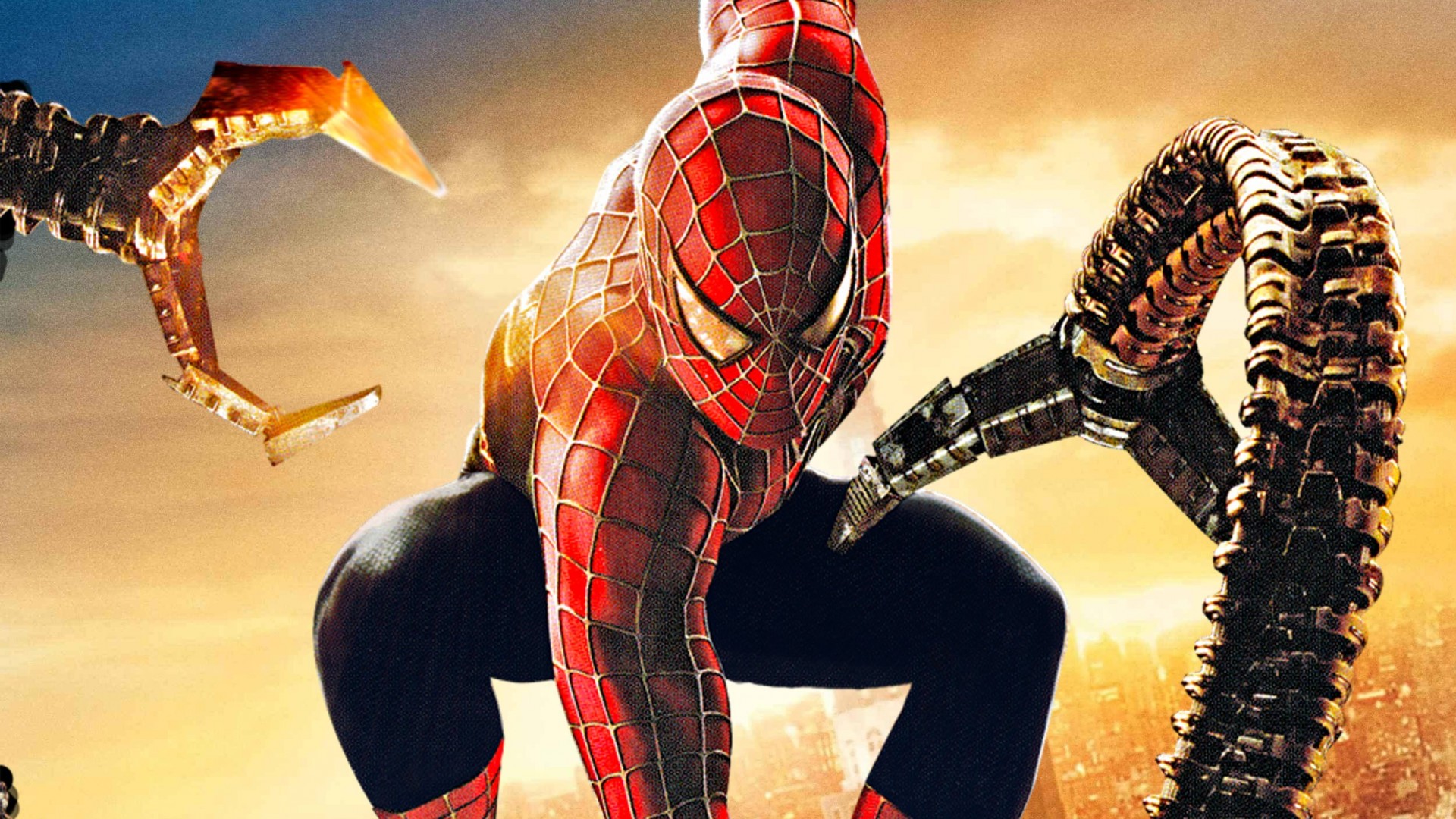
For the hospital scene, the production team had to build tentacles 13 feet long. Looking at the finished scene, the designers could not tell what was CGI and what was a puppet; the combined effects were too seamless to be seen with the naked eye. The designers were especially proud that the tentacles and their appearance were not leaked to the press before the film came out, which made them all the more surprising for audiences. The tentacles were also expensive, so security on the film set was tight to prevent anyone from stealing them.
- #015
- #016
- #017
- #018
- #019
Danny Elfman, who composed the music for this and many of Sam Raimi's other films, had some kind of disagreement with the director throughout this film and was reported to have said: "Seeing such a deep negative change in a person was almost enough to make me feel I no longer wanted to make films." Raimi and Elfman did reunite nine years later for Oz the Great and Powerful (2013).
- #020
- #021
- #022
EASTER EGG: On the DVD's second disc, go to "Making the Amazing," and the up arrow and the upper-right tentacle (Flo) will light up. This leads to a short segment in which director Sam Raimi found someone to give Alfred Molina "tips" on how to behave like Doc Ock. They go to the tentacles and ask the "acting" Doc Ock inside how the role should be played — the person giving the tips is Willem Dafoe. Alfred laughed a great deal at this.
- #023
In a deleted scene at the men's club, John Jameson introduces Mary-Jane to his father. He is initially a little suspicious of her because he knows she has been dating Harry Osborn; he even wonders whether Harry is paying her way. MJ and Jameson argue about Spider-Man's pros and cons. Jameson thinks he operates above the law and does best the work left to professionals, while MJ says he makes the world a better place.
- #024
- #025
- #026
- #027
When Doctor Octopus carries his tentacles, that is a practical effect. When the tentacles carry the Doctor, that is computer-generated imagery; to achieve this effect, a 6-meter-tall rig held Alfred Molina so he could glide around it, and the CGI tentacles were added afterward. However, because it saved money, using Edge FX's puppets was always preferred, and every scene was always shot with them first to see whether CGI was really necessary.
- #028
Contains a major spoiler — show
When J. Jonah Jameson needs a name for Doctor Octavius, one of Hoffman's suggestions is the title Doctor Strange, and Jameson notes that the name is already taken. Doctor Strange is another major co-creation of Stan Lee and Steve Ditko and a sorcerer superhero who is usually an ally of Spider-Man. Years later, Spider-Man would work alongside Dr. Strange in Avengers: Infinity War (2018), and Sam Raimi would be hired to direct Doctor Strange in the Multiverse of Madness (2022).
- #029
- #030
- #031
- #032
- #033
Contains a major spoiler — show
In the script: Peter rents a place above a television repair shop. He no longer lives with Harry since Norman's death, and Harry returns to his father's mansion. Harry's obsession with Spider-Man was more than Peter could bear; that is why he gets angry at Harry at the birthday party. Doctor Ock had tapped Peter's phone lines, which is how he knew he would find him with Mary-Jane at a cafe. The scene with the burning building was much shorter. MJ is so upset about missing Peter's play because she was the one who encouraged his acting talent. Harry wonders whether Quest, Oscorp's biggest rival, hired Spider-Man to discredit his company. According to the script, Hoffman is the Daily Bugle's advertising manager, which explains why Jameson constantly asks him to patent the names of the supervillains the Bugle invents. Betty Brant makes sure the bum is paid more for the Spider-Man costume than Jameson wanted to pay. In a scene cut from the film, the Bugle's night staff say that Jameson wears a suit and strikes fake heroic poses even though he thinks no one is watching; he even walked to his desk and stuck paper clips to a lamp as if he were making a web. The district attorney's office also wants to confirm the lawsuit is real, but Jameson will not hear of it. MJ confesses to Louise that she married John to prove something to her father and to show Peter what he is missing. The planetarium party Jameson hosts is held to raise money for the new science library. One of the things fueling Harry's depression was that the scientists who witnessed the failed fusion experiment considered suing Harry, since it was financed with Oscorp's money. Seeing MJ with another man like Peter also disturbs him.
- #034
- #035
- #036
- #037
In the first film, Harry Osborn and Peter Parker moved into a spacious apartment paid for by Norman Osborn, who was described as wealthy. But for this film, in which Peter lives alone, Tobey Maguire gave Sam Raimi suggestions on how Peter's apartment should look, based on his own observations of friends living in cramped, run-down New York apartments.
- #038
Michael Chabon submitted a script draft about a younger Doc Ock falling in love with Mary Jane. In Chabon's script, Octavius is the creator of the genetically altered spider that bites Peter Parker. Producer Avi Arad rejected the script, largely because he disliked the idea of another love triangle.
- #039
- #040
- #041
- #042
Although Dr. Curt Connors appears in this film, the character of Otto Octavius here is actually closer to Connors in the comics: a sensitive, intelligent mentor driven mad by an experiment gone wrong and transformed into a monstrous villain (Connors becomes the Lizard, Octavius becomes Doc Ock).
- #043
- #044
Peter rides a 1977 Puch Newport moped. The film's Picture Car Coordinator, Cyril O'Neil, managed to find 12 motorcycles, providing enough parts to build 7 working models. Three of them were destroyed by being crushed in the second-act chase scene, when the bike is recovered. Later, when Peter is shown dragging his moped home, it is actually one of these wrecked production motorcycles.
- #045
- #046
- #047
- #048
- #049
- #050
Contains a major spoiler — show
According to Michael Chabon, early drafts of the script before his involvement featured Doc Ock, Black Cat, The Lizard and Harry as the new Green Goblin. Reducing the number of "costumed characters" to just Doc Ock and Spider-Man was his suggestion. The film also featured Dr. Curtis Connors, played by Dylan Baker, who never became the Lizard. That did not happen until The Amazing Spider-Man (2012), in which Rhys Ifans played Dr. Curtis Connors/The Lizard. The character Felicia Hardy eventually appeared in The Amazing Spider-Man 2 (2014), played by Felicity Jones, but the character never used the Black Cat nickname or was portrayed as a cat burglar.
- #051
- #052
- #053
- #054
If you look carefully, Dr. Curt Connors has only one arm. He lost his arm in a war zone abroad. Before the accident he was a surgeon who treated soldiers. He was briefly mentioned but never seen in Spider-Man (2002). He fired Peter for always being late. In the comics, he becomes the Lizard when he tries to grow a new arm by combining lizard DNA with his own.
- #055
- #056
- #057
- #058
- #059
- #060
Doctor Ock's pier laboratory is believed to be an old building slowly sinking into the river (exterior shots show that one end has already partially collapsed). On the interior set, the floor and ceiling were tilted at skewed angles to each other, which is highly unusual and difficult to build safely.
- #061
- #062
- #063
Contains a major spoiler — show
Octavius's old laboratory and evoking the work of Fritz Lang and The Cabinet of Dr. Caligari (1920) to express how his life has collapsed and become more horrifying. The set measured 60 by 120 feet and stood 40 feet high, and took 15 weeks to build. A quarter-scale miniature was made for its collapse.
- #064
- #065
- #066
- #067
- #068
- #069
- #070
- #071
In the script, Doctor Octopus is not very happy about what has happened to him, but when his old self re-emerges, the tentacles are quick to seize control again. For example, they force him to rob the bank not only to finance his experiments but also to test the tentacles. They can also distract people, like a snake charmer, though this is not explicitly stated in the film.
- #072
- #073
- #074
- #075
- #076
- #077
- #078
(Around 29 minutes) The man who meets Spider-Man in the elevator (and compliments him on the Spider suit) is "Michael Novotny" from Queer as Folk (2000), a gay man obsessed with comic books and superheroes who always dreamed of meeting one of them on the show. An alternative version of this scene was used in the Spider-Man 2.1 cut of the film (around 32 minutes).
- #079
- #080
- #081
- #082
For the chase in the second act, director Sam Raimi wanted the crooks to drive a convertible with a wide, flat trunk that Spider-Man could land on while in motion. Several cars meeting the requirements were brought to the Sony lot for him to choose from; he picked a 1967 Lincoln Continental. Six of them were found and painted to match each other.
- #083
- #084
Sam Raimi initially intended the film to keep the 1.85:1 aspect ratio of Spider-Man (2002). But when he realized that to put Dr. Octopus and Spider-Man in the same shot the frame would have to be wider to accommodate Dr. Octopus's mechanical arms, Raimi raised the ratio to 2.39:1, though he shot most of the film in the Super 35 format.
- #085
- #086
Contains a major spoiler — show
(At around 1 hour 30 minutes) The car Doc Ock throws into the deli is a 2004 Saturn Ion Quad Coupe. Saturn provided four for the production; three were used and thrown within 30 yards of the building. Director Sam Raimi was reportedly very impressed by the vehicle's durability.
- #087
Contains a major spoiler — show
(At around 40 minutes) The hospital scene contains many homages to the Evil Dead films. Among the most notable are the POV shots of the tentacles (meant to represent a force) and a mini chainsaw used to attack them. Director Sam Raimi also directed the Evil Dead trilogy (The Evil Dead (1981), Evil Dead II (1987) and Army of Darkness (1992)), the film series that put him on the map.
- #088
- #089
- #090
- #091
Roughly 1 hour and 55 minutes in, near the end of the film, it was said to be notable that The Punisher (2004) is based on a supporting character from the Spider-Man comic books. This turned out to be false and to be merely someone who resembles Thomas Jane. It is a complete coincidence; the filmmakers never intended him to be the Punisher.
- #092
- #093
- #094
Contains a major spoiler — show
When Doctor Ock visits the attic, one of the Spider-Man pictures Harry looks at is a recreated version of the cover of Amazing Fantasy Vol. 1 #15 (August 1962). This image, by Alex Ross, appeared as the cover of Hero Illustrated #6 (December 1993) and was included in the Marvels (1994) trade paperback.
- #095
(At about 47 minutes) The bank used in the big action scene where Spidey fights Doc Ock is the same bank robbed by the Wilson Heights Gang in Police Academy 6: City Under Siege (1989).
- #096
- #097
- #098
Contains a major spoiler — show
The film's extended cut includes a scene in which Peter draws a picture of half his own face covered by the Spider-Man mask. This image has been used countless times in the comics, mostly to indicate Peter's spider-sense; 'The Uncanny Threat of the Terrible Tinkerer!' (The Amazing Spider-Man Vol. 1 #2, May 1963).
- #099
- #100
- #101
Sam Raimi wanted the film to take place in an "idealized" New York City, including elevated trains. The scenes showing a fight on the exterior of a commuter train amid a cluster of skyscrapers were shot in Chicago, Illinois, most likely on the famous elevated Loop that replaced the IRT Ninth Avenue Line (demolished in 1940, with its routes transferred to underground subway lines). Although the Chicago L trains, particularly the 2200-series cars (recognizable by their blinker-type doors), and the building shots belong to Lexington Avenue in Manhattan — including the balcony bridge connecting parts of Hunter College on the Upper East Side served by the IRT Lexington Avenue Line (4, 5 and 6 trains) — they were designed to appear as R-train cars with MTA New York City Subway stickers and destination signs reading "Bay Ridge" (4, 5 and 6 trains).
- #102
Comic book artist Alex Ross provided illustrations summarizing the events of Spider-Man (2002), similar to how the opening titles of Richard Lester's Superman II (1980) summarized the events of Superman (1978). The lenses on the costume in his illustrations do not match the designs in the trilogy. This is because Ross was not a fan of the way the costume was designed, so he redesigned the eyes to be closer to the original comics.
- #103
In the early stages of the film's pre-production, there was great fan demand for Venom to appear in the sequel. Sam Raimi responded: "I need to read more Spidey comics to understand why Venom hates Peter so much. I didn't use it in the first two films because I didn't know much about Venom." While Spider-Man 3 (2007) was in development, Raimi still had not fully understood the character, but at that point he did not want to use a character he knew little about.
- #104
While writing the first film, David Koepp had actually planned his own trilogy. Each was to have a different tone in each film. He wanted to tell the Gwen Stacy/Harry Osbourne story but ordered everything differently. The sequel, "The Amazing Spider-Man," was planned to have a budget of $75-80 million and a shorter running time. It involved Peter Parker learning that his parents did not die in a random plane crash but secretly worked for the government and were killed by their colleague Otto Octavius, who would soon become Doctor Octopus. It was described as having a rougher, sharper, almost R-rated (if not R-rated) tone. One example was Doc Ock killing Captain Stacy, who was referred to by the Daily Bugle as "COP KILLER." According to Koepp, it also introduced Gwen Stacy, who dies in the middle of the film, which "follows sort of The Empire Strikes Back model." Finally, the third film, titled "The Spectacular Spider-Man," was to have completely different villains (though we do not know who was planned), but making each film for a specific audience could have helped make it more family friendly. The first was for children and adults, the second for adults, and the third entirely for small children.
- #105
Sam Raimi initially wanted Kingpin to appear alongside Doc Ock, but this was impossible because Kingpin had been used in Daredevil (2003) by another studio, 20th Century Fox. He did, however, appear in an episode of Spider-Man: The New Animated Series (2003), voiced by the same actor, Michael Clarke Duncan, in the year the film was released.
- #106
Contains a major spoiler — show
The film's main villain is Otto Octavius, also known as Doctor Octopus, who first appeared in the comics in 'Spider-Man Versus Doctor Octopus' (Amazing Spider-Man Vol. 1 #3, July 1963). His film costume, consisting of sunglasses and a brown trench coat, reflects one of the outfits he wears in the Ultimate Spider-Man series. In the original Earth-616 timeline, Peter did not meet Octavius until he became Doctor Octopus, but in the Ultimate Spider-Man timeline they had already met before Otto became a villain, which is what happens in the film. In both stories Peter is introduced to Otto by Harry Osborn, as is clearly seen in 'Growing Pains' (Ultimate Spider-Man Vol. 1 #2, December 2000). The film versions of Peter and Otto achieve a harmony that reflects Stan Lee and Steve Ditko's original concept for the Doc Ock character. At the end of the film, it is their ability to connect with each other that allows Peter to reason with Octavius by appealing to his sense of intellectual responsibility. Otto's cinematic version has a wife named Rosie, played by Donna Murphy, whose tragic death is a major factor in his turn to crime. Rosie was created for the film, but she somewhat resembles another character, Mary Alice Anders, who first appeared in 'An Obituary for an Octopus' (Spider-Man Unlimited Vol. 1 #3, November 1993). Mary was a scientist who had a romantic relationship with Otto before he became Doc Ock; Otto's mother sabotaged the relationship, which deeply saddened her son and drove him toward villainy.
- #107
Contains a major spoiler — show
The scene in which Mary Jane refuses to answer the phone when Peter calls and he imagines her telling him that she knows he is Spider-Man resembles a scene from 'The Sinister Secret of Spider-Man's New Costume!' (Amazing Spider-Man Vol. 1 #258, November 1984). That issue was part of the 'Alien Costume Saga', which Sam Raimi continued to adapt in Spider-Man 3 (2007).
- #108
The first reaction to Alfred Molina's casting as Doc Ock was negative. Molina recalled: "I logged onto one of these [fan] websites and the first message was someone saying: 'How good that Sam Raimi stuck to his plan of hiring an experienced stage actor to play the villain. It worked the first time, so it's all a good sign, obviously a good idea.' It was a very positive message. I thought that was good and I kept scrolling down and the second message said something like: 'Who is Alfred Molina, I've never heard of him?!?' And the third was: 'He was that fat guy in Frida (2002).' Then they got progressively worse and less friendly. I quickly logged off and stayed away from fan sites after that. But ultimately what you see on screen is what it is and I think it's quite reasonable. And of course the fans enjoy it, which is great."
- #109
Director Sam Raimi felt he had to thematically explore Peter's inner conflict between his personal desires and his responsibility, the positive and negative sides of the path he chooses, and how he ultimately decides he can be happy as a heroic figure. Raimi noted that the story was partly influenced by Superman II (1980), which also explores the protagonist giving up his responsibilities. The sequel's story was mainly taken from the comic-book arc The Amazing Spider-Man No. 50, "Spider-Man No More!" According to Raimi, Peter Parker's story is about "a life out of balance." Peter is caught between a life in which he tries to help people as his Spider-Man alter ego and atones for his uncle's death, and a life in which he tries to balance his studies, his profession as a photographer, and his relationships with family and friends. Peter accepts that he cannot be with Mary Jane without putting her in danger because of his Spider-Man alter ego; he feared that if his enemies learned his true identity they would target his loved ones. As a result, Peter distances himself from Mary Jane, but in the end, after learning of her double life and the difficulties she faces, he revives his relationship with her.
- #110
Contains a major spoiler — show
Harry Osborn believes Spider-Man killed his father, creating a widening rift between him and Peter, just as in comics such as 'The Dark Wings of Death!' (The Amazing Spider-Man Vol. 1 #127, December 1973). Peter also learns that after Uncle Ben's death Aunt May is in financial difficulty, as also happened in comics such as 'Spider-Man' (The Amazing Spider-Man Vol. 1 #1, March 1963).
- #111
Contains a major spoiler — show
The DVD's tie-in comic also includes the cover of 'The Commuter Cometh!' (The Amazing Spider-Man Vol. 1 #267, August 1985), which may have been a visual influence on the train fight. The cover of 'The Molten Man Breaks Out!' (The Amazing Spider-Man Vol. 1 #133, June 1974) depicts Spider-Man fighting the Molten Man atop a fast-moving train, similar to the Doc Ock fight in the film (which does not actually happen in the story). The inspiration for the train fight was probably the aforementioned Spectacular Spider-Man Peter Parker #79, which featured a scene in which Spider-Man and Doc Ock fight on a railway line. In the film's extended cut, the moment Doctor Ock holds Spider-Man in front of an oncoming train is adapted directly from that story. The train fight also parallels the sequence in the previously mentioned 'Unmasked by Doctor Octopus!' issue, where Spider-Man goes to rescue Betty from Octavius. In both stories their fight ends with Spider-Man being defeated by Octavius and his mask coming off. Sam Raimi confirmed that this issue had a major influence on the film, so these similarities are almost certainly intentional. Octavius delivers the unconscious Spider-Man to Harry, and Harry finally learns that the man he holds responsible for his father's death is Peter. Harry discovered that Peter was Spider-Man in the comic 'Danger is a Man Named… Tarantula' (The Amazing Spider-Man Vol. 1 #134, July 1974), after seeing him stocking web fluid in their apartment.
- #112
- #113
In David Koepp's original 1999 script for Spider-Man (2002), Doc Ock was intended to play a major role. Although many said he should team up with the Green Goblin to fight Spider-Man, in Koepp's script Dr. Otto Octavius worked at Oscorp but his project involving mechanical arms was delayed and he was fired by Norman Osborn; Octavius attacked him, and when he was electrocuted (causing his chest harness to melt into his now-burned flesh), the green gas simultaneously affected Norman Osborn. During the parade scene, Doctor Ock watches the fight with Spider-Man on his television and discovers that Norman has put on the costume he took from the lab and wants revenge. Instead of the Green Goblin asking Jamison who took the photos of Spider-Man, it is Doc Ock, and he tells Peter to find Spider-Man and kill Norman for him. The climax was completely different from the film; set on a foggy winter morning, Spider-Man chased the Green Goblin, who had kidnapped MJ, to the Brooklyn Bridge, where Doc Ock followed to watch. During the fight on the bridge, MJ wedges a pumpkin bomb into the glider's chute before the Green Goblin leaves and detonates it in mid-air, where Spider-Man catches it in his web. Norman did not die initially but was arrested and exposed by the FBI, and Doc Ock, hiding from the police, was set up as the sequel's main villain, promising to kill Spider-Man. At the time, Robert De Niro was one of the actors considered, and designs for the character were worked on for three months before he was cut from the script. He was removed from the script by Sam Raimi because two villains were considered too many for the first film.
- #114
Contains a major spoiler — show
Peter has his first real battle against Doctor Octopus while escorting Aunt May to the bank. When they first fight, Octavius subdues Spider-Man by catching his arms with his tentacles. Doc Ock also restrained Peter this way in their first fight in the comics in The Amazing Spider-Man Vol. 1 #3. Another example of Doctor Octopus similarly restraining Spider-Man comes from 'The Cycle' (Ultimate Spider-Man Vol. 1 #18, April 2002). Throughout their cinematic battles, Doc Ock is repeatedly shown endangering the lives of civilians as a way of distracting Spider-Man. He does this in the comics in nearly every fight as well. Doctor Ock kidnaps Aunt May as a hostage. Otto and May have a complicated history in the comics, and Doc Ock even tried to marry her in The Amazing Spider-Man Vol. 1 #130-131 (March-April 1974), but only did so to get past her and claim ownership of a uranium mine she had inherited. Spider-Man and Doc Ock continue fighting along the side of a building, as they have many times in the comics. A scene from 'The Final Battle' (Peter Parker, The Spectacular Spider-Man Vol. 1 #79, June 1983) contains arguably one of the best-ever encounters between Spidey and Doc Ock. Spider-Man co-creator Stan Lee makes a cameo in this scene.
- #115
- #116
- #117
- #118
- #119
FRANCHISE TRADEMARK: One of Spider-Man's most important fights, in this case against Doctor Octopus, involves a train. Spider-Man also fights on trains in Spider-Man 3 (2007), Spider-Man: No Way Home (2021) and Spider-Man: Across the Spider-Verse (2023).
- #120
Production Story (122)
- #121
- #122
- #123
- #124
- #125
Costume designer James Acheson made subtle changes to the Spider-Man suit from the previous film. The colors were made richer and bolder; the spider emblem was given more elegant lines; the muscular suit beneath it was broken into pieces to provide a better sense of movement; and the helmet Tobey Maguire wore under his mask was improved, with a fake chin and magnetic eye lenses that were easier to remove added for better movement.
- #126
- #127
Alfred Molina, who plays Dr. Octopus, actually named his four mechanical tentacles (Larry, Harry, Flo and Moe). Flo was the upper-right tentacle, because it was operated with a female grip and was the most motherly of the tentacles; it took off his sunglasses and gave him sips of his drink.
- #128
- #129
(At about 5 minutes) Stan Lee first filmed the cameo of the man shouting: "Whoa! He stole that guy's pizza!" However, due to problems with the shoot, the scene was reshot with Donnell Rawlings, and Lee was given a different cameo, playing a pedestrian who pulls a woman out of the path of falling debris during a battle between Spider-Man and Doc Ock.
- #130
- #131
- #132
(At about 1 hour 9 minutes) When Jonah Jameson offers the disheveled man 50 dollars for the Spider-Man costume he found, he replies: "I could get more for it on eBay." In 2001, four Spider-Man costumes had been stolen from the set of the first Spider-Man (2002) film. They were finally recovered after an 18-month investigation and the arrest of a former film studio security guard and an accomplice. Columbia Pictures offered a 25,000-dollar reward for information leading to their return, while film memorabilia experts estimated the costumes' value at around 50,000 dollars.
- #133
- #134
- #135
- #136
Two more villains from the comics appear in the film. John Jameson (J. Jonah Jameson's son) is the Man-Wolf, and Dr. Curt Connors is the Lizard. Both are Jekyll-and-Hyde-type tragic villains, since they are good-hearted men who periodically transform into feral, animal-based alter egos against their will.
- #137
- #138
- #139
- #140
(At about 1 hour 3 minutes) When Peter throws the Spider-Man costume into the trash can, this is a recreation of a panel from issue 50 of The Amazing Spider-Man, "Spider-Man No More." As in the film, the costume is found and brought to J. Jonah Jameson, then taken back by Spider-Man, who leaves a note similar to the one in the film.
- #141
All Daily Bugle newspapers are dated chronologically and accurately so that they follow the film's plot day by day. One of the earlier newspapers carries the headline "MTA Insider Concerned Over Aging El Train Safety," a nod toward the weekend, when the Spidey/Doc Ock fight takes place on the El at the film's climax.
- #142
For the hospital scene, the production team had to build 13-foot-long tentacles. Looking back at the finished scene, the designers could not tell what was CGI and what was a puppet. The combined effects were too flawless to be seen with the naked eye. The designers were especially proud that the tentacles and what they looked like were not leaked to the press before the film came out. For audiences it was all the more surprising. The tentacles were also expensive and inadequate, so security on the film set was tight to prevent anyone from stealing them.
- #143
- #144
- #145
Danny Elfman, who composed the music for this and many of Sam Raimi's other films, had some kind of falling-out with the director during this film and was reported to have said: "Seeing such a deep negative change in a person was almost enough to make me feel I no longer wanted to make films." However, Raimi and Elfman reunited nine years later for Oz the Great and Powerful (2013).
- #146
- #147
EASTER EGG: On the second disc of the DVD, go to "Making the Amazing," and the up arrow and the upper-right tentacle (Flo) will light up. This leads to a short segment in which director Sam Raimi found someone to give Alfred Molina "tips" on how to behave like Doc Ock. They go to the tentacles, and inside, "acting" Doc Ock asks how he should be played — the person giving the tips is Willem Dafoe. Alfred laughed a great deal at this.
- #148
In a deleted scene at the men's club, John Jameson introduces Mary-Jane to his father. He is initially a little suspicious of her because he knows she dated Harry Osborn. He even wonders whether Harry paid for her. MJ and Jameson argue about the pros and cons of Spider-Man. Jameson thinks he operates above the law and does best the work left to professionals, while MJ says he makes the world a better place.
- #149
- #150
- #151
When Doctor Octopus carries his tentacles, this is a support. When the tentacles carry the Doctor, this is computer-generated imagery; to achieve this effect, a 6-meter-high rig held Alfred Molina so he could float around, and the CGI tentacles were added afterward. However, because it saved money, using Edge FX's puppets was always preferred, and every scene was always shot with them first to see whether CGI was really necessary.
- #152
- #153
- #154
- #155
(Around 1 hour 17 minutes) Later in the film, during the apartment fire, the man who tells Peter that someone is still trapped on the second floor (played by Michael Edward Thomas) is the same man from the first film who started throwing trash at the Green Goblin during their fight on the bridge.
- #156
In the script: * Peter rents a place above a television repair shop. Since Norman's death he no longer lives with Harry, and Harry returns to his father's mansion. Harry's obsession with Spider-Man was more than Peter could bear. This is why he gets angry at Harry at the birthday party. * Doctor Ock had Peter's phone lines tapped. That is how he knew he would find him at a cafe with Mary-Jane. * The scene with the burning building was much shorter. * The reason MJ is so upset about missing Peter's play is that she was the one who encouraged his acting talent. * Harry wonders whether Quest, Oscorp's biggest rival, hired Spider-Man to discredit his company. * According to the script, Hoffman is the Daily Bugle's advertising manager. This explains why Jameson constantly asks him to patent the names of the supervillains invented by the Bugle. * Betty Brant makes sure the bum is paid more for the Spider-Man costume than Jameson wanted to pay. In a scene cut from the film, the Bugle's night staff say that Jameson wears a suit and strikes fake heroic poses even though he thinks no one is watching. He even walked to his desk and stuck paper clips onto a lamp as if he were spinning webs. Also, the district attorney's office wants to confirm that the case is real, but Jameson will not hear of it. * MJ confesses to Louise that she is marrying John to prove something to her father and to show Peter what he is missing. * The planetarium party hosted by Jameson is held to raise money for the new science library. * One of the things fueling Harry's depression was that the scientists who witnessed the failed fusion experiment were considering suing Harry, since it was financed with Oscorp's money. Seeing MJ with another man like Peter also unsettles him.
- #157
- #158
(Around 40 minutes) The hospital scene began as a test shoot, but it came together so well that they decided to use it. In the director's commentary, Sam Raimi made clear that it is the arms, not Doctor Octopus himself, that attack the doctors; however, he was not sure whether he had made that explicit in the scene.
- #159
In the first film, Harry Osborn and Peter Parker moved into a spacious apartment paid for by Norman Osborn, who is described as wealthy. But for this film, in which Peter lives alone, Tobey Maguire gave Sam Raimi suggestions about how Peter's apartment should look, based on his own observations of friends living in cramped, run-down New York apartments.
- #160
Michael Chabon submitted a script draft about a younger Doc Ock falling in love with Mary Jane. In Chabon's script, Octavius is the creator of the genetically modified spider that bites Peter Parker. Producer Avi Arad rejected the script, largely because he disliked the idea of another love triangle.
- #161
- #162
- #163
- #164
Peter rides a 1977 Puch Newport moped. The film's Picture Car Coordinator, Cyril O'Neil, managed to find 12 motorcycles, providing enough parts to build 7 working models. Three of them were crushed and destroyed during the second-act chase scene because the bike is retrieved again. Later, when Peter is shown dragging his moped home, it is actually one of these badly wrecked production motorcycles.
- #165
- #166
- #167
- #168
According to Michael Chabon, the early drafts of the script before his involvement featured Doc Ock, Black Cat, The Lizard and Harry as the new Green Goblin. It was his suggestion to reduce the number of "costumed characters" to just Doc Ock and Spider-Man. The film also included Dr. Curtis Connors, played by Dylan Baker, who never becomes the Lizard. That did not happen until The Amazing Spider-Man (2012), in which Rhys Ifans played Dr. Curtis Connors/The Lizard. The character Felicia Hardy finally appeared in The Amazing Spider-Man 2 (2014), played by Felicity Jones, but the character never used the Black Cat nickname or was portrayed as a cat burglar.
- #169
- #170
- #171
- #172
- #173
- #174
- #175
- #176
The elevator scene between Tobey Maguire in the Spider-Man costume and Hal Sparks was improvised and allowed the two actors to trade barbs with each other. About 25 takes were shot. The ones used in the theatrical film are from the first take; a few of the others can be seen on the 2.1 Blu-ray release.
- #177
Doctor Ock's pier laboratory is believed to be an old building slowly sinking into the river (the exterior shots show that one end has already partially collapsed). On the interior set, the floor and ceiling were tilted at skewed angles to each other; this is highly unusual and difficult to build safely.
- #178
- #179
Using a collapsed pier as Doc Ock's lair to reflect a distorted version of Dr. Octavius's old laboratory and to evoke Fritz Lang's work and The Cabinet of Dr. Caligari (1920), expressing how his life has fallen apart and become more horrifying, was Neil Spisak's idea. The set was 60 x 120 feet and 40 feet high, and took 15 weeks to build. A quarter-scale miniature was made for its collapse.
- #180
The full-scale interior of Doc Ock's pier laboratory was built on Sony's Stage 30; this stage is called the "Esther Williams" stage because it contains the water tank used in many of Williams's films. For this film, after the set was built, the tank was filled to a depth of 1.2 meters, which can be seen in many shots as the river water beneath the rotting floorboards.
- #181
- #182
- #183
According to the novelization: * When Spider-Man arrives at Doctor Octavius's failed experiment, Harry assumes that he himself is the cause of the failure. * Doctor Ock believes he is helping Aunt May by giving her a quick death instead of a slow one brought on by old age. * The arms talk to Doctor Octopus. They even see him as a father, something that was cut from the film. The closest moment to this in the film is when Doctor Ock says he hears voices inside his head. It is also said that Spidey interfered with the experiment because he was jealous of Otto's success. * Instead of a single dream scene in the film, Uncle Ben appears to Peter frequently. * The usher played by Bruce Campbell is named Waldo. His scene with Peter was initially longer; Peter sticks Waldo's foot to the floor and, just near the end, was going to leave to watch MJ's play. * When Doctor Ock tries to rob the bank and Peter leaves Aunt May, Aunt May assumes the reason he ran off was to call the police rather than cowardice. * The elevator scene initially involved Spider-Man sharing it not with a single person but with an entire crowd of people. When Peter tells the man he made the costume himself, the novel tells us he got it from the brother of the Flying Dutchman, the rival of Bone-Saw, whom Peter fought in the first film. After beating Bone-Saw, Peter offered his services. * The police could not confirm Uncle Ben's killer because there were no witnesses. Peter could not come forward because he was involved in the incident. * In the opening scene, when Peter is late for his pizza delivery job because of a disturbance, we learn that the disturbance came from a man about to be crushed under a falling beam at a construction site. * Mary-Jane met John Jameson at Enriques, the restaurant where MJ worked in the first film. A trucker pinched her bottom and threw a plate of spaghetti in her lap. When Enrique asked him to apologize, he was thinking of giving in when John stepped in. His car battery was dead and he was waiting for a tow truck. He pretended to be an FBI agent, which made Enrique back off, and MJ quit her job. Soon afterward they began seeing each other. * Mary-Jane's family has separated since the first film. Apparently Mr. Watson has changed somewhat since the divorce. * MJ's line "If you never get on, you can never get off" made sense in her mind. * When Peter goes to the doctor, it takes place at the university's student health services department. His name is Dr Wally Davis and he has a more emotional character in the book. He even goes to a therapist. * Instead of stealing money to finance his experiment, Doctor Octopus broke into secret government facilities for the things he needed. They could not argue because they could not risk exposure. The tentacles also made use of an illegal electrical connection. * Peter thinks that all the women in his life have at some point dangled from a ledge. For example, Aunt May was taken hostage by the Green Goblin during his attack on Times Square, and Mary-Jane was taken hostage by Doc Ock. Peter is also bothered by MJ always being photographed with other men. In John's case there is even more, because he has not done even half of the heroic things Peter has done and is still celebrated as a hero, while Spider-Man is demonized by the press. * Although Jameson is overjoyed that Spider-Man has given up, in the novelization he is secretly not that pleased about it, because Spider-Man sells more copies of the Daily Bugle than other celebrities, and since he left, the Bugle's sales figures have fallen into a full-blown crisis. * When Peter goes to get his suit back, he secretly listens to Jameson's praise before taking it. Apparently Jameson had sent it to the dry cleaner's, so it felt better than ever. * Apparently, when Peter was a small child, he did not trust Aunt May after his mother died. However, in the reconciliation scene he begins to wonder whether May knows his secret. In the same scene, because he moves the table with ease, this is what leads him to try jumping the gap between two buildings, thinking his powers have returned. But he does not fall onto the car. * Aunt May begins blaming herself for Uncle Ben's death in the film, but in the novelization Peter wonders whether this is because Ben is haunting her too, especially now that he has given up being Spider-Man. When May confesses her role in Uncle Ben's death, instead of quietly getting up and going to his room as in the film, he tells her to go.
- #184
- #185
- #186
- #187
- #188
In the script, Doctor Octopus is not particularly happy about what has happened to him, but when his old self re-emerges, the tentacles are quick to seize control again. For example, they force him to rob the bank not only to finance his experiments but also to test the tentacles. They can also distract people, like a snake charmer, though this is not explicitly stated in the film.
- #189
- #190
- #191
(At about 29 minutes) The man who encounters Spider-Man in the elevator (and compliments him on the Spider suit) is "Michael Novotny" from Queer as Folk (2000), a gay man obsessed with comic books and superheroes who always dreamed of meeting one of them on the show. An alternative version of this scene was used in the film's Spider-Man 2.1 cut (at about 32 minutes).
- #192
- #193
Sam Raimi initially intended the film to keep the 1.85:1 aspect ratio of Spider-Man (2002). But he realized that for Dr. Octopus and Spider-Man to appear in the same shot, the frame would need to be wider to accommodate Dr. Octopus's mechanical arms. So Raimi raised the ratio to 2.39:1, though he shot most of the film in the Super 35 format.
- #194
Five different video games were developed and released for the film "Spider-Man 2." Rather than being ports of a single main game, these games were designed and developed independently (though all were published by Activision), resulting in games with very different concepts, stories, artwork/graphics, gameplay, objects, villains and features. Each version of the game was designed for different game systems: * Treyarch Invention's Spider-Man 2 (2004) (GameCube, Xbox and PlayStation 2) is an open-world 3D action game. * Fizz Factor's Spider-Man 2: The Game (2004) (PC) is an on-rails 3D game. * Backbone Entertainment's Spider-Man 2 (2004) (Nokia N-Gage) is a mix of a 2D platform game and 3D time trials. * Digital Eclipse's "Spider-Man 2" (Game Boy Advance) is a 2D platform game. * Vicarious Visions's Spider-Man 2 (2005) (PlayStation Portable) is a linear 3D game.
- #195
- #196
(At about 40 minutes) There are many nods to the Evil Dead films in the hospital scene. The most notable include POV shots of the tentacles (intended to represent force) and a mini chainsaw used to attack them. Director Sam Raimi also directed the Evil Dead trilogy (The Evil Dead (1981), Evil Dead II (1987) and Army of Darkness (1992)), the film series that put him on the map.
- #197
- #198
- #199
When Octavius complains that Peter is right about misinterpreting the calculations, the camera's point of view suddenly moves behind him. He then looks at the camera in a rage, appearing completely different; far more haggard and menacing. This "mirror image" of Octavius shows his sinister side and is a common occurrence in Raimi's films. In the previous film, Norman Osborn's argument with himself in the mirror is notable.
- #200
- #201
Chris Cooper, Robert De Niro, David Duchovny, Ed Harris, Arnold Schwarzenegger, Sir Sam Neill and Liev Schreiber were considered for the role of Otto Octavius/Dr. Octopus. De Niro had also been considered for the Green Goblin role in Spider-Man (2002), and Cooper would later play Norman Osborn in The Amazing Spider-Man 2 (2014).
- #202
- #203
- #204
As in 'Spider-Man No More!', Peter in the film grows increasingly frustrated by Jameson's campaign to turn the city's public against him. During his vision of Uncle Ben, Peter refers directly to the title of that story. After this vision, he decides to give up being Spider-Man and throws his costume in a trash can. The image of his costume hanging out of the trash can as Peter walks away in the background is a direct recreation of a panel from 'Spider-Man No More!'. Shortly afterward the costume is found and brought to Jameson's office at The Daily Bugle. In the film it is brought by a garbage collector, while in the comic it is found by a small child. In both versions of the story, Betty Brant is present in this scene. Jameson is overjoyed that he has won his war against Spider-Man. Newspapers announcing Spider-Man's retirement are then shown. In the film these carry the headline 'SPIDER-MAN NO MORE'. Jameson displays the costume on his office wall as a trophy.
- #205
- #206
- #207
- #208
The extended cut of the film includes a scene in which Peter draws a picture of his own face half-covered by the Spider-Man mask. This image was used countless times in the comics and mostly served to indicate Peter's spider sense; 'The Uncanny Threat of the Terrible Tinkerer!' (The Amazing Spider-Man Vol. 1 #2, May 1963).
- #209
In the comics, Harry learned of his father's double life on the night he died. In the issue 'The Battle of Central Park!' he found Norman's hiding place (The Amazing Spider-Man Vol. 1 #135, August 1974) and decided to adopt the Green Goblin identity to avenge his father. In the film he embarks on the same quest for revenge. That comic ended on a cliffhanger, with Harry about to put on the Green Goblin costume in the next issue. The film likewise ends on a similar cliffhanger, and fans would have to wait until Spider-Man 3 (2007) to see Harry become the Green Goblin.
- #210
- #211
The plotline about Spider-Man retiring from his crime-fighting career to enjoy a normal life and, in particular, to be with the woman he loves strongly recalls Superman II (1980). At one point, while being attacked by a pair of criminals, he hears one of them crying for help. In the comic Peter helps the victim, but in the film he walks away and leaves him to his fate. Although Peter does not help this victim in the film, he later rescues a child from a burning building. In both stories, his sense of responsibility forces him to keep helping people even though he has officially retired. As a consequence of Spidey's retirement, the crime rate in New York rises rapidly.
- #212
- #213
Sam Raimi wanted the film to take place in an "idealized" New York City, including elevated trains. The scenes showing a fight on the exterior of a commuter train in the middle of a cluster of skyscrapers were shot in Chicago, Illinois, most likely on the famous elevated Loop that replaced the IRT Ninth Avenue Line (demolished in 1940, with its routes transferred to underground subway lines). The Chicago L trains, particularly the 2200-series cars (recognizable by their blinker-type doors), were dressed to appear as R-train cars with MTA New York City Subway decals and destination signs reading "Bay Ridge," even though the shots of the buildings belong to Lexington Avenue, including the balcony bridge connecting parts of Hunter College on the Upper East Side served by the IRT Lexington Avenue Line (4, 5 and 6 trains).
- #214
Sam Raimi initially wanted the main stunt coordinator to be Siu-Tung Ching, who had not worked on the Spider-Man (2002) films. Sam could not hire him because he was working on Belly of the Beast (2003) with Steven Seagal. To make up for it, Sam hired Dion Lam (who was Ching's assistant on many of his Hong Kong films).
- #215
Comic book artist Alex Ross provided illustrations summarizing the events of Spider-Man (2002), similar to how Richard Lester's opening titles for Superman II (1980) summarized the events of Superman (1978). The lenses of the costume in his illustrations do not match the designs in the trilogy. This is because Ross was not a fan of the way the costume was designed, so he redesigned the eyes to be closer to the original comics.
- #216
In the early stages of the film's pre-production, there was a huge fan demand for Venom to appear in the sequel. Sam Raimi would respond to this as follows: "I need to read more about Spidey comics to understand why Venom hates Peter so much. I didn't use it in the first two films because I didn't know much about Venom." While Spider-Man 3 (2007) was in development, Raimi still hadn't fully understood the character, but at that point he didn't want to use a character he knew very little about.
- #217
The band 3 Doors Down wrote the song "Let Me Go" for this film, but it did not end up on the film's soundtrack. The band put it on their third album "Seventeen Days". The lyrics are heavily influenced by Peter Parker's struggle with his feelings for MJ and his belief that if these were to become an item, Spider-Man's enemies would exploit it and endanger his life. This is echoed in the song's chorus: "And you love me but you don't know who I am. I'm caught between this life I live and where I stand. And you love me but you don't know who I am. So let me go, let me go."
- #218
Similarities with Superman II (1980): *Lex Luthor, whom Superman defeated in the previous film, returns to form an alliance with the new villain General Zod. Harry Osborn, the son of the Green Goblin whom Spider-Man defeated in the previous film, forms an alliance with Doctor Octopus. *Superman gives up his powers to be able to have a relationship with Lois Lane. Peter Parker gives up being Spider-Man to have a relationship with Mary Jane. He then loses his powers. *Clark Kent needs to regain his powers to fight General Zod and save Lois Lane. Peter Parker must watch his back to fight Octavius and save Mary Jane. *Lois Lane discovers Superman's secret identity. Mary Jane discovers Spider-Man's secret identity. Peter Parker and Clark Kent also both work at major newspapers.
- #219
Early in the film, Peter tries to sell some pictures to J. Jonah Jameson, but the editor ignores all of his photos that are not directly related to Spider-Man. Jameson showed a similar disdain for Peter's work in the comics, as seen in the panel 'Man on a Rampage!' (The Amazing Spider-Man Vol. 1 #32, January 1966). Peter is fired by Jameson, then immediately rehired once the editor learns he has new photos of Spider-Man.
- #220
In the film, Octavius creates his mechanical arms to assist in his experiments, just as he did in the comics. In one of Otto's experiments, something goes wrong and he is severely injured. In the film, the accident occurs during an experiment funded by Oscorp, reflecting Doc Ock's origin story in the Ultimate Spider-Man series. Only in the Ultimate Spider-Man comics were the arms fused to him during the same laboratory explosion that transformed Norman Osborn into the Green Goblin, whereas in the film the accident occurs during an unrelated experiment. However, in both versions of the story, Oscorp was involved in the accident. The scene where Otto wakes up in the hospital and slaughters the medical staff around him is taken from 'Doctor Octopus' (Ultimate Spider-Man Vol. 1 #14, December 2001). In both stories, when he wakes up he finds himself lying in a hospital bed with his eyes bandaged, initially unaware that he has been fused to his metal arms. In the comic, he had been in a coma for several months before waking, while in the film he wakes shortly after being admitted. In both stories, his metal arms slaughter the surrounding medical staff with ruthless efficiency. The image of Otto walking around the city barefoot and shirtless evokes the Ultimate Spider-Man comics. After leaving the hospital, he walks onto a road and a car nearly hits him. Fortunately, his new arms give him the strength to lift the vehicle into the air. A similar scene occurred in 'Live' (Ultimate Spider-Man Vol. 1 #20, June 2002). Octavius heads toward the shore, where he sets up his new hideout in a ruined warehouse. Doc Ock had several similar hideouts in the comics, including one from 'Enter: Doctor Octopus' (Amazing Spider-Man Vol. 1 #53, October 1967). The fact that this issue's cover appears in the comic on the Spider-Man 2 DVD suggests this was a deliberate reference.
- #221
The train fight between Spider-Man and Doc Ock was shot in Chicago, because that city still has wide elevated trains running through its downtown, whereas in New York City most of the elevated lines in Manhattan were replaced by subways in the 1950s (elevated tracks are only prominent in the outer boroughs).
- #222
While writing the first film, David Koepp had actually planned his own trilogy. Each had a different tone in each film. He wanted to tell the Gwen Stacy/Harry Osbourne story but arranged everything in a different order. The sequel, "The Amazing Spider-Man," was planned to have a budget of 75-80 million dollars and a shorter running time. It involved Peter Parker learning that his parents did not die in a random plane crash, that they secretly worked for the government, and that they were killed by their colleague Otto Octavius, who would soon become Doctor Octopus. It was described as having a rougher, edgier, almost R-rated (if not R-rated) tone. One example was Doc Ock killing Captain Stacy and being called "COP KILLER." by the Daily Bugle. According to Koepp, it also introduced Gwen Stacy, who dies in the middle of the film, which he called "that follows sort of The Empire Strikes Back model." Finally, the third film, titled "The Spectacular Spider-Man," would have completely different villains (though we don't know who was planned), but making each film for a specific audience could have helped make it more family-friendly. The first for children and adults, the second for adults, and the third entirely for small children.
- #223
According to cinematographer Bill Pope, although Super 35 was primarily used on the film, 16 wide-format cameras were brought in to shoot the exterior of the subway train scene. To cover every angle of the train, all six Panavision Super 65mm cameras were brought in and used for the first time since Far and Away (1992), along with an 8-perf Iwerks camera, four Arri 435 cameras and 8 VistaVision cameras; three of them were combined with a rig to create a widescreen look.
- #224
- #225
The scene where Doctor Ock kidnaps Mary Jane was inspired by the story 'Unmasked by Doctor Octopus!' from Amazing Spider-Man Vol. 1 #12. In that issue, Octavius kidnaps Betty Brant while Peter watches helplessly. Note that this issue predates M. J.'s first appearance in the comics, and Betty was Peter's love interest at the time. Peter cannot defend Betty without revealing that he is Spider-Man, and therefore has to pretend to be helpless. Doc Ock tells Peter to deliver a message to Spider-Man and challenges him to meet him in battle if he wants to save Betty/Mary Jane. At this point, Peter decides to continue his life as Spider-Man and goes to Jameson's office to steal back his costume. He did the same thing in 'Spider-Man No More!' Jameson is horrified to learn that the web-shooter has returned. Spider-Man then races to save Mary Jane from Doc Ock, just as he raced to save Betty in 'Unmasked by Doctor Octopus!' The image of Spider-Man reflected in his glasses as he swings toward his second fight with Doc Ock is probably a nod to the cover of 'Doc Ock Wins!' (Amazing Spider-Man Vol. 1 #55, December 1967), which was one of the reprinted covers of the Spider-Man 2 DVD comic.
- #226
Initially, Sam Raimi wanted Kingpin to be in it alongside Doc Ock. However, since Kingpin was used in Daredevil (2003) by another film studio, 20th Century Fox, this would have been impossible. However, he appeared in an episode of Spider-Man: The New Animated Series (2003) and was voiced by the same actor, Michael Clarke Duncan, the year the film was released.
- #227
In the film's finale, Spider-Man is seen fighting Doc Ock in a warehouse on the Manhattan waterfront where Octavius has built a new fusion device. There is a similar scene in the Ultimate Spider-Man series, where the two fight at a nuclear power plant on the Manhattan waterfront. Spider-Man manages to subdue Octavius using his fists, as he did at the end of Doc Ock's first story in Amazing Spider-Man Vol. 1 #3. Doc Ock is finally defeated when one of his tentacles enters a power cable connected to the machine in his hiding place. The same thing happened in Frank Miller's 'Arms of the Octopus' (Daredevil Vol. 1 #165, July 1980) when Doc Ock fought Daredevil. Spider-Man cuts the power source before Octavius is fried, just as Daredevil did in the comics.
- #228
Later, Peter must attend the party at the planetarium. There, he learns that Mary Jane is engaged to John Jameson, and his spirits sink again. John, played in the film by Daniel Gillies, is an astronaut and the son of J. Jonah Jameson. He first appeared in the comics in the aforementioned Amazing Spider-Man Vol. 1 #1. The comic-book version of John Jameson was engaged to a woman named Kristine Saunders, as seen in 'The Mark of the Man-Wolf' (Amazing Spider-Man Vol. 1 #124, September 1973). This occurred around the time Harry Osborn wanted revenge on Spider-Man for his father's death. Peter's relationship with Harry deteriorates during the party. Harry appears to develop a drinking problem throughout the film, while in the comics he developed a drug problem. After the party, Peter notices that his powers have weakened further and that he can no longer cling to walls as he once did, as in 'Doctor Octopus Unmasks the Masked Man!'
- #229
One of Peter's teachers at university is Doctor Curt Connors, played by Dylan Baker. Connors had been mentioned in the previous film, but this marks his first appearance on screen. In the comics he debuted in 'Face-to-Face with the Lizard!' (The Amazing Spider-Man Vol. 1 #6, November 1963). As in the comics, the film version is shown with only one arm. Peter's character arc in the film shows him trying to balance different aspects of his life. His crime-fighting activities flourish at the expense of his social, professional and academic responsibilities. His teacher had told him the same thing in 'Spider-Man No More!'
- #230
The main villain of the film is Otto Octavius, also known as Doctor Octopus, who first appeared in the comics in 'Spider-Man Versus Doctor Octopus' (Amazing Spider-Man Vol. 1 #3, July 1963). His costume in the film, consisting of sunglasses and a brown trench coat, reflects one of the outfits he wore in the Ultimate Spider-Man series. In the original Earth-616 timeline, Peter did not meet Octavius until he became Doctor Octopus. However, in the Ultimate Spider-Man timeline, they had already met before Otto became a villain, which is what happens in the film. In both stories, Peter is introduced to Otto by Harry Osborn. This is clearly seen in 'Growing Pains' (Ultimate Spider-Man Vol. 1 #2, December 2000). The film versions of Peter and Otto achieve a harmony that reflects Stan Lee and Steve Ditko's original concept for the character Doc Ock. At the end of the film, it is their ability to connect with each other that allows Peter to reason with Octavius by appealing to his sense of intellectual responsibility. In Otto's cinematic version, he has a wife named Rosie, played by Donna Murphy, whose tragic death is a significant factor in his turn to crime. Rosie was created for the film, but she bears some resemblance to another character named Mary Alice Anders, who first appeared in 'An Obituary for an Octopus' (Spider-Man Unlimited Vol. 1 #3, November 1993). Mary was a scientist who had a romantic relationship with Otto before he became Doc Ock. Otto's mother sabotaged the relationship, which deeply upset her son and drove him toward villainy.
- #231
The scene in which Mary Jane refuses to answer the phone when Peter calls and he imagines her telling him that she knows he is Spider-Man resembles a scene from 'The Sinister Secret of Spider-Man's New Costume!' (The Amazing Spider-Man Vol. 1 #258, November 1984). This issue was part of the 'Alien Costume Saga' that Sam Raimi continued to adapt in Spider-Man 3 (2007).
- #232
The first reaction to Alfred Molina's casting as Doc Ock was negative. Molina recalled: "I logged onto one of these [fan] websites and the first message was someone saying: 'How good that Sam Raimi stuck to his plan of hiring an experienced stage actor to play the villain. It worked the first time, so it's a good sign, obviously a good idea.' It was a very positive message. I thought that was good and I kept scrolling down and the second message said something like: 'Who is Alfred Molina, I've never heard of him?!?' And the third was: 'He was that fat guy in Frida (2002).' Then they got progressively worse and less friendly. I quickly logged off and have avoided fan sites ever since. But ultimately what you see on screen is this and I think it's quite reasonable. And of course the fans enjoy it too, which is great."
- #233
After Octavius's escape, Hoffman and Jameson argue over what he should be called. Before settling on the name 'Doctor Octopus,' Hoffman suggests 'Doctor Strange.' Obviously, this is a nod to Marvel's Doctor Stephen Strange, who first appeared in 'Doctor Strange Master of Black Magic!' (Strange Tales Vol. 1 #110, July 1963). Like Spider-Man, Doctor Strange was created by the team of Stan Lee and Steve Ditko. Jameson then instructs Peter to cover a party being held at the planetarium. Peter asks whether he can be paid in advance, but Jameson flatly refuses. The same thing happened when Peter asked Jameson for an advance in 'Nothing Can Stop… The Sandman!' (The Amazing Spider-Man Vol. 1 #4, September 1963), a story Sam Raimi referenced heavily in Spider-Man 3 (2007).
- #234
In David Koepp's original script for Spider-Man (2002) in 1999, Doc Ock was intended to play a major role. Although many people said he should team up with the Green Goblin to fight Spider-Man, in Koepp's script Dr. Otto Octavius worked at Oscorp but his project involving mechanical arms was delayed and he was fired by Norman Osborn, but Octavius attacked him and when the electricity struck (causing the chest harness to melt into his now-burned flesh), the green gas simultaneously affects Norman Osborn as well. During the parade scene, Doctor Ock watches the fight with Spider-Man on his television and discovers that Norman has taken the costume from the laboratory and wants revenge. Instead of the Green Goblin asking Jamison who took the photos of Spider-Man, it is Doc Ock, and he tells Peter to find Spider-Man and kill Norman for him. The climax was completely different from the film; Spider-Man, set on a foggy winter morning in which the Green Goblin kidnaps MJ, chased him to the Brooklyn Bridge, where Doc Ock followed to watch. During the fight on the bridge, MJ wedges a pumpkin bomb into the glider's intake before the Green Goblin departs and detonates it in midair where Spider-Man catches it in his web. Norman did not die initially, he was arrested and exposed by the FBI, and Doc Ock, hiding from the police, promised to kill Spider-Man, establishing him as the main villain of the sequel. At that time, Robert De Niro was one of the actors considered for the period, and designs of the character were worked on for three months before being removed from the script. It was removed from the script by Sam Raimi, who thought two villains would be too many for the first film.
- #235
- #236
Tobey Maguire suffered from back problems that worsened while filming the riding scenes in Seabiscuit (2003), so Columbia considered Jake Gyllenhaal taking over the role of Spider-Man. Also, according to Variety, although Columbia agreed to significantly increase Maguire's salary for the sequel, "Maguire's pre-production behavior did not seem to reflect gratitude toward the studio. Columbia felt that Maguire's reported back problems… were now being used as a threat during negotiations if the actor's list of demands was not met." Maguire was then dating Jennifer Meyer, daughter of CAA founder Ron Meyer, who convinced Columbia to keep Maguire, "assuring the studio that Maguire would treat his back." Maguire agreed to undergo medical tests before filming, and Columbia insisted that his contract be renegotiated to include specified clauses that Maguire's back was in good condition. "Gyllenhaal reflected on being passed over for Spider-Man," The truth is, in the end, [Maguire] is Spider-Man. There are many roles in my career where I came up against another actor, or things happened, this probably could have happened but didn't, but maybe it would have. In the end, my belief is this: When an actor plays a character, especially in a film, the character is his, and that's it." He took on the role of Mysterio in Spider-Man: Far From Home (2019).
- #237
- #238
When Doc Ock is last seen in the film, he was sinking with the fusion device. This recalls the ending of 'And Men Shall Call Him… Octopus!' (Peter Parker, The Spectacular Spider-Man Annual Vol. 1 #1, December 1979), where Octavius is seen dragged to a watery grave after one of his tentacles gets caught in the hatch of a sinking submarine. Coincidentally, this was Doc Ock's last appearance before Daredevil Vol. 1 #165, and it includes a flashback to the scene of Octavius drowning in Frank Miller's comic. The final scene of Doc Ock sinking also recalls the image of the explosion that first fused his arms to him in the comics. The panel in Spider-Man Unlimited Vol. 1 #3 is a retelling of that scene. During the confrontation, Mary Jane finally realizes that Peter is Spider-Man. In the comics, she figured it out on her own, 'Beware the Claws of the Puma!' (The Amazing Spider-Man Vol. 1 #257, October 1984).
- #239
While accompanying Aunt May to the bank, Peter fights Doctor Octopus for the first time. In their first fight, Octavius catches Spider-Man's arms with his tentacles and neutralizes him. Doc Ock had also subdued Peter this way in their first fight in the comics in Amazing Spider-Man Vol. 1 #3. Another example of Doctor Octopus similarly restraining Spider-Man came from 'The Cycle' (Ultimate Spider-Man Vol. 1 #18, April 2002). Throughout their cinematic battles, Doc Ock is repeatedly shown endangering the lives of civilians as a way to distract Spider-Man. He does this in the comics in almost every fight as well. Doctor Ock kidnaps Aunt May as a hostage. Otto and May have a complicated history in the comics, and Doc Ock even tried to marry her in Amazing Spider-Man Vol. 1 #130-131 (March-April 1974), but only did so to get the better of her and claim ownership of a uranium mine she had inherited. Spider-Man and Doc Ock continue fighting beside a building, as they have many times in the comics. A scene from 'The Last Battle' (Peter Parker, The Spectacular Spider-Man Vol. 1 #79, June 1983) contains arguably one of the best encounters between Spidey and Doc Ock ever. Spider-Man co-creator Stan Lee makes a cameo in this scene.
- #240
- #241
- #242
Behind the Scenes (11)
- #243
- #244
- #245
At around 1 hour 9 minutes, when Jonah Jameson offers the disheveled man 50 dollars for the Spider-Man costume he found, he replies, "I could get more for it on eBay." In 2001, four Spider-Man costumes were stolen from the set of the first Spider-Man (2002) film. They were finally recovered after an 18-month investigation and the arrest of a former film studio security guard and an accomplice. Columbia Pictures offered a 25,000-dollar reward for information leading to their return, while film memorabilia experts estimated the costumes' value at around 50,000 dollars.
- #246
- #247
- #248
- #249
The elevator scene between Tobey Maguire in the Spider-Man costume and Hal Sparks was improvised and allowed the two actors to trade jabs at each other. About 25 takes were shot. The ones used in the theatrical film are from the first take attempt; a few of the others can be seen on the 2.1 Blu-ray release.
- #250
- #251
Sam Raimi initially wanted the main stunt coordinator to be Siu-Tung Ching, who had not worked on the Spider-Man (2002) films. Sam could not hire him because he was working on Belly of the Beast (2003) with Steven Seagal. To compensate, Sam hired Dion Lam (who was Ching's assistant on many of his Hong Kong films).
- #252
According to cinematographer Bill Pope, although Super 35 was primarily used on the film, 16 wide-format cameras were brought in to shoot the exterior look of the subway train scene. To cover every angle of the train, all six Panavision Super 65mm cameras were brought in and used for the first time since Far and Away (1992), along with an 8-perf Iwerks camera, four Arri 435 cameras and 8 VistaVision cameras; three of them were combined with a prism to create a large-format look.
- #253
Contains a major spoiler — show
The scene in which Doctor Ock kidnaps Mary Jane was inspired by the story 'Unmasked by Doctor Octopus!' from Amazing Spider-Man Vol. 1 #12. In that issue Octavius kidnaps Betty Brant while Peter watches helplessly; the issue predates Mary Jane's first appearance in the comics, and Betty was Peter's love interest at the time. Peter cannot defend Betty without revealing that he is Spider-Man, so he has to feign helplessness. Doc Ock tells Peter to deliver a message to Spider-Man and challenges him to meet in battle if he wants to save Betty/Mary Jane. At that point Peter decides to continue his life as Spider-Man and goes to Jameson's office to steal back his costume, just as he did in 'Spider-Man No More!'; Jameson is horrified to learn that the web-shooter has returned. Spider-Man then races to save Mary Jane from Doc Ock, just as he raced to save Betty in 'Unmasked by Doctor Octopus!' The image of Spider-Man reflected in his glasses as he swings toward his second fight with Doc Ock is probably a nod to the cover of 'Doc Ock Wins!' (Amazing Spider-Man Vol. 1 #55, December 1967), which was one of the reprinted covers in the Spider-Man 2 DVD comic.
Characters & Cast (3)
- #254
- #255
- #256
(Around 40 minutes) The hospital scene began as a test shoot, but it came together so well that they decided to use it. In the director's commentary, Sam Raimi made clear that it is the arms, not Doctor Octopus himself, that attack the doctors, though he was not sure whether he had expressed that clearly in the scene.
Easter Eggs & References (11)
- #257
Costume designer James Acheson made subtle changes to Spider-Man's suit from the previous film. The colors were made richer and bolder; the spider emblem was given more elegant lines; the muscular suit underneath was broken into pieces to allow a better sense of movement; and the helmet Tobey Maguire wore under his mask was improved, with a fake chin and magnetic eye lenses that were easier to remove added for better movement.
- #258
Contains a major spoiler — show
All the Daily Bugle newspapers are dated chronologically and accurately so that they follow the film's plot day by day. One of the earlier papers carries the headline "MTA Insider Concerned Over Aging El Train Safety," a nod toward the weekend and the Spidey/Doc Ock fight that takes place on the El at the film's climax.
- #259
When Octavius complains that Peter is right about misinterpreting the calculations, the camera's point of view suddenly moves behind him. He then looks at the camera in a rage, appearing completely different; far more haggard and menacing. This "mirror image" of Octavius shows his sinister side and is a common occurrence in Raimi's films. In the previous film, Norman Osborn's argument with himself in the mirror is a notable example.
- #260
Contains a major spoiler — show
As in 'Spider-Man No More!', Peter in the film grows increasingly frustrated by Jameson's campaign to turn the city's public against him. During his vision of Uncle Ben, Peter refers directly to the title of that story. After this vision he decides to give up being Spider-Man and throws his costume into a trash can. The image of his costume hanging out of the trash can as Peter walks away in the background is a direct reenactment of a panel from 'Spider-Man No More!'. Shortly afterward the costume is found and brought to Jameson's office at The Daily Bugle. In the film it is brought by a garbage collector, while in the comic it is found by a small boy. In both versions of the story Betty Brant is present in this scene. Jameson is overjoyed that he has won his war against Spider-Man. Newspapers announcing Spider-Man's retirement are then shown. In the film these carry the headline 'SPIDER-MAN NO MORE'. Jameson displays the costume on his office wall as a trophy.
- #261
- #262
Contains a major spoiler — show
There are several visual references to Spider-Man (2002) in this film: * Peter runs into a burning building to save a child. * Peter runs across a rooftop before trying (and failing) to shoot a web. * Peter throws out trash in Aunt May's backyard and talks with Mary Jane. * Spider-Man lies helpless on his enemy's couch. * A point-of-view shot in which Peter Parker sees a blurred image from behind his glasses.
- #263
Contains a major spoiler — show
Similarities to Superman II (1980): * Lex Luthor, whom Superman defeated in the previous film, returns to ally with the new villain General Zod. Harry Osborn, son of the Green Goblin whom Spider-Man defeated in the previous film, allies with Doctor Octopus. * Superman gives up his powers to be able to have a relationship with Lois Lane. Peter Parker gives up being Spider-Man to have a relationship with Mary Jane. He then loses his powers. * Clark Kent must regain his powers to fight General Zod and save Lois Lane. Peter Parker must watch his back to fight Octavius and save Mary Jane. * Lois Lane discovers Superman's secret identity. Mary Jane discovers Spider-Man's secret identity. Peter Parker and Clark Kent also both work at major newspapers.
- #264
Contains a major spoiler — show
One of Peter's teachers at university is Doctor Curt Connors, played by Dylan Baker. Connors had been mentioned in the previous film, but this marks his first appearance on screen. In the comics he debuted in 'Face-to-Face with the Lizard!' (Amazing Spider-Man Vol. 1 #6, November 1963). As in the comics, the film version is shown with only one arm. Peter's character arc in the film shows him trying to balance different aspects of his life; his crime-fighting activities flourish at the expense of his social, professional and academic responsibilities, reflecting the story of 'Spider-Man No More!' Connors tells Peter that his grades have dropped because he has been late, just as his teacher told him in 'Spider-Man No More!'.
- #265
Contains a major spoiler — show
After Octavius's escape, Hoffman and Jameson argue over what he should be called. Before settling on the name 'Doctor Octopus,' Hoffman suggests 'Doctor Strange.' This is clearly a nod to Marvel's Doctor Stephen Strange, who first appeared in 'Doctor Strange Master of Black Magic!' (Strange Tales Vol. 1 #110, July 1963). Like Spider-Man, Doctor Strange was created by the team of Stan Lee and Steve Ditko. Jameson then instructs Peter to cover a party held at the planetarium. Peter asks whether he can be paid in advance, but Jameson flatly refuses. The same thing happened when Peter asked Jameson for an advance in 'Nothing Can Stop… the Sandman!' (The Amazing Spider-Man Vol. 1 #4, September 1963), a story heavily referenced by Sam Raimi in Spider-Man 3 (2007).
- #266
- #267
Deeper Meaning (6)
- #268
- #269
- #270
- #271
Contains a major spoiler — show
In the film, Octavius creates his mechanical arms to assist with his experiments, just as he does in the comics. In one of Otto's experiments something goes wrong and he is severely injured. In the film the accident occurs during an experiment funded by Oscorp, reflecting Doc Ock's origin story in the Ultimate Spider-Man series. Only in the Ultimate Spider-Man comics were the arms fused to him during the same laboratory explosion that turned Norman Osborn into the Green Goblin, whereas in the film the accident occurs during an unrelated experiment. In both versions of the story, however, Oscorp is involved in the accident. The scene in which Otto wakes in the hospital and slaughters the surrounding medical staff is taken from 'Doctor Octopus' (Ultimate Spider-Man Vol. 1 #14, December 2001). In both stories he wakes to find himself in a hospital bed with his eyes bandaged, initially unaware that the metal arms have fused to him. In the comic he had been in a coma for several months before waking, while in the film he wakes shortly after being admitted. In both stories the metal arms slaughter the surrounding medical staff with ruthless efficiency. Otto's appearance as he wanders the city barefoot and shirtless evokes the Ultimate Spider-Man comics. After leaving the hospital he walks into a road and a car nearly hits him. Fortunately his new arms give him the strength to lift the vehicle into the air. A similar scene occurred in 'Live' (Ultimate Spider-Man Vol. 1 #20, June 2002). Octavius heads toward the shore, where he sets up his new hideout in a ruined warehouse. Doc Ock had several similar hideouts in the comics, including one from 'Enter: Doctor Octopus' (Amazing Spider-Man Vol. 1 #53, October 1967). The fact that this issue's cover appears in the comic included on the Spider-Man 2 DVD suggests this was a deliberate reference.
- #272
Contains a major spoiler — show
In the film's finale, Spider-Man is seen fighting Doc Ock in a warehouse on the Manhattan waterfront where Octavius has built a new fusion device. A similar scene appears in the Ultimate Spider-Man series, where the two fight at a nuclear plant on the Manhattan waterfront. Spider-Man manages to subdue Octavius with his fists, as he did at the end of Doc Ock's first story in Amazing Spider-Man Vol. 1 #3. Doc Ock is ultimately defeated when one of his tentacles plugs into a power cable connected to the machine in his hiding place. The same thing happened in Frank Miller's 'Arms of the Octopus' (Daredevil Vol. 1 #165, July 1980), when Doc Ock fought Daredevil. Spider-Man cuts the power source before Octavius is fried, just as Daredevil did in the comics.
- #273
Contains a major spoiler — show
Doc Ock is last seen in the film sinking with the fusion device. This recalls the ending of 'And Men Shall Call Him… Octopus!' (Peter Parker, The Spectacular Spider-Man Annual Vol. 1 #1, December 1979), in which Octavius is dragged to a watery grave after one of his tentacles becomes caught in the hatch of a sinking submarine. Coincidentally, this was Doc Ock's last appearance before Daredevil Vol. 1 #165, which includes a flashback to the scene of Octavius drowning in Frank Miller's comic. The final scene of Doc Ock sinking also recalls the image of the explosion that first fused the arms to Octavius in the comics. The panel in Spider-Man Unlimited Vol. 1 #3 is a retelling of that scene. During the confrontation, Mary Jane finally realizes that Peter is Spider-Man. In the comics she figured it out on her own, in 'Beware the Claws of Puma!' (The Amazing Spider-Man Vol. 1 #257, October 1984).
Career & Awards (2)
- #274
Contains a major spoiler — show
Mary-Jane Watson appears on stage as the innocent Cecily Cardew in Oscar Wilde's "The Importance of Being Earnest." Wilde's comedy not only concerns men with double identities (like Peter Parker), but Cecily Cardew is also unaware of their deliberate deceptions until the end of the second act of the three-act play (just as Mary-Jane is unaware of Peter's duality until the end of the second film of the trilogy).
- #275
Contains a major spoiler — show
The plotline of Spider-Man retiring from his crime-fighting career to enjoy a normal life and especially to be with the woman he loves strongly recalls Superman II (1980). At one point, while being attacked by a pair of criminals, he hears one of them crying for help. In the comic Peter helps the victim, but in the film he walks away and leaves him to his fate. Although Peter does not help this victim in the film, he later rescues a child from a burning building. In both stories his sense of responsibility forces him to keep helping people even though he has officially retired. As a result of Spidey's retirement, the crime rate in New York rises rapidly.
Life & Family (1)
- #276
Contains a major spoiler — show
Peter later has to follow the party at the planetarium, where he is devastated again upon learning that Mary Jane is engaged to John Jameson. Played by Daniel Gillies in the film, John is an astronaut and the son of J. Jonah Jameson; he first appeared in the comics in the aforementioned Amazing Spider-Man Vol. 1 #1. The comic-book version of John Jameson was engaged to a woman named Kristine Saunders, as seen in 'The Mark of the Man-Wolf' (Amazing Spider-Man Vol. 1 #124, September 1973). This occurred around the time Harry Osborn wanted revenge on Spider-Man over his father's death. Peter's relationship with Harry deteriorates during the party; Harry appears to develop a drinking problem over the course of the film, whereas in the comics he developed a drug problem. After the party, Peter notices that his powers have weakened further and that he can no longer cling to walls as he once could, as in 'Unmasked by Doctor Octopus!'.
Related pages
- Team America: World Police — Spider-Man 2 comes up in the facts on that page
- Stan Lee — Spider-Man 2 comes up in the facts on that page
- Spider-Man: Homecoming — Spider-Man 2 comes up in the facts on that page
Sources & editorial notes
Reference databases
- Wikipedia
- IMDb
Information from external sources is independently selected, consolidated and edited by Arka Evren. Sources are listed for verification and further reading. Encyclopedia text is used under its licence (CC BY-SA). How we work