

FILM · 1915 · USA
The Birth of a Nation
- Directed by
- D.W. Griffith
- Runtime
- 195 min
- Studio
- Epoch Film Co., D.W. Griffith Productions, Epoch Productions
173 archived facts 5 topics 1 source Last reviewed Nov 2026
Two families, abolitionist Northerners the Stonemans and Southern landowners the Camerons, intertwine. When Confederate colonel Ben Cameron is captured in battle, nurse Elsie Stoneman petitions for his pardon. In Reconstruction-era South Carolina, Cameron founds the Ku Klux Klan, battling Elsie's congressman father and his African-American protégé, Silas Lynch.

173 Interesting Facts About The Birth of a Nation
Interesting Facts (30)
- #001
When The Birth of a Nation opened in New York City, tickets cost $2.00 per person, an astronomical sum at the time. Adjusted for inflation, that would be roughly $63 in today's money (around 2025). The steep ticket prices generated substantial box-office revenue.
- #002
The film was first screened for President Woodrow Wilson in the East Room of the White House on Thursday, February 18, 1915.
- #003
D. W. Griffith agreed to pay Thomas Dixon Jr. $10,000 for the rights to the play "The Clansman." Because Griffith had run out of money and could only offer $2,500, he proposed that Dixon take a 25% share of the film instead. Dixon was not keen on the idea but reluctantly accepted. The film's unprecedented success made Dixon a very wealthy man; his earnings were the largest sum any writer had received for a motion picture story [as of 2007], amounting to several million dollars.
- #004
The heavy demand for prints of the film quickly wore down the single negative. All subsequent copies had to be struck from prints, which caused a decline in quality.
- #005
The excessive use of smoke bombs in the battle scenes darkened the battlefield, which was largely empty.
- #006
Director D. W. Griffith visualized the entire film in his mind and did not write a screenplay or keep written notes.
- #007
Among the many film techniques this film pioneered were panoramic long shots, iris effects, static shots, night photography, tracking shots, and the careful staging of battle scenes in which hundreds of extras appeared to number in the thousands. Griffith also used color tinting for dramatic purposes and created drama with his own musical score.
- #008
Until the premiere of Gone with the Wind (1939), it was Hollywood's highest-grossing film.
- #009
At roughly the 7th minute, the person playing Cameron's servant appears to be a white man.
- #010
Most of the Civil War scenes were based on real photographs. The post-war Reconstruction scenes, however, were not historically accurate, and many of them were in fact based on political cartoons (such as the legislative scenes) rather than photographs.
- #011
Because of its openly pro-Confederate sympathies and racist implications, the film was banned in many major cities with large African-American populations, such as Los Angeles and Chicago.
- #012
D. W. Griffith, the son of a Confederate veteran, was very surprised by some of the stinging reactions to the film, because he genuinely did not understand why anyone would object to it.
- #013
The film's premiere inspired many African-Americans to begin making their own films in order to protest its portrayal and to present positive alternative images and stories of African-American people.
- #014
The actor playing the hospital orderly was a minor performer whose wistful sigh at the sight of Lillian Gish entering the hospital moved audiences across the country. Viewers loved his performance so much that D. W. Griffith tried to track him down, supposedly without success. Some filmographies credit William Freeman with the role. Gish confirms this in her autobiography, writing that she met Freeman years later at a parade.
- #015
The Birth of a Nation is one of the most profitable films in history relative to its cost.
- #016
It ranked 7th among the 25 most controversial films of all time, according to Entertainment Weekly on June 16, 2006.
- #017
Among the film's investors were H. E. Aitken and Jesse L. Lasky, along with many others in Hollywood. The film's success helped them establish their own studios: Lasky founded Famous Players-Lasky, which eventually became Paramount Pictures, and Aitken was involved in founding several production companies, including Triangle Film Corp., Mutual Film Corp. and Majestic Motion Pictures.
- #018
In the 19th century the Ku Klux Klan never burned crosses as depicted in the film. The First Klan itself was largely low-profile and inactive in the American South. But after seeing its heroic portrayal in this film, many Southerners revived the Second Klan and adopted cross burning as one of their tactics.
- #019
The character Austin Stoneman is based on Thaddeus Stevens, a representative from Pennsylvania, down to details of his wig and clubfoot. The character Ben Cameron was modeled on Leroy McAfee, and Silas Lynch on Alonzo J. Ransier and Richard Howell Gleaves.
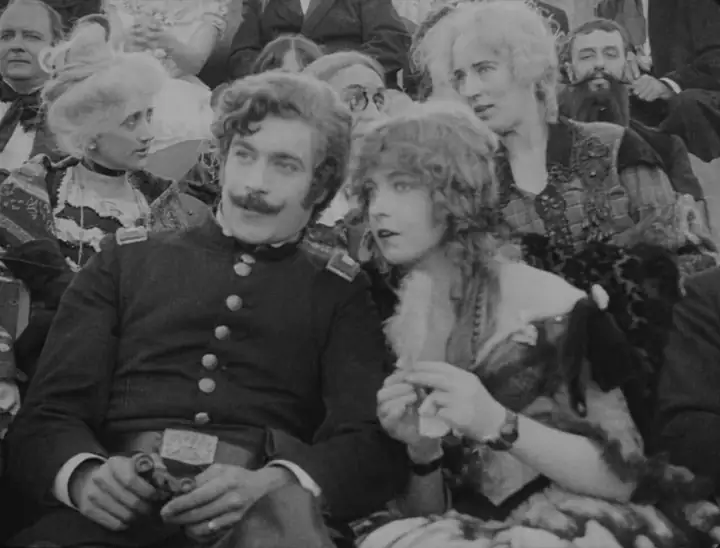
The Birth of a Nation (1915): Elsie Stoneman, at an evening eventImage: Wikimedia Commons · D. W. Griffith, Public domain - #020
It was released in 1915, the 50th anniversary of the end of the American Civil War.
- #021
By 1946 the film had been seen by 200,000,000 people worldwide.
- #022
After the film was released and criticized as racist, D. W. Griffith was deeply hurt. To show how damaging and dangerous people's intolerance could be, he decided to make Intolerance (1916) as a follow-up.
- #023
Before making this film, D. W. Griffith directed 13 Civil War-themed one-reel films.
- #024
The original copyright holder's failure to renew the film's copyright caused it to enter the public domain, meaning almost anyone could copy and sell a VHS/DVD copy of the film. As a result, most versions of the film on the market are either heavily (and often badly) edited and/or of extremely low quality, copied from a second- or third-generation (or later) copy of the film.
- #025
Ironically, D. W. Griffith had previously produced and directed Biograph's The Rose of Kentucky (1911), which portrayed the Ku Klux Klan as villains, a sharp contrast to this film made four years later, in which the KKK is portrayed positively.
- #026
For many years after its initial release, the film was used as a recruitment tool for the Ku Klux Klan.
- #027
The film was so successful that it led to The Fall of a Nation (1916), the first sequel in cinema history. No copy of the sequel is known to exist, making it a lost film.
- #028
The battlefield scenes were shot on the land where Universal Studios now stands.
- #029
Because of the chaotic nature of film distribution at the time, people with no connection to the actual production made a great many fortunes from this film. Louis B. Mayer was one of those who acquired the film's distribution rights for the eastern states, and the profit he made allowed him to found Louis B. Mayer Productions, which soon moved to Los Angeles.
- #030
The film was 12 reels long.
Production Story (86)
- #031
Because of its distributors' loose accounting methods, it is difficult to determine how much box office revenue the film actually earned. As a result, those connected to its production ridiculously exaggerated its ticket revenue. (Lillian Gish wrote in her autobiography that it earned more than 100 million dollars.) Its actual revenue is now estimated at around 10 million dollars, still a fantastic sum for the time.
- #032
The rumor that President Woodrow Wilson said after watching the film, 'It is like writing history with lightning. My only regret is that it is all so terribly true,' is famous. When the film became a subject of controversy for portraying the Ku Klux Klan heroically, Wilson, through his press secretary, denied that he had known its content before having it screened at the White House or that he approved of the film. Still, Wilson's published works as a historian closely align with the film's negative depiction of the Reconstruction era; in some prints, quotations from his writings even appear on screen. Wilson also consistently advocated racial segregation throughout his presidency.
- #033
When the film opened in New York, ticket prices were $2, an astronomical sum for the period. Adjusted for inflation, this equals roughly $63 in today's (approximately 2025) value. The exorbitant ticket prices ensured substantial box-office revenue.
- #034
It holds the distinction of being the first film screened at the White House; it was shown to President Woodrow Wilson in the East Room on Thursday, February 18, 1915.
- #035
D.W. Griffith agreed to pay $10,000 for the rights to Thomas Dixon Jr.'s play 'The Clansman.' However, since he ran out of money and could only pay $2,500, he offered Dixon a 25% share of the film. Although Dixon was not keen on the idea, he reluctantly accepted. The film's unprecedented success made Dixon very wealthy; his earnings were the highest amount a writer had ever received for a motion picture story [until 2007], reaching several million dollars.
- #036
It was Hollywood's highest-grossing film until Gone with the Wind (1939) was released.
- #037
The film's original budget was $40,000, but D.W. Griffith spent $110,000, the highest amount spent on a film up to that time.
- #038
Because of its openly pro-Confederate sympathies and racist subtext, the film was banned in many major cities with large African-American populations, such as Los Angeles and Chicago.
- #039
D.W. Griffith, the son of a Confederate veteran, was very surprised by the harsh reactions to the film, because he genuinely could not understand why anyone would be offended by it.
- #040
Relative to its cost, it is one of the most profitable films in history.
- #041
Among the investors were H.E. Aitken and Jesse L. Lasky, as well as many names from Hollywood. The film's success helped them establish their own studios: Lasky founded Famous Players-Lasky, which later became Paramount Pictures; Aitken was involved in the founding of several production companies such as Triangle Film Corp., Mutual Film Corp. and Majestic Motion Pictures.
- #042
By 1946, the film had been seen by 200,000,000 people worldwide.
- #043
When the film was released and criticized for being racist, D.W. Griffith was deeply hurt. He therefore decided to make Intolerance (1916) as a kind of sequel, aiming to show how destructive and dangerous people's intolerance can be.
- #044
Before making this film, D.W. Griffith had directed 13 Civil War-themed short films.
- #045
At its original premiere, it had an intertitle such as 'This is a depiction of the events of the Civil War and the formation of the Ku Klux Klan from the perspective of the American South.' This intertitle has been lost.
- #046
The original copyright holder's failure to renew the copyright for the film led to the film entering the public domain, which meant that almost anyone could duplicate and sell VHS/DVD copies of the film. As a result, most versions on the market are either severely (and often badly) edited or are of extremely low quality because they were duplicated from second-, third- (or higher) generation copies.
- #047
Ironically, D.W. Griffith had previously made and directed The Rose of Kentucky (1911) for Biograph, which portrayed the Ku Klux Klan as villains; this stands in sharp contrast to this film, made four years later, in which the KKK is presented in a positive light.
- #048
The film was so successful that it led to the first sequel in cinema history: The Fall of a Nation (1916). No copy of the sequel is known to exist, making it a lost film.
- #049
Because of distributors' loose accounting methods, it is difficult to determine how much the film actually earned at the box office. As a result, those involved in the production ridiculously exaggerated the box-office revenue (Lillian Gish wrote in her autobiography that it earned over $100 million). The actual revenue is estimated at around $10 million today, which is still an enormous figure for its era.
- #050
Due to the chaotic film distribution structure of the period, countless fortunes were made from this film by people with no connection to the actual production. Louis B. Mayer was one such beneficiary, acquiring the East Coast state distribution rights to the film and using the profits to found Louis B. Mayer Productions, shortly after which he moved to Los Angeles.
- #051
When the film was shown, protests and race riots broke out in Boston and Philadelphia, while Chicago, Denver, Kansas City (Missouri), Minneapolis, Pittsburgh and St. Louis refused to show it.
- #052
Chicago, Illinois, Wednesday, February 28, 1940: 'Judge Donald McKinley yesterday ordered the Chicago Police Department to stop interfering with the film 'The Birth of a Nation,' which it had recently halted at the Admiral Theatre on Lawrence Avenue. The court ruled that the injunction issued against police interference on March 5, 1917, is still in effect. The film will be shown at the Sonotone Theatre starting Friday.'
- #053
In 1931, an abridged version was released with a foreword in which D.W. Griffith was interviewed by Walter Huston. The two had previously collaborated on the film Abraham Lincoln (1930).
- #054
Its original title, 'The Clansman', was shelved after being deemed too bland given the breadth and scope of the subject.
- #055
The NAACP tried to have the film banned. When that effort failed, it sought to have some of the film's more extreme scenes censored.
- #056
Woodrow Wilson and Thomas Dixon Jr. had studied together at Johns Hopkins University and, in Dixon's words, had become 'close friends'. Years later, Dixon was asked to give the commencement address at Wake Forest University, his alma mater, but he declined and suggested that Wilson speak instead. After a reporter heard Dixon praising Wilson, he published a story about the two, giving the future president his first national exposure. In his autobiography, Dixon claimed that Wilson, in return for this favor, agreed to screen the film at the White House and said, 'Because you once took a day out of your busy life long ago to do something for me, I am glad to be able to do this little thing for you.'
- #057
May 14, 1938, East Orange, New Jersey: The Ormont Theater, which had refused to stop showing 'The Birth of a Nation' after it was brought back at the request of the 'East Orange City Council', cut the sections described as 'objectionable' in a petition signed by 608 people. Manager A.J. Rettig responded to the petitioners by saying the agitation had been started 'to create unnecessary harassment of a regular and peaceful business.'
- #058
The (edited) version of the film was re-released in theaters in 1923 and 1940.
- #059
Originally titled The Clansman, the film is a 1915 American silent epic drama directed by D.W. Griffith and starring Lillian Gish. The screenplay was adapted from Thomas Dixon Jr.'s 1905 novel and play The Clansman. Griffith wrote the screenplay with Frank E. Woods and produced the film with H.E. Aitken.
- #060
The film's only negative wore out quickly, unable to withstand the demand for prints. Because all subsequent copies were struck from positive prints, the image quality steadily declined.
- #061
The main reason for the heavy use of smoke bombs in the battle scenes was to conceal the largely empty terrain.
- #062
Although most of the Civil War scenes were based on real photographs, the post-war Reconstruction scenes were far from historically accurate. The legislature scenes in particular were shot drawing on the era's political cartoons rather than photographs.
- #063
Only one scene in the entire film was reshot, due to a continuity error involving the piece of cotton pinned to Mae Marsh's dress in the sequence where she returns home.
- #064
Camera operator Karl Brown thought during shooting that the film was an ordinary melodrama. But he was stunned when Griffith hired the Los Angeles Philharmonic Orchestra for the gala and had the score performed live; he said that when the conductor raised his baton and the orchestra began to play, the sound he heard was like nothing he had ever experienced. Brown also recalled that Griffith hummed certain themes to the composer to describe what he wanted.
- #065
Each major character in the film was assigned a specific musical theme to be played by an orchestra or theater organ during screenings. Griffith allowed Lillian Gish to choose the theme for her own character, Elsie Stoneman; that melody was later used under the title "The Perfect Song" as the theme music for the radio and television versions of the Amos 'n' Andy Show.
- #066
The scale of the battle scenes was unprecedented for its time, and for this reason the use of assistant directors to coordinate the movements of the extras in the background was an innovative approach.
- #067
At the Los Angeles premiere, the film was promoted under the title "The Clansman," drawn from the novel it was based on, with robed Klan members in attendance. Yet the white robes seen in both the film and the promotional materials were the invention of Griffith's costume department and bore no historical resemblance to the Ku Klux Klan's attire of the 1860s and 1870s.
- #068
The film was initially shown in two parts with an intermission. The first American production to have an original score composed for orchestra, it was also presented with a 13-page souvenir program.
- #069
The Ford's Theatre stage was shot on an exterior set built in the studio.
- #070
After D.W. Griffith's death, Donald Crisp claimed that he himself had directed the battlefield scenes. Historians consider the claim entirely baseless; Griffith never authorized a second unit and directed every scene himself. Crisp was most likely one of about a dozen assistant directors assigned to direct the extras.
- #071
Griffith was known for his economical shooting methods. For example, when a mistake was made during a take, instead of saying "Cut!" he would call other actors onto the same set and shoot a different scene rather than waste the setup.
- #072
The crew's meals were provided by the actors hunting for themselves every day.
- #073
Historian Kevin Brownlow voiced doubts about "Fireworks Wilson," whom assistant cameraman Karl Brown referred to in interviews as the special effects supervisor. Brownlow's doubt stems from Wilson being mentioned in no other record of the period, and he suggests that Brown may have invented the name because he could not recall that of the film's documented effects supervisor, Walter Hoffman.
- #074
Lillian Gish defended the film as not racist throughout her life, even though the production was constantly protested for glorifying the Ku Klux Klan and portraying Black people as stupid, ignorant savages.
- #075
When Mary Wynn passed away on December 22, 2001, at the age of 99, she was the film's last surviving cast member.
- #076
The extra playing the hospital sentry touched audiences' hearts across the country in the scene where he sorrowfully watches Lillian Gish enter the hospital. His performance was so admired that D.W. Griffith tried to find the actor, but reportedly failed. Some sources list William Freeman in the role; Gish confirms this in her autobiography, writing that she ran into Freeman years later at a parade.
- #077
The character Austin Stoneman was inspired by Pennsylvania congressman Thaddeus Stevens, down to details such as his wig and his limp. Ben Cameron was modeled on Leroy McAfee, and Silas Lynch on Alonzo J. Ransier and Richard Howell Gleaves.
- #078
D.W. Griffith had boards placed under the feet of Joseph Henabery, who played Abraham Lincoln, so that in the Emancipation Proclamation scene the 1.93-metre president would appear too large for the chair. Through his own research, Henabery added to his performance Lincoln's habit of leaning back on his tailbone and his steel-framed glasses; these touches pleased Griffith greatly.
- #079
Future directors John Ford, Raoul Walsh, Elmer Clifton, Joseph Henabery, Karl Brown and Donald Crisp worked on this film as actors or crew members. Although Erich von Stroheim is also listed in some sources — including his own claim — as an actor or assistant director, the records show that his first work with Griffith was Intolerance (1916), shot more than a year after this film.
- #080
Josephine Crowell (Mrs. Cameron), Jennie Lee (Mammy) and Dark Cloud (General) were the only actors alive during the American Civil War (1861-65). They were born on 11 January 1859, 4 September 1848 and 20 September 1861, respectively.
- #081
Elmo Lincoln, who played 'White-Arm Joe', also appeared in eight other uncredited roles in the film.
- #082
Because of the film's enormous significance, some actors are thought to have made exaggerated claims about working on the production in order to strengthen their résumés. Among the unverified names is John Ford, who said he played a Klansman riding a horse while holding his hood over one eye with one hand; such an extra is seen in the film and it may indeed be Ford. Bessie Love, though often referred to as the 'Piedmont Girl', denied claims that she appeared in the film. Erich von Stroheim claimed for years that he was the stuntman who fell from a roof (breaking two ribs in the process), but assistant director Joseph Henabery stated unequivocally that von Stroheim was not on a Griffith set before Intolerance (1916). Some have claimed to see von Stroheim as a painted-faced voter in the ballot-box scene. Henabery, who was on set as an actor and assistant director, said that the person who performed the roof fall was the Native American actor Charles Eagle Eye. George Beranger, for some reason, is listed as 'John French' in the original programme notes.
- #083
Although Jennie Lee's character is referred to as 'Mammy' in the film's subtitles, she is listed as 'Cyndy' in the original press materials and, over the years, as 'Dixie' in some sources.
- #084
The character played by William De Vaull is listed as 'Nelse', while William Freeman's is officially listed as 'Jake'. Many cast lists omit the character 'Nelse' and show De Vaull as 'Jake', while changing Freeman's character to 'Sentinel'.
- #085
In the original programme materials, George Beranger was listed as 'J.A. Beringer', and the character Duke Cameron was attributed to 'John French'. In addition, Wallace Reid's name was mistakenly written as 'Reed' in the original programmes.
- #086
Some of D.W. Griffith's colleagues questioned the casting of Henry B. Walthall as Colonel Ben Cameron, thinking he was physically too slight for the role. (Walthall was 1.70 metres tall.) Griffith confidently said, 'Wally will play him big.' He was right, but as a precaution the character was nonetheless nicknamed 'The Little Colonel'.
- #087
The rumour is famous that President Woodrow Wilson, after watching the film, said, 'It is like writing history with lightning. My only regret is that it is all so terribly true.' When the film became a subject of controversy for portraying the Ku Klux Klan heroically, Wilson, through his press secretary, denied that he had known its content before having it screened at the White House or that he endorsed the film. Nevertheless, Wilson's published works as a historian closely align with the film's negative portrayal of the Reconstruction era; in some editions, quotations from his writings even appear on screen. Wilson also consistently advocated racial segregation throughout his presidency.
- #088
When the film opened in New York, ticket prices were 2 dollars, an astronomical sum for the period. Adjusted for inflation, this equals roughly 63 dollars in today's (approximately 2025) value. The exorbitant ticket prices ensured significant box-office revenue.
- #089
It holds the distinction of being the first film screened at the White House; it was shown to President Woodrow Wilson in the East Room on Thursday, 18 February 1915.
- #090
D.W. Griffith agreed to pay 10,000 dollars for the rights to Thomas Dixon Jr.'s play 'The Clansman'. However, since he ran out of money and could only pay 2,500 dollars, he offered Dixon a 25% share of the film. Dixon was not keen on the idea but reluctantly accepted. The film's unprecedented success made Dixon very wealthy; his earnings, amounting to several million dollars, were the highest sum a writer had received for a motion picture story [until 2007].
- #091
It was Hollywood's highest-grossing film until the release of Gone with the Wind (1939).
- #092
The film's original budget was 40,000 dollars, but D.W. Griffith spent 110,000 dollars, the highest amount spent on a film up to that time.
- #093
D.W. Griffith, the son of a Confederate veteran, was greatly surprised by the harsh reactions to the film, because he genuinely could not understand why anyone would be offended by it.
- #094
Among the investors were H.E. Aitken and Jesse L. Lasky, as well as many figures from Hollywood. The film's success helped them establish their own studios: Lasky founded Famous Players-Lasky, which later became Paramount Pictures, while Aitken was involved in the founding of several production companies, including Triangle Film Corp., Mutual Film Corp. and Majestic Motion Pictures.
- #095
When the film was released and criticized for being racist, D.W. Griffith was deeply hurt. He therefore decided to make Intolerance (1916), a kind of sequel, to show how destructive and dangerous people's intolerance can be.
- #096
At its original premiere, it included an intertitle such as 'This is a depiction of the events of the civil war and the formation of the Ku Klux Klan from the perspective of the American South.' This intertitle has been lost.
- #097
The original copyright holder's failure to renew the copyright on the film led to the film entering the public domain, which meant that almost anyone could duplicate and sell VHS/DVD copies of the film. As a result, most of the versions on the market are either heavily (and often badly) edited or are of extremely low quality because they were duplicated from second-, third- (or higher) generation copies.
- #098
Because of distributors' loose accounting methods, it is difficult to determine how much the film actually earned at the box office. As a result, those involved in the production exaggerated the box office gross ridiculously (Lillian Gish wrote in her autobiography that it earned over 100 million dollars). The actual gross is estimated at around 10 million dollars in today's terms, which is still a tremendous figure for its era.
- #099
Because of the chaotic film distribution structure of the period, countless fortunes were made from this film by people with no connection to the actual production. Louis B. Mayer was one such beneficiary, having acquired the film's East Coast state distribution rights and used the profits to found Louis B. Mayer Productions, shortly after which he moved to Los Angeles.
- #100
Chicago, Illinois, Wednesday, February 28, 1940: 'Judge Donald McKinley yesterday ordered the Chicago Police Department to stop interfering with 'The Birth of a Nation,' which it had recently halted at the Admiral Theatre on Lawrence Avenue. The court ruled that the injunction issued against police interference on March 5, 1917, is still in effect. The film will be shown at the Sonotone Theatre starting Friday.'
- #101
In 1931, an abridged version was released featuring a prologue in which D.W. Griffith was interviewed by Walter Huston. The two had previously collaborated on the film Abraham Lincoln (1930).
- #102
Its original title, 'The Clansman,' was shelved after being deemed too bland given the breadth and scope of the subject.
- #103
The NAACP tried to have this film banned. When that effort failed, it tried to secure the censorship of some of the film's more extreme scenes.
- #104
Woodrow Wilson and Thomas Dixon Jr. had studied together at Johns Hopkins University and had become, in Dixon's words, 'close friends.' Years later, Dixon was asked to give the commencement speech at Wake Forest University, his alma mater, but he declined and suggested that Wilson speak instead. After a reporter heard Dixon praising Wilson, he published a story about the two, giving the future president his first national publicity. Dixon claimed in his autobiography that Wilson, in return for this favor, agreed to show the film at the White House and said, 'For the sake of a long-ago day when you took time out of your busy life to do something for me, I am glad to be able to do this little thing for you.'
- #105
May 14, 1938, East Orange, New Jersey: 'The Ormont Theatre, which refused to stop showing 'The Birth of a Nation' after it was re-released at the request of the East Orange City Council, cut the sections described as 'objectionable' in a petition signed by 608 people. Manager A.J. Rettig responded to the petitioners by saying the agitation had been started 'to create unnecessary harassment of a regular and peaceful business.'
- #106
The (edited) version of the film was re-released in cinemas in 1923 and 1940.
- #107
The film, originally titled The Clansman, is a 1915 American silent epic drama directed by D.W. Griffith and starring Lillian Gish. The screenplay was adapted from Thomas Dixon Jr.'s 1905 novel and play The Clansman. Griffith wrote the screenplay with Frank E. Woods and produced the film with H.E. Aitken.
- #108
The film is remembered as the work that inspired the birth of the second Ku Klux Klan. The organization re-emerged at Stone Mountain in Georgia the same year the film was released.
- #109
The film encouraged African Americans to create their own cinema, leading them to produce alternative images and stories in response to negative portrayals.
- #110
Regarded as the beginning of modern American cinema, the production is a turning point in film history.
- #111
In the 19th century, the Ku Klux Klan never burned crosses as depicted in the film; the first Klan was largely passive. However, the heroic portrayal in the film pushed Southerners to revive the second Klan and adopt cross burning as a tactic.
- #112
For many years after its release, the film was used as a recruitment tool for the Ku Klux Klan.
- #113
It earned a place on Roger Ebert's 'Great Movies' list and has been regarded as valuable by film critics.
- #114
It is the oldest feature film in the book '1001 Movies You Must See Before You Die,' edited by Steven Schneider.
- #115
The film's prologue includes the following statements: 'In this work, we have engraved the devastations of war on the mind so that war may be remembered with hatred; this effort will not be in vain.' and 'The bringing of the African to America planted the first seed of disunion.'
- #116
A turning point in film history, the film is praised for its technical mastery. It is the first American 12-reel film that is not a serial, and its subject draws partly on fiction and partly on history.
Behind the Scenes (19)
- #117
The film was made with only a single reshoot of one scene, prompted by a continuity error involving Mae Marsh and a piece of cotton pinned to her dress during the graduation scene.
- #118
The film's only negative wore out quickly, unable to withstand the demand for prints. Because all subsequent copies were duplicated from positive prints, the image quality steadily declined.
- #119
The main reason for the heavy use of smoke bombs in the battle scenes was largely to conceal the mostly empty terrain.
- #120
Director D.W. Griffith visualized the entire film in his mind; he neither wrote a screenplay nor kept written notes.
- #121
The film pioneered many techniques, including panoramic long shots, iris transitions, freeze frames, night shooting, tracking camera movements, and meticulously staged battle scenes that made hundreds of extras look like thousands. Color tinting was also used for dramatic effect, and atmosphere was created with its own original music.
- #122
Although most of the Civil War scenes were based on real photographs, the post-war Reconstruction scenes were far from historically accurate. In particular, the legislature scenes were shot drawing on the era's political cartoons rather than photographs.
- #123
Throughout the film, only a single scene was reshot, due to a continuity error involving the piece of cotton pinned to Mae Marsh's shirt in the homecoming sequence.
- #124
Camera operator Karl Brown thought during shooting that the film was an ordinary melodrama. But he was stunned when Griffith hired the Los Angeles Philharmonic Orchestra for the gala and had the score performed live; he said that when the conductor raised his baton and the orchestra began to play, the sound he heard was unlike anything before. Brown also recalled that Griffith hummed certain themes to the composer to describe what he wanted.
- #125
For every major character in the film, a special musical theme was designated to be played by an orchestra or theater organ during screenings. Griffith allowed Lillian Gish to choose the theme for her own character, Elsie Stoneman; that melody was later used, under the title "The Perfect Song," as the theme music for the radio and television versions of Amos 'n' Andy Show.
- #126
The film was exactly 12 reels long.
- #127
The scale of the battle scenes was unprecedented for its time, and for this reason the use of assistant directors to coordinate the movements of the background extras was an innovative approach.
- #128
At the Los Angeles premiere, the film was promoted under the title "The Clansman," based on the novel it was adapted from, with robed Klan members used in the promotion. Yet the white robes seen in both the film and the promotional materials were the invention of Griffith's costume department and bore no historical resemblance to the Ku Klux Klan's attire of the 1860s and 1870s.
- #129
The film was initially shown in two parts with an intermission. The first American production to have original music composed for an orchestra, it was also presented with a 13-page souvenir program.
- #130
Western Costume Co. took on one of its first major assignments with this film, supplying the Civil War costumes. Some of the costumes were also provided by Goldstein and Co.; the designs were by Robert Goldstein and the era's famous costume designer Clare West.
- #131
The Ford's Theatre scene was shot on an exterior set built in the studio.
- #132
After D.W. Griffith's death, Donald Crisp claimed that he himself had directed the battlefield scenes. Historians consider this claim entirely baseless; Griffith never authorized a second unit and directed every scene himself. Crisp was most likely one of about a dozen assistant directors assigned to direct the extras.
- #133
Griffith was known for his economical shooting methods. For example, when a mistake was made during a take, instead of saying "Cut!" he would call in other actors on the same set and shoot a different scene rather than waste the setup.
- #134
The crew's food needs were met by the actors hunting for themselves every day.
- #135
Historian Kevin Brownlow voiced his doubts about "Fireworks Wilson," whom assistant cameraman Karl Brown mentioned in interviews as the person in charge of special effects. Brownlow's doubt stems from Wilson not being mentioned in any other record of the period, and he suggests that Brown may have invented the name because he could not remember that of the film's documented effects supervisor, Walter Hoffman.
Characters & Cast (23)
- #136
Mary Wynn was the last surviving cast member of the film when she died on December 22, 2001, at the age of 99.
- #137
Joseph Henabery, one of D. W. Griffith's assistant directors and a contributing researcher, played Abraham Lincoln as well as 13 uncredited roles in the film.
- #138
Lillian Gish defended the film as not racist for her entire life, even though the production was constantly protested for glorifying the Ku Klux Klan and portraying Black people as stupid, ignorant savages.
- #139
When Mary Wynn passed away on December 22, 2001, at the age of 99, she was the last surviving cast member of the film.
- #140
At around the 7th minute of the film, the person playing the Cameron family's servant appears to be a white man.
- #141
The extra playing the hospital orderly touched audiences nationwide in the scene where Lillian Gish watches her entrance into the hospital with sorrow. His performance was so admired that D.W. Griffith tried to find the actor, but allegedly could not. Some sources list William Freeman in this role; Gish confirms this in her autobiography, writing that she encountered Freeman years later at a parade.
- #142
Joseph Henabery, one of D.W. Griffith's chief assistant directors and researchers, appeared in the film as Abraham Lincoln as well as in 13 other uncredited roles.
- #143
The character Austin Stoneman was inspired by Pennsylvania representative Thaddeus Stevens, down to details such as his wig and his limping leg. Ben Cameron was modeled on Leroy McAfee, and Silas Lynch on Alonzo J. Ransier and Richard Howell Gleaves.
- #144
D.W. Griffith had boards placed under the feet of Joseph Henabery, who played Abraham Lincoln, so that in the Emancipation Proclamation scene the chair would appear too small for the 1.93-meter president. Henabery added to his performance, through his own research, Lincoln's habit of leaning back on his tailbone and his steel-rimmed glasses; these touches pleased Griffith greatly.
- #145
Future directors John Ford, Raoul Walsh, Elmer Clifton, Joseph Henabery, Karl Brown and Donald Crisp worked on this film as actors or crew members. Erich von Stroheim is also listed in some sources — including his own claim — as an actor or assistant director, but records show that his first work with Griffith was Intolerance (1916), shot more than a year after this film.
- #146
Josephine Crowell (Mrs. Cameron), Jennie Lee (Mammy) and Dark Cloud (General) were the only cast members alive during the American Civil War (1861-65). They were born on January 11, 1859, September 4, 1848 and September 20, 1861, respectively.
- #147
Elmo Lincoln, who played 'White-Arm Joe,' appeared in eight other uncredited roles in the film.
- #148
This film made Lillian Gish a star.
- #149
Because of the film's enormous significance, some actors are thought to have made exaggerated claims about working on the production to bolster their résumés. Among the unverified names is John Ford, who said he played a Klansman riding a horse while holding his hood over one eye with one hand; such an extra is visible in the film and could indeed be Ford. Bessie Love, though often referred to as the 'Piedmont Girl,' denied claims that she appeared in the film. Erich von Stroheim claimed for years that he was the stuntman who fell from the roof (breaking two ribs in the process), but assistant director Joseph Henabery stated unequivocally that von Stroheim was not on a Griffith set before Intolerance (1916). Some have claimed to see von Stroheim as a voter with a painted face in the ballot box scene. Henabery, who was on set as an actor and assistant director, said that the person who performed the roof fall was the Native American actor Charles Eagle Eye. George Beranger, meanwhile, is listed for some reason as 'John French' in the original program notes.
- #150
Although Jennie Lee's character is referred to as 'Mammy' in the film's subtitles, she is listed as 'Cyndy' in the original press materials and as 'Dixie' in some sources over the years.
- #151
Milton Berle claimed that he appeared in this film as a baby; however, there is no official record proving this.
- #152
The character played by William De Vaull is officially listed as 'Nelse,' while William Freeman's is listed as 'Jake.' Many cast lists omit the character 'Nelse' and show De Vaull as 'Jake,' while changing Freeman's character to 'Orderly.'
- #153
Russell Hicks's first film.
- #154
Eugene Pallette's first appearance in a feature film came in an uncredited role as a Union soldier.
- #155
Charles King's film career began with this film.
- #156
Monte Blue's first film.
- #157
In the original program materials, George Beranger was listed as 'J.A. Beringer,' and the character Duke Cameron was attributed to 'John French.' Additionally, Wallace Reid's name was mistakenly written as 'Reed' in the original programs.
- #158
Some of D.W. Griffith's colleagues questioned the casting of Henry B. Walthall as Colonel Ben Cameron, thinking he was physically too frail for the role. (Walthall was 1.70 meters tall.) Griffith confidently said, 'Wally will play him big.' He was right, but as a precaution the character was nonetheless given the nickname 'The Little Colonel.'
Deeper Meaning (15)
- #159
It is generally regarded as marking the birth of modern American cinema.
- #160
The organization reappeared at Stone Mountain in Georgia the same year the film was released.
- #161
The film encouraged African Americans to create their own cinema; in this way, they began producing alternative images and stories against negative portrayals.
- #162
Regarded as the beginning of modern American cinema, this production is a turning point in film history.
- #163
It ranked 7th among the 25 most controversial films of all time on Entertainment Weekly's 2006 list.
- #164
In the 19th century, the Ku Klux Klan never burned crosses as in the film; the first Klan was largely passive. However, the heroic portrayal in the film pushed Southerners to revive the second Klan and adopt cross burning as a tactic.
- #165
After its release, the film was used for many years as a recruitment tool for the Ku Klux Klan.
- #166
In 1992, the Library of Congress deemed the film 'culturally, historically, or aesthetically significant' and preserved it in the National Film Registry.
- #167
It is considered one of 15 films that changed American cinema; it broke new ground with its technical innovations.
- #168
It ranked 44th on the American Film Institute's 1998 list of the 100 best American films.
- #169
Forrest Gump (1994) uses an edited segment from this film in the scene where Gump explains that he was named after his ancestor General Nathan Bedford Forrest; Tom Hanks's face is placed over a Confederate soldier.
- #170
It found a place on Roger Ebert's 'Great Movies' list and has been regarded as valuable by film critics.
- #171
It is the oldest feature-length film in the book '1001 Movies You Must See Before You Die,' edited by Steven Schneider.
- #172
The film's prologue includes the following statements: 'In this work, we have engraved the devastations of war on minds so that war may be remembered with hatred; this effort will not be in vain.' and 'The bringing of the African to America planted the first seed of disunion.'
- #173
This film, a turning point in cinema history, is praised for its technical mastery. It is the first American film with 12 reels that is not a serial, and its subject draws partly on fiction and partly on history.
Sources & editorial notes
Reference databases
- Wikipedia
- IMDb
Information from external sources is independently selected, consolidated and edited by Arka Evren. Sources are listed for verification and further reading. Encyclopedia text is used under its licence (CC BY-SA). How we work