FILM · 2004 · CANADA
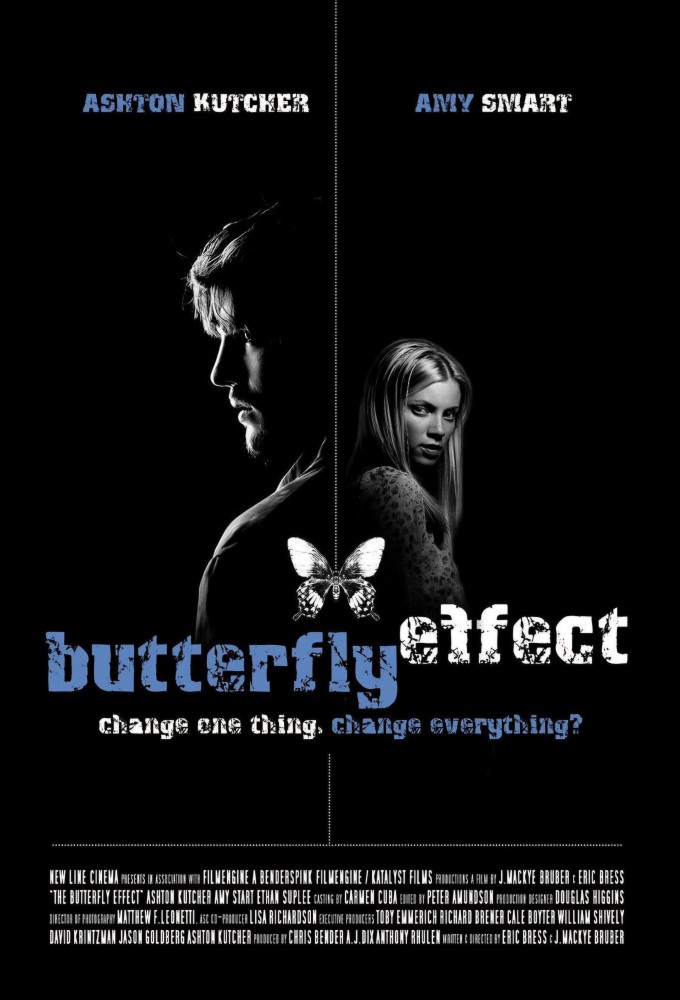
The Butterfly Effect
- Directed by
- Eric Bress, J. Mackye Gruber
- Runtime
- 113 min
- Studio
- FilmEngine, Katalyst Films, BenderSpink
37 archived facts 6 topics 1 source Last reviewed Sep 2026
A young man struggles to access sublimated childhood memories. He finds a technique that allows him to travel back into the past, to occupy his childhood body and change history. However, he soon finds that every change he makes has unexpected consequences.
Summary: TMDB
All facts (37)
- #001
Contains a major spoiler — show
There are four alternative endings. Most involve Evan and Kayleigh meeting as adults in a timeline where they never knew each other as children. In the first, Evan turns around and speaks to Kayleigh at the same time. In the second, Evan turns around after Kayleigh has already turned away and follows her. The directors called this the "happy sappy stalker ending" and said they would publicly distance themselves from the film if the studio insisted on including it in the theatrical cut. In the third ending, Kayleigh turns around first, then Evan turns around and Kayleigh walks away. Evan stands there for a minute, then walks away and does not follow her. The directors called this the "happy sappy ending" and said it was the minimum ending they would accept for the theatrical cut if the studio insisted, because Evan at least learns *something* about sacrifice. In the fourth, Evan watches the home movie of his own birth rather than meeting Kayleigh. He goes into the film and strangles himself in the womb. (This can be seen at the end of the Director's Cut.) This was always the directors' preferred ending, but the studio found it too harsh for a theatrical release, so the theatrical version instead ends with Evan berating Kayleigh at a childhood party, preventing them from ever developing a relationship.
- #002
Contains a major spoiler — show
(At around 42 minutes, director's cut only) Evan's mother mentions that she had previous late-term miscarriages before Evan was finally born. This information does more than set up the alternative ending in which Evan watches his birth video and strangles himself in the womb. It also raises the question of whether these were natural occurrences or whether Evan had siblings who shared the same fate and decided to end their own lives just before being born.
- #003
All of the prison scenes were shot in a real prison (in Washington State) with real inmates.
- #004
(At around 15 minutes) While Evan is being hypnotized, the lights flicker in the background of the psychiatrist's office after he blows up the mailbox. This was not a planned special effect; it was an actual short circuit in the wiring on the film set. The directors thought it fit the scene so well that they used the shot in the final cut of the film.
- #005
It was one of the most widely read unproduced screenplays in the industry. The film was not greenlit until writers/directors Eric Bress and J. Mackye Gruber decided to write Final Destination 2 (2003) and Ashton Kutcher signed on as executive producer of The Butterfly Effect.
- #006
Contains a major spoiler — show
Elden Henson shot all of his subsequent "normal" scenes first because he had to gain about 20 kilos a month for the later timelines in which his character is insane. He had to look as large as crazy Lenny and as thin as normal Lenny. To the producer's amazement, he succeeded.
- #007
(At around 1 hour 28 minutes) They only had to blow up three mailboxes, and only achieved the right result on the third attempt.
- #008
Contains a major spoiler — show
(At around 1 hour 29 minutes) The scene in which Evan has no arms was achieved using two shots: one of an empty bed, and another of Ashton Kutcher lying in the bed with green gloves on his hands (which were later erased). Both shots had the same camera movements. In most films this can be achieved using motion-control cameras that can replicate the same movement across multiple takes. However, because this film had a fairly low budget, the producers could not afford such equipment, and the two identical shots were achieved by moving the camera manually using a stopwatch as a reference. Any slight variations between the two shots were digitally corrected in post-production.
- #009
Contains a major spoiler — show
(At around 1 hour 17 minutes) There is a scene in which the alternative reality is created in which Evan finds himself as a fraternity brother at college. While his memory is being 'reconstructed', Kayleigh hitchhikes to visit 13-year-old Evan after he moves away. People do not realize that the driver is Karl, the bald inmate who would exist in that reality before going to the same prison as Evan (and this is not even mentioned in the DVD commentary).
- #010
Logan Lerman (Evan at age 7) wore dark contact lenses to match Ashton Kutcher's eyes.
- #011
Contains a major spoiler — show
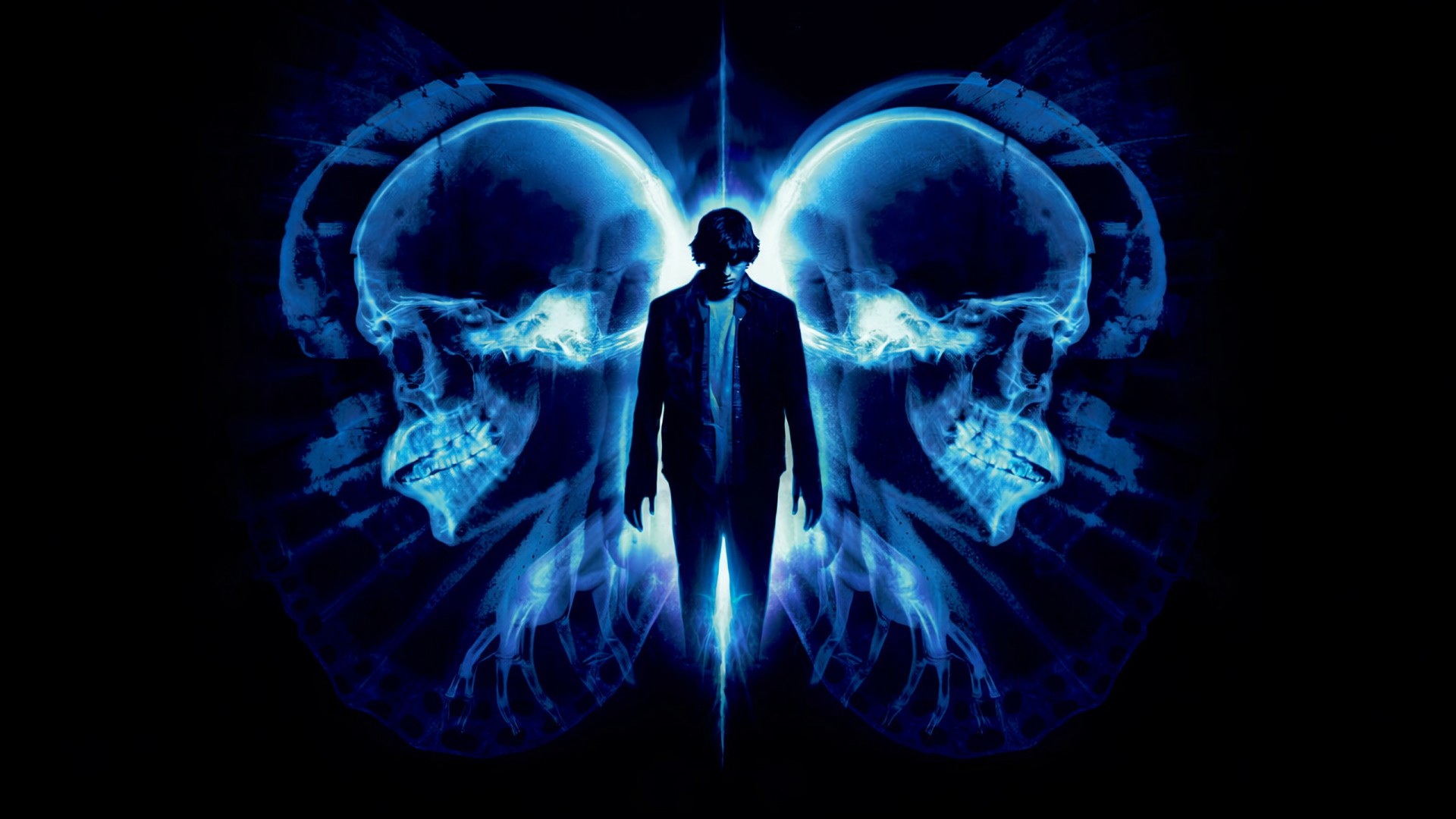
(At around 2 minutes) The film's title screen is a brain scan (shown from the front). In this image, the left and right lateral ventricles of the corpus callosum (the middle of the brain) are transposed. This is also the case in many schizophrenia patients. The displaced ventricles in the middle of the brain are sometimes said to resemble a butterfly. In the film, Evan is not schizophrenic, but in the penultimate universe in which the "jumps" occur (after he accidentally kills Kayleigh as a child), he is treated as if he were schizophrenic; the doctors tell him that everything that has happened to him throughout the film is a fabrication.
- #012
Contains a major spoiler — show
(At around 10 minutes) While Evan and his mother stand at Jason's grave, Kayleigh comes over and takes Evan's hand. Because of the distance of the shot and the score playing in the background, it is not clear what she says to him. She actually says, "You're probably better off now."
- #013
Contains a major spoiler — show
The film takes place in 1989, 1995, 2002 and 2010.
- #014
(At around 50 minutes) When Evan wakes up in the girls' dormitory, there is a "Bradbury University" pennant on the wall — a nod to Ray Bradbury.
- #015
The title is a reference to the concept in chaos theory that small events can lead to unpredictably large events. This is explained in the opening quote, which states that the flap of a butterfly's wings can cause a typhoon. It can also be seen as a secondary reference to Ray Bradbury's short story "A Sound of Thunder".
- #016
Contains a major spoiler — show
In the original ending, Evan travels back in time and commits suicide while he is an unborn baby in his mother's womb. This ending was used on the Director's Cut DVD. The theatrical version gave the film a different ending, changing the film's outcome to Evan returning to the day he met Kayleigh and upsetting her by telling her that a child hates him and his family and threatening to kill them all if she ever comes near him again. Evan did this because he thought the only way for himself, his family and his close friends to be happy in their lives was to avoid interaction with Kayleigh or her troubled, protective brother Tommy. Doing this made it possible for Kayleigh and Tommy to live with their mother instead of staying with their father and being abused, which led to the original chain of events. As Kayleigh explained in an earlier scene, wanting to be with Evan was the reason she did not go to live with her mother.
- #017
The picture above Evan's bed in his dorm room is Salvador Dalí's "Sleep".
- #018
The wig Eric Stoltz wore in the film was made from Stoltz's real hair.
- #019
Contains a major spoiler — show
At around 1 hour 40 minutes, during Evan's second-to-last jump back (after which he wakes up in the mental hospital), there is a rapid series of shots of people making funny faces. One of the people seen in several of the photographs is assistant director Eric Bress.
- #020
Contains a major spoiler — show
At around 9 minutes, assistant director Eric Bress not only appears briefly in a photograph during the second-to-last jump back, he also appears at the start of the film as a patient in the mental hospital. In the alternate ending (around 1 hour 50 minutes, director's cut only), he has a cameo as Andrea's new husband in the alternate timeline Evan creates.
- #021
Contains a major spoiler — show
At around 58 minutes, the fraternity pledge scene was shot on the lawn of the historic Ceperley House on the shore of Deer Lake in Burnaby, BC, Canada. Evan's proposal was shot in front of the gardener's cottage behind the house. Coincidentally, the mansion briefly served as a real fraternity house for SFU in the 1960s, before the city of Burnaby evicted the students to turn the house into an art gallery. The stubborn students barricaded themselves inside and set the living room on fire.
- #022
The "butterfly effect" refers to large future events being changed by something as harmless as stepping on a butterfly, or a butterfly flapping its wings in this film's opening. It comes from a 1952 Ray Bradbury story, The Sound of Thunder. In the story, a time traveler goes on safari to hunt dinosaurs. The animal is known to be doomed to die within minutes when a tree falls, so its death will not matter, and the hunters stay suspended above the ground on a prescribed path wearing hazmat suits, but the man panics, falls off the path and the hunt ends. When he returns to the present, he finds that history has turned out disastrously. When he takes off his hazmat suit, he sees a crushed prehistoric butterfly embedded in the mud on his boots.
- #023
At around 36 minutes, Evan's cigarette burn scar closely resembles a sketch of the Mandelbrot set, generally the symbol of the chaos theory at the heart of the butterfly effect.
- #024
Josh Hartnett, Seann William Scott and Joshua Jackson were offered the role of Evan.
- #025
The main character Evan wrote a total of ~4,745 journal entries from the age of six to 19 (essentially 365 days x 13 years). So 4,745 entries divided over 192 pages (front/back) in a standard notebook would fill about 24 notebooks in this film.
- #026
The final ending chosen by Eric Bress and J. Mackye Gruber was a tribute to the 80s Japanese classic The Girl Who Leapt Through Time (1983), adapted from Yasutaka Tsutsui's novel of the same name. The ending, in which the characters meet but do not recognize each other at first, is exactly the same in both films.
- #027
At around 17 minutes, the younger versions of Evan, Kayleigh and Tommy go to a movie theater showing Seven (1995), which is also showing Dumb and Dumber (1994). Both of these films, like this one, were released by New Line Cinema. Elden Henson (Lenny) and William Lee Scott (Tommy) appeared in Dumb and Dumberer: When Harry Met Lloyd (2003).
- #028
Ethan Suplee (Thumper) really was as obese as described. He later underwent an intense, long-term regimen of exercise and diet that completely changed his physique.
- #029
Ali Larter was offered the role of Kayleigh but dropped out of the film.
- #030
Evan's journals have the same cover design as John Doe's journals in Seven (1995), also released by New Line Cinema. They are the standard composition notebooks used every day by schoolchildren across the country.
- #031
It is the only Butterfly Effect film to be released in theaters. The sequels The Butterfly Effect 2 (2006) and The Butterfly Effect 3: Revelations (2009) went straight to DVD with new releases.
- #032
Kayleigh's (Amy Smart) workplace, the Hilltop Café, was also used in Bates Motel (2013). In episode 2.2, Shadow of a Doubt (2014), Dylan (Max Thieriot) and Bradley (Nicola Peltz Beckham) wait there for the bus.
- #033
Contains a major spoiler — show
At around 1 hour 50 minutes, Evan's final note would not matter, because if he strangles himself in the womb (which is impossible for a fetus to do), Evan erases himself before he is born and therefore cannot write the note.
- #034
At around 53 minutes, the number Evan dials when he calls "State" is 555-5785, a number frequently repeated by Frank Rizzo from The Jerky Boys.
- #035
Kevin G. Schmidt (13-year-old Lenny) and Ashton Kutcher (adult Evan) had previously appeared together in Cheaper by the Dozen (2003).
- #036
Tommy may suffer from antisocial personality disorder.
- #037
The fraternity Evan belongs to is Chi-Phi-Beta, a subtle nod to the film's science fiction themes.
Sources & editorial notes
Reference databases
Sources for the entries on this page
- IMDb IMDb
Information from external sources is independently selected, consolidated and edited by Arka Evren. Sources are listed for verification and further reading. Encyclopedia text is used under its licence (CC BY-SA). How we work