FILM · 2012 · NEW ZEALAND
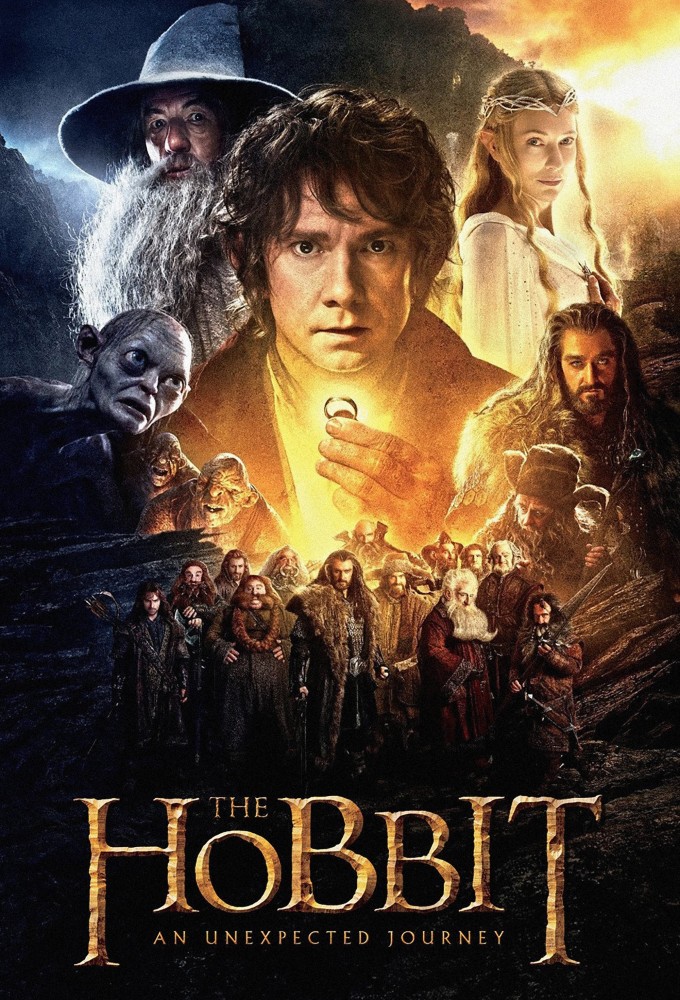
The Hobbit: An Unexpected Journey
- Directed by
- Peter Jackson
- Runtime
- 169 min
- Studio
- New Line Cinema, Metro-Goldwyn-Mayer, WingNut Films
227 archived facts 8 topics 1 source Last reviewed Sep 2026
Bilbo Baggins, a hobbit enjoying his quiet life, is swept into an epic quest by Gandalf the Grey and thirteen dwarves who seek to reclaim their mountain home from Smaug, the dragon.
Summary: TMDB
181 Interesting Facts About The Hobbit: An Unexpected Journey
- #001
When asked how many wizards there are, Gandalf says there are five, naming Saruman, Radagast and himself, then says he cannot remember the names of the other two and calls them only "The two blues." Their names, Alatar and Pallando, appear in Unfinished Tales, a collection of J. R. R. Tolkien's ideas and semi-manuscripts that his son Christopher Tolkien turned into a book. The producers did not have the rights to use material from that book, so the names of the two blue wizards are not revealed in this film.
- #002
Gollum appears in only one scene in the book. Andy Serkis completed that scene in the first week of production but stayed on as second unit director. He oversaw most of the landscape shots, the wide driving shots and the coverage of the secondary dwarf characters.
- #005
Viggo Mortensen refused to reprise the role of Aragorn, arguing that Aragorn does not appear in the book. Aragorn is briefly mentioned in The Hobbit: The Battle of the Five Armies (2014).
- #006
In the first scene of Smaug's attack on Erebor, the first roar we hear from Smaug is actually a recording of the seven-year-old daughter of the special effects supervisor. It was manipulated and edited to sound like a dragon and placed in the film.
- #009
Sir Ian McKellen admitted that he was so miserable at having to perform in tedious visual effects shots at first that he seriously considered suggesting Sir John Hurt in his place. Hurt had previously voiced Aragorn in The Lord of the Rings (1978).
- #010
When Sir Peter Jackson called Sir Christopher Lee to invite him to the premiere of The Hobbit: An Unexpected Journey (2012), Lee responded frighteningly, "Am I still in the movie?" Lee claims he was originally planned to appear in The Lord of the Rings: The Return of the King (2003), but his scenes were cut from the theatrical release, which led to a brief disagreement between the actor and the director. However, the scenes were restored in the extended edition.
- #012
Sir Peter Jackson cast Aidan Turner as Kili after watching him in Being Human (2008). Turner left the series in order to take part in The Hobbit trilogy.
- #013
Sir Ian Holm and Sir Christopher Lee shot their scenes at Pinewood Studios in London because health problems made flying to New Zealand difficult for them.
- #014
Contains a major spoiler — show
While filming the Battle of Azanulbizar, Richard Armitage struck his face so hard with his shield that he managed to bite clean through his lower lip. The injury is visible in the finished film. When Azog raises Thror's severed head and Thorin screams, the left side of his lower lip swells and a pool of blood forms between his gums and his lip.
- #015
Aidan Turner (Kili) is the only Dwarf actor to wear his own real beard. All twelve of the others have fake beards (or other kinds of fake facial hair).
- #017
The method for creating Hobbit feet was changed for this film. In The Lord of the Rings trilogy, the prosthetic feet only sat on top of the actors' and actresses' feet and had to be reapplied after they had walked for certain periods. In this film, the prosthetics extended up to their knees (Martin Freeman, Sir Ian Holm and Elijah Wood).
- #018
Sir Christopher Lee loved telling stories to the production crew while filming his role, so much so that production slowed down that day.
- #020
The ghost that attacks Radagast at Dol Guldur is the Witch-king of Angmar, who stabbed Frodo at Weathertop in The Lord of the Rings: The Fellowship of the Ring (2001). The Necromancer that Radagast detects is the first sign of Sauron's reappearance in Middle-earth.
- #021
Dwalin wields two large battle axes in combat. Graham McTavish suggested to Sir Peter Jackson that the axes be named after Emily Brontë's dogs, "Grasper" and "Keeper". Jackson adopted the idea, and both names were engraved on Dwalin's axes in Dwarvish runes. He also named his maces "Insult" and "Injury".
- #022
Some chapter titles from the book, such as "a merry gathering", "out of the frying pan and into the fire" and "roast mutton", are mentioned in the dialogue.
- #023
Contrary to popular belief, Cate Blanchett was not placed on a rotating platform to create the delicate turn in her entrance. She turned her body without the aid of any support.
- #026
Stephen Hunter (Bombur) caught the egg thrown into his mouth on the first take but failed to catch it in subsequent takes. The take used was therefore the first one.
- #028
According to Sir Peter Jackson, the Goblin Town scene was initially conceived as much bloodier, particularly regarding the removal of the Goblin King's stomach, but the PG-13 rating overruled those plans.
- #030
This is the first Middle-earth film in J. R. R. Tolkien's works, directed by Sir Peter Jackson, in which no characters of the race of Men speak. Some Men appear in the flashback of the opening but do not speak. Although they may appear to be, wizards are not exactly Men.
- #031
There was never any doubt that Sir Ian McKellen would reprise the role of Gandalf. Sir Peter Jackson told him: "You must play Gandalf, whether I direct it or not."
- #032
Richard Armitage said his first experience of acting on stage was playing an elf in a theatrical production of The Hobbit.
- #033
When Gandalf, Bilbo and the Dwarves arrive at Rivendell, the Wizard mentions that it is also known as "Imladris." The name is a word in Elvish (a fictional language created by J. R. R. Tolkien), and both names mean "deep valley of the cleft." Rivendell was founded and ruled by Elrond in the Second Age of Middle-earth, roughly four or five thousand years before the events of The Lord of the Rings.
- #035
The Dwarves were designed by J. R. R. Tolkien; their language sounds like a Semitic language, and the history of the Dwarves resembles the history of the ancient Hebrews.
- #036
Frodo (Elijah Wood), Saruman (Sir Christopher Lee), Galadriel (Cate Blanchett) and Legolas (Orlando Bloom) are characters returning from The Lord of the Rings trilogy, yet none of them appeared in the book The Hobbit. The same is true of Radagast (Sylvester McCoy), who is only mentioned in The Hobbit but does not appear until The Lord of the Rings. Conversely, Radagast was cut from The Lord of the Rings trilogy.
- #037
Richard Armitage's (Thorin Oakenshield's) wig was the only one among the Dwarf wigs made entirely from human hair.
- #038
Azog was a digital addition made to the film at the last minute. He was originally a prosthetic actor, but Sir Peter Jackson felt the effect lacked presence and had Weta create a motion-capture digital character performed by Manu Bennett, placing the character over previously filmed live-action footage of Azog. The original Azog appears in the film as the ill-fated Orc Lieutenant Yazneg.
- #042
The thirteen Dwarves were designed with unique silhouettes so that each Dwarf could be recognized by body outline even in the dark or from a distance.
- #043
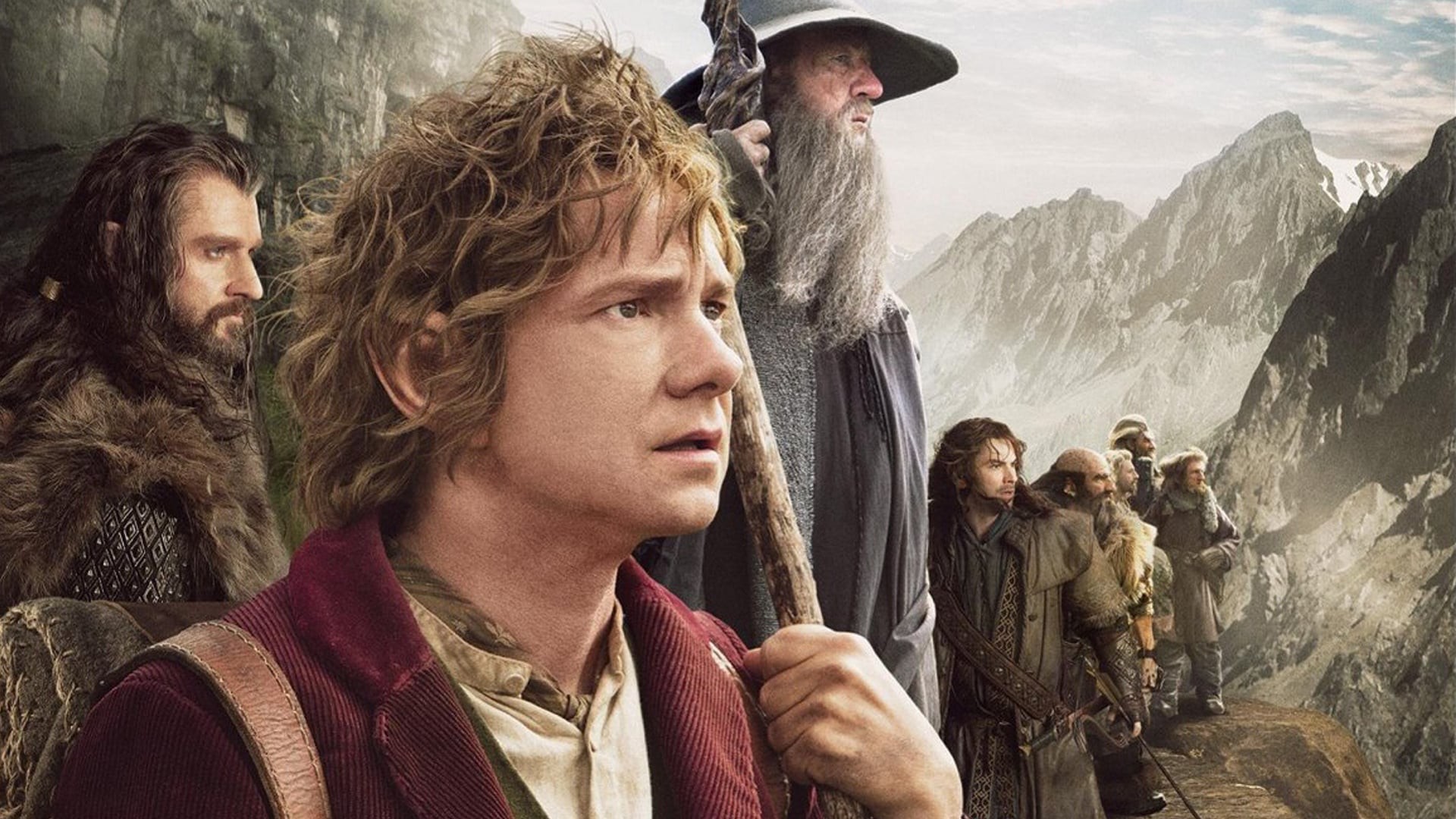
When Bilbo, Gandalf and the Dwarves reach the edge of the cliff just before the struggle against Azog and his Orcs, a familiar landscape can be seen in the distance. It is the same landscape Merry, Pippin and Treebeard see in The Lord of the Rings: The Two Towers (2002) as Saruman's Uruk-hai armies march toward Helm's Deep.
- #044
There are no curves or circles in Dwarven architecture, and most objects of Dwarven origin are polygonal. This is also clearly visible in the Dwarven writing that appears on the map of the Lonely Mountain.
- #045
Despite Bombur having only one line and Bifur being able to speak only Khuzdul, Stephen Hunter and William Kircher learned to speak in a Northern Irish accent to match James Nesbitt's natural accent.
- #046
The film went through various stages of pre-production hell, including separate legal disputes between New Line Cinema, Sir Peter Jackson and members of the Tolkien family that complicated the production. When MGM finally moved the project forward in 2008, further problems arose when MGM went bankrupt and froze production, causing director Guillermo del Toro to resign after three years of pre-production. Later, the project was nearly driven out of New Zealand when several unions and guilds blacklisted it, and shooting was delayed again while Peter Jackson recovered from surgery for a perforated ulcer.
- #048
When Bilbo points his sword at Gollum and Gollum stares at it and recoils in fear, it is a callback to the scene in The Lord of the Rings: The Two Towers (2002) in which Frodo (Elijah Wood) threatens Gollum with the same sword his uncle once used and says: "This is Sting. You've seen it before, haven't you?"
- #049
In the second trailer Gandalf can be heard saying: "Home is behind you, the world ahead." This is a quotation from the original The Lord of the Rings written by J. R. R. Tolkien; it is part of a poem Bilbo says as he leaves the Shire. In the films, however, it is a line Pippin says to Lord Denethor in The Lord of the Rings: The Return of the King (2003).
- #050
John Rhys-Davies refused to play the role of Gimli again because he did not want to go through the makeup process once more, which had given him constant skin problems.
- #051
Elrond's explanation of Orcrist and Glamdring, the swords found by Gandalf and Thorin in the troll cave, is suddenly interrupted by a dialogue between Bilbo and Balin. Orcrist and Glamdring were forged in the First Age of Middle-earth for Ecthelion and King Turgon respectively, to fight the orcs of Morgoth (a stronger, original Dark Lord before Sauron).
- #053
Like the previous adaptation, The Hobbit (1977), the Trolls in this film are played by actors who portray members of the Dwarves' company.
- #055
The meeting between the Orcs and Azog takes place at Weathertop, the place where Frodo, Sam, Merry and Pippin are attacked by the Nazgûl in The Lord of the Rings: The Fellowship of the Ring (2001).
- #058
The Trolls were voiced and performed through motion capture by three Dwarf actors: Peter Hambleton (Glóin), Mark Hadlow (Dori) and William Kircher (Bifur).
- #059
This film is the first cinema film shot and projected at forty-eight frames per second, twice as fast as the industry standard of twenty-four frames per second. The aim was to give the film smoother, more realistic motion with less flicker. The higher frame rate is especially useful when watching the film in 3D, as it helps the images sync correctly for each eye. There was debate about the frame rate; many viewers complained about poor quality in certain cinemas because of unsuitable equipment and inexperienced projectionists who did not know how to make the correct adjustments.
- #061
Sir Christopher Lee (Saruman) once said he very much wanted to voice the dragon Smaug in the film adaptation of "The Hobbit". Instead, he voiced the dragon-like Jabberwocky in Alice in Wonderland (2010).
- #062
This film was shot simultaneously with The Hobbit: The Desolation of Smaug (2013) and The Hobbit: The Battle of the Five Armies (2014), and was completed on 6 July 2012 after two hundred and sixty-six days of principal photography.
- #063
Contains a major spoiler — show
The scene with the Three Mountain Trolls is the only scene in the entire Middle-earth film saga in which the Trolls not only speak an intelligible language and show some intelligence but also have real names (Tom, William and Bert, their names in J. R. R. Tolkien's book The Hobbit). Most of the time, Trolls (most notably the Cave Troll in the Balin's Tomb sequence in The Lord of the Rings: The Fellowship of the Ring (2001)) are depicted as dumb brutes with no language skills, used primarily by Sauron's forces as Berserker-like soldiers or cheap slave labor (as in the Black Gate sequence in The Lord of the Rings: The Two Towers (2002)). However, the fact that the cave trolls seen in The Lord of the Rings are under Sauron's control may explain their silence and behavior.
- #064
It was released in the same year as the novel's 75th anniversary.
- #065
In 2008, New Line Cinema and Warner Bros. refused to pay money owed to Tolkien (including funds from The Lord of the Rings). This was followed by a dispute lasting two and a half years, which not only put the film into development limbo but also caused Guillermo del Toro to leave the production. Worse still, the legal problems would have caused the production to move entirely outside New Zealand. However, a deal was reached when Sir Peter Jackson decided to return as director in late 2009.
- #066
In The Lord of the Rings: The Fellowship of the Ring (2001), while Gandalf is at Bag End, Bilbo offers him Winyard wine but he asks for tea instead. In this film, Gandalf is offered tea (by Dori) but asks for wine instead.
- #067
Much of the story material in this film and the second film is taken not from the original novel 'The Hobbit' but from the Appendices added to the novel 'The Return of the King' and to 'Unfinished Tales of Númenor and Middle-earth' (particularly a chapter titled The Quest of Erebor). In it, Frodo asks Gandalf to explain why he arranged the Dwarves' quest when he was sent to Middle-earth to defeat Sauron. The reasons Gandalf gives are also connected to this, including Gandalf's meeting with Thorin at The Prancing Pony (an event that takes place in The Hobbit: The Desolation of Smaug (2013)) and Gandalf's fear that Sauron would form an alliance with Smaug to help Smaug enforce his own rule. Galadriel and Saruman are not specifically mentioned in this chapter or in the book, but as stated in the Appendices they are members of the White Council. Radagast is never stated to have been a member of the Council, but as shown in the film, in the books his home is located in Rhosgobel, near Dol Guldur in Mirkwood.
- #069
Apart from Bilbo's sword Sting, the elf swords do not glow blue in the presence of goblins and orcs. This was done because it was not done in The Lord of the Rings, but also because in tests the swords looked too much like lightsabers.
- #071
The voice of the sick hedgehog "Sebastian" was provided by a hedgehog named "Teddy Bear" from Zooniversity in Texas.
- #072
Bret McKenzie (Lindir) had previously appeared as a different elf character in The Lord of the Rings: The Fellowship of the Ring (2001) and The Lord of the Rings: The Return of the King (2003). His character in the Lord of the Rings films was never officially named during production, but fans unofficially dubbed him "Figwit" (from "Frodo is great… who is THAT?!?"), and Sir Peter Jackson accepted the use of the name.
- #073
While an entire scene in the film is devoted to the stone giants, the book describes them in only a single sentence.
- #074
Robert Kazinsky was cast as Fili and had shot several scenes, but for personal reasons he left the project about a month after filming began and returned to England. He was replaced by Dean O'Gorman.
- #075
Philippa Boyens expressed her regret that Guillermo del Toro's version of the film was not made. She explained that it would have had a different script and visual elements and would have resembled a fairy tale more closely. Boyens stated that the most significant script change was in Bilbo's characterization: "Instead of being a little younger and more innocent in the world, he once longed for adventure, lost that, and became a fussy and grumpy person, and changed."
- #076
As seen in the film, the original version of the film had no prologue. However, Peter Jackson decided to add one not only to show dwarven history but also to use Ian Holm as the older Bilbo (Martin Freeman), so that those who had not read the books would know this was a prequel to The Lord of the Rings.
- #077
When the book was first published in 1937, the only cast members then alive were Sir Christopher Lee, Sir Ian Holm and Barry Humphries. Sir Ian McKellen was born two years later, in 1939.
- #078
Except for Den Hannah, who played Old Took in this film, every cast member (including extras) wore a wig.
- #079
When Bilbo asks him "What have you lost?", Gollum cries out in distress over losing the One Ring, "Mustn't ask us! Not its business!" These were the same words he used in The Lord of the Rings: The Two Towers (2002) when Frodo asked him about his past.
- #080
The project was delayed several times due to various rights issues and internal struggles, which led intended director Guillermo del Toro to leave after 18 months of pre-production. Producer Sir Peter Jackson had initially planned to make Mortal Engines (2018), but since hiring del Toro had been his idea and bringing in a new, unprepared director would have been risky, he felt responsible for stepping in himself and finishing the project. Given the amount of money already spent, the studio granted him and Weta only six additional months of pre-production. Jackson had to begin shooting relatively unprepared, without his usual heavy reliance on storyboards, animatics, pre-visualizations and so on, while also battling a stomach ulcer. Another obstacle was that two films had originally been planned and shot. After principal photography, it was decided to restructure the footage from the first two films into a trilogy by adding a third film that required additional writing and shooting. Much of the material filmed during 10 weeks of additional shooting was adapted from the Appendices of The Return of the King novel, expanding the history of Middle-earth.
- #081
One of the dwarves tells Bilbo that his sword is "more of a letter opener." One of the products sold in connection with this film is in fact a letter opener modeled after Sting.
- #082
At least three of the dwarves' appearances in the film turned out quite differently from what the production team initially planned. At first Thorin had a very long beard (as in the book), and Kili and Bofur had more prosthetics on their heads. The producers decided Thorin's beard had to be trimmed so Richard Armitage could better show his emotions, and they wanted James Nesbitt's and Aidan Turner's faces to be more recognizable. The in-story explanation for why Thorin's beard is kept short is that he has been in mourning since the loss of Erebor and plans to regrow his beard after reclaiming the kingdom.
- #083
Contains a major spoiler — show
When Gandalf tells Bilbo that true courage is knowing when to spare a life, the music is a variation of the score heard in Moria, where Gandalf and Frodo discuss the incident in which Bilbo spared Gollum's life and Bilbo applied Gandalf's advice, and it reappears at that moment in An Unexpected Journey. From The Fellowship of the Ring: Frodo: It's a pity Bilbo didn't kill him when he had the chance. Gandalf: Pity? It was pity that stayed Bilbo's hand. Bilbo's sparing of Gollum's life is of course the Call for Frodo to do the same at Emyn Muil. This is a critical part of the story, as it sets off a chain of events that allows the One Ring to be destroyed.
- #085
The subtitle "An Unexpected Journey" does not appear until thirteen minutes into the film.
- #086
When Bilbo falls into the Goblin tunnels, after escaping from Gollum, he catches the Ring on his finger just as Frodo catches it at The Prancing Pony in The Lord of the Rings: The Fellowship of the Ring (2001).
- #087
This is not the first of Sir Peter Jackson's pet projects that he wanted Guillermo del Toro to direct. Del Toro was also offered the troubled Halo film, but he turned down the offer to direct his own pet project, Hellboy II: The Golden Army (2008). Del Toro accepted the chance to direct this film, but after being stuck in pre-production limbo for years, he left to move on to other projects.
- #088
WILHELM SCREAM: As the group struggles to get out of the Goblin Town, I heard it from one of the goblins falling from the walkway.
- #089
During the confrontation on the cliff, Sir Peter Jackson chose to have two dwarves dangling from Gandalf's staff at the tip of the tree to explain why Thorin (and eventually Bilbo) would not simply step forward and send Azog away instead of allowing him to face such danger. Originally, the eagles appeared in this scene when Thorin was struck down. Jackson added that Bilbo comes to Thorin's aid to continue his heroic journey of proving himself, the most important theme of this first Hobbit film.
- #090
The film was shot with thirty Red Epic cameras, the newest model of the Red Camera available at the time.
- #091
This is the only film in the trilogy, or in the entire Middle-earth saga, in which Legolas (Orlando Bloom) does not appear.
- #093
Guillermo del Toro's intended cast included Brian Blessed as Thorin, Doug Jones as Thranduil, Ian McShane in an unspecified Dwarf role (Del Toro described him as "the perfect Dwarf"), and Ron Perlman as Beorn.
- #094
Bag End in the Shire was rebuilt at the same spot as in The Lord of the Rings films, but with permanent materials so it could become a tourist attraction after the film's production.
- #095
The Lord of the Rings films grew longer as the series went on (two hours fifty-eight minutes, two hours fifty-nine minutes and three hours twenty-one minutes respectively). Conversely, the Hobbit films grew shorter as they went on (two hours forty-nine minutes, two hours forty-one minutes and two hours twenty-four minutes respectively). [These times do not take the Extended Editions into account.].
- #097
Sir Peter Jackson joked about the commentary: "If the eagles had flown Bilbo to Mount Doom and he dropped the ring into Mount Doom right now, it would have been a really good idea and an incredible cost-saving measure, you know? It would have saved everybody a lot of work."
- #098
Richard Armitage said: "One of the most beautiful memories I have is Peter Jackson blessing the new sound stage with a Maori Haka on the first day of shooting. I had to speak Maori to the crew because they saw my character as the King of the Dwarves. So they asked me to give this speech in Maori, and the door was raised and the sun was rising off the ground and it was incredibly impressive. It was a truly special moment."
- #099
This film marks the first time female dwarves are shown with beards.
- #100
Most of the wide shots of Gandalf alongside Bilbo and the dwarves were filmed either using forced perspective or by rotoscoping Gandalf out, enlarging him and placing him back into the frame so that both would appear in frame. This allowed all the lighting to match.
- #101
The Morgul blade that Radagast takes from the Witch-king's hand at Dol Guldur is the same blade that stabs Frodo in The Lord of the Rings.
- #104
The film ends with a close-up of Smaug's eye, which looks very similar to Sauron's eye in The Lord of the Rings trilogy.
- #105
It grossed more than The Lord of the Rings: The Fellowship of the Ring (2001) and The Lord of the Rings: The Two Towers (2002).
- #106
The 3D IMAX prints consisted of ninety-eight reels (forty-nine per eye), and the total film length was more than twenty-one miles.
- #109
The three trolls turn to stone in the same positions in which we see them during The Fellowship of the Ring. It is funny because they are visibly arguing, with one pointing downward (clearly the dwarves they are discussing eating). This made sense because that is how the scene happens in the book. Here the scene plays out differently (since Gandalf does not turn them against each other), but even so, when they turn to stone their poses change so that they are looking at each other, and one points downward with his index finger.
- #110
It was decided to use CGI for Azog, Bolg and the orcs, and Bolg was decided upon so suddenly that all the scenes had to be reshot, so in the trailers the one chasing the dwarves was Azog, but in the film it was Bolg.
- #111
It is the first of Sir Peter Jackson's Middle-earth films not to include the film's subtitle in a line of dialogue.
- #112
Contains a major spoiler — show
The White Council convenes in the film while Gandalf, Bilbo and the dwarves are staying with the Elves at Rivendell. In the book, this event takes place later, concurrently with the events seen in The Hobbit: The Desolation of Smaug (2013) after Gandalf leaves the dwarves in Mirkwood. The meeting itself is not shown but is later mentioned by Gandalf toward the end of the book.
- #113
Jed Brophy appears in this film as Nori. His son Sadwyn Brophy appeared as Eldarion in The Lord of the Rings: The Return of the King (2003). Jed also appeared as various orcs in The Lord of the Rings: The Two Towers (2002) and The Lord of the Rings: The Return of the King (2003).
- #114
Bilbo finds the rumors that he has "tunnels full of gold" absurd because his only chest "still smells of troll." Glóin, Nori and Bofur are shown burying a treasure chest taken from the troll hoard.
- #115
Martin Freeman had to shave his legs so that putting on and taking off Bilbo's prosthetic feet would be less uncomfortable.
- #117
Despite the quote "Out of the frying pan and into the fire," if you look closely at the climate order, you can see that the area is shaped to resemble a frying pan and that the tree hanging over the cliff's edge resembles a handle.
- #119
In a 2011 Total Film interview, Richard Armitage said: "The Hobbit was one of those books that got me into reading. It fired up my imagination. That's why I became an actor."
- #120
Contains a major spoiler — show
The musical cue in the scene where Bilbo finds the One Ring is the same as the corresponding scene in the prologue of The Lord of the Rings: The Fellowship of the Ring (2001). Because the Ring behaves strangely when dropped, it appears far heavier than it should be (a memorable effect achieved with magnets in the LOTR films). Although Gandalf notices how Bilbo slips the ring into his pocket and even senses something malicious about it, he does not yet understand its true nature and does not immediately panic. The Fellowship of the Ring had explained that, besides the One Ring, 19 other Great Rings were made for Elves, Dwarves and Men. Gandalf may always have assumed that Bilbo had found one of the unspecified Dwarf rings; only after a long investigation did Gandalf finally realize it was Sauron's One Ring.
- #121
The last shot completed by WETA Digital was Smaug awakening beneath the gold coins. Filming was completed one day before the New Zealand premiere.
- #122
Although Sir Peter Jackson preferred to shoot at his own studios on Stone Street, The Hobbit was nearly filmed in the United Kingdom, until the New Zealand government stepped in with financial incentives to keep him at home.
- #123
Contains a major spoiler — show
Irritated by Thorin's refusal to trust Elrond, Gandalf murmurs that Thorin's pride will be his downfall. The Battle of the Five Armies, in which Thorin dies, is a direct result of his pride and greed.
- #124
This is the second "prequel trilogy" to involve Richard Armitage and Sir Christopher Lee. Armitage appeared in Star Wars: Episode I - The Phantom Menace (1999), while Lee appeared in Star Wars: Episode II - Attack of the Clones (2002) and Star Wars: Episode III - Revenge of the Sith (2005).
- #125
Gollum cries three times in this film. The first is when he loses the riddle game, as Bilbo says, "Two guesses at once, wrong both times." Gollum groans in defeat as he falls onto his side. The second is when he realizes he has lost the One Ring and wails, "My precious is lost!" When Bilbo asks him what he has lost, Gollum turns toward him for a moment, his eyes red from crying. His third and final cry in the film comes when the invisible Bilbo, wearing the ring, is about to kill him and Gollum sheds tears. This is the only film that shows Gollum crying.
- #126
When they fall into the secret passage to Rivendell, Thorin pulls an arrow from the dead orc pursuing them, looks at it and says, "Elves." Similarly, when the Fellowship enters Moria, Legolas pulls an arrow from a Dwarf corpse, examines it and announces "Goblins."
- #128
Although Balin (Ken Stott) is portrayed as one of the oldest dwarves in Middle-earth lore, Balin was 17 years younger than Thorin. In the film Balin and Thorin are middle-aged when Smaug attacks Erebor, whereas in the books they should have been between 7 and 24 years old. The Hobbit novel begins 171 years after Smaug's attack, making them 177 and 195 years old respectively. The film does not explicitly state how much time has passed since Smaug's invasion and the start of the film, noting only that the dragon has not been seen for 60 years.
- #129
Contains a major spoiler — show
The answers to the riddles proposed by Gollum and Bilbo, including the first riddle Gollum says after the game, are: 1. mountain; 2. teeth; 3. wind; 4. eggs; 5. time; 6. the One Ring.
- #130
Contains a major spoiler — show
In J. R. R. Tolkien's original book and in the animated film, Smaug attacks Erebor/the Lonely Mountain at night. Although the film's opening narration by Bilbo and the song he sings in his home say the same thing, in this film's opening prologue Smaug's attack on Erebor and the nearby town of Dale is clearly in daylight.
- #131
The trolls who steal the horses and are eventually turned to stone appear as statues in The Fellowship of the Ring (2001). Their voices are provided by three dwarves (Will Kircher, Mark Hadlow and Peter Hambleton), who also did motion-capture performances for them.
- #132
The scene of Azog in the mountains while the dwarves are in Rivendell was added during reshoots to maintain dramatic tension and remind the audience that there is a villain in the film.
- #133
The first scene shot during the 266-day filming schedule was Bilbo waking up in Gollum's cave. The last scene was after the eagles leave the dwarves on the mountain top with Erebor in the distance.
- #134
After seeing Glamdring and Orcrist, Bilbo wonders whether his own elf sword has a name, and Balin tells him that swords are named after what they do. It takes the name "Sting" from killing the spiders in Mirkwood.
- #135
In the extended edition, Kíli takes an interest in the elves at Rivendell. Later, after arriving in Mirkwood, he falls in love with Tauriel.
- #136
J. R. R. Tolkien mentions the two Blue Wizards in some of his expanded works, but the production cannot refer to them because Warner Bros. holds the rights only to The Hobbit and The Lord of the Rings.
- #137
Saruman makes disparaging remarks about Radagast's fondness for mushrooms, much like his comment about Gandalf's "love of the halflings' leaf" in The Fellowship of the Ring.
- #138
Contains a major spoiler — show
Thorin's father Thráin was lost during the battle of Azanulbizar against Azog's army, but his death was never confirmed, and Azog mentions having encountered him. In the books, Thráin continued to live with his people after the battle but disappeared 46 years later (nearly 100 years before the start of The Hobbit novel) during an attempt to retake Erebor. Gandalf found Thráin five years later in Dol Guldur, where he had been captured, tortured and driven mad. These events are touched upon in The Hobbit: The Desolation of Smaug (2013).
- #139
The trumpet sound of the elf riders is the same as the trumpet Haldir's reinforcements use at the Battle of Helm's Deep.
- #140
The dwarves singing around the fire were filmed in slow motion, which meant they had to perform the song faster during shooting, and according to Sir Peter Jackson the song sounded "a bit chipmunky." This allowed them to slow the song down in the final version to achieve the slow motion while still having the song sound right.
- #141
After the dwarves light the campfire in Rivendell, Bofur roasts a sausage over the fire. Bifur beside him does the same, but instead of a sausage Bifur tries to roast a large piece of lettuce. Later, when Bofur throws the sausage to Bombur and causes Bombur's table to collapse, all the dwarves double over with laughter except Bifur, who focuses on the piece of lettuce as if determined to roast it thoroughly.
- #142
An earthquake occurred at the moment the commentary was being recorded, seconds before Smaug's first appearance on screen.
- #143
Saoirse Ronan was considered for the role of a young elf but left the project due to scheduling conflicts and the long production schedule.
- #144
Contains a major spoiler — show
Across the entire trilogy, the only scene in which Bilbo and Azog interact directly with each other is after Thorin's attempt to kill Azog on the cliff outside the Goblin Kingdom, when Azog knocks him out and tries to behead him and Bilbo stops Azog's lieutenant from doing so.
- #145
The rock on which the eagles leave the dwarves is shaped like a bear's head. It is called the Carrock, and it is where they will meet the skin-changer Beorn.
- #146
Children in the city of Dale appear during the prologue.
- #147
Martin Freeman appeared in Hot Fuzz (2007), in which Sir Peter Jackson played "Santa Claus, a. K. A. Father Christmas", Cate Blanchett (Galadriel) played a CSI, and Bill Nighy (who played Samwise Gamgee on BBC Radio) played a police officer. Freeman also appeared alongside Nighy in Shaun of the Dead (2004) and alongside Penelope Wilton, who was married to the previous Bilbo, Sir Ian Holm.
- #149
During the prologue of the film's Extended Edition, a close look reveals that Thror's throne in Erebor was built from the rock of the mountain, with natural veins of gold running through it.
- #150
This film used a shooting and projection frame rate of forty-eight frames per second, making it the first widely released motion picture to do so. The new projection rate was publicized as "High Frame Rate". However, the majority of cinemas projected the film at the industry-standard twenty-four frames per second after it was converted.
- #153
Gandalf counts the Dwarves three times: at Bilbo's house; when they arrive at the Hidden Valley (just before reaching Rivendell); and when they leave the Goblin King's cave.
- #154
Elrond helps Thorin read the secret runes on the map that are visible only by moonlight. In the next film, it is not the setting sun but the light of the moon, which becomes "the last light" on Durin's Day, that reveals the secret door. While reading the moon runes on the map, Elrond mentions a door that appears "when the thrush knocks". In the final scene, the camera follows a thrush flying toward Erebor, which then begins striking snails against a rock. The noise wakes Smaug. The rock on which the thrush lands is almost certainly the secret entrance, and the thrush itself plays a part in helping Bilbo find the keyhole and in Bard killing Smaug.
- #156
The Weinsteins reported earning 20 million dollars from the first film.
- #157
Most of the additional footage in the extended cut consists of longer versions of various scenes. In particular, more time is devoted at the beginning of the film to the white jewels rejected by the elves and to Bilbo's eventual sight of an image of Sauron wearing the ring he took from Gollum.
- #158
Martin Freeman was paid 3 million dollars for the first film.
- #159
Sir Ian McKellen was paid 9 million dollars for the trilogy.
- #160
Three of the actors in this film portrayed enemies of the comic-book hero Captain America: * Sir Christopher Lee (Saruman) played General Miguel in Captain America II: Death Too Soon (1979). * Hugo Weaving (Elrond) played the Red Skull in Captain America: The First Avenger (2011). * Richard Armitage (Thorin Oakenshield) played the assassin Heinz Kruger alongside Weaving in the same film. Martin Freeman also appeared in Captain America: Civil War (2016).
- #162
The ring is placed on Bilbo's finger just as it is (or will be) on Frodo's. Gandalf has trouble with the chandelier, just as in The Fellowship of the Ring.
- #163
After Bilbo beats Gollum in the riddle game and Gollum is upset, Bilbo goes to reach for the ring and realizes it is not there. This sets off a chain of events that leads to Bilbo's escape. Gollum intended to use the ring to become invisible and then attack and eat Bilbo.
- #164
Gandalf lights his pipe with the Flickering Flame and later uses the same effect to set pine cones on fire and hurl them at the wargs.
- #165
Gandalf sees Bilbo put the ring into his pocket (front left) and begins to know that the ring is the one Bilbo has in The Lord of the Rings. Alternatively, Bilbo hides the ring in the opposite pocket of The Fellowship of the Ring (the right front pocket of his waistcoat).
- #166
Sir Peter Jackson says that, because of limitations with lighting and proximity to the camera, he will probably never again shoot with practical miniatures. He now prefers to use digital miniatures.
- #167
Contains a major spoiler — show
After the encounter with the three trolls, the company of Thorin and Gandalf explores a nearby cave where the trolls hid from sunlight to avoid being turned to stone. Along with the swords Orcrist and Glamdring (and, of course, Sting), they find a great deal of treasure that the Dwarves put in a box and buried as a 'long-term deposit'. Early in the film, while talking with Frodo, Bilbo mentions a chest full of gold coins and that it still smells of troll. Since in the third film of The Hobbit Trilogy Bilbo claims that his share of the Erebor treasure is the Arkenstone he stole from Smaug and that he is therefore not entitled to any other part of the treasure, it can be argued that on the journey back from Erebor to the Shire he stopped at the troll cave and took the chest from his Dwarf companions. So in fact he stole from his friends, or rather committed theft.
- #168
Thomas Robins, who played the character Deagol in The Lord of the Rings: The Return of the King (2003) and also appeared briefly and uncredited as Gollum's Hand in The Lord of the Rings: The Fellowship of the Ring (2001), appeared in this film as Young Thrain. He also took small roles in other Peter Jackson films such as King Kong (2005) and Forgotten Silver (1995).
- #169
Luke Evans (Bard) and Orlando Bloom (Legolas) appeared in The Three Musketeers (2011). Sir Christopher Lee (Saruman) played Comte Rochefort in The Three Musketeers (1973) and The Four Musketeers (1974).
- #170
Before Lee Pace was cast, it was said that David Tennant would play Thranduil.
- #172
When the group is captured in Goblin-town, Óin's Ear Trumpet is crushed and flattened. Later, after they escape, he is still shown using it.
- #174
The return to the Battle of Moria was set in the same location where the Fellowship mourned Gandalf's death in Middle-earth. During this sequence, the Defiler Azog was to be killed and his son Bolg was to pursue Thorin. However, to simplify the story's villain, Azog was kept alive.
- #175
Sir Peter Jackson recalled: "A FedEx delivery guy pulls into my car. I go to the door and I take [the package] from him and he just looks at me. 'Hey there, you're the guy who did Lord of the Rings, right? Lord of the Rings, it was great man, great film.' I said, 'Yes, thank you,' and he turned back to the van, then he stopped and said: 'Oh, they should have made you do those Hobbit films, because they were terrible.' I'm just waiting, rolling my eyes, and I say, 'Yeah, tell me about it, mate.'".
- #176
Gollum says "precious" twelve times in this film.
- #177
Five villains from the Marvel Cinematic Universe appeared in this film: Hugo Weaving, who played Red Skull in Captain America: The First Avenger (2011); Richard Armitage, who played Heinz Kruger in Captain America: The First Avenger (2011); Lee Pace, who played Ronan the Accuser in Guardians of the Galaxy (2014); Andy Serkis, who played Klaw in Avengers: Age of Ultron (2015) and Black Panther (2018); and Cate Blanchett, who played Hela in Thor: Ragnarok (2017).
- #178
At the dinner in Rivendell, Balin dismisses Sting by saying it is not really a sword but more of a letter opener, and that it could be purchased from the Noble Collection website before the film's premiere.
- #179
The fake title used for the film's script was "Little Rivers," inspired by a location shoot in which the Dwarves ride horses.
- #180
Sir Peter Jackson had always planned to use the Goblin Town song in the film's theatrical cut, but because the scene with Gollum and Bilbo ran so long, it ultimately fell victim to the running time as well.
- #182
Martin Freeman, Sir Ian McKellen, Benedict Cumberbatch and Sir Ian Holm all played Shakespeare's Richard III.
- #183
After Gandalf arrives in Goblin Town, none of the Elven swords (Gandalf's, Thorin's or Bilbo's) glow to indicate that goblins are near, as they did in Gollum's cave.
- #184
Neill Blomkamp, Brett Ratner, David Yates and David Dobkin were considered to replace Guillermo del Toro as director.
- #185
Sir Peter Jackson wanted Radagast to be like a hippie wizard.
- #186
Radagast's home comes under attack by giant spiders, foreshadowing the second film, in which the Dwarves encounter spiders in Mirkwood.
- #187
As the Dwarves flee Smaug's attack on Erebor, the Dwarf to Thorin's right runs for his life.
- #188
In J. R. R. Tolkien's original draft of the novel, Gandalf's name was Bladorthin, while Thorin's name was Gandalf.
- #189
Gandalf splitting the rock to defeat the trolls is a callback to what he does to the Balrog in The Fellowship of the Ring. Not to mention that he does it at sunrise. Does "At dawn, look to the east" ring a bell?
- #190
Thrór's Gold Fever serves this purpose, because after the Lonely Mountain is reclaimed from Smaug, Thorin will come down with a similar "ailment," which prevents him from negotiating with the men of Laketown and the Woodland Elves (although interracial tension and having previously been the elves' prisoner probably did not help).
- #191
The Goblin King is played by the drag performer Barry Humphries, known for the character Dame Edna. Hugo Weaving played a drag queen in The Adventures of Priscilla, Queen of the Desert (1994).
- #192
Young Hobbits appear in two long scenes of this film. Samuel appears in the market scene, while Amelia appears in the market and in the return from Old Took's party.
- #193
Fíli and Kíli try to figure out how to work the tap on a beer barrel, then apparently give up and bring the whole barrel.
- #194
In the early stages of writing the novel The Hobbit, J. R. R. Tolkien considered naming the wizard (Gandalf) Thorin. As a reference to this, Peter Jackson wrote a scene in which Bilbo mistakenly calls Gandalf Thorin. The scene was filmed but later deleted because Jackson feared it would confuse audiences.
- #195
During the argument after dinner, Sir Peter Jackson shot the entire scene four or five times from every angle, which meant each camera angle took about an hour.
- #196
The first and only mention of 48 frames per second comes at two hours and twenty minutes into the commentary, when screenwriter and producer Philippa Boyens remarks on how good the Gollum sequence looks at the high frame rate.
- #197
The Goblin King forces Bilbo and the dwarves to listen to his own composition. Martin Freeman had previously appeared in The Hitchhiker's Guide to the Galaxy, known for the Vogons making their prisoners listen to their own terrible poetry.
- #198
Hugo Weaving (Elrond) and Benedict Cumberbatch (Smaug/Necromancer (voice)) worked together in Patrick Melrose (2018) as David Melrose and Patrick Melrose respectively, as they did in The Hobbit: The Battle of the Five Armies (2014).
- #199
When shown on television, with commercial breaks, it is often unclear which version is being shown because of the many variables in how often breaks are taken and how long each break is; this can easily stretch the film's runtime to roughly the equivalent length of the extended version. In fact, many broadcasters never state whether they are showing the original theatrical version of The Hobbit trilogy, the extended versions, or The Lord of the Rings trilogy.
- #200
When Bilbo suggests the trolls skin the dwarves, Thorin shouts and thrashes about furiously with the others (all of them lying on their backs except Fíli, who is desperately trying to turn over).
- #201
In The Lord of the Rings (1978), the role of Elrond was played by André Morell, while in the BBC Radio adaptation the role of Gandalf was played by Michael Hordern. In Sherlock (2010), Martin Freeman plays Dr. Watson, a role Morell played in The Hound of the Baskervilles (1959) and Hordern played in Young Sherlock Holmes (1985).
- #202
Thorin and Gandalf briefly argue about whether to go to Rivendell. Later, as they flee the wargs, Thorin loudly wonders where Gandalf is taking them.
- #203
Sir Ian McKellen and Sylvester McCoy had previously appeared together in King Lear (2008). The role of Lear had previously been played by Sir Michael Hordern, who also played Gandalf in the BBC Radio production of The Lord of the Rings. McCoy's role of the Fool had previously been played by Sir John Hurt, who not only shared the role of the Doctor (aka Doctor Who) with McCoy but also voiced Aragorn in The Lord of the Rings (1978). In the BBC Radio production of The Lord of the Rings, the voice of Radagast was provided by Donald Gee, who played a different role in Doctor Who (1963).
- #204
The dwarves' first appearance on camera was when they showed up on the threshold of Bilbo's door.
- #205
The role of Gandalf had previously been played by John Huston in The Hobbit (1977); his father, Walter Huston, had played Abraham Lincoln in Abraham Lincoln (1930). Lee Pace appeared in this film and in Lincoln (2012), which features a character named "W. N. Bilbo."
- #206
For the third time, actors from two different space-travel franchises played the same Middle-earth character. Ian Holm (Alien) and Martin Freeman (The Hitchhiker's Guide to the Galaxy) both play Bilbo. Brad Dourif appeared in both Alien: Resurrection and Star Trek: Voyager. The role was played on BBC Radio by Paul Brooke, who played the Rancor keeper in Star Wars: Episode VI - Return of the Jedi. In the television adaptation of The Return of the King, Aragorn was voiced by Theodore Bikel, who appeared in Star Trek: The Next Generation. The role had previously been voiced by John Hurt, who appeared in various space-travel-related projects: Alien (alongside Ian Holm), Spaceballs, Contact, Lost in Space and Doctor Who.
- #207
The Riddles in the Dark scene was the first scene Martin Freeman shot for this trilogy. It was also the last scene Sir Ian Holm shot for The Lord of the Rings: The Fellowship of the Ring (2001).
- #208
While filming the "Riddles in the Dark" scene, Martin Freeman accidentally slipped and fell. Andy Serkis stayed in character and asked in Gollum's voice, "Are you all right, precious? Do you want a hand?" Freeman jokingly replied, "It's only my pride."
- #209
While playing Dwalin, Graham McTavish wore prosthetic forearms. He described them as "enormous gloves, I guess, that go to just above the elbow."
- #210
Thranduil's giant elk may have been inspired by the Irish elk (Megaloceros giganteus), a giant deer species that went extinct about 7,700 years ago. Its antlers could span more than 14 feet.
- #211
Aidan Turner wore the fewest prosthetics of all the dwarf actors. The producers tried to give him more, including a bigger nose, a bigger forehead and reshaped eyebrows, but ultimately decided to apply only a small prosthetic to his nose.
- #212
The goblins were initially to be achieved using practical makeup and prosthetics. However, the practical costumes were too hot for the actors and completely blocked their vision, so motion-capture technology was used instead.
- #216
Lee Pace grew up in Houston, Texas, where a Middle-earth-themed restaurant called The Hobbit Cafe is located.
- #217
Graham McTavish had grown a beard while preparing to play Dwalin, but the production team told him to shave it because they planned to use fake beards for the dwarves.
- #218
The prosthetic Stephen Hunter wore on his head while playing Bombur consisted of five pieces and covered his entire head except for his eyes and lips. Between takes, Hunter hid his cell phone in his fake chin.
- #220
Eric Vespe of Ain't It Cool News (also known as Quint) appears as a hobbit who hands bread to Bilbo in the market.
- #222
Sir Ian Holm had previously appeared alongside Christopher Plummer and James Mason in Jesus of Nazareth (1977). Like Cumberbatch and Freeman, Plummer and Mason worked together as Holmes and Watson in Murder by Decree (1979).
- #223
Warner Bros. and MGM had previously handled the joint distribution of certain Turner Entertainment titles.
- #224
The film was released on 14 December 2012, four days before the 10th anniversary of The Lord of the Rings: The Two Towers (2002).
- #225
Lee Pace said of playing Thranduil, "All I do in this movie is sit. I sit on my throne. I sit on my chair in the tent. I sit on my horse."
- #226
This was Adam Brown's (Ori) first film.
- #227
With this film, the Middle-earth series' global box office revenue surpassed 3 billion dollars.
Sources & editorial notes
Reference databases
Sources for the entries on this page
- IMDb IMDb
Information from external sources is independently selected, consolidated and edited by Arka Evren. Sources are listed for verification and further reading. Encyclopedia text is used under its licence (CC BY-SA). How we work