
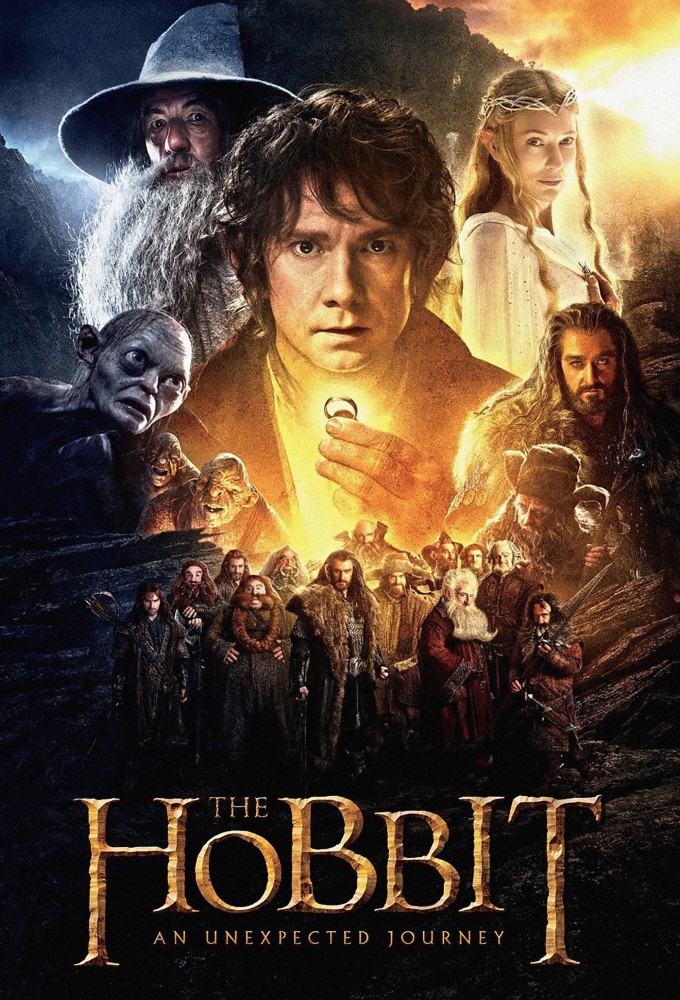
FILM · 2012 · NEW ZEALAND
The Hobbit: An Unexpected Journey
- Directed by
- Peter Jackson
- Runtime
- 169 min
- Studio
- New Line Cinema, Metro-Goldwyn-Mayer, WingNut Films
268 archived facts 7 topics 1 source Last reviewed Nov 2026
Bilbo Baggins, a hobbit enjoying his quiet life, is swept into an epic quest by Gandalf the Grey and thirteen dwarves who seek to reclaim their mountain home from Smaug, the dragon.
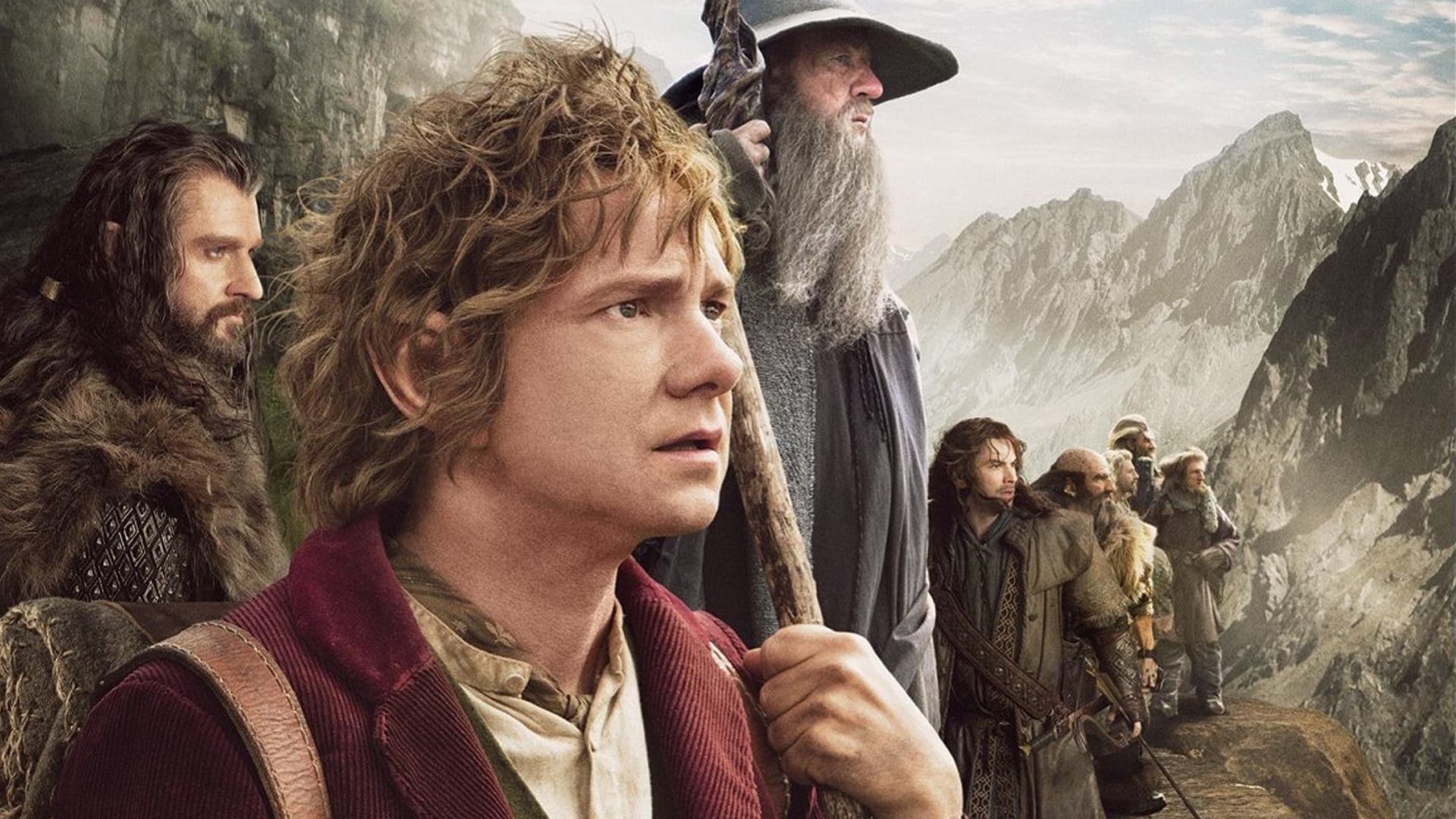
268 Interesting Facts About The Hobbit: An Unexpected Journey
Interesting Facts (111)
- #001
When asked how many wizards there are, Gandalf says there are five, naming Saruman, Radagast and himself, then says he cannot remember the names of the other two and calls them only "The two blues." Their names, Alatar and Pallando, appear in Unfinished Tales, a collection of J. R. R. Tolkien's ideas and semi-manuscripts that his son Christopher Tolkien turned into a book. The producers did not have the rights to use material from that book, so the names of the two blue wizards are not revealed in this film.
- #002
Gollum appears in only one scene in the book. Andy Serkis completed that scene in the first week of production but stayed on as second unit director. He oversaw most of the landscape shots, the wide driving shots and the coverage of the secondary dwarf characters.
- #003
- #004
- #005
When Sir Peter Jackson called Sir Christopher Lee to invite him to the premiere of The Hobbit: An Unexpected Journey (2012), Lee responded frighteningly, "Am I still in the movie?" Lee claims he was originally planned to appear in The Lord of the Rings: The Return of the King (2003), but his scenes were cut from the theatrical release, which led to a brief disagreement between the actor and the director. However, the scenes were restored in the extended edition.
- #006
- #007
Contains a major spoiler — show
While filming the Battle of Azanulbizar, Richard Armitage struck his face so hard with his shield that he managed to bite clean through his lower lip. The injury is visible in the finished film. When Azog raises Thror's severed head and Thorin screams, the left side of his lower lip swells and a pool of blood forms between his gums and his lip.
- #008
The method for creating Hobbit feet was changed for this film. In The Lord of the Rings trilogy, the prosthetic feet only sat on top of the actors' and actresses' feet and had to be reapplied after they had walked for certain periods. In this film, the prosthetics extended up to their knees (Martin Freeman, Sir Ian Holm and Elijah Wood).
- #009
- #010
Dwalin wields two large battle axes in combat. Graham McTavish suggested to Sir Peter Jackson that the axes be named after Emily Brontë's dogs, "Grasper" and "Keeper". Jackson adopted the idea, and both names were engraved on Dwalin's axes in Dwarvish runes. He also named his maces "Insult" and "Injury".
- #011
Contrary to popular belief, Cate Blanchett was not placed on a rotating platform to create the delicate turn in her entrance. She turned her body without the aid of any support.
- #012
- #013
- #014
- #015
- #016
- #017
Azog was a digital addition made to the film at the last minute. He was originally a prosthetic actor, but Sir Peter Jackson felt the effect lacked presence and had Weta create a motion-capture digital character performed by Manu Bennett, placing the character over previously filmed live-action footage of Azog. The original Azog appears in the film as the ill-fated Orc Lieutenant Yazneg.
- #018
- #019
When Bilbo, Gandalf and the Dwarves reach the edge of the cliff just before the struggle against Azog and his Orcs, a familiar landscape can be seen in the distance. It is the same landscape Merry, Pippin and Treebeard see in The Lord of the Rings: The Two Towers (2002) as Saruman's Uruk-hai armies march toward Helm's Deep.
- #020
- #021
- #022
The film went through various stages of pre-production hell, including separate legal disputes between New Line Cinema, Sir Peter Jackson and members of the Tolkien family that complicated the production. When MGM finally moved the project forward in 2008, further problems arose when MGM went bankrupt and froze production, causing director Guillermo del Toro to resign after three years of pre-production. Later, the project was nearly driven out of New Zealand when several unions and guilds blacklisted it, and shooting was delayed again while Peter Jackson recovered from surgery for a perforated ulcer.
- #023
When Bilbo points his sword at Gollum and Gollum stares at it and recoils in fear, it is a callback to the scene in The Lord of the Rings: The Two Towers (2002) in which Frodo (Elijah Wood) threatens Gollum with the same sword his uncle once used and says: "This is Sting. You've seen it before, haven't you?"
- #024
- #025
Elrond's explanation of Orcrist and Glamdring, the swords found by Gandalf and Thorin in the troll cave, is suddenly interrupted by a dialogue between Bilbo and Balin. Orcrist and Glamdring were forged in the First Age of Middle-earth for Ecthelion and King Turgon respectively, to fight the orcs of Morgoth (a stronger, original Dark Lord before Sauron).
- #026
- #027
- #028
- #029
This film is the first cinema film shot and projected at forty-eight frames per second, twice as fast as the industry standard of twenty-four frames per second. The aim was to give the film smoother, more realistic motion with less flicker. The higher frame rate is especially useful when watching the film in 3D, as it helps the images sync correctly for each eye. There was debate about the frame rate; many viewers complained about poor quality in certain cinemas because of unsuitable equipment and inexperienced projectionists who did not know how to make the correct adjustments.
- #030
- #031
Contains a major spoiler — show
The scene with the Three Mountain Trolls is the only scene in the entire Middle-earth film saga in which the Trolls not only speak an intelligible language and show some intelligence but also have real names (Tom, William and Bert, their names in J. R. R. Tolkien's book The Hobbit). Most of the time, Trolls (most notably the Cave Troll in the Balin's Tomb sequence in The Lord of the Rings: The Fellowship of the Ring (2001)) are depicted as dumb brutes with no language skills, used primarily by Sauron's forces as Berserker-like soldiers or cheap slave labor (as in the Black Gate sequence in The Lord of the Rings: The Two Towers (2002)). However, the fact that the cave trolls seen in The Lord of the Rings are under Sauron's control may explain their silence and behavior.
- #032
In 2008, New Line Cinema and Warner Bros. refused to pay money owed to Tolkien (including funds from The Lord of the Rings). This was followed by a dispute lasting two and a half years, which not only put the film into development limbo but also caused Guillermo del Toro to leave the production. Worse still, the legal problems would have caused the production to move entirely outside New Zealand. However, a deal was reached when Sir Peter Jackson decided to return as director in late 2009.
- #033
- #034
- #035
- #036
- #037
Philippa Boyens expressed her regret that Guillermo del Toro's version of the film was not made. She explained that it would have had a different script and visual elements and would have resembled a fairy tale more closely. Boyens stated that the most significant script change was in Bilbo's characterization: "Instead of being a little younger and more innocent in the world, he once longed for adventure, lost that, and became a fussy and grumpy person, and changed."
- #038
As seen in the film, the original version of the film had no prologue. However, Peter Jackson decided to add one not only to show dwarven history but also to use Ian Holm as the older Bilbo (Martin Freeman), so that those who had not read the books would know this was a prequel to The Lord of the Rings.
- #039
- #040
- #041
The project was delayed several times due to various rights issues and internal struggles, which led intended director Guillermo del Toro to leave after 18 months of pre-production. Producer Sir Peter Jackson had initially planned to make Mortal Engines (2018), but since hiring del Toro had been his idea and bringing in a new, unprepared director would have been risky, he felt responsible for stepping in himself and finishing the project. Given the amount of money already spent, the studio granted him and Weta only six additional months of pre-production. Jackson had to begin shooting relatively unprepared, without his usual heavy reliance on storyboards, animatics, pre-visualizations and so on, while also battling a stomach ulcer. Another obstacle was that two films had originally been planned and shot. After principal photography, it was decided to restructure the footage from the first two films into a trilogy by adding a third film that required additional writing and shooting. Much of the material filmed during 10 weeks of additional shooting was adapted from the Appendices of The Return of the King novel, expanding the history of Middle-earth.
- #042
- #043
At least three of the dwarves' appearances in the film turned out quite differently from what the production team initially planned. At first Thorin had a very long beard (as in the book), and Kili and Bofur had more prosthetics on their heads. The producers decided Thorin's beard had to be trimmed so Richard Armitage could better show his emotions, and they wanted James Nesbitt's and Aidan Turner's faces to be more recognizable. The in-story explanation for why Thorin's beard is kept short is that he has been in mourning since the loss of Erebor and plans to regrow his beard after reclaiming the kingdom.
- #044
Contains a major spoiler — show
When Gandalf tells Bilbo that true courage is knowing when to spare a life, the music is a variation of the score heard in Moria, where Gandalf and Frodo discuss the incident in which Bilbo spared Gollum's life and Bilbo applied Gandalf's advice, and it reappears at that moment in An Unexpected Journey. From The Fellowship of the Ring: Frodo: It's a pity Bilbo didn't kill him when he had the chance. Gandalf: Pity? It was pity that stayed Bilbo's hand. Bilbo's sparing of Gollum's life is of course the Call for Frodo to do the same at Emyn Muil. This is a critical part of the story, as it sets off a chain of events that allows the One Ring to be destroyed.
- #045
- #046
- #047
During the confrontation on the cliff, Sir Peter Jackson chose to have two dwarves dangling from Gandalf's staff at the tip of the tree to explain why Thorin (and eventually Bilbo) would not simply step forward and send Azog away instead of allowing him to face such danger. Originally, the eagles appeared in this scene when Thorin was struck down. Jackson added that Bilbo comes to Thorin's aid to continue his heroic journey of proving himself, the most important theme of this first Hobbit film.
- #048
- #049
- #050
Richard Armitage said: "One of the most beautiful memories I have is Peter Jackson blessing the new sound stage with a Maori Haka on the first day of shooting. I had to speak Maori to the crew because they saw my character as the King of the Dwarves. So they asked me to give this speech in Maori, and the door was raised and the sun was rising off the ground and it was incredibly impressive. It was a truly special moment."
- #051
- #052
- #053
- #054
- #055
The three trolls turn to stone in the same positions in which we see them during The Fellowship of the Ring. It is funny because they are visibly arguing, with one pointing downward (clearly the dwarves they are discussing eating). This made sense because that is how the scene happens in the book. Here the scene plays out differently (since Gandalf does not turn them against each other), but even so, when they turn to stone their poses change so that they are looking at each other, and one points downward with his index finger.
- #056
- #057
Contains a major spoiler — show
The White Council convenes in the film while Gandalf, Bilbo and the dwarves are staying with the Elves at Rivendell. In the book, this event takes place later, concurrently with the events seen in The Hobbit: The Desolation of Smaug (2013) after Gandalf leaves the dwarves in Mirkwood. The meeting itself is not shown but is later mentioned by Gandalf toward the end of the book.
- #058
- #059
- #060
Contains a major spoiler — show
The musical cue in the scene where Bilbo finds the One Ring is the same as the corresponding scene in the prologue of The Lord of the Rings: The Fellowship of the Ring (2001). Because the Ring behaves strangely when dropped, it appears far heavier than it should be (a memorable effect achieved with magnets in the LOTR films). Although Gandalf notices how Bilbo slips the ring into his pocket and even senses something malicious about it, he does not yet understand its true nature and does not immediately panic. The Fellowship of the Ring had explained that, besides the One Ring, 19 other Great Rings were made for Elves, Dwarves and Men. Gandalf may always have assumed that Bilbo had found one of the unspecified Dwarf rings; only after a long investigation did Gandalf finally realize it was Sauron's One Ring.
- #061
- #062
- #063
Gollum cries three times in this film. The first is when he loses the riddle game, as Bilbo says, "Two guesses at once, wrong both times." Gollum groans in defeat as he falls onto his side. The second is when he realizes he has lost the One Ring and wails, "My precious is lost!" When Bilbo asks him what he has lost, Gollum turns toward him for a moment, his eyes red from crying. His third and final cry in the film comes when the invisible Bilbo, wearing the ring, is about to kill him and Gollum sheds tears. This is the only film that shows Gollum crying.
- #064
- #065
Contains a major spoiler — show
In J. R. R. Tolkien's original book and in the animated film, Smaug attacks Erebor/the Lonely Mountain at night. Although the film's opening narration by Bilbo and the song he sings in his home say the same thing, in this film's opening prologue Smaug's attack on Erebor and the nearby town of Dale is clearly in daylight.
- #066
- #067
- #068
- #069
- #070
- #071
- #072
Contains a major spoiler — show
Thorin's father Thráin was lost during the battle of Azanulbizar against Azog's army, but his death was never confirmed, and Azog mentions having encountered him. In the books, Thráin continued to live with his people after the battle but disappeared 46 years later (nearly 100 years before the start of The Hobbit novel) during an attempt to retake Erebor. Gandalf found Thráin five years later in Dol Guldur, where he had been captured, tortured and driven mad. These events are touched upon in The Hobbit: The Desolation of Smaug (2013).
- #073
- #074
The dwarves singing around the fire were filmed in slow motion, which meant they had to perform the song faster during shooting, and according to Sir Peter Jackson the song sounded "a bit chipmunky." This allowed them to slow the song down in the final version to achieve the slow motion while still having the song sound right.
- #075
After the dwarves light the campfire in Rivendell, Bofur roasts a sausage over the fire. Bifur beside him does the same, but instead of a sausage Bifur tries to roast a large piece of lettuce. Later, when Bofur throws the sausage to Bombur and causes Bombur's table to collapse, all the dwarves double over with laughter except Bifur, who focuses on the piece of lettuce as if determined to roast it thoroughly.
- #076
- #077
Contains a major spoiler — show
Across the entire trilogy, the only scene in which Bilbo and Azog interact directly with each other is after Thorin's attempt to kill Azog on the cliff outside the Goblin Kingdom, when Azog knocks him out and tries to behead him and Bilbo stops Azog's lieutenant from doing so.
- #078
- #079
- #080
- #081
Elrond helps Thorin read the secret runes on the map that are visible only by moonlight. In the next film, it is not the setting sun but the light of the moon, which becomes "the last light" on Durin's Day, that reveals the secret door. While reading the moon runes on the map, Elrond mentions a door that appears "when the thrush knocks". In the final scene, the camera follows a thrush flying toward Erebor, which then begins striking snails against a rock. The noise wakes Smaug. The rock on which the thrush lands is almost certainly the secret entrance, and the thrush itself plays a part in helping Bilbo find the keyhole and in Bard killing Smaug.
- #082
Most of the additional footage in the extended cut consists of longer versions of various scenes. In particular, more time is devoted at the beginning of the film to the white jewels rejected by the elves and to Bilbo's eventual sight of an image of Sauron wearing the ring he took from Gollum.
- #083
- #084
- #085
- #086
- #087
- #088
Contains a major spoiler — show
After the encounter with the three trolls, the company of Thorin and Gandalf explores a nearby cave where the trolls hid from sunlight to avoid being turned to stone. Along with the swords Orcrist and Glamdring (and, of course, Sting), they find a great deal of treasure that the Dwarves put in a box and buried as a 'long-term deposit'. Early in the film, while talking with Frodo, Bilbo mentions a chest full of gold coins and that it still smells of troll. Since in the third film of The Hobbit Trilogy Bilbo claims that his share of the Erebor treasure is the Arkenstone he stole from Smaug and that he is therefore not entitled to any other part of the treasure, it can be argued that on the journey back from Erebor to the Shire he stopped at the troll cave and took the chest from his Dwarf companions. So in fact he stole from his friends, or rather committed theft.
- #089
- #090
- #091
Sir Peter Jackson recalled: "A FedEx delivery guy pulls into my car. I go to the door and I take [the package] from him and he just looks at me. 'Hey there, you're the guy who did Lord of the Rings, right? Lord of the Rings, it was great man, great film.' I said, 'Yes, thank you,' and he turned back to the van, then he stopped and said: 'Oh, they should have made you do those Hobbit films, because they were terrible.' I'm just waiting, rolling my eyes, and I say, 'Yeah, tell me about it, mate.'".
- #092
- #093
- #094
- #095
- #096
- #097
Thrór's Gold Fever serves this purpose, because after the Lonely Mountain is reclaimed from Smaug, Thorin will come down with a similar "ailment," which prevents him from negotiating with the men of Laketown and the Woodland Elves (although interracial tension and having previously been the elves' prisoner probably did not help).
- #098
- #099
In the early stages of writing the novel The Hobbit, J. R. R. Tolkien considered naming the wizard (Gandalf) Thorin. As a reference to this, Peter Jackson wrote a scene in which Bilbo mistakenly calls Gandalf Thorin. The scene was filmed but later deleted because Jackson feared it would confuse audiences.
- #100
- #101
- #102
- #103
- #104
- #105
- #106
- #107
- #108
- #109
- #110
- #111
Production Story (129)
- #112
In the early stages of writing The Hobbit, J. R. R. Tolkien considered naming the Wizard (Gandalf) Thorin. As a reference to this, Peter Jackson wrote a scene in which Bilbo mistakenly calls Gandalf "Thorin". The scene was shot but later cut because Peter Jackson thought it might look silly in the film and confuse the audience.
- #113
Contains a major spoiler — show
In the film, while Gandalf voices his last doubts about Sauron's return to his fortress at Dol Guldur, Elrond mentions the previous 400 years of "watchful peace" during the White Council. In the Appendices to The Lord of the Rings, it is clear that the Council had long known of this: 900 years before the beginning of the novel The Hobbit, Gandalf had driven Sauron out of Dol Guldur, initiating a period called the 'Watchful Peace' that ended 400 years later when Sauron returned there again; apparently the White Council was unaware of this until 90 years before the beginning of the book. Gandalf did in fact urge the White Council to act against Dol Guldur, but Saruman opposed it, stating that Sauron was not yet strong enough to warrant such a dangerous intervention. The film significantly condenses and simplifies this backstory by skipping the first White Council and having the Watchful Peace end at the beginning of the film.
- #114
- #115
When asked how many wizards there are, Gandalf says there are five; he names Saruman, Radagast and himself, then says he cannot remember the names of the other two and calls them only "The two blues." Their names, Alatar and Pallando, appear in Unfinished Tales, a collection by J. R. R. Tolkien. Tolkien's ideas and half-finished manuscripts were turned into a book by his son, Christopher Tolkien. The producers did not have the rights to use the material in that book, so the names of the two blue wizards are not revealed in this film.
- #116
In The Lord of the Rings trilogy, the illusion of scale was achieved by placing the Hobbit or Dwarf actors farther from the camera than Sir Ian McKellen, though they still lived on the same set. This time, however, the illusion had to be achieved by having the other actors on an entirely different set; McKellen played his role alone on a green-screen set with only an earpiece connecting him to the performances given by the other actors. McKellen felt lonely and frustrated. To cheer him up, cast and crew sneaked into the tent where he stayed during breaks and decorated it with mementos from The Lord of the Rings films (mostly old props and tapestries from Rivendell and Lothlórien) as well as fresh fruit and flowers.
- #117
The production team returned to the same location they had used for Hobbiton in The Lord of the Rings trilogy. The land is part of a farm whose owners allowed The Lord of the Rings production team to turn it into the Hobbiton set in the late 1990s. After filming on the first trilogy was completed, the farm's owners turned the land into a Tolkien tourist destination and ran guided tours of the Hobbiton set. When the team on The Hobbit trilogy made improvements and additions to the weathered Hobbiton set, the farm owners were happy to close their tourism business temporarily so that filming could take place there again.
- #118
- #119
- #120
- #121
Sir Peter Jackson claims that when he called Sir Christopher Lee to invite him to the premiere of The Hobbit: An Unexpected Journey (2012), Lee replied frighteningly, "Am I still in the movie?" Lee had initially been planned to appear in The Lord of the Rings: The Return of the King (2003), but his scenes were cut from the theatrical release, which led to a brief disagreement between the actor and the director. However, the scenes were restored in the extended edition.
- #122
While filming the Battle of Azanulbizar, Richard Armitage struck his face so hard with his shield that he managed to bite clean through his lower lip. The injury is visible in the finished film. When Azog lifts Thror's severed head and Thorin screams, the left side of his lower lip is swollen and a pool of blood forms between his gums and his lip.
- #123
Thranduil, Legolas's father, first appeared in the book The Hobbit only as "The Elven King," and his real name was never mentioned. When Legolas first appears in the book, he is described only in The Lord of the Rings as the Son of Thranduil of Mirkwood. When Legolas enters Lothlórien in The Lord of the Rings: The Fellowship of the Ring (2001), Haldir greets him in Elvish as "Legolas Thranduillion," the Sindarin equivalent of "Legolas, Son of Thranduil."
- #124
The method for creating Hobbit feet was changed for this film. In The Lord of the Rings trilogy, the prosthetic feet only sat on top of the actors' and actresses' feet and had to be reapplied after they had walked for certain periods of time. In this film, the prosthetics extended up to their knees (Martin Freeman, Sir Ian Holm and Elijah Wood).
- #125
Daniel Radcliffe, Shia LaBeouf, Josh Widdicombe, Eddie Redmayne, James McAvoy, Adam Brown (who ultimately played Ori), Erryn Arkin and Tobey Maguire were either considered for or auditioned for the role of Bilbo Baggins. However, Sir Peter Jackson said his first choice was always Martin Freeman. Freeman initially could not accept the role due to scheduling conflicts with Sherlock (2010), but Jackson reworked the entire shooting schedule of the trilogy to accommodate him. Jackson said, "I was having sleepless nights. It was probably six weeks before shooting was to begin and we hadn't been able to decide on anyone else, and at four in the morning I was torturing myself watching Sherlock on the iPad."
- #126
- #127
Dwalin uses two large battle axes in combat. Graham McTavish suggested to Sir Peter Jackson that the axes be named after Emily Brontë's dogs, "Grasper" and "Keeper". Jackson embraced the idea, and both names were engraved in Dwarvish runes on Dwalin's axes. He also named his maces "Insult" and "Injury".
- #128
- #129
- #130
The Goblin killed by Gollum was played by a performer wearing an animatronic head, with prosthetic makeup then applied to the entire body. Andy Serkis was so aggressive when striking its forehead with a stone that the electronic components inside were broken and had to be repaired for reshoots the following day.
- #131
- #132
This is the first Middle-earth film known in J. R. R. Tolkien's works, directed by Sir Peter Jackson, in which there are no characters who speak with people in the role of the "race of Men". Some people appear in the opening flashback but do not speak. Although they may appear to be, wizards are not exactly Men.
- #133
When Gandalf, Bilbo and the Dwarves arrive at Rivendell, the Wizard mentions that it is also known as "Imladris". This name is a word in Elvish (a fictional language created by J. R. R. Tolkien), and both names mean "deep valley of the cleft". Rivendell was founded and ruled by Elrond in the Second Age of Middle-earth, about four or five thousand years before the events of The Lord of the Rings.
- #134
- #135
Frodo (Elijah Wood), Saruman (Sir Christopher Lee), Galadriel (Cate Blanchett) and Legolas (Orlando Bloom) are characters returning from The Lord of the Rings trilogy, but none of them appeared in the book "The Hobbit". The same is true only for Radagast (Sylvester McCoy), who is named in The Hobbit but does not appear until The Lord of the Rings. Conversely, Radagast was cut from The Lord of the Rings trilogy.
- #136
- #137
Azog was a digital effect added to the film at the last minute. He was originally an actor in prosthetics, but Sir Peter Jackson felt the effect's presence was lacking and had Weta create a motion-capture digital character performed by Manu Bennett, placing the character over the previously filmed live-action Azog footage. The original Azog appears in the film as the ill-fated Orc Lieutenant Yazneg.
- #138
The riddle contest between Bilbo and Gollum was ultimately inspired by the Norse legend of the riddle competition between the wise giant Vafþrúðnir and Odin, the chief god in Germanic mythology (who also inspired Gandalf). Bilbo wins the contest by asking a question whose answer only he could know: what is in his pocket. This is exactly the same way Odin defeats Vafþrúðnir: by asking a question whose answer only he could know, "what did Odin whisper in his dying son Baldr's ear?"
- #139
- #140
- #141
When Bilbo, Gandalf and the Dwarves reach the edge of the cliff just before the struggle against Azog and his Orcs, a familiar landscape can be seen in the distance. This landscape is the same one Merry, Pippin and Treebeard see in The Lord of the Rings: The Two Towers (2002) as Saruman's Uruk-hai armies march toward Helm's Deep.
- #142
- #143
- #144
When Bilbo points his sword at Gollum and Gollum stares at him and recoils in fear, this is a callback to the scene in The Lord of the Rings: The Two Towers (2002) where Frodo (Elijah Wood) threatens Gollum with the same sword his uncle once used and says: "This is Sting. You've seen it before, haven't you?"
- #145
In the second trailer, Gandalf can be heard saying: "Home is behind, the world ahead." This is a quote from the original The Lord of the Rings written by J. R. R. Tolkien for the book. It is part of a poem Bilbo says as he leaves the Shire. In the films, however, it is a line Pippin says to Lord Denethor in The Lord of the Rings: The Return of the King (2003).
- #146
- #147
Sir Peter Jackson was hospitalized in January 2011 due to a perforated stomach ulcer, which was one of the contributing causes of J. R. R. Tolkien's death. Fortunately, it was caught in time and the surgery went smoothly; the only effect on the production was a one-month delay in principal photography, allowing Jackson to recover before putting himself under constant stress for another three years.
- #148
Elrond's explanation of Orcrist and Glamdring, the swords found by Gandalf and Thorin in the troll cave, is suddenly interrupted by a dialogue between Bilbo and Balin. Orcrist and Glamdring were forged in the First Age of Middle-earth for Ecthelion and King Turgon respectively, to fight against the Orcs of Morgoth (a stronger, original Dark Lord before Sauron).
- #149
- #150
In the early stages of writing The Hobbit, J. R. R. Tolkien considered naming the Wizard (Gandalf) Thorin. As a reference to this, Peter Jackson wrote a scene in which Bilbo mistakenly calls Gandalf "Thorin." The scene was shot but later cut because Peter Jackson thought it might look silly in the film and confuse the audience.
- #151
- #152
Despite playing a major role in this film and its two sequels, the Orc Azog had already died at the beginning of the book and was mentioned only once, as the killer of Thrór (Thorin's grandfather). According to the Appendices to the Lord of the Rings novels, Azog killed Thrór when he entered the Orc-invaded mines of Moria alone. This led to a nine-year war between Dwarves and Orcs and culminated in the Battle of Azanulbizar outside the gates of Moria, where Azog was killed by Thorin's second cousin Dáin. The film depicts the battle but has Azog lose only an arm (to Thorin instead of Dain), making him one of the trilogy's returning villains.
- #153
Smaug appeared in this film only as an eye and as an indistinct outline in the distance because Sir Peter Jackson had not yet decided on the look of his body. Something similar had happened to Gollum in The Lord of the Rings: The Fellowship of the Ring (2001); his brief appearances were largely concealed because the character was redesigned for The Lord of the Rings: The Two Towers (2002) and The Lord of the Rings: The Return of the King (2003).
- #154
- #155
This is the first cinema film shot and projected at forty-eight frames per second, twice as fast as the industry standard of twenty-four frames per second. The aim was to give the film smoother, more realistic motion with less flicker. The higher frame rate is especially useful when watching the film in 3D, as it helps the images sync correctly for each eye. There was debate about the frame rate; many viewers complained about the poor quality in certain cinemas because of unsuitable equipment and inexperienced projectionists who did not know how to make the correct adjustments.
- #156
The book, which is told in the present tense rather than as a flashback, does not include the opening scenes in which Sir Ian Holm plays the older Bilbo. These scenes take place on the same day as Bilbo's birthday seen at the beginning of The Lord of the Rings: The Fellowship of the Ring (2001). Shortly after the premiere of The Lord of the Rings: The Fellowship of the Ring (2001), Holm recorded similar scenes, this time as Frodo, to be included in a new boxed-set version of the BBC Radio adaptation of The Lord of the Rings.
- #157
- #158
The scene with the three Mountain Trolls is the only scene in the entire Middle-earth film saga in which the Trolls not only speak an intelligible language and show some intelligence but also have actual names (Tom, William and Bert, their names in J. R. R. Tolkien's book The Hobbit). Most of the time, Trolls (most notably the Cave Troll in the Balin's Tomb sequence in The Lord of the Rings: The Fellowship of the Ring (2001)) are portrayed as dumb brutes with no language skills, used primarily by Sauron's forces as Berserker-like soldiers or cheap slave labour (as in the Black Gate sequence in The Lord of the Rings: The Two Towers (2002)). However, the fact that the cave trolls seen in The Lord of the Rings are under Sauron's control may explain their silence and behaviour.
- #159
In 2008, New Line Cinema and Warner Bros. refused to pay money owed to the Tolkien estate (including funds from The Lord of the Rings). This was followed by a dispute lasting two and a half years, which not only put the film's development into question but also caused Guillermo del Toro to leave the production. Worse still, the legal problems would have caused the production to move entirely out of New Zealand. However, a deal was reached when Sir Peter Jackson decided to return as director in late 2009.
- #160
- #161
In the film, while Gandalf voices his last doubts about Sauron's return to his fortress at Dol Guldur, Elrond mentions the previous 400 years of the "watchful peace" during the White Council. In the Appendices of The Lord of the Rings, it is clear that the Council had long known of this: 900 years before the beginning of the novel The Hobbit, Gandalf had driven Sauron out of Dol Guldur; this began a period called the 'Watchful Peace,' which ended 400 years later when Sauron returned there; apparently the White Council was unaware of this until 90 years before the beginning of the book. Gandalf did in fact urge the White Council to take action against Dol Guldur, but Saruman opposed it, stating that Sauron was not yet strong enough to warrant such a dangerous intervention. The film significantly condenses and simplifies this backstory by skipping the first White Council and having the Watchful Peace end at the beginning of the film.
- #162
- #163
Sylvester McCoy (Radagast the Brown) had previously been considered for the role of Bilbo Baggins in The Lord of the Rings: The Fellowship of the Ring (2001). During the period when Guillermo del Toro was set to direct, McCoy was offered the role of Radagast. When Sir Peter Jackson took over the task, he changed most of del Toro's casting decisions but kept McCoy. Neither Radagast nor the sled pulled by rabbits appears in the novel The Hobbit, but Jackson based the second idea on Radagast's close friendship and ability to speak with wild animals as described in the novel 'The Fellowship of the Ring'.
- #164
- #165
- #166
Philippa Boyens expressed her regret that Guillermo del Toro's version of the film was not made. She explained that it would have had a different script and visual elements and would have resembled a fairy tale more. Boyens stated that the most important script change was in Bilbo's characterization: "Instead of being a bit younger and more innocent in the world, he was once someone who longed for adventure, lost that, became fussy and grumpy, and changed."
- #167
- #168
- #169
- #170
- #171
- #172
Due to various rights issues and internal struggles, the project was delayed several times, and this led to the departure of the intended director Guillermo del Toro after 18 months of pre-production. Producer Sir Peter Jackson had initially planned to make Mortal Engines (2018), but since hiring del Toro had been his idea and bringing in a new and unprepared director would be risky, he felt responsible for stepping in himself and finishing the project. Given the amount of money already spent, the studio granted him and Weta only six additional months of pre-production. Jackson had to begin shooting relatively unprepared, without his usual heavy reliance on storyboards, animatics, pre-visuals and so on, while also battling a stomach ulcer. Another obstacle was that two films had originally been planned and shot. After principal photography, it was decided to restructure the footage from the first two films into a third film requiring additional writing and shooting, creating a trilogy. Much of the material filmed during the 10 weeks of additional shooting was adapted from the Appendices of The Return of the King, expanding the history of Middle-earth.
- #173
- #174
The appearance of at least three of the Dwarves in the film turned out quite differently from what the production team had initially planned. At first Thorin had a very long beard (as in the book), while Kili and Bofur had more prosthetics on their heads. The producers decided that Thorin's beard had to be trimmed so that Richard Armitage could better show his emotions, and they wanted James Nesbitt's and Aidan Turner's faces to be more recognizable. The in-story explanation for why Thorin's beard is kept short is that he has been in mourning since the loss of Erebor and intends to regrow his beard after reclaiming the kingdom.
- #175
When Gandalf tells Bilbo that true courage is knowing when to spare a life, the music is a variation of the score played in Moria, where Gandalf and Frodo discuss the incident in which Bilbo spared Gollum's life, and where Bilbo applied Gandalf's advice, and it resurfaces for that moment in An Unexpected Journey. From The Fellowship of the Ring: Frodo: It's a pity Bilbo didn't kill him when he had the chance. Gandalf: Pity? It was pity that stayed Bilbo's hand. Bilbo's sparing of Gollum's life is of course a Call to the time when Frodo will do the same on Emyn Muil. This is a critical part of the story, as it sets off a chain of events that allows the One Ring to be destroyed.
- #176
- #177
During the confrontation on the cliff, Sir Peter Jackson chose to have two Dwarves dangling from the end of a tree by Gandalf's staff in order to explain why he did not simply step forward and send Azog off rather than allow Thorin (and eventually Bilbo) to face such danger. Initially, in this scene the eagles appeared when Thorin was struck down. Jackson added that Bilbo comes to Thorin's aid to continue the heroic journey of proving himself, which is the most important theme of this first Hobbit film.
- #178
- #179
- #180
- #181
- #182
Richard Armitage said: "One of the most beautiful memories I have is Peter Jackson blessing the new sound stage with a Maori Haka on the first day of shooting. I had to speak Maori to the crew because they saw my character as the King of the Dwarves. So they asked me to give that speech in Maori, and the door was raised and the sun was rising from the ground, and it was incredibly impressive. It was a truly special moment."
- #183
- #184
- #185
The increase in green screen greatly affected Ian McKellen, who was used to being on practical sets the first time around; his interactions with the hobbits were filmed either with body doubles or using forced perspective, so that he had scene partners to work with. "I was miserable," he admitted to Time Out: "I was miserable. That may be my impression, but I don't remember there being green screen in The Lord of the Rings. If Gandalf was on top of a mountain, I'd be there on the mountain." Things got so bad that the actor burst into tears when he sat alone on a set surrounded only by fabric. As he told Contact Music, "We couldn't be on the same set to shoot the dwarves and a large Gandalf. All I had beside me were 13 photographs of little illuminated dwarves on top of stands, and whoever was speaking would light up." As well as the way it "pushes your technical ability to its absolute limits," McKellen cried at the circumstances he found himself under, lamenting "that's not why I'm an actor."
- #186
For The Lord of the Rings, Andy Serkis's mo-cap performance was shot in post-production. For this film, Sir Peter Jackson set up mo-cap cameras on the film set so that Martin Freeman could interact with him and keep his eyelines straight. They shot the entire 10-minute scene as a single take for multiple camera angles. About 20 takes were done each day for four days to complete the scene.
- #187
The three trolls turn to stone in the same positions in which we see them during The Fellowship. It's funny because they are visibly arguing, one pointing downwards (obviously the dwarves they are discussing eating). This made sense because that is how the scene happens in the book. Here the scene plays out differently (since Gandalf doesn't turn them against each other), but even so, when they turn to stone their poses change so that they are looking at each other, and one points downwards with his index finger.
- #188
- #189
The White Council convenes in the film while Gandalf, Bilbo and the Dwarves are staying with the Elves in Rivendell. In the book, this event takes place later, at the same time as the events seen in The Hobbit: The Desolation of Smaug (2013) after Gandalf leaves the Dwarves in Mirkwood. The council meeting itself is not shown, but it is later mentioned by Gandalf toward the end of the book.
- #190
- #191
- #192
- #193
The musical cue for the scene in which Bilbo finds the One Ring is the same as the corresponding scene in the prologue of The Lord of the Rings: The Fellowship of the Ring (2001). Because the Ring behaves strangely when dropped, it appears far heavier than it should (a memorable effect achieved using magnets in the LOTR films). Although Gandalf notices how Bilbo puts the ring in his pocket and even senses something sinister about it, he does not yet understand its true nature and does not immediately panic. In The Fellowship of the Ring, it was told that, besides the One Ring, 19 Great Rings were made for Elves, Dwarves and Men. Gandalf may always have assumed that Bilbo had found one of the unspecified Dwarf rings; only after a long investigation did Gandalf finally realize that it was Sauron's One Ring.
- #194
- #195
- #196
Gollum cries three times in this film. The first is when he loses the riddle game, as Bilbo says, "Two guesses at once, wrong both times." Gollum groans in defeat as he falls onto his side. The second is when he realizes he has lost the One Ring and wails, "My precious is lost!" When Bilbo asks him what he has lost, Gollum's eyes have turned red from crying as he turns toward him for a moment. His third and final cry in the film comes when Gollum sheds a tear as the invisible Bilbo, wearing the ring, is about to kill him. This is the only film that shows Gollum shedding a tear.
- #197
- #198
Radagast (Sylvester McCoy, born Percy Kent-Smith) lets animals hide in various parts of his robe. Although his friendship with animals is consistent with the book, this may also be a nod to Kent-Smith's early act Sylveste McCoy (from which he took his stage name), in which he stuffed ferrets down his trousers.
- #199
Although Balin (Ken Stott) is portrayed as one of the oldest dwarves in Middle-earth lore, Balin was 17 years younger than Thorin. In the film, Balin and Thorin are middle-aged when Smaug attacks Erebor, while in the books they should be between 7 and 24 years old. The Hobbit novel begins 171 years after Smaug's attack, making them 177 and 195 years old respectively. The film does not explicitly state how much time has passed since Smaug's invasion and the beginning of the film, only noting that the dragon has not been seen for 60 years.
- #200
In J. R. R. Tolkien's original book and the animated film, Smaug attacks Erebor/Lonely Mountain at night. Although Bilbo's opening narration and the song he sings in his home say the same thing, in this film's opening prologue Smaug's attack on Erebor and the nearby town of Dale is clearly in daylight.
- #201
- #202
- #203
- #204
- #205
The dwarves singing around the fire were filmed in slow motion, which meant they had to perform the song faster during filming, and according to Sir Peter Jackson the song sounded "a bit chipmunky." This allowed them to slow down the song in the final version to achieve the slow motion while still having the song sound proper.
- #206
After the dwarves light the campfire in Rivendell, Bofur roasts a sausage over the fire. Bifur next to him does the same, but instead of a sausage Bifur tries to roast a large piece of lettuce. Later, when Bofur throws the sausage to Bombur and causes Bombur's counter to collapse, all the dwarves double over with laughter except Bifur, who focuses on the piece of lettuce as if determined to roast it thoroughly.
- #207
- #208
- #209
- #210
Sir Peter Jackson implies that a six-volume collection of The Lord of the Rings and Hobbit films and even toys exists, and that there was an idea to insert Martin Freeman into The Fellowship of the Ring in place of Ian Holm as the young Bilbo. But Jackson says: "If we had done that, I would still want the old version to be available and not thrown away, because it belongs to the history of The Lord of the Rings films… We are not going to go back and change anything in The Lord of the Rings right now."
- #211
Elrond helps Thorin read the secret runes on the map that are visible only in moonlight. In the next film, it is not the setting sun but the light of the moon, which becomes "the last light" on Durin's Day, that reveals the secret door. While reading the moon runes on the map, Elrond speaks of a door that appears "when the thrush knocks." In the final scene, the camera follows a thrush flying toward Erebor, which then begins striking snails against a rock. The noise awakens Smaug. The rock on which the thrush mentioned lands is almost certainly the secret entrance, and the thrush itself plays a role in helping Bilbo find the keyhole and also in Bard's killing of Smaug.
- #212
- #213
- #214
- #215
- #216
After the encounter with the three trolls, the group consisting of Thorin and Gandalf explores a nearby cave where they hide from sunlight to prevent the Trolls from turning to stone. Along with the swords Orcrist and Glamdring (and of course Sting), they find many treasures that the Dwarves put in a box and buried as a "long-term deposit." Early in the film, while talking with Frodo, Bilbo mentions a chest full of gold coins and that it still smells of troll. Since in the third film of The Hobbit Trilogy Bilbo claims that his share of the Erebor treasure is the Arkenstone he stole from Smaug and that he is therefore not entitled to any other part of the treasure, it can be argued that on the journey back from Erebor to the Shire he stopped by the troll cave and got the chest from his dwarf companions. So in fact he stole from his friends, or rather committed theft.
- #217
The shot showing the Dwarves' journey from the pantry to the dining room as they prepare for dinner is one of the longest motion-control shots in the film, at about one minute and fifteen seconds. On the first day of shooting that scene, only two or three takes were made, and none of them was a usable take. Peter Jackson states that this was the only time in his film career when he could not get a single usable bit of footage all day. The usable take was finally achieved halfway through the second day of shooting.
- #218
Sir Peter Jackson recalled, "The FedEx delivery guy drives into my car. I go to the door and I take [the package] from him and he just looks at me. 'Hey there, you're the guy who made The Lord of the Rings, right? The Lord of the Rings, that was great man, great film.' I said, 'Yes, thank you,' and he turned back to the van, then he stopped and said: 'Oh, they should have made you do those Hobbit films, because they were terrible.' I'm just waiting, rolling my eyes, and I say, 'Yeah, tell me about it man.'"
- #219
- #220
- #221
- #222
- #223
- #224
- #225
- #226
- #227
Thrór's Golden Fire condition serves this, because after the Lonely Mountain is retaken from Smaug, Thorin will come down with a similar "ailment," which prevents him from negotiating with the men of Laketown and the Woodland Elves (although interracial tension and having previously been the elves' prisoner probably did not help).
- #228
- #229
In the early stages of writing the Hobbit novel, J. R. R. Tolkien considered naming the wizard (Gandalf) Thorin. As a reference to this, Peter Jackson wrote a scene in which Bilbo mistakenly calls Gandalf Thorin. The scene was filmed, but was later deleted because Jackson feared it would confuse the audience.
- #230
- #231
- #232
- #233
- #234
- #235
- #236
- #237
Sir Peter Jackson was never seen during filming without a cup of tea in his hand. Martin Freeman, himself a passionate tea drinker, said, "I've never seen anything like it and I'm British. I'm a tea fan, but I've never seen anything like the amount of tea he drinks." Jackson's assistant, Sebastian Meek, said he brought Jackson an average of 22 cups of tea a day.
- #238
- #239
- #240
Behind the Scenes (14)
- #241
In The Lord of the Rings trilogy, the scale illusion was achieved by placing the Hobbit or Dwarf actors and actresses farther from the camera than Sir Ian McKellen, though they still lived on the same set. This time, however, the illusion had to be achieved by placing the other actors on an entirely different set; McKellen performed his role alone on a green-screen set with only an earpiece connecting him to the performances given by the other actors. McKellen felt lonely and frustrated. Cast and crew secretly entered the tent where he stayed during breaks and decorated it with mementos from The Lord of the Rings films (mostly old props and tapestries from Rivendell and Lothlórien) as well as fresh fruit and flowers.
- #242
The production team returned to the same location they had used for Hobbiton in The Lord of the Rings trilogy. The land is part of a farm whose owners allowed The Lord of the Rings production team to turn it into the Hobbiton set in the late 1990s. After filming on the first trilogy was completed, the farm's owners turned the land into a Tolkien tourist destination and ran guided tours of the Hobbiton set. When the team on The Hobbit trilogy made improvements and additions to the weathered Hobbiton set, the farm owners were happy to temporarily close their tourism business so that filming could take place there again.
- #243
Contains a major spoiler — show
The Goblin killed by Gollum was played by a performer wearing an animatronic head, with prosthetic makeup then applied to the entire body. Andy Serkis was so aggressive while striking his forehead with a stone that the electronic components inside broke and had to be repaired for filming the next day.
- #244
Every actor playing a Dwarf wore various "fat suits" during filming. The production team made three types of these costumes for the Dwarves. Some actors wore "muscle suits", while others wore a standard "fat suit". For the role of Bombur, however, only Stephen Hunter wore the device called the "extreme fat suit".
- #245
- #246
Contains a major spoiler — show
After being fatally slashed by Gandalf's sword, Barry Humphries spontaneously improvised the Goblin King's "That'll do it" line. Sir Peter Jackson greatly appreciated the unscripted humorous line because he was concerned about the level of violence in the scene.
- #247
- #248
- #249
The increase in green screen greatly affected Ian McKellen, who was used to being on practical sets the first time around; his interactions with the hobbits were filmed using either body doubles or forced perspective so that he had scene partners to work with. "I was miserable," he admitted to Time Out: "I was miserable. It may be my impression, but I don't remember green screen in The Lord of the Rings. If Gandalf was on top of a mountain, I'd be there on the mountain." Things got so bad that the actor broke down in tears when he sat alone on a set surrounded only by fabric. As he told Contact Music, "We couldn't be on the same set to shoot the dwarves and a big Gandalf. The only thing I had beside me was 13 photographs of the little dwarves on top of stands with lights, and whoever was speaking would light up." As well as the way it "pushes your technical ability to its absolute limits," McKellen cried at the circumstances he found himself under, lamenting "that's not why I became an actor."
- #250
For The Lord of the Rings, Andy Serkis's mo-cap performance was shot in post-production. For this film, Sir Peter Jackson set up mo-cap cameras on the film set so that Martin Freeman could interact with him and keep his eyelines level. They shot the entire 10-minute scene as a single take for multiple camera angles. About 20 takes were done each day for four days to complete the scene.
- #251
- #252
The shot showing the Dwarves going from the pantry to the dining room as they prepare for dinner is one of the longest motion-control shots in the film, at about one minute and fifteen seconds. On the first day of shooting that scene, only two or three takes were made and none of them was a usable take. Peter Jackson says this was the only time in his film career that he got nothing usable out of an entire day. The usable take was finally achieved halfway through the second day of shooting.
- #253
Sir Peter Jackson was never seen during filming without a cup of tea in his hand. Martin Freeman, himself a passionate tea drinker, said, "I've never seen anything like it, and I'm British. I'm a tea fan, but I've never seen anything like the amount of tea he drinks." Jackson's assistant, Sebastian Meek, said he brought Jackson an average of 22 cups of tea a day.
- #254
Characters & Cast (6)
- #255
- #256
- #257
- #258
Daniel Radcliffe, Shia LaBeouf, Josh Widdicombe, Eddie Redmayne, James McAvoy, Adam Brown (who ultimately played Ori), Erryn Arkin and Tobey Maguire were either considered for or auditioned for the role of Bilbo Baggins. However, Sir Peter Jackson said his first choice was always Martin Freeman. Freeman initially could not accept the role because of scheduling conflicts with Sherlock (2010), but Jackson reworked the entire shooting schedule of the trilogy to accommodate him. Jackson said, "I was having sleepless nights. It was probably six weeks before shooting was to begin and we hadn't been able to decide on anyone else, and at four in the morning I was torturing myself watching Sherlock on the iPad."
- #259
The book, narrated in the present tense rather than as a flashback, does not include the opening scenes in which Sir Ian Holm plays the older Bilbo. These scenes take place on the same day as Bilbo's birthday seen at the beginning of The Lord of the Rings: The Fellowship of the Ring (2001). Shortly after the premiere of The Lord of the Rings: The Fellowship of the Ring (2001), Holm recorded similar scenes, this time as Frodo, for inclusion in a new boxed-set version of the BBC Radio adaptation of The Lord of the Rings.
- #260
Sylvester McCoy (Radagast the Brown) had previously been considered for the role of Bilbo Baggins in The Lord of the Rings: The Fellowship of the Ring (2001). During the period when Guillermo del Toro was set to direct, McCoy was offered the part of Radagast. When Sir Peter Jackson took over the project, he changed most of del Toro's casting decisions but kept McCoy. Neither Radagast nor the rabbit-drawn sled appears in the Hobbit novel, but Jackson based the latter idea on Radagast's close friendship with and ability to speak to wild animals as described in the novel The Fellowship of the Ring.
Easter Eggs & References (2)
- #261
- #262
Smaug appears in this film only as an eye and as an indistinct outline in the distance because Sir Peter Jackson had not yet decided on the appearance of his body. Something similar had happened to Gollum in The Lord of the Rings: The Fellowship of the Ring (2001); the character's brief appearances were largely concealed due to his redesign for The Lord of the Rings: The Two Towers (2002) and The Lord of the Rings: The Return of the King (2003).
Deeper Meaning (4)
- #263
The riddle contest between Bilbo and Gollum was ultimately inspired by the Norse legend of the riddle competition between the wise giant Vafþrúðnir and Odin, the chief god in Germanic mythology (who also inspired Gandalf). Bilbo wins the contest by asking a question whose answer only he could know: what he has in his pocket. This is exactly how Odin defeats Vafþrúðnir: by asking "what did Odin whisper in his dying son Baldr's ear?", a question whose answer only he could know.
- #264
People for the Ethical Treatment of Animals (PETA) asked the New Zealand government to investigate claims that twenty-seven animals used in the film died due to poor living conditions. The claims included: sheep falling into pits, chickens being torn apart by unsupervised dogs, a horse falling down a steep set, and another horse being left on the ground for three hours after going lame. PETA said Peter Jackson should give a "firm assurance that this will never happen again" rather than "vainly defending himself." They also called Jackson a "CGI master" and noted that he could easily make convincing CGI animals instead of using real ones. Sir Peter Jackson denied the claims at a press conference held a few hours before the film's premiere, stating there was "absolutely none; no mistreatment, no abuse." Warner Bros. also released a statement in which Jackson rejected the claims, questioned their timing, and asserted that the main source of the claims could be traced to freelance animal handlers who had been fired by the production a year earlier "for cause."
- #265
Contains a major spoiler — show
When Gandalf presents Bilbo with the elven sword, he tells Bilbo that true courage comes from knowing not when to take a life but when to spare one. Bilbo later considers killing Gollum but decides not to. This was already touched on in The Lord of the Rings: The Fellowship of the Ring (2001), when Gandalf tells Frodo, "It was pity that stayed Bilbo's hand. [.] Do not be too eager to deal out death in judgment. Even the very wise cannot see all ends. My heart tells me that Gollum has some part to play yet, for good or ill, before this is over. The pity of Bilbo may rule the fate of many." Bilbo's decision later becomes a turning point, as he displays considerable courage against Azog.
- #266
Sir Peter Jackson hints that a six-volume collection of The Lord of the Rings and Hobbit films and even toys exists, and that there was an idea to insert Martin Freeman into The Fellowship of the Ring in place of Ian Holm as the young Bilbo. But Jackson says: "If we had done that, I would still want the older version to be available and not thrown away, because it belongs to the history of The Lord of the Rings films… We are not going to go back and change anything in The Lord of the Rings right now."
Life & Family (2)
- #267
Thranduil, Legolas's father, first appeared in The Hobbit book only as "The Elven King," and his real name was never mentioned. When Legolas first appears in the book, he is only identified in The Lord of the Rings as the Son of Thranduil of Mirkwood. When Legolas enters Lothlórien in The Lord of the Rings: The Fellowship of the Ring (2001), Haldir greets him in Elvish as "Legolas Thranduillion," the Sindarin equivalent of "Legolas, Son of Thranduil."
- #268
Despite playing a major role in this film and its two sequels, the Orc Azog had already died at the beginning of the book and was mentioned only once as the killer of Thrór (Thorin's grandfather). According to the Appendices to the Lord of the Rings novels, Azog killed Thrór when he entered the Orc-invaded mines of Moria alone. This led to a nine-year war between the Dwarves and Orcs, ending with the Battle of Azanulbizar outside the gates of Moria, where Azog was killed by Thorin's second cousin Dáin. The film narrates the battle but has Azog lose only an arm (to Thorin instead of Dain), making him one of the trilogy's returning villains.
Related pages
- The Hobbit: The Battle of the Five Armies — The Hobbit: An Unexpected Journey comes up in the facts on that page
- The Hobbit: The Desolation of Smaug — The Hobbit: An Unexpected Journey comes up in the facts on that page
- Sherlock — The Hobbit: An Unexpected Journey comes up in the facts on that page
Sources & editorial notes
Reference databases
- Wikipedia
- IMDb
Information from external sources is independently selected, consolidated and edited by Arka Evren. Sources are listed for verification and further reading. Encyclopedia text is used under its licence (CC BY-SA). How we work