

FILM · 2008 · USA
The Incredible Hulk
- Directed by
- Louis Leterrier
- Runtime
- 114 min
- Studio
- Marvel Studios, Valhalla Motion Pictures, Marvel Entertainment
155 archived facts 7 topics 1 source Last reviewed Nov 2026
Scientist Bruce Banner scours the planet for an antidote to the unbridled force of rage within him: the Hulk. But when the military masterminds who dream of exploiting his powers force him back to civilization, he finds himself coming face to face with a new, deadly foe.

155 Interesting Facts About The Incredible Hulk
Interesting Facts (124)
- #001
- #002
- #003
- #004
According to Louis Leterrier, the final shot (Banner smirking as his eyes turn green) was deliberately ambiguous. It was meant to show either that Bruce had finally learned to control the Hulk (for a Hulk sequel) or that he would become a threat (as the villain of The Avengers (2012)). Ultimately, the Hulk becomes a team player in The Avengers (2012), and Banner even reveals the secret to staying calm: he is always angry.
- #005
- #006
- #007
- #008
- #009
Martin Starr appears briefly in the film as a computer nerd. Nine years later, Starr shows up as a teacher in Spider-Man: Homecoming (2017). One theory within the Marvel Cinematic Universe is that Starr's character in this film is a younger version of his character in the second film, who is working on his degree. This was later confirmed by Kevin Feige, who produced both films and the rest of the MCU.
- #010
- #011
(At about the 32-minute mark) According to General Ross, the serum project that turned Bruce Banner into the Hulk was developed during World War II. This is a teaser for Captain America: The First Avenger (2011), in which the hero is created in the 1940s using a special serum. The recipient of the serum must also undergo a special radiation treatment; any accident or deviation from the procedure can cause horrific side effects, as happened to Banner and Blonsky as well as Johann Schmidt/Red Skull.
- #012
(At about 1 hour 4 minutes) After the Hulk appears at Culver University, the news interviews two students named Jack McGee and Jim Wilson. Jack McGee was a tabloid reporter who tried to track down the Hulk in the television series The Incredible Hulk (1977), and in the comics Jim Wilson was a young runaway who befriended the Hulk and was the nephew of Sam Wilson/The Falcon.
- #013
- #014
- #015
Louis Leterrier insisted on casting Tim Roth, of whom he is a big fan, as the film's main antagonist, even though Marvel Studios and Edward Norton were initially unsure that Roth would be the supervillain. Leterrier later said: "It's great watching a normal Cockney boy become a supervillain!"
- #016
- #017
- #018
Edward Norton rewrote Zak Penn's script substantially after Penn left to begin work on The Grand (2007). Marvel submitted the screenplay to the Writers Guild under both men's names (Norton using the pseudonym "Edward Harrison"), but the Guild credited only Penn, since Norton had rewritten only Penn's dialogue while keeping Penn's overall plot and structure. Norton was still credited as "Edward Harrison" on some posters.
- #019
- #020
- #021
- #022
At about one hour and twenty-five minutes, Zak Penn felt the name "Abomination" sounded too silly, so Emil Blonsky is referred to only by his own name. The word is used once, however, when Samuel Sterns warns Blonsky that mixing Banner's mutated DNA with an injection could make him "could be… an abomination."
- #023
- #024
- #025
In the comics, Emil Blonsky transforms into the Abomination, taking on a scaly reptilian appearance. Louis Leterrier felt that was fine but made no sense given that there is no reptilian element in his origin. So Blonsky's appearance is largely redefined in this film; his skin, muscles and bones are exaggerated and spread throughout his body. Leterrier describes Blonsky as "a super human just like Hulk, but a human who has had something injected in the wrong places and those places grow differently." The visual effects artists think of Blonsky as "a man who transforms but is not used to having these new attributes. For example, he is much heavier, so he stumbles when he walks on the pavement because his weight destroys it."
- #026
Edward Norton, who had rewritten films he starred in before, wrote a draft of the script that Louis Leterrier and Marvel Studios found satisfying enough to establish the film as a reboot of Hulk (2003). As Norton explained, "I don't think in great literature and great films that explaining the roots of the story means that it's the beginning of the story. Audiences know the story, so we deal with it artfully." Norton's rewrite added the character Doc Samson and references to other Marvel Comics characters. He also wanted to include "revelations about what set the whole thing in motion" to be explained in future installments.
- #027
Producer Gale Anne Hurd called the film a "requel" because it was partly a reboot and partly a sequel to Hulk (2003). Although the two films actually take place in different continuities, this film appears to pick up where the 2003 version left off. At the end of the 2003 film, Banner flees the country and travels the world to find a cure for his condition, and this film begins with Banner having been on the run for several years looking for a cure.
- #028
The Hulk's origin in this film is a combination of the Marvel Ultimates comics (in which Captain America is experimented on with a super-soldier serum) and The Incredible Hulk (1977) (extreme exposure to gamma radiation in an experiment). Even the equipment seen, down to the light sliding across Banner's face, is close to what was used in the television series.
- #029
- #030
- #031
- #032
Tim Roth signed on to the film because he was a fan of The Incredible Hulk (1977) and also to please his sons, who are comic book fans. On set he constantly asked whether there would be a "cool shot" for his children to see. He greatly enjoyed playing Blonsky but found it difficult, since he could not work on portraying Blonsky's state at the top, though he hired a personal trainer to help him capture Abomination's movements.
- #033
- #034
- #035
- #036
(At about 1 hour 40 minutes) Near the end of the film, while hiding in Canada, Banner receives a package addressed to David B. In the Hulk's early issues, Banner's name evolved from David Banner to Bob Banner and finally settled on Bruce Banner. When changes were pointed out in the letters columns, Marvel (and possibly Stan Lee) "explained" that the changes meant his full name was something like David Bob Bruce Banner, and that he preferred Bruce.
- #037
Contrary to popular belief, this film does not have a post-credits scene. The original theatrical version had one during the credits, but it was changed for the DVD and Blu-ray; the famous scene in which Tony Stark (Robert Downey Jr.) approaches General Ross (William Hurt) is the final scene of the main film and takes place before the credits. Apparently this was the first of two Marvel Cinematic Universe films to contain no post-credits or mid-credits scene. The second is Avengers Endgame (2019).
- #038
At the start of the film, a brief glimpse appears of Bruce's known colleagues. One of the names shown is that of Rick Jones. In the Incredible Hulk comic book, Rick Jones was an orphan who daringly went onto a weapons test site. Rick was unaware that day that Bruce was testing the gamma bomb, but when the bomb exploded he was saved by Bruce. That sacrifice caused Bruce to become the Hulk. Feeling guilty over what happened, Rick stayed by Bruce's side from that moment on.
- #039
- #040
- #041
- #042
- #043
- #044
- #045
In Germany the film was cut for a more commercial "Not under 12" rating. However, these cuts were made so clumsily that not only film enthusiasts but ordinary moviegoers noticed them, causing cinema owners to receive numerous complaints. To apologize for this, some cinemas handed out free movie tickets to complaining customers. In addition, many cinemas, including some of Germany's largest chains, posted warning messages on their websites to raise awareness of the issue.
- #046
- #047
In this film, Bruce (Edward Norton) learns to partially control his anger through martial arts training. The martial arts instructor who slaps him several times during the training (with Bruce's permission) is played by the famous Brazilian Jiu-jitsu Grand Master Rickson Gracie, whose family founded Brazilian Jiu-jitsu; in Brazil it is called "Gracie Jiu-jitsu." In the credits, however, his role is listed as "Aikido Instructor." Aikido is a soft-style martial art in which practitioners use techniques to redirect an attacker's momentum against them without being harmed themselves, whereas Jiu-jitsu is a hard-style martial art, and Bruce demonstrates the technique of overcoming the "shoot" together with his attacker in the factory and street chase scene.
- #048
- #049
- #050
In the comics, Thaddeus "Thunderbolt" Ross would later become the Red Hulk. Likewise, after some time, Ross's daughter and Bruce Banner/Hulk's love interest, Betty Ross, transforms into the Red She-Hulk. Bruce's cousin Jennifer Walters is already She-Hulk and, like him, is green in her Hulk form.
- #051
- #052
- #053
Although the final scenes take place in Manhattan (specifically Harlem), they were shot in Toronto, and the first showdown between the Hulk and the Abomination was filmed on Yonge Street. Many Toronto icons are visible, most notably the "spinning disc" sign of Record Man Sam and the marquee of the Zanzibar Tavern.
- #054
This was the only standalone Hulk film in the Marvel Cinematic Universe. Apart from Lou Ferrigno, no one returned to their role until William Hurt appeared in Captain America: Civil War (2016), Avengers: Infinity War (2018), Avengers: Endgame (2019) and Black Widow (2021). Tim Roth reprises the role of Blonsky / The Abomination in Shang-Chi and the Legend of the Ten Rings (2021) and the Disney+ series She-Hulk (2022).
- #055
- #056
- #057
- #058
- #059
- #060
- #061
- #062
- #063
- #064
In 2003, James Schamus wrote a treatment for a direct sequel to Hulk (2003) featuring the Grey Hulk, with The Leader and The Abomination considered as the main villains. At the time, however, Universal held the film rights, and when those rights lapsed at the end of 2005, Marvel held the production rights while Universal handled only distribution.
- #065
- #066
- #067
While General Ross speaks with Blonsky, he says: "Let me emphasize that what I am about to share with you is extremely sensitive, both personally and for the Army. You know we have an Infantry Weapons Development program. In World War II they started a sub-program for Bio-Tech Force Enhancement." Everything about the serum, especially regarding Bruce's and Blonsky's experiences with it, is a precursor to Captain America. The gamma radiation amplified the effect of the serum explained in Captain America: The First Avenger, which amplified a person's inner traits as well as physical ones, namely Bruce's anger issues and Blonsky's love of a good fight.
- #068
- #069
- #070
Toronto was chosen as the main shooting location because then-mayor David Miller was a big Hulk fan and offered many concessions.
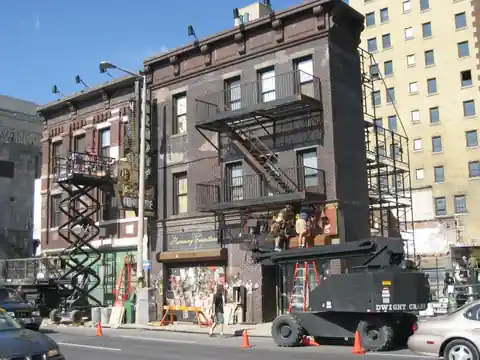
The Incredible Hulk (2008): Voice Of The Incredible Hulk, death sceneImage: Wikimedia Commons · Nhl4hamilton | Chit-Chat, Public domain - #071
- #072
- #073
- #074
- #075
At around the 9-minute mark, when Banner tries to talk to the girl at the bottling plant and the bald man bumps into him, Banner attempts to say "Don't make me angry. You wouldn't like me when I'm angry" in Portuguese, but because he cannot remember the word for angry he says "hungry" instead. "Mr. McGee, don't make me angry. You wouldn't like me when I'm angry." was a famous line from The Incredible Hulk (1977) series.
- #076
- #077
- #078
- #079
- #080
- #081
- #082
The film participated in Toronto's Green Screen initiative to help reduce carbon emissions and waste generated during filming. Hybrid and fuel-efficient vehicles using ultra-low-sulfur diesel as an energy source were used. To build the sets, the production department used sustainably harvested, locally sourced yellow pine instead of the commonly used lauan, and the wood was then either recycled or donated to environmental organizations. Paints containing no volatile organic compounds or with low volatility were used, and paint cans were turned over to waste management. A contractor was hired to remove trash bins. Eco-friendly products used on set included cloth bags, biodegradable food containers, porcelain and silver tableware, recycled paper, biodegradable soap and cleaners, rechargeable batteries, and stainless steel cups (one for each production member). Gale Anne Hurd hoped the film would serve as a symbol of the effort to encourage the reduction of pollution caused by film productions.
- #083
- #084
Director Louis Leterrier said: "William Hurt didn't want the mustache to play him. The size of the mustache was discussed, but sometimes he and I clashed. You have two kinds of actors. You have your partners, your best friends, who you have to coax all day, and then you have people who like having those arguments. They feed on it. That's how he worked. One day he was yelling at me, 'You don't know anything about actors!' It went really badly for him, he was in the giant helicopter at the end and I was in control. He said, 'You have to find the button for the nuclear power plant…' I took the control stick and shook him, and he fell and looked at me and said, 'I like you!' That was it. He just wanted to fight a little."
- #085
- #086
- #087
- #088
- #089
When Bruce and Betty arrive in New York City, Betty suggests taking the subway and Bruce says: "me in a metal tube, deep underground in the most aggressive city in the world." This may be a nod to Daredevil #163 (March 1980), in which Bruce gets help from Matt Murdock and then takes the subway, but transforms into the Hulk in the middle of a crowded subway station.
- #090
- #091
- #092
This will be the second film in which Bruce Banner is shown naked. The first was in Hulk (2003). In Hulk (2003), Bruce is shown naked after he fights the Hulk Gamma Dogs as the Hulk, defeats them, and then transforms back into himself. In this film, after he and Betty check into a motel while fleeing General Ross and the army, Bruce is shown naked when he collapses into a fetal position in the shower due to post-traumatic stress disorder.
- #093
Louis Leterrier saw the project less as an ordinary comic book adaptation and more as an opportunity to add his own voice to the great monster movie tradition. The French filmmaker explained, "My favorite movies growing up were Frankenstein, the original King Kong, werewolf movies." "And because the Hulk TV series was so formative, I also said, 'Of course! Yes!' They saw what I couldn't see. They saw that I was the one who could make this film." The Frankenstein allusions are, of course, this: science spiraling out of control creates a monster who is ostracized by society and forced into exile. Echoes of King Kong can be felt in the cave scene, where Betty Ross draws out some tender traces of humanity from Banner's angry personality. Leterrier was also influenced by An American Werewolf in London for the scene in particular where Banner tries to heal himself in Samuel Sterns's laboratory. And finally, in the third act, during which the army finds itself under attack by the newly created Abomination (Tim Roth), there is a shaky-cam camouflage of Matt Reeves's Cloverfield. "I love Matt Reeves, I love J. J. [Abrams]," Leterrier said. "I just think that what they brought to modern filmmaking, the simplicity of their directing and storytelling…" "It's very visceral," offered Horowitz. "You're kind of in the boots of them."
- #094
- #095
- #096
- #097
- #098
- #099
- #100
- #101
- #102
- #103
- #104
- #105
The film shows Bruce Banner/The Incredible Hulk traveling from Brazil to Canada. The film's early scenes depict him living in Brazil. Later, after his first transformation, he finds himself somewhere in Guatemala and then goes to Mexico. After Mexico, he is able to return to the United States (to New York, after Virginia). Finally, in the last scenes, he is seen running in Bella Coola in British Columbia.
- #106
This is the sixth Marvel film to show nudity in some form. The first five Marvel films are, in order, Howard the Duck (1986), Hulk (2003), The Punisher (2004), Blade: Trinity (2004) and X-Men: The Last Stand (2006). The Marvel films that follow are X-Men Origins: Wolverine (2009), The Wolverine (2013), X-Men: Days of Future Past (2014), Deadpool (2016), Logan (2017) and Thor: Love and Thunder (2022).
- #107
- #108
- #109
- #110
Soldiers arrive at the house and run a cable under the front door. When the men burst into the room, the dog takes the cable in its mouth. The dog barks furiously at the soldiers, and one of them appears to turn and shoot the dog with a dart gun. The dog is never shown being hit; only the barking stops. The scene was shot in separate takes. The trainer placed the dog on its mark, stood in front of the camera and verbally cued the dog to "fetch" the stiff piece of rope that also served as the cable. Off-screen, the trainer placed the dog on its mark and cued it to bark and act agitated. The dog was removed before the actor threw the fake dart.
- #111
- #112
- #113
- #114
It would not be wrong to say that this is the only MCU film to have premiered on HBO so far (and most likely the last to do so), and it has been on HBO Max since the service launched. All the other films premiered on Epix (from Iron Man (2008) to The Avengers (2012)), Starz (from Iron Man 3 (2013) to Ant-Man (2015), as well as the Tom Holland Spider-Man films released by Sony), and Netflix (from Captain America: Civil War (2016) to Ant-Man and the Wasp (2018)), and most recently Disney+ (beginning with Captain Marvel (2019)).
- #115
- #116
- #117
- #118
- #119
- #120
- #121
- #122
- #123
- #124
ABC began developing a Hulk TV series in 2010. Guillermo del Toro and David Eick were to executive produce alongside Marvel Entertainment heads Jeph Loeb and Joe Quesada. It would have been the first series produced under Marvel Television, a newly formed division under Loeb. It would also have been del Toro's first TV series and the first Marvel series produced for ABC after the network's parent company Disney acquired Marvel in 2009. However, after the success of The Avengers (2012), Marvel decided to take a different approach with Hulk and instead worked with Joss Whedon to create Agents of S.H.I.E.L.D. (2013), which became Marvel Television's first series. When the Hulk series was scrapped, del Toro moved on to developing Pacific Rim (2013).
Production Story (3)
- #125
- #126
The fictional Grayburn College where Samuel Sterns teaches was meant to actually be Columbia University in real life. Director Louis Leterrier wanted to include a cameo by Tobey Maguire as Peter Parker, who attends Columbia in Sam Raimi's Spider-Man films, in the scene where Banner and Sterns first meet at the university (at the time, Raimi's fourth Spider-Man film was still in development). Sony, which owns the film rights to Spider-Man, did not grant permission for the cameo. Leterrier then proposed scrapping the cameo and instead changing Columbia to Empire State University, the fictional college Peter Parker attends in the comics, but Sony rejected that as well.
- #127
Behind the Scenes (1)
- #128
Although Louis Leterrier liked Hulk (2003), he agreed with Marvel Studios that it would be better to depart from Ang Lee's cerebral style in the first film and focus on a more action-packed tone in order to continue the series. He also felt that, in keeping with the Hulk's poetic feel, most of the visual effects were "A fluorescent-green guy, who was simply flying around. He had no weight, and was too smooth-looking." He therefore wanted to make the film's visual effects bolder and darker "and perhaps even a little scarier!"
Characters & Cast (15)
- #129
- #130
- #131
- #132
- #133
Edward Norton was cast as Bruce Banner on the recommendation of Lou Ferrigno, who appeared in The Incredible Hulk (1977). Ferrigno said that Edward Norton reminded him of the late Bill Bixby, who played Dr. David Bruce Banner alongside him. Norton, a big fan of the series, had played a similar character in Fight Club (1999).
- #134
- #135
At around 38 minutes in, Edward Norton's wife Shauna Robertson produced Knocked Up (2007) and wanted one of the film's stars to appear in a cameo as a computer geek. The role was offered to Jason Segel, Jonah Hill and Seth Rogen before Martin Starr was cast. Starr would later appear as the same character nine years later in another Marvel Cinematic Universe film, Spider-Man: Homecoming. Another Knocked Up (2007) actor, Paul Rudd, would also later appear in the MCU as Scott Lang/Ant-Man in Ant-Man (2015).
- #136
- #137
- #138
- #139
- #140
- #141
- #142
- #143
Easter Eggs & References (8)
- #144
In a deleted scene, Blonsky describes the Hulk to General Greller: "Ten feet tall, fifteen hundred pounds easy, and green. Or gray, sir. Greenish gray. It was very dark, I couldn't tell." This is a nod to the Hulk being gray in his first comic-book appearance; problems with the gray coloring in the first issue led to his skin tone being changed to green.
- #145
- #146
In The Avengers (2012), Bruce Banner references the events of this film twice. In the first reference, he says that he destroyed Harlem on his last trip to New York. The second reference was in a shot that can be seen in the special features of The Incredible Hulk DVD. In it, Banner states that he once tried to "eat a bullet" but that "the other guy" caught it and spit it out. The event took place in the far north, as seen in the footage.
- #147
The film's canonicity within the MCU has been questioned since its release. It has only minor, superficial connections to other MCU films, such as Robert Downey Jr. briefly reprising his role as Tony Stark in Iron Man (2008) and Captain America: The First Avenger (2011), and broad strokes for the Hulk (2003) film, as it functions as a spiritual sequel, and Edward Norton was recast for The Avengers (2012). The events of this film are also rarely referenced in the rest of the MCU. William Hurt was asked to reprise his role as General Ross for Captain America: Civil War (2016), once again confirming that this film is still canon for the MCU.
- #148
- #149
- #150
Producer Gale Anne Hurd also produced Aliens (1986). The Avengers series contains many references to that series. The Avengers (2012) featured a cameo in which Harry Dean Stanton interacts with Bruce Banner. The first two films were directed by Joss Whedon, writer of Alien: Resurrection (1997). In Avengers: Infinity War (2018), the death of Ebony Maw, and in Avengers: Endgame (2019), the scene of the Chitauri advancing on Hawkeye, were taken from Aliens.
- #151
Deeper Meaning (2)
- #152
There are moments that foreshadow Captain America: The First Avenger (2011). First, a portrait of Steve Rogers, the original Captain America, hangs in General Ross's office. Later, a label can be seen on the storage tank reading "Dr. Reinstein" — the doctor who developed the Super Soldier serum that made Rogers Captain America — along with a radiation symbol and the words "vita-rays," implying the serum should not be used without them. Louis Leterrier shot a scene in which Banner encounters the Captain in the Arctic, but it was cut from the main film; it does, however, appear among the special features on some DVD releases.
- #153
The following characters appeared in the movie and were adapted from the comic books: * Robert Bruce Banner/The Hulk, referred to as Bruce Banner or The Hulk on screen. He made his first appearance in the comic story "The Hulk" from The Incredible Hulk #1 (May 1962) by writer Stan Lee and artist Jack Kirby. * Elizabeth "Betty" Ross, referred to as Betty Ross on screen. She made her first appearance in the comic story "The Hulk" from The Incredible Hulk #1 (May 1962) by writer Stan Lee and artist Jack Kirby. * Emil Blonsky/Abomination, referred to on screen as Emil Blonsky. He made his first appearance in the comic story "The Abomination!" from Tales to Astonish #90 by writer Stan Lee and artist Gil Kane. * General Thaddeus E. "Thunderbolt" Ross, referred to as General Thunderbolt Ross on screen. He made his first appearance in the comic story "The Hulk" from The Incredible Hulk #1 (May 1962) by writer Stan Lee and artist Jack Kirby. * Samuel Sterns/The Leader, referred to as Dr. Samuel Sterns on screen. He made his first appearance in the comic story "Enter... the Chameleon!" from Tales to Astonish #62 (December 1964) by writer Stan Lee and artist Steve Ditko. * Dr. Leonard Samson, aka Leonard Skivorski Jr./Doc Samson. He made his first appearance in the comic story "His Name is... Samson!" from The Incredible Hulk #141 (July 1971) by writer Roy Thomas and artist Herb Trimpe. * James 'Jim' Wilson, who made his first appearance in the comic story "A Titan Stalks the Tenements!" from Incredible Hulk #131 (September 1970) by writer Roy Thomas and artist Herb Trimpe. * Anthony Edward "Tony" Stark, referred to as Tony Stark on screen. He made his first appearance in the comic story "Iron Man Is Born!" Tales of Suspense #39 (March 1963) by writers Stan Lee & Larry Lieber and artists Don Heck & Jack Kirby. For the above list, only the creators of the character's first appearances are listed. As with all comic book characters, Iron Man and his supporting cast have had several reinventions and different contributions from different writers. These include different iterations in different mediums that all have added different concepts to the overall mythology of the characters.
Career & Awards (2)
Related pages
- Everyone Says I Love You — The Incredible Hulk comes up in the facts on that page
- Robert Downey Jr. — The Incredible Hulk comes up in the facts on that page
- Michael Kenneth Williams — The Incredible Hulk comes up in the facts on that page
Sources & editorial notes
Reference databases
- Wikipedia
- IMDb
Information from external sources is independently selected, consolidated and edited by Arka Evren. Sources are listed for verification and further reading. Encyclopedia text is used under its licence (CC BY-SA). How we work