
FILM · 2019 · CANADA
The Lighthouse
32 archived facts 6 topics 1 source Last reviewed Oct 2026
All facts (32)
- #001
Willem Dafoe and Robert Pattinson said they barely spoke to each other on set and were too exhausted after a day of shooting to hang out together, because the physically demanding shoot took place in bad weather. During production Pattinson stayed in a normal hotel with the rest of the crew, while Dafoe lived in isolation in a small fisherman's hut. On set, Pattinson preferred to eat and spend his breaks alone, whereas Dafoe stayed with the crew. Both said they liked each other very much when they had their first real conversation months later.
- #002
The scene in which Willem Dafoe's character curses Robert Pattinson's character with a sea curse because he did not like his cooked lobster was shot in a single take. According to director Robert Eggers, Dafoe did not blink for more than two minutes.
- #003
The dream sequence in which Wake stands naked, beams light from his eyes at Howard and holds Howard's arm with one hand is a reference to the 1904 painting "Hypnosis" by German artist Sascha Schneider.
- #004
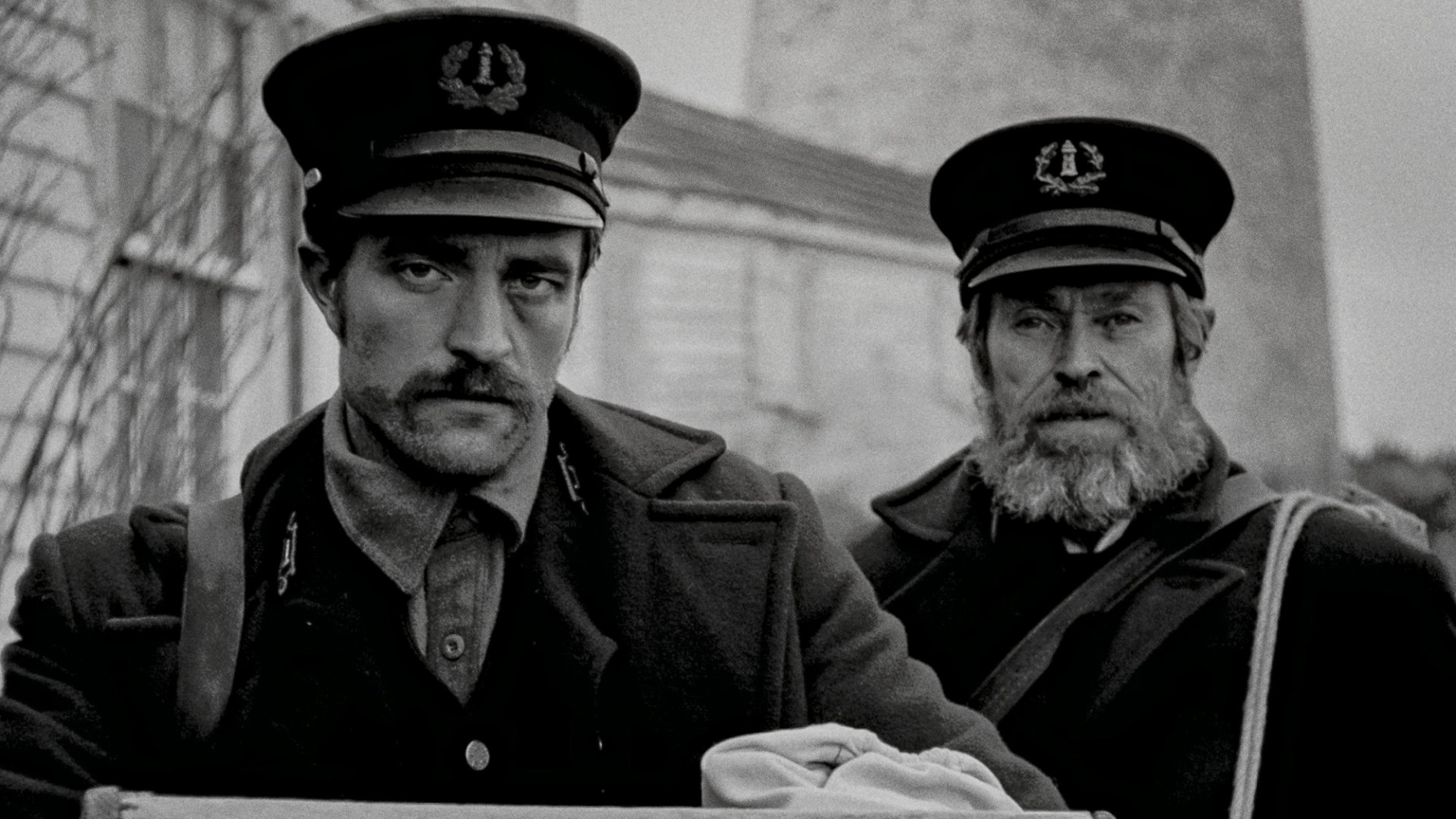
The film was shot on Double-X black-and-white stock, which requires far more light for exposure, so for night and interior shoots they had to use roughly 15 to 20 times more light on set to actually see anything in the film. The crew placed flickering 500 to 800 watt halogen bulbs inside period-appropriate kerosene lamps just a few feet from the actors' faces, which made the set blindingly bright and left the actors barely able to see each other. The lights were so bright that crew members sometimes wore sunglasses even during night shoots.
- #005
There were versions of the script that were "too clear." Director Robert Eggers's goal was to drive the audience mad and to confuse them just as Thomas Howard/Ephraim Winslow is confused, so the final script was more confusing for the audience.
- #006
The film's aspect ratio is 1.19:1, a nearly square frame used by filmmakers such as Fritz Lang and Georg Wilhelm Pabst in the early years of sound, when room for the soundtrack had to be made on the physical film. They chose this aspect ratio specifically for The Lighthouse because "the spaces in this film are meant to be limited; it's a much more close-up film than The Witch (2015). The idea of widescreen only emerged in the 1950s; we wanted to take people back even further than that."
- #007
The final shot, in which gulls hover over Thomas Howard/Ephraim Winslow's body and peck at him as he lies helpless on the rocks, echoes the Greek myth of "Prometheus": the Greek gods took fire away from humans as punishment for disobeying them, and the Titan Prometheus then stole the fire back to give this precious gift to humanity. The gods were enraged by Prometheus's theft of fire and punished him by chaining him helplessly to a rock, where an eagle was sent each day to eat his liver, which would grow back overnight and be devoured again the next day, forever.
- #008
Robert Pattinson's and Willem Dafoe's beards were completely real. However, because Pattinson is naturally dark blond, he had to dye his mustache dark. Dafoe's rotten teeth were prosthetics.
- #009
In the original script, Thomas Wake had a glass eye, a leg with a nail in it and three missing fingers. This was changed because director Robert Eggers thought the audience might misinterpret Wake as a pirate and because the effects required for his appearance would be too difficult on a limited budget.
- #010
Before shooting began, Willem Dafoe and Robert Pattinson rehearsed with director Robert Eggers for a week at a hotel in Halifax, Nova Scotia. Dafoe, because of his extensive theater background, likes to rehearse, while Pattinson did not want to perform and gave too much away in advance, preferring to jump blindly straight into the scene. He found the rehearsal process frustrating and uncomfortable; he was used to reacting impulsively in front of the camera and became too conscious of the scene by thinking about it too much beforehand. His method is that if he achieves certain things in rehearsal, it will later break the spontaneity and feel false in front of the camera. Eggers welcomed the two working so differently and said: "There's an incredible electrical chemistry on screen, but it was a chemistry born of tension. It couldn't have been better for this film. Rob hated rehearsing because he wanted to surprise me and Willem, but mostly he wanted to surprise himself with what he would do in the scene. Rob tends to be at his best on the first take and was afraid he would ruin it. So he held back during the rehearsal period."
- #011
Wake says that killing a gull brings bad luck because of the superstition that gulls contain the souls of sailors. Wake also mentions that his previous assistant went mad and died. The gull that is hostile to Howard/Winslow is missing one eye. Later, the rotting head found in the lobster trap (the one belonging to Wake's assistant) is shown to be missing the same eye as the gull, implying that this gull contains the spirit of Wake's former partner.
- #012
During shooting, director Robert Eggers was afraid the film would be "too funny," because Robert Pattinson and Willem Dafoe are natural at comedy and are very funny in real life. Eggers later used the musical score in post-production to keep the tone dark enough.
- #013
To draw inspiration for the dialogue, the Eggers brothers read works by Herman Melville, Robert Louis Stevenson and others, and consulted 19th-century slang and nautical dictionaries for short jargon. Willem Dafoe's character tends to deliver soliloquies in the style of William Shakespeare and Milton. For naturalistic dialogue, the Eggers brothers turned to the works of Sarah Orne Jewett, a Maine-based poet and novelist known for her writing set on the East Coast, including 'Tales of New England' and 'Strangers and Wayfarers,' both published in 1890. As research for her own work, Jewett interviewed old sailors and farmers, often writing in their dialects.
- #014
At the center of the sound design is a bellowing foghorn, so sound designer Damian Volpe turned to J. J. Jamieson, a craftsman living in Shetland, Scotland, who makes YouTube tutorials on operating and maintaining foghorns, for recordings of a period-appropriate foghorn. Using Jamieson's samples, Volpe altered the sound and created an ominous, memorable foghorn unique to the film. The foghorn heard throughout the film is a recording of the Nash Point Lighthouse Fog Horn (located in Wales, United Kingdom). The Nash Point foghorn is sounded with compressed air.
- #015
The word "wickie," used by Wake, is a 19th-century slang term for a lighthouse keeper, derived from the "wick trimming" required of lighthouse keepers.
- #016
The design of the mermaid's genitals was based on shark lips and was made entirely of silicone. Robert Eggers on the background: "The two-tailed mermaid in the Starbucks (coffee) cup is based on an older mermaid design: medieval and Renaissance mermaids were always split so that these anima figures in male fantasy could fulfill the roles unfairly imposed on them by their male dreamers. But it is not surprising that in the Victorian era they closed mermaids off and made them impenetrable. So the single-tailed mermaid silhouette became the archetypal mermaid look. For people today, and also for how a mermaid would have looked in the period in which the film is set. But we still had to figure out how mermaids could mate and create more mermaids. So we studied shark genitalia."
- #017
Willem Dafoe learned to knit for his role.
- #018
The script did not explain what Thomas Wake and Thomas Howard/Ephraim Winslow see when they look into the lighthouse light. Willem Dafoe and Robert Pattinson did not know either while playing these scenes. It is never explained and is left ambiguous. The script only described how their characters felt while looking at the light.
- #019
The mermaid carving Robert Pattinson used in the film was auctioned by A24 during the 2020 COVID-19 pandemic to benefit the NYC Food Bank. It sold to an anonymous buyer for $110,750.
- #020
In 2012, Robert Eggers's brother Max Eggers first came up with the idea of a contemporary ghost story set in a lighthouse. After trying and failing for years to get The Witch (2015) made, Eggers turned back to his brother Max to work on this ghost story, but after discovering a real-life tragedy about two Welsh lighthouse keepers in 1801, he decided it had to be a period film. However, when The Witch (2015) was finally financed and began shooting in 2014, this film was put on the back burner.
- #021
Every building seen on screen was constructed for the film. The lighthouse complex consisted of two sets: for exterior shots, a full-scale, 70-foot lighthouse tower capable of withstanding 120-kilometer winds was built on a unique volcanic rock outcrop at Cape Forchu in Nova Scotia, Canada. The lighthouse's skeleton was covered in plywood, then wrapped in a thin layer resembling brick cladding, and it was demolished after filming ended. A few interiors were also shot there, but most were built inside sound stages and warehouses outside Halifax, Nova Scotia. During the writing stage, it became clear that maneuvering the camera inside the lighthouse tower would be too cramped.
- #022
Residents of Yarmouth, Nova Scotia (where the lighthouse set was built) liked it so much that some fought to protect and preserve the fake lighthouse while the film was shooting, but it was removed due to safety concerns and because it was made only of wood.
- #023
Director Robert Eggers stated that the scene in which Robert Pattinson's character gets feces smeared on his face was inspired by The Big Lebowski (1998).
- #024
Except for the scene in which Robert Pattinson's character is finally at the top of the lighthouse and appears to be seized by the light, most of the film was shot with a special cyan filter to replicate orthochromatic film (as noted above). This was achieved by cinematographer Jarin Blaschke removing the filter and instead using a light that could change colors on command. At the start of the shoot it was set to cyan to mimic the filter's look, but as Pattinson's character grew increasingly mad, Blaschke gradually shifted the light to red to completely clean out skin tones and make the light appear more intense on black-and-white film stock.
- #025
Willem Dafoe did not want to wear a hat in the first dinner scene, but director Robert Eggers wanted his character to look authoritative and responsible. This is historically inaccurate, since wearing a hat in the kitchen was considered bad luck.
- #026
No seagulls were harmed during the filming of this movie. The seagull scenes were shot with a puppet that was digitally replaced with real seagulls. The real birds were trained rescue seagulls named Lady, Tramp and Johnny. Because they could not fly the seagulls to Nova Scotia, Canada, they reshot the scenes with the real seagulls in front of a green screen at a studio in England. The missing eye was completed in post-production. The other seagulls seen flying in the distance lived in that area and were constantly around during filming, which annoyed the crew because the seagulls quickly realized they could use them as a food source.
- #027
The Fresnel lighthouse lens produced for the film was a functional and historically accurate reproduction whose intense reflecting capacity allowed its light to be seen for 26 miles. Director Robert Eggers and cinematographer Jarin Blaschke discovered it during a research trip to Northern California. They visited Point Cabrillo, which has a lighthouse dating back to 1909 and houses a working Fresnel lens. Today only one team produces these lenses: Lens Preservation Specialist Dan Spinella and U.S. Coast Guard Lamp Specialist Kurt Fosburg. The team worked with Production Designer Craig Lathrop, who guided them to create the style of lens he had designed.
- #028
The wicks that pop at the beginning of the film were played by crew members.
- #029
Ten days before filming was to begin, the production company New Regency tried to convince director Robert Eggers to shoot in widescreen because the film's sets were "too beautiful" not to be shown at full scale.
- #030
While writing the screenplay, director Robert Eggers listened to hours of YouTube videos featuring subwoofer noise, crashing waves, blowing wind and foghorns.
- #031
The sound of Willem Dafoe's farts was added in post-production. They did not come from a sound library, meaning they were created practically. Sound designer Damian Volpe stated that he would not explain how he created the gas-passing sounds and would take the secret to his grave.
- #032
Robert Pattinson and Willem Dafoe both reached out to work with director Robert Eggers because they had liked his directorial debut, The Witch (2015). Dafoe had entered a theater to see the film based on the poster alone. He liked it so much that he went again the next day with his wife. He later arranged a meeting with Eggers. By chance, Eggers had been looking for a project that would interest both men before he finished the screenplay. He had also previously spoken with Pattinson about other roles in films including "The Knight" (2016) and Nosferatu (2024). However, Pattinson turned down that offer because the roles Eggers wanted him to play were too boring and ordinary for him.
Sources & editorial notes
Reference databases
Sources for the entries on this page
- IMDb IMDb kaydı
Information from external sources is independently selected, consolidated and edited by Arka Evren. Sources are listed for verification and further reading. Encyclopedia text is used under its licence (CC BY-SA). How we work