
FILM · 2015 · USA
The Martian
- Directed by
- Ridley Scott
- Runtime
- 141 min
- Studio
- Genre Films, TSG Entertainment, 20th Century Fox
178 archived facts 7 topics 2 sources Last reviewed Sep 2026
During a manned mission to Mars, Astronaut Mark Watney is presumed dead after a fierce storm and left behind by his crew. But Watney has survived and finds himself stranded and alone on the hostile planet. With only meager supplies, he must draw upon his ingenuity, wit and spirit to subsist and find a way to signal to Earth that he is alive.
Summary: TMDB
All facts (178)
- #001
After Rich Purnell finds a way to rescue Mark Watney, he slips and falls and tells his boss, "I need more coffee." Donald Glover said in an interview that he actually slipped, got up and kept acting, and that the footage was kept in the film's final edits.
- #002
Contains a major spoiler — show
In the novel, when Watney is rescued, he remarks that if this were a Hollywood film the whole crew would gather in the airlock and high-five each other. At the end of the film, that is exactly what happens.
- #003
20th Century Fox optioned Weir's novel in March 2013, with producer Simon Kinberg attached to develop it into a film.
- #004
Contains a major spoiler — show
Matt Damon admitted that the scene in which Mark becomes emotional upon hearing Commander Lewis's voice was real. The other actors had already wrapped and gone home, and their pre-recorded voices were actually played to Damon from inside the spacesuit. Damon was moved to tears as he thought about how his character had been utterly alone on Mars for two years and could only hear the pre-recorded voices of his castmates, who had already finished their scenes. Sir Ridley Scott was so impressed by Damon's performance that he shot only one take of the scene used in the film.
- #005
In May 2013, Drew Goddard entered negotiations with the studio to write and direct The Martian, and Matt Damon expressed interest in starring under Goddard's direction.
- #006
Contains a major spoiler — show
Matt Damon wanted to lose a large amount of weight for a scene near the end of the film, but Sir Ridley Scott forbade it. Damon had already done this during the shooting of Courage Under Fire (1996), but it had seriously endangered his health and he had to remain under medical supervision for a long time afterwards. A body double was used for The Martian instead.
- #007
Goddard instead pursued directing Sinister Six, a comic book film about a team of supervillains, after which Kinberg brought the book to Ridley Scott's attention.
- #008
Contains a major spoiler — show
When NASA and Watney communicate in writing for the first time, Watney drops an F-bomb. He is warned to watch his language because everything he writes is broadcast worldwide. In the film his reaction is not shown, only the reactions of others. In the novel his reply is: "Look! A pair of boobs! -> (. Y.)".
- #009
In May 2014, Ridley Scott entered negotiations with the studio to direct The Martian, with Matt Damon cast as the film's stranded astronaut.
- #010
A real potato farm was set up on the studio lot, containing potatoes at every stage of growth that could be used for filming.
- #011
Ridley Scott said he was drawn to The Martian because of its emphasis on science, and he believed a balance could be struck between entertainment and learning.
- #012
Contains a major spoiler — show
In his novel, Andy Weir personally created a piece of software to calculate the ship's arrival times (to Earth and to Mars) down to the exact minute.
- #013
Matt Damon said he was attracted to The Martian by the novel, the screenplay and the chance to work with Ridley Scott.
- #014
NASA was consulted to get the aspects of space and space travel, particularly those concerning Mars, as accurate as possible. NASA is federally funded, but it does not charge anyone, including for-profit private organizations, any fee for the use of and access to its archives and consultancy.
- #015
After Ridley Scott committed to The Martian, the project picked up pace and was quickly approved.
- #016
Early on, it is said that a compromised spacesuit would cause decompression and give a person roughly a minute to live. This is scientifically accurate; contrary to popular belief, acute decompression in space or on a planet with very low pressure such as Mars does not cause the body to immediately explode or expand. The main effects include confusion, loss of consciousness and some subcutaneous bleeding, but a generally healthy human body is accepted to be able to survive in a vacuum for a minute without life-threatening consequences.
- #017
The Martian was filmed with 3D cameras, and around 20 sets were constructed for the production.
- #018
Sir Ridley Scott claimed that Matt Damon's solo scenes were shot continuously over five weeks, after which Damon was taken off the schedule. As a result, Damon did not see most of his castmates again until the actors reunited for the film's promotion.
- #019
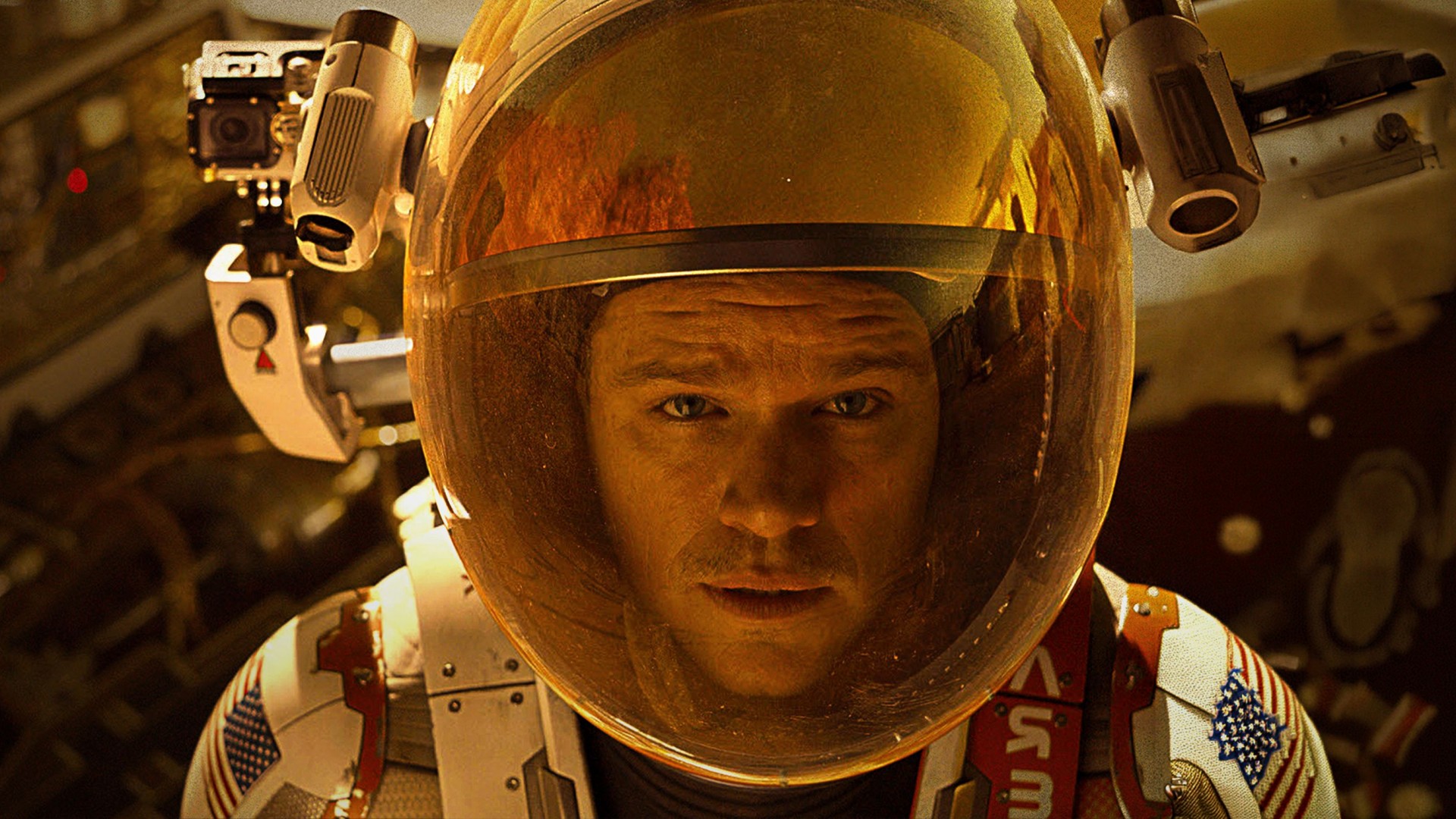
Interior scenes for The Martian were shot at Korda Studios, located 26 kilometres west of Budapest in the wine-making village of Etyek, Hungary, which had one of the largest sound stages in the world. Filming in Hungary began on November 24, 2014.
- #020
For The Martian, real potatoes were grown on a sound stage beside the one used for filming, planted at different times so that various stages of growth could appear in scenes. A team of six people built 15 suits for the film.
- #021
The atmospheric pressure on the surface of Mars averages 600 Pa (0.087 psi), about 0.6% of Earth's average sea-level pressure of 100 kPa (14.69 psi). It is so low that, as they put it, the "fierce storm" would be something like a very light breeze that ruffles your hair. Author Andy Weir admitted this is the biggest inaccuracy in the story. Because of the low air density, sound does not travel as it does on Earth, and in the freezing cold, toxic atmosphere and lack of pressure, someone would have to stand next to you and shout for you to hear them.
- #022
A special Mars rover model was constructed for the filming of The Martian, and the film's cast and team gave it to Jordan as thanks for the hospitality they received. The rover is now on display at Jordan's Royal Automobile Museum.
- #023
Contains a major spoiler — show
Mark Watney's journey to Ares 4 was much more grueling in the book. He had to deal with a dust storm that could largely prevent the solar panels from fully charging. His rover and trailer also rolled over while descending Schiaparelli's slope.
- #024
Matt Damon said that he and Ridley Scott drew inspiration from the documentary Touching the Void (2003), which showed trapped mountain climbers.
- #025
Contains a major spoiler — show
After performing surgery on himself, Mark gathers the pieces of the antenna to make sure no other piece is missing (and therefore is still stuck inside the wound, which increases the risk of sepsis).
- #026
Ridley Scott initially expected to film Mark Watney as a Robinson Crusoe figure in full isolation, but changed his approach because the character would be self-monitoring his behavior under various mission cameras.
- #027
The exterior scenes on Mars were shot at a slower rate to simulate Martian gravity, which is 38% of Earth's. Anything on the Martian surface therefore had to appear lighter and make slight jumps. However, the desired frame rate did not allow the cameras to run in sync. To eliminate this, the film was shot at 48 frames per second for the exterior scenes and then slowed down to the standard 24 frames per second. This meant a great deal of sound had to be re-recorded in post. As a result, it would have been impossible to sync the sound to Mark's lips, which were shot at the slower frame rate. To avoid this problem, Sir Ridley Scott preferred to have Mark present in the scenes rather than have him "narrate" by talking in the suit.
- #028
According to Todd McCarthy of The Hollywood Reporter, the Earth scenes in The Martian act as a hectic, densely populated counterweight to the Martian aridity, which he said is magnificently represented by exteriors shot near Wadi Rum in Jordan.
- #029
Contains a major spoiler — show
In the film's final section, a Chinese astronaut is later shown on a mission to Mars. This is a reference to a plotline that appears in the novel but is not shown in the film, in which the China National Space Agency arranges to take a Chinese astronaut on the next Mars mission in exchange for the use of booster rockets.
- #030
According to Ridley Scott, the first cut of The Martian ran 2 hours and 45 minutes. An extended version of the film was later issued on home video.
- #031
"Steely-eyed missile man" is a reference to the actions of flight controller John Aaron after two lightning strikes hit the Apollo 12 rocket within the first minute after launch. The electrical surge caused numerous problems in the craft's telemetry system and, if unresolved, would have led to the mission being aborted. Aaron recognized that the telemetry problem resembled one seen in tests a year earlier and advised the crew to switch the Signal Conditioning Electronics (SCE) system to the auxiliary position. This control was so obscure that neither the Capsule Commander nor the Flight Director knew what it was or even where it was, but pilot Alan Bean knew and followed Aaron's advice. Changing the setting solved the problem instantly and allowed the mission to continue. Aaron's quick, calm and effective response to the crisis earned him the title regarded at NASA as the highest possible praise.
- #032
Author Andy Weir first wrote the novel as a series on his blog. Writing with this serialized approach allowed him to build the story as it went along, essentially constructing each plotline around something that could go wrong and then working out how Mark would overcome it. Weir stated that he could not solve a failure of the vital life-support systems, so if the oxygenator, water reclaimer or RTG failed, Mark would die.
- #033
One of the panoramic shots of Mars shows Olympus Mons, the largest volcano discovered in the solar system. It is nearly three times larger than Mount Everest and covers an area the size of Missouri. It is also twice as tall as Everest, reaching a height far beyond the atmosphere.
- #034
At their first production meeting, Ridley Scott and producer Mark Huffam called NASA and spoke with its film and television liaison Bert Ulrich.
- #035
NASA chose to assist the filmmakers in depicting the science and technology of The Martian because it saw potential in promoting space exploration.
- #036
It was shot in only 72 days.
- #037
NASA's James L. Green, director of the Planetary Science Division, and Dave Lavery, program executive for Solar System Exploration, were among the NASA staff who contributed to The Martian. Director Ridley Scott spoke with Green twice before filming began.
- #038
The film's acceptance by the Golden Globes eligibility committee in the 'Comedy or Musical' category, and its subsequent wins for 'Best Motion Picture - Comedy or Musical' and 'Best Actor in a Comedy or Musical' (Matt Damon), sparked some controversy. Many filmmakers, such as Judd Apatow, criticized the producers' decision to submit The Martian as a comedy in order to avoid strong competition in the Best Drama category. The controversy led to a rule change stating that dramas with comedic overtones must be entered as dramas, not comedies.
- #039
Over the course of one month, NASA fielded hundreds of questions from The Martian's production about radioisotope systems and the design of potential habitats for future Mars astronauts. Green answered them himself or routed them to the appropriate expert before returning them to Scott's team for use in the production.
- #040
Contains a major spoiler — show
In the film, Watney has no way to communicate with NASA, so he finds and digs up Pathfinder, a spacecraft NASA launched to Mars in the 1990s. After some hacking, he uses the robot to communicate with NASA using a duplicate on Earth. In the real world, NASA builds a working copy of every spacecraft in case something happens to it after launch. This way engineers can troubleshoot and find fixes on Earth. Speaking to Tech Insider, Green said the real-life Pathfinder copy should be "turned on and dusted off," but that it exists. So NASA could theoretically really use it to communicate with a stranded Martian astronaut.
- #041
NASA supplied The Martian's production with hundreds of genuine photographs of Mars and of control centers, including images showing what the computer screens look like. Green also arranged an eight-hour tour of the Johnson Space Center in Houston for production designer Arthur Max, who met specialists there and took hundreds of photos.
- #042
In The Martian, Watney digs up a radioactive power source to use for heat. It is called a radioisotope thermoelectric generator (RTG), and NASA relies on them for long-distance space missions. RTGs are essentially batteries powered by radioactive plutonium-238. Plutonium produces heat as it naturally decays, and the battery casing converts the escaping heat into electricity. According to the Environmental Protection Agency, it is nearly impossible to turn Plutonium-238 into a nuclear weapon. Its radiation is not the dangerous, skin-penetrating type people need to worry about (unless it is inhaled). Still, because it is very hot, having the nuclear battery lying around is dangerous.
- #043
For The Martian, production designer Arthur Max built a futuristic, heavily modernized Mission Control as a studio set. Ars Technica described the film's depiction as "the space agency that we all dream of" and contrasted it with the real Johnson Center's appearance, which it called "a run down college campus".
- #044
The mission is named Ares 3, a tribute to Ares, the Greek god of war whose Roman name is Mars. The large ship traveling between Earth and Mars is named Hermes, after the Greek god who served as messenger and envoy. Hermes was regarded as the patron and protector of travelers. The Roman version of Hermes is Mercury.
- #045
According to Newsweek, NASA worked with The Martian more closely than with most other space-themed films, with staff from many NASA departments advising from script development through principal photography and later assisting with marketing timed to the theatrical release.
- #046
Andy Weir (the author) stated that the only moment he was disappointed was left out of the final film was Mark Watney creating an audio recording that goes "How come Aquaman can control whales? They're mammals! Makes no sense" after Teddy Sanders wonders what Watney is thinking on Mars. It can be found in the extra content of the Blu-ray release.
- #047
As part of its collaboration on The Martian, the production's NASA liaison placed the front page of the film's script in the payload of the spacecraft Orion during its Exploration Flight Test 1 on December 5, 2014.
- #048
In the novel, Mark Watney has two master's degrees, one in botany and one in mechanical engineering. In the film, however, he has a doctorate in botany, and although he is shown to be knowledgeable about the engineering and maintenance of the mission equipment, no engineering background is mentioned.
- #049
According to the Los Angeles Times, NASA and the wider scientific community anticipated The Martian as a way to publicize a human mission to Mars.
- #050
Matt Damon was asked to grow a beard a few weeks before filming began. The scene in which he shaves it with hair clippers was one of the first scenes shot and had to be filmed carefully because it could only be shot once.
- #051
The New York Times reported that The Martian serves as a plug for NASA, which returned the favor by promoting the movie on its website.
- #052
Drew Goddard, who wrote the film's screenplay, also decided at one point to direct it, but he left that role for the directing of a Spider-Man spin-off film that never came to be. After that, Sir Ridley Scott read the screenplay and joined the project.
- #053
Contains a major spoiler — show
After the probe explodes during launch, Sean Bean can be seen saying "GC, lock the doors," the same command given in 2003 by NASA Entry Flight Director LeRoy Cain after the Space Shuttle Columbia broke apart during re-entry. The command instructs the Ground Controller (GC) to lock the control room doors so that no one can enter or leave until all data is secured for an internal investigation.
- #054
When designing the film's spacesuits, the costume designer looked at many of NASA's real Mars suits and said that because of their bulk they were "exactly like a Buzz Lightyear suit." Even Sir Ridley Scott did not like them, so the final designs of the suits were based on pictures of the real suits but aimed for a more practical approach.
- #055
In October 2015, NASA released a web tool that let users follow Mark Watney's journey across Mars, along with details of the agency's next steps and a report on health hazards for a real human mission to Mars.
- #056
Real-life NASA astronaut Jessica Watkins reported that during an unscheduled break while the crew was serving on the ISS in 2022, she would watch The Martian, her favorite film.
- #057
Much of the research and development related to Prometheus (2012), especially the spacesuits, was used in this film.
- #058
The original cover page of the screenplay draft was aboard a real NASA ship, Orion, when it launched. The cover featured an illustration of Matt Damon's character on Mars saying "I'm gonna science the shit out of this planet."
- #059
According to author Andy Weir, the story takes place in 2035.
- #060
As Watney sets out on his long walk, he stops to stand on top of a hill. In the distance, a number of dust devils can be seen. When NASA sent the Opportunity rover to Mars in 2004, it was expected to last 90 days, largely because of the prediction that over a three-month period enough Martian dust would collect on its solar panels that they could no longer recharge. Despite this, it remarkably continued to operate for 14 years, traveled about 28 miles, performed hundreds of tests and sent back thousands of photographs. NASA attributes this durability to the dust devils that occasionally pass over and blow the dust away. Its successor, the nuclear-powered Curiosity rover, landed on Mars in 2012 and, as of 2024, is still operating. The Perseverance rover arrived in 2021 to begin its exploration with the primary mission of finding evidence of ancient microbial life on Mars.
- #061
On September 28, 2015 (four days before the film's release in the US), NASA announced that it had found evidence that salty water still flows on the surface of Mars.
- #062
Contains a major spoiler — show
In both the film and the novel, Watney grows his own food by planting potato eyes in the soil. He fertilizes the plants with human waste and produces liquid water for the crop from rocket fuel. Given what is already known about Martian soil, there is no reason this would not work in real life. Botanist Bruce Bugbee, who works with NASA, told Tech Insider that NASA has already made progress on farming in space. In 2015, for the first time, astronauts on the International Space Station tasted some of the lettuce they had grown in microgravity.
- #063
The buildings representing NASA headquarters and the Chinese space center in the film are two famous cultural centers in Budapest that in real life are only three tram stops apart.
- #064
Contains a major spoiler — show
In the novel, it emerges that the Hermes crew would have a chance if they carried out a resupply during a Rich Purnell Maneuver — it was decided that Johannsen, as the smallest member of the crew and therefore the one needing the least food, would commit suicide so that the rest of the crew could A) avoid wasting precious food resources and B) eat her for protein and remain the only survivors. When the resupply effort succeeds, Martinez asks who gets to eat first and says he thinks he should get the tastiest part; Johannsen moves away from him and calls out: "What? I thought you liked Mexican!"
- #065
According to NASA, Mars has a reddish-orange glow during the day because of all the dust. Since Mars has almost no atmosphere, sunrises and sunsets appear blue. A day on Mars, or a "sol," is about 37 minutes longer than an Earth day. The natural human circadian rhythm (or sleep-wake cycle) is about 24 hours 11 minutes, but experiments show that people have no trouble adapting to cycles ranging from 23 hours 30 minutes to 24 hours 36 minutes, so humans would not experience major disruptions to their biological clocks on Mars. A Martian year is nearly two Earth years, because Mars orbits the Sun much farther out than Earth and therefore takes longer to complete one revolution. The average surface temperature on Mars is a cold minus-80 degrees Fahrenheit (minus-62 degrees Celsius). However, temperatures can range from as low as about minus-195 degrees Fahrenheit (minus-126 degrees Celsius) in winter to a comfortable 68 degrees Fahrenheit (20 degrees Celsius) in summer. Gravity on Mars is only 40% of Earth's, so a person on the Martian surface would weigh 60% less than on Earth. Mars has almost no atmosphere — about 1% of the density of the atmospheric "blanket" around Earth — which is not enough to protect the surface from dangerous space radiation. Dust storms can envelop the planet for days. In the novel, these storms cause Watney's initial stranding as well as other significant plot points.
- #066
Contains a major spoiler — show
Toward the end, after flying through the Martian atmosphere, Watney (Matt Damon) says he is experiencing chest pain, likely because G-forces broke some of his ribs. This is undoubtedly due to spaceflight osteopenia, which causes bones to lose density after prolonged exposure to low or zero gravity. Since Mars's gravity is only 38% of Earth's, Watney's long stay there made his bones brittle, possibly worsened by a lack of vitamins and minerals from his food. The subcutaneous hemorrhages visible on his back could also be a result of vitamin deficiency, particularly vitamin K, of which potatoes provide very little.
- #067
Production designer Arthur Max: "We built this at Korda Studios in Budapest; it has the largest — the reason we went there was that it currently has the largest stage in the world. As large an area as the enhanced stage at Pinewood that held the previous record. But 6 meters taller. So we could also put in the world's largest green screen, a four-walled green screen. There was enough space to create a big Martian landscape, drive our rover at speed, reset, walk around immediately, build our habitat, and later place the legs of our climbing vehicle." [Various 2015].
- #068
Except for a few interior shots and close-ups, all of the helmet visors on the EVA suits (both the glass visor and the retractable shiny gold sunshield) were created digitally. The aim was to minimize complications with reflective visors mirroring green screens, studio lights, cameras and crew members. This is done by creating a similar environment in CG and capturing virtual reflections in the visually generated visors along with the astronauts. This is captured by a virtual camera in 3D space. The virtual camera's position, angle and distance, lens, f-stop and other settings are adjusted to match exactly the settings of the real physical camera.
- #069
The Mars mission in the film mimics the real missions NASA plans for the future.
- #070
The surface of Mars is being examined, and currently is examined, by a camera satellite orbiting with enough precision to pick out an object the size of a basketball. When the images were studied, worm-like shapes on the surface were discovered to actually be collapsed lava pits. It was also discovered that the vents contain passages reaching deep into the surface. The greatest danger on Mars is cosmic and solar radiation, so the best shelter would be deep underground, which would provide far better protection than any spacecraft. Therefore, as of 2020, the latest research indicates that the first humans to arrive on Mars would set up their facilities inside an empty lava tube underground rather than on the surface. An additional advantage is that the most likely place to find actual life thriving on Mars is also underground.
- #071
The Orion constellation can be seen in almost every frame of space throughout the film. It is even visible in the background of most scenes, including through the windows of the hab and the Hermes.
- #072
Contains a major spoiler — show
In the film, the romantic interest between astronauts Beth Johanssen and Chris Beck is not revealed until just before Watney's rescue and is kept secret from the rest of the crew. In the book, not only does Watney know there is romantic tension between the two, but Commander Lewis also knows; when they return to Mars, after a heating problem in Martinez and Watney's bunk makes the room uninhabitable, she lets them share a room, which meant Martinez had to use Beck's bunk.
- #073
Contains a major spoiler — show
The film ends with Mark returning to Earth and teaching a group of astronaut candidates. None of this is in the novel, which ends with the crew rescuing Watney and beginning the journey back to Earth. Watney writes in his log, "This is the happiest day of my life."
- #074
Contains a major spoiler — show
The supply rocket was lost because the protein cargo liquefied. Liquid payloads are safe if held tightly in full containers, but if they are allowed to slosh, serious stability problems arise. Sloshing allows the liquid cargo to shift with a force much greater than its actual weight. For example, naval damage-control principles take into account both the loss of buoyancy from flooding and the loss of stability caused by partially flooded compartments, and it can be advantageous to completely fill a compromised compartment with water to eliminate sloshing.
- #075
The costumes in the film are complex and use a working lighting system, as in all space dramas of the past few decades. In real life an internal lighting system would be questionable, but for film and TV, even if it creates a glint in the actors' eyes, their faces need to be visible.
- #076
Contains a major spoiler — show
Mark Watney spends a total of 568 Martian sols on Mars. Of these, 543 were spent stranded there after the Ares III evacuation. In terms of Earth days, Mark spent 578 Earth days (roughly 1 year 7 months) stuck on Mars. Counting from Earth departure, the total length of the entire Ares III mission, including the emergency evacuation from Mars and the Earth/Mars gravity assists to rescue Mark, was 772 sols. This means the entire Ares III mission as a whole lasted 795 Earth days (or roughly 2 years 2 months).
- #077
Whenever Mark boots up a computer (that is, when he finds the MAV), a series of source code appears on the screen. The code is written in PVS (Prototype Verification System), an experimental macro language NASA actually uses, and it is very likely to appear in a future spacecraft. This particular piece of code is taken from the already existing NASA PVS Library, and if you type part of it into Google, you can find this code snippet as open source.
- #078
Contains a major spoiler — show
In the novel, while still in contact, Mark occasionally emails the Hermes crew; he emails Beck telling him to hurry up and "tell Johannsen how you feel." In these emails it emerges that Mark considers Martinez his best friend.
- #079
Astrophysicist Neil deGrasse Tyson said this is the most accurate film he has ever seen in terms of astrophysics and habitability on Mars.
- #080
The tent-like shelter where Watney spends most of his time is called the "hab," short for Mars Lander Habitat. NASA already has working prototypes of Mars habs equipped with oxygenators, water reclamators and airlocks to protect astronauts from Mars's nearly airless, radiation-bombarded surface. The space agency also recently hosted a competition to see who could design the best 3D-printable Mars Hab. Some of the designs might actually one day go to the red planet.
- #081
Contains a major spoiler — show
At the end of the film, while Mark Watney is in the lecture hall, the slogan on the floor is "Per ardua ad astra," a Latin phrase meaning "Through hardships to the stars," "A rough road leads to the stars" or "To the stars through difficulties." Besides being the motto of many air forces and institutions around the world, it is also the slogan written on the Apollo 1 memorial plaque.
- #082
Minor changes were made to the script during shooting, partly to achieve better scientific accuracy. Producer Mark Huffam said: "We're working with %90 of the script that we started with."
- #083
During the "Council of Elrond" discussion, Teddy Sanders says he wants to be referred to as Glorfindel. Glorfindel is in fact a very important character from The Lord of the Rings novels — that is, one of the high elves named Glorfindel in "The Silmarillion" who fought against Sauron and was also partly responsible for carrying Frodo on the final leg of the flight to Rivendell (the role played by Arwen in the film), and who would later join the Council as one of Elrond's chief advisors. His name means "golden-haired," and actor Jeff Daniels has blond hair.
- #084
About 20 sets were built, which is not many compared with other films, but they were far more "technical." To put this in perspective against other Sir Ridley Scott films, he used 70 sets on Exodus: Gods and Kings (2014) and more than 100 on American Gangster (2007).
- #085
Contains a major spoiler — show
In the novel it is Beck who rescues Watney in space, while in the film it is Commander Lewis.
- #086
The launch footage used at the end of the film for the next ARES mission was real footage of the test flight of the new ORION capsule, launched by NASA from Launch Complex 37 at Cape Canaveral Air Force Station.
- #087
Contains a major spoiler — show
In the novel Mark Watney accidentally destroys Pathfinder's circuitry, thereby eliminating the communication vector with NASA. The entire journey to the Ares 4 MAV took place in a complete blackout, apart from one-way communication from Mark to NASA. This was done using visual Morse code with Martian rocks. Mark "spelled out" his message while waiting for the batteries to charge during daylight hours. Toward the end of the film, the NASA administrator says that "limited contact with Watney" potentially refers to this event.
- #088
By completing the shoot ahead of schedule, they saved two million dollars from the budget.
- #089
Teddy is seen reading a speech from a red folder. In the novel the color of the folder carries more significance, and there is also a blue folder containing an alternative speech with a different outcome.
- #090
Andy Weir mentioned that there is a hierarchy among the crew. From highest to lowest, it runs Lewis, Martinez, Vogel, Beck, Johanssen and Watney.
- #091
Irrfan Khan was the first choice for the role of Vincent Kapoor (actually Venkat Kapoor, of Indian origin). He was unavailable due to his commitment to the Bollywood film Piku (2015). Chiwetel Ejiofor was later cast in the role.
- #092
Part of the cabin used in the film is actually the rear galley of a Boeing 737.
- #093
Contains a major spoiler — show
The same alarm sound from the Nostromo (the ship in Alien (1979)) can also be heard after the main hatch of the Hermes is opened during the rescue.
- #094
While examining Johanssen's laptop, Mark notices copies of "Zork II" and "The Leather Goddesses of Phobos." These were 1980s computer games that Infocom called interactive fiction, in which text was used to describe scenes and the player typed actions to accomplish things. Phobos is also the larger of Mars's two moons. "Zork" is perhaps the most famous of these games, and the fact that Johanssen has the sequel as well as the Mars-centered Goddesses game shows that she is a serious fan of these games (which were very popular in the 80s). Infocom had numerous titles set in space, and if you look carefully enough they can still be found online.
- #095
The rocket technology in this film is based on real-life plasma rockets designed and manufactured by the company Ad Astra Rocket. The company was founded by former NASA astronaut Franklin Chang-Diaz, a Costa Rican citizen.
- #096
The shooting schedules were so specific that Kate Mara and Sebastian Stan arrived on set before sunrise and left after sunset. They applied this "isolation" during filming to help them with their characters.
- #097
Contains a major spoiler — show
Most of the problems flagged as errors in the film are cases where information was omitted or rearranged from the novel in terms of time or rate of progress. For example, in the novel Watney correctly calculates how much soil he needs for his crops, which is far more than is seen in the film; repairing the airlock is a more extensive process; the "hab canvas" is actually a high-tech, radiation-resistant material and not a simple tarpaulin; the explosion during the water experiment is caused by more complex reasons than those explained in the film; and Watney actually cuts a hole in the cleaned rover so he can use it for extra storage instead of the operational rover.
- #098
Apollo astronaut Eugene Cernan praised the film. Cernan was on the Moon in December 1972. He was the subject of the documentary The Last Man on the Moon (2014).
- #099
Contains a major spoiler — show
Watney's remarks about space piracy make more sense in the novel. In the film he stays in contact with NASA throughout the journey to the Ares IV MAV, and therefore, rather than seizing it as an act of technical piracy, he is given implicit permission to use the MAV. In the novel, losing radio contact with NASA before reaching the MAV makes it impossible to obtain any permission to use the vehicle, making his claim to be a space pirate much more valid.
- #100
Contains a major spoiler — show
According to Neil deGrasse Tyson, this "may be the first SciFi blockbuster - ever - in which nobody dies."
- #101
The door of the NASA building shown in the film is actually the gate of Korda Studios in Etyek, near Budapest, Hungary, where many scenes of the film were shot.
- #102
The text on the computer screen where the astronauts make their first long-distance communication from the ship to the planet is displayed just like MUTHER, the computer in Alien (1979), also directed by Sir Ridley Scott.
- #103
Contains a major spoiler — show
Teddy Sanders (Jeff Daniels) questions the logic of risking the lives of the five people on the Hermes crew to save one man. A similar debate was the subject of Saving Private Ryan (1998), and coincidentally Matt Damon was the man who needed saving in both films.
- #104
The Martian rover was donated to the Royal Automobile Museum in Amman, Jordan, to thank the Jordanian people for their hospitality. The desert scenes were shot in Wadi Rum, Jordan.
- #105
The Hermes's front antenna (the large round dish with two small dishes on either side) is identical to the AE-35 antenna on the Discovery spacecraft, which was shown as a key plot point in 2001: A Space Odyssey (1968).
- #106
Watney's story about JPL began when a group of Caltech students nearly burned down their dormitory, and it is mostly true. The students in question were Frank Malina, Jack Parsons and Ed Forman, and they were expelled from campus after the incident. They continued their experiments and later founded the Jet Propulsion Laboratory.
- #107
Some scenes were shot in Wadi Rum, Jordan. The desert valley, several miles long, had previously been used as a stand-in for Mars, particularly in Red Planet (2000).
- #108
Although the film used one of the largest green screens in history to shoot the exterior scenes outside the Hab, the entire green screen initially had to be covered and draped with dark materials when filming the storm scene. This was to allow the real use of sand and high-powered fans to create a sandstorm in which the actors could relax. Shooting it against green screen would have been difficult for two main reasons. First, the green screen is so bright that even after CGI backgrounds were added it would have been impossible to see the sand flying around, and second, the scene takes place during a storm in the middle of the night, so no background VFX was needed.
- #109
At the press conference held for the film, Sir Ridley Scott admitted that the only regret of his career was re-editing the film for an extended cut.
- #110
NASA estimates that a journey to Mars with current space travel technology would take about six to eight months. In The Martian, Watney and the rest of the crew use the fictional Hermes spacecraft to reach the red planet. In the film's promotional video, astrophysicist Neil deGrasse Tyson says Hermes is "the most complex and expensive object ever built." On a real trip to Mars, we would have to worry about astronauts losing muscle mass and bone density while spending so much time in a microgravity environment. Space is also full of dangerous cosmic radiation that can break down human DNA.
- #111
It was President Barack Obama's favorite film of 2015. "It shows humans as problem solvers," he said.
- #112
Contains a major spoiler — show
According to some NASA scientists, the plot point in which a lone JPL scientist suddenly works out a gravity-assist return to Mars for the Hermes is unrealistic, because that would probably be one of the first possibilities investigated. It is noted that the Hermes would be used on all the remaining Ares missions, including Ares IV, which would probably rescue Watney. A gravity-assist return trajectory would clearly be faster and less time-consuming than slowing the ship into Earth orbit, loading the Ares IV crew and supplies, and breaking out of Earth orbit to return to Mars, and it would generally be only marginally riskier, unless the ship needed a major overhaul between missions.
- #113
Contains a major spoiler — show
In the book, the trips to the Pathfinder and to Ares 4 required far more effort, and during these trips Watney nearly died several times. Moreover, for example, preparing the rover with the drill took several days, a situation that was compressed in time for the film.
- #114
Contains a major spoiler — show
The idea of using a gravity assist to send the Hermes back to Mars is similar to the flight plan used to bring the Apollo 13 astronauts home after their spacecraft was disabled. In the latter case, the Moon was used to accelerate the ship and send it back toward Earth in order to save fuel and speed up the return journey.
- #115
Matt Damon was nominated for the Oscar for Best Actor in a Leading Role for his performance in this film. This makes him the only nominee in the Best Actor category at the 88th Academy Awards nominated for playing a fictional character. All the other Best Actor nominees were nominated for playing historical figures.
- #116
Contains a major spoiler — show
The film stays extremely faithful to the book. A few minor plot points were changed or omitted. Particularly noteworthy is that the amount of dialogue in the film is almost the same as in the book.
- #117
Contains a major spoiler — show
The Gloria Gaynor song "I Will Survive," which plays in the film's final section, is significant not only because it is a widely hated disco song, but also because Watney manages to survive for months on Mars's inhospitable surface. The song is also fitting because it contains the line "And so you're back from outer space."
- #118
Just before leaving the Hab for the last time, Mark Watney goes outside without his helmet and then comes back to get it. This is a reference to 2001: A Space Odyssey (1968), in which Dave Bowman leaves his helmet behind while going to rescue his crewmate, making a nearly fatal mistake.
- #119
At 1:34:50 in the film, the windows of the place meant to be the Chinese Space Agency headquarters appear to have Star Trek: The Next Generation communicator symbols etched into them. This is actually the symbol of the China National Space Administration.
- #120
The wounds or marks observed on Mark Watney's body during the period when he is at his weakest (especially visible in the shower scene before his final departure) are generally interpreted as a combination of skin infections, lesions and pressure sores (bedsores). These physical ailments were caused by various factors: Malnutrition/Vitamin Deficiency: A prolonged, limited potato diet and the potential compromising of nutrient sources in the film (due to earlier accidents) lead to symptoms resembling scurvy or, more specifically, pellagra (B3/tryptophan deficiency). Wearing an EVA Suit for Long Periods: Wearing the same Extravehicular Activity (EVA) suit for a long time causes friction, sweat buildup and skin irritation. Poor Hygiene: Being unable to shower properly or clean himself for more than a year. Physical Trauma: He took severe beatings from dust storms, explosions and long, cramped drives in the rover. While some viewers debate whether these are radiation burns, the prevailing interpretation is that they are "bed sores" or skin lesions caused by harsh living conditions, poor nutrition and lack of hygiene.
- #121
Contains a major spoiler — show
In the book, Watney recounts how, right after being rescued, he screamed "like a little girl" from the injury he suffered during his ascent from Mars, and turned down his microphone so the others wouldn't hear him. He then says, "What they say is true. No one can hear you scream like a little girl in space." This is a reference to the tagline of Alien (1979): In space, no one can hear you scream. That film was also directed by Sir Ridley Scott. Both films also earned Scott a Saturn Award for Best Director.
- #122
Cate Blanchett was Sir Ridley Scott's first choice for the role of Commander Lewis, which would have marked a reunion between actor and director after Robin Hood (2010), but Blanchett could not take the role due to a scheduling conflict. The role went to Jessica Chastain instead.
- #123
Contains a major spoiler — show
The film has no human villain. Mars itself can be considered the antagonist, however, and screenwriter Drew Goddard sees "the conditions" as the enemy. There was some thought given to turning Teddy Sanders into a villain who doesn't take Watney's situation seriously and refuses to listen to his advisers, but the idea was quickly set aside in order to keep Sanders as a good man whose disagreements over how to rescue Watney are reasonable. The screenplay emphasizes that Mitch Henderson resigns from NASA as ordered, since after defying Sanders's decision and putting his own plan into action, he is not present alongside Sanders and the other senior officials in the film's final scenes when the new Ares mission is launched.
- #124
The Martian landscape and environment were created through a combination of location shooting and CGI.
- #125
The film is adapted from the first published novel by science fiction writer Andy Weir.
- #126
The opening word of the title, MARTIAN, gradually fades away letter by letter. This is the reverse of Ridley Scott's ALIEN title, whose letters appeared piece by piece until the title was fully readable.
- #127
This was Ridley Scott's first Oscar nomination in 14 years. His previous one was for Black Hawk Down (2001).
- #128
The character listed in the cast as "CNN Reporter" is played by Frederik Pleitgen, a real Berlin-based CNN correspondent. "Fred," as he is known, is German but speaks with a flawless American accent thanks to a partly North America-focused German bachelor's and master's education and graduate study in the United States.
- #129
Contains a major spoiler — show
The film and the book make small references to each other regarding their differences. In the film, Teddy interrupts Bruce and tells him that when they decided to build the first Iris probe, he would have said the overtime alone would be a nightmare. That is exactly what Bruce says in the book. In the book's closing monologue, Mark Watney says that if this were a movie, everyone would be waiting for him at the airlock to high-five him, and that is exactly what happens in the film.
- #130
The rocket seen above the escalators at NASA is a Mercury Redstone.
- #131
Contains a major spoiler — show
In the film, the rocket used to launch the Iris supply probe to Mars for astronaut Mark Watney is an Atlas V (500 series) that explodes shortly after a launch that appears successful. In reality, Atlas V rockets had never failed up to the making of the film. A launch can be considered a partial failure if the payload is not delivered to the correct orbit, but the customer still declared it a success.
- #132
The film begins on Sol 18, but the book begins on Sol 6.
- #133
The Martian surpassed Gladiator (2000) to become Sir Ridley Scott's highest-grossing film.
- #134
As Mark Watney prepares the rover and the MAV for the final leg of his journey, ABBA's "Waterloo" plays as background music. The song is on side B of the "ABBA's Greatest Hits" album that Commander Lewis's husband displayed during their earlier video chats.
- #135
Contains a major spoiler — show
At the end of the film, when Watney sits on a bench on Earth and says "hey there" to a small plant sprouting in the ground between his feet, it is a potato plant, just like the potato plant he grew on Mars and that saved his life.
- #136
Mark Watney tells Martinez not to do a barrel roll. This is a valid order for Boeing test pilots. Tex Johnson did it in August 1955 at the Seattle Seafair festival in the Dash 80 (the first 707).
- #137
Contains a major spoiler — show
For the launch of the Iris-1 probe, footage of the Atlas V 541 Mars Science Laboratory is shown lifting off. The in-flight breakup is footage of the in-flight breakup of the Delta 3614 that carried the GOES-G satellite in 1986. The difference is clearly visible in the blue color of the core booster and in the solid rocket motors evenly spaced around it. No Atlas V vehicle ever failed in flight.
- #138
The score references the ping at the start of Pink Floyd's Echoes and the horns at the start of Jerry Goldsmith's score for Patton (1970). Echoes mentions sand (and is quite long), and part of Patton takes place in the North African deserts that resemble the Martian landscape.
- #139
Naomi Scott filmed the Ryoko scenes that were cut from the film's theatrical release. The scenes were eventually restored for the extended cut released in late 2016.
- #140
When Teddy tells Bruce via teleconference that they must finish the Iris probe within three months, one of the JPL workers in the front row scribbles the word NO in capital letters and holds it up to Bruce in protest.
- #141
Pre-release research revealed that many people thought The Martian would be a horror film and that the title referred to an alien rather than to Mark Watney. This was probably due in part to director Ridley Scott's association with the Alien series and Prometheus.
- #142
To have the 126 square meters of soil area Watney mentions as necessary, the HAB module's diameter would have had to be more than 41.5 feet — in fact it appeared to be around 25 feet, and so would have had only about 50 m2 of area, which would have had a major effect on his potato crop.
- #143
The plot lines of the returning vehicle having to stand upright on the Martian surface to leave the planet and of a botanist/astronaut growing Earth plants in Martian soil had previously been seen in George Pal's Conquest of Space (1955). A space funeral scene from Conquest of Space (1955) was in some way copied in Alien, also directed by Sir Ridley Scott.
- #144
It is the second Ridley Scott film nominated for Best Picture. The first, Gladiator (2000), won the award.
- #145
Compared with the previous Sir Ridley Scott space epic Prometheus (2012), which was given 34 weeks to complete post-production, production problems on The Martian (2015) pushed shooting back four weeks and gave the post-production team a tight 24 weeks to finish the film.
- #146
Filming of the NASA scenes took three weeks.
- #147
Contains a major spoiler — show
The footage used for the launch of Iris 1 is footage of the Mars Science Laboratory on an Atlas V-541 rocket. The trailer shows an accelerated shot of the same rocket's gantry retracting. The Mars Science Laboratory logo can be seen on the payload fairing below the NASA "meatball" and above the US flag and the Atlas 'A' logo.
- #148
Watney compares poking a hole in his suit glove to create a reaction control thruster to Iron Man (2008). Many of the actors in this film had appeared or would later appear in various Marvel adaptations: Sebastian Stan played Bucky Barnes/the Winter Soldier in Captain America: The First Avenger (2011) and Captain America: The Winter Soldier (2014) at the time and later in Captain America: Civil War (2016); Kate Mara played Sue Storm/the Invisible Woman in Fantastic Four (2015) and a US Marshal's deputy in Iron Man 2 (2010); Michael Peña played Luis in Ant-Man (2015) and its sequel Ant-Man and the Wasp (2018); Donald Glover is the voice of Miles Morales/Spider-Man in the animated series Ultimate Spider-Man (2012) and later appeared in Spider-Man: Homecoming (2017); both Chiwetel Ejiofor and Benedict Wong later appeared in Doctor Strange (2016); Matt Damon appeared in Thor: Ragnarok (2017) as the actor playing Loki, and Jessica Chastain played the villain Vuk in the X-Men-based film "Dark Phoenix."
- #149
Contains a major spoiler — show
During the failed resupply attempt, the first shot shows the resupply rocket at Launch Complex 37 at Cape Canaveral Air Force Station; the launch footage they used was actually from Launch Complex 41, also at Cape Canaveral Air Force Station.
- #150
While discussing his relationship with Ares 4, Mark describes his actions as those of a space pirate. In the Metroid video game series, the notorious Space Pirate Ridley is named after this film's director, Ridley Scott.
- #151
Contains a major spoiler — show
Much of the film's plot and the novel it is based on resemble Mission to Mars (2000). Both are about a crew trying to rescue the sole astronaut left on Mars, and both astronauts survived by growing food during the years they were stranded on the planet. Both films begin with a dust storm that causes an astronaut to remain on Mars. In Mission to Mars the dust storm is created by an alien species that kills all but one of the crew, whereas in The Martian it is a natural event that causes all but one of the crew to escape. Both films feature an astronaut being rescued just outside the planet's orbit using thrusters and a tether.
- #152
It is Matt Damon's fourth highest-grossing film worldwide, after The Odyssey (2026), Oppenheimer (2023) and Interstellar (2014), all directed by Sir Christopher Nolan.
- #153
In the novel, Mark Watney also displays a distinctly refined distaste for disco music.
- #154
Sol is a Latin word meaning sun.
- #155
Matt Damon and Leonardo DiCaprio were the 2016 Best Actor Oscar nominees who were nominated for Best Male Performance at the 2016 MTV Movie Awards for The Martian (2015) and The Revenant (2015). DiCaprio took home both awards.
- #156
During the technical checks before launching the rescue probe, a technician declared that the signal was 'five by five.' Besides being a term describing the strength and clarity of a radio signal, this was a phrase repeatedly uttered by the character Faith in Buffy the Vampire Slayer (1997), which counted screenwriter Drew Goddard among its staff writers. The phrase is also used by Corporal Ferro in James Cameron's Aliens (1986), the sequel to Ridley Scott's Alien (1979). It is also a way of describing how good an audio signal is. During the Apollo test missions (and most notably the audio of the Apollo 1 fire), you hear mission control counting from one to five, and the astronauts respond as to how good the quality is. For example, 4 to 5, 3 to 5, etc. if they missed a number).
- #157
Contains a major spoiler — show
Matt Damon shrugs his shoulders to the music while playing "Hot Stuff," which he described as "at least a disco" song. That song and shoulder shrug were in The Full Monty, a nod from The Martian to the men queuing at the Job Centre in that film.
- #158
Contains a major spoiler — show
At roughly 1:50:50, Sebastian Stan's character discusses their intercept speed and what he can and cannot do, saying "(Anything faster than) 10 m/s is like jumping on a moving train," which is exactly what his character did shortly before his death in Captain America: The First Avenger (2011).
- #159
Contains a major spoiler — show
Early in the film, after Mark is left behind, a computer screen shows a section of the HAB losing pressure. Later in the film, a section of the HAB blows out because of that pressure loss.
- #160
The Martian (2015) shares the following similarities with Red Planet (2000), which also features a female mission commander: a six-person crew; HABs before launch; HAB explosions; crew member(s) stranded on Mars; radio communication re-established using Pathfinder; a long journey between past and future Mars mission sites; relaunch into orbit using an existing rocket that must be stripped down; the restart exposing the front of the vehicle; a fainting spell; a restart; retrieval into orbit by the commanding officer using a tether; and a crew member who enjoys the interest subplot.
- #161
In the DVD extras, the credits of the ReFocused program indicate that the program was made in 2045.
- #162
Matt Damon's character narrates most of this story on screen to a screen, and presumably archives it so others can see it when he returns. Damon has also provided voice work for many films, including Geronimo: An American Legend (1993), The Rainmaker (1997) and many more. He also narrated the documentary Inside Job (2010).
- #163
The film's cast includes two Oscar winners, Matt Damon and Jessica Chastain, and three Oscar nominees: Chiwetel Ejiofor, Kristen Wiig and Sebastian Stan.
- #164
Matt Damon and Jessica Chastain had previously appeared in Interstellar (2014) but shared no scenes. Both films involve space travel.
- #165
The film references the Chinese space program but not the Russian (and earlier Soviet) space program. China's space program is in fact Russia's space program and still uses similar modules to this day. In the book, the only mention of the Soviet space program is a rather unflattering reference to the "module" Watney has to use to leave Mars and its lack of shielding. This is so even though Yuri Gagarin, the first human in space, was Russian/Soviet.
- #166
Contains a major spoiler — show
In Destination Moon (1950) and Red Planet (2000), the jettisoning equipment on the spacecraft was also used to lighten the load and save an astronaut's life.
- #167
Michael Peña and Kate Mara had previously appeared together in Shooter (2007).
- #168
About four minutes in, while storm warnings are being discussed, a cartoon taped to the monitor is visible. It is a big coincidence that the producers would nod to Dejah Thoris, Princess of Helium, from Edgar Rice Burroughs's Barsoom novels.
- #169
Contains a major spoiler — show
Near the end of the film, a scene shows people around the world watching news of the attempt to rescue Watney in city centers such as Times Square in New York and Trafalgar Square in London. In Matt Damon's next film, Downsizing (2017), one of the opening scenes shows people around the world watching news about the first humans to shrink themselves to five inches tall, and Matt Damon's character is shown watching it.
- #170
Contains a major spoiler — show
Several shots of the NASA Control Center focus on a glowing sign reading "CAPCOM," short for Capsule Communicator. The popular video game publisher Capcom produced the game Mars Matrix, which features a food shortage on Mars as a major plot point.
- #171
Kate Mara, Michael Peña, Sebastian Stan, Chiwetel Ejiofor, Matt Damon, Benedict Wong and Donald Glover have all appeared in Marvel Comics films. Kristen Wiig has also appeared in a DC Comics film.
- #172
Matt Damon and Sean Bean played Odysseus in Odyssey (2026) and Troy (2004) respectively, and the journey home mirrors Mark's journey of ten years or more. The second film, however, was generally based on the Iliad. Both the Iliad and the Odyssey were written by Homer. Christopher Nolan was determined to direct Troy decades earlier before collaborating with Damon for the third time on Odyssey. Damon has also appeared alongside Bean in the Ocean's films, with Brad Pitt, who also appeared in Troy, and with George Clooney, who starred in O Brother, Where Art Thou? (2000), a loose adaptation of the Odyssey, as Ulysses Everett McGill, a character based on Odysseus.
- #173
Contains a major spoiler — show
Matt Damon and Jessica Chastain's previous space travel film, Interstellar (2014), stars Matthew McConaughey. McConaughey had previously appeared in an earlier space travel film, Contact (1997). That film also featured Tom Skerritt and John Hurt, who had previously appeared together in Alien (1979), another space travel film directed by Sir Ridley Scott.
- #174
Kate Mara's sister, Rooney Mara, appeared in The Girl with the Dragon Tattoo (2011), directed by David Fincher, who directed Alien³ (1992). Noomi Rapace, who played the role in the original The Girl with the Dragon Tattoo (2009), also appeared in Prometheus (2012), Sir Ridley Scott's prequel to Alien (1979).
- #175
Jeff Daniels's breakthrough role was also in Terms of Endearment (1983), in which he played a Houstonian and Jack Nicholson played an astronaut.
- #176
Four of the actors were born in the same years but in different months. In 1977: Jessica Chastain was born on March 24 and Chiwetel Ejiofor on July 10. In 1983: Kate Mara was born on February 27 and Donald Glover on September 25.
- #177
The large telescope at Parkes in New South Wales was crucial for communications during the Apollo moon landing. Mindy Park, a satellite communications engineer at NASA's Satcom, was the first person to notice something was off and to realize that the object had "moved" on Mars.
- #178
Mark Watney pretends to be a pirate named Captain Blondbeard. The film's lead actress, Jessica Chastain, had previously appeared in the 2006 TV film "Blackbeard" about the real-life notorious pirate Blackbeard.
Sources & editorial notes
Reference databases
Sources for the entries on this page
- Wikipedia The Martian (film) — Wikipedia
- IMDb IMDb
Information from external sources is independently selected, consolidated and edited by Arka Evren. Sources are listed for verification and further reading. Encyclopedia text is used under its licence (CC BY-SA). How we work