
FILM · 2015 · USA
The Martian
- Directed by
- Ridley Scott
- Runtime
- 141 min
- Studio
- Genre Films, TSG Entertainment, 20th Century Fox
178 archived facts 7 topics 2 sources Last reviewed Sep 2026
During a manned mission to Mars, Astronaut Mark Watney is presumed dead after a fierce storm and left behind by his crew. But Watney has survived and finds himself stranded and alone on the hostile planet. With only meager supplies, he must draw upon his ingenuity, wit and spirit to subsist and find a way to signal to Earth that he is alive.
Summary: TMDB
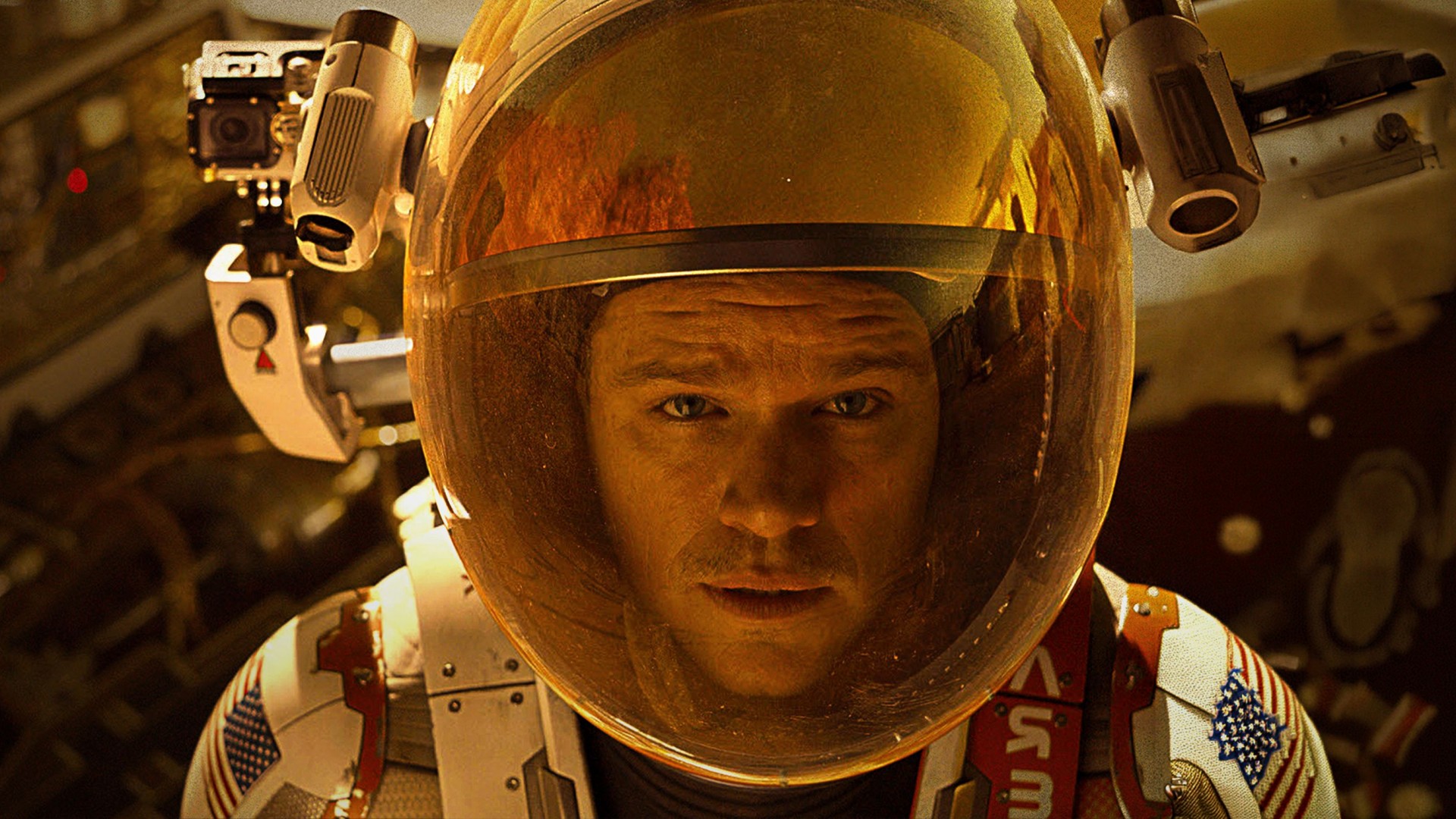
10 Easter Eggs and References in The Martian
- #029
Contains a major spoiler — show
In the film's final section, a Chinese astronaut is later shown on a mission to Mars. This is a reference to a plotline that appears in the novel but is not shown in the film, in which the China National Space Agency arranges to take a Chinese astronaut on the next Mars mission in exchange for the use of booster rockets.
- #084
About 20 sets were built, which is not many compared with other films, but they were far more "technical." To put this in perspective against other Sir Ridley Scott films, he used 70 sets on Exodus: Gods and Kings (2014) and more than 100 on American Gangster (2007).
- #087
Contains a major spoiler — show
In the novel Mark Watney accidentally destroys Pathfinder's circuitry, thereby eliminating the communication vector with NASA. The entire journey to the Ares 4 MAV took place in a complete blackout, apart from one-way communication from Mark to NASA. This was done using visual Morse code with Martian rocks. Mark "spelled out" his message while waiting for the batteries to charge during daylight hours. Toward the end of the film, the NASA administrator says that "limited contact with Watney" potentially refers to this event.
- #114
Contains a major spoiler — show
The idea of using a gravity assist to send the Hermes back to Mars is similar to the flight plan used to bring the Apollo 13 astronauts home after their spacecraft was disabled. In the latter case, the Moon was used to accelerate the ship and send it back toward Earth in order to save fuel and speed up the return journey.
- #118
Just before leaving the Hab for the last time, Mark Watney goes outside without his helmet and then comes back to get it. This is a reference to 2001: A Space Odyssey (1968), in which Dave Bowman leaves his helmet behind while going to rescue his crewmate, making a nearly fatal mistake.
- #121
Contains a major spoiler — show
In the book, Watney recounts how, right after being rescued, he screamed "like a little girl" from the injury he suffered during his ascent from Mars, and turned down his microphone so the others wouldn't hear him. He then says, "What they say is true. No one can hear you scream like a little girl in space." This is a reference to the tagline of Alien (1979): In space, no one can hear you scream. That film was also directed by Sir Ridley Scott. Both films also earned Scott a Saturn Award for Best Director.
- #129
Contains a major spoiler — show
The film and the book make small references to each other regarding their differences. In the film, Teddy interrupts Bruce and tells him that when they decided to build the first Iris probe, he would have said the overtime alone would be a nightmare. That is exactly what Bruce says in the book. In the book's closing monologue, Mark Watney says that if this were a movie, everyone would be waiting for him at the airlock to high-five him, and that is exactly what happens in the film.
- #141
Pre-release research revealed that many people thought The Martian would be a horror film and that the title referred to an alien rather than to Mark Watney. This was probably due in part to director Ridley Scott's association with the Alien series and Prometheus.
- #157
Contains a major spoiler — show
Matt Damon shrugs his shoulders to the music while playing "Hot Stuff," which he described as "at least a disco" song. That song and shoulder shrug were in The Full Monty, a nod from The Martian to the men queuing at the Job Centre in that film.
- #165
The film references the Chinese space program but not the Russian (and earlier Soviet) space program. China's space program is in fact Russia's space program and still uses similar modules to this day. In the book, the only mention of the Soviet space program is a rather unflattering reference to the "module" Watney has to use to leave Mars and its lack of shielding. This is so even though Yuri Gagarin, the first human in space, was Russian/Soviet.
Sources & editorial notes
Reference databases
Sources for the entries on this page
- IMDb IMDb
Information from external sources is independently selected, consolidated and edited by Arka Evren. Sources are listed for verification and further reading. Encyclopedia text is used under its licence (CC BY-SA). How we work