
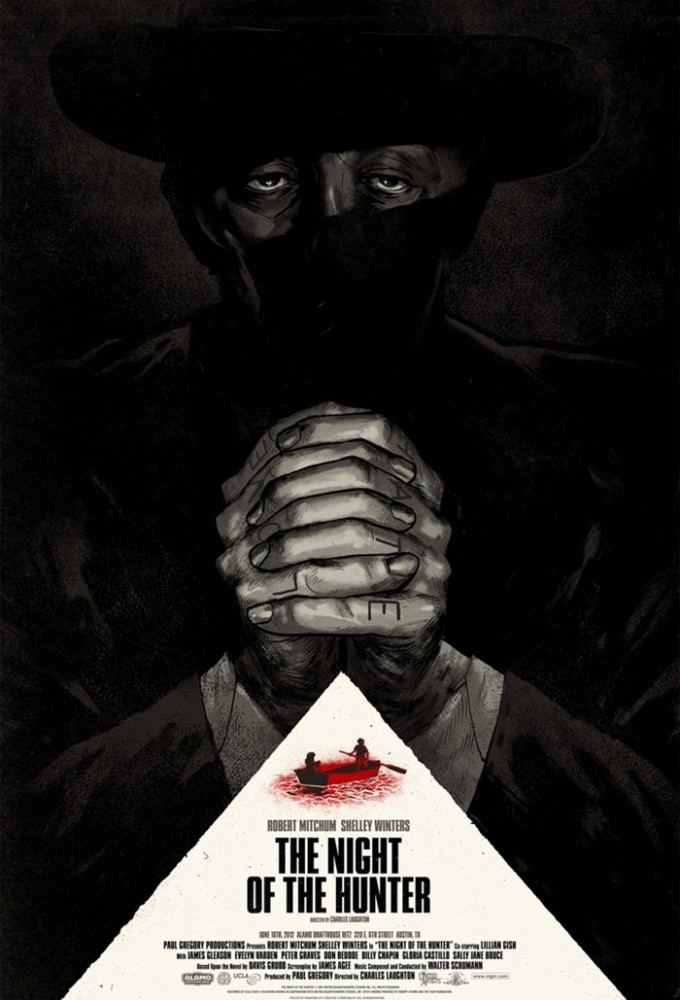
FILM · 1955 · USA
The Night of the Hunter
- Directed by
- Charles Laughton
- Runtime
- 93 min
- Studio
- Paul Gregory Productions, United Artists
153 archived facts 6 topics 1 source Last reviewed Nov 2026
In Depression-era West Virginia, a serial-killing preacher hunts two young children who know the whereabouts of a stash of money.

153 Interesting Facts About The Night of the Hunter
Interesting Facts (22)
- #001
The scene in which Powell rides a horse in the distance was actually a dwarf on a pony, filmed with forced perspective.
- #002
Robert Mitchum, who in later life was generally indifferent to such matters, said that Charles Laughton was his favorite director and stated that among the films he appeared in, this was his favorite director.
- #003
The underwater shot of Shelley Winters' corpse in the Ford was the last footage filmed for the movie. After seeing the finished film, actor Don Beddoe was so convinced that he thought it was not a dummy but Winters holding her breath.
- #004
Although weak critical reviews are often cited as the reason Charles Laughton never directed another feature film, Laughton said he preferred directing in the theater. There you could constantly change and improve the production (by adding lines, changing the lighting and sets), but a film, once made, could never be changed.
- #005
It was reportedly Robert Mitchum himself who came up with the idea of hanging upside down from his bunk. Charles Laughton liked the idea, and it was shot that way.
- #006
Lillian Gish feared that Charles Laughton and Robert Mitchum might undermine Powell's evil. Laughton explained to her, half-jokingly, that he did not want to ruin Mitchum's future career by pushing him to play pure evil; however, the touches of humor in the character actually serve to play up the preacher's essentially ridiculous and deranged psychology. And Mitchum's borderline clowning makes the children's escape and their eventual triumph over him more plausible.
- #007
Kitty White was an acquaintance of Davis Grubb, who wrote the novel on which the film is based. Charles Laughton was looking for a vocalist to sing composer Walter Schumann's lullaby, and Grubb suggested that Laughton listen to White sing at a nightclub. He did, and White was chosen to sing the unforgettable lullaby.
- #008
François Truffaut referred to the film as "an experimental film that truly experiments."
- #009
Shelley Winters' last line just before her throat is cut, "Bless us all," was deleted from the final film.
- #010
The original script called for Willa's hair to cover the gash in her throat in the underwater scene, but Charles Laughton chose to shoot it as Uncle Birdie sees it.
- #011
The scene in which the children escape by boat, leaving the angry, knife-wielding preacher in the depths of the water, was actually shot on a soundstage. Because the level was quite shallow, Robert Mitchum crouched in the water.
- #012
After first learning that Shelley Winters had won the role of Willa Harper, Robert Mitchum said: "She looks like a wasted girl from West Virginia, like me, and her voice sounds like it. The only thing she'll do convincingly is float in the water with her throat cut."
- #013
One day Robert Mitchum arrived on the film set drunk, and producer Paul Gregory told him he was in no condition to work. Mitchum became angry at this and walked over to the producer's Cadillac, opened the front door and urinated on the front seat.
- #014
Novelist Stephen King has said that, in his view, The Night of the Hunter is the most frightening film of all time.
- #015
According to novelist Davis Grubb, Charles Laughton wanted the film to closely resemble the mental images the author had while writing the book. In Lee Server's biography "Robert Mitchum: Baby, I Don't Care," the author stated that Laughton "learned that Grubb was an amateur sketch artist who liked to draw scenes and caricatures of the people he created in his fiction." Seeing the value of such visualizations firsthand from the author's own hand, Laughton sent him to Hollywood and called on him throughout the production to beg for more; he noted that Grubb sometimes drew the exact expression on a character's face. The author made more than a hundred such pen-and-ink drawings for the film. Grubb said, "Perhaps I may immodestly state that I am not only the author of the novel from which the screenplay was adapted, but also the actual set designer."
- #016
The money used to depict the stolen $10,000 is Mexican 10- and 100-peso notes. The banknotes had last been printed in 1914 and had become worthless by the time the film was made.
- #017
The song "Pretty Fly" was sung live and a cappella by Sally Jane Bruce while filming the river scene, but because of her very fragile voice, her tendency to rush the phrases and the noise of the river, it was replaced by a studio recording made by Betty Benson.
- #018
An earlier presentation stated that, due to inflation, $10,000 would be worth $110,000 in 2022, but that figure is based on 1955, the year the film was released. The film is set around the Depression of 1930, and so the money's modern equivalent would be roughly double, at about $220,000.
- #019
Robert Mitchum initially suggested to Charles Laughton that they shoot the film in authentic Appalachian locations, but the director could not afford location shooting. He also wanted to create the film's distinctive look on Hollywood sound stages, and he found what he was looking for at Pathe, Republic Studios and Rowland V. Lee's farm in the San Fernando Valley.
- #020
Emmett Lynn was originally cast and filmed in the role of Birdie Steptoe, but director Charles Laughton replaced him with James Gleason and reshot all of Lynn's scenes.
- #021
According to Robert Mitchum's autobiography, Mitchum openly despised Shelley Winters throughout the filming, and he later claimed that in the scene where her character's corpse is seen dead underwater, he wished Charles Laughton had actually used Winters.
- #022
Charles Laughton later had passages from the book on which the film is based recorded with musical accompaniment from the film's score.
Production Story (69)
- #023
According to Philippe Garnier's book included in the Blu-ray package, United Artists was not very warm toward director Charles Laughton and producer Paul Gregory. Although "Hunter" had a 36-day shooting schedule, UA allowed Stanley Kramer's Not as a Stranger (1955), starring Robert Mitchum, to begin shooting before "Hunter" was finished. Some scenes, such as Mitchum's arrest by the police, had not been shot when Mitchum had to leave to start the Kramer film, and these scenes had to be filmed at a time when Mitchum was briefly on leave, which contributed to this film going over budget.
- #024
Producer Paul Gregory and Charles Laughton gave key crew members such as cinematographer Stanley Cortez a 1 percent share of the film on top of their salaries. This was an almost unheard-of gesture in the industry. Gregory and Laughton said it was done not to encourage artists but to reward their art. They went ahead with the decision despite objections from United Artists.
- #025
Although the reason Charles Laughton never made another feature is usually attributed to bad reviews, he himself stated that he preferred directing for the theater. In the theater, changes could be made constantly; lines could be added and lighting and sets adjusted. In cinema, by contrast, once the work was finished, everything froze.
- #026
Kitty White was an acquaintance of Davis Grubb, the author of the novel on which the film was based. While Charles Laughton was searching for a vocalist to perform composer Walter Schumann's lullaby, Grubb suggested he listen to White at a nightclub. Laughton listened, and White was chosen to sing that eerie lullaby.
- #027
The line 'Bless all of us' that Shelley Winters says just before her throat is cut was removed from the film in the final cut.
- #028
According to Philippe Garnier's book in the Blu-ray package, United Artists showed little respect for director Charles Laughton and producer Paul Gregory. Although 'Hunter' had a 36-day shooting schedule, UA allowed filming on the Stanley Kramer film 'Not as a Stranger' (1955), starring Robert Mitchum, to begin before 'Hunter' was finished. Some scenes, such as Mitchum's arrest by the police, had not yet been shot, and when Mitchum had to go to the set of Kramer's film, these scenes were shot in his spare time, which led to the budget being exceeded.
- #029
Robert Mitchum's autobiography contains many fabricated anecdotes about the making of the film; in one of them, it is claimed that Charles Laughton did not much like children and hated directing them so much that Mitchum directed the children in several scenes. In reality, Laughton was obsessed with every detail on his first film; he strove to get the right performance from every actor, including the children. This meticulousness even led him to fire an actor whose scenes had all been shot and reshoot the role with someone else.
- #030
According to Lee Server's biography 'Robert Mitchum: Baby, I Don't Care,' Mitchum's commitment to Laughton and the project began to wane in the final week of the 36-day shoot. Producer Paul Gregory said, 'Laughton had a sharp weakness for Mitchum, and Mitchum said a lot about how much he loved Charles, but he was using drugs, he was drunk and whatever state he was in; Charles sometimes couldn't get him in front of the camera. So he put us through a lot. The film went two hundred thousand dollars over budget.' According to Gregory, Mitchum sometimes resembled the character he was playing in a disturbing way: 'He was charming. He was a devilish son of a bitch with a lot of charm. To be honest, Mitch scared me a little. I was always on edge. Most of the time he was in some state and you could never predict what he would do. He would get drunk or fight with the valet he carried around with him, kicking him here and there. I came from the theater world and I had never seen anyone like that.'
- #031
To promote the film, Robert Mitchum and Shelley Winters appeared on The Ed Sullivan Show in the spring of 1955. In her autobiography, Winters recounted that the stress of live television drove Mitchum to drink and left her 'shrill and numb.' The pair put on their costumes and, with Mitchum showing the words 'love' and 'hate' on his hands, performed their scene rather badly. Winters said she stammered and slipped into a Brooklyn accent, while Mitchum spoke so softly that the microphones were turned all the way up and 'millions of viewers in the US could hear our stomachs rumbling.' According to Winters, Mitchum raised the wrong hand to emphasize a point about love and hate in the scene, and the audience burst out laughing.
- #032
According to novelist Davis Grubb, Charles Laughton wanted the film to closely resemble the images the author had envisioned in his mind while writing the book. As noted in Lee Server's biography, Laughton learned that Grubb was an amateur sketch artist who loved to draw scenes and caricatures of the characters he conceived. Recognizing the value of these visualizations by the author's hand, Laughton had them sent to Hollywood and made pleading phone calls for more throughout the production; he even sometimes asked Grubb to draw the exact facial expression he had in mind for a particular scene. The author produced more than a hundred pencil drawings for the film. Grubb said, 'Perhaps immodestly, I can say that I was not only the author of the novel from which the screenplay was adapted, but also the real set designer.'
- #033
Robert Mitchum initially suggested to Charles Laughton that the film be shot in authentic Appalachian Mountain locations, but the director did not have the budget for location shooting. He also wanted to create the film's distinctive look in Hollywood studios, and he found what he was looking for at Pathe, Republic Studios and Rowland V. Lee's ranch in the San Fernando Valley.
- #034
Emmett Lynn was initially cast and shot for the role of Birdie Steptoe, but director Charles Laughton replaced him with James Gleason and reshot all of Lynn's scenes.
- #035
Charles Laughton later made a recording in which he read passages from the book on which the film was based, accompanied by the film's score.
- #036
Reports that screenwriter James Agee wrote an incomprehensible script were proven false when its first draft was discovered in 2004. Though this 293-page document was excessively long, as first drafts often are, it was scene for scene the very film Laughton directed. The reports that Agee was fired, particularly those in Robert Mitchum's autobiography, were also unfounded. Although Laughton gritted his teeth at such a massive text with only five weeks to go before shooting began, he calmly renewed Agee's contract and asked him to cut the text in half; after lengthy efforts at persuasion, Agee did so. Laughton had shown himself to be a brilliant script editor in his theater work ('Galileo', 'The Caine Mutiny Court-Martial', etc.); he could persuade even the most stubborn and proud writer to make the necessary cuts, and he succeeded with Agee as well. Later, apparently at Mitchum's request, Agee visited the set to resolve a disagreement between the star and Laughton. Letters and documents found in the archive of Agee's agent Paul Kohner confirm this; Simon Callow's BFI book on 'The Night of the Hunter', written by Laughton's biographer, meticulously corrects this part of the record. [It should be noted, however, that in his 1987 Laughton biography, Callow made obvious errors, such as claiming that Laughton wrote the script himself and, thinking Agee was merely a veteran Hollywood writer, stole the credit. He even repeated this error while presenting the film's television broadcast.] Agee's first draft may eventually be published, but it has already been read by scholars, above all Prof. Jeffrey Couchman of Columbia University, and Couchman published his findings in an article titled 'Credit Where Credit Is Due'. Defending Agee's moral right to the screenplay credit does not cast a shadow on Laughton's greatness as a director - it is clear that he was a master with writers as much as with actors - but while Agee's contribution to 'The Night of the Hunter' is of primary and lasting importance, for years he was belittled and even slandered (especially in Mitchum's autobiography).
- #037
Charles Laughton was so disappointed by the film's poor reception, both critically and commercially, at its first showing that he swore never to direct a film again, and indeed he never did. The next film he planned to direct was to be an adaptation of 'The Naked and the Dead'.
- #038
The scene showing the townspeople entering Spoon's store after watching a film is the only complete scene that was actually shot and later cut entirely.
- #039
Laughton wrote the script himself, despite never having written a screenplay before.
- #040
The film failed at the box office and broke Laughton's heart, but today it is regarded as a masterpiece.
- #041
Charles Laughton's agent, Paul Gregory, bought the film rights to the book before it was even published, and the idea of Charles directing it was his as well.
- #042
The script was 350 pages long and was a faithful transcription of every small detail in the book.
- #043
The underwater shot of Shelley Winters's corpse inside the Ford was the last scene filmed for the movie. When actor Don Beddoe watched the finished film, he found it so convincing that he thought he was looking not at a dummy but at Winters holding her breath.
- #044
It is said that Charles Laughton got along well with the boy who played John, but did not get along with the girl in the role of Pearl and sometimes shouted at her. Because Laughton kept the camera running after scenes had ended, the camera often caught the girl's reactions to him. Some of these outtakes were used in the final cut as reaction shots to the Preacher character.
- #045
The film's cinematographer, Stanley Cortez, had previously worked on Orson Welles's masterpiece The Magnificent Ambersons (1942). Years after this film, he said that of all the directors he had worked with, only two understood light, that "indescribable, incredible thing": Welles and Laughton.
- #046
The original script called for Willa's hair to cover the cut on her throat in the underwater scene, but Charles Laughton chose to shoot it as Uncle Birdie Day sees it.
- #047
The underwater sequence with Shelley Winters's dummy was shot in the studio tank at Republic Pictures, where John Wayne had filmed Wake of the Red Witch (1948). The eerie images were captured by an underwater cameraman wearing a scuba suit and forced to hold a camera attached to a hook. The tank at Fox was used initially, but it was abandoned because the paint in it had peeled off and the water was not clear.
- #048
The iris shot used in the film was the first in an American live-action film since cinematographer Stanley Cortez used it in The Magnificent Ambersons (1942).
- #049
Immediately after the 'leaning' duet between Harry Powell and Rachel Cooper, an owl appears on a tree branch, then a rabbit, then the owl again as if looking at the rabbit, and then a black string appears running from the owl's neck up off the top of the screen. Watched at normal speed, the owl appears to swoop down on the rabbit; but in slow motion it becomes clear that the string is pulled, knocking the owl off the branch and causing it to flap its wings.
- #050
Although Robert Mitchum was generally indifferent to such matters throughout his career, years later he said that Charles Laughton was his favorite director and that this film was his favorite among the productions he had appeared in.
- #051
When Lillian Gish asked Charles Laughton at their first meeting why he wanted her for the role, Laughton replied, "When I first went to the cinema, people sat bolt upright in their seats and leaned forward. Now they sprawl back, eating candy and popcorn. I want them to sit up straight again."
- #052
Charles Laughton regarded Robert Mitchum as "one of the best actors in the world" and described his private personality, so different from his public image, in Esquire magazine: "All that tough talk is a curtain, you know. He's a well-read, gentle, courteous man; he has wonderful manners and speaks beautifully when he wants to. He's a sensitive person and a complete gentleman. He's actually extremely shy." While Laughton generally could not be at ease with overly macho men, he was utterly comfortable with his leading man.
- #053
Robert Mitchum wanted the role of the preacher very much. The moment during the audition that impressed Charles Laughton most was when Mitchum, describing the character as "a diabolical shit," instantly responded, "Here I am!"
- #054
Shelley Winters said this film was "the most thoughtful and measured performance I gave in my career."
- #055
Lillian Gish was worried that Charles Laughton and Robert Mitchum were downplaying Powell's evil. Laughton explained to her, half-jokingly, that he did not want to push Mitchum into playing the character as wholly evil and thereby ruin his future career; but the touches of humor in the character actually served to emphasize the preacher's essentially ridiculous and warped psychology. Mitchum's borderline clowning also made the children's escape and their eventual triumph over him more believable.
- #056
When Robert Mitchum learned that Shelley Winters had won the role of Willa Harper, he said, "She looks and talks like a worn-out West Virginian girl, just like me. The only scene she could convincingly play would be floating in the water with her throat cut."
- #057
At her brother Billy Chapin's funeral, Lauren Chapin said she was surprised that, despite her leading role in the film, she was billed only eighth in the opening credits.
- #058
According to Robert Mitchum's autobiography, Mitchum openly belittled Shelley Winters throughout the shoot and later claimed he wished Charles Laughton had actually used Winters in the scene where her character's corpse is seen underwater.
- #059
Charles Laughton first offered the role of Harry Powell to Gary Cooper; Cooper declined it on the grounds that it could damage his career.
- #060
Michael Chapin (b. 1936) has an uncredited speaking role in the film as Ruby's Boyfriend and is the older brother of Billy Chapin (1943-2016), who played John Harper in a major supporting role. The two brothers' acting careers are remarkably similar: this film was Michael's last and Billy's second-to-last; both brothers had their first uncredited screen experience in 1944 (in different films) and received their final acting credits in 1959 (on different TV programs).
- #061
Robert Mitchum tried to explain to Billy Chapin that he needed to understand his character and his relationship with the preacher better. Chapin, notorious for his mischief, replied, "That's probably why I just won the New York Film Critics Circle Award." Charles Laughton roared, "Get that child away from me!" and from that moment on, Mitchum patiently directed the boy in their scenes together.
- #062
According to an April 1954 Hedda Hopper column, Shelley Winters's rivals for the role of Willa were Anne Baxter and Grace Kelly; Hopper claimed that "these three beauties... all sex experts, are besieging [''Night of the Hunter'' producer] Paul Gregory for the film's female lead."
- #063
Producer Paul Gregory and Charles Laughton gave key crew members such as cinematographer Stanley Cortez a 1 percent share of the film on top of their salaries. This was an almost unheard-of gesture in the industry. Gregory and Laughton said it was done not to motivate the artists but to reward their art. They went ahead with the decision despite United Artists' objections.
- #064
Although Charles Laughton's never directing a feature again is generally attributed to bad reviews, he himself stated that he preferred directing for the theater. In the theater, changes could be made constantly, lines could be added and lighting and sets adjusted. In cinema, by contrast, once the work was finished everything froze.
- #065
Kitty White was an acquaintance of Davis Grubb, the author of the novel on which the film is based. When Charles Laughton was looking for a vocalist to perform composer Walter Schumann's lullaby, Grubb suggested he listen to White at a nightclub. Laughton listened, and White was chosen to sing that eerie lullaby.
- #066
The line "Bless us all," which Shelley Winters says just before her throat is cut, was removed from the film in the final cut.
- #067
According to Philippe Garnier's book in the Blu-ray package, United Artists showed little respect for director Charles Laughton and producer Paul Gregory. Although 'Hunter' had a 36-day shooting schedule, UA allowed shooting on the Stanley Kramer film 'Not as a Stranger' (1955), starring Robert Mitchum, to begin before 'Hunter' was finished. Some scenes, such as Mitchum's arrest by the police, had not yet been shot, and when Mitchum had to go to the set of Kramer's film, these scenes were shot in his spare time, which led to the budget being exceeded.
- #068
Robert Mitchum's autobiography contains many fabricated anecdotes about the making of the film; one of them claims that Charles Laughton disliked children so much and hated directing them so much that Mitchum directed the children in several scenes. In reality, Laughton was obsessed with every detail on his first film; he strove to get the right performance from every actor, including the children. This meticulousness even led him to fire an actor whose scenes had all been shot and reshoot the role with someone else.
- #069
According to Lee Server's biography 'Robert Mitchum: Baby, I Don't Care,' Mitchum's commitment to Laughton and the project began to wane during the final week of the 36-day shoot. Producer Paul Gregory said, 'Laughton had a sharp weakness for Mitchum, and Mitchum said a lot about how much he loved Charles, but he was using drugs, he was drunk, and whatever state he was in, Charles sometimes couldn't get him in front of the camera. So he put us through a lot. The film went two hundred thousand dollars over budget.' According to Gregory, Mitchum sometimes resembled the character he was playing in a disturbing way: 'He was charming. He was a devilish son of a bitch with a lot of charm. To be honest, Mitch scared me a bit. I was always on edge. Most of the time he was in some state and you could never predict what he would do. He would get drunk or fight with the valet he carried around with him, kicking him here and there. I came from the theater world and I had never seen anyone like that.'
- #070
To promote the film, Robert Mitchum and Shelley Winters appeared on The Ed Sullivan Show in the spring of 1955. In her autobiography, Winters recounted that the stress of live television drove Mitchum to drink and left her 'shrill and numb.' The pair put on their costumes and — with Mitchum displaying the words 'love' and 'hate' on his hands — performed their scene rather badly. Winters said she stammered and slipped into a Brooklyn accent, while Mitchum spoke so softly that the microphones were turned all the way up and 'millions of viewers across the US could hear our stomachs rumbling.' According to Winters, Mitchum raised the wrong hand to emphasize a point about love and hate on stage, and the audience burst out laughing.
- #071
According to novelist Davis Grubb, Charles Laughton wanted the film to closely resemble the images the author had envisioned in his mind while writing the book. As noted in Lee Server's biography, Laughton learned that Grubb was an amateur sketch artist who loved to draw scenes and caricatures of the characters he conceived. Recognizing the value of these visualizations from the author's hand, Laughton had them sent to Hollywood and made pleading phone calls for more throughout the production; he even sometimes asked Grubb to draw the exact facial expression he had in mind for a particular scene. The author produced more than a hundred pencil drawings for the film. Grubb said, 'Perhaps immodestly, I can say that I was not only the author of the novel from which the screenplay was adapted, but also the actual set designer.'
- #072
Robert Mitchum initially suggested to Charles Laughton that the film be shot in authentic Appalachian Mountain locations, but the director did not have the budget for location shooting. He also wanted to create the film's distinctive look in Hollywood studios, and he found what he was looking for at Pathe, Republic Studios and the Rowland V. Lee ranch in the San Fernando Valley.
- #073
Charles Laughton later made a recording in which he narrated passages from the book on which the film was based, accompanied by the film's score.
- #074
Reports that screenwriter James Agee had written an incomprehensible screenplay were proven false when his first draft was found in 2004. Although this 293-page document was excessively long, as is common in first drafts, it was scene for scene the very film Laughton directed. Reports that Agee was fired, particularly those in Robert Mitchum's autobiography, were also unfounded. Although Laughton gritted his teeth at such a massive text with only five weeks to go before shooting began, he calmly renewed Agee's contract and asked him to cut the text in half; after lengthy persuasion, Agee did so. Laughton had proven himself a brilliant script editor in his theater work ('Galileo,' 'The Caine Mutiny Court-Martial,' etc.); he could persuade even the most stubborn and proud writer to make the necessary cuts, and he achieved this with Agee as well. Later, apparently at Mitchum's request, Agee visited the set to resolve a disagreement between the star and Laughton. Letters and documents found in Agee's agent Paul Kohner's archive confirm this; Simon Callow's BFI book on 'The Night of the Hunter,' written by Laughton's biographer, meticulously corrects this part of the record. [It should be noted, however, that in his 1987 Laughton biography, Callow made blatant errors, such as claiming that Laughton wrote the screenplay himself and usurped the credit, thinking Agee was merely a senior Hollywood writer. He even repeated this error while presenting the film's television broadcast.] Agee's first draft may eventually be published, but it has already been read by scholars, foremost among them Prof. Jeffrey Couchman of Columbia University, and Couchman published his findings in an article titled 'Credit Where Credit Is Due.' Defending Agee's moral right to the screenplay credit does not cast a shadow on Laughton's greatness as a director — it is clear that he was a master with writers as much as with actors — but Agee, whose contribution to 'The Night of the Hunter' was of primary and lasting importance, was belittled and even slandered for years (especially in Mitchum's autobiography).
- #075
Charles Laughton was so disappointed that the film was poorly received both critically and commercially upon its initial release that he swore never to direct a film again, and indeed he never did. The next film he planned to direct was to be an adaptation of 'The Naked and the Dead.'
- #076
The scene showing the townspeople entering the Spoon store after watching a film is the only complete scene that was actually shot and then cut entirely.
- #077
Laughton wrote the screenplay himself, despite never having written one before.
- #078
Charles Laughton's agent, Paul Gregory, bought the film rights to the book before it was even published, and the idea of having Charles direct it was his as well.
- #079
The screenplay was 350 pages long and was a faithful, detail-for-detail adaptation of every small element in the book.
- #080
The Dutch-born American serial killer Harry Powers (born Herman Drenth) is the inspiration for the Preacher character in the film.
- #081
François Truffaut said of the film, "a truly experimental film."
- #082
The crowd shouting "Bluebeard!" in the courtroom scene is a reference to a French folk tale about a man who marries several women and kills them.
- #083
Novelist Stephen King says that in his eyes this is the most frightening film of all time.
- #084
Mexican 10- and 100-peso banknotes were used to represent the 10,000 dollars stolen in the film; these banknotes were last printed in 1914 and were worthless at the time the film was made.
- #085
A previous entry stated that 10,000 dollars would be worth 110,000 dollars in 2022 when adjusted for inflation, but that figure is based on 1955, the year the film was released; however, since the film is set during the Great Depression, around 1930, the money's present-day equivalent is roughly twice that, or 220,000 dollars.
- #086
The film's Swedish title spoils the film by revealing where the money is hidden: Trasdocka literally means Rag Doll (Pearl's toy).
- #087
It was included, with the song "Leaning on the Everlasting Arms," on the American Film Institute's 2004 list of 400 films nominated for the 100 best scores in cinema history.
- #088
The pocket knife with which Harry Powell (Robert Mitchum) kills Willa (Shelley Winters) belonged to the novel's author, Davis Grubb; Grubb had found the knife while walking along the Ohio River in his home state of West Virginia. The name Harry Powell was engraved on the knife, and Grubb used that name for his novel's protagonist.
- #089
It was included in the book "1001 Movies You Must See Before You Die," edited by Steven Schneider.
- #090
In the Spanish version, the translators changed the girl's name from Pearl to May, perhaps because it is difficult to pronounce in Spanish.
- #091
After the stolen money is quickly hidden again by John, two banknotes cut into the shape of paper figures fly all the way to the preacher's feet.
Behind the Scenes (16)
- #092
Producer Paul Gregory and Charles Laughton brought in key crew members such as cinematographer Stanley Cortez, and each of them had a 1% share of the film. This was given to them on top of their salaries, something that is never done. Gregory and Laughton said this was done not to incentivize artists but to reward them for their art. It was done over the objections of United Artists.
- #093
The iris shot used in the film was the first iris shot in American live-action films since cinematographer Stanley Cortez used one in The Magnificent Ambersons (1942).
- #094
The scene in which Powell rides a horse in the distance was actually shot with a dwarf on a pony; a forced perspective was used to create the illusion.
- #095
The underwater shot of Shelley Winters's corpse inside the Ford was the last scene filmed for the movie. When actor Don Beddoe watched the finished film, he found it so convincing that he thought what he was seeing was not a dummy but Winters holding her breath.
- #096
It is said that Charles Laughton got along well with the boy who played John, but did not get along with the girl in the role of Pearl and sometimes shouted at her. Because Laughton kept the camera running after scenes ended, the camera often caught the girl's reactions to him. Some of these outtakes were used in the final cut as reaction shots to the Preacher character.
- #097
It is said that Robert Mitchum himself came up with the idea of hanging upside down in the doorway. Charles Laughton liked the idea and the scene was shot that way.
- #098
The film's cinematographer, Stanley Cortez, had previously worked on Orson Welles's masterpiece The Magnificent Ambersons (1942). Years after this film, he said that of all the directors he worked with, only two understood light, that 'indescribable, incredible thing': Welles and Laughton.
- #099
The original script called for Willa's hair to cover the cut on her throat in the underwater scene, but Charles Laughton chose to shoot it as Uncle Birdie sees it.
- #100
The underwater sequence with Shelley Winters's dummy was shot in the studio tank at Republic Pictures, where John Wayne was filming Wake of the Red Witch (1948). The eerie images were captured by an underwater cameraman wearing a scuba suit and forced to hold a camera attached to a hook. The tank at Fox was used initially, but it was abandoned because the paint in it had peeled off and the water was not clear.
- #101
The iris shot used in the film was the first in American live-action films since cinematographer Stanley Cortez used it in The Magnificent Ambersons (1942).
- #102
The scene in which the children escape by boat and leave the knife-wielding preacher raging chest-deep in the water was actually shot in a sound studio. Robert Mitchum was crouching in the water because the water level was quite shallow.
- #103
One day Robert Mitchum came to the set drunk and producer Paul Gregory told him he was in no condition to work. Taking offense, Mitchum walked over to the producer's Cadillac, opened the front door and urinated on the front seat.
- #104
The song 'Pretty Fly' was sung live and a cappella by actress Sally Jean Bruce during the shooting of the river scene; however, because her voice was too fragile, she tended to rush the phrases, and the river was noisy, it was replaced with a studio recording by professional singer Betty Benson.
- #105
The main underwater footage in a critical scene was shot not by cinematographer Stanley Cortez or one of the camera crew, but by the film's art director, Hilyard M. Brown.
- #106
Immediately after the 'leaning' duet between Harry Powell and Rachel Cooper, an owl appears on a tree branch, then a rabbit, then the owl again as if looking at the rabbit, and then a black string appears from the owl's neck extending to the top of the screen. Watched at normal speed, the owl appears to swoop down on the rabbit; but in slow motion it becomes clear that the string was pulled, knocking the owl off the branch and causing it to flap its wings.
- #107
This film was one of the first productions to use a camera mounted on a helicopter.
Characters & Cast (24)
- #108
At their first meeting, Lillian Gish asked Charles Laughton why he wanted her for the role, and he replied: "When I first went to the cinema, people sat upright in their seats and leaned forward. Now they throw their heads back and eat candy and popcorn. I want them to sit upright again."
- #109
Robert Mitchum's autobiography contains many false accounts of the making of the film; in one of them, it is said that Charles Laughton had no great love for children and hated directing them in this film so much that Robert Mitchum found himself directing the children in several scenes. In reality, Laughton was obsessed with every aspect of his first feature film, including getting every actor's performance (even the children's) right, which would lead him in particular to fire an actor after all his scenes had been shot and start the role over again with another actor.
- #110
In the eulogy she gave at her brother Billy Chapin's funeral, Lauren Chapin said she was surprised that, despite his leading role in the film, he was billed only eighth in the opening credits.
- #111
Jane Darwell, Ethel Barrymore, Helen Hayes, Agnes Moorehead, Louise Fazenda and Elsa Lanchester were considered for the role of Rachel Cooper.
- #112
Although Robert Mitchum was generally indifferent to such matters throughout his career, years later he said that Charles Laughton was his favorite director and that this film was his favorite among the productions he appeared in.
- #113
When Lillian Gish asked Charles Laughton at their first meeting why he wanted her for this role, Laughton replied, "When I first went to the movies, people sat bolt upright in their seats and leaned forward. Now they sprawl back, eating candy and popcorn. I want them to sit up straight again."
- #114
Charles Laughton regarded Robert Mitchum as "one of the best actors in the world" and described his private personality, so different from his public image, in Esquire: "All that tough talk is a curtain, you know. He is a well-read, gentle, courteous man; he has wonderful manners and can speak beautifully when he wants to. He is a sensitive person and a complete gentleman. He is actually extremely shy." While Laughton generally could not be at ease with overly macho men, he was utterly comfortable with his leading man.
- #115
Robert Mitchum badly wanted the role of the preacher. The moment during casting that impressed Charles Laughton most was when Mitchum, upon describing the character as "a diabolical shit," immediately responded, "Here I am!"
- #116
Shelley Winters said this film was "the most thoughtful and restrained performance I have ever given in my career."
- #117
Lillian Gish worried that Charles Laughton and Robert Mitchum were downplaying Powell's evil. Laughton explained to her, half-jokingly, that he did not want to ruin Mitchum's future career by pushing him to play the part as wholly evil; yet the touches of humor in the character actually served to emphasize the preacher's essentially ridiculous and warped psychology. Mitchum's borderline clowning also made the children's escape and their eventual triumph over him more believable.
- #118
Robert Mitchum's performance was seen as a change of pace for the actor, but Mitchum, known for his reluctance to accept praise for his work, responded, "I didn't change anything but my underwear."
- #119
When Robert Mitchum learned that Shelley Winters had won the role of Willa Harper, he said, "She looks and talks like a beat-up West Virginian girl, as much as I do. The only scene she could convincingly play is floating in the water with her throat cut."
- #120
In her speech at her brother Billy Chapin's funeral, Lauren Chapin said she was surprised that, despite his leading role in the film, he was billed only eighth in the opening credits.
- #121
According to Robert Mitchum's autobiography, Mitchum openly belittled Shelley Winters throughout the shoot and later claimed that Charles Laughton wished he had actually used Winters in the scene where her character's corpse is seen underwater.
- #122
Charles Laughton's first choices for the two adult leads were Gary Cooper and Betty Grable, but both turned the roles down.
- #123
Charles Laughton first offered the role of Harry Powell to Gary Cooper; Cooper declined the part on the grounds that it could damage his career.
- #124
Michael Chapin (b. 1936) has an uncredited speaking role in the film as Ruby's Boyfriend and is the older brother of Billy Chapin (1943-2016), who played John Harper in a major supporting role. The two brothers' acting careers are remarkably similar: this film was Michael's last and Billy's next-to-last; both brothers had their first uncredited screen experience in 1944 (in different films) and received their final acting credits in 1959 (on different TV programs).
- #125
John Carradine and Laurence Olivier were considered for the role of Harry Powell.
- #126
Robert Mitchum tried to explain to Billy Chapin that he needed to understand his character and his relationship with the preacher better. Chapin, notorious for his mischief, replied, "That's probably why I just won the New York Critics Circle Award." Charles Laughton roared, "Get that child away from me!" and from that moment on, Mitchum patiently directed the boy in their scenes together.
- #127
Kathy Garver's feature film debut.
- #128
James Gleason (Uncle Birdie) had appeared with Charles Laughton in Tales of Manhattan (1942).
- #129
Gloria Castillo's feature film debut.
- #130
According to a Hedda Hopper column dated April 1954, Shelley Winters's rivals for the role of Willa were Anne Baxter and Grace Kelly; Hopper claimed that "these three beauties... all sex experts, are besieging [''Night of the Hunter'' producer] Paul Gregory for the female lead of the film."
- #131
Kay Lavelle's last film.
Easter Eggs & References (1)
- #132
During the trial, the crowd chants "Bluebeard!" This is a reference to a French folk tale about a man who marries several women and then kills them.
Deeper Meaning (21)
- #133
The Dutch-born American serial killer Harry Powers (born Herman Drenth) was the inspiration for the Preacher.
- #134
Dutch-born American serial killer Harry Powers (born Herman Drenth) was the inspiration for the Preacher character in the film.
- #135
Charles Laughton described the film as "a nightmarish sort of Mother Goose tale."
- #136
François Truffaut called it "a genuinely experimental film."
- #137
In the courtroom scene, the crowd shouting "Bluebeard!" is a reference to a French folk tale about a man who marries multiple women and kills them.
- #138
Novelist Stephen King says that in his eyes this is the most terrifying film of all time.
- #139
Mexican 10- and 100-peso banknotes were used to represent the $10,000 stolen in the film; these banknotes were last printed in 1914 and were worthless at the time of filming.
- #140
The film was selected for the National Film Registry in 1992 on the grounds that it is "culturally, historically, or aesthetically significant."
- #141
A previous entry stated that $10,000 would be worth $110,000 in 2022 when adjusted for inflation, but that figure is based on 1955, the year the film was released; since the film is set during the Great Depression, around 1930, the amount would be roughly twice that today, or about $220,000.
- #142
The film's Swedish title spoils the movie by revealing where the money is hidden: Trasdocka literally means Rag Doll (Pearl's toy).
- #143
It was included on the American Film Institute's 2004 list of 400 films nominated for the 100 best scores in cinema history, for the song "Leaning on the Everlasting Arms."
- #144
It ranked 34th on the American Film Institute's 2001 list of the "100 Most Thrilling American Films."
- #145
The pocket knife with which Harry Powell (Robert Mitchum) kills Willa (Shelley Winters) belonged to Davis Grubb, the author of the novel; Grubb had found the knife while walking along the Ohio River in his home state of West Virginia. The name Harry Powell was engraved on the knife, and Grubb used that name for his novel's protagonist.
- #146
The film is on Roger Ebert's "Great Movies" list.
- #147
This film is release number 541 in the Criterion Collection.
- #148
The Clash's 1980 album "London Calling" includes the song "Death or Glory," which contains the line "Love 'n' hate tattooed across the knuckles of his hands."
- #149
This film is on Letterboxd's Official Top 250 Narrative Feature Films list.
- #150
It is included in the book "1001 Movies You Must See Before You Die," edited by Steven Schneider.
- #151
In the Spanish version, the translators changed the girl's name from Pearl to May, perhaps because Pearl is difficult to pronounce in Spanish.
- #152
After the stolen money is quickly re-hidden by John, two banknotes cut into paper human figures fly all the way to the preacher's feet.
- #153
The character named Icey Spoon runs an ice cream shop.
Sources & editorial notes
Reference databases
- Wikipedia
- IMDb
Information from external sources is independently selected, consolidated and edited by Arka Evren. Sources are listed for verification and further reading. Encyclopedia text is used under its licence (CC BY-SA). How we work