
FILM · 1987 · USA
The Untouchables
- Directed by
- Brian De Palma
- Runtime
- 119 min
- Studio
- Paramount Pictures, Linson Entertainment
258 archived facts 6 topics 1 source Last reviewed Nov 2026
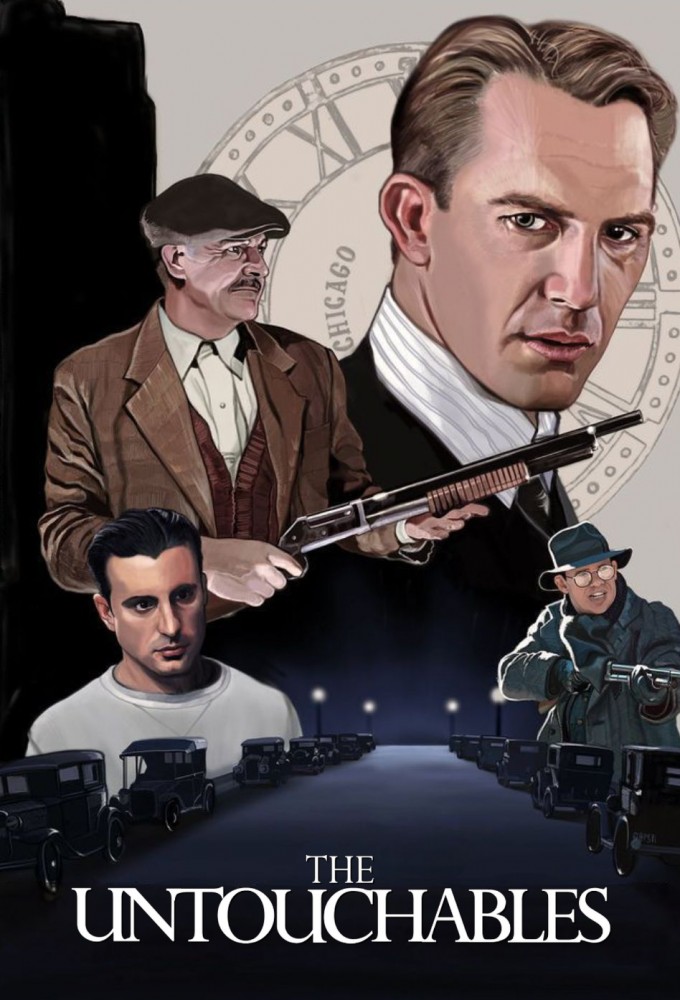
Elliot Ness, an ambitious prohibition agent, is determined to take down Al Capone. In order to achieve this goal, he forms a group given the nickname “The Untouchables”.

258 Interesting Facts About The Untouchables
Interesting Facts (21)
- #001
In one scene, an envelope lands on Eliot Ness's desk. It is assumed to be a bribe, but the amount inside is never revealed. In real life, Al Capone promised Eliot Ness that if he ignored Capone's bootlegging operations, there would be two $1,000 bills (roughly $46,000–$48,000 in 2025) on his desk every Monday morning. Ness refused the bribe and struggled financially in later years. He died at 54 nearly penniless.
- #002
- #003
- #004
The scene in which Al Capone pulls out a baseball bat at a dinner party and suddenly beats one of his men to death is based on an event that took place on May 7, 1929. Two of Capone's most feared hitmen, Albert Anselmi and John Scalise, plotted to kill Capone and take over his gang. Capone heard of this and invited all his friends, including Anselmi and Scalise, to a dinner. In the middle of the party, Capone produced a baseball bat, beat both men to death, and then shot both of them in the head. In a conflicting version of the story, another of Capone's hitmen, Tony "Joe Batters" Accardo, is the one who beat the traitors to death with the bat.
- #005
- #006
- #007
According to director Brian De Palma and producer Art Linson in the DVD documentary, it was Sir Sean Connery's idea to shoot the "blood oath" scene between Ness and Malone in a Catholic church. It was originally to take place on the street (in the same scene that follows the church scene). Connery thought that in Chicago, the only "safe" place where the two characters would make such a commitment to fight Capone would be a church.
- #008
- #009
- #010
- #011
In the original script, Eliot Ness and George Stone fought Capone's gunmen on a stopped train in the final shootout. When Brian De Palma decided that Paramount Pictures would find staging the scene and finding a 1930s-era train too expensive, he designed the shootout on the stairs of Union Station in Chicago.
- #012
- #013
- #014
- #015
The real Frank Nitti did not die in the manner or at the time depicted in this film. When Capone was sent to prison, he took over Al Capone's empire. In 1943, Nitti and other Chicago mob members were charged with extortion. The mob leader blamed Nitti for the charges and told him to take responsibility for all of them. Fearing a long prison sentence because of his claustrophobia, Nitti went drunk to a railway line five blocks from his home and, after missing on the first shot, shot himself in the head with a.38 caliber pistol. His real-life death was depicted in the film Nitti: The Enforcer (1988), in which Anthony LaPaglia played the role of Nitti.
- #016
- #017
The infamous dinner scene was based on an event that took place in Cicero, Illinois, in February 1929, two weeks after the most notorious murder in the history of Chicago's gangland. Unlike in the film, Al Capone executed not one but three disloyal associates who were plotting to assassinate him and take over his criminal empire.
- #018
The film originally had a different ending. It was to include a scene in which the camera holds a close-up of Robert De Niro's face as he warms up for a shave. The camera would then pull up, as in the film's opening scene, to reveal reporters around Capone, but this time Capone is in a prison cell.
- #019
- #020
- #021
Production Story (92)
- #022
Eliot Ness and his role in bringing down Al Capone had been completely forgotten by the time of his death in 1957. No Chicago newspaper published a report of his passing. His heroic fame only began after the posthumous publication of the book The Untouchables, which he wrote with Oscar Fraley, and the television series The Untouchables (1959) adapted from that book.
- #023
According to director Brian De Palma and producer Art Linson in the DVD documentary, the idea to shoot the 'blood oath' scene between Ness and Malone in a Catholic church came from Sean Connery. The scene was originally to take place on the street, but Connery thought that in Chicago, the church was the only 'safe' place for such an oath against Capone.
- #024
- #025
- #026
The close-up of Malone and Ness in the blood oath scene was shot using a split-focus diopter. This uses a semi-convex glass placed in front of the lens to make one half nearsighted and the other farsighted, keeping both the foreground and background sharp. The effect can only be achieved when there is almost no movement of the actors or the camera, and De Palma has used this technique in many of his films to create mystery.
- #027
Brian De Palma took the idea for the train station scene from the classic Odessa Steps massacre sequence in Battleship Potemkin (1925). In that scene too, a baby carriage rolls down the steps, and the sailors caught in crossfire in this film are a tribute to the sailors on the Potemkin. The idea of a baby carriage rolling down the steps had also been seen before in films such as Bananas (1971) and Brazil (1985); Robert De Niro also appeared in Brazil.
- #028
- #029
- #030
- #031
- #032
- #033
The film shows a bridge over a small river in what appears to be the high desert of the West. There is no customs-immigration station on the bridge. In fact, there is no river (or water) boundary along the US-Canada border between Lake of the Woods (Minnesota) and Puget Sound on the Pacific coast. The bridge border crossings in northern Minnesota and Michigan are over much larger rivers, connect two towns and are in forested areas.
- #034
When Ness fires his gun, the gun changes from an M1911A1 to a Star Model B. The Model B is a Spanish clone of the M1911A1. The Model B uses 9mm Parabellum rounds (more reliable as blanks), while the 1911 is.45 ACP. The 9mm was more reliable until shortly after filming on The Untouchables was completed.
- #035
At the end of the film, as Ness clears his desk, a 'Lucky Strike' cigarette pack with a white and red logo is visible. Lucky Strike cigarettes' distinctive dark green pack did not change to white until 1942; the change was made out of a need for a 'modern' design and was presented with a marketing campaign claiming that the copper in the green color was needed for the war effort. In fact, the 'Lucky Strike goes to war!' campaign referred not to the Axis powers but to Camel and Chesterfield.
- #036
- #037
- #038
- #039
- #040
- #041
Sir Sean Connery arrived on set in golf clothes. His close-up was shot and Sean was given the rest of the day off. Afterwards, Andy Garcia and Charles Martin Smith caught up with him and said, "That was very clever, you dropped by for five minutes on your way back from golf and shot your scene, that's it." Connery turned to them and said, "This isn't my first barbecue."
- #042
- #043
Bob Hoskins had initially been signed for the role of Al Capone, but Brian De Palma's first choice, Robert De Niro, became available and the role changed hands. Hoskins still received $200,000 from De Palma "for being a great backup." Hoskins would later tell the anecdote of asking De Palma, "Is there another film you don't want me for?"
- #044
The role of Eliot Ness was offered to Don Johnson, but he turned it down. Johnson's close friend Kevin Costner later took the part. To avoid hurting Costner and casting a shadow over his success, Johnson did not mention for years that the role had been offered to him first. The two appeared together in Tin Cup in 1996.
- #045
Although Sir Sean Connery appeared in more than seventy films, became one of the world's most famous stars and won many awards over a career spanning more than fifty years, including three Golden Globes, he won his only Oscar for his role in this film. Connery, who received the Best Supporting Actor award at the 1988 ceremony, also had this as his only Oscar nomination. Because he officially retired in 2006 and passed away in 2020, this Oscar remained the only award he won for a specific acting role.
- #046
- #047
- #048
- #049
- #050
Actor Billy Drago said in an interview: "The first scene we shot was the one where the little boy gets blown up. While I was waiting outside on the street where the lighting was being set up, an elderly woman came up with a little boy and wanted to take a photo, so I hugged the child. The next day I saw the photo published in the newspaper! And that little boy was Nitti's great-great-grandson."
- #051
- #052
- #053
- #054
- #055
The film became a subject of mockery in the United Kingdom and Ireland for casting Sean Connery as an Irish policeman. Connery's Scottish accent led to the assumption that Americans did not know the difference between the two countries or accents. Connery's winning the Academy Award for Best Supporting Actor at the 1988 Oscars for this role only increased the mockery.
- #056
Actor Billy Drago recalled in an interview: "I had the opportunity to get to know the Nitti family. They still live in the Chicago area, they have markets and businesses: normal businesses; they are no longer connected to the mob! The hotel I was staying in was the hotel owned by Capone and Nitti at the time. While I was in the lobby, the concierge came over and told me the Nitti family would pick me up at 8 o'clock. No one really asked if I wanted to go - it was an offer I couldn't refuse! But it would have been too interesting an adventure to turn down anyway. While I was waiting in the lobby, a limousine pulled up, someone got out and introduced himself as someone working for the Nitti family, and we toured all the blues clubs in Chicago. At each one we were greeted as if royalty had arrived. 'The Nitti family is here!' It was a lot of fun, but they started to make me a little nervous because they gradually began treating me as if I really were Frank Nitti. They had me put my back to the wall so I could see everyone, and all the young Italian lads came up to pay their respects and said, 'So you're playing Uncle Frank, huh? You look good, you look good.' It gave me an idea of how things were and what went on. They weren't bothered by Frank being portrayed as such a bad guy; the legend is too big."
- #057
- #058
- #059
- #060
Several actors in The Untouchables appeared in films about US/Soviet espionage. Kevin Costner played a Russian sleeper agent posing as a US naval officer in No Way Out. Charles Martin Smith played a Russian training American sleeper agents in The Experts. Richard Bradford was a Russian agent trying to rescue American sleeper agents in Little Nikita. Sir Sean Connery played a Russian submarine commander defecting to the US in The Hunt for Red October.
- #061
- #062
- #063
- #064
When Eliot Ness died in 1957, his role in bringing down Al Capone had been completely forgotten; Chicago newspapers did not even report his death. His heroic fame began with the posthumous publication of The Untouchables, which he wrote with Oscar Fraley, and the series The Untouchables (1959) adapted from that book.
- #065
In the original script, the final confrontation was to be Eliot Ness and George Stone clashing with Capone's men on a stopped train. However, when Paramount decided that finding a period train from the 1930s and setting up the scene would be too expensive, Brian De Palma devised the iconic Union Station staircase shootout.
- #066
- #067
Paramount made this film using the film rights to Eliot Ness's autobiography, which it held; those rights had previously been used for the series The Untouchables (1959). Although the studio initially planned the film as an adaptation of the series, director Brian De Palma, producer Art Linson and screenwriter David Mamet chose to add their own interpretation and create an epic feature film inspired by real events.
- #068
- #069
- #070
- #071
Filming on the Brian De Palma-directed prequel 'The Untouchables: Capone Rising' was scheduled to begin in October 2007. Nicolas Cage was to play a young Al Capone, and Gerard Butler was to play the younger version of Sean Connery's character Malone; however, the film ultimately could not be made. Butler had said at Cannes that the script was 'incredible.'
- #072
- #073
- #074
The film does not include Capone's hitmen Anthony Accardo, nicknamed 'Joe Batters,' and 'Machine Gun Jack' McGurn. Accardo had received this nickname from Capone because he killed traitors with a baseball bat; however, Capone had not personally carried out this act. Frank Nitti, meanwhile, was not Capone's chief hitman.
- #075
- #076
- #077
In one scene, an envelope is left on Eliot Ness's desk; it is assumed to be a bribe, but the amount inside is never revealed. In reality, Al Capone had promised Ness that in exchange for turning a blind eye to bootlegging, there would be two $1,000 bills (roughly $46,000-$48,000 in 2025) on his desk every Monday morning. Ness refused this bribe and suffered financial hardship in later years; he died at the age of 54 with virtually nothing to his name.
- #078
- #079
Al Capone pulling out a baseball bat at a dinner and suddenly killing one of his men is based on an event that took place on May 7, 1929. Albert Anselmi and John Scalise, two of Capone's most feared hitmen, had plotted to kill Capone and take over his gang. When Capone got wind of this, he invited all his associates, including Anselmi and Scalise, to a dinner; in the middle of the party, he beat the two of them to death with a baseball bat, then shot them in the head. In a different version of the story, the person who killed the traitors with a bat is recorded as Tony 'Joe Batters' Accardo, another of Capone's hitmen.
- #080
- #081
- #082
- #083
- #084
The real Frank Nitti did not die in the manner or at the time shown in this film. When Capone was sent to prison, Nitti took over the empire. In 1943 Nitti and other Chicago mob members were tried on extortion charges. The mob leader blamed Nitti for the charges and told him to take the fall for all of them. Fearing a long prison sentence because of his claustrophobia, Nitti, drunk, went to the railway five blocks from his home and, after missing with his first shot, shot himself in the head with a.38-caliber pistol. His real death was depicted in the film Nitti: The Enforcer (1988), in which Anthony LaPaglia played Nitti.
- #085
When Ness and the bailiff remove Frank Nitti from the courtroom for carrying a concealed weapon, Nitti produces a "permit" in the form of a 'carte blanche' signed by Chicago Mayor William Thompson. This is a nod to the real relationship between Al Capone and the mayor, described on Wikipedia as 'mutually profitable' (Capone had supported Thompson's election campaigns).
- #086
- #087
The character Oscar Wallace (Charles Martin Smith) was inspired by IRS agent Frank Wilson, who worked to prosecute Capone for income tax evasion. Wilson had been working on this project since 1928 and in real life had almost nothing to do with Ness and the Untouchables. Wilson was not killed by Capone, though it is said that Capone issued a death order for him that was never carried out.
- #088
Before his tax evasion conviction, Capone served 8 months at Eastern State Penitentiary in Philadelphia, Pennsylvania, on a weapons charge. This was in fact arranged by Capone and his mob bosses (among them Capone's childhood friend and Lucky Luciano, one of the founders of American organized crime, and his mentor Johnny Torrio) after the aftermath of the St. Valentine's Day Massacre and his pursuit of fame drew the anger of the leaders of the newly formed National Union.
- #089
When Agent George Stone is introduced, Malone learns that his real name is Giuseppe Petri and that he was born in Italy. In Italian, Giuseppe Petri can literally be translated as 'Joseph Stone'. Only the filmmakers know why the name 'George' was chosen, since that would be 'Giorgio' in Italian.
- #090
- #091
In the finale of the courtroom scene, Capone becomes violently enraged at the verdict, even punching his lawyer. In reality Al Capone accepted the verdict calmly and meekly told the press he was innocent. In fact, although Capone was generally violent and unpleasant when dealing with his rivals and those within his organization, he was very protective of his public image as Chicago's gentle, 'misunderstood philanthropist' and made great efforts to appear refined, polite and well-mannered in public (and when dealing with the press). An outburst in the courtroom (especially in front of the press) as in the film would have been completely contrary to his character.
- #092
- #093
- #094
The Chicago Mafia, also known as the Chicago Outfit, was founded in the early 20th century by a brothel operator named Big Jim Colosimo. He later brought his nephew Johnny Torrio from New York to help him run his prostitution empire and stand up to the local Black Hand extortionists. Torrio also brought with him his young lieutenant and Chicago's future crime king Al Capone. When Torrio suggested that Colosimo get involved in bootlegging, Colosimo refused and was then killed; the murder is alleged to have been ordered by Torrio. From 1920 to 1925 the Chicago Outfit was a dual crime operation, until the rival North Side Gang's attempt on Torrio's life forced him into retirement and left Capone in sole control. To date the Chicago Outfit has had 15 bosses and has been involved in numerous criminal enterprises, from labor union racketeering to skimming Las Vegas casinos.
- #095
- #096
At one point Eliot Ness says that drinking alcohol is illegal. Drinking was never illegal during Prohibition. The 18th Amendment only made the production, transportation and sale of alcoholic beverages illegal. People who had bought alcohol before January 16, 1920 could, and did, continue to drink and serve it privately.
- #097
Frank Nitti did not die after being thrown off the roof of the courthouse by Elliot Ness during Capone's trial. In fact, Nitti was at the time serving 18 months of a 2-year sentence for tax evasion at Leavenworth Prison and would not have been released until six months after Capone entered prison. In reality, Nitti, drunk and desperate, shot himself at a railroad yard in 1943, more than ten years later, rather than testify before the grand jury that was about to try him on extortion charges.
- #098
Although the Chicago Outfit was an Italian-American criminal organization, it did not begin as a traditional Mafia crime family. Capone was of Campanian (Naples) origin, and in the pre-Commission days of organized crime, non-Sicilian criminals, including other Italians like himself, were not admitted to membership. During Capone's era the Outfit was an ethnic mix of Italian/Sicilian, Jewish, Irish and Welsh.
- #099
- #100
When Frank Nitti empties his pockets after being dragged from the courtroom, he puts down a Walking Liberty Half Dollar, a Standing Liberty Quarter and a Mercury Dime, which would have been almost uncirculated at the time, but the coins shown in the film are the kind coin collectors call junk silver, valuable only for their silver content.
- #101
- #102
Contrary to popular belief, Elliot Ness and Al Capone never met in real life. The idea that Ness threatened Capone with a fight, killed Capone's man Frank Nitti and took part in a Prohibition raid with mounted police at the Canadian border (as heavily fictionalized in this film) is absurd.
- #103
Robert De Niro had previously won an Oscar for playing Vito Corleone in The Godfather Part II (1974). Andy Garcia was nominated for an Oscar for playing Vito's grandson Vincent Corleone in The Godfather Part III (1990). In addition, the character Santino 'Sonny' Corleone (James Caan), the father of Garcia's character and the son of De Niro's character, was named after Al Capone's son.
- #104
- #105
- #106
- #107
- #108
- #109
- #110
- #111
- #112
- #113
Behind the Scenes (43)
- #114
The close-up of Malone and Ness in the blood oath scene was shot using a split-focus diopter. This is a half-convex glass placed in front of the actual lens to make one half nearsighted and the other farsighted. As a result, the foreground and background (here both actors) are in focus. This effect can only be achieved when there is almost no actor or camera movement, and it is generally used to create more mystery. Brian De Palma has used it in many of his films.
- #115
- #116
According to director Brian De Palma and producer Art Linson in the DVD documentary, the idea to shoot the 'blood oath' scene between Ness and Malone in a Catholic church came from Sean Connery. The scene was originally going to take place on the street, but Connery thought that in Chicago, the church was the only 'safe' place for such an oath against Capone.
- #117
- #118
- #119
The close-up of Malone and Ness in the blood oath scene was shot using a split-focus diopter. This uses a semi-convex glass placed in front of the lens to make one half nearsighted and the other farsighted, keeping both the foreground and background in focus. The effect can only be achieved when there is almost no movement of the actor or camera, and De Palma has used this technique in many of his films to create mystery.
- #120
- #121
Brian De Palma took the idea for the train station scene from the classic Odessa Steps massacre sequence in Battleship Potemkin (1925). In that scene, too, a baby carriage rolls down the steps, and the sailors caught in crossfire in this film are a tribute to the sailors on the Potemkin cruiser. The idea of a baby carriage rolling down the steps had also been seen before in films such as Bananas (1971) and Brazil (1985); Robert De Niro also appeared in Brazil.
- #122
- #123
- #124
The subjective shot in which the camera enters the hotel, goes up in the elevator to Capone's penthouse and enters the bedroom symbolized the FBI's efforts to bring Capone to justice. While the exterior shots are dark red, everything is very bright and colorful when Capone's bedroom is entered; this symbolizes that Capone is surrounded by blood but none of it touches him.
- #125
- #126
- #127
- #128
The first liquor raid scene was shot on LaSalle Street with period cars and extras. Ness and his men come out of the Rookery Building (between Adams and Quincy) and enter the City National Bank and Trust at 208 S. LaSalle. In the background, the building with the clock is the Chicago Board of Trade at LaSalle and Jackson.
- #129
- #130
- #131
- #132
- #133
The film shows a bridge over a small river in what appears to be the high desert of the West. There is no customs-immigration station on the bridge. In fact, there is no river (or water) border along the US-Canada border between Lake of the Woods (Minnesota) and Puget Sound on the Pacific coast. The bridge border crossings in northern Minnesota and Michigan are over much larger rivers, connect two towns, and are in forested areas.
- #134
When Ness fires his gun, the gun changes from an M1911A1 to a Star Model B. The Model B is a Spanish clone of the M1911A1. The Model B uses 9mm Parabellum rounds (more reliable as blanks), while the 1911 is.45 ACP. The 9mm was more reliable until shortly after filming on The Untouchables ended.
- #135
At the end of the film, as Ness clears his desk, a white and red 'Lucky Strike' cigarette pack is visible. Lucky Strike cigarettes' distinctive dark green pack did not change to white until 1942; the change was made out of a need for a 'modern' design and was presented with a marketing campaign claiming that the copper in the green color was needed for the war effort. In fact, the 'Lucky Strike went to war!' campaign referred not to the Axis powers but to Camel and Chesterfield.
- #136
- #137
- #138
When Eliot Ness died in 1957, his role in bringing down Al Capone had been completely forgotten; Chicago newspapers did not even report his death. His heroic fame began after the posthumous publication of The Untouchables, which he wrote with Oscar Fraley, and the series The Untouchables (1959) adapted from that book.
- #139
In the original script, the final confrontation had Eliot Ness and George Stone battling Capone's men on a stopped train. But when Paramount decided that finding a period train from the 1930s and staging the scene would be too expensive, Brian De Palma devised the iconic Union Station staircase shootout.
- #140
- #141
- #142
Paramount made this film using the film rights to Eliot Ness's autobiography, which it already owned; those rights had previously been used for the series The Untouchables (1959). Although the studio initially planned the film as a series adaptation, director Brian De Palma, producer Art Linson and screenwriter David Mamet chose to add their own interpretations and create an epic feature film inspired by real events.
- #143
- #144
- #145
- #146
- #147
Filming on 'The Untouchables: Capone Rising,' the prequel Brian De Palma was to direct, was scheduled to begin in October 2007. Nicolas Cage was to play a young Al Capone and Gerard Butler the younger version of Sean Connery's character Malone; however, the film was ultimately never made. Butler had said at Cannes that the script was 'incredible.'
- #148
Actor Billy Drago (Nitti) said in an interview, 'Even the things that went wrong on this film went right.' Being a period film and shooting on the streets of Chicago made the work difficult; because the studio did not know the film would be a hit, it called De Palma and halted production. With the raw footage he had left, De Palma shot the famous train station scene, which was not in the script.
- #149
- #150
- #151
- #152
The film does not include Capone's hitmen Anthony Accardo, nicknamed 'Joe Batters,' and 'Machine Gun Jack' McGurn. Accardo received that nickname from Capone because he killed traitors with a baseball bat; in reality, Capone did not carry out this act himself. Frank Nitti, meanwhile, was not Capone's chief hitman.
- #153
- #154
- #155
- #156
Characters & Cast (50)
- #157
- #158
Don Johnson was offered the role of Eliot Ness but turned it down. Kevin Costner, a good friend of Johnson's, later accepted the part. Johnson said he congratulated Costner on getting the role and never told him until several years later that it had been offered to him, so as not to offend Costner or overshadow his praise. Costner and Johnson later appeared together in Tin Cup (1996).
- #159
- #160
- #161
- #162
- #163
- #164
Sir Sean Connery arrived on set in golf clothes. His close-up was shot and Sean was given the rest of the day off. Andy Garcia and Charles Martin Smith caught up with him after the scene and said, "That was very clever, you stopped by for five minutes on your way back from golf and shot your scene, that's it." Connery turned to them and said, "This isn't my first barbecue."
- #165
- #166
Initially Bob Hoskins had been signed for the role of Al Capone, but the part changed hands once Brian De Palma's first choice, Robert De Niro, became available. Hoskins nonetheless received $200,000 from De Palma "for being a great backup." Hoskins would later recount the anecdote of asking De Palma, "Is there another film you don't want me for?"
- #167
The role of Eliot Ness was offered to Don Johnson, but he turned it down. Johnson's close friend Kevin Costner later accepted the part. To avoid hurting Costner and casting a shadow over his success, Johnson did not reveal for years that the role had first been offered to him. The two appeared together in Tin Cup in 1996.
- #168
Although Sir Sean Connery appeared in more than seventy films, became one of the world's most famous stars and won many awards over a career spanning more than fifty years, including three Golden Globes, he won his only Oscar for his role in this film. Connery, who received the Best Supporting Actor award at the 1988 ceremony, also earned his only Oscar nomination for it. Since he officially retired in 2006 and died in 2020, this Oscar remained the only award he won for a specific acting role.
- #169
- #170
- #171
- #172
- #173
- #174
- #175
- #176
- #177
- #178
Actor Billy Drago said in an interview: "The first scene we shot was the one where the little boy gets blown up. While I was waiting outside on the street where they were setting up the lights, an elderly woman came up with a little boy and wanted to take a photo, so I hugged the boy. The next day I saw the photo published in the newspaper! And that little boy turned out to be Nitti's great-great-grandson."
- #179
- #180
- #181
- #182
- #183
- #184
- #185
- #186
- #187
- #188
- #189
- #190
Alec Baldwin, Nicolas Cage, Michael Douglas, Rutger Hauer, Ed Harris, William Hurt, Don Johnson, Michael Keaton, Mel Gibson, Christopher Lambert, Stephen Lang, John Malkovich, Ron Perlman, Kurt Russell, Arnold Schwarzenegger, Sylvester Stallone, John Travolta, Bruce Willis and James Woods were among the names considered for the role of Eliot Ness.
- #191
The film became a laughing stock in the United Kingdom and Ireland when Sean Connery was cast to play an Irish policeman. Connery's Scottish accent led to the assumption that Americans do not know the difference between the two countries or accents. Connery's win for Best Supporting Actor at the 1988 Oscars for this role only increased the mockery.
- #192
Actor Billy Drago recalled in an interview: "I got the chance to know the Nitti family. They still live in the Chicago area, they have markets and businesses: normal businesses; they are no longer connected to the mob! The hotel I was staying in was the hotel that Capone and Nitti owned at the time. While I was in the lobby, the concierge came over and told me the Nitti family would pick me up at 8 o'clock. No one really asked if I wanted to go - it was an offer I couldn't refuse! But it would have been too interesting an adventure to turn down anyway. While I was waiting in the lobby, a limousine pulled up, someone got out and introduced himself as someone who worked for the Nitti family, and we went around all the blues clubs in Chicago. In each one we were greeted as if royalty had arrived. 'The Nitti family is here!' It was a lot of fun, but they started to make me a little nervous because they gradually began treating me as if I really were Frank Nitti. They put my back to the wall so I could see everyone, and all the young Italian lads came up to pay their respects and said, 'So you're playing Uncle Frank, huh? You look good, you look good.' It gave me an idea of how things were and what went on. They weren't bothered by Frank being portrayed as such a bad guy; the legend is too big."
- #193
- #194
- #195
- #196
- #197
- #198
- #199
- #200
Several actors in The Untouchables appeared in films about US/Soviet espionage. Kevin Costner played a Russian sleeper agent posing as a US naval officer in No Way Out. Charles Martin Smith played a Russian training American sleeper agents in The Experts. Richard Bradford was a Russian agent trying to rescue American sleeper agents in Little Nikita. Sir Sean Connery played a Soviet submarine commander who defects to the United States in The Hunt for Red October.
- #201
- #202
- #203
- #204
- #205
- #206
Deeper Meaning (48)
- #207
In one scene, an envelope is left on Eliot Ness's desk; it is assumed to be a bribe, but the amount inside is never revealed. In reality, Al Capone had promised Ness that in exchange for turning a blind eye to bootlegging, there would be two $1,000 bills (roughly $46,000–48,000 in 2025) on his desk every Monday morning. Ness refused this bribe and struggled financially in the years that followed; he died at the age of 54 with almost nothing to his name.
- #208
- #209
Al Capone suddenly pulling out a baseball bat at a dinner and killing one of his men is based on an event that took place on May 7, 1929. Albert Anselmi and John Scalise, two of Capone's most feared hitmen, plotted to kill Capone and take over his gang. When Capone got wind of this, he invited all of his associates, including Anselmi and Scalise, to a dinner; in the middle of the party he beat the two of them to death with a baseball bat, then shot them in the head. In a different version of the story, the man who killed the traitors with the bat is recorded as Tony 'Joe Batters' Accardo, another of Capone's hitmen.
- #210
- #211
- #212
- #213
- #214
The famous dinner scene is based on an event that took place in Cicero, Illinois, in February 1929, two weeks after the most notorious murder in Chicago gangster history. Unlike in the film, Al Capone executed not one but three disloyal associates who had plotted to assassinate him and seize his criminal empire.
- #215
- #216
- #217
The real Frank Nitti did not die in the manner or at the time shown in this film. When Capone was sent to prison, Nitti took over the empire. In 1943, Nitti and other Chicago mob members were tried on extortion charges. The mob leader blamed Nitti for the charges and told him to take the fall for all of them. Fearing a long prison sentence because of his claustrophobia, Nitti went drunk to the railway five blocks from his home and, after missing with his first shot, shot himself in the head with a.38-caliber pistol. His real death was depicted in the film Nitti: The Enforcer (1988), in which Anthony LaPaglia played Nitti.
- #218
- #219
When Ness and the bailiff remove Frank Nitti from the courtroom for carrying a concealed weapon, Nitti produces a 'permit' in the form of a 'carte blanche' signed by Chicago Mayor William Thompson. This is a reference to the real relationship between Al Capone and the mayor, described on Wikipedia as 'mutually profitable' (Capone had supported Thompson's election campaigns).
- #220
- #221
The character Oscar Wallace (Charles Martin Smith) was inspired by IRS agent Frank Wilson, who worked to prosecute Capone for income tax evasion. Wilson had been working on this project since 1928 and in real life had almost nothing to do with Ness and the Untouchables. Wilson was not killed by Capone, though it is said that Capone put out a contract on his life that was never carried out.
- #222
Before his tax evasion conviction, Capone served 8 months at Eastern State Penitentiary in Philadelphia, Pennsylvania, on a weapons charge. This was in fact arranged by Capone himself and mob bosses (among them Capone's childhood friend and founding father of American organized crime Lucky Luciano, as well as his mentor Johnny Torrio) after the fallout from the Saint Valentine's Day Massacre and his pursuit of fame drew the anger of the leaders of the newly formed National Union.
- #223
When Agent George Stone is introduced, Malone learns that his real name is Giuseppe Petri and that he was born in Italy. In Italian, Giuseppe Petri can literally be translated as 'Joseph Stone.' Only the filmmakers know why the name 'George' was chosen, since that would be 'Giorgio' in Italian.
- #224
- #225
- #226
- #227
At the end of the courtroom scene, Capone reacts furiously to the verdict, even punching his lawyer. In reality, Al Capone accepted the verdict calmly and meekly told the press that he was innocent. In fact, although Capone was generally violent and unpleasant when dealing with his rivals and those within his organization, he was very protective of his public image as Chicago's gentle, 'misunderstood philanthropist,' and he made great efforts to appear refined, polite and well-mannered in public (and when dealing with the press). An outburst in the courtroom (especially in front of the press) as shown in the film would have been completely contrary to his character.
- #228
- #229
- #230
- #231
- #232
The Chicago Mafia, also known as the Chicago Outfit, was founded in the early 20th century by a brothel operator named Big Jim Colosimo. He later brought in his nephew Johnny Torrio from New York to help him run his prostitution empire and stand up to the local Black Hand extortionists. Torrio also brought with him his young lieutenant and Chicago's future crime king, Al Capone. When Torrio suggested that Colosimo get involved in bootlegging, Colosimo refused and was then killed; the murder is alleged to have been ordered by Torrio. From 1920 to 1925, the Chicago Outfit was a dual crime administration, until the rival North Side Gang's attempt on Torrio's life forced him into retirement and left Capone in sole control. To date, the Chicago Outfit has had 15 bosses and has been involved in numerous criminal enterprises, from labor union racketeering to skimming Las Vegas casinos.
- #233
- #234
At one point, Eliot Ness says that drinking alcohol is illegal. Drinking was never illegal during Prohibition. The 18th Amendment only made the production, transportation and sale of alcoholic beverages illegal. People who had purchased alcohol before January 16, 1920 could and did continue to drink and serve it privately.
- #235
Frank Nitti did not die as a result of being thrown off the roof of the courthouse by Elliot Ness during Capone's trial. In fact, Nitti was at that time serving 18 months of a 2-year sentence for tax evasion at Leavenworth Prison and would not be released until 6 months after Capone was imprisoned. In reality, Nitti, drunk and desperate, shot himself at a railway yard in 1943, more than a decade later, rather than testify before the grand jury that was about to try him on extortion charges.
- #236
Although the Chicago Outfit is an Italian-American criminal organization, it did not begin as a traditional Mafia crime family. Capone was of Campanian (Naples) origin, and in the pre-Commission days of organized crime, non-Sicilian criminals, including other Italians like himself, were not admitted to membership. During Capone's era, the Outfit was an ethnic mix of Italian/Sicilian, Jewish, Irish and Welsh.
- #237
- #238
When Frank Nitti empties his pockets after being dragged from the courtroom, he puts down a Walking Liberty Half Dollar, a Standing Liberty Quarter and a Mercury Dime; these would have been almost uncirculated at the time, but the coins shown in the film are the kind coin collectors call junk silver, valuable only for their silver content.
- #239
- #240
- #241
- #242
Robert De Niro had previously won an Oscar for playing Vito Corleone in The Godfather Part II (1974). Andy Garcia was nominated for an Oscar for playing Vito's grandson Vincent Corleone in The Godfather Part III (1990). Also, the character Santino 'Sonny' Corleone (James Caan), who is the father of Garcia's character and the son of De Niro's character, was named after Al Capone's son.
- #243
- #244
- #245
- #246
- #247
- #248
- #249
- #250
- #251
- #252
- #253
- #254
Career & Awards (4)
- #255
- #256
- #257
Although Sir Sean Connery appeared in more than seventy films (eventually becoming one of the world's most famous movie stars) and won numerous film awards over a highly successful career spanning more than fifty years (including three Golden Globes), his role in this film earned him his only Academy Award (Best Supporting Actor, presented to him at the 1988 ceremony). It was also his only Oscar nomination. Since Sir Sean Connery officially retired from acting in 2006 and died in 2020, this film's Oscar is the only one he was given for a specific acting role.
- #258
The character Oscar Wallace (Charles Martin Smith) was generally based on IRS agent Frank Wilson, who worked to charge Capone with income tax evasion. Wilson had been working on this project since 1928 and in real life had almost nothing to do with Ness and the Untouchables. Wilson was not killed by Capone, though Capone was reportedly said to have taken out a contract on his life that was never carried out.
Sources & editorial notes
Reference databases
- Wikipedia
- IMDb
Information from external sources is independently selected, consolidated and edited by Arka Evren. Sources are listed for verification and further reading. Encyclopedia text is used under its licence (CC BY-SA). How we work