
FILM · 2009 · USA
Up
- Directed by
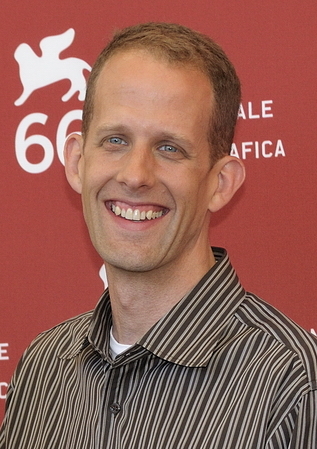
- Pete Docter
- Runtime
- 96 min
- Studio
- Pixar
34 archived facts 5 topics 1 source Last reviewed Sep 2026
Carl Fredricksen spent his entire life dreaming of exploring the globe and experiencing life to its fullest. But at age 78, life seems to have passed him by, until a twist of fate (and a persistent 8-year old Wilderness Explorer named Russell) gives him a new lease on life.
Summary: TMDB

All facts (34)
- #001
Pete Docter based Up's flying-house fantasy on the idea of escaping from life when it becomes too irritating, an idea that grew out of his own difficulty with social situations while growing up.
- #002
While Bob Peterson was away from Up for three months to co-direct Ratatouille, actor and writer Tom McCarthy joined Pete Docter on the story and created the character Russell.
- #003
Pete Docter chose an elderly man as Up's protagonist after drawing a grumpy old man with smiling balloons, and he and Tom McCarthy felt that the worldview of someone Carl's age would be a rich source of humor; Docter was not worried about an elderly lead in a children's film, saying children would relate to Carl as they do to their grandparents.
- #004
With Carl and Russell as the leads, Docter and Peterson envisioned the house landing on a Soviet-era spy airship disguised as a giant cloud instead of a tepui, but Docter said the idea was rewritten because it resembled another Pixar project then in development.
- #005
Docter briefly included magic fountain-of-youth eggs laid by the bird to explain the age gap between Muntz and Carl, but removed the subplot as too distracting, judging that audiences would forgive the minor inconsistency; The Station Agent by Tom McCarthy was the biggest single early influence on Up.
- #006
Pete Docter said Up reflects his friendships with Disney veterans Frank Thomas, Ollie Johnston and Joe Grant, all of whom died before the film's release, leading the film to be dedicated to them.
- #007
Joe Grant approved the script of Up and offered advice before his death in 2005, reminding Pete Docter that the audience needed an "emotional bedrock" given how wacky the adventure would become.
- #008
Pete Docter felt Joe Grant's personality shaped Carl's deceased wife Ellie more than it shaped the grouchy main character, and the "emotional bedrock" Grant called for became Carl's mourning for his wife.
- #009
Carl was based primarily on Spencer Tracy, Walter Matthau and James Whitmore, along with the grandparents of Pete Docter and his team, because Docter saw "something sweet about [those] grumpy old guys".
- #010
The South America setting in Up was chosen partly out of Pete Docter's love of tropical locations and partly because it was remote enough that Carl would be stuck with Russell without social authorities able to intervene.
- #011
Pete Docter and Bob Peterson concluded that a child character would be the most effective way to help Carl stop being stuck in his ways in Up.
- #012
For the role of Russell in Up, director Pete Docter held a nationwide casting call and auditioned 400 boys.
- #013
Jordan Nagai, who is Japanese American, accompanied his brother to an audition for Up even though his brother was the one trying out; Docter noticed that Nagai behaved and spoke non-stop like Russell and cast him, at age eight.
- #014
While recording the role of Russell in Up, Docter encouraged Jordan Nagai to act physically as well as vocally, lifting him upside down and tickling him for the scene in which Russell encounters Kevin.
- #015
East Asian Americans have positively noted that Up marked Pixar's first casting of an East Asian lead character, in contrast to the common practice of casting non-East Asians in East Asian parts, and that the role of an "all-American" boy carried none of the stereotypes typically seen with East Asian characters, such as martial arts.
- #016
Pete Docter described Carl's relationship with Russell as reflecting that Carl is not really ready for the whirlwind that a kid is, as few people are.
- #017
Pete Docter cited Casablanca and A Christmas Carol as inspirations for Up, describing both as resurrection stories about men who lose something and regain purpose during their journey.
- #018
Pete Docter and Rivera cited the Muppets, Hayao Miyazaki, Dumbo and Peter Pan as inspirations for Up, and also saw parallels to The Wizard of Oz while trying to keep Up from feeling too similar.
- #019
The character Charles Muntz in Up was inspired by Howard Hughes and Errol Flynn.
- #020
In the DVD extra "The Many Endings of Muntz", Pete Docter and his team discussed how difficult it was to settle on the character's final fate.
- #021
Up director Pete Docter chose Venezuela as the film's setting after Ralph Eggleston showed him video of the tepui mountains in Canaima National Park.
- #022
In 2004, Pete Docter and eleven other Pixar artists traveled by airplane, jeep and helicopter to reach Monte Roraima, where they spent three days and three nights painting, sketching and encountering wildlife including ants, mosquitoes, scorpions, frogs and snakes.
- #023
Pete Docter said the real rocks and plants the team saw could not be used in Up because reality was so strange that audiences would not believe it.
- #024
The animators made Russell Asian-American and modeled him on Peter Sohn, a Korean-American Pixar storyboard artist whose likeness in a meeting sketch became the character's design.
- #025
For Up, Pixar gave Carl Fredricksen a more extreme caricatured design than usual, standing only about three heads high, and avoided elderly details such as liver spots or ear hair while adding wrinkles, nose pockmarks, a hearing aid and a cane to convey age.
- #026
Pete Docter sought a stylized look for Up in which Carl's squarish head suggests his containment within his house, while Russell's rounded shape evokes a balloon; Docter said the effect worked better than the realistic humans of Toy Story, who suffered from the "uncanny valley".
- #027
The human designs in Up drew on cartoonists Al Hirschfeld, Hank Ketcham and George Booth, and simulating realistic cloth on the caricatured characters proved harder than creating the 10,000 balloons that lift the house, prompting new programs for the cloth and for Kevin's iridescent feathers.
- #028
To animate elderly characters in Up, Pixar animators studied their own parents or grandparents and watched footage of the Senior Olympics; the directors limited Carl's movements, barring him from turning his head more than 15–20 degrees without turning his torso or raising his arms high, though they wanted him to become more flexible and "action hero"-like near the film's end.
- #029
For Up, a technical director calculated that Carl's house would need 23 million balloons to fly, but Pete Docter found that this number made the balloons appear as small dots. The balloons were instead made twice Carl's size.
- #030
Up used 10,297 balloons for shots of the house simply flying and 20,622 balloons for the lift-off sequence, with a varying number in other scenes.
- #031
Up was the third Pixar film scored by Michael Giacchino, following The Incredibles and Ratatouille.
- #032
Pete Docter's priority for the music of Up was emotion, leading Michael Giacchino to write a character theme-based score that producer Jonas Rivera felt enhanced the story.
- #033
In Up, "Muntz's Theme" is the first music heard, playing as young Carl watches a newsreel about Muntz in a movie theater; it begins as a celebratory theme and echoes through the film when Muntz reappears 70 years later.
- #034
"Ellie's Theme" in Up is introduced when Ellie appears as a little kid and recurs in different versions, including a full orchestral arrangement during the sequence where Carl lifts his house with balloons; Michael Giacchino compared the film to opera because each character has a unique theme that changes at particular story moments.
Continue through the archive


Sources & editorial notes
Reference databases
Sources for the entries on this page
- Wikipedia Up (2009 film) — Wikipedia
Information from external sources is independently selected, consolidated and edited by Arka Evren. Sources are listed for verification and further reading. Encyclopedia text is used under its licence (CC BY-SA). How we work