
FILM · 1983 · CANADA
Videodrome
- Directed by
- David Cronenberg
- Runtime
- 88 min
- Studio
- Filmplan International
37 archived facts 5 topics 1 source Last reviewed Nov 2026
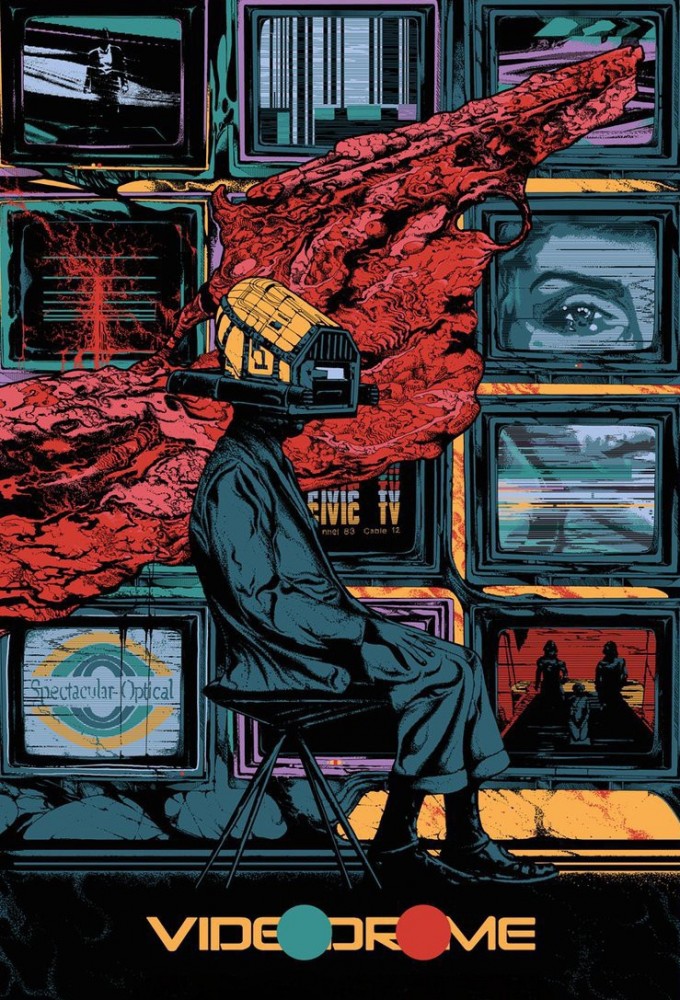
As the president of a trashy TV channel, Max Renn is desperate for new programming to attract viewers. When he happens upon "Videodrome," a TV show dedicated to gratuitous torture and punishment, Max sees a potential hit and broadcasts the show on his channel. However, after his girlfriend auditions for the show and never returns, Max investigates the truth behind Videodrome and discovers that the graphic violence…

37 Interesting Facts About Videodrome
Interesting Facts (28)
- #001
- #002
- #003
- #004
- #005
- #006
- #007
- #008
Prefilm video footage of Harry was rear projected through an airtight plexiglass chamber onto the sheet of rubber, which in turn could be inflated with a bellows. The effects called for certain parts of the television to expand and contract. Rick Baker's team had always used simple cable and pressure controls to puppeteer live performances. Airflow was often regulated by blowing air through an assortment of tubes. But the TV proved too large and complex for this approach. Physical effects supervisor Frank Carere devised a solution. To grossly oversimplify, Carere outfitted a keyboard organ with a valve air compressor. The result was a device that could inflate air bladders in sequence when the operator pressed certain keys.
- #009
- #010
- #011
- #012
- #013
The chest-slit sequences had James Woods built into a couch with the chest-slit apparatus glued onto him. Woods swore he would never work with anything that had to be glued onto him ever again! During filming the sequences with the flesh-gun (which "fired" bursts of cold, vaporous gas), Woods played a prank on director David Cronenberg by smearing his (real) hand with blue paint and pretending he had frostbite.
- #014
- #015
- #016
- #017
- #018
- #019
- #020
- #021
Several effects set pieces were cut, including one involving the TeleRANGER. The sequence would have seen a return to one of Cronenberg's preferred locations the bathtub. The hallucination required the SFX team to waterproof the television, which, according to the script, was to rise improbably out of the depths of the tub.
- #022
- #023
- #024
- #025
- #026
When Rick Baker first read David Cronenberg's screenplay, he knew immediately that one scene in particular would be completely unworkable and unaffordable. The scene involved two people kissing with their faces ultimately melding then forming a mass that then attacks another character. Ironically, ten years later, Screaming Mad George achieved almost the exact same effect in Brian Yuzna's controversial Society (1989).
- #027
- #028
Production Story (4)
- #029
Among the scenes that were scripted but deleted was one where Max Renn's TV rises up out of his bathtub while showing an image. The crew had researched how to do this - there had been talk of having the actor in the tub - and had come up with several solutions. One involved filling the tub with a clear fluid that was non-conductive, but that would have cost $25 a quart. The crew eventually decided to take a real TV and simply cover its insides with layers of waterproofing insulation. It worked - they dunked the TV into a swimming pool and found, to their astonishment, that TVs float due to the ultra-high vacuum inside the picture tube. The scene was axed just before it was to be filmed.
- #030
The TeleRANGER does appear in a later effect in the film in a sequence where a hand clutching a gun juts out from behind the screen. The transitional effect switching between a real video image and a flesh TV appliance, is relatively straightforward, Rick Baker and his team built a variant of the breathing screen. Lennick and his assistant Lee Wilson figured out a front projection process that featured a series of graduated filters that allowed The operators to fade in and out an image of video static without expensive post-production optical matting. Then it was just a matter of pushing the finger puppet forward in synch with the projected visuals. The benefit of pulling off the TV screen effects was that the effect was done once shooting wrapped, as the effects team hoped that they would get to go home by Christmas which some of them did barely.
- #031
- #032
Behind the Scenes (2)
- #033
An epilogue was planned but never filmed. In it, Max Renn, Bianca O'Blivion, and Nicki Brand appear on the set of Videodrome. Bianca and Nicki are shown to have chest slits (vaginas) of their own, from which emerge strange mutated sex organs. This concept was also used in one of Cronenberg's earlier films, Rabid (1977). The scene was scrapped along with many others due to cost overruns, bad timing (Debbie Harry had stomach flu and James Woods was visiting relatives), and the sheer difficulty of executing such a special-effects scene. A number of other ambitious special effects sequences were also dropped.
- #034
Easter Eggs & References (2)
- #035
- #036
The film was shot in Toronto in the late fall of 1981. Because Canadian government funded films were beholden to non-negotiable cut-off dates, production had to wrap by the end of the calendar year. As a consequence David Cronenberg and his crew had to start shooting without a finished script. To be clear, Cronenberg did have a complete script when filming began, but it was a prototype. In fact, this prototype was a wilder, more audacious, and by all accounts more shocking script.
Deeper Meaning (1)
- #037
It is revealed in the movie that once you have seen the Videodrome signal that the brain tumor begins to form and you begin to hallucinate. Max sees the Video signal early on in the movie so it could be implied that most of the movie is Max hallucinating. Taking it one step farther, the first thing the audience sees is the Videodrome signal, therefore it has already affected the audience and the entire movie is the viewer's hallucination.
Sources & editorial notes
Reference databases
- Wikipedia
- IMDb
Information from external sources is independently selected, consolidated and edited by Arka Evren. Sources are listed for verification and further reading. Encyclopedia text is used under its licence (CC BY-SA). How we work