

DIRECTOR · BORN 1895 · DIED 1966
Buster Keaton
- Born
- 3 October 1895, Piqua, Kansas, USA
- Died
- 1 February 1966
- Known for
- The General (1926), Limelight (1952), Sunset Boulevard (1950)
134 archived facts 5 topics 1 source Last reviewed Nov 2026
Buster Keaton (3 October 1895 – 1 February 1966) was an actor best known for The General, Limelight and Sunset Boulevard.
134 Interesting Facts About Buster Keaton
Interesting Facts (33)
- #001
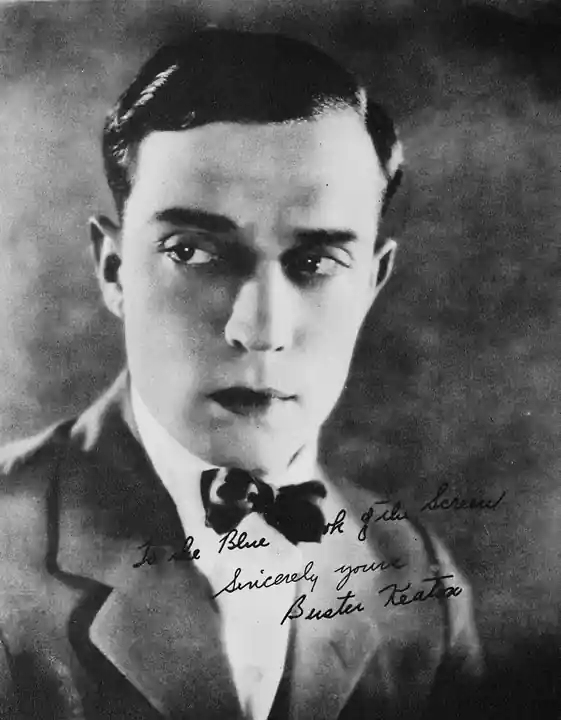
Buster Keaton died quietly in his sleep at his home on February 1, 1966, shortly after playing cards with his wife Eleanor. His health had already been seriously undermined by the lung cancer he had long battled, yet he managed to remain active until his final days. This peaceful death stands in contrast to his often expressionless but deeply layered screen character.
Buster Keaton: portraitImage: Wikimedia Commons · The Blue Book of the Screen, Inc., Public domain - #002
In 1952, the famous actor James Mason bought Keaton's former Hollywood mansion. While renovating the house, he found several reels of Keaton's films that were thought to be lost and immediately recognized their historical value. Mason took on the responsibility of preserving these films, ensuring that an important part of cinema history survived to the present day, and this discovery also helped spark a reassessment of Keaton's nearly forgotten work.
- #003
During the shooting of the 1924 film Sherlock Jr., Keaton suffered a serious accident and broke his neck. He only learned of the injury years later, when his doctor saw an X-ray of his neck during a routine physical examination. The incident reveals Keaton's determination to perform his own dangerous scenes without a stunt double and his extraordinary tolerance for pain. Traces of the accident are clearly visible in some scenes of the film.
- #004
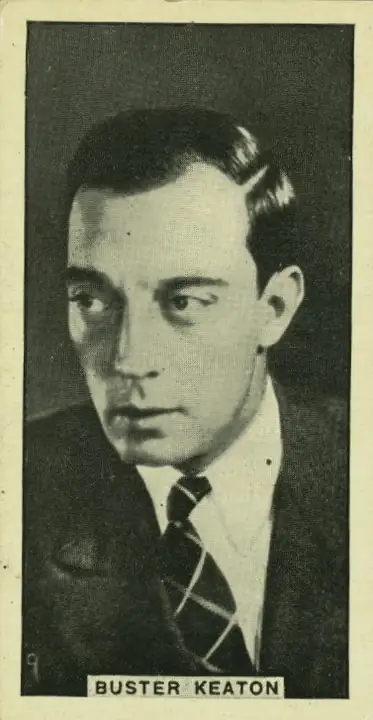
In his films, Keaton generally cast actors who were taller and bulkier than himself in antagonist roles. This made his screen character 'Buster' appear physically disadvantaged and heightened the comic effect. Charlie Chaplin, known for his short stature, used a similar technique. The method helped both comedians emphasize their characters' vulnerability and connect with the audience.
Buster Keaton: a sceneImage: Wikimedia Commons · MGM, Public domain - #005
Keaton was a heavy smoker for most of his life. In January 1966, after a month-long bout of coughing, he was diagnosed with lung cancer, but his doctors kept the news from him. Keaton believed he had suffered a severe case of bronchitis and thought he was recovering. Although his health deteriorated rapidly, he managed to remain active until his death, showing how strong his will was.
- #006
While many stars of silent cinema resisted the transition to sound films, Keaton welcomed the innovation. He knew his character did not need dialogue, but he eagerly awaited the dimension sound effects would add to his comedy. He once summed up his view by saying, 'If someone says boom, it really *booms*.' This approach shows how open-minded and innovative he was about the art of cinema.
- #007
In the unforgettable train station scene in Sherlock Jr. (1924), Keaton was hanging from a pipe connected to a water tank. The water suddenly emptied and dragged him onto the tracks; the accident broke his neck. Yet Keaton allowed the footage of this dangerous moment to be used in the film. The scene went down in cinema history as proof of his commitment to physical comedy and his courage in taking risks.
- #008
Keaton often said he owed all his knowledge of cinema and the art of comedy to Roscoe 'Fatty' Arbuckle. Arbuckle guided Keaton through his first film experiences and introduced him to the world of cinema. By blending Arbuckle's teachings with his own unique style, Keaton became one of the greatest masters of silent cinema.
- #009
While many stars of silent cinema struggled with the transition to sound films, Keaton had an advantage. Thanks to a good baritone voice, no speech impediment and years of stage experience, dialogue was no problem for him. He was therefore eager to move into sound cinema and produced successful work in that era as well. Keaton's adaptability shows what a versatile artist he was.
- #010
Keaton loved playing baseball and would not neglect the sport even on film sets. In the 1930s, at the annual Hollywood charity games held for Mt. Sinai Hospital, he led the comedians' team and, together with his writers, prepared comic routines on the field. These events reveal both Keaton's sense of fun and his charity. Baseball was for him not just a sport but also a source of inspiration.
- #011
When Keaton was three years old, he caught his right index finger in a wringer washing machine and the finger was crushed; it had to be amputated at the first joint. The injury affected some of his movements throughout his life. It is most clearly visible in the film The Garage (1919), when he steadies Roscoe 'Fatty' Arbuckle's head with his right hand while wiping his face with his left. Despite this impairment, Keaton succeeded in becoming a master of physical comedy.
- #012
Keaton's performance as Johnny Gray in The General (1926) is considered one of the most unforgettable in cinema history. In 2006, Premiere magazine ranked the performance 34th on its list of the '100 Greatest Performances of All Time.' The selection proves that Keaton was not only a comedian but also a serious actor. The film is still regarded today as one of the masterpieces of silent cinema.
- #013
Great comedians of the era such as Charles Chaplin and Stan Laurel referred to their screen characters as the 'Little Man.' The term represented the ordinary person whom all three portrayed, struggling to stay on his feet despite hardships. This shared approach shows the universal language of silent cinema and the interaction among the comedians. Each interpreted the character in his own unique style.
- #014
Because of a finger injury he suffered as a child, Keaton developed the ability to use his right and left hands for different tasks. He wrote with his left hand and played the ukulele with his right. When playing baseball he threw with his right hand and batted with his left. This ambidexterity shows his ability to adapt to life despite his physical disability and even to turn it into an advantage.
- #015
In a poll conducted in the 2000s, Entertainment Weekly named Keaton the 7th greatest director of all time. Keaton was the highest-ranked comedy director on the list, an achievement not even Charlie Chaplin managed, as Chaplin did not make the list at all. The selection shows that Keaton's directorial genius, not just his acting, was recognized.
- #016
The American Film Institute (AFI) placed Keaton 21st on its '50 Greatest Screen Legends' list, announced in 1999. The list includes the most influential actors in film history, and Keaton's presence on it is a sign of his enduring legacy. Keaton is regarded as one of the most important figures of silent cinema.
- #017
At Keaton's funeral in 1966, the famous actor and comedian Dick Van Dyke delivered a eulogy. Van Dyke spoke of Keaton's influence on him and his contributions to the world of comedy. This gesture shows the deep impression Keaton left on his colleagues. Van Dyke's presence also proves that Keaton was not only a legend but also a beloved figure.
- #018
Four of Keaton's films appear on the American Film Institute's '100 Years...100 Laughs' list: The General (1926) at 18th, It's a Mad, Mad, Mad, Mad World (1963) at 40th, Sherlock Jr. (1924) at 62nd and The Navigator (1924) at 81st. This achievement lays bare his comedy genius in both silent and sound cinema. Keaton is one of the comedians with the most films on the list.
- #019
The Navigator (1924) is recorded as Keaton's most successful film at the box office. The film, a comedy set on a submarine and a giant ship, was one he both directed and starred in. Its commercial success coincided with the period when Keaton's popularity was at its peak. It is still counted among the classics of silent cinema today.
- #020
Most of Keaton's biographers overlook his 1964 appearance on ABC-TV's variety show The Hollywood Palace. Yet the program was a great success for its producers Nick Vanoff and William O. Harbach, who brought Keaton and Gloria Swanson together in the same sketch. Keaton was back in the spotlight at the time thanks to It's a Mad, Mad, Mad, Mad World (1963). The meeting is significant as a coming together on screen of two legends from Hollywood's golden age.
- #021
During his time at MGM working as a 'roving gag man', Keaton made uncredited contributions to Red Skelton's film A Southern Yankee (1948). No one could find a solution to the problem of how the character, held hostage by an angry dog, would get out of the house. Keaton came to the set and suggested removing the door hinges, so that the character could go out while the dog came in.
- #022
Keaton was honored with two stars on the Hollywood Walk of Fame: one at 6619 Hollywood Boulevard for his contributions to film, and another at 6321 Hollywood Boulevard for his contributions to television. This double honor symbolizes his impact on both the film and television worlds. Keaton thus stands among the important figures of both silent cinema and early television.
- #023
On 19 August 2019, Turner Classic Movies (TCM) devoted a special day to Keaton's films as part of its 'Summer Under the Stars' programming. The event shows his place in film history and that his works remain current. More than half a century after his death, Keaton's films are still watched and appreciated.
- #024
In his later years, Keaton formed a closer friendship with his colleague Stan Laurel. The two would occasionally get together and talk. Keaton was among the guests at Laurel's funeral in 1965. This friendship was a sign of the respect the two great comedians held for each other. Keaton passed away only a few months after Laurel's death.
- #025
Keaton was depicted on one of ten 29-cent stamps issued by the United States Postal Service on April 27, 1994, honoring silent film stars. Designed by cartoonist Al Hirschfeld, the stamps also featured figures such as Rudolph Valentino, Clara Bow, Charles Chaplin, Lon Chaney, John Gilbert, Zasu Pitts, Harold Lloyd, Theda Bara and the Keystone Cops.
- #026
After his death in 1966, Keaton was buried at Forest Lawn Memorial Park in Los Angeles, California. The cemetery is the final resting place of many famous figures. Keaton's grave is still visited by fans, and his legacy lives on in cinema history.
- #027
Because of his expressionless face on screen, Keaton was known as 'The Great Stone Face.' The nickname was part of his comedy style: he created comic situations almost entirely through physical movement, revealing his emotions hardly at all. This trait was one of the things that set him apart from other comedians, and it made him one of the most original figures of silent cinema.
- #028
Keaton's last film work was the 1965 short The Railrodder. However, that film was released before feature films whose shooting had been completed earlier, such as A Funny Thing Happened on the Way to the Forum (1966). For this reason, 'Forum' is generally considered Keaton's last feature film. The Railrodder holds a special place as his farewell to cinema.
- #029
British actor David Jason is one of Keaton's greatest fans and says he was inspired by him when doing his own stunts. Jason stated that he felt greatly honored when the Daily Mirror compared him to Keaton. The comparison shows that Keaton's influence was not limited to his own era but extended to later generations.
- #030
In the 1930s, Keaton bought a huge motorhome he called the 'Black Cruiser.' It contained an admiral's uniform, a butler and a German Shepherd named Kaptan. When MGM objected to the vehicle being on the studio grounds, Keaton pulled it outside and hosted lavish lunches there for anyone who wanted to join. This behavior shows his determination to defy studio rules and keep to his own style.
- #031
Keaton was introduced to bridge on the advice of an actor friend, who said the game was a good way to be accepted in Hollywood circles. With his usual thoroughness, he set about learning it: he bought books, set up hands and played all four hands himself until he had fully grasped the strategies. He soon became a sought-after bridge partner. In one of his last roles, in Sunset Boulevard, he played a bridge player whose only line is 'Pass.'.
- #032
Keaton's biography appears in the reference book 'World Film Directors, Volume One, 1890-1945,' published in 1987 under the editorship of John Wakeman. Pages 523-531 of the book describe Keaton's life and career in detail. The source is an important reference point for film historians, and Keaton's inclusion in such academic works underscores his importance in cinema history.
- #033
Keaton is mentioned in the song 'Cinéma' by the Italian singer Paola Del Medico. The song is a tribute to the great names of cinema. Keaton's inclusion in the song shows his international recognition. Artists continue to keep his legacy alive in different cultures.
Behind the Scenes (68)
- #034
Keaton was already battling cancer during the shooting of A Funny Thing Happened on the Way to the Forum (1966), the last film he completed. On this film and the other films he made during his MGM period, he had to use a stunt double. Before 1928, however, he performed all his dangerous scenes himself, even doubling for others, as in Sherlock Jr., where he played both the motorcycle rider and the falling man. This change shows the seriousness of his health condition.
- #035
Buster Keaton passed away quietly in his sleep at his home on February 1, 1966, shortly after playing cards with his wife Eleanor. His death was a silent and peaceful end for one of the greatest silent film comedians in cinema history. Keaton's health had already deteriorated seriously due to the lung cancer he had been battling for a long time, yet he managed to stay active until his final days. This peaceful death stands in contrast to his often expressionless but deeply layered character on screen.
- #036
In 1952, the famous actor James Mason had purchased Keaton's old mansion in Hollywood. While renovating the house, he found several reels of Keaton's films that were thought to be lost and immediately recognized their historical value. Mason took on the responsibility of preserving these films, ensuring that an important part of cinema history survived to the present day. This discovery also paved the way for a reevaluation of Keaton's works that had been on the verge of being forgotten.
- #037
When Keaton married Natalie Talmadge in 1921, the Talmadge family was a great acting dynasty in both theater and cinema. In Hollywood, the rumor was widespread that Keaton had made this marriage to gain respectability in the industry, and this gossip followed him even at the peak of his career. Yet today, while Keaton is remembered as a cinema legend, very few people remember who the Talmadge family was.
- #038
During the filming of the 1924 film Sherlock Jr., Keaton suffered a serious accident and broke his neck. However, he only learned of this injury years later, when his doctor saw an X-ray of his neck during a routine physical examination. This incident reveals Keaton's determination to perform his own dangerous scenes without using a stunt double and his extraordinary resilience to pain. The traces of the accident can be clearly seen in some scenes of the film.
- #039
After serving in Germany during World War I, Keaton began experiencing hearing problems from 1918 onward. The effects of the war did not affect his career during the silent film era; however, this condition led to some difficulties in communication in later years. Even so, despite this handicap, Keaton achieved great success in both acting and directing.
- #040
In his films, Keaton generally used actors who were taller and bulkier than himself in antagonist roles. In this way, he made his on-screen character 'Buster' appear physically disadvantaged and heightened the comic effect. Charlie Chaplin, known for his short stature, used a similar technique. This method made it easier for both comedians to connect with the audience by emphasizing their characters' vulnerability.
- #041
Early in his career, Keaton not only did all his own stunts but also performed stunts for other actors in his films. Particularly in his own productions, he stood in for his crewmates in dangerous scenes. However, after signing a contract with MGM in 1928, he was forced to use stunt doubles due to studio policies.
- #042
Keaton was a heavy smoker for most of his life. In January 1966, after a month-long coughing fit, he was diagnosed with lung cancer, but his doctors kept the news from him. Keaton thought he had suffered a severe bout of bronchitis and believed he was recovering. Despite his health deteriorating rapidly, he managed to stay active until his death, which shows how strong-willed he was.
- #043
While many stars of silent cinema resisted the transition to sound films, Keaton welcomed this innovation. He knew his character did not need dialogue, but he eagerly awaited the dimension sound effects would add to his comedy. He once summed up this view by saying, 'If someone says boom, it really goes *boom*.' This approach shows how open-minded and innovative he was about the art of cinema.
- #044
Keaton was an important mentor in the acting career of the famous comedian Lucille Ball. With the training she received from Keaton, Ball made great progress in physical comedy and timing. Keaton's stage experience and understanding of comedy laid the foundation for the skills Ball would later use in her own legendary television show.
- #045
In the unforgettable train station scene in Sherlock Jr. (1924), Keaton was hanging from a pipe connected to a water tank. The water suddenly emptied and dragged him onto the tracks; as a result of this accident, he broke his neck. However, Keaton allowed the footage of this dangerous moment to be used in the film.
- #046
Keaton often stated that he owed all his knowledge of cinema and the art of comedy to Roscoe 'Fatty' Arbuckle. Arbuckle guided Keaton in his first film experiences and introduced him to the world of cinema. By blending Arbuckle's teachings with his own unique style, Keaton became one of the greatest masters of silent cinema.
- #047
Keaton was a passionate baseball fan and carried this passion into his business life as well. He often organized baseball games between shoots and even used the sport in casting. According to legend, the job application form included the questions 'Are you a good actor?' and 'Are you a good baseball player?'; those who answered 'Yes' to both questions were hired. This practice shows Keaton's both playful and unconventional approach to management.
- #048
When Keaton's career collapsed in the 1930s, it drove him into a deep depression and he began drinking heavily. But his marriage to Eleanor Norris in 1940 became a turning point in his life. With Eleanor's support, he overcame his alcoholism and regained his self-confidence. This marriage brought about a rebirth in both his personal and professional life, and it lasted until his death.
- #049
While many stars of silent cinema struggled with the transition to sound films, Keaton had an advantage. Thanks to his good baritone voice, the absence of any speech impediment and years of stage experience, dialogue was no problem for him. He was therefore eager to move into sound cinema, and he produced successful work during this period as well. Keaton's adaptability shows just how versatile an artist he was.
- #050
Keaton loved playing baseball and would not neglect the sport even on film sets. In the 1930s, at the annual Hollywood charity games held for Mt. Sinai Hospital, he would lead the comedians' team and, together with its writers, stage comic routines on the field. These events reveal both Keaton's sense of entertainment and his philanthropy. For him, baseball was not just a sport but also a source of inspiration.
- #051
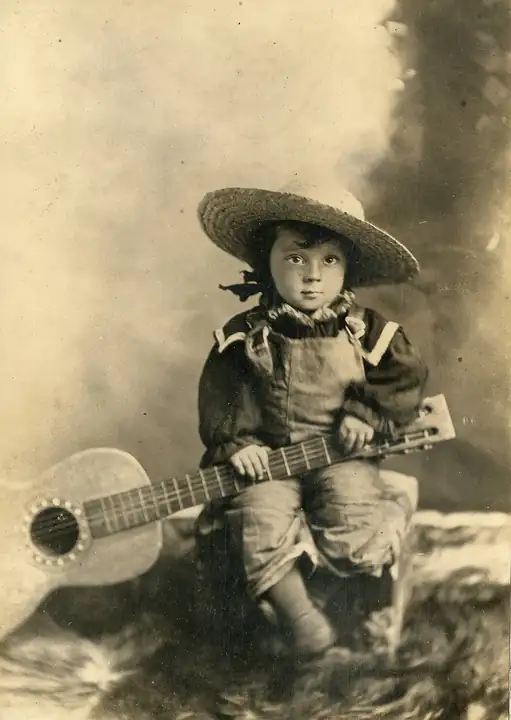
Because Keaton spent his childhood on vaudeville tours with his family, he could not have a normal childhood. But every summer, on their holidays at an Actors' Colony on the shores of Lake Michigan in Muskegon, he found a more orderly life. This period was an opportunity for him both to rest and to socialize with other children. The city of Muskegon has honored this haunt of Keaton's with a historical marker.
- #052
When Keaton was three years old, he caught his right index finger in a clothes wringer and the finger was crushed; it had to be amputated at the first joint. This injury affected certain movements for the rest of his life. It is most clearly visible in the film The Garage (1919), when he steadies Roscoe 'Fatty' Arbuckle's head with his right hand while wiping his face with his left. Despite this disability, Keaton succeeded in becoming a master of physical comedy.
- #053
Keaton's performance as Johnny Gray in The General (1926) is regarded as one of the most unforgettable in cinema history. In 2006, Premiere magazine placed this performance at number 34 on its list of the '100 Greatest Performances of All Time.' This selection proves that Keaton was not only a comedian but also a serious actor. The film is still counted among the masterpieces of silent cinema today.
- #054
Giant comedians of the era such as Keaton, Charles Chaplin and Stan Laurel called their on-screen characters the 'Little Man.' The term represented the ordinary person whom all three portrayed, someone trying to stay on his feet despite hardships. This shared approach shows the universal language of silent cinema and the interaction among the comedians themselves. Each of them interpreted this character in his own unique style.
- #055
Keaton first met Roscoe 'Fatty' Arbuckle while walking on Broadway in New York. Arbuckle was with Keaton's old vaudeville friend Louis Anger, who introduced them. Arbuckle invited Keaton to the Colony Studio, where he would make comedies for Joseph M. Schenck. This chance encounter laid the groundwork for the birth of one of the most famous comedy teams in cinema history.
- #056
Keaton's nickname 'Buster' became identified with him and played a major role in popularizing the name. In fact, it is believed that the name was first used for him. The word 'buster' means 'punch' or 'blast' in English and evokes Keaton's daring in physical comedy. Today the name has become a brand associated with him.
- #057
During the shooting of The Cameraman (1928), Keaton decided to have crew member Edward Brophy play a comic role. This sudden decision marked the beginning of Brophy's own successful comedy career. Keaton's instinct for discovering talent and giving people opportunities shows that he was not only a good artist but also a good observer.
- #058
Because of the finger accident he suffered as a child, Keaton developed the ability to use his right and left hands for different tasks. He wrote with his left hand and played the ukulele with his right. When playing baseball, he threw with his right hand and batted with his left. This ambidexterity shows his ability to adapt to life despite his physical disability and even to turn the situation to his advantage.
- #059
Silent cinema's three great comedians, Keaton, Charles Chaplin and Harold Lloyd, held control of their films at the start of their careers. But in the 1920s Keaton was persuaded to sell his studio and his films to MGM, while Chaplin and Lloyd preserved their independence. This decision caused Keaton financial and personal troubles, while Chaplin and Lloyd grew rich. The episode is a turning point often debated in cinema history.
- #060
In a poll conducted in the 2000s, Entertainment Weekly named Keaton the 7th greatest director of all time. Keaton, the highest-ranked comedy director on the list, achieved a distinction that even Charlie Chaplin failed to match, as Chaplin did not make the list at all.
- #061
The American Film Institute (AFI) placed Keaton at number 21 on its '50 Greatest Screen Legends' list, announced in 1999. The list includes the most influential actors in cinema history, and Keaton's presence on it is an indication of his enduring legacy. Keaton is regarded as one of the most important figures of silent cinema.
- #062
At Keaton's 1966 funeral, the famous actor and comedian Dick Van Dyke delivered a eulogy. Van Dyke spoke of Keaton's influence on him and his contributions to the world of comedy. This gesture shows the deep impression Keaton left on his colleagues. Van Dyke's presence also proves that Keaton was not only a legend but also a beloved figure.
- #063
Four of Keaton's films appear on the American Film Institute's '100 Funniest Films' list: The General (1926) at No. 18, It's a Mad, Mad, Mad, Mad World (1963) at No. 40, Sherlock Jr. (1924) at No. 62 and The Navigator (1924) at No. 81. This achievement lays bare his comic genius in both silent and sound cinema. Keaton is one of the comedians with the most films on the list.
- #064
Keaton was already battling cancer during the shooting of A Funny Thing Happened on the Way to the Forum (1966), the last film he completed. On this film and the others he made during his MGM period, he had to use a stunt double. Yet before 1928 he performed all his dangerous scenes himself, even doubling for others by playing both the motorcycle rider and the falling man, as in Sherlock Jr. This change shows the seriousness of his health condition.
- #065
The Navigator (1924) went on record as Keaton's most successful film at the box office. The film, a comedy set on a submarine and a giant ship, was one he both directed and starred in. Its commercial success coincided with the period when Keaton's popularity was at its peak. It is still counted among the classics of silent cinema today.
- #066
As a child, Keaton dreamed of becoming an engineer. His frequent use of complex machines, trains and other mechanical devices in his films can be seen as an extension of that childhood dream. Keaton's curiosity about engineering formed the foundation of his creativity and his problem-solving ability.
- #067
Keaton died on February 1, 1966; on the same day, the famous gossip columnist and actress Hedda Hopper, who had appeared with him in The Stolen Jools (1931), Speak Easily (1932) and Sunset Boulevard (1950), also died. This coincidence remained an interesting footnote in Hollywood history. Both names had left their mark on the world of cinema, albeit in different fields.
- #068
Most of Keaton's biographers overlook his 1964 appearance on ABC-TV's variety show The Hollywood Palace. Yet the program was a great success for its producers Nick Vanoff and William O. Harbach; they brought Keaton and Gloria Swanson together in the same sketch. Keaton was back in the spotlight at the time with It's a Mad, Mad, Mad, Mad World (1963).
- #069
There are many legends about the origin of Keaton's nickname 'Buster'. The most common is that the famous illusionist Harry Houdini gave him the name after seeing the young Keaton fall down a staircase without injury. Houdini worked in the same medicine show as Keaton's father Joe. According to other accounts, it was his father Joe who gave him the name. Which is true is not known for certain, but these stories enrich Keaton's legendary persona.
- #070
During his time working at MGM as a 'roving gag man', Keaton made uncredited contributions to Red Skelton's film A Southern Yankee (1948). No one could find a solution to the problem of how the character held hostage by an angry dog would get out of the house. Keaton came to the set and suggested removing the door hinges; that way the character could go out while the dog came in.
- #071
In the later stages of his career, Keaton appeared in around 16 commercials. Among them were brands such as Colgate Toothpaste, Alka-Seltzer, 7-Up, Marlboro Cigarettes, Budweiser Beer, Ford Motors and Milky Way Chocolate. These commercials show his popularity and his connection with the public. Even in commercials, Keaton displayed his distinctive style of physical comedy.
- #072
Keaton was honored with two stars on the Hollywood Walk of Fame: one at 6619 Hollywood Boulevard for his contributions to film, and the other at 6321 Hollywood Boulevard for his contributions to television. This double honor symbolizes his impact on both the film and television worlds. Keaton thus took his place among the important names of both silent cinema and early television.
- #073
On August 19, 2019, a special day was devoted to Keaton's films as part of Turner Classic Movies (TCM)'s 'Summer Stars' programming. This event shows his place in cinema history and that his works remain current. More than half a century after his death, Keaton's films are still watched and appreciated.
- #074
In his later years, Keaton formed a closer friendship with his colleague Stan Laurel. The two would occasionally get together and talk. Keaton was among the guests at Laurel's 1965 funeral. This friendship was a sign of the respect two great comedians held for each other. Keaton passed away only a few months after Laurel's death.
- #075
In a 1996 poll by Entertainment Weekly, Keaton was chosen as the 35th greatest film star of all time. The list includes the most influential names in cinema history, and Keaton's place on it shows his enduring popularity. Keaton is regarded as one of the most important stars of silent cinema.
- #076
Keaton generally did not get along well with the family of his wife, Natalie Talmadge. He felt that the Talmadges looked down on him and belittled him because he was a comedian. These tense relations caused Keaton difficulties in his private life. Even so, this did not affect his commitment to his career and his art.
- #077
When Keaton was still a small child, he formed an acrobatics group with his family called 'The Three Keatons'. Together with this group, they performed on vaudeville stages. This experience laid the foundation for Keaton's physical comedy and stage command. These years spent with his family were decisive in both his personal and his artistic development.
- #078
During the shooting of The Electric House (1922), Keaton slipped on an escalator and broke his ankle. This injury continued during the shooting of his next film, The Play House (1921); for this reason, the stunts in that film were accepted more calmly than usual. Keaton continued working despite his injury, and this shows his dedication to his work.
- #079
Keaton appeared in eight films selected for the National Film Registry by the Library of Congress as being 'culturally, historically, or aesthetically significant': One Week (1920), Cops (1922), Sherlock Jr. (1924), The Navigator (1924), The General (1926), Steamboat Bill, Jr. (1928), The Cameraman (1928) and Sunset Boulevard (1950). He also directed seven of these films himself. This achievement consolidated his place in cinema history as both an actor and a director.
- #080
Keaton was depicted on one of ten 29-cent stamps issued by the United States Postal Service on April 27, 1994, honoring silent film stars. Designed by cartoonist Al Hirschfeld, these stamps also included names such as Rudolph Valentino, Clara Bow, Charles Chaplin, Lon Chaney, John Gilbert, Zasu Pitts, Harold Lloyd, Theda Bara and the Keystone Cops. This honor shows Keaton's lasting impact on American culture.
- #081
Keaton's favorite film was the 1921 production Hard Luck. This film was considered lost for many years, but a copy was later found. Keaton's fondness for this film shows how much he valued his own work. Hard Luck is still regarded today as one of Keaton's most important short films.
- #082
Keaton's mother Myra was of English and German origin; his father Joe was of Scottish and Irish origin. Inheriting his family's vaudeville tradition, Keaton became an important figure in the world of American entertainment.
- #083
After working at MGM studios for five years, Keaton was fired by Louis B. Mayer because of his drunken behavior. The films he made during this period are generally considered to be of lower quality than his work in his own independent period. This event became a symbol of the decline in Keaton's career. However, he later managed to recover.
- #084
After his death in 1966, Keaton was buried at Forest Lawn Memorial Park in Los Angeles, California. This cemetery is the final resting place of many famous names. Keaton's grave is still visited by his fans. His legacy lives on in cinema history.
- #085
While his divorce proceedings from Natalie Talmadge were still ongoing, Keaton married Mae Scriven in Mexico on January 1, 1932. Because this marriage took place before the divorce was finalized, it led to legal problems; for this reason they married legally again in 1933. This event shows the complicated period in Keaton's private life. The marriage was short-lived and ended in 1934.
- #086
Because of his expressionless face on screen, Keaton was known as 'The Great Stone Face'. This nickname was part of his comedy style; he would create comic situations almost without ever revealing his emotions, using only physical movements. This trait was one of the most important elements distinguishing him from other comedians. Thanks to this, Keaton became one of the most original names of silent cinema.
- #087
Keaton's last film work was the 1965 short film The Railrodder. However, this film was released before feature-length films such as A Funny Thing Happened on the Way to the Forum (1966), whose shooting had been completed earlier. For this reason, 'Forum' is generally considered Keaton's last feature-length film. The Railrodder holds a special place as the production with which he bade farewell to cinema.
- #088
British actor David Jason is one of Keaton's greatest fans and says he was inspired by him when doing his own stunts. Jason stated that he felt greatly honored when the 'Daily Mirror' newspaper compared him to Keaton.
- #089
In the 1930s, Keaton bought a huge motorhome that he named the 'Black Cruiser'. In this vehicle there was an admiral's uniform, a butler and a German Shepherd named Captain. When MGM objected to the vehicle being on the studio grounds, Keaton pulled it outside and organized luxurious lunches for anyone who wanted to join. This behavior shows his determination to defy studio rules and maintain his own style.
- #090
Keaton's father Joe initially strongly opposed Buster's appearing in films; he regarded the vaudeville stage as far superior to cinema. To get his father used to the idea, Buster began including him in his films in small roles. Joe's most positive comment about the films was, 'The films aren't bad, I suppose.' This anecdote shows Keaton's relationship with his family and his patience.
- #091
Keaton had two sons, Buster Keaton Jr. and Bob Talmadge, from his marriage to Natalie Talmadge. His children held an important place in his private life. After the divorce, however, his relationship with his children became distant. Even so, Keaton tried to fulfill his role as a father.
- #092
Keaton appeared in three films nominated for the Best Picture Oscar: The Hollywood Revue of 1929 (1929), Sunset Boulevard (1950) and Around the World in 80 Days (1956). In the first two he played himself; the third was the only production to win the Best Picture award. These films show his presence in different periods of his career and bear witness to the changing face of Hollywood.
- #093
Keaton was introduced to the game of bridge on the recommendation of an actor friend; it was said that the game was a good way to gain acceptance in Hollywood circles. With his usual meticulousness, he set about learning the game: he bought books, set up hands and played all four hands by himself until he had fully grasped the strategies. He soon became a sought-after bridge partner. In one of his last roles, in Sunset Boulevard, he played a bridge player whose only line is 'Pass'.
- #094
Keaton's biography appears in the reference book 'World Film Directors, Volume One, 1890-1945', published in 1987 under the editorship of John Wakeman. On pages 523-531 of the book, Keaton's life and career are described in detail. This source is an important point of reference for film historians. Keaton's inclusion in such academic works emphasizes his importance in film history.
- #095
Keaton is mentioned in the Italian singer Paola Del Medico's song 'Cinéma'. This song is a tribute to the great names of cinema. Keaton's inclusion in this song shows his international recognition. Artists continue to keep his legacy alive in different cultures.
- #096
Keaton was the older brother of two siblings, Harry Keaton and Louise Keaton. His family was active in the world of vaudeville, and this enabled Keaton to enter stage life at an early age. Growing up with his siblings was influential in both his personal and his artistic development. Keaton stepped into his film career with his family's support.
- #097
The exact degree of Keaton's kinship with the actress Camille Keaton is not known. According to some sources she is his second or third cousin, while according to others she is his great-aunt. Even so, this connection shows that the Keaton family continued its presence in the world of cinema.
- #098
Through his marriage to Natalie Talmadge, Keaton became the brother-in-law of the famous actresses Norma Talmadge and Constance Talmadge. After the divorce, however, this family tie came to an end. The Talmadge sisters were important stars of the period, and Keaton's connection to them influenced his relationships in Hollywood circles.
- #099
During his marriage to Natalie Talmadge, Keaton became the son-in-law of Margaret Talmadge. After the divorce, however, this relationship also came to an end. Margaret Talmadge was a powerful mother figure who managed her daughters' careers. Keaton's relationship with her became complicated along with the difficulties of the marriage.
- #100
Keaton's great-granddaughter Keaton Talmadge took her name from his surname. Keaton Talmadge is also a voice actress and carries on her great-great-grandfather's legacy.
- #101
Keaton is the great-great-grandfather of the voice actress Keaton Talmadge. Keaton Talmadge took her first and last name from her famous ancestor and carries his legacy in her career.
Deeper Meaning (1)
- #102
After five years working at MGM studios, Keaton was fired by Louis B. Mayer because of his drunken behavior. The films he made during this period are generally considered lower in quality than his earlier independent work. The incident became a symbol of the decline in Keaton's career, though he later managed to recover.
Career & Awards (11)
- #103
After serving in Germany during World War I, Keaton began to experience hearing problems from 1918 onward. The effects of the war did not harm his career in the silent film era, but the condition caused some difficulties in communication in later years. Even so, despite this impairment, Keaton achieved great success in both acting and directing.
- #104
Early in his career, Keaton not only did all his own stunts but also performed stunts for other actors in his films. Especially in his own productions, he stood in for his colleagues in dangerous scenes. However, after signing with MGM in 1928, studio policies forced him to use stunt doubles.
- #105
Keaton was an important mentor in the acting career of the famous comedian Lucille Ball. Through the training she received from Keaton, Ball made great progress in physical comedy and timing. Keaton's stage experience and understanding of comedy laid the foundation for the skills Ball would later use in her own legendary television show.
- #106
Keaton first met Roscoe 'Fatty' Arbuckle while walking on Broadway in New York. Arbuckle was with Keaton's old vaudeville colleague Louis Anger, who introduced them. Arbuckle invited Keaton to the Colony Studio, where he would make comedies for Joseph M. Schenck. This chance encounter laid the groundwork for the birth of one of the most famous comedy teams in film history.
- #107
While filming The Cameraman (1928), Keaton decided to cast crew member Edward Brophy in a comedy role. This sudden decision marked the start of Brophy's own successful comedy career. Keaton's instinct for spotting talent and giving people opportunities shows that he was not only a good artist but also a good observer.
- #108
The three great comedians of silent cinema — Keaton, Charles Chaplin and Harold Lloyd — held control of their films early in their careers. But in the 1920s Keaton was persuaded to sell his studio and his films to MGM, while Chaplin and Lloyd kept their independence. This decision caused Keaton financial and personal troubles, while Chaplin and Lloyd grew rich. The episode is a turning point often debated in film history.
- #109
Later in his career, Keaton appeared in roughly 16 commercials. Among them were brands such as Colgate Toothpaste, Alka-Seltzer, 7-Up, Marlboro Cigarettes, Budweiser Beer, Ford Motors and Milky Way Chocolate. These commercials show his popularity and his connection with the public. Even in commercials, Keaton displayed his distinctive style of physical comedy.
- #110
In a 1996 poll by Entertainment Weekly, Keaton was named the 35th greatest film star of all time. The list included cinema history's most influential figures, and Keaton's place on it reflects his enduring popularity. He is regarded as one of the most important stars of silent cinema.
- #111
Keaton appeared in eight films selected for the National Film Registry by the Library of Congress as 'culturally, historically, or aesthetically significant': One Week (1920), Cops (1922), Sherlock Jr. (1924), The Navigator (1924), The General (1926), Steamboat Bill, Jr. (1928), The Cameraman (1928) and Sunset Boulevard (1950). He also directed seven of these films himself.
- #112
Keaton appeared in three films nominated for the Best Picture Oscar: The Hollywood Revue of 1929 (1929), Sunset Boulevard (1950) and Around the World in 80 Days (1956). In the first two he played himself, and the third was the only one of them to win Best Picture. These films show his presence in different periods of his career and bear witness to Hollywood's changing face.
- #113
Keaton was the son of the vaudeville performers Joe Keaton and Myra Keaton. His family played a major role in his discovering and developing his talents. Keaton began joining his family's shows when he was only three years old. This early experience formed the foundation of his stage career.
Life & Family (21)
- #114
When Keaton married Natalie Talmadge in 1921, the Talmadge family was a great acting dynasty in both theater and film. In Hollywood, it was widely rumored that Keaton had made the marriage to gain standing in the industry, and the rumor followed him even at the peak of his career. Yet today, while Keaton is remembered as a cinema legend, very few people remember who the Talmadge family was — an irony that reflects his enduring legacy.
- #115
Keaton was a passionate baseball fan and brought that passion into his working life as well. He often organized baseball games between takes and even used the sport in his casting. According to legend, the job application form included the questions 'Are you a good actor?' and 'Are you a good baseball player?'; those who answered 'Yes' to both were hired. This practice shows Keaton's both playful and unconventional approach to management.
- #116
When Keaton's career collapsed in the 1930s, it drove him into a deep depression and he turned to alcoholism. But his marriage to Eleanor Norris in 1940 was a turning point in his life. With Eleanor's support, he overcame his alcohol addiction and regained his self-confidence. The marriage brought about a rebirth in both his personal and professional life and lasted until his death.
- #117
Because Keaton spent his childhood on vaudeville tours with his family, he could not have a normal childhood. But every summer, on their vacations to an Actors' Colony in Muskegon on the shore of Lake Michigan, he found a more orderly life. This period was an opportunity for him both to rest and to socialize with other children. The city of Muskegon has honored this favorite spot of Keaton's with a historical marker.
Buster Keaton: Vaudeville Artist, behind the scenesImage: Wikimedia Commons · Unknown author Unknown author, Public domain - #118
Keaton's nickname 'Buster' became inseparable from him, and he played a major role in popularizing the name. It is in fact believed that the name was first used for him. The word 'buster' means 'punch' or 'blast' in English and evokes Keaton's daring in physical comedy. Today the name has become a brand associated with him.
- #119
As a child, Keaton dreamed of becoming an engineer. His frequent use of complex machines, trains and other mechanical devices in his films can be seen as an extension of this childhood dream. Keaton's curiosity about engineering formed the basis of his creativity and his problem-solving ability.
- #120
Keaton died on 1 February 1966; on the same day, the famous gossip columnist and actress Hedda Hopper, who had appeared with him in The Stolen Jools (1931), Speak Easily (1932) and Sunset Boulevard (1950), also died. This coincidence remains a curious footnote in Hollywood history. Both names left their mark on the film world, albeit in different fields.
- #121
There are many legends about the origin of Keaton's nickname 'Buster'. The most common is that the famous illusionist Harry Houdini gave him the name after seeing the young Keaton fall from a staircase without injury. Houdini worked in the same medicine show as Keaton's father, Joe. According to other accounts, it was his father Joe who gave him the name. Which is correct is not known for certain, but these stories enrich Keaton's legendary persona.
- #122
Keaton generally did not get along well with the family of his wife, Natalie Talmadge. He felt the Talmadges looked down on and belittled him because he was a comedian. These tense relations caused difficulties in Keaton's private life, yet they did not affect his commitment to his career and his art.
- #123
While still a small child, Keaton formed an acrobatic act called 'The Three Keatons' with his family. They performed on vaudeville stages together. This experience laid the foundation for Keaton's physical comedy and stage command, and the years he spent with his family were decisive for both his personal and artistic development.
- #124
Keaton's favorite of his own films was the 1921 Hard Luck. The film was considered lost for many years, but a copy was later found. Keaton's fondness for this film shows how much he valued his own work. Hard Luck is still regarded today as one of Keaton's most important short films.
- #125
Keaton's mother, Myra, was of English and German descent, while his father, Joe, was of Scottish and Irish descent. Keaton carried on his family's vaudeville tradition and became a major figure in American entertainment.
- #126
While his divorce from Natalie Talmadge was still in progress, Keaton married Mae Scriven in Mexico on January 1, 1932. Because the marriage took place before the divorce was finalized, it led to legal problems, so they married legally again in 1933. The episode reflects the complicated period in Keaton's private life. The marriage was short-lived and ended in 1934.
- #127
Keaton's father, Joe, initially opposed Buster's appearing in films, regarding the vaudeville stage as far superior to cinema. To get his father used to the idea, Buster began including him in his films in small roles. Joe's most positive comment about the films was, 'The films aren't bad, I suppose.' The anecdote shows Keaton's relationship with his family and his patience.
- #128
From his marriage to Natalie Talmadge, Keaton had two sons, Buster Keaton Jr. and Bob Talmadge. His children held an important place in his private life, but after the divorce his relationship with them was distant. Even so, Keaton tried to fulfill his duties as a father.
- #129
Keaton was the older brother of two siblings named Harry Keaton and Louise Keaton. His family was active in the vaudeville world, which led Keaton to enter stage life at an early age. Growing up with his siblings influenced both his personal and artistic development. Keaton took his first steps into a film career with his family's support.
- #130
The exact degree of kinship between Keaton and the actress Camille Keaton is not fully known. According to some sources he was her second or third cousin, while according to others he was her great-uncle. Still, this connection shows that the Keaton family continued its presence in the film world.
- #131
Through his marriage to Natalie Talmadge, Keaton became the brother-in-law of the famous actresses Norma Talmadge and Constance Talmadge. However, this family tie ended after the divorce. The Talmadge sisters were major stars of the era, and Keaton's connection to them influenced his relationships within Hollywood circles.
- #132
During his marriage to Natalie Talmadge, Keaton became the son-in-law of Margaret Talmadge. However, this relationship also ended after the divorce. Margaret Talmadge was a powerful mother figure who managed her daughters' careers. Keaton's relationship with her became complicated along with the difficulties of the marriage.
- #133
Keaton's great-grandson Keaton Talmadge took his name from his surname. Keaton Talmadge is also a voice actor and carries on his great-great-grandfather's legacy.
- #134
Keaton is the great-great-grandfather of the voice actor Keaton Talmadge. Keaton Talmadge took his first and last name from his famous ancestor and carries his legacy in his career.
Sources & editorial notes
Reference databases
- Wikipedia
- IMDb
Information from external sources is independently selected, consolidated and edited by Arka Evren. Sources are listed for verification and further reading. Encyclopedia text is used under its licence (CC BY-SA). How we work