

ACTOR · BORN 1923 · DIED 2008
Charlton Heston
- Birth name
- John Charles Carter
- Born
- October 4, 1923 · Wilmette, Illinois, USA
- Age
- 84
- Died
- April 5, 2008 · Beverly Hills, California, USA (died at 84 · pneumonia and Alzheimer's disease)
- Height
- 1.89 m
- Nickname
- Chuck
- Occupation
- Actor, Director, Writer
- Spouse
- Lydia Clarke (1944–2008)
- Children
- Fraser C. Heston, Holly Heston Rochell
- Oscars
- 1 win, 0 nominations (Ben-Hur)
- Awards
- 19 wins, 39 nominations
- Known for
- Ben-Hur (Judah Ben-Hur), The Omega Man (Neville), Touch of Evil (Mike Vargas)
159 archived facts 5 topics 1 source Last reviewed Nov 2026
Charlton Heston (4 October 1923 – 5 April 2008) was an actor best known for Ben-Hur, The Omega Man and The Big Country.
Charlton Heston over the years


159 Interesting Facts About Charlton Heston
Interesting Facts (63)
- #001
When Heston asked James Cameron why he wanted him for Spencer Trilby in True Lies (1994), Cameron said, "I need someone who can plausibly intimidate Arnold Schwarzenegger."
- #002
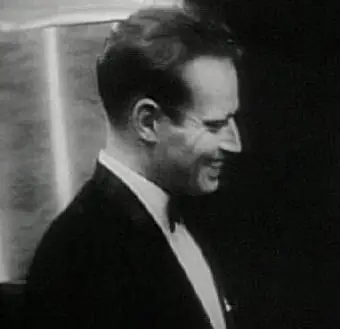
Meeting Toshirō Mifune around 1960, Heston was hugely impressed by the Japanese star and remarked that if Mifune spoke English, "he could be the greatest star in the world." The two exchanged Christmas cards from then until Mifune's death.
Charlton Heston: a sceneImage: Wikimedia Commons · Screenshot, from DVD The Ten Commandments, 50th Anniversary Collectio…, Public domain - #003
Politically Heston and Kirk Douglas were far apart, Douglas a staunch liberal Democrat and Heston a staunch conservative Republican, yet they were very close friends. Douglas spoke warmly of the friendship, and it ran so deep that after seeing Bowling for Columbine (2002), especially the scene in which Heston is grilled about his NRA role and asked, as an NRA member, to apologize for a killing, Douglas said he would never forgive the film's director and interviewer, Michael Moore, for how he treated Heston.
- #004
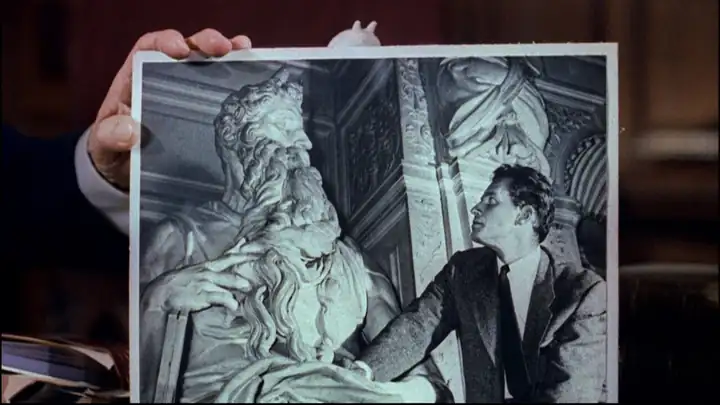
Heston got Moses in Cecil B. DeMille's The Ten Commandments (1956) because he looked uncannily like Michelangelo's statue of Moses.
Charlton Heston: Michelangelo and MosesImage: Wikimedia Commons · Trailer screenshot, Public domain - #005
Heston turned down General Joseph W. Stilwell in Steven Spielberg's comedy 1941 (1979), feeling the film insulted World War II veterans.
- #006
His funeral took place a week after his death, on April 12, 2008, attended by 250 people including former First Lady Nancy Reagan, California Governor Arnold Schwarzenegger, Olivia de Havilland, Keith Carradine, Pat Boone, Tom Selleck, Oliver Stone and Rob Reiner.
- #007
He broke his nose playing high school football, and later said it worked in his favor as an actor because it gave him "the profile of an Eagle."
- #008
From Skyjacked (1972) on, Charlton Heston wore a hairpiece in every film.
- #009
Charlton Heston's Hollywood home was crammed with souvenirs of his career. He and his wife lived in the same house near Mulholland Drive in Los Angeles for more than forty years, a postmodern-style house built by the actor's father and filled with memorabilia inside and out after his Best Actor Oscar for Ben-Hur (1959). In the backyard, a table held a Roman figure cracking a whip over four horses pulling a chariot. Two big brass door knockers from the House of Hur set hung at the entrance to his study, and above the fireplace was a painting of a heavy Conestoga wagon, beside a pen sketch of King Lear by his friend Sir Laurence Olivier. Most windows looked out over glittering canyon views. The central hallway was lined with twenty paintings of Heston in his major roles: Ben-Hur, Moses, Richelieu, Michelangelo, stranded astronaut Commander Taylor in Planet of the Apes (1968), the steel-willed Major Dundee, detective Thorn in Soylent Green (1973), Andrew Jackson in The President's Lady (1953), tough ranch foreman Steve Leech in The Big Country (1958), and the cowpoke Will Penny (1967), from Heston's favorite of his films.
- #010
Charlton Heston's will asked for him to be cremated, saying that after a lifetime in makeup he didn't want his body on display after death.
Charlton Heston: Ben HurImage: Wikimedia Commons · Trailer screenshot, Public domain - #011
Though often painted as an arch-conservative, Charlton Heston wrote in his autobiography "In the Arena" (1995) that he had opposed the McCarthy witch hunts of the 1950s and the Vietnam War, and thought President Richard Nixon was bad for America.
- #012
Charlton Heston never smoked, but he held a pipe in some early publicity photos because Clark Gable and Cary Grant both smoked pipes.
- #013
In 1969 some Democrats urged Charlton Heston to run for the California State Senate, but he said no because he wanted to keep acting.
- #014
Charlton Heston named Gary Cooper as his boyhood hero, and later acted with him in The Wreck of the Mary Deare (1959), where he admired Cooper for doing his own stunts, like staying underwater for long stretches, despite poor health and advancing years.
- #015
On June 18, 1968, Charlton Heston went on The Joey Bishop Show (1967) with Gregory Peck, James Stewart and Kirk Douglas to call for gun control after Senator Robert F. Kennedy's assassination. Ironically, thirty years later Heston became President of the National Rifle Association (NRA) and campaigned against gun control.
- #016
During the 1993 Waco standoff, the FBI recruited Charlton Heston to be the voice of God and reason with David Koresh, though the plan was never put into action.
- #017
A U.S. Army veteran of World War II, Charlton Heston visited combat troops in Vietnam in 1967. At a camp in South Vietnam's delta region he was even "initiated" into the GIs' base club, which meant taking a kiss on the ear.
- #018
Charlton Heston researched the real Cardinal Richelieu in depth for The Three Musketeers (1973) and The Four Musketeers (1974), and though the character is the villain, he came to deeply respect the man's real achievements for France. He found a quote attributed to Richelieu, "I have no enemies, France has enemies," and liked it so much he insisted it go into the films somewhere. He got his way: slightly altered ("I have no enemies, only enemies of France."), it turns up in the second film, when Richelieu offers d'Artagnan the chance to become one of his soldiers.
- #019
Charlton Heston called his decision not to use a Spanish accent as Mexican narcotics officer Miguel 'Mike' Vargas in the film noir Touch of Evil (1958) one of the biggest mistakes of his career.
- #020
Somewhat ironically, Charlton Heston was an outspoken supporter of the Gun Control Act of 1968, signed by President Lyndon B. Johnson.
- #021
Charlton Heston was popular in Greece, where his name was spelled "Charlton Easton" because "Heston" has scatological overtones in Greek.
- #022
Charlton Heston was president of the Screen Actors Guild from 1966 to 1971.
- #023
Charlton Heston turned down the chance to star with Marilyn Monroe in Let's Make Love (1960) so he could be directed on stage by Sir Laurence Olivier, whom he greatly admired.
- #024
Looking back on director Cecil B. DeMille in his 1995 autobiography "In the Arena," Charlton Heston wrote, "I should have thanked him for my career."
- #025
Charlton Heston offered to give back his whole salary on Major Dundee (1965) so director Sam Peckinpah could shoot key scenes cut for time and money. The producers took the money but still wouldn't let the scenes be filmed. In "In the Arena" (1995), Heston wrote that the film's real trouble was that everyone had a different idea of it: he saw it as a film about life after the Civil War, the producers wanted a routine cavalry-versus-Indians picture, and Peckinpah, in Heston's view, was really thinking of his next film, The Wild Bunch (1969).
- #026
John Wayne offered Charlton Heston Jim Bowie in The Alamo (1960), but he turned it down because of the film's political implications.
- #027
Major Dundee (1965) ran so far over schedule that Charlton Heston couldn't campaign for Lyndon B. Johnson in the 1964 presidential election. He later admitted in "In the Arena" (1995) that his politics had by then begun drifting to the Right.
- #028
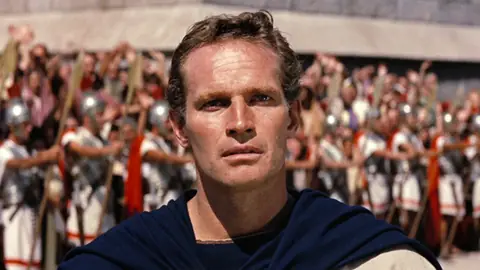
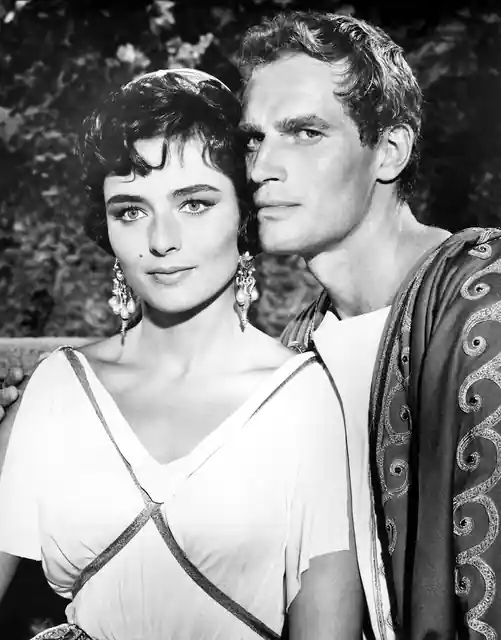
Charlton Heston spent three months learning to drive a chariot for Ben-Hur (1959).
Charlton Heston: Judah Ben-hurImage: Wikimedia Commons · unknown (MGM), Public domain - #029
Charlton Heston owned more than 400 modern and antique guns.
- #030
In 2000, Charlton Heston surprised the Oxford Union by reading his speech on gun laws off a teleprompter, which later fed rumors that he had known about his Alzheimer's long before announcing it in August 2002.
- #031
Charlton Heston and his wife, Lydia Clarke, both fought cancer and survived it, he prostate cancer and she breast cancer.
- #032
Charlton Heston received the Kennedy Center Honors in the same year as Lauren Bacall, Bob Dylan, Jessye Norman and Edward Villella.
- #033
When The Colbys (1985) was cancelled, Charlton Heston and his co-stars John James and Emma Samms were all offered contracts to carry on their characters in Dynasty (1981), the show it was spun off from. James and Samms signed, but Heston said no when his salary demands couldn't be met.
- #034
As a young man, Charlton Heston was a keen runner, swimmer and tennis player.
- #035
In "In the Arena" (1995), Charlton Heston wrote that Anthony Mann was a good director but that his lack of experience with big historical epics hurt El Cid (1961), which might have been better under William Wyler, his director on The Big Country (1958) and Ben-Hur (1959), or someone like him.
- #036
Charlton Heston was born the year Cecil B. DeMille made and released his original The Ten Commandments (1923); Heston would later star in the remake, The Ten Commandments (1956).
- #037
Charlton Heston stepped down as president of the National Rifle Association because of his failing health.
- #038
Charlton Heston admitted to Harry Belafonte that he felt he never became as good an actor as he could have been.
- #039
A 3-meter bronze statue of Charlton Heston, based on Will Penny (1967) and showing him in full cowboy gear with a pistol, stands outside the NRA's national headquarters in Washington, D.C.
- #040
Charlton Heston made four films with Oliver Reed: The Three Musketeers (1973), The Four Musketeers (1974), Crossed Swords (1977) and Treasure Island (1990).
- #041
Charlton Heston once said in an interview that he'd like to remake El Cid (1961), his favorite of his epics.
- #042
In the animated sitcom Family Guy (1999), Joe Swanson accidentally shoots Charlton Heston. Horrified, Joe apologizes over and over, and as Heston slumps to the ground he says, "That's okay son - it's your right as an American citizen!"
- #043
In The Celluloid Closet (1995), Gore Vidal recalls that one thing he was brought in to rewrite on Ben-Hur (1959) was the relationship between Messala and Ben-Hur. Director William Wyler worried that two men who had been close friends as boys wouldn't believably hate each other over politics, so Vidal devised a subtly veiled subtext suggesting they had been lovers in their youth and that their feud grew out of Ben-Hur rejecting Messala. Wyler was wary at first but agreed, on condition that the characters' sexuality was never mentioned outright in the script, that Vidal discuss the idea with Stephen Boyd himself, and that he not tell Heston, who Wyler feared would panic. When Vidal later said publicly that he had added the gay subtext, Heston denied it, even claiming Vidal had contributed very little to the final script and that his missing screen credit was because he'd been fired for trying to slip in homosexual innuendo. Vidal countered by quoting Heston's own 1978 autobiography, in which the actor admitted Vidal had written much of the final shooting script.
- #044
Charlton Heston turned down the nuclear submarine captain Rock Hudson played in Ice Station Zebra (1968), feeling the script gave the character too little depth.
- #045
In "In the Arena" (1995), Charlton Heston admitted that, not being Jewish, he probably wouldn't be cast as Moses or Ben-Hur today.
- #046
Charlton Heston opposed abortion and introduced Bernard Nathanson's anti-abortion documentary Eclipse of Reason (1987), about late-term abortions.
- #047
As NRA president, Charlton Heston often told audiences he had "marched for civil rights long before it became fashionable to do so." In fact he took part in only two events, one in 1961 and the March on Washington in August 1963, as his busy film career kept him from doing more for the cause at the time.
- #048
As a young man, Charlton Heston built up his biceps and triceps doing pull-ups and chin-ups on an iron bar fixed to a wall.
- #049
Empire (UK) magazine placed Charlton Heston 28th on its "The Top 100 Movie Stars of All Time" list.
- #050
Before Heston starred in The Omega Man (1971), a remake of Vincent Price's The Last Man on Earth (1964), he and Price had appeared together in Cecil B. DeMille's epic The Ten Commandments (1956).
- #051
In January 2005, neighbors below Heston's hillside home sued him, claiming heavy rain had sent debris down the slope onto their houses. The suit said "slope failure" on Heston's land had seriously damaged their homes and cut their market value, and the couple sought at least $1.2 million plus punitive damages. Heston's lawyer, Jeff Briggs, said the actor owned only ten percent of the slope, the rest belonging to the neighbors (January 3, 2007).
- #052
When producer Aaron Spelling asked Barbara Stanwyck to star opposite Heston in The Colbys (1985), she replied, "Are you trying to tell me I'm older than Moses?"
- #053
In the early 1990s, Charlton Heston tried and failed to revive the play "Mister Roberts."
- #054
Charlton Heston eventually tired of his "action man" image, wanting more recognition as a dramatic actor.
- #055
Charlton Heston was friends with novelist Patrick O'Brian, who also pictured Heston as Captain Jack Aubrey.
- #056
Charlton Heston appeared in two Best Picture Oscar winners, The Greatest Show on Earth (1952) and Ben-Hur (1959), and one nominee, The Ten Commandments (1956).
- #057
In World War II, Charlton Heston served in the United States Army Air Forces as a radio operator on B-25 bombers patrolling the Aleutian Islands. He saw no combat, but nearly died when an ambulance hit him as he tried to rescue the crew of a crashed plane, and his injuries meant he finished his service as an air traffic controller.
- #058
Charlton Heston was on excellent terms with English Shakespearean actor Douglas Wilmer.
- #059
Heston's nose was broken during a school football game.
- #060
Of all the directors he worked with, Charlton Heston said he most enjoyed working with Orson Welles.
- #061
Late in life, Charlton Heston was accused of overstating his part in the Civil Rights movement.
- #062
Charlton Heston refused to let scenes from The Agony and the Ecstasy (1965) be used in the documentary The Celluloid Closet (1995), telling the filmmakers he had researched Michelangelo thoroughly and could assure them the painter was not gay.
- #063
Having made so many historical films, Charlton Heston once said his goal was to act in modern clothes.
Behind the Scenes (69)
- #064
He came down with flu while shooting Planet of the Apes (1968), and the producers had him keep working through it, grueling as it was, because they felt the rasp in his voice suited the character. In his shoot diary, Heston described "feeling like Hell" while filming the scene where his character is dragged away from Nova (Linda Harrison), made worse by the fire hose turned on him.
- #065
He missed the start of his presentation at the 44th Academy Awards (1972) because of a blown tire on the Santa Monica freeway. Clint Eastwood took his place, and before Eastwood could finish the speech Heston was going to give, Heston arrived, to laughter and amusement from the audience.
- #066
When he met Toshirō Mifune around 1960, he was enormously impressed by the Japanese star and, claiming Mifune spoke no English, said "he could be the greatest star in the world". The two actors exchanged Christmas cards from their meeting until Mifune's death.
- #067
He said Planet of the Apes (1968) was the most physically demanding film he had ever made.
- #068
Although he and Kirk Douglas differed greatly on politics (Douglas was a very liberal Democrat and Heston a very conservative Republican), Heston and Douglas were very close friends. Douglas spoke warmly of their friendship; so much so that after seeing Bowling for Columbine (2002) — and in particular the scene in which Heston is questioned about his involvement with the NRA and asked, as an NRA member, to apologize for the killings — Douglas said he would never forgive the film's director and interviewer, Michael Moore, for the way he treated Heston.
- #069
He was cast as Moses in Cecil B. DeMille's The Ten Commandments (1956) because he bore an uncanny resemblance to Michelangelo's statue of Moses.
- #070
He turned down the role of General Joseph W. Stilwell in Steven Spielberg's comedy 1941 (1979) because he considered the film an insult to World War II veterans.
- #071
While appearing together in a play in 1960, Laurence Olivier told Heston that he had the potential to be the greatest American actor of the century. When the play received negative notices, Heston said, "I guess you learn to forget bad notices?" and Olivier replied, "What's more important, laddie, and much harder -- learn to forget good notices."
- #072
He was fond of drawing and sketching, and whenever he had the chance he often sketched his films' cast and crew. His sketches were later published in the book "Charlton Heston's Hollywood: 50 Years in American Film".
- #073
He initially turned down the role of Steve Leech in The Big Country (1958) because he did not think the part was big enough after the success he had had with The Ten Commandments (1956), but his agent persuaded him to take it on the grounds that working with both Gregory Peck, who was still a bigger star than Heston at the time, and director William Wyler would be worth it for his career. That relationship led to Heston being cast as the lead in Wyler's next film, Ben-Hur (1959), for which he won the Best Actor Oscar.
- #074
He had the flu during the shooting of Planet of the Apes (1968). The producers decided he should perform throughout his illness, physically taxing as it was, because they felt the hoarse timbre of his voice added something to the character. In a diary he kept during the shoot, Heston wrote that while filming the scene in which his character is forcibly separated from Nova (Linda Harrison), he "felt like Hell", made worse by the fire hose being turned on him.
- #075
He broke his nose playing football in high school. He later said this ultimately worked to his advantage as an actor because it gave him "the profile of an Eagle".
- #076
He was very popular in Japan, where even his less successful films were generally well received, because his screen persona embodied the qualities the Japanese admired in their Samurai warriors.
- #077
After their sons were born, they decided to adopt their next child so they could be sure it would be a girl. Heston and his wife felt that a son and a daughter made a perfect family.
- #078
From Skyjacked (1972) onward, he wore a hairpiece in every film.
- #079
He was the first choice to star in Alexander the Great (1956), but he turned it down so that he could play Moses in The Ten Commandments (1956). The role eventually went to Richard Burton.
- #080
Heston's Hollywood mansion is filled with memories from his career. He and his wife lived in the same house near Mulholland Drive in Los Angeles for more than forty years. After Heston won the Academy Award for Best Actor for Ben-Hur (1959), the postmodern-style house, designed by architect William S. Beckett, was filled inside and out with memories. On a table in the back garden sits a Roman figure wielding a whip, violently attacking four horses harnessed to a chariot. At the entrance to his study, two large brass door knockers from the House of Hur film set were mounted. Above the fireplace hung a painting of a cumbersome Conestoga wagon, and right beside it hung a pen sketch depicting his friend Sir Laurence Olivier as King Lear. From most of the windows, glittering views of the canyons could be seen. In the house's central corridor hung twenty paintings of Heston in important roles: Ben-Hur, Moses, Richelieu, Michelangelo, Planet of the Apes (1968), the marooned astronaut Commander Taylor, the steel-willed Major Dundee, Soylent Green (1973) detective Thorn, Andrew Jackson in The President's Lady (1953), the tough ranch foreman Steve Leech from The Big Country (1958), and cattle prodding Will Penny (1967) from Heston's favorite film.
- #081
In his will, cremation of his body was requested, and he stated that after a lifetime of wearing makeup, he did not want his body put on display after his death.
- #082
Although he was often portrayed as ultra-conservative, Heston wrote in his autobiography "In the Arena" (1995) that he opposed the McCarthy witch hunts of the 1950s, opposed the Vietnam War, and thought President Richard Nixon was bad for America.
- #083
Although Heston was a lifelong non-smoker, he held a pipe in some of his early publicity photos because both Clark Gable and Cary Grant smoked pipes.
- #084
He cited actor Gary Cooper as his childhood role model. Heston co-starred with Cooper in The Wreck of the Mary Deare (1959). Heston praised Cooper for being able to perform his own stunts, such as staying underwater for long periods, despite his poor health and advancing age.
- #085
On June 18, 1968, Heston appeared on The Joey Bishop Show (1967) and, along with Gregory Peck, James Stewart and Kirk Douglas, called for gun control after the assassination of Senator Robert F. Kennedy. Ironically, thirty years later, Heston was elected President of the National Rifle Association (NRA) and campaigned against gun control.
- #086
During the 1993 Waco standoff, Heston was hired by the FBI to provide the voice of God and reason with David Koresh while speaking to him. The plan was never used.
- #087
A World War II U.S. Army veteran, he visited combat troops during the Vietnam War in 1967. In fact, at a camp in the delta region of South Vietnam, he was "initiated" into the GIs' base club because he had to receive a kiss on the ear.
- #088
He did a great deal of research on the historical Cardinal Richelieu, whom he played in The Three Musketeers (1973)/The Four Musketeers (1974). Although the character is portrayed as an enemy, Heston gained great respect for the man because of his real achievements on behalf of France. He came across a quote attributed to Richelieu: "I have no enemies, France has enemies." He liked the sentence so much that he insisted it be used in the films somewhere, and eventually got his wish. Although slightly altered ("I have no enemies, only enemies of France."), this line appears in the second film in the scene where Richelieu offers d'Artagnan the chance to become one of his soldiers.
- #089
He stated that not using a Spanish accent for the Mexican narcotics officer Miguel 'Mike' Vargas in the film noir Touch of Evil (1958) was one of the biggest mistakes he made as an actor.
- #090
Somewhat ironically, Heston was a vocal supporter of the Gun Control Act of 1968 signed by President Lyndon B. Johnson.
- #091
Heston was a popular actor in Greece, and his name was written as "Charlton Easton" because "Heston" carries scatological connotations in the Greek language.
- #092
Lord Laurence Olivier was so impressed by Heston's stage skills that he remarked that Heston had a future on the stage.
- #093
He turned down the offer to star alongside Marilyn Monroe in Let's Make Love (1960) in order to be directed by Sir Laurence Olivier, whom he greatly admired, in a play.
- #094
In his autobiography "In the Arena" (1995), he wrote the following about director Cecil B. DeMille: "I should have thanked him for my career."
- #095
Heston wanted to appear in The Return of the Musketeers (1989), but his character from the previous film, Cardinal Richelieu, had died by the film's 1648 setting. Fortunately, director Richard Lester had a painting of Richelieu made using Heston as the model. This painting is seen at the beginning of the film and was given to Heston after shooting.
- #096
A voracious reader by nature, Heston often went to great lengths to research the historical figures he portrayed and the periods his films depicted. His research on Cardinal Richelieu affected him so much that he insisted on playing Richelieu as a morally ambiguous character rather than a villain in The Three Musketeers (1973) and its sequel.
- #097
He turned down the Gary Cooper role in High Noon (1952).
- #098
He offered to return his entire salary to the producers of Major Dundee (1965) so that director Sam Peckinpah could shoot some important scenes that had been cut due to time and budget constraints. The producers took back Heston's paycheck but still did not allow the scenes to be shot. In his autobiography "In the Arena" (1995), Heston wrote that the main problem with Major Dundee (1965) was that everyone had a different idea of what the film was: Heston saw it as a film about post-Civil War life, the producers wanted only a standard cavalry-versus-Indians film, whereas according to Heston, Peckinpah really had his next film, The Wild Bunch (1969), in mind.
- #099
John Wayne offered Heston the role of Jim Bowie in The Alamo (1960), but he declined because of the film's political implications.
- #100
In the 1964 presidential election, when Major Dundee (1965) went off schedule, he was unable to campaign for Lyndon B. Johnson. Heston later admitted in his autobiography "In the Arena" (1995) that his political beliefs had begun to shift to the Right.
- #101
He called The Call of the Wild (1972) his worst film.
- #102
In 2000, he surprised the Oxford Union by reading his speech on gun laws from a teleprompter. This later fueled rumors that he had known about his Alzheimer's disease long before announcing it to the world in August 2002.
- #103
He was considered for the role of Police Chief Martin Brody in the blockbuster Jaws (1975) but turned it down. The role ultimately went to Roy Scheider.
- #104
When the series The Colbys (1985) was cancelled, he and his co-stars John James and Emma Samms were all offered contracts to continue playing their characters on Dynasty (1981), from which The Colbys was spun off. Heston ultimately declined because his salary demands could not be met. James and Samms accepted their contracts.
- #105
In his autobiography "In the Arena" (1995), he stated that he thought Anthony Mann was a good director but also felt that Mann's lack of experience directing large-scale historical films such as the epic El Cid (1961) hurt the overall product, and that El Cid (1961) might have benefited from being directed by William Wyler, who directed Heston in The Big Country (1958) and Ben-Hur (1959), or someone like Wyler.
- #106
He was born in the same year that Cecil B. DeMille directed and released his original epic The Ten Commandments (1923). Heston would later appear in the remake, The Ten Commandments (1956).
- #107
In 1999, he joined Karl Malden in lobbying for the Honorary Lifetime Achievement Oscar to be given to veteran director Elia Kazan. Marlon Brando, who never appeared in public, refused to present the award, and Robert De Niro and Martin Scorsese ultimately did so.
- #108
He took on three roles after Burt Lancaster turned them down. In 1958, the producers of Ben-Hur (1959) offered Lancaster $1 million to star in their epic; Lancaster turned it down because, as an atheist, he did not want to help promote Christianity. Lancaster also said he did not agree with the story's "violent morals." Three years later, in 1961, Lancaster announced his intention to make a biographical film in which he would play Michelangelo and show the truth about the painter's homosexuality. However, due to the five-month shooting schedule of Luchino Visconti's masterpiece The Leopard (1963), he had to shelve this project. Heston took on the role of Michelangelo in The Agony and the Ecstasy (1965) and, even thirty years later in his autobiography, still denied that the painter was homosexual despite all evidence to the contrary. Lancaster also turned down the role of General Gordon in Khartoum (1966).
- #109
Charlton Heston felt he was not as good an actor as he could have been throughout his life. He admitted this to Harry Belafonte.
- #110
A 10-foot bronze statue of Heston, inspired by Will Penny (1967), holding a pistol and dressed in a full cowboy outfit, was erected in front of the NRA's national headquarters in Washington, D.C.
- #111
He turned down the lead role in The Omen (1976), which later went to Gregory Peck.
- #112
In an interview, he stated that he wanted to remake El Cid (1961), his favorite among his epics.
- #113
On December 4, 1993, he appeared on Charlton Heston/Paul Westerberg (1993) at the age of 70, becoming the oldest man to host Saturday Night Live in the show's history and the third oldest overall after Miskel Spillman and Ruth Gordon.
- #114
Although he played Martha Scott's son in The Ten Commandments (1956) and Ben-Hur (1959), in real life he was only eleven years younger than Martha Scott.
- #115
In the animated sitcom Family Guy (1999), Heston is accidentally shot by the character Joe Swanson. Joe is horrified and apologizes profusely. As he collapses to the ground, Heston responds, "That's okay son - it's your right as an American citizen!"
- #116
According to Gore Vidal, as recounted in The Celluloid Closet (1995), one of the script elements he was brought in to rewrite for Ben-Hur (1959) was the relationship between Messala and Ben-Hur. Director William Wyler was worried that two men who had been close friends in their youth would not come to hate each other over a disagreement about politics. So Vidal devised a subtly veiled subtext suggesting that Messala and Ben-Hur had been lovers in their youth and that their quarrel was a result of Ben-Hur's rejection of Messala. Wyler was initially hesitant about implementing the subtext, but agreed on the conditions that the script never refer directly to the characters' sexuality, that Vidal discuss the idea personally with Stephen Boyd, and that he not mention the subtext to Heston, whom he feared would panic at the idea. After Vidal admitted publicly that he had added the homosexual subtext, Heston denied the claim and went so far as to suggest that Vidal had contributed very little to the final script and that his absence from the screen was the result of his being fired for trying to add homosexual innuendo. Vidal refuted this claim by quoting from Heston's 1978 autobiography, in which the actor admitted that Vidal wrote most of the final shooting script.
- #117
Due to production delays on The Agony and the Ecstasy (1965), he had to turn down a role in the comedy The Great Race (1965), so the role went to Tony Curtis.
- #118
He turned down the role of Rock Hudson's nuclear submarine captain in Ice Station Zebra (1968) because he felt there was not much characterization in the script.
- #119
In his autobiography "In the Arena" (1995), he admitted that, because he was not Jewish, he probably would not be cast in the roles of Moses and Ben-Hur in the modern era.
- #120
His portrayal of Buffalo Bill Cody in Pony Express (1953), an early western in Heston's career, inspired the Bills, a Congolese youth cult that idolized American westerns.
- #121
As president of the NRA, he often told his audiences in his speeches that he had "marched for civil rights long before it became fashionable to do so." In reality he took part in only two events: the first in 1961, and the second the March on Washington in August 1963. Because of his busy film career at the time, he was unable to appear more often in support of the Civil Rights cause.
- #122
In his youth, he used an iron bar fixed to the wall to do pull-ups and chin-ups to build his biceps and triceps.
- #123
Neighbors living below Heston's hill sued the actor in January 2005, claiming their properties were damaged when heavy rain sent debris down the slope onto their homes. The suit alleged that "slope failure" on Heston's property caused serious damage to their homes and lowered their market value. The couple sought at least $1.2 million plus punitive damages. Heston's attorney, Jeff Briggs, said the actor owned ten percent of the slope and the rest belonged to the neighbors (January 3, 2007).
- #124
He was friends with Brock Peters, with whom he worked on numerous plays throughout the 1940s and 1950s and on films throughout the 1960s and 1970s. They were set to appear in a multiracial casting of "Romeo and Juliet" (1946), with Peters playing Tybalt and Heston taking the role of Mercutio, but the production was abandoned due to a lack of financial backing.
- #125
Reports at the time suggested that Heston badly wanted to play Sir Thomas More in A Man for All Seasons (1966). The role went to Paul Scofield instead. Heston later directed and starred in A Man for All Seasons (1988).
- #126
In 1996, Heston attended the Conservative Political Action Conference, the annual meeting of conservative movement organizations. There he agreed to pose for a group photograph that included Gordon Lee Baum, founder of the Council of Conservative Citizens (CCC) and a former White Citizens' Council organizer. Virginia's conservative Republican Senator George Allen also appeared in the photograph, which was published in the Summer 1996 issue of the CCC's newsletter, Citizens Informer.
- #127
He eventually grew tired of his "action man" image because he wanted more attention as a dramatic actor.
- #128
He was friends with author Patrick O'Brian, who envisioned Heston playing the character Captain Jack Aubrey.
- #129
During World War II, he served as a radio operator on B-25 bombers patrolling the Aleutian Islands with the United States Army Air Forces. Although he never saw combat, he nearly died when an ambulance struck him while he was trying to rescue the crew of a downed plane, and because of his injuries he completed his service as an air traffic controller.
- #130
Charlton Heston was initially considered for the role of Sergeant J. J. Sefton in Stalag 17, but when the script was changed to make the character less heroic, he was passed over in favor of someone better suited to the part. Kirk Douglas stated that the role was his next and turned it down, which made William Holden the third choice. Douglas later regretted the decision, saying it was the biggest mistake of his career.
- #131
He did not allow scenes from The Agony and the Ecstasy (1965) to be used in the documentary The Celluloid Closet (1995). Heston told the filmmakers that he had done a great deal of research on Michelangelo and could assure them that the painter was not homosexual.
- #132
Because he appeared in so many historical films, he said at one point that his goal was to act in modern clothes.
Characters & Cast (13)
- #133
Heston loved to draw and often sketched the casts and crews of his films whenever he got the chance; the sketches were later collected in the book "Charlton Heston's Hollywood: 50 Years in American Film."
- #134
Charlton Heston was first choice for Alexander the Great (1956) but turned it down to play Moses in The Ten Commandments (1956), and the role went to Richard Burton.
- #135
Charlton Heston took Ben-Hur (1959) after Burt Lancaster turned it down.
- #136
An avid reader, Charlton Heston often went to great lengths researching the historical figures he played and the eras of his films. His research into Cardinal Richelieu affected him so much that he insisted on playing him as morally ambiguous rather than a villain in The Three Musketeers (1973) and its sequel.
- #137
Charlton Heston took three roles that Burt Lancaster had turned down. In 1958 the producers of Ben-Hur (1959) offered Lancaster $1 million to star, but as an atheist he didn't want to help promote Christianity, and he said he disagreed with the story's "violent morals." In 1961 Lancaster announced plans for a biopic in which he would play Michelangelo and reveal the truth about the painter's homosexuality, but the five-month shoot of Luchino Visconti's masterpiece The Leopard (1963) forced him to shelve it. Heston played Michelangelo in The Agony and the Ecstasy (1965) and, even in his autobiography thirty years later, still denied the painter was gay despite all the evidence. Lancaster also turned down General Gordon in Khartoum (1966).
- #138
Charlton Heston turned down the lead in The Omen (1976), which then went to Gregory Peck.
- #139
Delays on The Agony and the Ecstasy (1965) forced Charlton Heston to give up a role in the comedy The Great Race (1965), which went to Tony Curtis.
- #140
One of Charlton Heston's biggest regrets was never playing the title role in "Becket."
- #141
Charlton Heston was considered, along with English actor Ronnie Barker, for Claudius in the British miniseries I, Claudius (1976), but the part went to the lesser-known Derek Jacobi.
- #142
Charlton Heston was considered for Pike Bishop in Sam Peckinpah's The Wild Bunch (1969), but William Holden got the role.
- #143
Charlton Heston was friends with Brock Peters, with whom he did many plays in the 1940s and 1950s and films in the 1960s and 1970s. The two were to appear in a multiracial "Romeo and Juliet" (1946), Peters as Tybalt and Heston as Mercutio, but the production collapsed for lack of funding.
- #144
Reports at the time said Charlton Heston badly wanted to play Sir Thomas More in A Man for All Seasons (1966), but Paul Scofield got the part. Heston later directed and starred in A Man for All Seasons (1988).
- #145
Charlton Heston was first considered for Sergeant J. J. Sefton in Stalag 17, but when the script made the character less heroic, he was dropped for someone better suited. The role was next offered to Kirk Douglas, who turned it down, leaving William Holden as third choice; Douglas later called it the biggest mistake of his career.
Career & Awards (6)
- #146
Heston missed the start of his presenting slot at the 44th Academy Awards (1972) because of a blowout on the Santa Monica freeway. Clint Eastwood filled in, and before he'd finished the speech Heston was meant to give, Heston arrived, to the audience's laughter and delight.
- #147
He first turned down Steve Leech in The Big Country (1958), thinking the part too small after the success of The Ten Commandments (1956), but his agent convinced him that working with Gregory Peck, then still the bigger star, and director William Wyler would be good for his career. That connection led Wyler to cast him as the lead in his next film, Ben-Hur (1959), which won Heston the Best Actor Oscar.
- #148
While training as an actor early on, Charlton Heston paid his way by modeling at The Art Students League in New York, across from Carnegie Hall, until the lure of Hollywood and a contract ended his modeling days.
- #149
In 1999, Charlton Heston joined Karl Malden in lobbying for veteran director Elia Kazan to receive an Honorary Lifetime Achievement Oscar. Marlon Brando refused to present it, and in the end Robert De Niro and Martin Scorsese did.
- #150
Charlton Heston's Buffalo Bill Cody in Pony Express (1953), one of his early westerns, inspired the Bills, a Congolese youth cult devoted to American westerns.
- #151
Charlton Heston made his Broadway debut in 1948 in a small part in Antony and Cleopatra and his film debut in 1950 with Dark City. His first major film was The Greatest Show on Earth in 1952, in which he played circus manager Brad.
Life & Family (8)
- #152
In the 1960s he gave his time and energy to the Civil Rights movement, marching several times with the Reverend Dr. Martin Luther King Jr., including at the 1963 March on Washington, and he narrated the original, uncut version of King: A Filmed Record… Montgomery to Memphis (1969).
- #153
The name Charlton Heston joined his mother's maiden name (Lila Charlton) to the surname of his stepfather, Chester Heston.
- #154
Charlton Heston saw no contradiction between his civil rights activism in the 1960s and his defense of gun rights in the 1990s, insisting he had only ever stood for "freedom in the truest sense."
- #155
Charlton Heston wanted to be in The Return of the Musketeers (1989), but his Cardinal Richelieu was dead by the film's 1648 setting. Director Richard Lester got around it by having a portrait of Richelieu painted with Heston as the model; it appears at the start of the film and was given to Heston after the shoot.
- #156
Heston's three grandchildren were John Alexander Clarke "Jack" Heston, Ridley Charlton Rochell and "Charlie" Rochell.
- #157
Charlton Heston played Martha Scott's son in The Ten Commandments (1956) and Ben-Hur (1959), though in real life he was only eleven years younger than her.
- #158
Charlton Heston was of English, Scottish and a little German descent, and his maternal grandparents were Canadian.
- #159
Charlton Heston had hip replacement surgery in 1996 and was treated for alcoholism in 2000.
Related pages
- The Message — Charlton Heston comes up in the facts on that page
- Kingdom of the Planet of the Apes — Charlton Heston comes up in the facts on that page
- Anne Baxter — Charlton Heston comes up in the facts on that page
Charlton Heston — Movies and TV
Charlton Heston's 129 IMDb acting credits included films such as Ben-Hur, Touch of Evil and Planet of the Apes, alongside television work in The Colbys and Dynasty.
| Year | Title | Role |
|---|---|---|
| 1948–1971 | The Ed Sullivan Show Toast of the Town (TV series, 2 episodes) | Dramatic Reader |
| 1956–1961 | Playhouse 90 (TV series, 2 episodes) | Charles Gray |
| 1958 | Touch of Evil | Mike Vargas |
| 1958 | The Big Country | Steve Leech |
| 1958 | The Buccaneer | Gen. Andrew Jackson |
| 1959 | The Wreck of the Mary Deare | John Sands |
| 1959 | Ben-Hur | Judah Ben-Hur |
| 1961–1963 | Alcoa Premiere (TV series, 1 episode) | Paul Malone |
| 1961 | El Cid | El Cid Rodrigo de Vivar |
| 1962 | The Pigeon That Took Rome | Captain Paul MacDougall |
| 1962 | Diamond Head | King Howland |
| 1963 | 55 Days at Peking | Maj. Matt Lewis |
| 1963 | The Patriots (TV movie) | Thomas Jefferson |
| 1964 | What Is a Boy (TV short) | Narrator |
| 1965 | The Greatest Story Ever Told | John the Baptist |
| 1965 | Major Dundee | Major Amos Charles Dundee |
| 1965 | The Agony and the Ecstasy | Michelangelo |
| 1965 | The War Lord | Chrysagon |
| 1966 | Planet of the Apes Test Reel (Short film) | Thomas |
| 1966 | Khartoum | General Charles 'Chinese' Gordon |
| 1967 | Will Penny | Will Penny |
| 1967 | Counterpoint | Lionel Evans |
| 1968 | Elizabeth the Queen (TV movie) | Robert Devereaux, Earl of Essex |
| 1968 | Planet of the Apes | George Taylor |
| 1969 | Number One | Ron Catlan |
| 1970 | Julius Caesar | Mark Antony |
| 1970 | The Don Adams Special: Hooray for Hollywood (TV movie) | Narrator |
| 1970 | Beneath the Planet of the Apes | Taylor |
| 1970 | The Hawaiians | Whip Hoxworth |
| 1971 | The Omega Man | Neville |
| 1971–1987 | The Two Ronnies (TV series, 1 episode) | Bar Customer: Pinocchio II Segment |
| 1972 | Antony and Cleopatra | Marc Antony |
| 1972 | Skyjacked | Henry O'Hara |
| 1972 | The Call of the Wild | John Thornton |
| 1973 | Soylent Green | Thorn |
| 1973 | The Adventures of Mowgli Maugli | Narrator |
| 1973 | The Three Musketeers | Cardinal Richelieu |
| 1974 | The Fun of Your Life (Short film) | Narrator |
| 1974 | Airport 1975 | Alan Murdock |
| 1974 | The Four Musketeers | Cardinal Richelieu |
| 1974 | Earthquake | Graff |
| 1976 | The Last Hard Men | Sam Burgade |
| 1976 | Midway | Captain Matt Garth |
| 1976 | Two-Minute Warning | Capt. Peter Holly |
| 1977 | Energy: A National Issue (TV movie) | Narrator |
| 1977 | Crossed Swords The Prince and the Pauper | Henry VIII |
| 1978 | Gray Lady Down | Captain Paul Blanchard |
| 1980 | The Mountain Men | Bill Tyler |
| 1980 | The Awakening | Matthew Corbeck |
| 1981–1989 | Dynasty (TV series, 4 episodes) | Jason Colby |
| 1982 | Mother Lode | Silas McGee |
| 1983 | Chiefs (Miniseries, 3 episodes) | Hugh Holmes |
| 1984 | Nairobi Affair (TV movie) | Lee Cahill |
| 1985–1987 | The Colbys (TV series, 49 episodes) | Jason Colby |
| 1987 | Proud Men (TV movie) | Charley MacLeod Sr. |
| 1987–1989 | The Dame Edna Experience (TV series, 1 episode) | Chuck |
| 1987 | The Bold and the Beautiful (TV series, 6 episodes) | Charlton Heston |
| 1988 | A Man for All Seasons (TV movie) | Sir Thomas More |
| 1989 | Original Sin (TV movie) | Louis Mancini |
| 1989 | Call from Space (Short film) | Alien |
| 1989 | One Incoming (TV movie) | Narrator |
| 1990 | Treasure Island (TV movie) | Long John Silver |
| 1990 | Solar Crisis | Adm. 'Skeet' Kelso |
| 1990 | The Little Kidnappers (TV movie) | James MacKenzie |
| 1990 | Almost an Angel | God |
| 1991 | Cults: Saying No Under Pressure (Video) | Narrator |
| 1991 | The Crucifer of Blood (TV movie) | Sherlock Holmes |
| 1991–1999 | Noel's House Party (TV series, 1 episode) | Star guest |
| 1992 | Crash Landing: The Rescue of Flight 232 (TV movie) | Captain Al Haynes |
| 1992 | Genghis Khan: The Story of a Lifetime | Trogul |
| 1992 | Noël (TV short) | Narrator |
| 1993 | Wayne's World 2 | Good Actor |
| 1993 | Tombstone | Henry Hooker |
| 1993–1996 | SeaQuest 2032 SeaQuest DSV (TV series, 1 episode) | Abalon |
| 1993–2015 | Late Show with David Letterman (TV series, 1 episode) | Dave's Supervisor |
| 1994 | True Lies | Spencer Trilby |
| 1994 | In the Mouth of Madness | Jackson Harglow |
| 1994 | Texas (TV movie) | Narrator |
| 1994 | The Great Battles of the Civil War (TV series, 40 episodes) | Abraham Lincoln |
| 1994–2004 | Friends (TV series, 1 episode) | Charlton Heston |
| 1995 | The Avenging Angel (TV movie) | Brigham Young |
| 1995–2002 | The Outer Limits (TV series, 1 episode) | Chief Justice Haden Wainwright |
| 1996 | Alaska | Perry |
| 1996 | Hamlet | Player King |
| 1996 | The Lord Protector | Narrator |
| 1996–2009 | Adventures from the Book of Virtues (TV series, 1 episode) | Cincinnatus |
| 1997 | Hercules | Narrator |
| 1998 | Armageddon | Narration by |
| 1998 | Bagpipe: Instrument of War - Part 1 (TV movie) | Narrator |
| 1998 | Gideon | Addison Sinclair |
| 1999 | Bagpipe: Instrument of War - Part 2 (TV movie) | Narrator |
| 1999 | The Road to Santiago Camino de Santiago (Miniseries, 3 episodes) | Professor Marcelo Rinaldi |
| 1999 | Any Given Sunday | AFFA Football Commissioner |
| 2000–2001 | Cursed (TV series, 1 episode) | Charlton Heston |
| 2001 | Town & Country | Eugenie's Father |
| 2001 | Cats & Dogs | The Mastiff |
| 2001 | Planet of the Apes | Zaius |
| 2001 | The Order | Professor Finley |
| 2003 | Ben Hur (Video) | Ben Hur |
| 2003 | My Father My Father, Rua Alguem 5555 | The Father (Josef Mengele) |
Director
| Year | Title |
|---|---|
| 1972 | Antony and Cleopatra |
| 1982 | Mother Lode |
| 1988 | A Man for All Seasons |
Charlton Heston — Personal Life
Charlton Heston was married to Lydia Clarke from 1944 until his death in 2008. They had 2 children, Fraser C. Heston and Holly Heston Rochell.
- Spouse
- Lydia Clarke (1944–2008 · his death · 2 children)
- Children
- Fraser C. Heston, Holly Heston Rochell
- Parent
- Russell Whitford Carter, Lilla Carter
Born John Charles Carter on October 4, 1923, in Wilmette, Illinois, Charlton Heston was the son of Russell Whitford Carter and Lilla Carter.
He married Lydia Clarke in 1944, and they remained married until his death in 2008. Their children were Fraser C. Heston and Holly Heston Rochell. He died on April 5, 2008, in Beverly Hills, California, from pneumonia and Alzheimer's disease.
Charlton Heston — Awards
Charlton Heston won 19 awards from 39 total nominations. His honors included the 1960 Best Actor Oscar for Ben-Hur and the 1978 Jean Hersholt Humanitarian Award.
| Year | Award | Title | Category | Result |
|---|---|---|---|---|
| 1952 | Photoplay Awards | The Greatest Show on Earth | Best Performances of the Month (March) | Won |
| 1952 | Primetime Emmy Awards | — | Best Actor | Nominated |
| 1953 | Primetime Emmy Awards | — | Best Actor | Nominated |
| 1956 | Golden Apple Awards | — | Most Cooperative Actor | Won |
| 1957 | Laurel Awards | The Ten Commandments | Top Male Dramatic Performance | Won |
| 1957 | Golden Globes | The Ten Commandments | Best Actor - Drama | Nominated |
| 1960 | Academy Awards | Ben-Hur | Best Actor in a Leading Role | Won |
| 1960 | Walk of Fame | — | Motion Picture | Won |
| 1960 | Fotogramas de Plata | The Ten Commandments | Best Foreign Performer (Mejor intérprete de cine extranjero) | Won |
| 1960 | Golden Globes | Ben-Hur | Best Actor - Drama | Nominated |
| 1961 | David di Donatello Awards | Ben-Hur | Best Foreign Actor (Migliore Attore Straniero) | Won |
| 1962 | Golden Globes (Henrietta Award) | — | World Film Favorite - Male | Won |
| 1963 | Bambi Awards | The Pigeon That Took Rome | Best Actor - International | Won |
| 1963 | Golden Globes | The Pigeon That Took Rome | Best Actor - Comedy or Musical | Nominated |
| 1967 | Golden Globes (Cecil B. DeMille Award) | — | — | Won |
| 1969 | Western Heritage Awards (Bronze Wrangler) | Will Penny | Theatrical Motion Picture | Won |
| 1972 | Actor Awards (Life Achievement Award) | — | — | Won |
| 1975 | Academy of Science Fiction, Fantasy & Horror Films, USA (Special Award) | — | — | Won |
| 1978 | Academy Awards (Jean Hersholt Humanitarian Award) | — | — | Won |
| 1984 | ShoWest Convention, USA (Lifetime Achievement Award) | — | — | Won |
| 1996 | Primetime Emmy Awards | Andersonville Diaries | Outstanding Informational Special | Nominated |
| 1997 | The Kennedy Center Honors | — | — | Won |
| 2003 | Long Beach International Film Festival, Pasadena (Lifetime Achievement Award) | — | — | Won |
| 2010 | Western Heritage Awards (Hall of Great Western Performers) | — | — | Won |
Charlton Heston — Career
Charlton Heston's acting career included Ben-Hur, Touch of Evil, El Cid and Planet of the Apes. He also directed Antony and Cleopatra (1972), Mother Lode (1982) and A Man for All Seasons (1988).
- 1923
Charlton Heston was born John Charles Carter on October 4, 1923.
- 1941
He made his feature film debut in Peer Gynt, based on Henrik Ibsen's play.
- 1956
He starred in The Ten Commandments.
- 1959
He starred in Ben-Hur.
- 1960
He won the Best Actor Oscar for Ben-Hur.
- 1968
He starred in Planet of the Apes.
- 1972
He directed and acted in Antony and Cleopatra.
- 1978
He received the Jean Hersholt Humanitarian Award.
- 1982
He directed and acted in Mother Lode.
- 1988
He directed and acted in A Man for All Seasons.
Charlton Heston — FAQ
When was Charlton Heston born and how old was he when he died?
He was born on October 4, 1923, and died on April 5, 2008, aged 84.
How tall was Charlton Heston?
He was 189.2 cm tall, also listed as 1.89 m.
Who was Charlton Heston's wife?
He was married to Lydia Clarke from 1944 until his death in 2008.
Who were Charlton Heston's children and parents?
His children were Fraser C. Heston and Holly Heston Rochell. His parents were Russell Whitford Carter and Lilla Carter.
What was Charlton Heston's real name and nickname?
His birth name was John Charles Carter. His nickname was Chuck.
What was Charlton Heston's first film?
He made his feature film debut in Peer Gynt (1941), based on Henrik Ibsen's play.
What movies was Charlton Heston known for?
He was known for Ben-Hur (1959), Touch of Evil (1958), El Cid (1961), Planet of the Apes (1968) and The Omega Man (1971).
Did Charlton Heston win an Oscar?
He won the Best Actor Oscar in 1960 for Ben-Hur (1959). His overall awards record included 19 wins from 39 total nominations.
Continue through the archive
Sources & editorial notes
Reference databases
- Wikipedia
- IMDb
Information from external sources is independently selected, consolidated and edited by Arka Evren. Sources are listed for verification and further reading. Encyclopedia text is used under its licence (CC BY-SA). How we work