

FILM · 2011 · UK
Rise of the Planet of the Apes
- Directed by
- Rupert Wyatt
- Runtime
- 105 min
- Studio
- Dune Entertainment, Chernin Entertainment, Ingenious Media
147 archived facts 6 topics 1 source Last reviewed Nov 2026
A highly intelligent chimpanzee named Caesar has been living a peaceful suburban life ever since he was born. But when he gets taken to a cruel primate facility, Caesar decides to revolt against those who have harmed him.
147 Interesting Facts About Rise of the Planet of the Apes
Interesting Facts (57)
- #001
Contains a major spoiler — show
In the original ending, which was actually filmed, Will dies on screen. In the final cut, Will tells Caesar to come home and tries to get him to leave with him, Caesar replies "Caesar is home," and Will lets him go. Because of the graphic shown before the end credits depicting the virus spreading rapidly worldwide, Will is presumed to have eventually died along with most of the human race. In the original ending, Caesar and Will are in the forest and Will tries to persuade him to return home; they are interrupted by soldiers and Caesar is about to be shot, but Will shields him from the bullets and is killed. A month before the film's release, plans changed and James Franco and Andy Serkis flew out over the Fourth of July weekend to shoot the final portion that remains in the film.
- #002
- #003
- #004
- #005
- #006
- #007
- #008
- #009
Caesar's speaking voice was created by sound designer Chuck Michael, who combined the voices of fully grown male chimpanzees recorded at Chimp Haven with Andy Serkis's voice.
- #010
- #011
- #012
- #013
- #014
Contains a major spoiler — show
After deciding that Caesar's mother would die early in the film, Caesar had a "romance" at the ape shelter with a female chimpanzee named Cornelia, who was taken to the Gen-Sys laboratory and whose reason for going there in her place was to free her. Scenes of the pair appeared in some trailers before finally being cut. Cornelia returns in Dawn of the Planet of the Apes (2014).
- #015
- #016
- #017
- #018
- #019
Contains a major spoiler — show
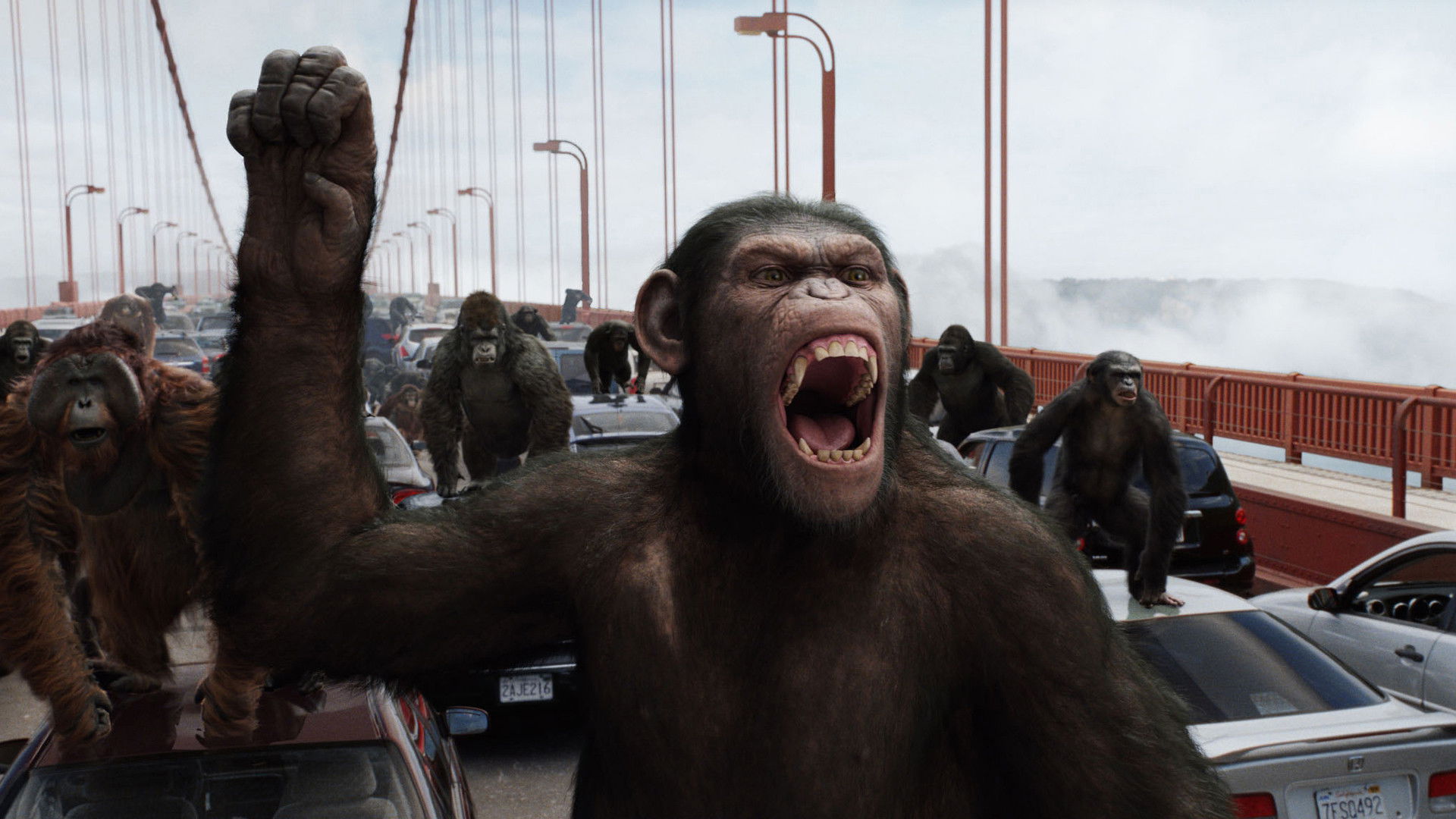
Although the film's climax appears to show a great many apes running through San Francisco, Rupert Wyatt planned it based on real ape populations in America, particularly a facility in San Bruno housing 70 to 80 apes. Across the whole country, there are about 3,000 great apes in US laboratories. Only about 300,000 chimpanzees exist in the wild.
- #020
- #021
- #022
- #023
- #024
- #025
Contains a major spoiler — show
Other debated topics on set included how much and what kind of clothing Caesar should wear (so he would not resemble Clyde from Every Which Way but Loose), how many times the apes should be shot or appear to be shot on the Golden Gate Bridge (because audiences reacted more negatively to apes being shot than to humans being shot), and whether Caesar should ultimately push Jacobs off the bridge.
- #026
- #027
Contains a major spoiler — show
The mistreatment Caesar suffers in captivity mirrors that of George Taylor in Planet of the Apes (1968). Both escape and attack a guard, and both are seized by the authorities after their owners, who know they are intelligent, protest. Both are attacked by one of their speechless brethren, which leads to a fight, and both are then locked in a separate cell. When they turn combative, both are attacked with fire hoses jammed through the bars of their cells.
- #028
- #029
- #030
- #031
- #032
- #033
- #034
Contains a major spoiler — show
In an earlier version of the script, Rocket's eyes begin turning green (a sign of intelligence) after he bites Caesar during their first encounter. After Caesar and Rocket escape the primate facility and visit both Will's house and the Gen-Sys laboratory, they use stolen scissors to share their blood with the other apes at the facility, thereby passing on their viral intelligence. In this version of the script, Dodge Landon, taking over from Caesar, shoots and kills Rocket on the Golden Gate Bridge. In a deleted scene, after his defeat by Caesar, Rocket is left alone in his pen, preserving his pride and refusing to exercise even after being hosed down by Dodge. This scene may explain the later script in which Caesar gives Rocket a cookie and instructs him to distribute the cookies.
- #035
Contains a major spoiler — show
The film contains relatively little dialogue, with long stretches featuring very little or no spoken words. For example, at the film's midpoint, when Caesar steals ALZ-113 and begins carrying out his plan to unleash it on the apes, there is a five-minute, 45-second span containing only a single line of spoken dialogue (and it occurs off-screen).
- #036
When Rodney asks Dodge about Caesar's clothes and whether they might cause problems with the other apes, Rodney is wearing clothes of the same colors as Caesar (a dark red shirt and blue jeans). Rodney is later beaten by the apes in the shelter before Caesar intervenes, just as Caesar is beaten by Rocket in the play area after Rocket tears the red shirt off his back.
- #037
- #038
- #039
- #040
Contains a major spoiler — show
Koba may be based on two real-life apes: Kanzi, a bonobo at Georgia State University who specializes in keyboard communication (and whose name also begins with the letter "K"); and Saddam, a wild, aggressive chimpanzee known to have killed several children near Kibale National Park in Uganda before being captured by an angry mob.
- #041
Contains a major spoiler — show
Under California's exotic animal laws, it is illegal to own a primate. Therefore, neighbors or anyone who saw Caesar in public could report him to animal control and have him removed as soon as they learned of his existence. In addition, when Caesar was ultimately removed, there would have been no date of objection, since keeping him was against California law.
- #042
- #043
- #044
- #045
- #046
- #047
Rodney is seen watching Charlton Heston's The Agony and the Ecstasy (1965) on television because Rupert Wyatt wanted to include Heston in the film without resorting to tricks. Conversely, Dodge is heard watching Dancing with the Stars.
- #048
- #049
- #050
Contains a major spoiler — show
In an earlier version of the script, Hunsiker's first name was given as Douglas. In that same script, Steven Jacobs contracted the virus at the Gen-Sys laboratories before taking a taxi home. Hunsiker then used the same taxi to drive him to the airport, thereby infecting himself with the disease.
- #051
- #052
Contains a major spoiler — show
An earlier version of the script differed in the details of Franklin's fate. Instead of Franklin, it was a chimpanzee caretaker named Evans (perhaps a reference to Maurice Evans) who contracted the ALZ-113 virus in the operating room and died as a result. Caesar and Rocket escaped their facilities and entered the laboratory to look for Caesar's mother. In exchange for a bracelet, Rocket freed the sinister Koba, who then killed Franklin before returning to his cage and pinned the murder on Caesar. Koba later deliberately infected Steven Jacobs with the deadly virus, who in turn infected Hunsiker.
- #053
- #054
Contains a major spoiler — show
Will Rodman's surname is a partial anagram of Armando, a similar character in Conquest of the Planet of the Apes (1972). Both men raised their own Caesar from birth and kept them on a leash in society. Another coincidence is that neither Armando nor Will would ever see their adopted ape sons take control of their ape empires.
- #055
- #056
Contains a major spoiler — show
Koba is partly responsible for the ALZ-113 outbreak because he exposed Robert Franklin, who failed to put his breathing mask on properly while the feed tube for 113 was loose. This makes Carver's statement in Dawn of the Planet of the Apes (2014) that the apes had already "killed off half the planet" somewhat true.
- #057
Production Story (72)
- #058
- #059
- #060
In the original ending (which was in fact filmed), Will dies on screen. In the final cut of the film, Will tells Caesar to come home and tries to get him to leave with him, Caesar replies "Caesar is home," and Will lets him go. Because of the graphic shown before the end credits depicting the virus spreading rapidly across the world, it is assumed that Will (along with most of the human race) eventually dies. In the original ending, Caesar and Will are in the woods and Will tries to persuade him to come home. They are interrupted by soldiers and Caesar is about to be shot, but Will shields him from the bullets and is killed. A month before the film's release, the ideas changed, and James Franco and Andy Serkis flew out to shoot the final portion remaining in the film over the July 4th weekend.
- #061
- #062
- #063
- #064
- #065
- #066
- #067
- #068
In a deleted scene on the Blu-ray release, Rodney tends to Caesar and Rocket after their confrontation, which causes them to calm down. Rodney tells Caesar that he cannot remove the restraints on him and instead offers the chimpanzee a cookie. This kindness may explain why Caesar chooses to lock him up during the uprising rather than let the apes kill him.
- #069
- #070
- #071
- #072
- #073
- #074
After deciding that Caesar's mother would die early in the film, Caesar had a "romance" at the ape sanctuary with a female chimpanzee named Cornelia, who was taken to the Gen-Sys laboratory and whose reason for going there in his place was to free her. Scenes of the pair appeared in some trailers before finally being cut. Cornelia returns in Dawn of the Planet of the Apes (2014).
- #075
- #076
- #077
- #078
- #079
- #080
- #081
Although the film's climax appears to show a large number of apes running through San Francisco, Rupert Wyatt planned it based on real ape populations in America, particularly a facility in San Bruno housing 70 to 80 apes. Counting the entire country, there are about 3,000 great apes in laboratories in the US. Only about 300,000 chimpanzees exist in the wild.
- #082
- #083
Caesar uses a bundle of sticks to explain to Maurice that an ape alone is weak, but apes together are strong. The bundle of sticks, or fasces, was a symbol of authority in ancient Rome, the origin of Caesar's name. Caesar's charisma also recalls Benito Mussolini, who adopted the fasces as the symbol of the Italian Fascist Party. The concept of the fasces, or bundle of sticks, is also used in various symbols in the architecture of the US White House and Capitol Building, and is the subject of Aesop's fable "The Bundle of Sticks", which shows a father how his sons should work together.
- #084
This is Charlton Heston's fifth "appearance" film in the Planet of the Apes films. He (1) starred in Planet of the Apes (1968), (2) played a smaller role in Beneath the Planet of the Apes (1970), (3) was seen in archival footage in Escape from the Planet of the Apes (1971) (kissing Zira in a sepia-toned flashback), (4) starred as Zaius in Tim Burton's Planet of the Apes (2001), and (5) can be seen on a television set in this film, playing Michelangelo from The Agony and the Ecstasy (1965) (in the ape dormitory).
- #085
- #086
- #087
Other topics discussed on the film set included how much and what kind of clothing Caesar should wear (so as not to resemble Clyde from Every Which Way but Loose), how many times the apes should be shot or not shot on the Golden Gate Bridge (because audiences reacted more negatively to apes being shot than to humans being shot), and whether Caesar should ultimately push Jacobs off the bridge.
- #088
- #089
- #090
The mistreatment Caesar is subjected to in captivity also mirrors the mistreatment George Taylor suffers in Planet of the Apes (1968). Both escape and attack a guard, and are seized by the authorities over the protests of their owners, who know they are intelligent. Both are attacked by one of their mute brethren, which results in a fight, and are then locked in a separate cell. Both are attacked with fire hoses jammed against the bars of their cell when they become combative.
- #091
- #092
Caesar's father Alpha was never clearly shown on screen, but the role was given to Jay Caputo, and an earlier version of the script gave the character a more prominent part that was cut from the film's theatrical release. A scene removed from the film's Blu-ray release reveals Alpha's possible fate, in which he sets off chasing the truck to save his friend but is shot by the hunters before he can get close. Bright Eyes screams and looks on in tears as Alpha lies dead.
- #093
- #094
- #095
Koba is the first and only bonobo known to appear in a "Planet of the Apes" film. He first appeared in this film. Despite this, Koba does not much resemble a typical bonobo. Bonobos have longer legs, a less stocky body and a darker face than chimpanzees. However, Koba appears to have only a darker face. His legs and body look the same as those of the other chimpanzees in the film. Although bonobos are normally peaceful and never resort to violence, Koba is extremely aggressive; he is unquestionably the most violent ape in Caesar's kingdom. This is likely due to the experiments in which he was tested as torture for many years.
- #096
- #097
- #098
- #099
- #100
- #101
In an earlier version of the script, Rocket's eyes begin to turn green after he bites Caesar during their first encounter (a sign of intelligence). After Caesar and Rocket escape the primate facility and visit both Will's house and the Gen-Sys laboratory, they use stolen scissors to share their blood with the other apes at the facility, thereby passing on their viral intelligence. In this version of the script, Dodge Landon, taking Caesar on, shoots and kills Rocket on the Golden Gate Bridge. In a deleted scene, after his defeat by Caesar, Rocket is left alone in his pen and keeps his pride, refusing to exercise even after being hosed down by Dodge. This scene may explain the later script in which Caesar gives Rocket a cookie and instructs him to distribute the cookies.
- #102
- #103
When Caroline says it is appropriate to be afraid of chimpanzees, Caesar mocks the idea by jumping on Will and pretending to punch him, while everyone laughs. Caesar later does almost the same thing to Hunsiker, the only difference being that he beats him badly. On his first night in the cages, Caesar draws a symbol resembling the attic window of Will's house to comfort himself. Later, during the apes' attack on San Francisco, the same symbol appears again, apparently scrawled on a road sign to mark the territory.
- #104
The film has relatively little dialogue, and there are long stretches with very little or no talking at all. For example, at the halfway point, when Caesar steals ALZ-113 and begins putting his plan to unleash it on the apes into action, there are five minutes and 45 seconds with only a single line of spoken dialogue (and it happens off-screen).
- #105
When Rodney asks Dodge about Caesar's clothes and whether they might cause problems with the other apes, he is wearing clothes in the same colors as Caesar (a dark red shirt and blue jeans). Rodney is later beaten by the apes in the shelter before Caesar intervenes, just as Caesar is beaten by Rocket in the play area after Rocket tears his red shirt off his back.
- #106
- #107
Koba may be based on two real-life apes: Kanzi, a bonobo at Georgia State University who specializes in keyboard communication (and whose name also begins with the letter "K"); and a wild, aggressive chimpanzee named Saddam, known to have killed several children near Kibale National Park in Uganda before being captured by an angry crowd.
- #108
Rupert Wyatt pays tribute to many films in the movie. The shot of Caesar walking toward the apes' common area through the tunnel for the first time was a nod to Maximus's entrance into the arena in Gladiator (2000). Dodge and his friend bringing girls into the facility at night is a reference to McMurphy sneaking his girlfriend and her friend into the hospital in One Flew Over the Cuckoo's Nest (1975). Hearing only the sounds of the apes in the fog on the Golden Gate Bridge is a nod to the army hearing only the sounds of the enemy in Zulu (1964).
- #109
- #110
Under California's exotic animal laws, it is illegal to own a primate. So neighbors, or anyone who saw Caesar in public, could report him to animal control and have him removed as soon as they learned of his existence. In addition, when Caesar was ultimately removed, there would have been no date of appeal, since ownership was contrary to the laws in California.
- #111
- #112
- #113
- #114
- #115
- #116
- #117
- #118
- #119
An earlier version of the script gave Hunsiker the first name Douglas. In the same script, Steven Jacobs was infected with the virus at the Gen-Sys Laboratories before taking a taxi home. Hunsiker later used the same taxi to drive him to the airport, thereby infecting himself with the disease as well.
- #120
Charles Rodman (John Lithgow) regains his ability to play the piano after the ALZ-112 treatment. This may be a reference to A Fish Called Selma (1996), in which Troy McClure starred in a musical adaptation of Planet of the Apes (1968). In the song "Dr. Zaius", McClure, playing George Taylor, asks, "Can I play the piano anymore?" Dr. Zaius replies, "Of course you can", and Taylor answers, "Well, I couldn't before."
- #121
- #122
An earlier version of the script differed in the details of Franklin's fate. Instead of Franklin, the person infected with the ALZ-113 virus in the operating room and who died as a result was a chimpanzee caretaker named Evans (perhaps a reference to Maurice Evans). Caesar and Rocket escaped from their facilities and entered the laboratory to look for Caesar's mother. In exchange for a bracelet, Rocket released the sinister Koba, who then killed Franklin before returning to his cage and pinned the murder on Caesar. Koba later deliberately infected Steven Jacobs with the deadly virus, and he in turn infected Hunsiker.
- #123
- #124
Will Rodman's surname is a partial anagram of Armando, a similar character in Conquest of the Planet of the Apes (1972). Both of these men raised their own Caesar from birth and kept them on a leash in society. Another coincidence is that neither Armando nor Will would ever see their adopted ape sons take control of an ape empire.
- #125
Koba is partly responsible for the ALZ-113 outbreak because he exposed Robert Franklin, who failed to put on his breathing mask properly while the feed tube for 113 was loose. This makes Carver's statement in Dawn of the Planet of the Apes (2014) that the apes had already "killed off half the planet" somewhat true.
- #126
- #127
When Robert's body is found in his apartment, a reference to the match between the New York Rangers and the Vancouver Canucks can be heard on the TV in the background. The Canadian restaurant chain Tim Horton's is also mentioned. Robert is played by Canadian actor Tyler Labine, who grew up in British Columbia.
- #128
- #129
Behind the Scenes (2)
- #130
- #131
Contains a major spoiler — show
When Koba demonstrates his intelligence by proving that ALZ-113 works, he writes Jacobs's name on the board. They originally planned for him to operate a robotic arm, but the people who were supposed to bring the arm to the set that day failed to do so and the team had to improvise.
Characters & Cast (2)
Easter Eggs & References (8)
- #134
This is the first film to feature chimpanzees, gorillas and orangutans as well as another species of great ape; the injured laboratory ape Koba and some of the apes at Gen-Sys and the shelter are bonobos. Until very recently, this species was assumed to be a subspecies of chimpanzee, which explains its absence from earlier films.
- #135
- #136
- #137
- #138
"Dodge Landon" is a reference to Dodge and Landon, members of Taylor's astronaut crew played by Jeff Burton and Robert Gunner in Planet of the Apes (1968). Directly quoting Taylor's lines such as "It's a madhouse! A MADHOUSE!" and "Take your stinking paws off me you damn dirty ape," Dodge Landon is a blend of the three astronaut characters.
- #139
- #140
Rupert Wyatt pays homage to many films in the movie. The shot of Caesar first walking through the tunnel toward the common area full of apes was a nod to Maximus's entrance into the arena in Gladiator (2000). Dodge and his friend bringing girls into the facility at night is a reference to McMurphy sneaking his girlfriend and her friend into the hospital in One Flew Over the Cuckoo's Nest (1975). Hearing only the sounds of the apes in the fog on the Golden Gate Bridge is a nod to the army that hears only the sounds of the enemy in Zulu (1964).
- #141
Deeper Meaning (6)
- #142
Contains a major spoiler — show
In a deleted scene on the Blu-ray release, Rodney tends to Caesar and Rocket after their confrontation, which calms them down. Rodney tells Caesar that he cannot remove the restraints on him and instead offers the chimpanzee a cookie. This kindness may explain why Caesar chooses to lock him up during the uprising rather than let the apes kill him.
- #143
Caesar uses a bundle of sticks to explain to Maurice that one ape alone is weak, but apes together are strong. The bundle of sticks, or fasces, was a symbol of authority in ancient Rome, the origin of Caesar's name. Caesar's charisma also recalls Benito Mussolini, who adopted the fasces as the symbol of the Italian Fascist Party. The concept of the fasces, or bundle of sticks, is also used in various symbols in the architecture of the US White House and Capitol, and is the subject of Aesop's fable "The Bundle of Sticks," which shows a father how his sons should work together.
- #144
Caesar's father, Alpha, is never clearly shown on screen, but the role was given to Jay Caputo, and an earlier version of the script gave the character a more prominent part that was cut from the film's theatrical release. A scene removed from the film's Blu-ray release reveals Alpha's possible fate: he chases the truck to save his friend but is shot by the hunters before he can reach it. Bright Eyes screams and looks on in tears as Alpha lies dead.
- #145
Contains a major spoiler — show
Koba is the first and only bonobo known to appear in a "Planet of the Apes" film, making his debut in this one. Despite this, Koba does not much resemble a typical bonobo. Bonobos have longer legs, a less stocky body and a darker face than chimpanzees, yet Koba appears to have only the darker face; his legs and body look the same as those of the other chimpanzees in the film. Although bonobos are normally peaceful and never resort to violence, Koba is extremely aggressive, the undisputed most violent ape in Caesar's kingdom. This is likely due to the years of experiments in which he was tortured as a test subject.
- #146
Contains a major spoiler — show
When Caroline says it is appropriate to be afraid of chimpanzees, Caesar mocks the idea by jumping on Will and pretending to punch him while everyone laughs. Caesar later does almost the same thing to Hunsiker, except that he beats him badly. On his first night in the cages, Caesar draws a symbol resembling the attic window of Will's house to comfort himself. Later, during the apes' attack on San Francisco, the same symbol reappears, apparently scrawled on a road sign as a way of marking the territory.
- #147
Related pages
- Kingdom of the Planet of the Apes — Rise of the Planet of the Apes comes up in the facts on that page
Sources & editorial notes
Reference databases
- Wikipedia
- IMDb
Information from external sources is independently selected, consolidated and edited by Arka Evren. Sources are listed for verification and further reading. Encyclopedia text is used under its licence (CC BY-SA). How we work