
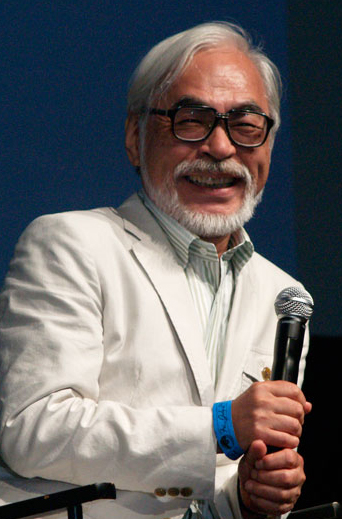
DIRECTOR · BORN 1941
Hayao Miyazaki
- Born
- 5 January 1941, Tokyo, Japan
- Known for
- Spirited Away (2001), Howl's Moving Castle (2004), Princess Mononoke (1997), My Neighbor Totoro (1988)
27 archived facts 5 topics 1 source Last reviewed Sep 2026
Hayao Miyazaki (born 5 January 1941) is a director and screenwriter best known for Spirited Away, Howl's Moving Castle and Princess Mononoke.
27 Interesting Facts About Hayao Miyazaki
Production Story (4)
- #001
Hayao Miyazaki and Isao Takahata started pre-production on a series based on Astrid Lindgren's Pippi Longstocking books, but it was scrapped when they couldn't meet Lindgren and permission was refused. Miyazaki had gone to Sweden with Tokyo Movie Shinsha president Yutaka Fujioka to try to secure the rights, his first trip outside Japan.
- #002
Reusing concepts, scripts, designs and animation from the abandoned Pippi Longstocking project, Hayao Miyazaki wrote, designed and animated two Panda! Go, Panda! shorts in 1972 and 1973, directed by Isao Takahata with Ōtsuka as animation director; the pandas were a nod to the panda craze sweeping Japan at the time.
- #003
Future Boy Conan, adapted from Alexander Key's The Incredible Tide, featured warplanes, aircraft and environmental themes that would resurface throughout Hayao Miyazaki's later work.
- #004
The Castle of Cagliostro was made in four months and released on December 15, 1979, though Hayao Miyazaki wished he'd had one more month.
Behind the Scenes (3)
- #005
The director of Gulliver's Travels Beyond the Moon accepted Miyazaki's proposed changes to the ending; his contribution went uncredited but was widely praised.
- #006
Only eight episodes of Future Boy Conan were finished when it started airing, and each episode was turned around in ten to fourteen days.
- #007
Hayao Miyazaki put his own stamp on the Lupin franchise in The Castle of Cagliostro, drawing on several of Maurice Leblanc's Arsène Lupin novels and The Adventures of Mr. Wonderbird, and visually on Kagoshima Publishing's Italian Mountain Cities and the Tiber Estuary, reflecting his love of Europe.
Deeper Meaning (1)
- #008
Miyazaki said The White Snake Enchantress moved him to tears and made a profound impression, pushing him to make work true to his own feelings rather than follow trends; its "pure, earnest world," he said, brought out a side of him that longed to affirm the world rather than reject it.
Career & Awards (12)
- #009
Hayao Miyazaki wanted to be a manga artist but found he couldn't draw people, so for years he drew planes, tanks and battleships instead. Influenced by manga artists including Tetsuji Fukushima, Soji Yamakawa and Osamu Tezuka, he destroyed much of his early work, believing that copying Tezuka's style was "bad form" and was holding back his own development.
- #010
Hayao Miyazaki's interest in animation began in his third and final year at Toyotama High School, when, instead of studying for entrance exams, he snuck out to see The White Snake Enchantress (1958), Japan's first feature-length color animated film.
- #011
Hayao Miyazaki joined Toei Doga in 1963, the last year the company did regular hiring, renting a four-and-a-half-tatami apartment near the studio in Nerima, Tokyo, for ¥6,000 a month on a Toei salary of ¥19,500.
- #012
On The Great Adventure of Horus, Prince of the Sun, Hayao Miyazaki worked closely with his mentor Yasuo Ōtsuka, whose approach to animation deeply shaped his own.
- #013
For Flying Phantom Ship (1969), Hayao Miyazaki pitched scenes of military tanks causing mass hysteria in downtown Tokyo and was hired to storyboard and animate them.
- #014
Hayao Miyazaki left Toei Animation in August 1971, frustrated by the lack of creative prospects and freedom and by clashes with management over The Great Adventure of Horus.
- #015
After following Isao Takahata and Yōichi Kotabe to A-Pro, Hayao Miyazaki made his directing debut on Lupin the Third Part I, directing or co-directing 17 of its 23 episodes with Takahata; the series had originally been meant as a film.
- #016
In June 1973, Hayao Miyazaki and Isao Takahata moved from A-Pro to Zuiyō Eizō to work on World Masterpiece Theater, including Heidi, Girl of the Alps, for which Miyazaki traveled to Switzerland to research and sketch.
- #017
When Zuiyō Eizō split in July 1975, Hayao Miyazaki and Isao Takahata's branch became Nippon Animation; after a short stint on Dog of Flanders in 1975, they moved on to 3000 Leagues in Search of Mother in 1976, for which Miyazaki went to Argentina and Italy on research trips.
- #018
Hayao Miyazaki was chief animation instructor for new staff at Telecom Animation Film, a Tokyo Movie Shinsha subsidiary, helping train its second intake of employees.
- #019
Under the pseudonym Teruki Tsutomu, which can be read as "Telecom employee," Hayao Miyazaki directed two episodes of Lupin the Third Part II.
- #020
Hayao Miyazaki directed six episodes of Sherlock Hound in 1981 before legal problems with Arthur Conan Doyle's estate halted production; by the time they were sorted out he was busy with other projects, so Kyôsuke Mikuriya directed the rest, which aired from November 1984 to May 1985. It was Miyazaki's last TV work.
Life & Family (7)
- #021
Miyazaki's father, Katsuji Miyazaki, born in 1915, ran Miyazaki Airplane, a company owned by his brother that made rudders for fighter planes during World War II, which kept the family well off in Miyazaki's early years.
- #022
Hayao Miyazaki's earliest memories include "bombed-out cities." In 1944, when he was three, his family evacuated to Utsunomiya, and after the city was bombed in July 1945 they moved on to Kanuma.
- #023
The bombing Miyazaki saw at four left a lasting impression. As a child he also had digestive problems and was told he wouldn't live past 20, which made him feel like an outcast and see himself as "clumsy and weak."
- #024
From 1947 to 1955, Miyazaki's mother, Yoshiko, suffered from spinal tuberculosis, spending the first years in hospital before being cared for at home, so Miyazaki and his siblings had to take over the household chores.
- #025
Yoshiko Miyazaki, described as frugal, strict and intellectual and known for questioning "socially accepted norms," was closest to Hayao and strongly influenced him and his work, inspiring several of his characters. She died in July 1983 at 72.
- #026
At Gakushuin University, Miyazaki joined the Children's Literature Research Club, the closest thing to a comics club at the time, and was sometimes its only member; in his spare time he drew manga, never finishing a story but piling up thousands of pages of openings.
- #027
Soon after joining Toei, Miyazaki took a leading role in a labor dispute, and in 1964 he became chief secretary of the union, whose vice-chairman was Isao Takahata, the start of a lifelong partnership and friendship.
Related pages
- The Great Mouse Detective — Hayao Miyazaki comes up in the facts on that page
- Toy Story 2 — Hayao Miyazaki comes up in the facts on that page
- The Legend of Zelda: A Link to the Past — Hayao Miyazaki comes up in the facts on that page
Continue through the archive

Sources & editorial notes
Reference databases
- Wikipedia
- IMDb
Sources for the entries on this page
- Wikipedia Hayao Miyazaki — Wikipedia
Information from external sources is independently selected, consolidated and edited by Arka Evren. Sources are listed for verification and further reading. Encyclopedia text is used under its licence (CC BY-SA). How we work