
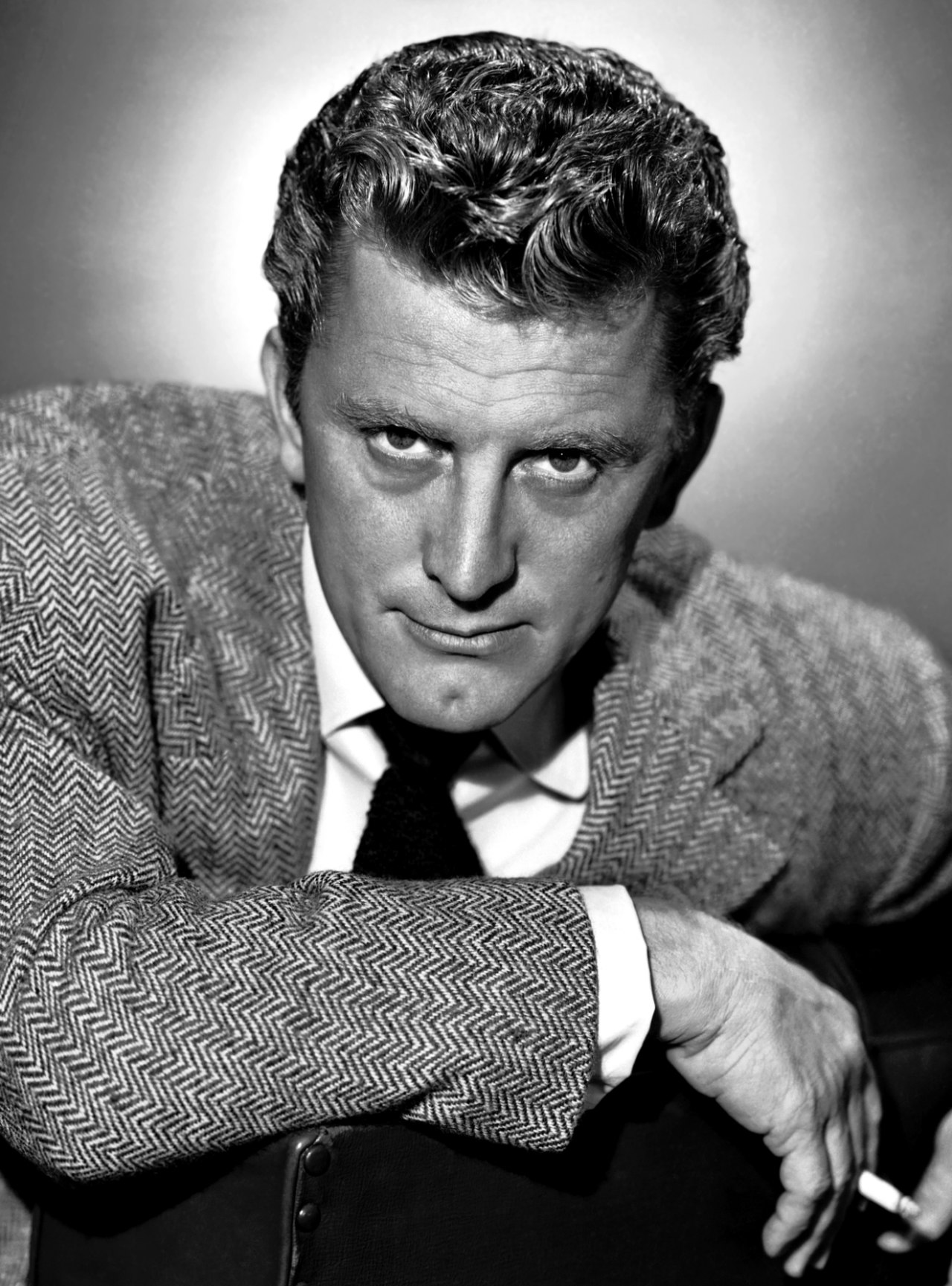
ACTOR · BORN 1916 · DIED 2020
Kirk Douglas
- Born
- 9 December 1916, Amsterdam, New York, USA
- Died
- 5 February 2020
- Known for
- Paths of Glory (1957), Ace in the Hole (1951), 20,000 Leagues Under the Sea (1954), The Final Countdown (1980)
37 archived facts 5 topics 1 source Last reviewed Sep 2026
Kirk Douglas (9 December 1916 – 5 February 2020) was an actor best known for Paths of Glory, Ace in the Hole and 20,000 Leagues Under the Sea.
Kirk Douglas over the years


37 Interesting Facts About Kirk Douglas
Interesting Facts (13)
- #001
Kirk Douglas would have been aboard producer Mike Todd's private plane in 1958 had he not followed the advice of his wife, Anne Douglas. Todd's wife, Elizabeth Taylor, had also planned to be on the same flight but cancelled at the last minute because of a severe cold. The plane crashed and everyone on board was killed, making Douglas's decision a critical turning point that saved his life.
- #002
In most of his films, Kirk Douglas wore lifts in his shoes to appear taller, which made him look roughly 5'11" or 6'0" on screen. Burt Lancaster once found these lifts on set and hid them as a joke, which infuriated Douglas. The incident lays bare the competitive and at times tense relationship between the two men.
- #003
After Kirk Douglas became a star with 'Champion' (1949), the famous gossip columnist Hedda Hopper told him, 'Now that you're a big hit, you've become a real bastard.' Douglas's reply was sharp: 'You're wrong. I was always a bastard. You just didn't notice before.' The answer sums up his confident, never-mincing-words personality.
- #004
At a 1987 tribute night held by the American Academy of Dramatic Arts for Kirk Douglas, Burt Lancaster, who had worked with him for many years, took the stage and said, 'Kirk, I would be the first to tell you that you are a difficult man.' After a brief pause he added, 'And I would be the second.' These joking yet sincere words show the respect the two men held for each other and the complicated relationship between them.
- #005
- #006
- #007
- #008
- #009
For his first western, 'Along the Great Divide' (1951), Kirk Douglas learned to ride horses from cowboy Stan Polson, owner of the Apple Valley stables. The training formed the basis of his performances in the western genre. Thanks to this experience, Douglas went on to appear in many western films.
- #010
Kirk Douglas co-hosted the release party for folk-rock musician Donovan's album 'Barabajagal' (1969) with Cass Elliot. At the party he posed for photos with Donovan and Elliot and described Donovan as 'not only a gentleman, but also a gentle man'. The event shows Douglas's connection to the music world.
- #011
Kirk Douglas had been signed for the role of Gabey in the film 'On the Town' (1949), but had to withdraw from the project because he developed psychosomatic laryngitis. This health problem caused him to miss an important opportunity in his career. Another actor was brought in to replace him.
- #012
In Lana Wood's 2021 memoir Little Sister: My Investigation into the Mysterious Death of Natalie Wood, Kirk Douglas was accused of raping the 16-year-old Natalie Wood. The allegation surfaced after Douglas's death and sparked major controversy. Douglas's family and representatives denied the accusations.
- #013
Footage of Kirk Douglas's boxer performance in the 1949 film Champion was used as flashback scenes in the 1999 film Diamonds. In Diamonds, Douglas played a former boxer who had suffered a stroke. It was a coincidence that mirrored real life: at 83, Douglas had indeed suffered a stroke. The event is known as one of the difficult periods of his life and added depth to his performance in Diamonds.
Behind the Scenes (1)
Characters & Cast (3)
- #015
Because of his box-office power, MGM tried to persuade Kirk Douglas to replace Ricardo Montalban in the film 'The Story of Three Loves' (1953). Douglas would not accept the offer without meeting Montalban, who had trained for the role. Montalban appreciated Douglas's gesture and, understanding the studio's position, gave up the role. The incident shows Douglas's sensitivity towards his colleagues.
- #016
Kirk Douglas was initially cast as Colonel Sam Trautman in 'First Blood' (1982), but he wanted significant changes made to the script. In particular, he demanded that John Rambo die at Trautman's hands as in the novel. When the writers refused, Douglas left the project and the role went to Richard Crenna. The decision shows his meticulousness about creative control.
- #017
Career & Awards (8)
- #018
Kirk Douglas appeared in the stage play 'One Flew Over the Cuckoo's Nest' and later bought the film rights to the work. He did not make the film himself, however; he passed the rights to his son Michael Douglas, who secured the financing and brought the 1975 film 'One Flew Over the Cuckoo's Nest' to the screen. The decision gave Michael a major success in his career, and the film won five Oscars, including Best Picture.
- #019
Kirk Douglas played an important role in breaking the Hollywood blacklist. A member of the 'Hollywood Ten', screenwriter Dalton Trumbo, was hired by Douglas to write the screenplay for the 1960 film 'Spartacus'. Despite intense criticism from figures such as John Wayne and Hedda Hopper, Douglas did not back down and ensured that Trumbo's name appeared in the credits. This bold move led Steven Spielberg to thank him publicly in 1996 when he presented him with a lifetime achievement Oscar.
- #020
- #021
- #022
In his last book, 'Let's Face It: 90 Years of Living, Loving and Learning,' Kirk Douglas admitted he regretted turning down some major roles over his career. These included William Holden's Oscar-winning role in 'Stalag 17' (1953), Stephen Boyd's role in 'The Fall of the Roman Empire' (1964) and Lee Marvin's Oscar-winning role in 'Cat Ballou' (1965). The remarks show he engaged in deep self-criticism about his career.
- #023
Kirk Douglas said his favorite film was the 1962 release 'Lonely Are the Brave'. The western tells the story of a lone cowboy in modern society and is regarded as one of the most personal projects of Douglas's acting career. The film reflects his artistic taste and his interest in roles with depth.
- #024
After winning a scholarship to the American Academy of Dramatic Arts in New York, Kirk Douglas worked as a waiter at Schraft's restaurant on 86th Street and Broadway. There he met many aspiring actors, among them John Forsythe. This experience shows the difficult days before he began his acting career.
- #025
Kirk Douglas admitted that for a time he did not actually want to act in films and aspired to be a great star of the stage. His stage career, however, never achieved the breakthrough he expected. When he adapted One Flew Over the Cuckoo's Nest for the stage, the play was ahead of its time and he could not persuade anyone to turn it into a film. Although he held the rights for 14 years, no producer showed interest in the project during that time. The experience pushed Douglas toward a film career and led him to take roles in the productions that made him one of Hollywood's biggest stars.
Life & Family (12)
- #026
On 23 February 1991, Kirk Douglas survived a helicopter crash in which two people were killed. He was seriously injured in the back in the crash, and the injury affected him for a long time. The event shows his struggle to survive and his determination to stand firm despite physical hardship.
- #027
It was widely believed that Kirk Douglas and Burt Lancaster were close friends, but in reality this friendship was largely invented through Douglas's flair for publicity. Although the two respected each other's acting talent, in their private lives they were highly competitive and even harboured a personal dislike for one another. The situation shows how complicated Hollywood's apparent friendships can be.
- #028
Although Kirk Douglas was raised in a Jewish family, he did not much observe religious practices as an adult. On his 83rd birthday, however, he held a second Bar Mitzvah ceremony, renewing his faith, and returned to his religious practices after that date. The event shows that he experienced a spiritual awakening later in life.
- #029
Kirk Douglas gave up a habit of smoking two to three packs of cigarettes a day in 1950. The decision shows the importance he placed on his health; his father, Herschel, died of lung cancer in 1954. Douglas's decision to quit smoking was a conscious one made before his father's tragic death.
- #030
After his son Michael Douglas was fired from the stage play 'Summer Tree', Kirk Douglas bought both the stage and film rights to the story and gave them to Michael. The gesture was a sign of the father's support for his son's career and his belief in his talent. Michael thereby got the chance to play the lead in a significant project.
- #031
Kirk Douglas played Ernest Borgnine's son in the 1958 film 'The Vikings', even though in real life he was six weeks older than Borgnine. This ironic situation is an interesting example of how age differences can be stretched to fit a script in Hollywood.
- #032
- #033
In 1966, during the filming of 'The War Wagon,' Kirk Douglas recorded a television commercial supporting Democratic California Governor Edmund G. Brown. It came right after the commercial John Wayne recorded for Republican candidate Ronald Reagan, and it angered Wayne considerably. The incident laid bare how different the two legendary actors' political views were.
- #034
Kirk Douglas lived in Palm Springs, California, for more than 40 years. In October 2005, the city named a leafy street 'Kirk Douglas Way' in his honor. The street surrounds part of Palm Springs International Airport. Douglas and his family attended the opening ceremony, held with great fanfare; his son Joel led the campaign.
- #035
The claim that Kirk Douglas broke the blacklist by hiring Dalton Trumbo to write the screenplay for 'Spartacus' (1960) was publicly disputed by Trumbo's children, the film's producer Edward Lewis and Howard Fast's children. These disputes show the complexity of the blacklist era and how controversial Douglas's role was.
- #036
Kirk Douglas met his first wife, Diana Douglas, at the American Academy of Dramatic Arts in New York thanks to his friend and classmate Lauren Bacall. This meeting was an important turning point in both his personal and professional life. His marriage to Diana resulted in the birth of his son Michael Douglas.
- #037
Kirk Douglas's wife, Anne Douglas, claimed for many years to have been born in 1930, but later openly admitted she was in fact born in 1919. The admission suggests the couple tended to conceal certain personal details over the course of their lives. Anne's statement on the matter surprised the public.
Related pages
- Wall Street — Kirk Douglas comes up in the facts on that page
- Catherine Zeta-Jones — Kirk Douglas comes up in the facts on that page
- Jack Lemmon — Kirk Douglas comes up in the facts on that page
Continue through the archive
Sources & editorial notes
Reference databases
- Wikipedia
- IMDb
Information from external sources is independently selected, consolidated and edited by Arka Evren. Sources are listed for verification and further reading. Encyclopedia text is used under its licence (CC BY-SA). How we work