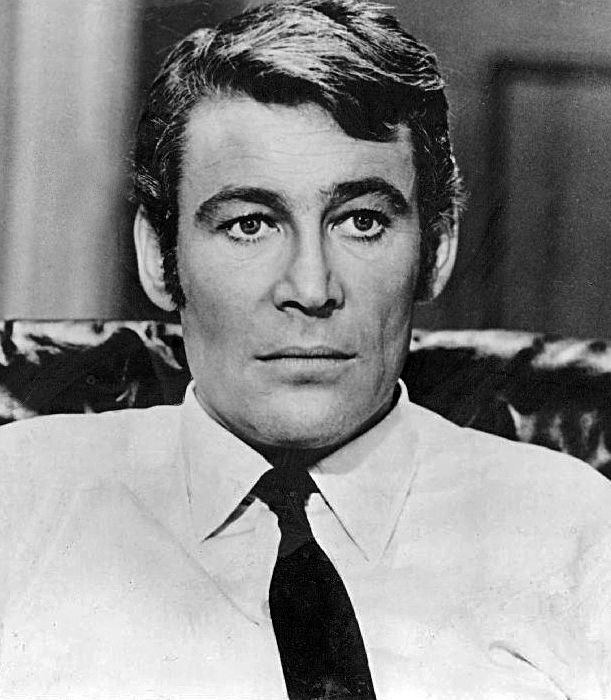
ACTOR · BORN 1932 · DIED 2013
Peter O'Toole
- Born
- 2 August 1932
- Died
- 14 December 2013
97 archived facts 5 topics 1 source Last reviewed Sep 2026
All facts (97)
- #001
Peter O'Toole was nominated for the Academy Award for Best Actor eight times over the course of his career but never won. Those eight nominations made him the most-nominated actor never to win the award. The record is regarded as a sign of his acting ability and his standing in the film world.
- #002
Peter O'Toole's daughter Kate O'Toole said that, because of her father's personal superstitions, he wore green socks every day. On David Letterman's show in 1983, however, O'Toole explained that his father held a superstition requiring him not to wear the colour green and had expressed this to him quite harshly. To disobey his father, he reasoned that his green socks would go unnoticed, and he kept up the habit for life.
- #003
When he was awarded an honorary Oscar for lifetime achievement in 2003, O'Toole initially considered turning it down, feeling that such an award meant the end of his career. In a letter to the Academy he said he was 'still in the game' and asked for more time 'to win the lovely bugger outright.' He accepted only after the Academy informed him that it would give him the award whether or not he accepted it.
- #004
After Peter O'Toole's death, his ashes were brought to Ireland and kept safely at Áras an Uachtaráin, the official residence of President Michael D Higgins. The ashes will be kept there until they are buried in the west of Ireland. The arrangement reflects O'Toole's strong connection to Ireland and his love for his country.
- #005
Peter O'Toole once said that his real date of birth had not been recorded and that he might have been born in June 1932. Leeds City Council's birth, death and marriage records, however, proved that he was born on 2 August 1932 at St James's University Hospital in Leeds. The records removed the uncertainty about O'Toole's date of birth.
- #006
Peter O'Toole's performance as T.E. Lawrence in Lawrence of Arabia (1962) topped Premiere magazine's '100 Greatest Performances of All Time' list, published in 2006. The performance is regarded as one of the most memorable and impressive pieces of acting in film history. The role brought O'Toole international fame and was the turning point of his career.
- #007
Travelling to America with Omar Sharif for the premiere of Lawrence of Arabia, Peter O'Toole took Sharif to a Lenny Bruce show the night before the opening. After the show they met Lenny backstage and went out drinking together. When Lenny said he had to go home, they accompanied him, but as Lenny injected himself with drugs they were caught in a police raid and all of them were arrested. At the police station Omar Sharif called the producer Sam Spiegel, who had them released.
- #008
Peter O'Toole was one of six actors nominated for an Oscar twice for playing the same role in two separate films. He played King Henry II in Becket (1964) and The Lion in Winter (1968) and was nominated for Best Actor for both performances. Other actors to have achieved this include Bing Crosby, Al Pacino, Paul Newman and Cate Blanchett.
- #009
Peter O'Toole was said to have declined a knighthood in 1987 for political reasons. The decision may reflect his political stance and personal principles. Throughout his career O'Toole took an active stance on political matters.
- #010
On 10 July 2012 Peter O'Toole announced his retirement from acting. The announcement marked the end of a long and successful career. O'Toole retired as a figure who had left a deep mark on the worlds of film and theatre.
- #011
In 1976 Peter O'Toole underwent surgery to remove part of his stomach and intestines; at the time this was attributed to his heavy drinking, but it was later announced that he had stomach cancer. The following year he nearly died from a blood disease. These two serious health problems greatly affected his ability to work at the time and caused a pause in his career.
- #012
During the shooting of Venus (2006), Peter O'Toole broke his hip but returned to the set only three weeks later. The incident shows his dedication to his work and his professionalism. Despite his age and health problems, O'Toole kept working.
- #013
Peter O'Toole could play the bagpipes and was a member of an Irish pipe band in his youth. He displayed the skill in two of his films: Kidnapped (1960) and Brotherly Love (1970). Playing the bagpipes was part of his attachment to Irish culture.
- #014
From the 1980s onwards, Peter O'Toole is often seen in his films wearing an Irish Claddagh ring on the third finger of his right hand. The ring is a symbol particular to the Galway region of Ireland and reflects O'Toole's attachment to his Irish heritage. The detail became part of his personal style.
- #015
Peter O'Toole won the career-defining role in Lawrence of Arabia (1962) after Marlon Brando and Albert Finney turned it down. Director David Lean and producer Sam Spiegel initially wanted Brando, but Brando refused the part. Finney, although he went through extensive screen tests, refused to sign a seven-year contract. These developments cleared the way for O'Toole and made him an international star.
- #016
Peter O'Toole attended a Catholic school where the nuns beat him to correct his left-handedness. The experience shows that he went through a harsh education in his childhood. Despite such difficulties, O'Toole achieved great success in his acting career.
- #017
Peter O'Toole was nearly cast as Professor Henry Higgins in My Fair Lady (1964), since Rex Harrison was thought to be too old for the part. O'Toole's salary demands, however, were more than producer Jack L. Warner was willing to pay. The role therefore remained with Harrison.
- #018
Peter O'Toole's middle name was in fact James, but he often used the Irish version, Seamus. The preference shows his attachment to his Irish identity. O'Toole was proud of his Irish origins.
- #019
The film The Man Who Fell to Earth (1976) was originally conceived as a vehicle for Peter O'Toole. The project ultimately went in a different direction, however, and the lead role was given to David Bowie. O'Toole's absence from the project can be seen as a significant missed opportunity in his career.
- #020
Peter O'Toole disliked Troy (2004) and walked out of the finished film minutes into it. He also disliked the director, Wolfgang Petersen. The situation shows that O'Toole had a personality that expressed his views about projects openly.
- #021
Peter O'Toole played Augustus, the first Roman emperor, in Augustus: The First Emperor (2003). His former wife, Siân Phillips, had previously played Augustus's wife Livia in the series I, Claudius (1976). The coincidence stands out as an interesting parallel in the two careers.
- #022
Peter O'Toole was a close friend of Katharine Hepburn. Some believe his daughter Kate O'Toole was named after Hepburn, but according to Siân Phillips's autobiography, they named their daughter after the character Kate in William Shakespeare's The Taming of the Shrew. The line "Kate, sweet Kate, the prettiest Kate in Christendom" inspired the choice of name.
- #023
Peter O'Toole was honoured with the Laurence Olivier Theatre Award in 2000 for his outstanding achievements over his theatre career. The award confirmed his standing and talent in the theatre world. O'Toole had also won great acclaim for his stage performances.
- #024
Peter O'Toole and his close friend Richard Harris appeared in different adaptations of Gulliver's Travels. Harris played Gulliver in the 1977 film version, while O'Toole played the Emperor of Lilliput in the 1996 TV film. The two Irish actors were part of the same story, albeit in different projects.
- #025
After Richard Harris's death, his family hoped Peter O'Toole would take on the role of Professor Albus Dumbledore in Harry Potter and the Prisoner of Azkaban (2004). The role went to Michael Gambon instead. O'Toole was a close friend of Harris, and his family therefore saw him as a suitable successor.
- #026
Peter O'Toole said that working with José Ferrer on Lawrence of Arabia (1962) taught him more about acting than any acting class. Ferrer regarded his small role in the film as the best performance of his career. Ironically, Ferrer nearly turned the role down because he appeared for only five minutes in the four-hour film.
- #027
Peter O'Toole turned down the lead role in Doctor Zhivago (1965) because, after the experience of Lawrence of Arabia (1962), he did not want to work with David Lean again. The decision reflects the difficult working relationship between O'Toole and the director. The role eventually went to Omar Sharif.
- #028
Peter O'Toole was the first choice for the role of King Henry VIII in A Man for All Seasons (1966), but the part went to Robert Shaw. Shaw was nominated for an Oscar for Best Supporting Actor for his performance. O'Toole's loss of the role can be seen as a significant missed opportunity in his career.
- #029
Peter O'Toole named Rose Byrne and Jodie Whittaker as the best young actresses he had worked with. The praise reflects O'Toole's appreciation of young talent and his pleasure in working with them. Both actresses went on to achieve significant success in their careers.
- #030
A two-page Peter O'Toole biography included on the DVD of Rogue Male (1976) ended with the line "Peter O'Toole died in 2003 after a long illness." Whoever entered this incorrect information must have been surprised to see O'Toole attend the 79th Academy Awards in 2007 for his nomination for Venus (2006). The incident shows that false reports of O'Toole's death were in circulation.
- #031
Richard Harris's family asked Peter O'Toole to take over the role of Dumbledore in the Harry Potter films in Harris's place. O'Toole was proud of the offer but declined, saying he was too tired for such a commitment. He also added that he would not be able to get insurance because of his age.
- #032
Peter O'Toole was considered to play the Eighth Doctor in Doctor Who: The Movie (1996). He was also considered for the character of Borusa and was keen on the role, but the character was cut from the script. The situation shows O'Toole's interest in science fiction.
- #033
While a student at RADA in the early 1950s, Peter O'Toole was active in protesting the British intervention in the Korean War. He later became an active opponent of the Vietnam War in the 1960s. This political stance shows he was an artist sensitive to social issues.
- #034
Peter O'Toole was considered for Sean Connery's roles in Marnie (1964), Highlander (1986) and The Name of the Rose (1986). Although he did not appear in these projects, it shows he was an actor considered for the major productions of the period.
- #035
Peter O'Toole appeared in four films nominated for the Best Picture Oscar: Lawrence of Arabia (1962), Becket (1964), The Lion in Winter (1968) and The Last Emperor (1987). Of these, Lawrence of Arabia and The Last Emperor won the award. He was also nominated for Best Actor for his performances in the first three films.
- #036
Director Billy Wilder initially considered Peter O'Toole for the role of Sherlock Holmes and Peter Sellers for Dr. Watson in The Private Life of Sherlock Holmes (1970). Wilder later decided to go ahead with lesser-known stars. The project can be seen as an important opportunity O'Toole missed.
- #037
In 1995, Empire magazine selected Peter O'Toole as one of the 100 sexiest stars in film history, placing him at number 47. The selection shows that O'Toole was known not only for his acting but also for his charisma and appeal.
- #038
Peter O'Toole worked with major names such as Peter Sellers, Woody Allen, Ursula Andress and Burt Bacharach on What's New Pussycat (1965) and Casino Royale (1967). These projects showcased his talent for comedy and gave him the chance to collaborate with a range of artists.
- #039
Peter O'Toole's performance as Alan Swann in My Favorite Year (1982) ranked 56th on Premiere magazine's list of the "100 Greatest Movie Characters of All Time." The character is regarded as an unforgettable role that showed O'Toole's ability to combine comedy and drama.
- #040
Peter O'Toole was approached for the role of Dillinger/Sark in Tron (1982), but after reading the script he became far more interested in playing the character Tron. The situation is an indication of O'Toole's engagement with projects and his creative choices.
- #041
As a boy, Peter O'Toole played rugby league in Leeds and was also a rugby union fan. He attended Five Nations matches with friends such as Richard Harris, Kenneth Griffith, Peter Finch and Richard Burton. He was also a lifelong cricketer, coach and enthusiast, and a supporter of Sunderland A.F.C.
- #042
Peter O'Toole turned down the role of Judas Iscariot in Jesus of Nazareth (1977) due to health problems. The role eventually went to Ian McShane. O'Toole's health problems were adversely affecting his career at the time.
- #043
Although Peter O'Toole always claimed he was born in Ireland, birth records actually show that he was born in Leeds, England. There is no record of any Peter O'Toole born in Ireland in 1932. O'Toole's family had lived in Leeds since 1930. This shows that what O'Toole told about his Irish identity does not match the facts.
- #044
On 18 May 2014, a new award in memory of Peter O'Toole was launched at the Bristol Old Vic Theatre School. The award is given each year to two young actors from the school and includes a professional contract at the Bristol Old Vic Theatre. The award aims to honour O'Toole's contributions to theatre.
- #045
Peter O'Toole was the father of the actors Lorcan O'Toole, Kate O'Toole and Pat O'Toole. His children carried on his legacy, and Kate O'Toole also had an acting career. O'Toole's family continued to keep his name alive after his death.
- #046
Peter O'Toole was seriously considered for the role of Marc Anthony in Cleopatra (1963). However, the role eventually went to Richard Burton. O'Toole's absence from this project can be seen as a significant missed opportunity in his career.
- #047
Leeds City Council's birth, death and marriage records proved that Peter O'Toole, who proudly claimed throughout his life to be Irish, was in fact a Yorkshireman born on 2 August 1932 at St James's University Hospital in Leeds. These records revealed that what O'Toole told about his Irish identity did not match the facts.
- #048
GQ magazine selected Peter O'Toole as one of the 50 best-dressed men of the last 50 years. This selection shows that O'Toole was known not only for his acting but also for his style and elegance. O'Toole drew attention for his elegance throughout his career.
- #049
Peter O'Toole was considered for the lead role in Doctor Dolittle (1967). However, the role eventually went to Rex Harrison. O'Toole's absence from this project can be regarded as a significant missed opportunity in his career.
- #050
Peter O'Toole appeared in four films with his former wife Siân Phillips: Becket (1964), Goodbye, Mr. Chips (1969), Murphy's War (1971) and Under Milk Wood (1971). These films were part of the pair's professional as well as personal relationship. O'Toole and Phillips continued to work together.
- #051
While studying at RADA in the early 1950s, Peter O'Toole was active in protesting the British intervention in the Korean War. He later became an active opponent of the Vietnam War in the 1960s. He also played a part in creating the present form of the famous folk song 'Carrickfergus'; he passed the song on to Dominic Behan, who published and recorded it in the mid-1960s.
- #052
Over his career, Peter O'Toole played three kings: one twice (King Henry II in Becket (1964) and The Lion in Winter (1968)), one fictional (Sir/King Cedric Willingham in King Ralph (1991)) and King Priam in Troy (2004). He also played two emperors: one real (Emperor Tiberius Caesar in Caligula (1979)) and one fictional (the Emperor of Lilliput in Gulliver's Travels (1996)). In addition, he took on the roles of a fictional prince (Prince Meleagre in The Rainbow Thief (1990)) and a real president (President Paul von Hindenburg in Hitler: The Rise of Evil (2003)).
- #053
Peter O'Toole was initially considered for the role of Richard Helms in Nixon (1995), but the role was given to Sam Waterston. O'Toole's absence from this project can be seen as a significant missed opportunity in his career.
- #054
Peter O'Toole appeared in two films that won the Academy Award for Best Picture: Lawrence of Arabia (1962) and The Last Emperor (1987). These films are among the most important productions in cinema history, and O'Toole's share in these achievements is great.
- #055
Peter O'Toole tested for Montgomery Clift's role in Suddenly, Last Summer (1959). The test went so badly that the producer Sam Spiegel nearly did not cast him in Lawrence of Arabia (1962). This event was a critical turning point in O'Toole's career.
- #056
Peter O'Toole was considered for Richard Harris's role in Mutiny on the Bounty (1962). However, the role eventually went to Marlon Brando. O'Toole's absence from this project can be regarded as a significant missed opportunity in his career.
- #057
Peter O'Toole was initially cast as Torquemada in The Pit and the Pendulum (1991), but he later left the project. The role was given to Lance Henriksen. The reasons for O'Toole's departure from the project are unknown.
- #058
At the time of his death, Peter O'Toole was residing in Galway, Ireland, and London, England. These two cities were places where he spent a significant part of his life. O'Toole had established strong ties with both Ireland and England.
- #059
Peter O'Toole was Terry Gilliam's first choice for the lead role in The Adventures of Baron Munchausen (1988). However, the role eventually went to John Neville. O'Toole's absence from this project can be seen as a significant missed opportunity in his career.
- #060
Peter O'Toole was considered for Richard Burton's roles in Who's Afraid of Virginia Woolf? (1966) and Anne of the Thousand Days (1969). Although he did not appear in these projects, this shows that he was an actor considered for the era's major productions.
- #061
According to Richard Benjamin, Peter O'Toole trained in music hall, the British equivalent of vaudeville. This training contributed to O'Toole's stage performances and comic ability, and he drew on the experience in both theatre and film.
- #062
In 1997, Peter O'Toole worked as a professional cricket coach in London, reflecting his passion for and expertise in the sport. Alongside acting, O'Toole devoted significant time to sport.
- #063
The son of Peter O'Toole and Karen Brown is named Lorcan O'Toole. Lorcan followed in his father's footsteps with an acting career, and O'Toole's children carried on his legacy.
- #064
Peter O'Toole was offered the role of Grigori Rasputin in the 1971 film Nicholas and Alexandra but turned it down; Tom Baker was eventually cast. The reasons for O'Toole's refusal are unknown.
- #065
The title character of the comic book Alan Ford, widely popular in Italy, was modelled on Peter O'Toole's physical features. This shows that O'Toole was an internationally recognised figure.
- #066
Peter O'Toole was one of 13 actors to receive an Academy Award nomination for playing a real king. The group also includes names such as Charles Laughton, Robert Morley, Basil Rathbone, Laurence Olivier, José Ferrer, Yul Brynner, John Gielgud and Robert Shaw, and O'Toole's place among them reflects his success at portraying historical figures.
- #067
Peter O'Toole was considered for the role of Lancelot in the 1967 film Camelot, but the part went to Franco Nero. His absence from the project can be seen as a significant missed opportunity in his career.
- #068
Peter O'Toole was among the names mentioned for the character played by Cyril Cusack in the 1966 film Fahrenheit 451. In François Truffaut's science-fiction classic, set in a dystopian world where firemen burn books, Cusack's role is a significant one, and O'Toole's consideration for it shows how seriously producers of the period regarded him as an actor.
- #069
Peter O'Toole was among the actors considered for the role of Dr. Sam Loomis in the 1978 horror classic Halloween. Directed by John Carpenter, the film is regarded as a pioneer of the slasher genre; Loomis is the psychiatrist trying to stop serial killer Michael Myers, and the part ultimately went to Donald Pleasence. O'Toole's consideration for the role shows the range of his career.
- #070
Peter O'Toole was among the actors mentioned for the role of Clay Shaw, played by Tommy Lee Jones in Oliver Stone's 1991 film JFK. The film deals with the assassination of US President John F. Kennedy, and Shaw is the businessman alleged to have been connected to the assassination. O'Toole's consideration for the role is evidence of his strong presence in political dramas.
- #071
Peter O'Toole turned down the role of Michael in David Lean's 1970 film Ryan's Daughter; the part went to John Mills, who won an Oscar for his performance. O'Toole was also considered for the role of Major Randolph Doryan, played by Christopher Jones. Staying away from the project could have been a turning point in his career, but he chose to pursue different projects.
- #072
In the 1996 adaptation of Gulliver's Travels, Peter O'Toole played the father of John Standing and Edward Fox, although in real life he was only two years older than Standing and less than five years older than Fox. This is a striking example of how the actor could transform his age on stage and screen, and the performance shows how flexible he was as a character actor.
- #073
Peter O'Toole was among those considered for the role of Fagin in the 1968 musical film Oliver! Adapted from Charles Dickens's novel, the production won many Oscars, including Best Picture; Fagin is the old man who has orphaned children steal for him, and the part ultimately went to Ron Moody. O'Toole's consideration for the role shows the confidence in his musical ability.
- #074
In 1983, Peter O'Toole played Sherlock Holmes in three separate television films: Sherlock Holmes and the Sign of Four, Sherlock Holmes and the Valley of Fear and Sherlock Holmes and a Study in Scarlet. He also played Arthur Conan Doyle, Holmes's creator, in the 1997 film FairyTale: A True Story. These two roles show O'Toole's interest in literary characters and his ability to approach them from different angles.
- #075
Peter O'Toole named Eric Porter as the actor who influenced him most. Porter was one of the leading figures of British theatre and cinema, known especially for his performance in the series The Forsyte Saga. O'Toole's statement reveals which names inspired him in his acting career.
- #076
Peter O'Toole was Billy Wilder's first choice to play Sherlock Holmes in the 1970 film The Private Life of Sherlock Holmes, but the role went to Robert Stephens. Wilder's choice shows how respected an actor O'Toole was at the time and that he was seen as tailor-made to portray an iconic character like Holmes.
- #077
Peter O'Toole saw his former wife Siân Phillips, whom he divorced in 1979, only once. Phillips was one of the leading actresses of British theatre, and her marriage to O'Toole lasted from 1959 to 1979. The separation lays bare the difficulties in O'Toole's private life and the distance in his relationships.
- #078
Although Peter O'Toole described himself as Irish, he was born in England and his mother was Scottish. This identity confusion, combined with his deep attachment to Irish culture, formed an important part of his personality. He often reflected this Irish identity throughout his acting career.
- #079
Peter O'Toole was set to star alongside Toshirō Mifune in "Will Adams," to be directed by John Huston, written by Dalton Trumbo and produced by Eugene Frenke and Jules Buck. The film was announced with the tagline "A bold adventurer defies the traditions of a mighty empire." The project never came to fruition, however, and no film starring O'Toole and Mifune together was ever made.
- #080
Peter O'Toole was considered for the role of Fielding, played by James Fox, in David Lean's 1984 film A Passage to India. The film was adapted from E.M. Forster's novel of the same name and dealt with themes of racism and justice during the British Raj. O'Toole's consideration for the role is an indication of his success in period dramas.
- #081
In 2005, actor Kevin Quarmby, who later trained as a Shakespeare scholar, wrote a detailed account of Peter O'Toole's eccentric behaviour in the lead role of the 1980 Old Vic production of Macbeth. This account lays bare O'Toole's unusual and unpredictable performances on the stage. O'Toole's interpretation of Macbeth reflects the boldness and originality of his approach to Shakespeare.
- #082
After his divorce from Siân Phillips, Peter O'Toole referred to her from that moment on as "my widow." The phrase reflects O'Toole's witty and mocking personality. His making such remarks about their post-divorce relationship shows that he handled even the events of his private life with his own distinctive humour.
- #083
Peter O'Toole was to reprise his stage role in the 1961 film Jungle Fighters, but lost the part to Laurence Harvey because the studio wanted a well-known actor. This shows that O'Toole was not yet a full-fledged star at the time and that producers were looking for a box-office guarantee. Even so, the loss was not a major turning point in his career.
- #084
Peter O'Toole was Harry Saltzman's first choice for the breakthrough role played by Albert Finney in the 1960 film Saturday Night and Sunday Morning. Saltzman would later become famous as the producer of the James Bond films. Finney's performance is regarded as an important example of the British New Wave. O'Toole's consideration for the role shows how highly he was regarded by the era's leading producers.
- #085
Peter O'Toole was initially considered for the role of Robert Blakeley, played by Michael Caine, in the 1972 film X, Y & Zee. The film is a drama about marital turmoil and infidelity. O'Toole's consideration for the role shows the wide range in which he was regarded as a character actor.
- #086
Peter O'Toole was considered to play Quentin Crisp in the 1975 film The Naked Civil Servant. The film was adapted from the autobiographical work of the English writer and gay rights activist Quentin Crisp. The role ultimately went to John Hurt, who won great acclaim for the performance. O'Toole's consideration for the role shows his interest in bold and unusual characters.
- #087
Peter O'Toole was initially considered for the role of Joe Baker, played by Dean Martin, in the 1971 film Something Big. The film was a Western comedy and held an important place in Martin's career. O'Toole's consideration for the role shows that his comedic ability was also recognised.
- #088
Peter O'Toole was Sam Spiegel's first choice for the role of Jason 'Jake' Rogers, played by James Fox, in the 1966 film The Chase. The film was a drama directed by Arthur Penn and starring names such as Marlon Brando and Robert Redford. O'Toole's consideration for the role shows how sought after he was by the era's most important producers.
- #089
Peter O'Toole was initially announced for the role of Sir Harald Alabaster, played by Jeremy Kemp, in the 1995 film Angels and Insects. The film was a drama set in Victorian England and dealing with class differences. O'Toole's consideration for the role is a continuation of his success in period films.
- #090
Peter O'Toole always tried to avoid seeing his own films. This behaviour is similar to that of many actors who dislike watching their own performances. This attitude of O'Toole's suggests that he was a perfectionist and self-critical artist.
- #091
Peter O'Toole was considered for the role of Sean O'Casey, played by Rod Taylor, in the 1965 film Young Cassidy. The film dealt with the life of the Irish playwright Sean O'Casey. O'Toole's consideration for the role shows his potential to play a character that overlapped with his Irish identity.
- #092
Peter O'Toole was initially considered for the role of Malcolm, played by Freddie Jones, in the 2000 film Married 2 Malcolm. The film was a comedy-drama about an old man who marries a young woman. O'Toole's consideration for the role shows his mastery of playing older characters.
- #093
Peter O'Toole turned down the role of Sir Michael Barrington, played by Timothy Dalton, in the 1977 film Sextette. The film was a comedy starring Mae West and was her last film. O'Toole's rejection of the role shows his meticulousness in choosing projects and how he steered his career.
- #094
Peter O'Toole was considered for the role of Charlie Venner, played by Del Henney, in the 1971 film Straw Dogs. The film was a violence-themed thriller directed by Sam Peckinpah. O'Toole's consideration for the role shows his interest in dark and disturbing characters.
- #095
Peter O'Toole was considered for the role played by Stanley Baker in the 1959 film Chance Meeting. The film was a crime drama about a murder investigation. O'Toole's consideration for the role shows that he was regarded as a respected actor even early in his career.
- #096
Peter O'Toole was initially announced to star in the 1982 film Killing 'em Softly. The film was a thriller about a serial killer. The project never came to fruition, however, and O'Toole's role in the film was never realised.
- #097
Peter O'Toole's daughter Kate, born in 1959, studied at Yale University. His other daughter Patricia, born in 1963, worked as a journalist and arts editor at the Yorkshire Evening Post before aiming for a career in theatre management. That O'Toole's children went in different directions shows the diversity in his family life and that he raised his children as independent individuals.
Sources & editorial notes
Reference databases
Sources for the entries on this page
- IMDb IMDb
Information from external sources is independently selected, consolidated and edited by Arka Evren. Sources are listed for verification and further reading. Encyclopedia text is used under its licence (CC BY-SA). How we work