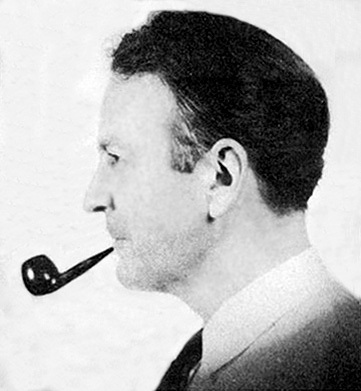
WRITER · BORN 1888 · DIED 1959
Raymond Chandler
- Born
- 23 July 1888
- Died
- 26 March 1959
59 archived facts 3 topics 1 source Last reviewed Sep 2026
32 Interesting Facts About Raymond Chandler
- #001
In the mid-1950s, Raymond Chandler encouraged Ian Fleming to keep writing his James Bond novels by writing a few words of advice to Fleming's American publishers. The gesture reflected Chandler's admiration for Fleming's work and its literary merit. Chandler's support played a significant role in the continuation of the Bond series.
- #002
When Chandler was once asked how he felt about Hollywood having 'ruined' his books, he took the questioner into his study, pointed to his works and said, 'There they are. They're fine.' The answer reveals Chandler's confidence in the durability of his books and his calm attitude toward Hollywood adaptations. According to the author, the original works are always safe and valuable.
- #004
Chandler appears in a brief behind-the-scenes shot in Double Indemnity (1944). Toward the end of the film, he can be seen sitting on a chair outside Edward G. Robinson's mezzanine office as Fred MacMurray leaves. The cameo shows Chandler's relationship with Hollywood and his closeness to the world of cinema.
- #007
Chandler referred to Veronica Lake disparagingly as 'Moronica.' The nickname reflects Chandler's negative view of Lake's acting or personality. Such remarks show Chandler's critical attitude toward Hollywood stars.
- #014
The last novel Chandler completed, 'Playback,' was originally written as a screenplay for Universal Studios. After Universal paid him, the studio decided not to film it, so Chandler turned it into a novel. The transformation shows Chandler's move from screenwriting to novel writing and his ability to adapt his work into different formats.
- #015
'Playback,' the last of the Philip Marlowe novels, is based on an original, unfilmed screenplay by Chandler — a screenplay in which the character Marlowe does not appear. This shows that Chandler could construct stories even before creating the character of Marlowe. The novel is a product of Chandler's screenwriting experience.
- #016
A legendary detective novelist and occasional screenwriter, Chandler created Philip Marlowe. Chandler is regarded as one of the most important figures of the hardboiled detective genre. The character of Marlowe has earned an unforgettable place in literary history.
- #019
As a sign of respect and appreciation, Raymond Chandler wrote a personal letter to the writer Dashiell Hammett praising his works. The letter shows Chandler's admiration for Hammett and their literary friendship. This exchange between the two writers contributed to the development of detective literature.
- #022
Because of his early years in England, Raymond Chandler described himself as 60% English and 40% American. This sense of identity led his work to carry traces of both English and American culture. Chandler's description sums up his position between the two cultures.
- #023
His prose was admired by figures such as Ian Fleming, W.H. Auden and Evelyn Waugh. This admiration shows that Chandler's literary talent and influence were widely recognized. Chandler's works were respected not only within genre literature but in the broader literary world.
- #024
The house Chandler lived in on Shetland Ln. in Brentwood is shown in the film Hollywood Mouth 2 (2014). While living there he wrote the novels 'The High Window' and 'Lady in the Lake'. The house is an important place in Chandler's creative process and served as a source of inspiration for his work.
- #025
In British radio plays, he was portrayed twice by Patrick Stewart in connection with his adventures as a film writer. These portrayals show that Chandler's Hollywood experiences and personality were adapted for radio plays. Patrick Stewart's performance successfully reflected Chandler's character.
- #026
Because Raymond Chandler recreated the hard-boiled detective genre, the term 'Chandleresque' was coined. The term is used to describe Chandler's style and influence. Chandler's innovative approach broke new ground in detective literature.
- #027
In 1912 Chandler studied accounting in Los Angeles. This education allowed him to later work as an executive at an oil company. His accounting knowledge played an important role in his success in business.
- #031
Unlike his quick-witted character Philip Marlowe, Raymond Chandler was known to be a well-read individual. Chandler's extensive reading habits influenced his literary style and depth. This shows itself in the rich references and use of language in his work.
- #032
While working on the screenplay for 'Strangers on a Train', Chandler frequently clashed with director Alfred Hitchcock over artistic differences. In the end they refused to speak to each other, and Hitchcock threw out Chandler's contribution. This dispute is one of Chandler's difficult experiences in Hollywood and shows his determination to protect his creative vision.
- #036
He worked as a journalist for the Daily Express and the Westminster Gazette. This journalistic experience helped Chandler develop his writing skills. Journalism laid the groundwork for his later fiction writing.
- #037
The story 'The Little Sister' is said to be based on Raymond Chandler's contempt for Hollywood. This novel reflects Chandler's criticism of and frustrations with Hollywood. Chandler's Hollywood experiences are one of the themes frequently treated in his work.
- #038
He once described Los Angeles as a 'paradise of failures'. This was a reference to Raymond Chandler's hatred of the city. Chandler's negative view of Los Angeles led him to depict the city's dark sides in his work.
- #039
While casting for 'The Big Sleep' (1946), Raymond Chandler wanted Cary Grant to play Philip Marlowe. Grant declined, but Chandler approved the selection of Humphrey Bogart. Bogart's performance is regarded as one of the most iconic interpretations of the Marlowe character in cinema history.
- #041
Chandler was reportedly unhappy with how Philip Marlowe was portrayed when the character was adapted for radio, believing his creation was not faithfully represented in radio adaptations. This dissatisfaction reflects Chandler's attachment to his character and the importance he placed on Marlowe being portrayed accurately.
- #042
Among all the actors who played Philip Marlowe, Humphrey Bogart and Dick Powell are considered the best. The two actors portrayed Marlowe in different but impressive ways, and Chandler himself appreciated their performances.
- #044
Following the poor sales of the novels 'The Big Sleep' and 'Farewell My Lovely', Raymond Chandler found himself on the edge of poverty. These financial difficulties were one of the obstacles Chandler faced in his writing career, though the period laid the groundwork for his later successes.
- #045
While working as an oil company executive, Raymond Chandler earned $3,000 a month. This high income reflects Chandler's financial situation before he turned to writing, and the job experience also influenced his later writing career.
- #047
Besides being a novelist and short story writer, Chandler was also a poet, though his poems met with very little success. Chandler's poetry shows a different side of his literary talent, but he earned his real fame through his prose.
- #048
The only recurring criticism of Chandler's writing is that his narratives are somewhat disjointed and inconsistent. This criticism points to certain weaknesses in Chandler's storytelling, yet the trait also gave his work a distinctive character.
- #052
Chandler was prone to writer's block. This indicates that he sometimes had difficulty during the writing process, and writer's block caused delays in the completion of his works.
- #053
Ed Bishop played Philip Marlowe in six BBC radio adaptations. These radio plays allowed the Marlowe character to come to life in a different medium, and Bishop's performance remained faithful to Chandler's character.
- #054
Chandler had a separate career as a detective fiction critic, contributing to critical analysis of the genre. These reviews demonstrate his deep understanding of detective literature.
- #055
British songwriter Robyn Hitchcock paid tribute to Chandler in 1986 with his song 'Raymond Chandler Evening'. The song shows the influence of Chandler's literary legacy on popular culture, and Hitchcock's tribute underscores the enduring quality of Chandler's work.
- #058
Chandler personally praised Dick Powell's performance as Marlowe in the film 'Murder, My Sweet'. Chandler liked Powell's interpretation and appreciated the performance, which remains one of the notable portrayals of Marlowe in cinema history.
- #059
Alfred Hitchcock and Chandler clashed intensely over the screenplay for 'Strangers on a Train', and the two men were not speaking to each other during the production. The dispute shows Chandler's determination to protect his creative vision and his conflict with Hitchcock's directorial approach.
Sources & editorial notes
Reference databases
Sources for the entries on this page
- IMDb IMDb
Information from external sources is independently selected, consolidated and edited by Arka Evren. Sources are listed for verification and further reading. Encyclopedia text is used under its licence (CC BY-SA). How we work