

ACTOR · BORN 1930 · DIED 2002
Richard Harris
- Born
- 1 October 1930
- Died
- 25 October 2002
- Known for
- Unforgiven (1992), The Crown (2016), Mutiny on the Bounty (1962), The Wild Geese (1978)
57 archived facts 6 topics 1 source Last reviewed Nov 2026
Richard Harris (1 October 1930 – 25 October 2002) was an actor best known for Unforgiven, The Crown and Mutiny on the Bounty.
57 Interesting Facts About Richard Harris
Interesting Facts (7)
- #001
- #002
On 30 September 2006, Manuel Di Lucia, of Kilkee, County Clare, a longtime friend, organised the placement in Kilkee of a bronze life-size statue of Richard Harris. It shows Harris at the age of eighteen playing squash. The sculptor was Seamus Connolly and the work was unveiled by Russell Crowe. Harris was an accomplished squash player, winning the Tivoli Cup in Kilkee four years in a row from 1948 to 1951, a record unsurpassed to this day.
- #003
Harris paid £75,000 for William Burges' Tower House in Holland Park in 1968, after discovering that Liberace had arranged to buy the house but not yet put down a deposit. Harris employed the original decorators, Campbell Smith & Company Ltd. to carry out extensive restoration work on the interior.
- #004
- #005
While still a student, he rented the tiny "off-West End" Irving Theatre in London and directed his own production of Clifford Odets' "Winter Journey (The Country Girl)". The critics approved, but the production used up all his savings. Harris claimed that he was forced to sleep in a coal cellar for six weeks, but he actually stayed with some relatives in London.
- #006
- #007
Production Story (14)
- #008
His casting as Oliver Cromwell in Cromwell (1970) was deemed odd, as Harris was patriotic Irish hellraiser and Cromwell was a puritan whose military campaign in Ireland was called genocidal or near-genocidal. Harris took the role because the money was too good to pass up. In interviews he said he admired Cromwell for making Britain more democratic.
- #009
Producers were initially reluctant to cast him as King Arthur in Camelot (1967) due to his limited singing ability. Harris was cast after Richard Burton, who had played the part on Broadway in 1961, demanded too much money. Harris insisted on doing his own singing live and later enjoyed a successful pop career, touring America in 1972.
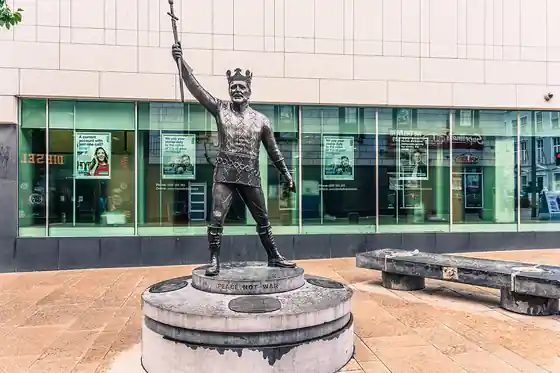
Richard Harris: King ArthurImage: Wikimedia Commons · William Murphy from Dublin, Ireland, CC BY-SA 2.0 - #010
- #011
- #012
- #013
- #014
- #015
Concerning his role as Dumbledore in the Harry Potter films, Harris had stated that he did not intend to take the part at first, since he knew it was a 'multi-film deal' and that his health was in decline, but he relented and accepted it because his 11-year-old granddaughter threatened never to speak to him again if he did not take it.
- #016
- #017
- #018
- #019
- #020
- #021
Behind the Scenes (4)
- #022
- #023
In an interview on The Tonight Show Starring Johnny Carson (1962), he told a story about when he was a young actor playing Seyton in a theatrical production of "Macbeth." The lead actor was a real jerk to him, making constant demeaning references to Harris' Irish heritage. On opening night Harris couldn't take it anymore. In Act V, Macbeth turns to him and says, "Wherefore was that cry?" Harris was supposed to reply, "The queen, my lord, is dead," after which Macbeth goes into his famous soliloquy about "Tomorrow, and tomorrow, and tomorrow." Instead, Harris decided instead to say, "Oh, don't worry. She's fine. She'll be up and about in ten minutes." He ruined the performance and was promptly fired.
- #024
- #025
Characters & Cast (3)
- #026
Despite his initial reluctance to accept the role of Albus Dumbledore in the Harry Potter films (he only agreed to do so at the urging of his granddaughter) he was determined not to let his battle with Hodgkin's disease get in the way of him playing the role. During post-production on Harry Potter and the Chamber of Secrets (2002), producer David Heyman visited Harris in the hospital. By this point Harris' illness had progressed to the point where he had become very gaunt and could speak in barely more than a whisper, yet he begged the producer not to recast the role. Ultimately, however, the role had to be recast, and Harris passed away a few weeks later.
- #027
His casting as Oliver Cromwell in Cromwell (1970) was deemed odd, as Harris was patriotic Irish hellraiser and Cromwell was a puritan whose military campaign in Ireland was called genocidal or near-genocidal. Harris took the role because the money was too good to pass up. In interviews he said he admired Cromwell for making Britain more democratic.
- #028
Career & Awards (11)
- #029
On 30 September 2006, Manuel Di Lucia, of Kilkee, County Clare, a longtime friend, organised the placement in Kilkee of a bronze life-size statue of Richard Harris. It shows Harris at the age of eighteen playing squash. The sculptor was Seamus Connolly and the work was unveiled by Russell Crowe. Harris was an accomplished squash player, winning the Tivoli Cup in Kilkee four years in a row from 1948 to 1951, a record unsurpassed to this day.
- #030
In an interview with the Toronto Star in 2001, Harris expressed his concern that his association with the Harry Potter films would outshine the rest of his career. He explained, "Because, you see, I don't just want to be remembered for being in those bloody films, and I'm afraid that's what's going to happen to me.".
- #031
While still a student, he rented the tiny "off-West End" Irving Theatre in London and directed his own production of Clifford Odets' "Winter Journey (The Country Girl)". The critics approved, but the production used up all his savings. Harris claimed that he was forced to sleep in a coal cellar for six weeks, but he actually stayed with some relatives in London.
- #032
- #033
In his youth he was a fan of Marlon Brando and could imitate or parody his performance in On the Waterfront (1954) at the drop of a hat. However, he did not get along with Brando while filming Mutiny on the Bounty (1962) and blamed the American star's on-set behavior for the film going over budget and over schedule. During the 1960s he often criticized Brando's eccentric movie choices in interviews.
- #034
- #035
During the 1940s and early 1950s he went to see all the films of John Wayne and Gary Cooper. Later, however, he described both actors as "pantomime cowboys". The westerns he made, like A Man Called Horse (1970), were decidedly revisionist in tone.
- #036
- #037
- #038
Harris did not enjoy his first time in Hollywood making The Wreck of the Mary Deare (1959). Production had to be halted several times due to the frequent illnesses of star Gary Cooper. Harris turned down the role of Commodus in The Fall of the Roman Empire (1964) and was 34 when he starred in his first Hollywood movie, Major Dundee (1965).
- #039
He won the role of King Arthur in Camelot (1967), the film version of Alan Jay Lerner & Frederick Loewe's hit musical, after close friend and drinking buddy Richard Burton, who had played Arthur in the original 1960 Broadway production, turned it down. Burton had had a huge success with the show, winning a 1961 Tony Award for Best Actor in a Musical. Harris replaced Burton in the roadshow of the 1980 revival of the musical when Burton was unable to continue due to bursitis, a tour that ended up back on Broadway, with Harris as Arthur, in 1981.
Life & Family (18)
- #040
- #041
- #042
- #043
Harris paid £75,000 for William Burges' Tower House in Holland Park in 1968, after discovering that Liberace had arranged to buy the house but not yet put down a deposit. Harris employed the original decorators, Campbell Smith & Company Ltd. to carry out extensive restoration work on the interior.
- #044
- #045
In 1954, while looking for a bedsit in London, he saw a board behind the window of a shop that listed all the rooms it had for rent. On that board was a sign that offered a room for thirteen shillings a week, which read "No Irishmen or black need to apply". He got so infuriated by this that he wrapped his jersey around his hand, punched through the glass and took the sign, which he kept for the rest of his life.
- #046
While living in England he popped out for milk one day and saw in a newspaper that Young Munster were playing in Thomond Park, Limerick. He got the next available flight to Ireland and spent the next three weeks on a drinking binge. All of this was unknown at the time to his wife, who had no idea where he was. When he finally returned to England he rang the doorbell of his house. His wife answered the door and before she had a chance to say anything, he said, "Well, why didn't you pay the ransom?".
- #047
- #048
- #049
- #050
- #051
- #052
He spent the last 12 years of his life living in Room 758 at the world-famous Savoy Hotel in London. His room was located in the "Courtside" section of the hotel. It did have a view of the river, but not as fine a view as the "Hotel" section riverside rooms. He only had his room cleaned once a week and very rarely notified the hotel that he was out of his room, so they had to check his door ten times a day to see if his "Do Not Disturb" sign flipped around to say "Make Up My Room".
- #053
He enjoyed a friendly rivalry with English actor Oliver Reed during the late 1960s and early 1970s. Reed would often refer to himself as "Mr. England." When Harris would hear him saying that, he would then refer to himself as "Mr. Ireland.".
- #054
- #055
- #056
- #057
Related pages
- Chris Pine — Richard Harris comes up in the facts on that page
- Joaquin Phoenix — Richard Harris comes up in the facts on that page
Continue through the archive
Sources & editorial notes
Reference databases
- Wikipedia
- IMDb
Information from external sources is independently selected, consolidated and edited by Arka Evren. Sources are listed for verification and further reading. Encyclopedia text is used under its licence (CC BY-SA). How we work