
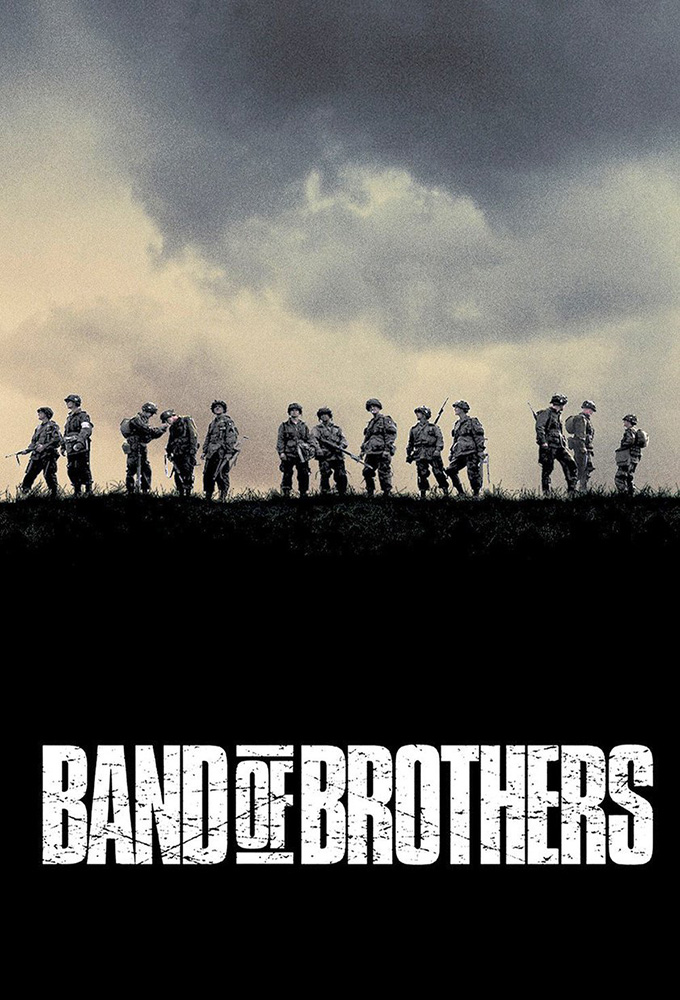
TV SERIES · 2001–2001 · USA
Band of Brothers
- Network
- HBO
- Seasons
- 1
- Episodes
- 10
- Studio
- DreamWorks Pictures, Playtone, HBO
224 archived facts 8 topics 1 source Last reviewed Nov 2026
Drawn from interviews with survivors of Easy Company, as well as their journals and letters, Band of Brothers chronicles the experiences of these men from paratrooper training in Georgia through the end of the war. As an elite rifle company parachuting into Normandy early on D-Day morning, participants in the Battle of the Bulge, and witness to the horrors of war, the men of Easy knew extraordinary bravery and…

224 Interesting Facts About Band of Brothers
Interesting Facts (24)
- #001
The hard shock that many of the paratroopers spoke of when they jumped at Normandy, causing them to lose their leg bags, helmets, and other equipment, was caused by the parachute the troopers were using (not the type shown in the film). That parachute was called a T-1, and as it deployed out of its pack the canopy came out first, then the suspension lines and finally the risers connected to the harness. With this design, by the time all of the lines are fully deployed the canopy has completely filled with air, acting as a brake for the lines, causing the paratrooper to come to an abrupt stop at the end of the deployment. The heavier the paratrooper and the more equipment he was carrying, the more sudden the stop or shock. Modern-design parachutes deploy in the exact opposite way (lines first, then canopy), greatly reducing the opening shock. On D-Day, not only were the leg bags a new "innovation", with which the paratroopers hadn't practiced, but frequently the aircraft were flying much faster than expected (to avoid flak) and the shock of opening was, therefore, increased.
- #002
- #003
During the boot camp training, Neal McDonough's weapon went off, and damaged part of his face. After the wound became infected, he had to be taken to a London hospital at ten p.m. Not wanting the press to hear about it, he gave his name as Buck Compton. He also refused Novocaine while the wound was stitched, under the basis that a 1940s soldier wouldn't have had it. He was wearing his costume the whole time. He arrived back at the base at three a.m., just in time for drills.
- #004
- #005
- #006
The black and white "Invasion stripes" on the wings of the C-47 in the scene where the soldiers are entering the plane are wavy and sloppily painted. This is accurate. The word went down to all allied air units on June 4th to paint broad stripes on the planes for recognition. Maintenance personnel used paint brushes, many of them purchased from English retailers, to paint the stripes on thousands of planes, literally overnight. Concerned that the Germans might use Allied aircraft, captured during and before Dunkirk, to infiltrate and destroy Allied air formations, the so-called "invasion stripes" were added to identify friendly planes.
- #007
Tom Hanks claimed that when the real Richard Winters was shown early footage of the re-creation of the Battle of Carentan, Winters complimented the sound effects and costume accuracy, but complained that the battle looked too chaotic and did not convey the level of strategy and preparation put into the assault. Hanks claimed he and the series directors tried to balance conveying the professionalism of Easy Company while also making the battle scenes realistic for an audience.
- #008
- #009
Prior to production, the various directors were told that the actors were in contact with the veterans they were playing. If the actors said that the veterans disapproved or disagreed with something in the script, it would have to be changed. Many of the actors frequently got themselves taken out of certain scenes after the respective veterans said they weren't there for the event in question.
- #010
- #011
Renee Lemaire was only given a passing mention in Stephen Ambrose's book. During pre-production, the writers became familiar with her story. She was a native of Bastogne, who worked as a nurse in Brussels, and was visiting family when the battle began. When the aid station was bombed, she evacuated six people from the burning building, and died trying to save a seventh. As she was at a different aid station to the one, to which Eugene Roe kept going back and forth, it's unknown if they ever met. The producers, however, wanted to feature her as a character anyway.
- #012
The real-life Donald Malarkey and Warren Muck were good friends with Frederick Niland, a fellow paratrooper in the 101st Airborne. Niland was the soldier who Matt Damon's character was loosely based on in Saving Private Ryan (1998), another World War II project, which executive producer Steven Spielberg directed. Tom Hanks, who was a producer on this series, had a major role in "Ryan". Fritz was sent back to America as the sole surviving member of four brothers who had been in combat. Two of his brothers had been killed on D-Day, while the other had been killed the same week in the China/Burma/India theater. Their mother received all 3 telegrams about her sons' deaths the same day.
- #013
Donald Malarkey is shown meeting an American-born German prisoner of war who lived in Malarkey's home state of Oregon but whose family had returned to Germany before the war. The encounter really happened, but with one very important difference: in the series Malarkey did not know the man from Oregon, whereas in real life the two had actually worked across from each other for years.
- #014
- #015
- #016
In the second episode, "Day of Days," when the company first attacks the German gun position at Brecourt, there appears to be a kind of cinematic error, as if an American soldier throws a grenade and it explodes when it hits a fleeing German soldier. Grenades do not explode on contact; they have timed fuses. What actually happened, however, was this: Buck Compton was an All-American catcher for UCLA and threw that grenade at the enemy without a bow and hit him, and it exploded the moment it struck. In the film, though, the grenade hits the soldier's back and explodes, whereas in the real event it hit the soldier's head and exploded.
- #017
- #018
- #019
Renee Lemaire was mentioned only in passing in Stephen Ambrose's book. During pre-production, the writers became familiar with her story. She was from Bastogne, worked as a nurse in Brussels, and was visiting her family when the war began. When the aid station was bombed, she evacuated six people from the burning building and died trying to save a seventh. It is unknown whether she and Eugene Roe ever met, since she was at a different aid station from the one he kept going back and forth to. The producers nevertheless wanted to highlight her as a character.
- #020
- #021
- #022
- #023
- #024
Production Story (79)
- #025
Before production, the various directors were told that the actors were in contact with the veterans they were playing. If the actors said that the veterans disapproved of or disagreed with something in the script, it would have to be changed. Many of the actors frequently had themselves removed from certain scenes after the respective veterans said they weren't there for the event in question.
- #026
- #027
- #028
- #029
Tom Hanks claimed that when the real Richard Winters was shown early footage of the re-creation of the Battle of Carentan, Winters complimented the sound effects and costume accuracy but complained that the battle looked too chaotic and did not convey the level of strategy and preparation put into the assault. Hanks claimed he and the series directors tried to balance conveying the professionalism of Easy Company while also making the battle scenes realistic for an audience.
- #030
- #031
- #032
The actor and comedian Connor Ratliff was cast in, and then fired from, a small role (Zielinski) in this miniseries. Although he was never given an official reason for the firing, he was told unofficially that Tom Hanks, who was both an executive producer of the series and the director of the episode Ratliff was set to appear in, objected to his appearance on the basis that he had "dead eyes." Though Ratliff moved on with his life and career, the incident stayed with him, so even though (by his own description) it was a "very stupid mystery," two decades later Ratliff created a podcast called "Dead Eyes" to discover the truth about why he was fired and reflect on the larger issues of how to deal with rejection and disappointment in one's career and life. After two years of podcast episodes, Hanks himself appeared on it to answer Ratliff's questions.
- #033
The series was screened at Fort Campbell, Kentucky, in August 2001 to members of the 101st Airborne Division just a few weeks before the attacks of September 11, 2001. Several real-life characters from the series, and the actors who portrayed them, including William Guarnere, C. Carwood Lipton, and Donald Malarkey, met with soldiers who were serving in the "Screaming Eagles" at the time. Guarnere even danced the Jitterbug, despite having only one leg. Eighteen months later, the 101st deployed and participated in the invasion of Iraq.
- #034
- #035
- #036
Renee Lemaire was only given a passing mention in Stephen Ambrose's book. During pre-production, the writers became familiar with her story. She was a native of Bastogne, who worked as a nurse in Brussels, and was visiting family when the battle began. When the aid station was bombed, she evacuated six people from the burning building, and died trying to save a seventh. As she was at a different aid station to the one to which Eugene Roe kept going back and forth, it's unknown if they ever met. The producers, however, wanted to feature her as a character anyway.
- #037
The real-life Donald Malarkey and Warren Muck were good friends with Frederick Niland, a fellow paratrooper in the 101st Airborne. Niland was the soldier on whom Matt Damon's character was loosely based in Saving Private Ryan (1998), another World War II project, which executive producer Steven Spielberg directed. Tom Hanks, who was a producer on this series, had a major role in Saving Private Ryan. Fritz was sent back to America as the sole surviving member of four brothers who had been in combat. Two of his brothers had been killed on D-Day, while the other had been killed the same week in the China/Burma/India theater. Their mother received all three telegrams about her sons' deaths the same day.
- #038
- #039
- #040
- #041
Rick Gomez had a longer audition process than the others. He had to fly back to New York City immediately afterwards to do a play to which he was committed. He described waiting outside and hearing the casting director bickering with Tom Hanks before calling him back in, and having him go through more screentests and readings that were usually reserved for callbacks.
- #042
- #043
More than 330,000 pounds of recycled paper were used to create the snow on the forest set, the largest amount ever used in a production, and covering the entire set took four weeks. The miniseries' total budget was 120 million dollars, of which the construction cost was 17 million dollars.
- #044
Before production, directors were told that the actors were in contact with the veterans they were portraying. If the actors reported that the veterans did not approve of or agree with something in the script, that part had to be changed. Many actors were frequently cut from certain scenes after the veteran in question said he had not been present at the event.
- #045
- #046
Tom Hanks stated that when the real Richard Winters was shown early footage recreating the Battle of Carentan, Winters praised the sound effects and the accuracy of the costumes but said the battle looked too chaotic and did not reflect the level of strategy and preparation that went into the attack. Hanks said that he and the series' directors tried to strike a balance between conveying Easy Company's professionalism and making the battle scenes realistic for the viewer.
- #047
Renee Lemaire appeared only briefly in Stephen Ambrose's book. During pre-production, the writers learned more about her story. A native of Bastogne, Lemaire was working as a nurse in Brussels and was visiting her family when the war began. When the aid station was bombed, she evacuated six people from the burning building and lost her life trying to save a seventh. Because she was at a different aid station from the one Eugene Roe came and went to, it is not known whether the two ever met. The producers nevertheless wanted to show her as a character.
- #048
- #049
- #050
- #051
The series was shown to members of the 101st Airborne Division at Fort Campbell, Kentucky, in August 2001, just weeks before the September 11, 2001 attacks. Some of the characters in the film and the actors who portrayed them (including William Guarnere, C. Carwood Lipton and Donald Malarkey) met with soldiers serving in the 'Screaming Eagles' at that time. Guarnere did the Jitterbug despite having only one leg. Eighteen months later, the 101st Division was deployed and took part in the invasion of Iraq.
- #052
- #053
- #054
- #055
- #056
During basic training, Neal McDonough's weapon discharged and part of his face was damaged. When the wound became infected, he had to be taken to a hospital in London at ten o'clock. Because he did not want the press to hear about it, he gave his name as Buck Compton. While being stitched up, he refused Novocaine, because he thought a soldier of the 1940s would not have had it. He wore his costume the entire time. He returned to base at three o'clock and made it back exactly in time for drill.
- #057
According to Matt Hickey (O'Keefe), the hours on set were so long that the actors often slept around the set. He says that on the concentration camp set, he, Ron Livingston and James Madio slept on top of a watchtower and woke up to find that an assistant director had been frantically searching for them for two hours.
- #058
Several innovations concerned the use and firing of squibs, small explosives that cause bullet holes in costumes and sets. The special effects team developed a firing mechanism that used compressed air instead of traditional pyrotechnics, so that the actors could be much closer to one another when a squib went off, without the dangers inherent in traditional squibs. They also invented a new firing system controlled by a button hidden in an actor's costume sleeve and pre-wired for up to eight hits.
- #059
- #060
In the scene where the soldiers board the plane, the black-and-white 'invasion stripes' on the wings of the C-47 were painted wavy and sloppily. This is accurate. On June 4, all Allied air units were ordered to paint broad stripes on their aircraft for identification. Maintenance personnel painted the stripes on thousands of aircraft literally overnight, using brushes bought from British retailers. The 'invasion stripes' were added to identify friendly aircraft out of concern that the Germans would use captured Allied aircraft to infiltrate and destroy Allied air formations before and during Dunkirk.
- #061
- #062
Over 330,000 pounds of recycled paper were used to create snow for the forest set; this was the largest amount ever used in a production, and preparing the entire set took four weeks. The total budget of the miniseries was 120 million dollars. Of this, 17 million dollars was construction costs.
- #063
The actors playing replacements were ostracized by the actors who were present at the boot camp in order to create a genuine sense of resentment among them. The only exception was Robin Laing (Babe Heffron), who recalled that Frank John Hughes (Bill Guarnere) took him under his wing, just as the real Guarnere did with the real Heffron.
- #064
- #065
The severe shock that the paratroopers mention when jumping into Normandy, which caused them to lose their leg bags, helmets and other equipment, came from the parachute the soldiers used (not the type shown in the film). This parachute was called the T-1, and when it deployed from its pack, first the canopy came out, then the suspension lines, and finally the risers attached to the harness. With this design, when all the lines were fully extended, the canopy filled completely with air and acted as a brake for the lines, causing the paratrooper to come to an abrupt stop at the end of deployment. The heavier the paratrooper and the more equipment he carried, the more abrupt the stop or shock was. Modern parachute designs deploy in the opposite way (lines first, then canopy), greatly reducing the opening shock. On D-Day, leg bags were not only a new 'innovation', they were something the paratroopers had not practiced with, and often the planes flew much faster than expected (to avoid anti-aircraft fire), which increased the opening shock.Neal McDonough smuggled a bottle of whiskey into basic training camp and filled his canteen with whiskey instead of water. This meant he could not drink much during training. He said the other actors were impressed, apparently because they did not need to drink water.
- #066
Jimmy Fallon, who has a brief appearance in the fifth episode as 2nd Lt. George C. Rice, explained on his talk show The Tonight Show Starring Jimmy Fallon (2014) that although his character drives a military Jeep (all of which are manual transmission), he himself did not know how to drive a manual. During filming, the Jeep he 'drove' had to be pushed by crew members. Sound was later added to make it appear he was driving.
- #067
- #068
- #069
- #070
- #071
- #072
- #073
The white 'PT' (physical training) T-shirts worn in the first episode and seen with the paratrooper in the closing scenes of the final episode, with the words 'U.S. Paratroops--Camp Toccoa, GA', are exact replicas of those worn during training. The Stephens County Museum in Toccoa houses the original along with uniforms, Normandy maps and other Airborne exhibits. While the originals were printed in black ink, the replicas sold at the museum for fundraising are very dark blue and have a small copyright notice in the lower right corner of the design.
- #074
- #075
- #076
- #077
- #078
- #079
- #080
- #081
Joe Liebgott and Frank Perconte were among the oldest men in Easy Company; when the war ended they were 30 and 28 respectively. Ross McCall and James Madio, who played them, were the youngest members of the main cast; both were 24 during filming. The situation was the exact opposite for Denver 'Bull' Randleman and Buck Compton; their actors were more than ten years older than their characters.
- #082
Actor and comedian Connor Ratliff was cast in a small role (Zielinski) in this miniseries and was then fired. Although the reason for his dismissal was never officially explained, it was said unofficially that Tom Hanks, one of the series' producers and the director of the episode Ratliff was to appear in, objected to his appearance because of his 'dead eyes'. Ratliff moved on with his life and career, but the incident stayed with him; despite it being, in his words, 'a very stupid mystery', twenty years later Ratliff launched a podcast called 'Dead Eyes' to learn the truth about why he was fired and to tackle bigger subjects such as how to deal with rejection and disappointment in a career. After two years of podcast episodes, Hanks came on the show to answer Ratliff's questions.
- #083
Babe Heffron and Bill Guarnere were invited by the production team to visit the set. At the airport, according to Babe, they were met in full military uniform by Frank John Hughes, who imitated Guarnere's speech, accent and tone almost perfectly. Both were deeply impressed when Frank said he had to stay in character at all times. On set, however, this caused confusion when their names were called; they could not tell whether someone was addressing the actor playing them or them directly.
- #084
- #085
Rick Gomez's audition process took longer than the others'. He immediately had to return to New York for a play he was committed to. While waiting, he said he heard the casting director arguing with Tom Hanks, after which he was called back and given more screen tests and readings, which are usually reserved for callbacks.
- #086
When the real William Guarnere visited the set, Mark Huberman (Les Hashey) asked him what he thought of his character. When Guarnere said he did not like him, Huberman claimed that Frank John Hughes never spoke to him on set again after that day; Hughes, however, explained that this was due to method acting.
- #087
When the actors arrived at boot camp, they were told that from that day on they were to lose their natural accents (especially the actors from the United Kingdom), learn to speak like their characters, and from then on be called only by their characters' names. They had to remain this way throughout filming.
- #088
Before production, the directors were told that the actors were in contact with the veterans they were portraying. If the actors indicated that the veterans did not approve of or agree with something in the script, that part had to be changed. Many actors were frequently cut from certain scenes after the veteran in question said he had not been present at the event.
- #089
Tom Hanks stated that when the real Richard Winters was shown early footage recreating the Battle of Carentan, Winters praised the sound effects and the accuracy of the costumes but said the battle looked too chaotic and did not reflect the level of strategy and preparation that went into the attack. Hanks said that he and the series directors tried to strike a balance between conveying Easy Company's professionalism and making the battle scenes realistic for the viewer.
- #090
Renee Lemaire was mentioned only briefly in Stephen Ambrose's book. During pre-production, the writers learned her story in closer detail. A native of Bastogne, Lemaire was working as a nurse in Brussels and was visiting her family when the war began. When the aid station was bombed, she evacuated six people from the burning building and lost her life trying to save a seventh. Since she was at a different aid station from the one Eugene Roe came and went from, it is not known whether the two ever met. The producers nevertheless wanted to show her as a character.
- #091
- #092
The series was shown to members of the 101st Airborne Division at Fort Campbell, Kentucky, in August 2001, just weeks before the September 11, 2001 attacks. Some of the characters in the film and the actors who played them (including William Guarnere, C. Carwood Lipton and Donald Malarkey) met with soldiers serving in the 'Screaming Eagles' at that time. Despite having only one leg, Guarnere danced the Jitterbug. Eighteen months later, the 101st Division was deployed and took part in the invasion of Iraq.
- #093
- #094
- #095
- #096
- #097
Joe Liebgott (Ross McCall) is portrayed as Jewish in the series; because of his name, his appearance and his hatred of the Germans, the men of the Company assumed he was Jewish. In reality, however, Liebgott was a Catholic, the son of Austrian immigrants. According to his son, his anger toward the Nazis stemmed from his belief that they had given the German people a bad reputation. He knew his friends thought he was Jewish but found it amusing not to correct them.
- #098
- #099
- #100
"Currahee" is a corrupted form of a word meaning "standing together alone" in the American Cherokee language. The first members of the 506th Regiment trained on Currahee Mountain in Georgia. Since airborne troops jump behind enemy lines and stand together on their own, this slogan is extremely fitting. "Currahee" was a shout the 506th Regiment cried out as they exited the door on their first jumps and continued to use in combat.
- #101
In the second episode, when the company first attacks the German gun position at Brecourt, an American soldier throwing a grenade that hits a fleeing German soldier and explodes looks like a cinematic error. Grenades do not explode on contact; they have timed fuses. But this really happened: Buck Compton was a baseball catcher who had played for UCLA and threw the grenade without an arc, and it exploded the moment it struck. Unlike in the film, in the real event the grenade hit the soldier's head, not his back.
- #102
The real Donald Malarkey and Warren Muck were close friends with Frederick Niland, a paratrooper in the 101st Airborne. Niland inspired the character played by Matt Damon in Saving Private Ryan, directed by Steven Spielberg, who is an executive producer of this series alongside Tom Hanks. Fritz was sent back to America as the only surviving one of four brothers who were in the war. Two of his brothers were killed on D-Day, and the other on the China/Burma/India front that same week. Their mother received news of the deaths of three sons on the same day.
- #103
Behind the Scenes (65)
- #104
- #105
The actors endured a grueling ten-day boot camp where they learned the basics, from how to wear a uniform and stand at attention to sophisticated field tactics and parachute jump training. The average day was sixteen hours long, beginning at five a.m., rain or shine, with strenuous calisthenics and a three to five mile run, followed by several hours of tactical training, including weapons handling and jump preparation.
- #106
- #107
- #108
- #109
The site of the actual Camp Toccoa is now partly occupied by an industrial plant near the highway above Toccoa, Georgia, with the remaining areas now overgrown by a pine forest. A flagpole and monument are located by the highway at what was once the camp's main gate. Locations of former camp streets are denoted by street signs named for personnel and terminology of the paratroops (Currahee Street, for instance) but have a tendency to be snapped up by souvenir hunters. The winding trail up Mount Currahee is named for Colonel Robert F. Sink. It is accessible, but the last few hundred feet are extremely rough, and part of it passes over a bare rock outcropping, not recommended driving for low-slung vehicles. Communications antennas surmount the crest of Currahee.
- #110
When the real William Guarnere visited the set, Mark Huberman (Les Hashey) asked him what he thought of his character. When Guarnere replied he didn't like him, Huberman claims that Frank John Hughes never spoke to him on-set again afterwards, though Hughes did clarify that it was for the sake of method acting.
- #111
- #112
During the boot camp training, Neal McDonough's weapon went off and damaged part of his face. After the wound became infected, he had to be taken to a London hospital at ten p.m. Not wanting the press to hear about it, he gave his name as Buck Compton. He also refused Novocaine while the wound was stitched, on the basis that a 1940s soldier wouldn't have had it. He was wearing his costume the whole time. He arrived back at the base at three a.m., just in time for drills.
- #113
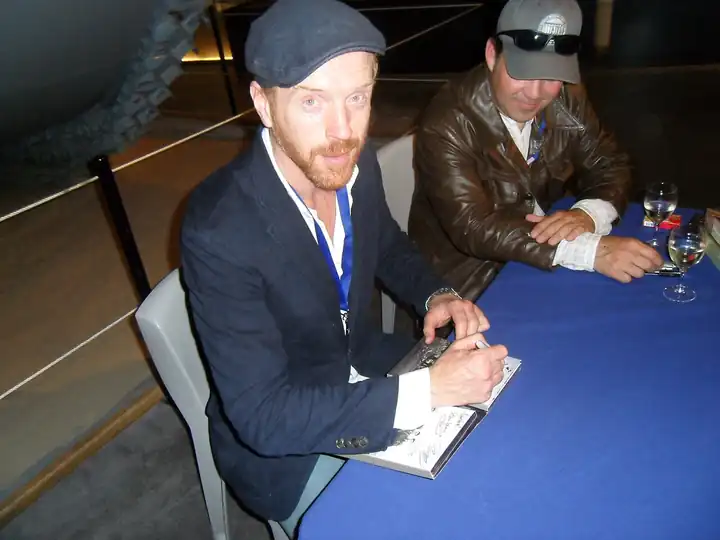
Damian Lewis (Dick Winters) put effort into working out prior to going to boot camp, since the real Richard D. Winters was famously one of the best athletes of Easy Company. Lewis estimated that of the approximately fifty actors who went to boot camp, he was the tenth best at exercise.
Band of Brothers (2001): Damian Lewis signs books at a signing eventImage: Wikimedia Commons · Engyles, CC BY 2.0 - #114
- #115
When the actors arrived for boot camp, they were told that from that day forward they were to lose their natural accents (mainly for the actors from the UK), learn how to speak like their characters, and from then on they would only be called by their character's name. They had to stay this way for the entirety of the shoot afterwards.
- #116
- #117
- #118
- #119
- #120
- #121
- #122
- #123
- #124
- #125
- #126
- #127
- #128
The white "PT gear" (physical training) t-shirts worn in the first episode, and seen again in the closing scenes of the last episode with the parachutist, and the legend "U.S. Paratroops--Camp Toccoa, GA". are exact reproductions of the ones worn during training. The Stephens County Museum in Toccoa has an original on display, as well as uniforms, Normandy maps, and other Airborne exhibits. The originals were printed with black ink, while reproductions sold at the museum as a fund-raiser are in a very dark blue, and have a small copyright legend at the bottom right of the design.
- #129
According to Matt Hickey (O'Keefe), because the on-set hours were so long, actors frequently just slept around the set. He jokes that while on the concentration camp set, he, Ron Livingston, and James Madio went to sleep at the top of a lookout tower. They later woke to find out that an assistant director had been frantically searching for them for two hours.
- #130
- #131
- #132
- #133
- #134
Babe Heffron and Bill Guarnere were invited to visit the set by the production team. They were met at the airport by Frank John Hughes in full army getup, who according to Babe, did an almost perfect imitation of Guarnere's speech, accent, and tone. The men were both highly impressed when Frank told them about having to stay in character at all times. On set, however, it caused confusion when people called out their names. They weren't sure whether someone was talking to the actor playing them, or to them directly.
- #135
- #136
The actors playing the replacements were ostracized by the actors who had been at boot camp, in order to generate an authentic feeling of resentment between them. The exception was Robin Laing (Babe Heffron), who recalls Frank John Hughes (Bill Guarnere) taking him under his wing, as the real Guarnere had done to the real Heffron.
- #137
- #138
Jimmy Fallon, who had a brief appearance as Second Lieutenant George C. Rice in episode five, revealed on his talk show, The Tonight Show Starring Jimmy Fallon (2014), that even though his character was shown driving a military Jeep, which are all stick shifts, Fallon himself did not know how to drive one. During filming, the Jeep he was "driving" had to be pushed by crew members. Sound was later added to make it appear as though he was driving it.
- #139
- #140
- #141
Several innovations involved the use and firing of squibs, the small charges that cause the bullet holes in costumes and sets. The special effects team came up with a firing mechanism using compressed air instead of traditional pyrotechnics, so that actors could be much closer together when a squib went off without the dangers inherent in conventional squibs. They also invented a new firing system whereby an actor was pre-wired with up to eight hits, controlled by a button he activated that was hidden in the sleeve of his costume.
- #142
- #143
Contains a major spoiler — show
In episode two, "Day Of Days", when the company first attacks the German gun position at Brecourt, there appears to be some kind of cinematic error when it looks as though an American soldier throws a grenade and it explodes upon hitting a fleeing German soldier. Grenades don't explode on contact, they have timed fuses. However, this actually happened: Buck Compton had been an All-American catcher for UCLA and threw that grenade at the enemy with no arc, and it exploded as soon as it struck. However, unlike in the film, when the grenade hit the soldier in the back and exploded, in the actual incident, it hit him in the head and exploded.
- #144
- #145
According to Matt Hickey (O'Keefe), the hours on set were so long that the actors often slept around the set. He says that on the concentration camp set, he, Ron Livingston and James Madio slept on top of a watchtower and woke up to learn that an assistant director had been frantically searching for them for two hours.
- #146
Several innovations concerned the use and firing of squibs, small explosives that create bullet holes in costumes and sets. The special effects team developed a firing mechanism that used compressed air instead of traditional pyrotechnics, so that actors could be much closer to one another when a squib went off, without the dangers inherent in traditional squibs. They also invented a new firing system controlled by a button hidden in an actor's costume sleeve and pre-wired for up to eight hits.
- #147
The actors endured a grueling ten-day basic training camp where they learned everything from wearing uniforms and standing at attention to complex field tactics and parachute jump training. An average day lasted sixteen hours, starting at five in the morning and including strenuous calisthenics and a three-to-five-mile run in rain or sunshine, followed by several hours of tactical training, including weapons handling and jump preparation.
- #148
- #149
- #150
- #151
Over 330,000 pounds of recycled paper were used to create snow for the forest set; this was the largest amount ever used in a production, and preparing the entire set took four weeks. The miniseries' total budget was 120 million dollars. Of this, 17 million dollars went to construction costs.
- #152
The actors playing replacements were ostracized by the actors who had been at basic training camp, in order to create an authentic sense of resentment among them. The only exception was Robin Laing (Babe Heffron), who recalled that Frank John Hughes (Bill Guarnere) took him under his wing, just as the real Guarnere had done for the real Heffron.
- #153
- #154
The harsh shock that the paratroopers mention when jumping into Normandy, and that caused them to lose their leg bags, helmets and other equipment, came from the parachute the soldiers used (not the type shown in the film). This parachute was called the T-1, and when it deployed from its pack, first the canopy came out, then the suspension lines, and finally the risers attached to the harness. With this design, when all the lines were fully extended, the canopy filled completely with air and acted as a brake for the lines, causing the paratrooper to come to an abrupt stop at the end of deployment. The heavier the paratrooper and the more equipment he carried, the more abrupt the stop or shock was. Modern-design parachutes deploy in the opposite way (lines first, then canopy), greatly reducing the opening shock. On D-Day, leg bags were not only a new 'innovation', they were also something the paratroopers had not practiced with, and the planes often flew much faster than expected (to avoid anti-aircraft fire), which increased the opening shock.Neal McDonough smuggled a bottle of whiskey into boot camp and filled his canteen with whiskey instead of water. This meant he could not drink much during training. He said the other actors were impressed, apparently because they did not need to drink water.
- #155
- #156
- #157
Jimmy Fallon, who has a brief appearance in the fifth episode as 2nd Lt. George C. Rice, explained on his talk show The Tonight Show Starring Jimmy Fallon (2014) that although his character drives a military Jeep (all of which are manual transmission), he himself did not know how to drive a manual. During filming, the Jeep he 'drove' had to be pushed by crew members. Sound was later added so it would appear he was driving.
- #158
- #159
- #160
- #161
- #162
- #163
- #164
- #165
- #166
- #167
The white 'PT' (physical training) T-shirts worn in the first episode and seen with the paratrooper in the closing scenes of the final episode, with the words 'U.S. Paratroops--Camp Toccoa, GA', are exact replicas of those worn during training. The Stephens County Museum in Toccoa has the original along with uniforms, Normandy maps and other Airborne exhibits. While the originals were printed in black ink, the replicas sold at the museum for fundraising are very dark blue and have a small copyright notice in the lower right corner of the design.
- #168
Characters & Cast (30)
- #169
David Schwimmer portrays Captain Herbert M. Sobel and filmed his scenes while on hiatus from Friends (1994). In that series, his on-screen father is portrayed by Elliott Gould, who in A Bridge Too Far (1977) portrayed Colonel Stout, a character based on Colonel Robert F. Sink, Sobel's superior officer.
- #170
- #171
- #172
- #173
- #174
Joe Liebgott and Frank Perconte were two of the oldest Easy Company men, being 30 and 28, respectively, when the war ended. Ross McCall and James Madio, who played them, were two of the youngest main cast members, both being 24 during filming. It was the opposite with Denver 'Bull' Randleman and Buck Compton, whose actors were over ten years older than their characters.
- #175
Damian Lewis claims that when he was waiting to go into his audition, the actor in front of him was almost identical to the real Richard D. Winters. Convinced that the actor would be chosen, Lewis was surprised when the same man came up to him and congratulated him after the audition was over.
- #176
- #177
Joe Liebgott (played by Ross McCall) is portrayed as Jewish in the miniseries, and based on his name, appearance, and utter hatred of the Germans, his fellow members of E Company all assumed that he was Jewish, but the real Liebgott was a Roman Catholic, the son of Austrian immigrants; according to his son, his especially virulent hatred of the Nazis stemmed largely from his belief that they gave Germanic people in general a bad name. He was apparently aware that his fellow troopers thought he was Jewish, but never bothered to correct them, as he found it amusing.
- #178
- #179
- #180
- #181
- #182
- #183
- #184
- #185
- #186
- #187
- #188
Joe Liebgott and Frank Perconte were among the oldest men in Easy Company; when the war ended they were 30 and 28, respectively. Ross McCall and James Madio, who portrayed them, were the youngest actors in the main cast; both were 24 during filming. The situation was the exact opposite for Denver 'Bull' Randleman and Buck Compton; their actors were more than ten years older than their characters.
- #189
Actor and comedian Connor Ratliff was cast in a small role (Zielinski) in this miniseries and was then fired. Although the reason for his dismissal was never officially explained, it was said unofficially that the series' producers and Tom Hanks, who directed the episode Ratliff was to appear in, objected to his appearance because of his 'dead eyes.' Ratliff moved on with his life and career, but the incident stayed with him; although, as he put it, it was 'a very stupid mystery,' twenty years later Ratliff launched a podcast called 'Dead Eyes' to learn the truth about why he was fired and to tackle bigger questions such as how to deal with rejection and disappointment in a career. After two years of podcast episodes, Hanks came on the show to answer Ratliff's questions.
- #190
Babe Heffron and Bill Guarnere were invited by the production team to visit the set. At the airport, according to Babe, they were greeted in full military uniform by Frank John Hughes, who imitated Guarnere's speech, accent and tone almost perfectly. Both were deeply impressed when Frank said he had to stay in character at all times. On set, however, it caused confusion when their names were called; they couldn't tell whether someone was addressing the actor portraying them or them directly.
- #191
- #192
- #193
Rick Gomez's audition process took longer than the others'. He immediately had to return to New York for a play he had committed to. While waiting, he said he heard the casting director arguing with Tom Hanks, after which they called him back and had him do more screen tests and readings, which were usually reserved for callbacks.
- #194
When the real William Guarnere visited the set, Mark Huberman (Les Hashey) asked him what he thought of his character. When Guarnere said he didn't like him, Huberman claimed that Frank John Hughes never spoke to him on set again after that day; Hughes, however, explained that it was because of method acting.
- #195
- #196
- #197
- #198
Michael Cudlitz (Sergeant Denver 'Bull' Randleman) and Kirk Acevedo (Joseph Toye) worked together on the fourth season of The Walking Dead (2010). Both of their characters also serve in the military; Cudlitz played former Army Ranger Sergeant Abraham Ford, and Acevedo played Spec. Mitch Dolgen, a tank operator for the Army.
Easter Eggs & References (4)
- #199
Donald Malarkey is seen meeting an American-born German POW who had lived in Oregon, Malarkey's home state, but whose family had returned to Germany before the war. That incident actually happened, but with one crucial difference. In the film, Malarkey hadn't known the man back in Oregon. In real life, the two had actually worked across the street from each other for years.
- #200
The black and white "invasion stripes" on the wings of the C-47 in the scene where the soldiers are entering the plane are wavy and sloppily painted. This is accurate. The word went down to all Allied air units on June 4th to paint broad stripes on the planes for recognition. Maintenance personnel used paint brushes, many of them purchased from English retailers, to paint the stripes on thousands of planes, literally overnight. Concerned that the Germans might use Allied aircraft captured during and before Dunkirk to infiltrate and destroy Allied air formations, the so-called "invasion stripes" were added to identify friendly planes.
- #201
- #202
Deeper Meaning (17)
- #203
Lt. Norman Dike was a better soldier than the series would have us believe. It is true that his men gave him the nickname "Foxhole Norman," and that he apparently froze during the attack on Foy, and had to be relieved. But he was no coward. He had already been awarded a Bronze Star for his actions during Operation Market Garden in Holland, and he earned a second Bronze Star while at Bastogne, for rescuing three of his men while under enemy fire. During the charge into Foy, Lt. Dike was wounded, and it was likely the shock of his injury, and not cowardice or panic, that caused him to freeze up. He was transferred back to Battalion HQ, and was later promoted to Captain and became an aide to Gen. Maxwell Taylor. After the War, he remained with the Army Reserve, served in Korea, and retired in 1957 with the rank of Lieutenant Colonel. However, at Foy, Dike told First Squad to go on a flanking mission and for everyone else to provide suppressing fire, despite there being no adequate cover and they would be cut off from the company. Many of the men, including First Sergeant Lipton observed Dike, commenting, "He fell apart." While his previous and subsequent actions may be favorable, his command ability at Foy as well as his constant, unexplained disappearances, inattention to the men under his command and his preference for remaining in a foxhole, rather than fighting, did not endear him to the men under his command or his superiors.
- #204
- #205
- #206
"Currahee" is a bastardization of an American Cherokee Indian word meaning "stands together alone." The original members of the 506th were trained at Currahee Mountain, Georgia. Considering that airborne troops jump behind enemy lines and are used to standing together, alone against the enemy, it is a highly appropriate slogan. "Currahee" was the cry of the 506th as they cleared the door on their first jump, and it continued to be their cry when in combat.
- #207
- #208
Joe Liebgott (Ross McCall) is portrayed as Jewish in the series; because of his name, appearance and hatred of Germans, members of the company assumed he was Jewish. The real Liebgott, however, was a Catholic, the son of Austrian immigrants. According to his son, his anger at the Nazis stemmed from his belief that they gave the German people a bad reputation. He knew his friends thought he was Jewish but found it amusing not to correct them.
- #209
- #210
- #211
"Currahee" is a corrupted form of a word meaning "we stand alone together" in the American Cherokee language. The first members of the 506th Regiment trained on Currahee Mountain in Georgia. Since airborne troops jump behind enemy lines and stand alone together, this slogan is highly fitting. "Currahee" was a shout the 506th Regiment cried as they exited the door on their first jumps and continued to use in combat.
- #212
In the second episode, when the company first attacks the German gun position at Brecourt, an American soldier throwing a grenade that strikes a fleeing German soldier and explodes appears to be a cinematic error. Grenades do not explode on contact; they have timed fuses. But this really happened: Buck Compton was a baseball catcher who had played for UCLA and threw the grenade without an arc, and it exploded the moment it struck. Unlike in the series, in the real event the grenade hit the soldier's head, not his back.
- #213
- #214
The real Donald Malarkey and Warren Muck were close friends with Frederick Niland, a paratrooper in the 101st Airborne. Niland inspired the character played by Matt Damon in Saving Private Ryan, directed by Steven Spielberg, who served as executive producer of this series alongside Tom Hanks. Fritz was sent back to America as the sole survivor of four brothers who were at war. Two of his brothers were killed on D-Day, and the other on the China/Burma/India front the same week. Their mother received news of the deaths of three sons on the same day.
- #215
- #216
Lieutenant Norman Dike was a better soldier than shown in the series. It is true that his men nicknamed him 'Foxhole Norman' and that he froze during the attack on Foy. But he was not a coward. He had received a Bronze Star for his actions in Operation Market Garden in the Netherlands and earned a second Bronze Star in Bastogne by rescuing three of his men under fire. He was wounded during the assault on Foy, and his freezing was probably due to the shock of the wound, not cowardice or panic. He was sent back to battalion headquarters, later promoted to captain and became an aide to General Maxwell Taylor. After the war he remained in the Reserve Forces, served in Korea and retired in 1957 with the rank of lieutenant colonel. At Foy, however, Dike ordered First Platoon to make a flanking maneuver and provide covering fire for the others, even though there was insufficient cover and they would have been cut off from the company. Many people, including First Sergeant Lipton, observed Dike and remarked, 'He fell apart.' Although his earlier and later actions were positive, his command ability at Foy, his constant unexplained disappearances, his indifference to his men and his preference for staying in a foxhole rather than fighting made him liked by neither his men nor his superiors.
- #217
Part of the area where the real Camp Toccoa stood now hosts an industrial facility above the highway near Toccoa, Georgia, while the remaining areas are covered with pine forest. Beside the highway, at the site of the camp's main entrance, there is a flagpole and a monument. The locations of the old camp streets are marked with street signs bearing the names of paratrooper personnel and terminology (for example, Currahee Street), but these signs are frequently stolen by souvenir hunters. The winding trail up Currahee Mountain has been named after Colonel Robert F. Sink. The trail is accessible, but the last few hundred meters are quite rugged and part of it passes over a bare rock outcrop; it is not recommended for low-clearance vehicles. There are communication antennas at the summit of Currahee.
- #218
- #219
Career & Awards (2)
Life & Family (3)
- #222
- #223
- #224
The real-life Captain Sobel attempted suicide in 1970 after not being able to cope with his survivor's guilt. However, he did not die, but instead was left blind. Additional info (by 2nd source): Apparently he did die in 1987 in an assisted living facility, due to malnutrition and neglect.
Sources & editorial notes
Reference databases
- Wikipedia
- IMDb
Information from external sources is independently selected, consolidated and edited by Arka Evren. Sources are listed for verification and further reading. Encyclopedia text is used under its licence (CC BY-SA). How we work