
ArkaEvren
Futurama

TV SERIES · 1999–present · USA

Futurama

Created by
Matt Groening
Network
FOX, Comedy Central, Hulu
Seasons
11
Episodes
164
Studio
20th Century Fox Television, The Curiosity Company, 20th Television Animation

36 archived facts 4 topics 4 sources Last reviewed Oct 2026

The adventures of a late-20th-century New York City pizza delivery boy, Philip J. Fry, who, after being unwittingly cryogenically frozen for one thousand years, finds employment at Planet Express, an interplanetary delivery company in the retro-futuristic 31st century.

  • Futurama — production image

36 Interesting Facts About Futurama

Interesting Facts (19)

  1. #001

    Futurama takes its name from the Futurama Pavilion, designed by Norman Bel Geddes for the 1939 New York World's Fair, which displayed how the world would look in 1959.

    INTERESTING FACTS · SOURCED

  2. #002

    Hypnotoad's voice is a recording of a turbine engine played backwards. The sound effect, titled "Angry Machine," was included in the Avid editing program the team used and was initially meant only as a placeholder, but they liked it so much that they kept it in.

    INTERESTING FACTS · SOURCED

  3. #003

    One of the subtlest jokes in the series is that in the future owls replace pigeons and rats as pests. In many episodes, if you look carefully, you can see owls pecking at food on the ground or emerging from mouse holes.

    INTERESTING FACTS · SOURCED

  4. #004

    Dr. Zoidberg had teeth in the first few episodes.

    INTERESTING FACTS · SOURCED

  5. #005

    Zapp Brannigan was written specifically for Phil Hartman. When Hartman was murdered, the role was given to Billy West, who did an impression of Phil Hartman.
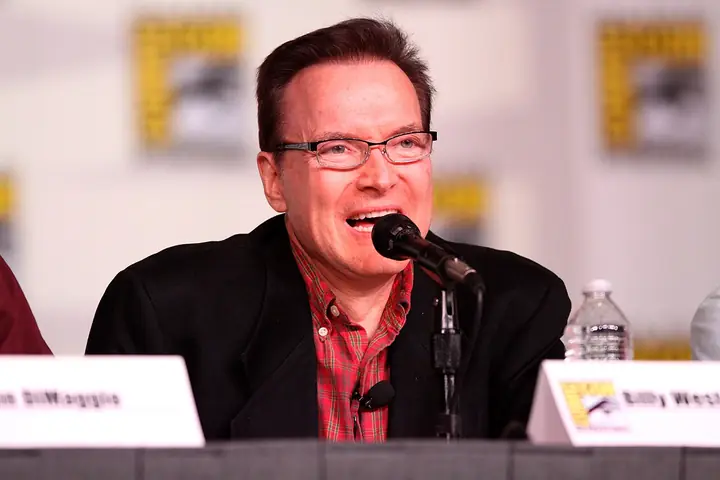
    Futurama (1999) — Billy West
    Futurama (1999): Billy WestImage: Wikimedia Commons · Gage Skidmore from Peoria, AZ, United States of America, CC BY-SA 2.0

    INTERESTING FACTS · SOURCED

  6. #006

    "J" is Matt Groening's favorite middle initial, a tribute to Jay Ward, creator of Rocky and Bullwinkle (Bullwinkle J. Moose) and other classics; hence the "J" in Philip J. Fry, Hubert J. Farnsworth, Cubert J. Farnsworth, Homer J. Simpson, Abraham J. Simpson and Bart J. Simpson.

    INTERESTING FACTS · SOURCED

  7. #007

    Hermes was originally named Dexter and was not Jamaican until his first lines were recorded.

    INTERESTING FACTS · SOURCED

  8. #008

    Professor Hubert J. Farnsworth was named after Philo T. Farnsworth, one of the pioneers of television, whose invention was first demonstrated at the 1939 New York World's Fair alongside the Futurama exhibit.

    INTERESTING FACTS · SOURCED

  9. #009

    Bender's first words are "bite my shiny metal ass."

    INTERESTING FACTS · SOURCED

  10. #010

    Bender's antenna has been used as: an antenna, a timer button for his internal digital camera, a beer tap handle, a mailbox flag, a measure of his manhood, a popcorn butter dispenser handle, a lighter, a pager vibrator, a toilet flush handle, a cooking timer, an alarm clock snooze button (accidentally, by Fry), a voicemail alert light, a voicemail "delete all" button, a "little bender," a beer brewing lid, a binary time machine activator, a motor oil suntan lotion dispenser, a soundtrack dispenser button and a laser rock show.

    INTERESTING FACTS · SOURCED

  11. #011

    The character Cubert (the Professor's clone) was originally conceived as someone who would point out all the series' inconsistencies and plot holes. The idea was for him to be the voice of obsessive fans who pay too much attention to detail. Unfortunately, the writers could not find a way to introduce him until the second season, and apart from his first episode, he never took on the role originally intended for him.

    INTERESTING FACTS · SOURCED

  12. #012

    Matt Groening modeled Bender's appearance on the robot Necron 99/Peace from Ralph Bakshi's post-apocalyptic fantasy film Wizards (1977).

    INTERESTING FACTS · SOURCED

  13. #013

    While creating the character Zoidberg, Billy West drew inspiration from Lou Jacobi's performance in The Diary of Anne Frank (1959). Because of Zoidberg's surname, he imagined the character as having Yiddish mannerisms. He also said the idea of a poor doctor appealed to him.

    INTERESTING FACTS · SOURCED

  14. #014

    Some of the series' sound effects were taken from other science fiction television series such as The Jetsons (1962) and Star Trek (1966).

    INTERESTING FACTS · SOURCED

  15. #015

    Characters such as Professor Wernstrom, who were meant to appear only once, were brought back because the writers liked them so much.

    INTERESTING FACTS · SOURCED

  16. #016

    By the year 3000, owls had replaced rats and pigeons as the most visible animal pest. The reason was never fully explained, but it is based on logic. The series' creators suggested that between the years 2000 and 3000, as New York City's rat and pigeon problem spiraled out of control, large numbers of owls (the natural predator of rats and pigeons) were brought in to help keep the population in check. Although they succeeded, the owls soon took their prey's place as the city's most prolific animal nuisance. As a result, anywhere in the series where you would expect to see rats, mice, pigeons or other common scavenger animals, owls are usually found instead.

    INTERESTING FACTS · SOURCED

  17. #017

    Every one of Mayor Poopenmeyer's speeches contains the words "and so," and they usually begin with those words.

    INTERESTING FACTS · SOURCED

  18. #018

    The hieroglyphs in the opening titles read: "Tasty Human Burgers." There are two more examples of this alphabet (one on the left a few frames after the ship passes R, and another while it turns quickly to the right).

    INTERESTING FACTS · SOURCED

  19. #019

    Matt Groening said the idea for the series came to him while listening to The Incredible String Band's song "Robot Blues."

    INTERESTING FACTS · SOURCED

Production Story (8)

  1. #020

    Matt Groening said that he and David X. Cohen went "overboard" in their discussions, and he called the effort to get Futurama on the air "by far the worst experience of my grown-up life".

    PRODUCTION STORY · SOURCED

  2. #021

    Fox ordered thirteen episodes of Futurama, but immediately afterward the network feared the show's themes were unsuitable and argued with Matt Groening over whether it would have creative input.

    PRODUCTION STORY · SOURCED

  3. #022

    The Futurama episode "I, Roommate" was written to Fox's specifications to address the network's concerns; Fox strongly disliked it, but after negotiations Groening received the same independence he had on Futurama.

    PRODUCTION STORY · SOURCED

  4. #023

    Other titles considered for Futurama included Aloha, Mars! and Doomsville; Matt Groening notes that these were "resoundly rejected, by everyone concerned with it".

    PRODUCTION STORY · SOURCED

  5. #024

    Nibbler's shadow can be seen in some versions of the pilot episode just before Fry falls into the cryogenic tube. Later in the series, it was revealed that Nibbler was in fact the one who pushed Fry into the cryogenic tube.

    PRODUCTION STORY · SOURCED

  6. #025

    According to Matt Groening, viewers were sometimes able to decipher the alien language seen in the background on the night the pilot episode aired. The only starting point for the code in that episode was a sign reading "Drink Slurm." The sign appeared once with the word "Drink" written in the alien code and once in plain English. This led the producers to create a second, more complex alien code to be seen in the background of later episodes.

    PRODUCTION STORY · SOURCED

  7. #026

    After Fox said it should not be used, Matt Groening bought the rights to use the "30th Century Fox" logo. A few months later, Fox said they liked it.

    PRODUCTION STORY · SOURCED

  8. #027

    Leela's costume choice draws inspiration from popular female heroes of well-known science fiction films. Starting with the pilot episode, she takes off her jacket to reveal the white sleeveless top underneath. The look is believed to originate from Sigourney Weaver in Alien (1979) and was copied by Linda Hamilton in Terminator 2: Judgment Day (1991) and by Carrie-Anne Moss in Red Planet (2000).

    PRODUCTION STORY · SOURCED

Behind the Scenes (3)

  1. #028

    Matt Groening said that when Fox tried to give him notes on Futurama, he insisted on working the same way he had on The Simpsons, and that this was the only way he did business.

    BEHIND THE SCENES · SOURCED

  2. #029

    For Futurama, CGI was rendered at 24 frames per second while hand-drawn animation was often done at 12 frames per second, and the absence of artifacts gave the animation a smooth, fluid look.

    BEHIND THE SCENES · SOURCED

  3. #030

    Futurama's CGI characters appeared slightly different because hand-drawn characters were spatially "cheated" through slight out-of-proportion or off-perspective features that emphasized facial and bodily traits and improved expression legibility; PowerAnimator and Maya were used for the comic-like CGI, while Toonz handled digital ink and paint and compositing.

    BEHIND THE SCENES · SOURCED

Characters & Cast (6)

  1. #031

    Billy West auditioned for "just about every part" on Futurama and won the roles of Professor Farnsworth and Doctor Zoidberg. He also read for Fry, but his friend Charlie Schlatter was initially cast in that role; a casting change brought West back to audition, and he was then given the part.

    CHARACTERS & CAST · SOURCED

  2. #032

    According to Billy West, the voice of Fry was deliberately modeled on his own so that another performer would find it difficult to replicate. West based Doctor Zoidberg's voice on Lou Jacobi and George Jessel.

    CHARACTERS & CAST · SOURCED

  3. #033

    Zapp Brannigan was originally created for Phil Hartman, who insisted on auditioning and, according to Matt Groening, "just nailed it"; after Hartman's death, Billy West took the role. West said his version of Zapp Brannigan imitated Hartman and was also modeled after big dumb announcers he knew.

    CHARACTERS & CAST · SOURCED

  4. #034

    In a June 2010 interview, Katey Sagal said she did not learn until many years after Futurama began that another person had originally been set to voice Leela.

    CHARACTERS & CAST · SOURCED

  5. #035

    Bender was the most difficult character to cast in Futurama, because the show's creators had not decided what a robot should sound like.

    CHARACTERS & CAST · SOURCED

  6. #036

    John Goodman was intended to reprise Robot Santa after "Xmas Story" but could not due to scheduling problems, so John DiMaggio took over the role starting with "A Tale of Two Santas"; in that same episode, Dan Castellaneta was unable to reprise the Robot Devil due to his work on The Simpsons, and Maurice LaMarche took over that role for that episode only.

    CHARACTERS & CAST · SOURCED

Related pages

Sources & editorial notes

Reference databases

  • Wikipedia English Wikipedia article
  • IMDb IMDb title page (trivia)

Sources for the entries on this page

  1. Wikipedia Futurama — WikipediaEncyclopedia · accessed 17 Sep 2026
  2. Wikipedia Vikipedi (TR)Database · accessed 20 Sep 2026

Information from external sources is independently selected, consolidated and edited by Arka Evren. Sources are listed for verification and further reading. Encyclopedia text is used under its licence (CC BY-SA). How we work