

TV SERIES · 2007–2015 · USA
Mad Men
- Created by
- Matthew Weiner
- Network
- AMC
- Seasons
- 7
- Episodes
- 92
- Studio
- RadicalMedia, Weiner Bros., Lionsgate Television
242 archived facts 8 topics 1 source Last reviewed Nov 2026
Set in 1960-1970 New York, this sexy, stylized and provocative drama follows the lives of the ruthlessly competitive men and women of Madison Avenue advertising.

242 Interesting Facts About Mad Men
Interesting Facts (24)
- #001
- #002
McCann Erickson, an agency that is mentioned by name over the course of the series and then plays a large role in the ongoing plot during the final two seasons, is an actual advertising agency. The company as it still exists (as of 2015) was formed in 1930 from the merger of the Erickson Company and the H. K. McCann Company. The agency's website states that they operate "180 offices in more than 120 countries."
- #003
In June 2016, after he was already the Republican Party's presumptive presidential nominee, Donald J. Trump's campaign filed its monthly Federal Election Commission financial disclosure report for May. The report, which was nearly 1700 pages long, showed that the campaign had made four payments (adding up to $35,000.00) to a New Hampshire company for "web advertising"; the name provided on the FEC report for this company was "Draper Sterling." An investigation by Judd Legum at the website Think Progress found a money trail leading to strong evidence that this entity was not an actual company, but rather just a front for Trump field operatives--in other words, a way for the Trump Campaign to funnel money to itself. Think Progress also clarified, "Draper and Sterling, of course, are the fictional names of the two lead characters in Mad Men, the hit AMC show about advertising."
- #004
Clips from and references to the movie and the song Bye Bye Birdie (1963) pervade much of the third season. It had already been established in previous seasons that Don's affectionate pet name for Betty is "Birdy;" since the third season ends with Betty flying to Reno to divorce Don, the prominence of the song is the showrunner's nod to the fact that the third season is the one in which Don must literally say "bye bye" to his wife, "Birdy."
- #005
Stan and Peggy initially weren't supposed to end up together but Jay Ferguson (Stan) rooted for them from the beginning, despite being told by Weiner that it would never happen. To help change the writers minds, Ferguson stated that he would often make Stan give little looks or longing glances at Peggy "just in case". The tactic worked and the writers slowly began to go along with it until Weiner agreed.
- #006
- #007
- #008
During a 2013 interview in the New York Times Magazine, the interviewer, Andrew Goldman, asked Elisabeth Moss (who plays Peggy) if she thought the Don-Peggy relationship would "ever be consummated, given the obvious sexual tension between them." Moss's reply was, "I hope not. Anyone who sleeps with Don does not have a long road ahead of them. It's like the kiss of death to sleep with Don. I really think it would be jumping the shark to do that."
- #009
During an April 2018 interview with Jon Hamm on National Public Radio, journalist Scott Simon asked Hamm what he thought happened to Don Draper after the end of the final episode of Mad Men. Hamm's response was: "I think he got up after he meditated, and he got in a car and on a plane the next day to New York City and came back and pitched that idea. I think Don's revelatory moment was that he's an ad man. Do I hope that he continued down the spiritual journey that he kind of went down the last few episodes of the show? Sure. I always rooted for Don. You know, Don was a very damaged soul, and I just think he needed a lot more help with accessing that part of him."
- #010
- #011
Contains a major spoiler — show
In the show, Henry Francis, an advisor to Nelson Rockefeller, convinces Betty to leave Don so she can marry him. In real life Rockefeller did that himself when he convinced Margaretta Murphy, mother of four, to leave her husband, James Murphy. Margaretta married Rockefeller a month after she left her husband.
- #012
- #013
Most of the Sterling Cooper office sets have visible ceilings, which is unusual for television; typically, permanent overhead lighting rigs are used so the crew can quickly change lighting setups for different scenes. The visible ceilings made the sets look more realistic, but they also meant more work for the crew, who had to constantly reposition lights and furniture for different camera setups.
- #014
- #015
- #016
- #017
The role of Robert "Bobby" Draper was played by four different child actors over the course of the series. Bobby was first played by Maxwell Huckabee; toward the end of the first season, Huckabee was replaced by Aaron Hart; at the start of the third season, Hart was replaced by Jared Gilmore; and from the fifth season on, Gilmore was replaced by Mason Vale Cotton. It is particularly notable that Hart became the youngest actor to win a SAG Award (which he won for the role of Bobby Draper). By contrast, Draper's eldest child, Sally, was played by the same actress, Kiernan Shipka, from the beginning of the series. Shipka was six years old when the first "Mad Men" episode aired.
- #018
- #019
- #020
When Don Draper wore sunglasses in season 3, the frames became one of the most sought-after items of the holiday season and sparked a heated debate over whether they were made by Randolph Engineering or American Optical, since both companies produced nearly identical frames. Many men's fashion magazines such as GQ named Randolph Engineering as the maker because of the company's positive reputation in the fashion industry, and criticized viewers who bought the relatively cheap American Optical frames (produced for the US Army) as "cheapskates." However, Randolph Engineering did not begin producing its square aviator until the 1970s; given the series' period authenticity and Matthew Weiner's commitment to historical accuracy, this means Don's frames were in fact the American Optical Aviator, produced in the 1960s.
- #021
- #022
The character Ken Cosgrove was probably based in part on novelist/poet James Dickey, who worked in advertising in the 1960s while publishing poems in The New Yorker and other leading magazines. He also has a great deal in common with screenwriter/novelist Herman Raucher, who staged plays on Broadway while working as an advertising executive. Raucher left advertising when the success of his novel and his screenplay for Summer of 42 made him a millionaire.
- #023
- #024
Like most American showrunners, Matthew Weiner rewrote every script of the series to some degree. When deciding whether to add his name, he applied the following system: by his own estimate, if more than 20% of the original writer's work remained in the final shooting script, that person would be the sole credited writer. By the end of the series' run, only 18 of its 92 episodes did not credit Weiner at all.
Production Story (84)
- #025
- #026
January Jones auditioned twice for the role of Peggy Olson before Matthew Weiner asked her to read for the part of Betty Draper instead, despite the fact that at that point the character was barely in the pilot and he had no plans of fleshing her out.
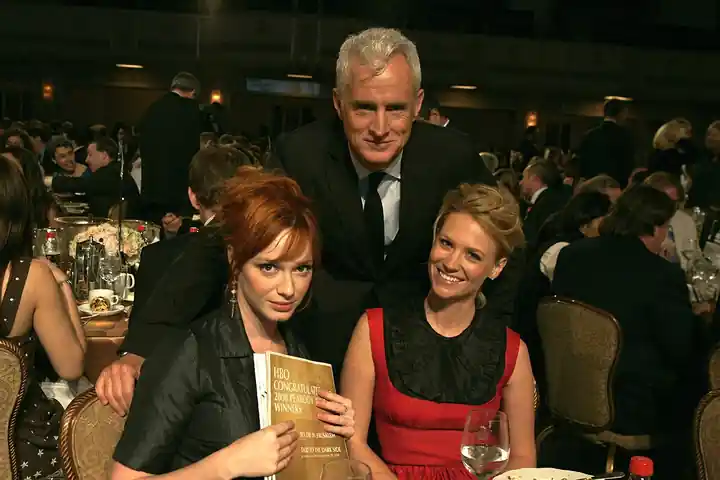
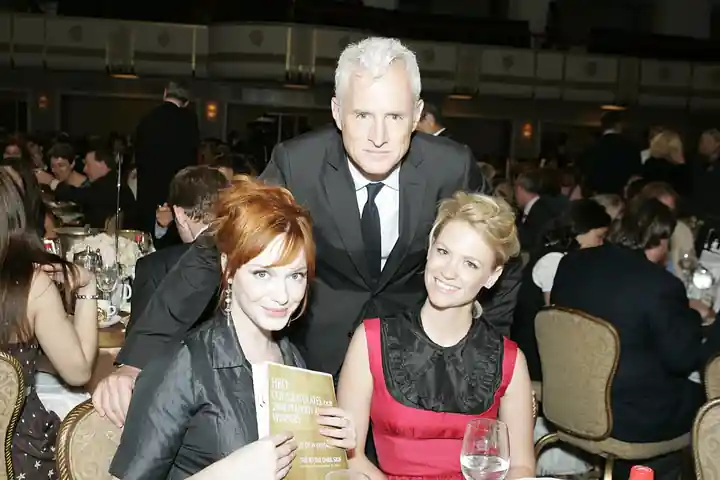
Mad Men (2007): Christina Hendricks, John Slattery and January Jones at a partyImage: Wikimedia Commons · Peabody Awards, CC BY 2.0 - #027
- #028
- #029
According to Jon Hamm, actor Thomas Jane was originally sought for the role of Don Draper but the AMC team were informed that Jane "doesn't do television". Ironically, Jane later went on to star in the HBO series Hung (2009).
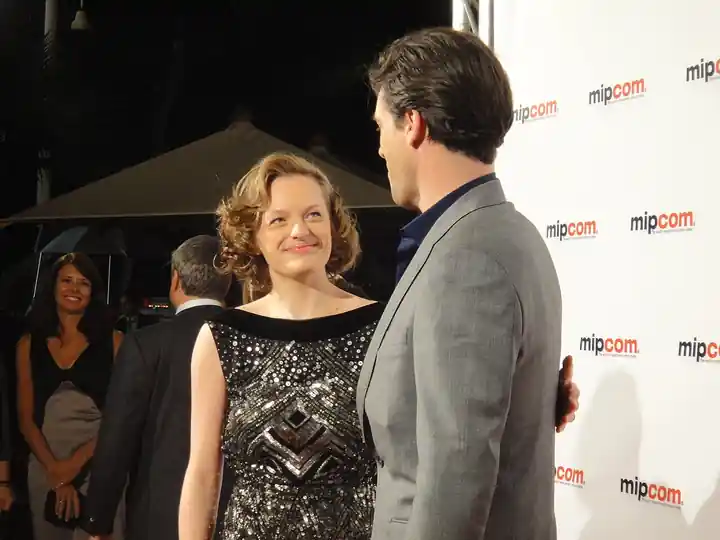
Mad Men (2007): Elisabeth Moss and Jon Hamm together at an eventImage: Wikimedia Commons · Angela Natividad, CC BY-SA 2.0 - #030
Very unusual on a TV-show, almost no information is provided for the press during the shooting. This includes casting or storylines. The main cast is not allowed to talk about it and any guest actor signs a contract not to tell anybody he/she is working on the show. Matthew Weiner and his team oversee and decide how the information is given and how it is released.
- #031
Like most American showrunners, Matthew Weiner rewrote every single script for the show, to some extent. When deciding on whether to add his name or not, he came up with the following system: if, by his estimation, more than 20% of the original writer's work remained in the final shooting script, that person would be the sole credited writer. At the end of the show's run, only 18 out of 92 episodes were not credited to Weiner at all.
- #032
- #033
- #034
- #035
- #036
- #037
- #038
In addition to having created the series, Matthew Weiner was the show runner, head writer, and an executive producer; he contributed to each episode-writing or co-writing the scripts, casting various roles, and approving costume and set designs. He was notorious for being selective about all aspects of the series, and promoted a high level of secrecy around production details.
- #039
At the end of almost all episodes, the show either fades to black or smash cuts to black as period music, or a theme by series composer David Carbonara, plays during the ending credits; at least one episode ends with silence or ambient sounds. A few episodes have ended with more recent popular music, or with a diegetic song dissolving into the credits music. The Beatles authorised the use of "Tomorrow Never Knows" for the Season 5 episode "Lady Lazarus (2012)", and the same track was used over the closing credits. It marked a rare instance where the band licensed its music for a television series. Lionsgate, which produces Mad Men, paid $250,000 for the use of the song in the episode. Bob Dylan's "Don't Think Twice It's All Right" ended the last episode of Season 1.
- #040
- #041
Matthew Weiner shot the pilot on the hiatus between the two parts of season 6 of The Sopranos (1999), and he used a lot of the crew from the HBO show to do it. David Chase agreed to help him in what he could, but making sure that Weiner would come back to write the last episodes of The Sopranos (1999).
- #042
- #043
- #044
Shortly before the show premiered, Matthew Weiner got worried when he heard the news that an adaptation of Richard Yates's Revolutionary Road was going to be shot. The novel and the show share some important thematic, plot, and setting elements, and Weiner feared that everyone would complain about him copying Yates's traits. The irony was that when Revolutionary Road (2008) premiered in 2008, Mad Men (2007) had already aired two seasons, so people actually accused Sam Mendes's movie of looking too much like Mad Men (2007).
- #045
Although produced and shot in one piece, AMC decided for promotional reasons to split the final season in two parts. The first half will contain seven episodes and will be titled "The Beginning". After a several month long break the season will resume with the second half, titled "The End of an Era".
- #046
- #047
The writers, including Matthew Weiner, amassed volumes of research on the period in which Mad Men takes place so as to make most aspects of the series-including detailed set design, costume design, and props-historically accurate, producing an authentic visual style that garnered critical praise.
- #048
- #049
- #050
- #051
- #052
Contains a major spoiler — show
According to TV Guide, Bryan Batt (Sal) knew that Sal would eventually have a sex scene with a hotel bellhop before filming for the pilot episode started; show creator Matthew Weiner took Batt aside and explained the storyline during the very first makeup test for the show. However, the scene did not actually appear in the series until the third season's first episode.
- #053
Contains a major spoiler — show
Season 1 opens in March 1960 and finishes Thanksgiving Day, 24th November 1960. Season 2 picks up on Valentine's Day, 14th February 1962 and ends in October 1962 with the peaceful resolution of the Cuban missile crisis. Season 3 starts somewhere during Spring 1963 with Betty Draper (January Jones) being approximately six months pregnant and ends on the evening of 16th December 1963. Season 4 begins around Thanksgiving in November 1964 and ends in October 1965. Season 5 begins on Memorial Day weekend in May 1966 and ends in March 1967. Season 6 begins at Christmastime in December 1967 and ends on Thanksgiving Day, 28th November 1968. Season 7 begins in January 1969, around the inauguration of President Richard Nixon and ends mid-season on the morning of 22nd July 1969, two days after the successful moon landing of Apollo 11. The second half of season 7 jumps to 1970 with the final episode playing in October 1970.
- #054
Contains a major spoiler — show
During a March 2015 interview with Matt Zoller Seitz, Matthew Weiner got a question from the audience about why Weiner chose the name "Whitman" as Don's birth name (specifically, whether it was a reference to the poet Walt Whitman). Weiner said that the choice of Whitman had nothing to do with Walt Whitman; rather, it was meant to be a contraction of "white man."
- #055
- #056
- #057
- #058
- #059
- #060
- #061
The actors do not smoke real cigarettes. They use Ecstasy brand herbal cigarettes, which contain no tobacco or nicotine. In an article in The New York Times, series creator Matthew Weiner said, "You don't want actors smoking real cigarettes. They get agitated and nervous. I've been on sets where people throw up because they've smoked so much." When Jon Hamm was asked what the herbal cigarettes are like, he told Vulture, "They're terrible. They taste like a mixture of marijuana and soap."
- #062
In 2012, costume designer Janie Bryant told Slate that in the first episode of every season, Peggy repeats one of her costumes from the previous season. Bryant said she "loved" this tradition because "I think it's really based in reality. It's what we do in real life: we repeat our clothes."
- #063
Most of the Sterling Cooper office sets have visible ceilings, which is unusual for television. Usually there are fixed lighting rigs overhead, which allows the crew to change lighting setups quickly for different scenes. Having the ceilings visible made the sets look more realistic. But it created more work, since the crew had to constantly reposition lights and furniture for different camera angles.
- #064
- #065
According to an article in Esquire in October 2013, one of makeup artist Lana Horochowski's responsibilities was making sure Jon Hamm was always clean-shaven. Hamm's facial hair grew extraordinarily fast, and on long shooting days his beard would grow back enough to be visible on camera. It was not unusual for Horochowski to shave Hamm three times in a single shooting day. After this disclosure, dermatologist Dr. Peter Hino warned viewers not to imitate Hamm by shaving more than once a day, because it could irritate or damage the skin of a man with an average beard growth rate.
- #066
Mad Men, famous for its precision, was so meticulous that even the time of day in which the story took place was planned. For example, the makeup department was instructed to add stubble appropriate to Jon Hamm's skin if a scene took place after 5 o'clock. This happens in many dramas; it is not unusual for makeup departments to do this.
- #067
In the show's first season, costume designer Janie Bryant and makeup department head Debbie Zoller developed a detailed, multi-stage makeup and costume process for actress Elisabeth Moss to simulate Peggy's weight gain. Bryant made several body garments in different levels of fullness for Moss to wear under her costumes. Zoller created a four-stage facial prosthesis: first a fairly light piece that enlarged Moss's chin and neck, then gradually larger cheek pieces, slowly creating the impression that she had visibly gained weight. During the shooting of the fifth season, makeup artists repeated this process, this time for actress January Jones in the role of Betty (Draper) Francis. Although Betty's significant weight gain story was initially designed to explain Jones's pregnancy, Jones did not come close to the weight the show's producers had planned for Betty; so makeup artists put Jones in a fat suit and covered her face and neck with prosthetic makeup materials to simulate Betty's weight gain. They also used a larger body double to shoot a scene in which the heavier Betty comes out of the bathroom.
- #068
At the end of almost every episode, as period music or a theme by series composer David Carbonara plays over the credits, the screen either fades to black or cuts abruptly; at least one episode ends with silence or ambient sound. A few episodes have ended with more recent popular music or with a diegetic song turning into the credits music. The Beatles allowed the use of "Tomorrow Never Knows" for the season 5 episode "Lady Lazarus" (2012), and the same track also played over the closing credits. This was a rare instance of the group licensing its music to a television series. Producer Lionsgate paid $250,000 for the use of the song in the episode. Bob Dylan's "Don't Think Twice, It's All Right" ended the season 1 finale.
- #069
The writers, including Matthew Weiner, amassed voluminous research about the period in which Mad Men is set, making most aspects of the show historically accurate, including detailed set design, costume design and props, and thereby producing an original visual style that earned critical praise.
- #070
- #071
- #072
- #073
The pilot episode was shot at Silvercup Studios in New York and at various locations around the city; subsequent episodes were shot at Los Angeles Center Studios. The episode is available in high definition for broadcast on AMC HD and for on-demand video services from various cable affiliates.
- #074
- #075
Stan and Peggy were not initially planned to be together; however, Jay Ferguson (Stan) championed them from the very beginning, even though Weiner said it would never happen. To change the writers' minds, Ferguson noted that he had Stan give Peggy small glances or longing looks "just in case." The tactic worked, and the writers gradually warmed to it, until Weiner agreed.
- #076
- #077
- #078
The role of Robert "Bobby" Draper was played by four different child actors over the course of the series. Bobby was initially played by Maxwell Huckabee; Huckabee was replaced by Aaron Hart at the end of the first season; Hart was replaced by Jared Gilmore at the start of the third season; and Gilmore was replaced by Mason Vale Cotton from the fifth season onward. Notably, Hart became the youngest actor to win a SAG Award (won for playing Bobby Draper). By contrast, the eldest Draper child, Sally, was played by the same actress, Kiernan Shipka, from the beginning of the series. Shipka was six years old when the first "Mad Men" episode aired.
- #079
- #080
In a 2013 interview with New York Times Magazine, interviewer Andrew Goldman asked Elisabeth Moss (who plays Peggy) whether the Don-Peggy relationship would "ever be consummated, given the obvious sexual tension between them." Moss's response was: "I hope not. There's no long road ahead for anyone who sleeps with Don. Sleeping with Don is like a kiss of death. Doing that would really be jumping the shark."
- #081
- #082
- #083
- #084
- #085
- #086
- #087
- #088
In 2008, series creator Matthew Weiner told the Chicago Tribune that Peggy and Pete's son was put up for adoption (as he told Pete) and was not raised by Peggy's sister or mother. He also stated that the audience's belief that the child was raised by Peggy's sister was a deliberate misdirection. In 2013, Weiner expanded on this at the Paley Center: Pete and Peggy's child 'went into the Catholic Church's adoption system... untraceable, you can't find your biological parents. I guess you can now, but it's very hard.' This story was confirmed in the fourth-to-last episode of season 7, 'Time & Life,' when Peggy confesses to Stan that she had a baby and gave it up for an anonymous, closed adoption: 'I'm here and he's with a family. I don't know, but not because I don't care. I don't know because you're not supposed to know, or you can't go on with your life.'
- #089
Shortly before the series aired, Matthew Weiner became worried when he heard the news that Richard Yates' novel Revolutionary Road was being adapted. The novel and the series shared significant thematic, plot and setting elements, and Weiner feared everyone would accuse him of copying Yates' traits. Ironically, when Revolutionary Road (2008) was released in 2008, Mad Men (2007) had already completed two seasons, so people actually said that Sam Mendes' film resembled Mad Men a great deal.
- #090
Unusually for a television series, almost no information is given to the press during filming. This includes the cast or storylines. The main cast is not allowed to talk about it, and guest actors sign contracts to not tell anyone they worked on the series. Matthew Weiner and his team decide how information is given out and spread.
- #091
- #092
- #093
Season 1 begins in March 1960 and ends on Thanksgiving, November 24, 1960. Season 2 begins on Valentine's Day, February 14, 1962, and ends with the peaceful resolution of the Cuban missile crisis in October 1962. Season 3 begins in the spring of 1963, at a time when Betty Draper (January Jones) is about six months pregnant, and ends on the evening of December 16, 1963. Season 4 begins around Thanksgiving in November 1964 and ends in October 1965. Season 5 begins on the Memorial Day weekend in May 1966 and ends in March 1967. Season 6 begins at Christmas time in December 1967 and ends on Thanksgiving, November 28, 1968. Season 7 begins around the inauguration of President Richard Nixon in January 1969 and ends at the midpoint of the season on the morning of July 22, 1969, two days after the successful Apollo 11 Moon landing. The second half of season 7 jumps to 1970, and the finale takes place in October 1970.
- #094
- #095
- #096
In addition to creating the series, Matthew Weiner was showrunner, head writer and executive producer; he contributed to every episode, wrote or co-wrote the scripts, cast various roles and approved the costume and set designs. He was known for being particular about every aspect of the series and maintained a high level of secrecy around production details.
- #097
In 2025, the actress Zosia Mamet, who guest-starred as Joyce Ramsay in seasons 4 and 5, published an essay collection titled 'Does This Make Me Funny?', in which she devoted one essay to her time on this series and to Matthew Weiner's verbal abuse. Without explicitly naming either the series or Weiner, but giving enough information to make it clear who they were, Mamet wrote that she had signed on for several episodes in season 5, but that while shooting her first episode, 'Mystery Date', Weiner shouted and berated her for 30 minutes because he did not like the way she took paper out of an envelope. So devastated by the experience, the actress asked her manager to get her out of her contract for the other episodes, and she never returned to the series.
- #098
Joan eventually names her new independent company "Holloway, Harris". Many viewers wondered where these names came from. When Joan offered Peggy a partnership, she had said their company would be called "Harris, Olson", because "it takes two names to look real." Joan had also told Peggy that she did not want a professional partnership with anyone else. When Peggy turned down the offer, Joan gave the company her own two surnames: Holloway (her maiden name before marriage) and Harris (the surname she took when she married Dr. Greg Harris and continued to use after the divorce). This confirms the fact, implied earlier in the episode, that Joan went into business on her own.
- #099
The series' title sequence pays homage to the skyscraper-filled opening credits graphic designer Saul Bass made for Alfred Hitchcock's 1959 film North by Northwest and to the falling man poster he made for the 1958 film Vertigo. Weiner has cited Hitchcock as a major influence on the series' visual style.
- #100
After the series finale aired, many viewers entered into heated debates about the meaning of the final moments. The majority interpreted it as Don having a moment of happiness and enlightenment during a meditation session, after which the real-life 1971 Coca-Cola ad "Hilltop" plays, meaning that Don realized he was meant to be an ad man, returned to McCann and, drawing on his experience at the meditation retreat, created perhaps the most famous advertisement of the 1970s. Proponents of this theory pointed to several clues, such as Don repairing a Coca-Cola machine in an earlier episode and the physical and sartorial similarities between the other retreat participants and the singers in the ad. However, a significant and vocal minority believed alternative interpretations, such as that the ad was created by Peggy rather than Don, or that the ad did not actually exist in the lives of the Mad Men characters and represented Don's spiritual awakening. These alternative theories were refuted in the days after the finale aired, first by a New York Times interview with Jon Hamm, who played Don Draper, and then by a public conversation showrunner Matthew Weiner had with A. M. Holmes at the New York Public Library. Weiner confirmed that the episode implied Don wrote the Coca-Cola ad: "The idea that some kind of enlightened state could have created something very pure, not just an appropriation, appealed to me... I think it's the best ad ever made, and it comes from a very good place."
- #101
When Don Draper wore sunglasses in season 3, the frames became one of the most sought-after items of the holiday season and sparked a fierce debate over whether they were made by Randolph Engineering or American Optical; both companies produced nearly identical frames. Many men's fashion magazines such as GQ named Randolph Engineering as the manufacturer because of its positive reputation in the fashion industry and criticized viewers who bought American Optical frames (relatively cheap and produced for the US Army) as "cheapskates". However, Randolph Engineering did not begin producing its square aviator sunglasses until the 1970s; given the series' period authenticity and Matthew Weiner's commitment to historical accuracy, Don's frames are in fact the American Optical Aviator, which was in production in the 1960s.
- #102
Clips from and references to the film and song Bye Bye Birdie (1963) appear throughout much of season 3. In earlier seasons it had been established that Don's affectionate nickname for Betty was "Birdy"; since season 3 ended with Betty flying to Reno to divorce Don, the prominence of the song is a nod by the showrunner to the idea that season 3 was the season in which Don literally said "bye bye" to his wife "Birdy".
- #103
McCann Erickson, which is mentioned throughout the series and plays a major role in the storyline that continues through the final two seasons, is a real advertising agency. Still in existence as of 2015, the company was formed in 1930 from the merger of the Erickson Company and the H. K. McCann Company. The agency's website states that it operates with "180 offices in more than 120 countries".
- #104
In an April 2018 interview with Jon Hamm on National Public Radio, journalist Scott Simon asked Hamm what he thought happened to Don Draper after the end of Mad Men's finale. Hamm's response was: "I think he got up after meditating, got in a car and flew to New York City the next day, came back and pitched that idea. I think Don's moment of enlightenment was that he was an ad man. Do I hope he continues on the spiritual journey he embarked on in the last few episodes of the series? Of course. I always rooted for Don. You know, Don was a very wounded soul, and I think he needed a lot more help to get to that part of himself."
- #105
In the season 1 finale, Peggy giving birth without knowing she was pregnant and denying her condition was met with confusion (and a little disbelief) by some viewers. Viewers who believed this was impossible may not be aware that "pregnancy denial syndrome" is a rare but very real mental condition in which a woman cannot psychologically accept an unwanted pregnancy for a personal reason. There are also real cases of women who do not have this mental condition and do not regard the pregnancy as unwanted, yet still fail to notice that they are pregnant (in fact, the reality series "I Didn't Know I Was Pregnant", which began airing on TLC in 2008, shows that this is common enough). In these cases, women generally assume they cannot be pregnant because of widely circulated misinformation about the symptoms of pregnancy: although girls are usually taught that menstruation definitely stops during pregnancy, this is not always true - some women continue to bleed throughout their pregnancies. Conversely, some women initially have very irregular periods, so not menstruating for several months in a row may not seem strange to them or appear to be a sign of pregnancy. In Peggy's story, Peggy also had a strong practical reason to believe she could not be pregnant: she had started taking the birth control pill before having sex with Pete. At the time, she did not understand that the pill takes a month to become effective, because the doctor she went to did not explain this to her even though it was his responsibility to do so. Peggy had been raised in a strict Catholic home (Catholicism was stricter about birth control then than it is now), so it is unlikely that she would have gotten the correct information the doctor failed to give her from her sister, her mother or her Catholic school education.
- #106
In the season 6 episode "The Better Half" (2013), Megan wears a white T-shirt (along with white panties) with a large, red, five-pointed star on it. This outfit is identical to the one worn by model and actress Sharon Tate in a 1967 photo shoot for Esquire Magazine (though Tate was also submerged in water and holding a bow and arrow). The shoot's photographer's daughter recognized the outfit and tweeted Mad Men costume designer Janie Bryant to ask whether Tate's photo had inspired Megan's costume; Bryant said it was "not a coincidence"; Bryant had been instructed by showrunner Matthew Weiner to put a "political T-shirt" on Megan, and Bryant thought Tate's T-shirt worked as a subtle stance against the Vietnam War (the red star was a widely recognized symbol of North Vietnam and of Communist regimes in general). Two years after the Esquire photo shoot, Sharon Tate was killed by the Manson Family, so the reference (along with other perceived similarities between Tate's life and Megan's story) led some viewers to theorize that Megan might soon meet a similar fate. However, in an interview at the January 2015 Television Critics Association press tour, Weiner rejected this theory: "The Sharon Tate thing, you know, is very tenuous and thin and also 'Wow, that's too much of a coincidence.' I don't know what to tell you. I would like people to know that I strive for historical accuracy so much that I would not add a person who was not killed by the Manson family to that murder. So that's the dumbest argument in the world to me. But I love that people have conspiracy theories, have all these other things, and I don't know what to tell you."
- #107
In a March 2015 interview with Matt Zoller Seitz, Matthew Weiner was asked why he chose "Whitman" as Don's birth name (specifically, whether it was a nod to the poet Walt Whitman). Weiner said the choice of Whitman had nothing to do with Walt Whitman; it was a shortening of the words "white man."
- #108
The small, ball-shaped glasses that Draper and his colleagues frequently use are a design that has been known as "roly poly" glasses since at least the 1950s. The metal band around the rim, an innovative accent introduced by the artist Dorothy Carpenter Thorpe, made the design even more popular (and widely imitated) in the 1960s and beyond. These glass sets were ideal business gifts, since bands made of silver, chrome, platinum and even gold could be custom-stenciled with initials, company logos or other work-related graphics. Draper's glasses appear to have platinum bands.
Behind the Scenes (34)
- #109
Jon Hamm confirmed that the beverages consumed on the show are non-alcoholic, pointing out that the shooting schedule is actually very hectic and that he would never drink during the day either on or off camera.
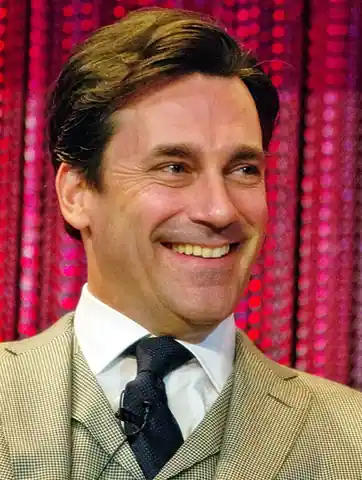
Mad Men (2007): Jon Hamm in a suit and smilingImage: Wikimedia Commons · Dominick D, CC BY-SA 2.0 - #110
- #111
In 2012, costume designer Janie Bryant told Slate magazine that she always repeats one of Peggy's costumes from the previous season during the next season's premiere. Bryant said that she "loves" that tradition for Peggy because "I think that this all is really based in reality. That's what we would do in real life: We repeat our clothes."
- #112
The pilot episode was shot at Silvercup Studios in New York City and various locations around the city; subsequent episodes were filmed at Los Angeles Center Studios. It is available in high definition for showing on AMC HD and on video-on-demand services available from various cable affiliates.
- #113
According to an October 2013 article in Esquire Magazine, one of makeup artist Lana Horochowski's responsibilities was to make sure that Jon Hamm was clean shaven at all times. Hamm's facial hair grows exceptionally fast, and, during long shooting days, it would regrow to the point that stubble would become visible on camera. It wasn't unusual for Horochowski to have to shave Hamm three times during the course of one day of filming. In response to this revelation, Dr. Peter Hino, a dermatologist, cautioned viewers not to try shaving multiple times a day in emulation of Hamm, as it could prove irritating/damaging to the skin of a man with an average rate of beard growth.
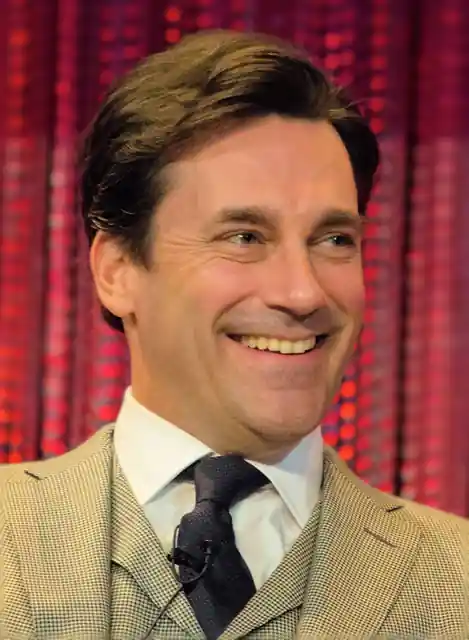
Mad Men (2007): Jon Hamm in a suit smilingImage: Wikimedia Commons · Dominick D, CC BY-SA 2.0 - #114
Most of the sets for the Sterling Cooper offices have visible ceilings, which is unusual for television. Typically there are permanent lighting rigs overhead, which allow the crew to quickly change lighting set ups for different scenes. Having the ceilings visible made the sets appear more realistic. But it also made more work for the crew, who were constantly having to reposition lights and furniture for different camera set ups.
- #115
In 2025, actress Zosia Mamet, who guest starred on seasons 4 and 5 as Joyce Ramsay, published an essay book called 'Does This Make Me Funny?' in which she dedicated one essay to her time on this show and the verbal abused she endured by Matthew Weiner. Without naming explicitly neither the show nor Weiner, but giving enough information to know it's them, Mamet wrote how she was contracted for several episodes in season 5 but how when shooting her first one, 'Mystery Date', Weiner screamed and berated her for 30 minutes for not liking how she took a paper out of an envelope. The actress was so crushed after the experience that she asked her agent to get her out of her contract for the other episodes, and she never returned to the show.
- #116
- #117
According to Jon Hamm, the production's pursuit of historical accuracy is such that series researchers will insist on knowing weather conditions, news items, and popular culture for a particular period related to the script's time frame.
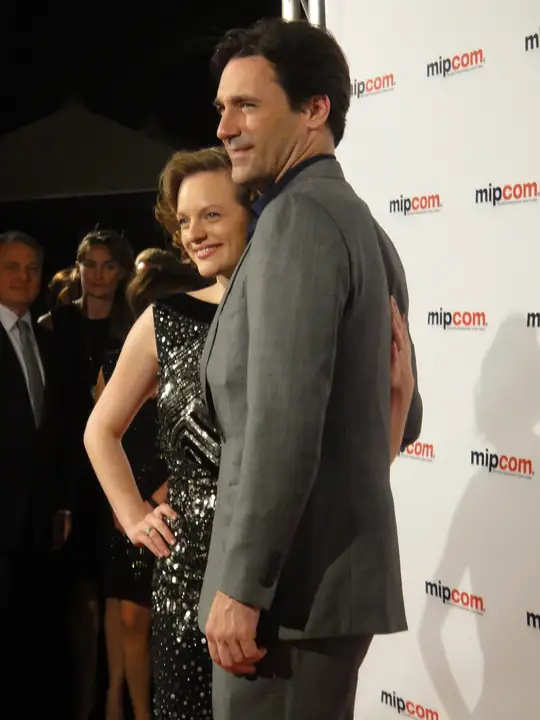
Mad Men (2007): Elisabeth Moss and Jon Hamm at the mipcom eventImage: Wikimedia Commons · Angela Natividad, CC BY-SA 2.0 - #118
Notorious for its specificity, Mad Men was actually so meticulous that it was planned down to the hour when it was taking place. For example, the makeup department was instructed to adjust Jon Hamm's skin with appropriate facial hair if the scene was taking place after 5 to resemble Draper's 5 O'clock shadow. This happens on many dramas. It's not unusual for make up departments to do this.
- #119
When Don Draper appeared wearing sunglasses in season 3, the frames became one of the most sought-after items of the holiday season, sparking an intense debate as to whether they were made by Randolph Engineering or American Optical, as both companies manufactured a nearly identical frame. Many mens' fashion magazines, such as GQ, cited Randolph Engineering as the manufacturer, due to the company's positive reputation in the fashion industry, and criticized viewers who purchased American Optical frames (which are relatively inexpensive and manufactured for the US Military) as "cheapskates." However, Randolph Engineering did not begin manufacturing their square aviator until the 1970s; given the show's period authenticity and Matthew Weiner's devotion to historical accuracy, this means that Don's frames are, in fact, the American Optical Aviator, which was in manufacture during the 1960s.
- #120
The actors do not smoke real cigarettes. They smoke Ecstacy herbal cigarettes, which are tobacco and nicotine free. Show creator Matthew Weiner said in a New York Times article, "You don't want actors smoking real cigarettes. They get agitated and nervous. I've been on sets where people throw up, they've smoked so much." When asked what it's like to smoke herbal cigarettes, Jon Hamm (who plays Don Draper) told Vulture, "Terrible. They taste like a mixture between pot and soap."
- #121
The little ball-shaped glasses often used by Draper and colleagues are a design known since at least the 1950s as "roly poly" tumblers. The band of metal plating along the rim, an innovative accent introduced by artist Dorothy Carpenter Thorpe, made the design even more popular (and much-copied) through the 1960s and beyond. Sets of these made ideal business gifts, as the bands (made of silver, chrome, platinum, or even gold) could be custom-stenciled with initials, company logos or other business-related graphics. Draper's glasses appear to have platinum bands.
- #122
After the final episode of the series aired, many viewers engaged in fierce debate about the meaning of the episode's final moments. Most interpreted the very ending (in which Don seems to experience a moment of happiness and revelation during a meditation session, and then the real-life 1971 Coca-Cola commercial "Hilltop" plays) to mean that Don realized he was meant to be an adman all along, returned to McCann, and created perhaps the most famous ad of the 1970s based on his experience at the meditation retreat. Proponents of this theory noticed several clues that indicated it, including the fact that Don fixes a Coke machine in a previous episode and also the strong physical and sartorial similarities between many of the other attendees at the retreat and the singers in the ad. However, a significant and vocal minority of viewers and critics believed in other interpretations, including the possibility that Peggy, not Don, created the ad or that the ad did not literally "exist" in the Mad Men characters' lives and instead represented Don's spiritual awakening. These alternate theories were debunked in the days after the last episode aired - first by Jon Hamm (the actor who played Don Draper) in a New York Times interview and then by showrunner Matthew Weiner himself in a public conversation with A. M. Holmes at the New York Public Library. Weiner confirmed that the episode was meant to imply that Don wrote the Coke ad: "The idea that some enlightened state, and not just co-option, might've created something that is very pure [appealed to Weiner].... To me, it's the best ad ever made, and it comes from a very good place."
- #123
Contains a major spoiler — show
During the show's first season, an elaborate, multi-stage makeup and costuming process was developed by costume designer Janie Bryant and makeup department head Debbie Zoller for actress Elisabeth Moss to simulate Peggy's weight gain. Bryant created several body suits with different levels of padding for Moss to wear under her costumes. Zoller made four stages of facial prosthetics, starting with a fairly subtle piece to augment Moss's chin and neck, and then added increasing cheek pieces to create the illusion that she was slowly becoming significantly heavier. During the filming of the fifth season, the makeup artists repeated the process--this time for January Jones, the actress who plays Betty (Draper) Francis. Although the storyline in which Betty gained a great deal of weight was initially contrived in anticipation of having to explain Jones's pregnancy, Jones didn't gain anything close to the amount of weight that the showrunners intended for Betty to gain, so the makeup artists dressed Jones in a fat suit and covered her face and neck in prosthetic makeup appliances to simulate Betty's weight gain. They also employed a larger body double to film a scene in which heavier Betty gets out of the bath.
- #124
- #125
According to an article published in Esquire Magazine in October 2013, one of makeup artist Lana Horochowski's responsibilities was making sure Jon Hamm was always clean-shaven. Hamm's beard grows extremely quickly, and on long shooting days it grew back enough to become visible on camera. It was not unusual for Horochowski to have to shave Hamm three times during a single day's filming. In response to this account, dermatologist Dr. Peter Hino warned viewers not to try shaving more than once a day in imitation of Hamm, since doing so could irritate or damage the skin of a man with average beard growth.
- #126
In a highly unusual situation for a TV program, almost no information is given to the press during production. This includes casting and storylines. The main cast is not allowed to talk about it, and guest actors sign a contract agreeing not to tell anyone they are working on the series. Matthew Weiner and his team control and decide how information is given out and how it is published.
- #127
- #128
The actors do not smoke real cigarettes. They use Ecstasy brand herbal cigarettes, which contain no tobacco or nicotine. In an article in The New York Times, series creator Matthew Weiner said, "You don't want actors smoking real cigarettes. They get agitated and nervous. I've been on sets where people throw up because they've smoked so much." When Jon Hamm was asked how the herbal cigarettes were, he told Vulture, "They're terrible. They taste like a mixture of marijuana and soap."
- #129
In 2012, costume designer Janie Bryant told Slate magazine that in the first episode of every season, Peggy repeats one of her costumes from the previous season. Bryant said she "loved" this tradition because "I think it's really based in reality. It's what we do in real life: we repeat our clothes."
- #130
In most of the Sterling Cooper office sets, the ceilings are visible, which is unusual for television. Usually there is fixed lighting equipment overhead, which allows the crew to change lighting setups quickly for different scenes. Having the ceilings visible made the sets look more realistic. However, it created more work, since the crew had to constantly reposition lights and furniture for different camera angles.
- #131
- #132
According to an article in Esquire magazine in October 2013, one of makeup artist Lana Horochowski's responsibilities was making sure Jon Hamm was always clean-shaven. Hamm's facial hair grew extraordinarily fast, and on long shooting days his beard would grow back enough to be visible on camera. It was not unusual for Horochowski to shave Hamm three times in a single shooting day. After this statement, dermatologist Dr. Peter Hino warned viewers not to imitate Hamm by shaving more than once a day, because it could irritate or damage the skin of a man with an average beard growth rate.
- #133
Mad Men, famous for its precision, was so meticulous that even the time of day in which the story took place was planned. For example, the makeup department was instructed to add a beard suited to Jon Hamm's skin if a scene took place after 5 o'clock. This happens in many dramas; it is not unusual for makeup departments to do this.
- #134
In the show's first season, costume designer Janie Bryant and makeup department head Debbie Zoller developed an elaborate, multi-stage makeup and costume process for actress Elisabeth Moss to simulate Peggy's weight gain. Bryant made several body garments in different levels of fullness for Moss to wear under her costumes. Zoller, meanwhile, made a four-stage facial prosthesis: first a very light piece that enlarged Moss's chin and neck, then gradually larger cheek pieces, slowly creating the impression that she had visibly gained weight. During the shooting of the fifth season, makeup artists repeated this process, this time for actress January Jones in the role of Betty (Draper) Francis. Although the story of Betty gaining a lot of weight was initially designed to explain Jones's pregnancy, Jones did not come close to the weight the show's producers had planned for Betty; so makeup artists put Jones in a fat suit and covered her face and neck with prosthetic makeup materials to simulate Betty's weight gain. They also used a larger body double to shoot a scene in which the heavier Betty comes out of the bathroom.
- #135
At the end of almost every episode, as period music or a theme by series composer David Carbonara plays over the credits, the screen either fades to black or cuts abruptly; at least one episode ends with silence or ambient sounds. Several episodes have ended with more recent popular music or with a diegetic song turning into the credits music. The Beatles allowed the use of "Tomorrow Never Knows" for the season 5 episode "Lady Lazarus" (2012), and the same track also played over the closing credits. This was a rare instance of the group licensing its music to a television series. The show's producer, Lionsgate, paid $250,000 for the use of the song in the episode. Bob Dylan's "Don't Think Twice, It's All Right" ended the first season's finale.
- #136
The writers, including Matthew Weiner, amassed voluminous research about the period in which Mad Men is set; in this way they produced an original visual style that earned critical praise by making most aspects of the show historically accurate, including detailed set design, costume design and props.
- #137
- #138
- #139
- #140
- #141
The pilot episode was shot at Silvercup Studios in New York and various locations around the city; subsequent episodes were shot at Los Angeles Center Studios. The episode is available in high definition for broadcast on AMC HD and for video-on-demand services from various cable affiliates.
- #142
Characters & Cast (64)
- #143
- #144
- #145
- #146
The role of Robert "Bobby" Draper was played by four different child actors over the course of the series. Bobby was originally played by Maxwell Huckabee; Huckabee was replaced with Aaron Hart toward the end of the first season; Hart was replaced with Jared Gilmore by the start of the third season; and Gilmore was replaced with Mason Vale Cotton starting with season five. It is particularly notable that Hart was the youngest actor ever to win a SAG Award (which he won for playing Bobby Draper). By contrast, the oldest Draper child, Sally, was played by the same actress, Kiernan Shipka, since the start of the show. Shipka was six years old when her first "Mad Men" episode aired.

Mad Men (2007): Kiernan Shipka in a black top on the red carpetImage: Wikimedia Commons · Thomas Lewis, CC BY-SA 2.0 - #147
- #148
- #149
- #150
- #151
- #152
- #153
- #154
Character Ken Cosgrove was likely based in part on the novelist/poet James Dickey, who worked in advertising in the 1960s while publishing poems in The New Yorker and other prominent magazines. He also bears much in common with screenwriter/novelist Herman Raucher, who staged plays on Broadway while working as an advertising executive. Raucher ultimately left advertising when the success of his novel and screenplay for Summer of 42 made him a millionaire.
- #155
When Jon Hamm was in the auditioning stages for Don Draper, creator Matt Weiner guessed that Hamm, like Don, was not raised by his own parents. In real life, Hamm's mother died of colon cancer when he was 10, after which he largely lived with his grandmother. In addition, when Hamm was 20, his father passed away.
- #156
- #157
- #158
- #159
- #160
- #161
Stan and Peggy were not originally planned to be together; however, Jay Ferguson (Stan) championed them from the very beginning, even though Weiner said it would never happen. To change the writers' minds, Ferguson said he made Stan give Peggy little glances or wistful looks "just in case." The tactic worked, and the writers gradually warmed to it until Weiner agreed.
- #162
- #163
- #164
- #165
- #166
- #167
The role of Robert "Bobby" Draper was played by four different child actors over the course of the series. Bobby was initially played by Maxwell Huckabee; Huckabee was replaced by Aaron Hart at the end of the first season; Hart was replaced by Jared Gilmore at the start of the third season; and Gilmore was replaced by Mason Vale Cotton from the fifth season onward. Notably, Hart became the youngest actor to win a SAG Award (he won it for playing Bobby Draper). By contrast, the eldest Draper child, Sally, was played by the same actress, Kiernan Shipka, from the beginning of the series. Shipka was six years old when the first "Mad Men" episode aired.
- #168
- #169
In a 2013 interview with New York Times Magazine, interviewer Andrew Goldman asked Elisabeth Moss (who plays Peggy) whether the Don-Peggy relationship would "ever be consummated, given the obvious sexual tension between them." Moss's response was: "I hope not. There's not a long road ahead for anyone who sleeps with Don. Sleeping with Don is like a kiss of death. Doing that would really be jumping the shark."
- #170
- #171
- #172
- #173
- #174
- #175
According to TV Guide, Bryan Batt (Sal) knew before filming of the pilot began that Sal would eventually have a sex scene with a hotel bellhop; series creator Matthew Weiner took Batt aside and explained the story during the show's first makeup test. However, the scene did not appear until the first episode of the third season.
- #176
- #177
- #178
- #179
- #180
- #181
- #182
- #183
- #184
- #185
- #186
- #187
- #188
Matthew Weiner shot the pilot during the break between the two parts of The Sopranos' sixth season and used many crew members from the HBO production. David Chase agreed to help as much as he could but wanted to be sure that Weiner would return to write the final episodes of The Sopranos.
- #189
- #190
In 2008, series creator Matthew Weiner told the Chicago Tribune that Peggy and Pete's son was put up for adoption (as she told Pete) and was not raised by Peggy's sister or mother. He also stated that the audience thinking the child was raised by Peggy's sister was a deliberate misdirection. In 2013, Weiner expanded on this at the Paley Center: Pete and Peggy's child 'went into the Catholic Church's adoption system... untraceable, you can't find your biological parents. I guess you can now, but it's very hard.' This story was confirmed in the seventh season's fourth-to-last episode 'Time & Life,' when Peggy confesses to Stan that she gave birth to a baby and gave it up for a closed, anonymous adoption: 'I'm here and he's with a family. I don't know, but not because I don't care. I don't know because you're not supposed to know, or you can't go on with your life.'
- #191
Shortly before the series aired, Matthew Weiner became worried when he heard the news that Richard Yates's novel Revolutionary Road was going to be adapted. The novel and the series shared significant thematic, plot and setting elements, and Weiner feared everyone would accuse him of copying Yates's traits. Ironically, when Revolutionary Road (2008) was released in 2008, Mad Men (2007) had already completed two seasons, so people actually said that Sam Mendes's film was very similar to Mad Men.
- #192
Unusually for a television series, almost no information is given to the press during filming. This includes the cast or storylines. The main cast is not allowed to talk about it, and guest actors sign contracts not to tell anyone they are working on the series. Matthew Weiner and his team decide how information is given and spread.
- #193
- #194
- #195
Like most American series producers, Matthew Weiner rewrote every script on the series to some degree. He developed the following system for deciding whether to add his name: by his estimate, if more than 20% of the original writer's work remained in the final shooting script, that person would be credited as sole writer. By the end of the series, only 18 of the 92 episodes did not credit Weiner at all.
- #196
- #197
Season 1 begins in March 1960 and ends on Thanksgiving, November 24, 1960. Season 2 begins on Valentine's Day, February 14, 1962, and ends with the peaceful resolution of the Cuban Missile Crisis in October 1962. Season 3 begins in the spring of 1963, when Betty Draper (January Jones) is about six months pregnant, and ends on the evening of December 16, 1963. Season 4 begins around Thanksgiving in November 1964 and ends in October 1965. Season 5 begins on Memorial Day weekend in May 1966 and ends in March 1967. Season 6 begins at Christmas time in December 1967 and ends on Thanksgiving, November 28, 1968. Season 7 begins around the inauguration of President Richard Nixon in January 1969 and ends at the midpoint on the morning of July 22, 1969, two days after Apollo 11's successful Moon landing. The second half of season 7 jumps to 1970, and the finale takes place in October 1970.
- #198
- #199
- #200
- #201
- #202
In addition to creating the series, Matthew Weiner was the showrunner, head writer and executive producer; he contributed to every episode, wrote or co-wrote the scripts, cast various roles and approved the costume and set designs. He was known for being selective about every aspect of the series and maintained a high level of secrecy around production details.
- #203
In March 2011, following negotiations between the network and the series creator, AMC picked up Mad Men for a fifth season, which aired on 25 March 2012. It was reported that Matthew Weiner signed a $30 million contract that would keep him at the helm of the series for three more seasons.
- #204
Although it was produced and shot as a single piece, AMC decided to split the final season into two parts for promotional reasons. The first half would contain seven episodes and be titled 'The Beginning'. After a break of several months, the season would continue with the second half, titled 'The End of an Era'.
- #205
Among its award highlights is winning the Primetime Emmy Award for Outstanding Drama Series four times, once for each of the first four seasons; the fourth win tied the record for serial dramas previously set by Hill Street Blues (1981-84), L.A. Law (1987, 1989-91) and The West Wing (2000-03).
- #206
In 2025, actress Zosia Mamet, who guest-starred as Joyce Ramsay in seasons 4 and 5, published an essay collection titled 'Does This Make Me Funny?', in which she devoted one essay to her time on this series and to Matthew Weiner's verbal abuse. Without explicitly naming either the series or Weiner, but giving enough information to make it clear who they were, Mamet wrote that she had signed on for several episodes in season 5 but that while shooting her first episode, 'Mystery Date', Weiner yelled and berated her for 30 minutes because he did not like the way she took paper out of an envelope. The actress was so devastated by the experience that she asked her manager to get her out of her contract for the other episodes, and she never returned to the series.
Easter Eggs & References (8)
- #207
- #208
Stan Rizzo has a very large poster of a man with an eyepatch hanging over his bed. This man is Moshe Dayan (1915-1981), the Israeli military leader who became a famous pop-cultural icon during the late 1960s after his role in 1967's Six Day War. During a 2015 Washington Post interview, showrunner Matthew Weiner elaborated on why Stan would have a poster of Dayan in his home: "I think that despite anti-Semitism, that the Israeli victories in the late Sixties were very inspiring to the American public. And those characters like Moshe Dayan were completely heroic. For being outnumbered, for being smarter, for winning against all odds."
- #209
- #210
In the first season, as revenge for acting inappropriately toward his wife, Don Draper (Jon Hamm) bribed Sterling Cooper's building staff to pretend the elevators were out of order, so he could humiliate Roger Sterling (John Slattery) With the elevators out of service, he was able to march Sterlin up 23 flights of stairs after stuffing themselves on raw oysters, martinis, and cheesecake at the restaurant. Sterling wound up losing his expensive lunch in front of important clients from the Nixon campaign. However, the very next entry opens with Hollis (La Monde Byrd) -the same elevator operator who had rigged the elevators in the prior episode -apologizing to Peggy Olsen (Elizabeth Moss) and Pete Campbell (Vincent Kartheiser) because the service elevator is out and the janitor is having to use the main elevators to move his mop bucket from floor to floor. So clearly, Sterling, who's always proudly pointing out how his name is on the building, should have realized he could have just used the service elevator. It's still a pretty brutal revenge scheme on Draper's part, if you don't know about the service elevators.
- #211
- #212
- #213
In the pilot, Betty (January Jones) slept on the left side of the bed. In the rest of the series, she sleeps on the right side of the bed.
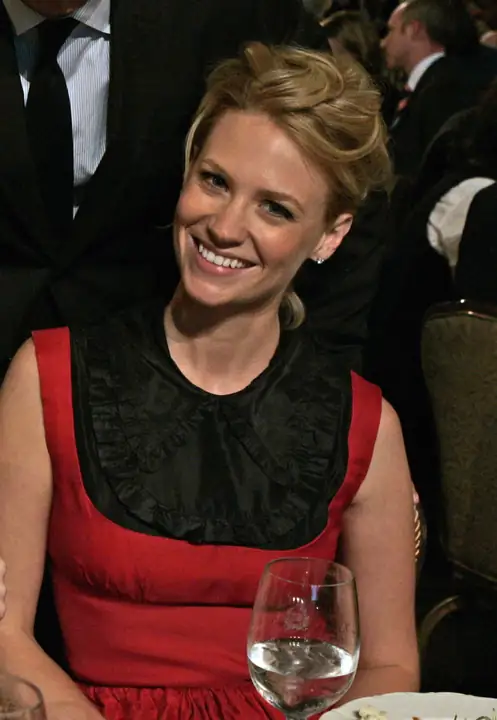
Mad Men (2007): January Jones in a red and black dress at a tableImage: Wikimedia Commons · Original: Peabody Awards / Derivative work: Danyele, CC BY 2.0 - #214
Contains a major spoiler — show
In the season six episode "The Better Half (2013)" Megan wears a white t-shirt with a large, red, five-pointed star on it (along with white panties). This outfit is identical to the one that model and actress Sharon Tate wore (albeit while also doused with water and holding a bow and arrow) in a 1967 photo shoot for Esquire Magazine. The daughter of that shoot's photographer recognized the outfit and tweeted Mad Men's costume designer, Janie Bryant, to ask if the photo of Tate had indeed inspired Megan's costuming, and Bryant tweeted back that it was "no coincidence"; Bryant had been instructed by showrunner Matthew Weiner to put Megan in a "political T-shirt," and Bryant thought that Tate's shirt worked as a subtle statement against the Vietnam War (the red star was a widely recognized symbol of North Vietnam and Communist regimes in general). Two years after the Esquire photo shoot, Sharon Tate was murdered by the Manson Family, so the reference (along with other perceived similarities between Tate's life and Megan's storyline) lead to a theory among some viewers that Megan might soon meet a similar fate. However, in an interview at the January 2015 Television Critics Association press tour, Weiner was very dismissive of this theory: "the Sharon Tate thing, you know, it's so flimsy and thin, and at the same time, I'm like, 'Wow, that's a lot of coincidence.' I don't know what to tell you. I would like to think that people would know that the show's striving for historical accuracy that I would not add a person who was not murdered by the Manson family into that murder. So that in itself is the dumbest argument in the world for me. But I love that people have conspiracy theories, that they have all this other stuff, and I don't know what to tell you."
Deeper Meaning (18)
- #215
- #216
- #217
Contains a major spoiler — show
During his March 2015 discussion with Matt Zoller Seitz at the Museum of Jewish Heritage, Matthew Weiner refuted the early and ongoing fan theory that Don Draper is a secretly Jewish man who is passing as a WASP. Weiner said that when he first heard this fan theory it took him by complete surprise; he had hoped that it would be answered definitively for viewers by the episode "The Hobo Code (2007)," which shows Don being brought up by a stepmother who was (in Weiner's words) a "Holy Roller" (meaning that she was a demonstrative evangelical protestant), but even that does not seem to have quelled the theory for some fans.
- #218
Contains a major spoiler — show
The revelation in the last episode of Season 1 that Peggy has been pregnant without knowing it and gives birth while denying her condition was met with confusion (and some disbelief) from some viewers. Viewers who believe this is impossible may not be aware that "Pregnancy Denial Syndrome" is a rare but definitely existent mental condition in which a woman is psychologically incapable of acknowledging a pregnancy that is unwelcome for some personal reason. Furthermore, there are real cases of women who do not have this mental condition--and who may not consider a pregnancy to be unwelcome--but who nonetheless do not realize they are pregnant (indeed there are enough of these that a TLC reality series titled "I Didn't Know I Was Pregnant (2008)" started running in 2008). In these cases, women often assume they cannot be pregnant because of widely disseminated misinformation about the signs of pregnancy: although girls often get taught that it is absolutely certain that your periods will stop when you are pregnant, that is actually not always true--some women continue to bleed throughout their pregnancies. Conversely, some women have very irregular periods to begin with, so missing multiple months in a row wouldn't necessarily strike them as odd or as an indication of pregnancy. In terms of Peggy's storyline, Peggy also had a strong practical reason to believe she couldn't be pregnant: she had started the pill before she had sex with Pete. She didn't understand that (during that era) it would take a whole month for the contraceptive to go into effect because although the doctor she went to had a responsibility to explain that to her, he failed to do so. Peggy grew up in a strict Catholic home (Catholicism was even more strictly against birth control then than it is now), so she wouldn't have been likely to have gotten the accurate information that the doctor failed to give her from her sister, mother, or Catholic School education either.
- #219
Shortly before the series premiered, Matthew Weiner became worried when he heard that an adaptation of Richard Yates's Revolutionary Road was going to be filmed. The novel and the series share some significant thematic, plot and setting elements, and Weiner feared everyone would complain that he was copying Yates's traits. The irony is that when Revolutionary Road (2008) was released in 2008, Mad Men (2007) had already aired two seasons, so people actually accused Sam Mendes's film of resembling Mad Men (2007) too closely.
- #220
Joan finally names her new independent company "Holloway, Harris." Many viewers had wondered where these names came from. When Joan offered Peggy a partnership, she had said their firm would be called "Harris, Olson," because "it takes two names to look real." Joan had also told Peggy that she did not want a professional partnership with anyone else. When Peggy turned the offer down, Joan gave the company her own two surnames: Holloway (her maiden name) and Harris (the name she took when she married Dr. Greg Harris and kept using after the divorce). This confirms the fact, hinted at earlier in the episode, that Joan went into business on her own.
- #221
The show's title sequence pays tribute to graphic designer Saul Bass's opening credits, filled with skyscrapers, for Alfred Hitchcock's 1959 film North by Northwest, and to his falling-man poster for the 1958 film Vertigo. Weiner has cited Hitchcock as a major influence on the show's visual style.
- #222
After the final episode aired, many viewers fell into heated debates about the meaning of its closing moments. The majority interpreted it as Don having a moment of happiness and enlightenment during a meditation session, after which the real-life 1971 Coca-Cola ad "Hilltop" plays, meaning that Don realized he was meant to be an ad man, returned to McCann and, drawing on his experience at the meditation retreat, created perhaps the most famous commercial of the 1970s. Supporters of this theory pointed to several clues, such as Don repairing a Coca-Cola machine in an earlier episode and the physical and sartorial resemblances between the other retreat participants and the singers in the ad. However, a significant and vocal minority believed alternative interpretations, such as that the ad was created by Peggy rather than Don, or that the ad did not really exist in the lives of the Mad Men characters and represented Don's spiritual awakening. These alternative theories were refuted in the days after the finale aired, first by Jon Hamm, who played Don Draper, in a New York Times interview, and then by showrunner Matthew Weiner in a public conversation with A. M. Holmes at the New York Public Library. Weiner confirmed that the episode implies Don wrote the Coca-Cola ad: "The idea that some kind of enlightened state could have created something so pure, not just an appropriation, appealed to me... I think it's the best ad ever made, and it comes from a very good place."
- #223
When Don Draper wore sunglasses in season 3, the frames became one of the most sought-after items of the holiday season and sparked a fierce debate over whether they were made by Randolph Engineering or American Optical, since both companies produced nearly identical frames. Many men's fashion magazines, such as GQ, named Randolph Engineering as the manufacturer because of its positive reputation in the fashion industry, and criticized viewers who bought American Optical frames (relatively cheap and made for the U.S. Army) as "cheapskates." However, Randolph Engineering did not begin producing its square aviator sunglasses until the 1970s; given the show's period authenticity and Matthew Weiner's commitment to historical accuracy, Don's frames are in fact the American Optical Aviator, which was in production in the 1960s.
- #224
Clips from and references to the film and song Bye Bye Birdie (1963) appear throughout much of season 3. In earlier seasons it had been established that Don's affectionate nickname for Betty was "Birdy"; since season 3 ends with Betty flying to Reno to divorce Don, the prominence of the song is a nod from the showrunner to the fact that season 3 is the season in which Don literally says "bye bye" to his wife "Birdy."
- #225
McCann Erickson, which is mentioned throughout the series and plays a major role in the storyline that continues through the final two seasons, is a real advertising agency. Still in existence as of 2015, the company was formed in 1930 by the merger of the Erickson Company and the H. K. McCann Company. The agency's website states that it operates with "180 offices in more than 120 countries."
- #226
In an April 2018 interview with Jon Hamm on National Public Radio, journalist Scott Simon asked Hamm what he thought happened to Don Draper after the end of Mad Men's final episode. Hamm's response was: "I think he got up after meditating, got in a car and flew to New York City the next day, went back and pitched that idea. I think Don's moment of enlightenment was that he was an ad man. Do I hope he continued on the spiritual journey he embarked on in the last few episodes of the show? Of course. I always rooted for Don. You know, Don was a very wounded soul, and I think he needed a lot more help to get to that part of himself."
- #227
The character Ken Cosgrove was probably inspired in part by the novelist/poet James Dickey, who published poems in The New Yorker and other major magazines while working in advertising in the 1960s. He also has a great deal in common with the screenwriter/novelist Herman Raucher, who staged plays on Broadway while working as an advertising executive. Raucher left advertising when the success of his novel and screenplay Summer of '42 made him a millionaire.
- #228
In the season one finale, Peggy giving birth without knowing she was pregnant and denying her condition was met with confusion (and a little disbelief) by some viewers. Viewers who believed this was impossible may not have been aware that "Pregnancy Denial Syndrome" is a rare but very real mental condition in which a woman cannot psychologically accept an unwanted pregnancy for personal reasons. There are also real cases of women who do not have this mental condition and do not regard the pregnancy as unwanted, yet still fail to notice they are pregnant (in fact, the reality series "I Didn't Know I Was Pregnant," which began airing on TLC in 2008, shows that this is common enough). In these cases, women generally assume they cannot be pregnant because of widely circulated misinformation about the symptoms of pregnancy: girls are usually taught that menstruation definitely stops during pregnancy, but this is not always true — some women continue to bleed throughout their pregnancies. Conversely, some women have very irregular periods to begin with, so not menstruating for several months in a row may not seem strange to them or appear to be a sign of pregnancy. In Peggy's story, Peggy also had a strong practical reason to believe she could not be pregnant: she had started taking birth control pills before having sex with Pete. She did not understand that the pill took a month to become effective at the time, because the doctor she went to did not explain this to her even though it was his responsibility to do so. Peggy had been raised in a strict Catholic home (Catholicism was stricter about birth control then than it is now), so it is unlikely that she would have received the correct information the doctor failed to give her from her sister, her mother, or her Catholic school education.
- #229
In the season six episode "The Better Half" (2013), Megan wears a white T-shirt (along with white underwear) with a large, red, five-pointed star on it. This outfit is identical to the one worn by model and actress Sharon Tate in a 1967 photo shoot for Esquire Magazine (though Tate was also soaking wet and holding a bow and arrow). The photographer's daughter recognized the outfit and tweeted Mad Men costume designer Janie Bryant to ask whether Tate's photo had inspired Megan's costume; Bryant said it was "not a coincidence"; Bryant had been instructed by showrunner Matthew Weiner to put Megan in a "political T-shirt," and Bryant thought Tate's T-shirt worked as a subtle stance against the Vietnam War (the red star was a widely recognized symbol of North Vietnam and of Communist regimes in general). Two years after the Esquire photo shoot, Sharon Tate was killed by the Manson Family, so the reference (along with other perceived similarities between Tate's life and Megan's story) led some viewers to theorize that Megan might soon meet a similar fate. However, in an interview at the January 2015 Television Critics Association press tour, Weiner rejected this theory: "The Sharon Tate thing, you know, is very tenuous and thin and also 'Wow, that's too much of a coincidence.' I don't know what to tell you. I wish people knew that I strive for historical accuracy so much that I wouldn't add a person who wasn't killed by the Manson family to that murder. So that's the dumbest argument in the world to me. But I love that people have conspiracy theories, have all these other things, and I don't know what to tell you."
- #230
In a March 2015 interview with Matt Zoller Seitz, Matthew Weiner was asked why he chose "Whitman" as Don's birth surname (specifically, whether it was a reference to the poet Walt Whitman). Weiner said the choice of Whitman had nothing to do with Walt Whitman; it was a shortening of the words "white man."
- #231
In the series, Henry Francis, an adviser to Nelson Rockefeller, persuades Betty to leave Don and marry him. In real life, Rockefeller did this himself by persuading Margaretta Murphy, a mother of four, to leave her husband James Murphy. Margaretta married Rockefeller a month after leaving her husband.
- #232
The small ball-shaped glasses that Draper and his colleagues often use are a design that has been known as "roly poly" glasses since at least the 1950s. The metal band around the rim, an innovative accent introduced by artist Dorothy Carpenter Thorpe, made the design even more popular (and widely imitated) in the 1960s and beyond. These glass sets were ideal business gifts because the bands, made of silver, chrome, platinum, or even gold, could be custom-stenciled with initials, company logos, or other business-related graphics. Draper's glasses appear to have platinum bands.
Career & Awards (6)
- #233
- #234
- #235
- #236
Award highlights include winning the Primetime Emmy Award for Outstanding Drama Series four times, for each of its first four seasons; its fourth win tied the record for serial dramas set earlier by Hill Street Blues (1981) (1981-84), L.A. Law (1986) (1987, 1989-91), and The West Wing (1999) (2000-03).
- #237
- #238
Life & Family (4)
- #239
- #240
In 2008, show creator Matthew Weiner told the Chicago Tribune that Peggy and Pete's son was given up for adoption (as she told Pete) and is not being raised by Peggy's sister or mother. Weiner also said that the misdirection to make the audience think that the son is being raised by Peggy's sister was deliberate. In 2013, Weiner expanded on this at a Q&A session at the Paley Center for Media. Weiner said that Pete and Peggy's child is "gone into the Catholic church's adoption system... it's untraceable, you can't find your birth parents. I guess you could now, but it's pretty hard." This storyline was not absolutely confirmed onscreen until season 7, in "Time & Life," the fourth-to-last episode of the whole series, when Peggy admits to Stan that she had a baby and gave him up in an anonymous, closed adoption: "I'm here and he's with a family somewhere. I don't know, but it's not because I don't care. I don't know because you're not supposed to know, or you can't go on with your life."
- #241
Joan finally chooses the name "Holloway, Harris" for her new, independent company. Many viewers were left confused about where these names came from. When Joan proposed a partnership to Peggy, she said that their company would be named "Harris, Olson," because "you need two names to make it sound real." Joan also told Peggy that she didn't want a professional partnership with anyone else but Peggy. So after Peggy turned down Joan's offer, Joan gave the company both of her own names: Holloway (her original last name from before she was married) and Harris (the name she acquired when she married Dr. Greg Harris and kept even after she divorced him). This verifies the implication from earlier in the episode that Joan has gone into business by herself, with no other partner.
- #242
In 2008, series creator Matthew Weiner told the Chicago Tribune that Peggy and Pete's son had been put up for adoption (as she told Pete) and was not raised by Peggy's sister or mother. Weiner also said the misdirection that led the audience to believe the boy was raised by Peggy's sister was intentional. Weiner expanded on the subject in 2013 during a Q&A session at the Paley Media Center. Weiner said that Pete and Peggy's child "went into the Catholic church's adoption system… you can't trace it, you can't find your birth parents. I guess you can now, but it's pretty hard." This storyline was not absolutely confirmed onscreen until season 7, in "Time & Life", the fourth and final episode of the whole series, when Peggy confesses to Stan that she had a baby and gave it away anonymously and secretly: "I'm here and he's with a family somewhere. I don't know, but it's not because I don't care, it's because you're not supposed to know, or you can't move on with your life."
Sources & editorial notes
Reference databases
- Wikipedia
- IMDb
Information from external sources is independently selected, consolidated and edited by Arka Evren. Sources are listed for verification and further reading. Encyclopedia text is used under its licence (CC BY-SA). How we work