

TV SERIES · 2010–2017 · UK
Sherlock
- Created by
- Mark Gatiss, Steven Moffat
- Network
- BBC One
- Seasons
- 4
- Episodes
- 12
- Studio
- Hartswood Films, BBC Cymru Wales, Masterpiece
232 archived facts 8 topics 2 sources Last reviewed Nov 2026
A modern update finds the famous sleuth and his doctor partner solving crime in 21st century London.

232 Interesting Facts About Sherlock
Interesting Facts (35)
- #001
Watson's P226R is likely meant to be his army service pistol. Although the P226 is used in the British Military, it is mainly used by Special Forces and it is rare to be held by Infantry, where the Browning Hi-Power or the Glock 17 Gen 3, which is phasing out both handguns for its high magazine capacity and reliability, are more common. The P226 was issued widely as an Urgent Operational Requirement (UOR) during British Operations in Afghanistan.
- #002
- #003
Both Benedict Cumberbatch and Mark Gatiss dye their hair black for their roles as Sherlock and Mycroft. They're naturally ginger (Gatiss) and brown haired (Benedict).
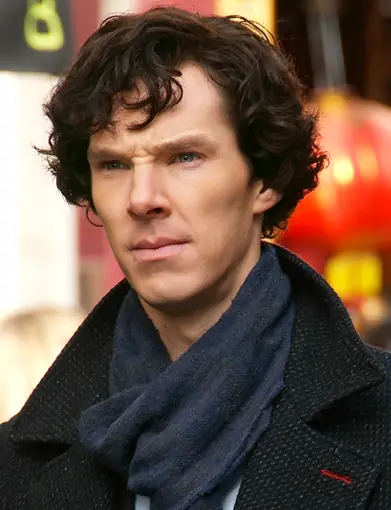
Sherlock (2010): Sherlock in a dark coat on the street in front of red lanternsImage: Wikimedia Commons · Fat Les from London, UK, CC BY 2.0 - #004
- #005
- #006
Although John and Sherlock aren't the wealthiest of people and Sherlock is frequently seen on different occasions denying any reward in money for his job, Watson's clothes do not reflect this. In fact his famous black jacket costs £750, shoes £175, knitted jumper over £200 and his watch a staggering £3000. Sherlock's famous coat is also a staggering £1,750.
- #007
In the Season 2 premiere, Sherlock talks of the 'myth' about the Allies knowing about the Coventry bombing and still letting it happen so that they don't disclose that they have cracked the enigma code. In the movie The Imitation Game (2014) Benedict Cumberbatch plays Alan Turing and the entire scene is played out on the screen.
- #008
In Conan Doyle's original stories, Sherlock Holmes and Dr. Watson addressed each other by their last names, which was common during Victorian times. Since nowadays it is more common for people to address each other with the first name, the show has the two characters address each other as "Sherlock" and "John".
- #009
Benedict Cumberbatch, Martin Freeman and Toby Jones are involved in comic book movies in the MARVEL cinematic universe. Cumberbatch plays Dr. Stephen Strange in Doctor Strange (2016), Freeman has a role in Captain America: Civil War (2016) and Black Panther (2018) as Everett K. Ross and Toby Jones as Dr. Arnim Zola.
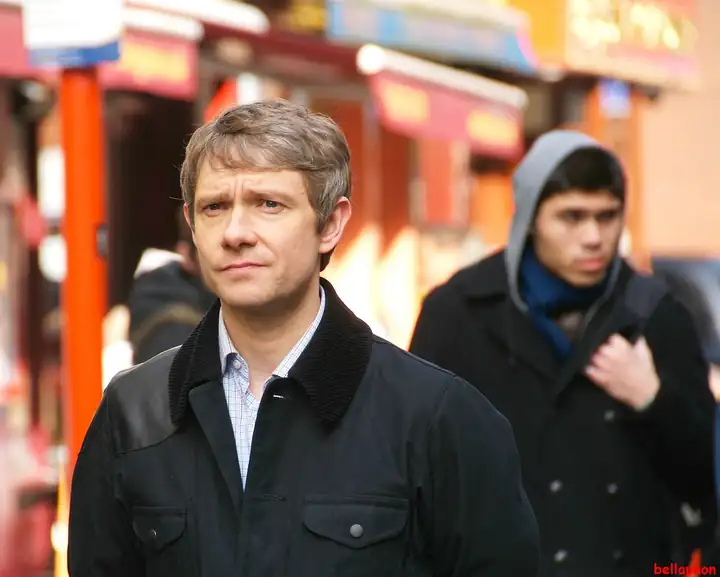
Sherlock (2010): Martin Freeman and Sherlock Holmes on the streetImage: Wikimedia Commons · Fat Les (bellaphon) from London, UK, CC BY 2.0 - #010
- #011
"Jim" Moriarty's appearance is subtly the exact opposite of Sherlock's; Sherlock's hair is long and curly, while Moriarty's is clean and combed. Sherlock wears an open collar while Moriarty always wears a tie. As well, Sherlock dons his classic long overcoat with his high collar popped, while Moriarty's is a shorter, trimmer jacket with a Nehru collar. And in most cases, Sherlock is clean shaven whilst Jim wears light five o'clock shadow on his face.
- #012
Certain 1890s scenes in semi-period "The Abominable Bride", could be seen to imply that the entire 21st "modern" period settings, of the rest of the entire run, could actually be the drug-induced (mind palace) hallucinations or imaginings of the 1890s period Sherlock Holmes, thus turning the entire series as one long alternate version of "reality".
- #013
- #014
The role of Molly Hooper never appeared in the books or short stories and was intended to be a one-off character, created to address Sherlock's lack of social skills, particularly any romantic encounter. However, Steven Moffat and the other producers liked Louise Brealey's performance so much that they decided to expand her character.
- #015
Much of the crew of Sherlock (2010) is related to one another. Sherlock's parents are in fact the parents of actor Benedict Cumberbatch, Wanda Ventham and Timothy Carlton; Amanda Abbington (Mary Morstan) and Martin Freeman (John Watson) were real-life partners; producer Sue Vertue is the wife of writer Steven Moffat, and co-producer and writer Beryl Vertue is her mother-in-law; the husband of writer Mark Gatiss plays the lawyer in The Reichenbach Fall (2012); and Steven Moffat's son plays Sherlock Holmes as a child in several episodes.
- #016
- #017
Sherlock sometimes uses a memory technique he calls his "Mind Palace." This is not an invention of the writers; it is a memory method called the "Method of Loci" that dates back to Ancient Rome. One of the most famous real-life practitioners of this method in history was the sixteenth-century Italian Jesuit missionary Matteo Ricci, who introduced it to China.
- #018
- #019
In the original story A Study in Scarlet, Scotland Yard finds "rache" written in blood on a wall, and Lestrade thinks the victim was trying to write Rachel. Sherlock then says it is the German word for revenge. In A Study in Pink (2010), the victim scratches "rache" on the floor. The forensic specialist Anderson thinks the victim was trying to write the German word for revenge, but Sherlock deduces that the victim died before finishing writing "Rachel."
- #020
- #021
- #022
- #023
- #024
- #025
- #026
- #027
"Jim" Moriarty's appearance is the exact opposite of Sherlock's; Sherlock's hair is long and curly, while Moriarty's is neat and combed. Sherlock wears an open collar, while Moriarty always wears a tie. Sherlock also wears his classic long coat with a high collar, while Moriarty's is a shorter, sleeker coat with a Nehru collar. And in most cases, Sherlock is clean-shaven while Jim wears a light five o'clock shadow.
- #028
Although John and Sherlock are not the wealthiest people, and Sherlock is seen refusing any reward for his work in various situations, Watson's clothing does not reflect this. In fact, his famous black coat costs £750, his shoes £175, his knit sweater over £200, and his watch a surprising £3,000. Sherlock's famous coat also carries a surprising price of £1,750.
- #029
- #030
- #031
In the season 2 premiere, Sherlock mentions the 'legend' about the Allies knowing of the Coventry bombing yet allowing it in order not to reveal that they had cracked the Enigma code. In the film The Imitation Game (2014), Benedict Cumberbatch plays Alan Turing, and the entire scene is played out on screen.
- #032
In Conan Doyle's original stories, Sherlock Holmes and Dr. Watson addressed each other by their surnames, which was common in the Victorian era. Since it is more common today for people to address each other by first name, the two characters in the series address each other as "Sherlock" and "John".
- #033
Benedict Cumberbatch, Martin Freeman and Toby Jones all appear in comic-book films within the MARVEL cinematic universe. Cumberbatch plays Dr. Stephen Strange in Doctor Strange (2016), Freeman plays Everett K. Ross in Captain America: Civil War (2016) and Black Panther (2018), and Toby Jones plays Dr. Arnim Zola.
- #034
When Sherlock and John enter the laboratory where Dr. Stapleton works, Dr. Stapleton says to another scientist, "Okay, Michael, let's try Harlow 3 next time". This scientist is played by composer Michael Price, who also plays the young Dr. Frankland in the photograph Sherlock later finds.
- #035
Watson's P226R is presumably meant to be his army service pistol. Although the P226 is used in the British Army, it is mainly used by Special Forces and is rarely held by the Infantry, where the Browning Hi-Power or the Glock 17 Gen 3 are more common, both of which were phased out for their high magazine capacity and reliability. The P226 was widely issued as an Urgent Operational Requirement (UOR) during British Operations in Afghanistan.
Production Story (73)
- #036
The role of Molly Hooper was never in the books or short stories and was only meant to be a one-off character to further indicate Sherlock's lack of social skills, particularly addressing any romantic encounters. However, Steven Moffat and other producers loved Louise Brealey's performance so much that they decided to expand her character.
- #037
- #038
Benedict Cumberbatch was cast after Steven Moffat and Mark Gatiss watched his performance in Atonement (2007). They thought he looked like a perfect Holmes.
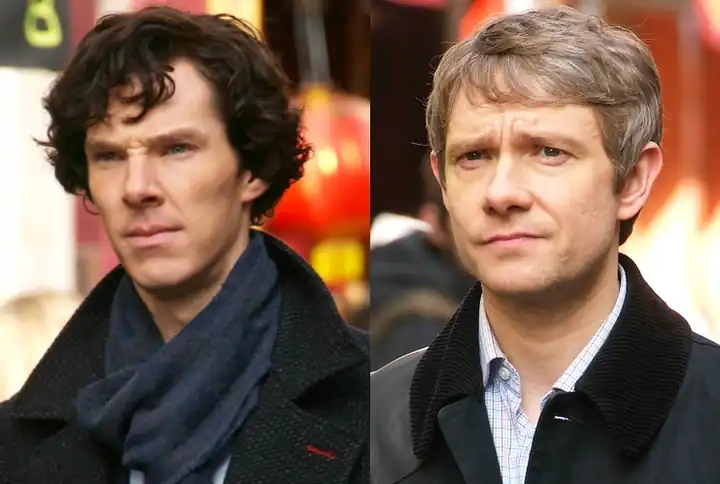
Sherlock (2010): Benedict Cumberbatch and Martin Freeman during filmingImage: Wikimedia Commons · Fat Les (bellaphon) from London, UK derivative works: RanZag ( talk ), CC BY 2.0 - #039
- #040
Several websites and social media accounts by characters of the series were created as tie-ins: The Science of Deduction by Sherlock Holmes, The personal blog of Dr. John Watson, Molly Hooper's online diary, The website Connie Prince - Beauty Queen of Hearts, Irene Adler's Twitter account @thewhiphand, and Holmes' Twitter account @ContactSH.
- #041
When Martin Freeman arrived for his first audition, he had just had his wallet stolen. He was in such a bad mood that the producers thought he wasn't interested in the role. Luckily, he was fine at the next audition and got the role.
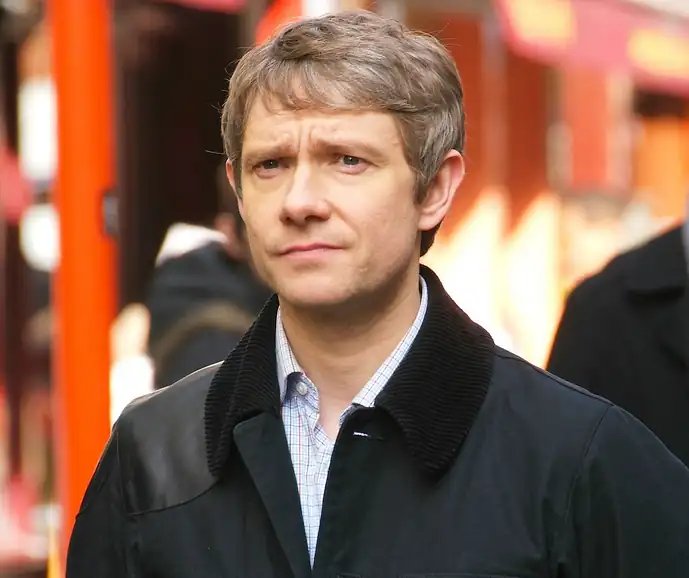
Sherlock (2010): Martin Freeman and Sherlock Holmes during filmingImage: Wikimedia Commons · Martin_Freeman_filming_Sherlock.jpg : Fat Les (bellaphon) from London…, CC BY 2.0 - #042
In Conan Doyle's original stories, Sherlock Holmes and Dr. Watson addressed each other by their last names, which was common during Victorian times. Since nowadays it is more common for people to address each other by their first names, the show has the two characters address each other as "Sherlock" and "John".
- #043
- #044
Matt Smith auditioned for the role of Doctor Watson before his Doctor Who (2005) audition. Steven Moffat thought he would do better playing Holmes, but the part was already given to Benedict.
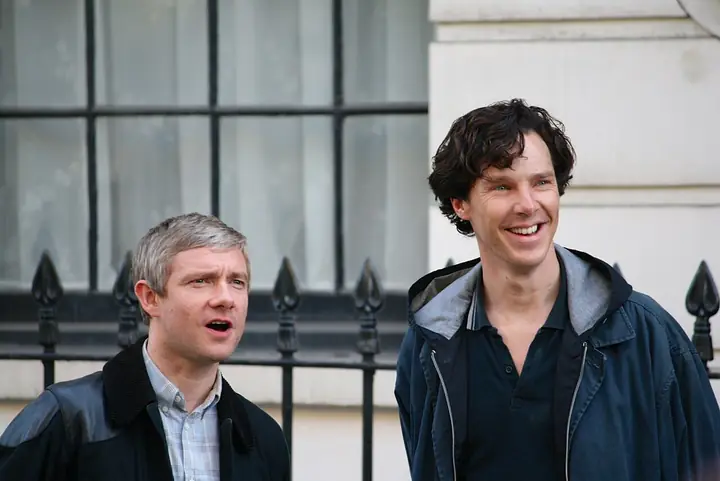
Sherlock (2010): Benedict Cumberbatch and Martin Freeman outsideImage: Wikimedia Commons · Saschaporsche, CC BY-SA 3.0 - #045
Originally this was shot as a 60-minute one-off TV movie. Its costs ballooned to an almost unheard-of one million pounds, and rumors flew that the BBC would pull the plug and leave it unaired. Instead, they asked Mark Gatiss and Steven Moffat to turn the whole thing into a series pilot. That would entail making it longer. And they wrote a longer script. But they couldn't get the same cinematographer back, and didn't think the added scenes would be consistent with what they had already filmed. So they shot the whole pilot over.
- #046
- #047
- #048
Sherlock was devised by Steven Moffat and Mark Gatiss, both fans of Sherlock Holmes with prior experience adapting or using Victorian literature for television.
- #049
- #050
- #051
- #052
Mark Gatiss noted that the original Watson was invalided home after the Second Anglo-Afghan War (1878–80), and observed that it is the same war now, calling it the same unwinnable war.
- #053
- #054
- #055
- #056
- #057
- #058
- #059
- #060
- #061
- #062
Mark Gatiss and Steven Moffat noted that a modern door would show only the house number with separate doorbells for each flat, but they kept the full house number because it is so iconic.
- #063
- #064
It was initially shot as a one-off 60-minute TV film. Costs rose to a nearly unheard-of one million pounds, and rumours circulated that the BBC would pull the plug and leave it unaired. Instead, they asked Mark Gatiss and Steven Moffat to turn everything into a series pilot. This required a longer running time, and they wrote a longer script. However, they could not get the same cinematographer back, and they did not think the added scenes would be consistent with the scenes they had already shot. So they reshot the entire pilot.
- #065
Family ties run deep on the set of Sherlock (2010). Wanda Ventham and Timothy Carlton, who play Sherlock's parents, are the real-life mother and father of lead actor Benedict Cumberbatch. Amanda Abbington, who plays Mary Morstan, was the partner of Martin Freeman, who plays John Watson, at the time; producer Sue Vertue is the wife of writer Steven Moffat, and co-producer Beryl Vertue is his mother-in-law. The wife of writer Mark Gatiss appears as a lawyer in the episode The Reichenbach Fall (2012), while Steven Moffat's son played the young Sherlock in several episodes.
- #066
- #067
- #068
Although John and Sherlock are not particularly wealthy and Sherlock often turns down the reward money, Watson's clothes do not reflect this. His famous black coat costs 750 pounds, his shoes 175 pounds, his knit sweater over 200 pounds and his watch exactly 3000 pounds. Sherlock's famous coat, meanwhile, carries a hefty price tag of 1750 pounds.
- #069
Various websites and social media accounts for the series' characters were created as tie-ins: Sherlock Holmes's 'The Science of Deduction' site, Dr. John Watson's personal blog, Molly Hooper's online diary, Connie Prince's 'Beauty Queen of Hearts' site, Irene Adler's Twitter account @thewhiphand and Holmes's Twitter account @ContactSH.
- #070
The character Molly Hooper was intended for a single episode to highlight Sherlock's social awkwardness and especially his clumsiness in romantic encounters. However, Louise Brealey's performance impressed the producers so much that they decided to expand the character. Thus Molly gained unexpected depth in the story.
- #071
- #072
While preparing for the role of Holmes, Benedict Cumberbatch read all of Conan Doyle's original stories from beginning to end. This extensive preparation played a major role in his capturing the nuances of the character. This meticulous work lies at the heart of the attention to detail in Cumberbatch's performance.
- #073
- #074
- #075
- #076
- #077
In an interview, Benedict Cumberbatch explained that he played Sherlock in a way that could be read as sociopathic, autistic, or both at once. This ambiguity was a deliberate choice that deepened the character's mystery and complexity. The audience is kept in a state of constant curiosity about Sherlock's mind.
- #078
Jim Moriarty's appearance was designed to be the exact opposite of Sherlock's. Where Sherlock has long, curly hair, Moriarty's hair is straight and combed; where Sherlock wears an open collar, Moriarty always wears a tie. Furthermore, against Sherlock's long coat and turned-up collar, Moriarty's jacket is shorter with a Nehru collar; in most scenes, while Sherlock is clean-shaven, Moriarty has light stubble.
- #079
Before his Doctor Who audition, Matt Smith took part in a screen test for the role of John Watson. Steven Moffat thought Smith would be better suited to the role of Holmes, but that role had already been given to Benedict Cumberbatch. In a twist of fate, Smith was steered toward the TARDIS and Cumberbatch toward Baker Street.
- #080
In the summer of 2011, in Danny Boyle's stage production of Frankenstein, Benedict Cumberbatch and Jonny Lee Miller alternated nightly between the roles of the creator and the creature. Both actors later portrayed Sherlock Holmes in modern adaptations set on opposite sides of the Atlantic.
- #081
- #082
In Conan Doyle's original stories, Holmes and Watson addressed each other by their surnames, a common custom in the Victorian era. To reflect contemporary familiarity, the series chose to have the characters call each other 'Sherlock' and 'John.' This small change made it easier to connect with the modern viewer.
- #083
- #084
- #085
Benedict Cumberbatch, Robert Downey Jr. and Ian McKellen both portrayed Sherlock Holmes and appeared in Marvel films. Cumberbatch is remembered as Doctor Strange, Downey as Iron Man, and McKellen as Magneto. On the other hand, Michael Caine and Matt Frewer, who have also played Sherlock Holmes, appeared in DC productions; Caine as Alfred Pennyworth and Frewer as Moloch in Watchmen. Frewer had also appeared in Marvel's TV film Generation X.
- #086
The series' creators, Mark Gatiss and Steven Moffat, had previously worked together on Doctor Who. There are interesting connections between the two universes: figures such as Peter Cushing and Tom Baker played both the Doctor and Sherlock. In fact, the Tenth Doctor, David Tennant, says in one episode that he was a student of Dr. Joseph Bell, the inspiration for Holmes; Brian Cox portrayed both Bell and Sydney Newman, the creator of Doctor Who.
- #087
- #088
- #089
- #090
The series was actually shot as a one-off 60-minute TV film. When costs soared to nearly unheard-of figure of one million pounds, rumors spread that the BBC would shelve the project. Thereupon, producers Mark Gatiss and Steven Moffat were asked to turn the film into a series pilot, which meant extending the running time. When they could not work with the same cinematographer due to concerns that the new scenes would not match the previous footage, they reshot the entire pilot from scratch.
- #091
- #092
- #093
- #094
Sherlock sometimes uses a memory technique he calls the 'Mind Palace.' This is not an invention of the writers but a memory method called the 'Method of Loci,' which dates back to Ancient Rome. One of its most famous practitioners in history was the 16th-century Italian Jesuit missionary Matteo Ricci, who introduced the method to China.
- #095
- #096
- #097
In the original story A Study in Scarlet, Scotland Yard finds 'rache' written in blood on the wall, and Lestrade thinks the victim was trying to write Rachel. Sherlock, however, says it means revenge in German. In A Study in Pink (2010), the victim scratches 'rache' on the floor, and while forensic examiner Anderson thinks he was trying to write revenge in German, Sherlock guesses that the victim died before he could write 'Rachel'.
- #098
- #099
- #100
- #101
- #102
In this new series, Dr. Watson served as a captain (and medical doctor) in the 5th Northumberland Fusiliers, who served in Afghanistan. The 5th Northumberland Fusiliers did indeed serve in Afghanistan during the Second Anglo-Afghan War (1878-1880). The first story of the old Sherlock Holmes series takes place in 1881. However, the 5th Northumberland Fusiliers was renamed the 'Northumberland Fusiliers' in 1881 (the 5 was dropped from the title), which means that the modern Dr. Watson serving in the 5th Northumberland is a salute to the old legacy. The old 5th Northumberland was last named the 'Royal Northumberland Fusiliers' and was amalgamated in 1968. Watson's current regiment would be the 'Royal Regiment of Fusiliers', which has served in Afghanistan repeatedly over the last 16 years.
- #103
In the first episode of season 2, Sherlock mentions the 'legend' that the Allies knew about the Coventry bombing and allowed it to happen in order not to reveal that they had broken the Enigma code. In the film The Imitation Game (2014), Benedict Cumberbatch plays Alan Turing, and this scene is brought to the screen.
- #104
- #105
In the first episode of season 4 (The Six Thatchers), as a harbinger of the main villain of the following episodes, Culverton Smith, when Dr. John H. Watson (Martin Freeman) gets off the bus and sees E (credited as Elizabeth, played by Sian Brooke), a poster with Smith's face (later played by Toby Jones) is visible at the bus stop. The poster is visible only for a moment and its slogan reads '[_] murder will', only this much being readable because Watson's body blocks the rest of the poster.
- #106
- #107
Some 1890s scenes in the special 'The Abominable Bride' imply that all the 21st-century 'modern' period settings in the rest of the series may actually be drug-induced (mind palace) hallucinations or dreams of an 1890s-era Sherlock Holmes, thus making the entire series a long alternative version of 'reality'.
- #108
In the second episode of season 1, Sherlock tells John about the time he 'argued' with a chip-and-pin machine; John explains that it was mostly the machine insulting him while he 'sat there'. This is later similar to John and Sherlock's arguments; John mostly shouts while Sherlock sits and listens. John even calls Sherlock a 'machine' during one of these arguments at Reichenbach Falls.
Behind the Scenes (32)
- #109
The real address of 221B Baker Street (which is actually 187 N Gower Street, London) features a Blue Plaque on its wall for Giuseppe Mazzini, one of the founders of the modern 'Little Italy', who lived in the area while in London in the 1800s. This is featured in an episode of 'Look at Life' (Roman Invasion) and also shows the shop below as it was then in the 1960s.
- #110
- #111
- #112
Many of the crew in Sherlock (2010) are related. Sherlock's parents are actually actor Benedict Cumberbatch's parents, Wanda Ventham and Timothy Carlton; Amanda Abbington (Mary Morstan) and Martin Freeman (John Watson) were real-life partners; producer Sue Vertue is writer Steven Moffat's wife, and co-producer and writer Beryl Vertue is his mother-in-law; writer Mark Gatiss' husband is the barrister in The Reichenbach Fall (2012); Steven Moffat's son plays Sherlock Holmes as a child in a few episodes.
- #113
- #114
Although John and Sherlock aren't the wealthiest of people and Sherlock is frequently seen on different occasions denying any reward in money for his job, Watson's clothes do not reflect this. In fact, his famous black jacket costs £750, shoes £175, knitted jumper over £200, and his watch a staggering £3000. Sherlock's famous coat is also a staggering £1,750.
- #115
- #116
- #117
Filming of the Sherlock pilot episode, written by Steven Moffat and directed by Coky Giedroyc, began in January 2009.
- #118
- #119
- #120
- #121
- #122
Benedict Cumberbatch wore a Belstaff coat costing £1,000 in Sherlock.
- #123
- #124
- #125
- #126
- #127
- #128
- #129
Family ties were quite dense on the set of Sherlock (2010). Wanda Ventham and Timothy Carlton, who play Sherlock's parents, are the real mother and father of lead actor Benedict Cumberbatch. Amanda Abbington, in the role of Mary Morstan, and Martin Freeman, who plays John Watson, were partners at the time; producer Sue Vertue is the wife of writer Steven Moffat, and co-producer Beryl Vertue is his mother-in-law. The wife of writer Mark Gatiss appears as a lawyer in the episode The Reichenbach Fall (2012), while Steven Moffat's son played the young Sherlock in several episodes.
- #130
- #131
- #132
- #133
During the break between the first and second seasons, Martin Freeman and Benedict Cumberbatch appeared in Peter Jackson's Hobbit trilogy: An Unexpected Journey (2012), The Desolation of Smaug (2013) and The Battle of the Five Armies (2014). This time Freeman played the lead role of Bilbo, while Cumberbatch brought Smaug and the Necromancer to life through motion capture and voice work.
- #134
Although John and Sherlock are not particularly wealthy and Sherlock often turns down the reward money, Watson's clothes do not reflect this. His famous black coat costs 750 pounds, his shoes 175 pounds, his knitted sweater over 200 pounds and his watch exactly 3000 pounds. Sherlock's famous coat, meanwhile, carries a high price of 1750 pounds.
- #135
- #136
- #137
When Sherlock and John enter the laboratory where Dr. Stapleton works, Stapleton says to another scientist, 'All right Michael, let's try Harlow 3 next time.' The person playing that scientist is Michael Price, who composes the series' music; he also plays the young Dr. Frankland in the photograph Sherlock later finds.
- #138
Watson's P226R pistol most likely represents the weapon he used during his military service. Although the P226 is used in the British army, it is mainly preferred by the Special Forces; in the infantry, the Browning Hi-Power or the Glock 17 Gen 3, which stands out for its high capacity and reliability, are more common. The P226 had been widely distributed during operations in Afghanistan under an urgent operational requirement.
- #139
Various websites and social media accounts belonging to the series' characters were created as tie-ins: Sherlock Holmes's 'The Science of Deduction' site, Dr. John Watson's personal blog, Molly Hooper's online diary, Connie Prince's 'Beauty Queen of Hearts' site, Irene Adler's Twitter account @thewhiphand and Holmes's Twitter account @ContactSH.
- #140
On the wall of 187 N Gower Street, the real address of 221B Baker Street, there is a blue plaque belonging to Giuseppe Mazzini, one of the founders of the modern 'Little Italy'. This plaque, placed in memory of Mazzini, who lived in London in the 1800s, appears in the 'Roman Invasion' episode of the 'Look at Life' series and also shows the shop on the ground floor as it was in the 1960s.
Characters & Cast (56)
- #141
- #142
In an interview with DigitalSpy, Benedict Cumberbatch revealed that he plays Sherlock so that he can be read as either sociopathic or autistic or both.
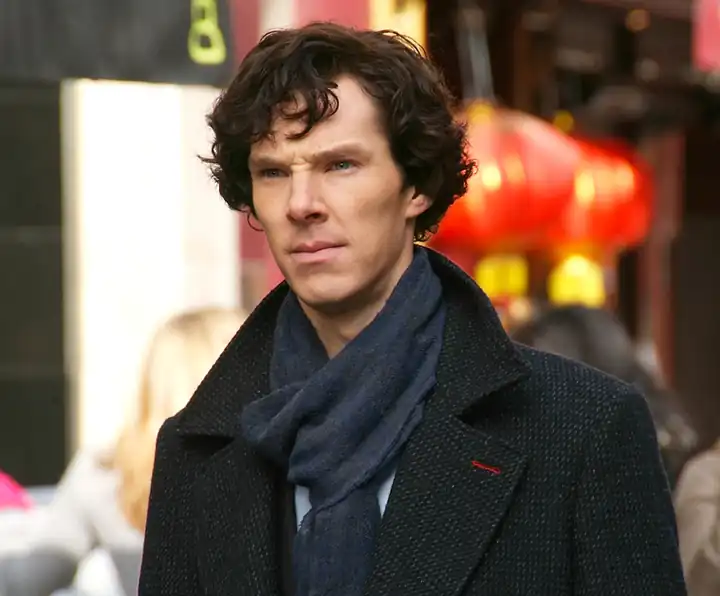
Sherlock (2010): Sherlock Holmes in a dark coat in front of red lanternsImage: Wikimedia Commons · Benedict_Cumberbatch_filming_Sherlock.jpg : Fat Les (bellaphon) from …, CC BY 2.0 - #143
- #144
- #145
In the summer of 2011 Danny Boyle created a National Theatre production of 'Frankenstein' in which Benedict Cumberbatch and Jonny Lee Miller played the creator and monster and alternately changed nightly. Both actors then went on to play another Victorian creation Sherlock Holmes, both set in the present day, allbeit opposite side of the Atlantic.
- #146
- #147
In Series 4, Episode 1 (The Six Thatchers), there is foreshadowing of the next episodes' main villain, Culverton Smith, when a poster of Smith's face (later played by Toby Jones) can be seen at the bus stop when Dr. John H. Watson (Martin Freeman) leaves the bus and sees E (credited as Elizabeth, played by Sian Brooke). The poster can only be seen for a split second, but the tagline reads "There will be murder in the [_]", and this is all you can see, as Watson's body blocks the rest of the poster.
- #148
Contains a major spoiler — show
"Jim" Moriarty's appearance is subtly the exact opposite of Sherlock's: Sherlock's hair is long and curly, while Moriarty's is clean and combed. Sherlock wears an open collar, while Moriarty always wears a tie. Sherlock dons his classic long overcoat with his high collar popped, while Moriarty's is a shorter, trimmer jacket with a Nehru collar. In most cases, Sherlock is clean-shaven, whilst Jim wears a light five o'clock shadow on his face.
- #149
- #150
- #151
- #152
- #153
- #154
In the summer of 2011, Danny Boyle created 'Frankenstein', a National Theatre production in which Benedict Cumberbatch and Jonny Lee Miller played the creator and the creature, alternating each night. Both actors later went on to play another modern-day Victorian Sherlock Holmes production, albeit on the other side of the Atlantic.
- #155
- #156
The character of Molly Hooper was intended for a single episode, to highlight Sherlock's social awkwardness and especially his clumsiness in romantic encounters. However, Louise Brealey's performance impressed the producers so much that they decided to expand the character. Thus Molly gained unexpected depth in the story.
- #157
- #158
While preparing for the role of Holmes, Benedict Cumberbatch read all of Conan Doyle's original stories from beginning to end. This extensive preparation played a major role in his capturing the character's nuances. This meticulous work lies at the foundation of the attention to detail in Cumberbatch's performance.
- #159
- #160
- #161
- #162
- #163
In an interview, Benedict Cumberbatch explained that he played Sherlock in a way that could be read as a sociopath, as autistic, or as both at once. This ambiguity was a deliberate choice that heightens the character's mystery and depth. The viewer is kept in a constant state of curiosity about Sherlock's mind.
- #164
Jim Moriarty's appearance was designed to be the exact opposite of Sherlock's. In contrast to Sherlock's long, curly hair, Moriarty's hair is straight and combed; while Sherlock wears an open collar, Moriarty always wears a tie. Furthermore, against Sherlock's long coat and turned-up collar, Moriarty's coat is shorter with a Nehru collar; in most scenes, while Sherlock is clean-shaven, Moriarty has light stubble.
- #165
Before the Doctor Who auditions, Matt Smith took part in a screen test for the role of John Watson. Steven Moffat thought Smith would be better suited to the role of Holmes, but that role had already been given to Benedict Cumberbatch. As fate would have it, Smith was steered to the TARDIS and Cumberbatch to Baker Street.
- #166
- #167
- #168
In Conan Doyle's original stories, Holmes and Watson addressed each other by their surnames; this was a common custom in the Victorian era. To reflect present-day familiarity, the series chose to have the characters call each other 'Sherlock' and 'John'. This small change made it easier to connect with the modern viewer.
- #169
- #170
- #171
Benedict Cumberbatch, Robert Downey Jr. and Ian McKellen both played Sherlock Holmes and appeared in Marvel films. Cumberbatch is remembered as Doctor Strange, Downey as Iron Man and McKellen as Magneto. On the other hand, Michael Caine and Matt Frewer, who have also played Sherlock Holmes, appeared in DC productions; Caine as Alfred Pennyworth and Frewer as Moloch in Watchmen. Frewer had also appeared in Marvel's TV film Generation X.
- #172
The series' creators Mark Gatiss and Steven Moffat had previously worked together on Doctor Who. There are interesting links between the two universes: there are figures such as Peter Cushing and Tom Baker who played both the Doctor and Sherlock. In fact, the Tenth Doctor, David Tennant, says in one episode that he was a student of Dr. Joseph Bell, the inspiration for Holmes; Brian Cox, meanwhile, played both Bell and Sydney Newman, the creator of Doctor Who.
- #173
- #174
- #175
- #176
The series was in fact shot as a one-off 60-minute TV film. When costs ballooned to nearly unheard-of figure of one million pounds, rumors spread that the BBC would shelve the project. Thereupon producers Mark Gatiss and Steven Moffat were asked to turn the film into a series pilot, which meant extending the running time. Unable to work with the same cinematographer out of concern that the new scenes would not match the earlier footage, they reshot the entire pilot from scratch.
- #177
- #178
- #179
- #180
Sherlock sometimes uses a memory technique he calls the 'Mind Palace.' This is not an invention of the writers but a memory method called the 'Method of Loci,' which dates back to Ancient Rome. One of its most famous practitioners in history is the 16th-century Italian Jesuit missionary Matteo Ricci, who introduced the method to China.
- #181
- #182
- #183
In the original story A Study in Scarlet, Scotland Yard finds the word 'rache' written in blood on the wall, and Lestrade thinks the victim was trying to write Rachel. Sherlock, however, says it means revenge in German. In A Study in Pink (2010), the victim scratches 'rache' on the floor, and while forensic specialist Anderson thinks the victim was trying to write revenge in German, Sherlock deduces that the victim died before he could write 'Rachel.'
- #184
- #185
- #186
- #187
- #188
- #189
In this new series, Dr. Watson served as a captain (and medical doctor) in the 5th Northumberland Fusiliers, having served in Afghanistan. The 5th Northumberland Fusiliers did indeed serve in Afghanistan during the Second Anglo-Afghan War (1878-1880). The first story of the old Sherlock Holmes series takes place in 1881. However, the 5th Northumberland Fusiliers was renamed the 'Northumberland Fusiliers' in 1881 (the 5 in the title was dropped), meaning that the modern Dr. Watson's service in the 5th Northumberland is a salute to the old legacy. The old 5th Northumberland was last named the 'Royal Northumberland Fusiliers' and was amalgamated in 1968. Watson's current regiment would be the 'Royal Regiment of Fusiliers,' which has served repeatedly in Afghanistan over the past 16 years.
- #190
In the first episode of Season 2, Sherlock mentions the 'legend' that the Allies knew about the Coventry bombing and allowed it to happen in order not to reveal that they had cracked the Enigma code. In The Imitation Game (2014), Benedict Cumberbatch plays Alan Turing, and this scene is brought to the screen.
- #191
- #192
In the first episode of Season 4 (The Six Thatchers), as a harbinger of the main villain of the following episodes, Culverton Smith, when Dr. John H. Watson (Martin Freeman) gets off the bus and sees E (credited as Elizabeth, played by Sian Brooke), a poster with Smith's face (later played by Toby Jones) is visible at the bus stop. The poster is visible only for a moment and its slogan reads '[_] will be murder,' with only that much legible because Watson's body blocks the rest of the poster.
- #193
- #194
Some of the 1890s scenes in the special 'The Abominable Bride' imply that all the 21st-century 'modern' period settings in the rest of the series may actually be drug-induced (mind palace) hallucinations or dreams of an 1890s-era Sherlock Holmes, thereby turning the entire series into a long alternative version of 'reality.'
- #195
- #196
In the 2nd episode of season 1, Sherlock tells John about the time he 'argued' with a chip-and-pin machine; John explains that it was mostly the machine insulting him while he 'sat there'. This later resembles John and Sherlock's arguments; John mostly shouts while Sherlock sits and listens. John even calls Sherlock a 'machine' during one of these arguments at the Reichenbach Falls.
Easter Eggs & References (25)
- #197
- #198
- #199
Show runners Mark Gatiss and Steven Moffat previously worked together on Doctor Who (2005). There is actually considerable overlap between the characters. The Doctor has been played by Peter Cushing and Tom Baker, both of whom have also played Sherlock. The tenth Doctor (David Tennant) at one point claims to be a student of "Dr. Bell," a reference to Joseph Bell, the inspiration for Holmes. Brian Cox played Bell in The Strange Case of Sherlock Holmes & Arthur Conan Doyle (2005). Cox has also played Doctor Who creator Sydney Newman in An Adventure in Space and Time (2013).
- #200
- #201
In the Season 2 premiere, Sherlock talks of the 'myth' about the Allies knowing about the Coventry bombing and still letting it happen so that they don't disclose that they have cracked the Enigma code. In the movie The Imitation Game (2014), Benedict Cumberbatch plays Alan Turing and the entire scene is played out on the screen.
- #202
In this new series, Dr. Watson used to be a Captain (and medical doctor) serving with the 5th Northumberland Fusiliers deployed to Afghanistan. The 5th Northumberland Fusiliers did indeed serve in Afghanistan in the Second Anglo-Afghan War (1878-1880). The first story of the old Sherlock Holmes series took place in 1881. The 5th Northumberland Fusiliers, however, was renamed "The Northumberland Fusiliers" in 1881 (no 5th left in the title), which means the modern Dr. Watson's service with the 5th Northumberlands is a nod to its old heritage. The former 5th Northumberlands evolved into its last formation named "Royal Northumberland Fusiliers" and was amalgamated in 1968. Watson's current regiment would be "The Royal Regiment of Fusiliers", with whom he has served in Afghanistan multiple times over the past 16 years.
- #203
- #204
- #205
- #206
- #207
- #208
- #209
- #210
- #211
- #212
- #213
- #214
In A Study In Scarlet-the original story- Scotland Yard finds "rache" on a wall written with blood, and Lestrade thinks that the victim was trying to write Rachel. Then Sherlock says that it was revenge in German. In A Study in Pink (2010), the victim claws 'rache' into the floor. Anderson, the forensic expert, thinks that the victim was trying to write revenge in German, but Sherlock reckons the victim died before finishing to write 'Rachel'.
- #215
In this new series Dr. Watson used to be a Captain (and medical doctor) serving with the 5th Northumberland Fusiliers deployed to Afghanistan. The 5th Northumberland Fusiliers did indeed serve in Afghanistan in the Second Afghan-Anglo war (1878-1880). The first story of the old Sherlock Holmes series took place in 1881. The 5th Northumberland Fusiliers, however, was renamed into the "The Northumberland Fusiliers" in the year 1881 (no 5th left in title), which means the modern Dr. Watson service with the 5th Northumberlands is a nod to its old heritage. The former 5th Northumberlands evolved into its last formation named "Royal Northumberland Fusiliers" and was amalgamated in 1968. Watsons current Regiment would be 'The Royal Regiment Of Fusiliers', with whom have served in Afghanistan multiple times over the past 16 years.
- #216
- #217
Contains a major spoiler — show
In Series 1 Episode 2, Sherlock talks to John about when he "argued" with a chip-and-pin machine—John explains it was mostly him hurling abuse at it while it "sat there". Later on this resembles John and Sherlock's arguments, with John mostly yelling while Sherlock sits and listens. John even calls Sherlock a "machine" during one of these arguments in Reichenbach Falls.
- #218
Contains a major spoiler — show
In the original story A Study in Scarlet, Scotland Yard finds "rache" written in blood on a wall, and Lestrade thinks the victim was trying to write "Rachel". Sherlock then says it was "revenge" in German. In A Study in Pink (2010), the victim claws "rache" into the floor. Anderson, the forensic expert, thinks the victim was trying to write "revenge" in German, but Sherlock reckons the victim died before finishing writing "Rachel".
- #219
- #220
- #221
Deeper Meaning (5)
- #222
Sherlock sometimes uses a memory technique that he calls a "Mind Palace." This is not an invention of the screenwriters; rather, it is a method of aiding memory that dates back to Ancient Rome called the "Method of Loci". One of history's most famous real-life practitioners was the sixteenth-century Italian Jesuit missionary Matteo Ricci, who introduced the method to China.
- #223
- #224
Contains a major spoiler — show
It becomes very obvious when binge watching the first 14 episodes, including "Many Happy Returns", but excluding the original version of the pilot, that seasons 1-4 actually subtly form one long story arc, eventually leading up to the shocking revelation of what the "Redbeard" references are.
- #225
Contains a major spoiler — show
Certain 1890s scenes in the semi-period "The Abominable Bride" could be seen to imply that the entire 21st-century "modern" period settings of the rest of the entire run could actually be the drug-induced (mind palace) hallucinations or imaginings of the 1890s-period Sherlock Holmes, thus turning the entire series into one long alternate version of "reality".
- #226
Career & Awards (5)
- #227
During the hiatus between the first and second series, Martin Freeman and Benedict Cumberbatch were both cast in Peter Jackson's films The Hobbit: An Unexpected Journey (2012), The Hobbit: The Desolation of Smaug (2013) and The Hobbit: The Battle of the Five Armies (2014). This time Freeman took the lead as Bilbo, and Cumberbatch provided the motion-capture and voice for Smaug the Dragon and The Necromancer.
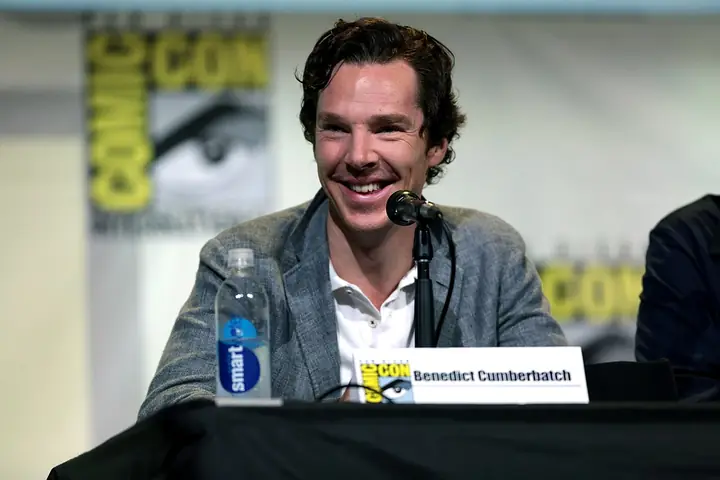
Sherlock (2010): Benedict Cumberbatch sitting at a tableImage: Wikimedia Commons · Gage Skidmore from Peoria, AZ, United States of America, CC BY-SA 2.0 - #228
Benedict Cumberbatch starred in Peter Jackson's "Hobbit" trilogy alongside Christopher Lee. Both actors have portrayed Sherlock Holmes in different productions. Also Ian McKellen portrayed an elderly Sherlock in Mr. Holmes (2015).
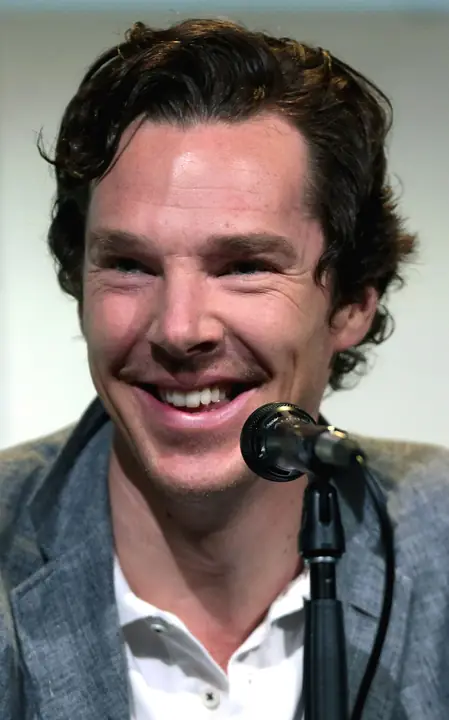
Sherlock (2010): Benedict Cumberbatch smiling while speaking into a microphoneImage: Wikimedia Commons · Gage Skidmore, CC BY-SA 3.0 - #229
Benedict Cumberbatch, Robert Downey Jr. and Ian McKellen have all played the character of Sherlock Holmes before. All three of them have also played roles in Marvel movies. Cumberbatch plays Dr. Stephen Strange, Downey plays Iron Man and McKellen played Magneto. Whilst Sir Michael Caine and Matt Frewer, who also played Sherlock Holmes, both appeared in DC movies. Frewer as the former villain Moloch in Watchmen, and Caine as Bruce Wayne's butler Alfred Pennyworth in Christopher Nolan's Dark Knight Trilogy. Matt Frewer was also in the Marvel made-for-TV movie Generation X (1996).
- #230
In the summer of 2011, Danny Boyle created a National Theatre production of 'Frankenstein' in which Benedict Cumberbatch and Jonny Lee Miller played the creator and the monster and alternately changed nightly. Both actors then went on to play another Victorian creation, Sherlock Holmes, both set in the present day, albeit on opposite sides of the Atlantic.
- #231
Benedict Cumberbatch, Martin Freeman and Toby Jones are involved in comic book movies in the MARVEL cinematic universe. Cumberbatch plays Dr. Stephen Strange in Doctor Strange (2016), Freeman has a role in Captain America: Civil War (2016) and Black Panther (2018) as Everett K. Ross and Toby Jones as Dr. Arnim Zola.
Life & Family (1)
Continue through the archive


Sources & editorial notes
Reference databases
- Wikipedia
- IMDb
Sources for the entries on this page
- Wikipedia Sherlock (TV series) — Wikipedia
Information from external sources is independently selected, consolidated and edited by Arka Evren. Sources are listed for verification and further reading. Encyclopedia text is used under its licence (CC BY-SA). How we work