

TV SERIES · 1993–2018 · USA
The X-Files
- Created by
- Chris Carter
- Network
- FOX
- Seasons
- 11
- Episodes
- 218
- Studio
- Ten Thirteen Productions, 20th Century Fox Television
501 archived facts 8 topics 1 source Last reviewed Nov 2026
The exploits of FBI Special Agents Fox Mulder and Dana Scully who investigate X-Files: marginalized, unsolved cases involving paranormal phenomena. Mulder believes in the existence of aliens and the paranormal while Scully, a skeptic, is assigned to make scientific analyses of Mulder's discoveries that debunk Mulder's work and thus return him to mainstream cases.

501 Interesting Facts About The X-Files
Interesting Facts (44)
- #001
- #002
- #003
- #004
Several actors and actresses who co-starred or guest-starred would eventually go on to prominent co-starring or recurring roles in Stargate SG-1 (1997) and/or its spin-offs: Amanda Tapping (Colonel Carter); Don S. Davis (General Hammond); Mitch Pileggi (Colonel Caldwell); Teryl Rothery (Dr. Janet Frasier); Colin Cunningham (Major Paul Davis); Megan Leitch (Captain Ke'ra); Steven Williams (Gen. Vidrine); Bill Dow (Dr. Bill Lee); Elizabeth Rosen (Lieutenant Jennifer Hailey); Jamil Walker Smith (Master Sergeant Ronald Greer); and Willie Garson (Marty Lloyd).
- #005
- #006
- #007
- #008
- #009
According to X-Files creator Chris Carter, when he first pitched the idea for his series to 20th Century Fox, they declined because they weren't interested in a UFO drama series. After Carter got turned down by Columbia, Universal, Warner Bros., and Paramount, Fox reconsidered, and ended up liking Carter's idea.
- #010
- #011
Gillian Anderson has declared several times that her favorite episode is "Bad Blood" and David Duchovny that his favorite end in an episode is 'The Post-Modern Prometheus'', in which Mulder and Scully dance together. Also, they agree that the third season episode "Teso Dos Bichos" is the worst one, with Anderson calling it "that one episode about killer pussycats".
- #012
- #013
Props from Mulder's X-Files office are currently preserved and on display at the Hollywood Entertainment Museum in Los Angeles. According to the museum, the famous I Want to Believe UFO poster from the office continually had to be replaced as copies kept disappearing from the set. The poster on display at the museum is reportedly one of the last available copies of the original set-used posters.
- #014
- #015
- #016
- #017
The series does not show episode titles on-screen. While this was not unusual even in 1993 (though it is more commonplace in 2004 when virtually no American dramatic television series display episode titles), what is unusual is that many fans learned episode titles as well as advance plot information via the Internet. The X-Files was one of the first television series to be so promoted.
- #018
- #019
Piper Anderson-Klotz, Gillian Anderson's daughter, was literally raised on the set of this show, so when she saw a monster or something that would scare any other child she used to be curious and ask if she could touch it. Regarding this situation, David Duchovny used to say he was lucky for not being the one who would have to pay for her therapist. On the contrary, when Gillian wanted to her younger sons see her in the series she showed them Bad Blood (1998), one of the most comic episodes, it only gave them nightmares.
- #020
- #021
- #022
- #023
According to The X-Files creator Chris Carter, when he first pitched the idea for the series to 20th Century Fox, they turned it down because they were not interested in a UFO drama. After Carter was rejected by Columbia, Universal, Warner Bros. and Paramount, Fox reconsidered and eventually liked his idea.
- #024
- #025
Chris Carter wanted the series to end after the fifth season, when his original contract along with Gillian Anderson's and David Duchovny's contracts expired. Carter wanted to continue the story in a series of feature films beginning with The X Files (1998). However, FOX Network realized that demand for the series was too high to cancel it, and instead required the film to fit between the show's fifth and sixth seasons. Carter found writing the fifth and sixth seasons alongside the film very difficult, since he had to craft a script that viewers would not need to have seen the series to understand, and a run of episodes tied to the film that would not depend directly on the film's plot to make sense.
- #026
Gillian Anderson has said several times that her favorite episode is "Bad Blood," while David Duchovny said his favorite ending in an episode is 'The Post-Modern Prometheus,' in which Mulder and Scully dance together. They also agree that the third-season episode "Teso Dos Bichos" is the worst episode, and Anderson calls it "that one episode about killer pussycats."
- #027
When the producers cast the role of the Cigarette Smoking Man, they had no idea the character would become so important to the series. Once the character grew more prominent, they worried that William B. Davis, who had been cast merely as an extra, could not carry the role. As it turned out, Davis, one of Canada's most respected acting teachers, impressed series creator Chris Carter so much that he made the Cigarette Smoking Man the show's main villain.
- #028
- #029
The props in Mulder's X-Files office are now preserved and displayed at the Hollywood Entertainment Museum in Los Angeles. According to the museum, the office's famous "I Want to Believe" UFO poster had to be replaced constantly because copies kept disappearing from the set. The poster on display at the museum is reported to be one of the last surviving copies of the posters used on the original set.
- #030
- #031
- #032
- #033
- #034
- #035
The series does not display episode titles on screen. While this was not unusual even in 1993 (it became more common by 2004, when almost no American dramatic television series showed episode titles), what was unusual was that many fans learned episode titles, as well as advance plot information, through the Internet. The X-Files was one of the first television series to be promoted this heavily.
- #036
- #037
- #038
Throughout the ninth season of the series, the opening title sequence included an image of a list titled "F. B. I. Contacts, Witnesses, and Contributors." The names on the list were actually the screen names of posters on the official "X-Files" message board and changed with each new episode that season. The other names on the list were anagrams of characters from the series.
- #039
- #040
Gillian Anderson's daughter Piper Anderson-Klotz literally grew up on the set of this series, so whenever she saw a monster or anything that would frighten a child, she would become curious and ask whether she could touch it. Regarding this, David Duchovny would say that he was lucky not to be the one who had to pay for her therapist. Gillian, on the other hand, when she wanted to show the series to her young sons, showed them Bad Blood (1998), one of the funniest episodes, and only gave them nightmares.
- #041
- #042
- #043
- #044
Production Story (185)
- #045
Mimi Rogers was cast at David Duchovny's suggestion; they had worked together in The Rapture.
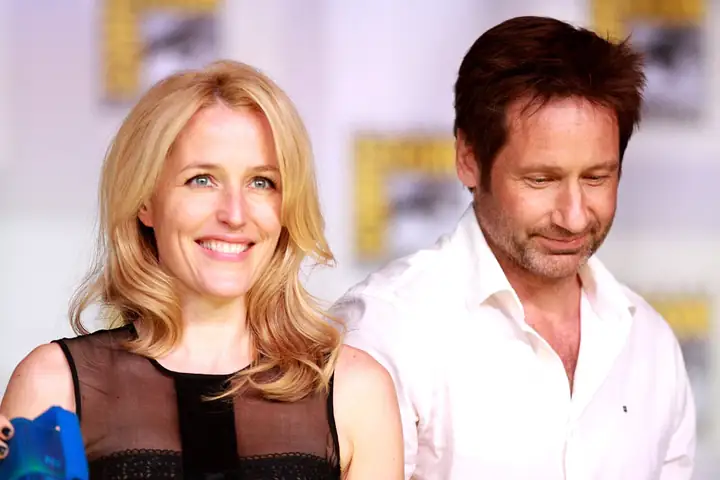
The X-Files (1993): Gillian Anderson and David Duchovny at an eventImage: Wikimedia Commons · Gage Skidmore from Peoria, AZ, United States of America, CC BY-SA 2.0 - #046
- #047
The first five seasons of the show were filmed in Vancouver, British Columbia, Canada. The show often cast local Canadian actors in guest and secondary roles, often reusing the same actors in different parts in multiple episodes. The most prominent example of this was Nicholas Lea, who appeared in a guest role in Season One before being cast in the unconnected, more prominent role of Alex Krycek starting in Season Two, but there are many other examples of local actors who had multiple roles over the course of several different episodes, including: Roger Cross, J.B. Bivens, Lorena Gale, Gillian Barber, Forbes Angus, Larry Musser, Harrison Coe, Hrothgar Mathews, P. Lynn Johnson, and Doug Abrahams (among many others). Each of these appeared in three or more episodes, each time as a different character (Barber played three characters in four episodes).
- #048
- #049
Chris Carter wanted the show to end after the fifth season, when his original contract, as well as those of Gillian Anderson and David Duchovny, expired. Carter wanted to continue the story in a series of feature films, starting with The X Files (1998). The FOX Network, however, found demand for the show too high to cancel the series, so they instead mandated that the film fit in between seasons five and six of the show. Carter found writing seasons five and six as well as the film very difficult, as he had to craft a screenplay that would not require the audience to have seen the show to understand it, and episodes of the series that would tie in to the film but not rely directly on the film's plot to make sense.
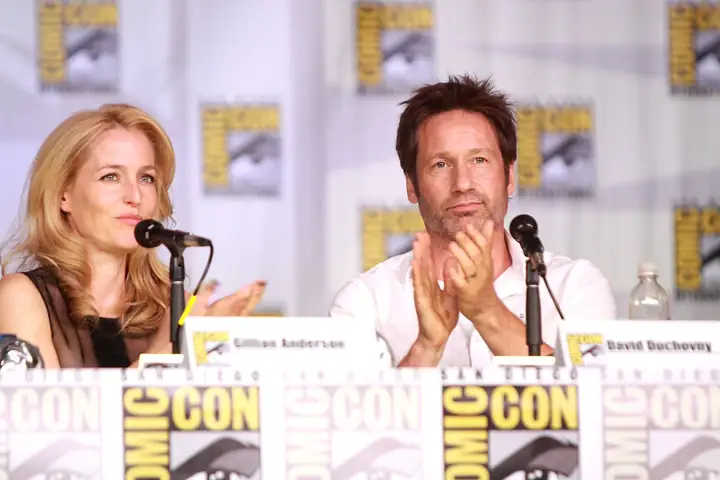
The X-Files (1993): Gillian Anderson and David Duchovny at a Comic-Con panelImage: Wikimedia Commons · Gage Skidmore from Peoria, AZ, United States of America, CC BY-SA 2.0 - #050
- #051
- #052
When the series started, many broadcasters would show the series in a prime late evening slot. For example in the UK and Ireland, BBC One (UK terrestrial) and RTE 2 (Ireland terrestrial), and Sky One (UK and Ireland satellite) could often be only a few episodes apart within the same season. By 2019, only RTE 2 was showing season 11, and even then it had been shunted onto the mid-week 2am slot, as many fans had drifted away over 26 years.
- #053
- #054
- #055
- #056
- #057
Chris Carter has cited Moonlighting (1985) as an influence on this show, specifically the relationship between Mulder and Scully. Carter also has said that the show is an example of how not to further the story, as the sexual tension between the two leads should never be resolved. In spite of this, he always has admitted that Scully loves Mulder and Mulder loves Scully, although he is not very open to a romantic relationship between them being more agree with a platonic love for them.
- #058
- #059
Being too young for the part, Gillian Anderson lied about her real age when she auditioned for it, saying that she was four years older than she actually was.
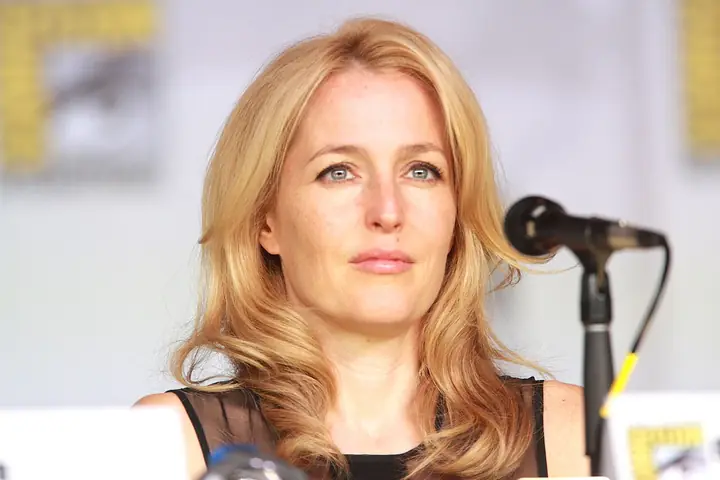
The X-Files (1993): Gillian Anderson in front of a microphoneImage: Wikimedia Commons · Gage Skidmore from Peoria, AZ, United States of America, CC BY-SA 2.0 - #060
Former director and producer Rob Bowman didn't return to direct the series because in a roundtable discussion as to whether or not to do another "X-Files" feature film, it was decided that a six-episode mini-series would be able to go more in depth with previous story arcs and continuity from the original series and first film.
- #061
In the UK, Twentieth Century Fox Home Entertainment released new "Mytharc" multi-part episodes as edited-together television movies on VHS in the mid-1990s. However, these tapes (which usually took the title of just one of the episodes comprising them but were sometimes completely re-named) were extremely expensive and released as numbered "Files" in the wrong order. For example, "File 3: Abduction" ("Duane Barry"/"Ascension"/"One Breath") confusingly came after "File 1: The Unopened File" ("Anasazi"/"The Blessing Way"/"Paper Clip"). Although by the third season most mythology episodes were multi-part stories, important plot information relating to the conspiracy could still sometimes only be found in the unavailable standalone episodes, further confusing viewers of these releases. Also, "Colony"/"Endgame" and "Piper Maru"/"Apocrypha" were seemingly forgotten to be included in the series until long after many later episodes.
- #062
- #063
- #064
- #065
Throughout most of the series run, the penultimate (last but one) episode of each season is usually themed as a pastiche, or loving tribute to an iconic piece of popular culture. For example, in one season, it was a clear reference to cult Paramount series "The Brady Bunch", and in season 11 the reference was the Hammer Films' horror film genre. Often it's blatant, and sometimes it's subtle.
- #066
- #067
Fox executives originally wanted Pamela Anderson to play Dana Scully. They objected to Gillian Anderson, asking, "Where's the sex appeal?" Chris Carter recalled, "Even though Gillian's beautiful, she wasn't their idea of sexy. First, because they didn't understand what I was trying to do with the show. And she was an unknown, so that never helps."
- #068
- #069
- #070
- #071
- #072
One of the first television series to switch to a 16:9 widescreen aspect ratio, beginning with its fifth season in 1997 at the insistence of Chris Carter to give the show a more cinematic feel, though FOX aired the episodes cropped to 4:3 while the original 16:9 versions were released on DVD. The series was remastered in 16:9 high definition in 2014, converting the first four seasons to widescreen as well, generally through cropping.
- #073
In a 2015 interview with National Public Radio, composer Mark Snow said that when he was originally trying to compose the theme song, after he sent series creator Chris Carter a few ideas, which Carter rejected, Carter sent Snow the 1985 song "How Soon Is Now?" by The Smiths, saying, "I just love these guitars. Listen to this song, and see if it inspires something." Snow also said that he got the idea for the whistling element of the theme from an old Proteus sample called "Whistling Joe", but the whistle actually heard in the recording of the theme is bolstered by Snow's wife, who was a particularly strong whistler.
- #074
The addition of the Skinner character in Tooms (1994) was fortuitous for Mitch Pileggi, as the part was to go to the actor who played Blevings but who was busy when this episode was to be shot, and it was given to Pileggi instead. His chemistry with Mulder, Scully, and CSM resulted in Skinner being made a permanent member of the cast of characters.
- #075
- #076
- #077
- #078
The series does not show episode titles on-screen. While this was not unusual even in 1993 (though it is more commonplace in 2004, when virtually no American dramatic television series display episode titles), what is unusual is that many fans learned episode titles as well as advance plot information via the Internet. The X-Files was one of the first television series to be so promoted.
- #079
According to X-Files creator Chris Carter, when he first pitched the idea for his series to 20th Century Fox, they declined because they weren't interested in a UFO drama series. After Carter was turned down by Columbia, Universal, Warner Bros. and Paramount, Fox reconsidered and ended up liking Carter's idea.
- #080
- #081
Some episodes were compiled and commercialized on VHS as movies, as part of a limited series plus two documentaries. The list of these VHS releases is as follows: - "The X Files: File 1 - Unopened File": Anasazi (1995), The Blessing Way (1995) and Paper Clip (1995). - "The X Files: File 2 - Tooms": Squeeze (1993) and Tooms (1994). - "The X Files: File 3 - Abduction": Duane Barry (1994), Ascension (1994) and One Breath (1994). - "The X Files: File 4 - Colony": Colony (1995) and End Game (1995). - "The X Files: File 5 - 82517": Nisei (1995) and 731 (1995). - "The X Files: Special Edition - Piper Maru": Piper Maru (1996) and Apocrypha (1996). - "The X Files: File 6 - Master Plan": Talitha Cumi (1996) and Herrenvolk (1996). - "The X Files: File 7 - Tunguska": Tunguska (1996) and Terma (1996). - "The X Files: File 8 - Tempus Fugit": Tempus Fugit (1997) and Max (1997). - "The X Files: File 9 - Redux": Gethsemane (1997), Redux (1997) and Redux II (1997). - "The X Files: File 10 - Emily": Christmas Carol (1997) and Emily (1997). - "The X Files: File 11 - Patient X": Patient X (1998) and The Red and the Black (1998). - "The X Files: The End": The End (1998) and the documentary Inside the X Files (1998), which includes interviews with the cast and creator Chris Carter, never-before-seen segments from the series, some outtakes, as well as a preview for the then-upcoming movie The X Files (1998). - Secrets of the X Files, Part 1 (1995). - Secrets of the X Files, Part 2 (1996).
- #082
Chris Carter wanted the show to end after the fifth season, when his original contract, as well as those of Gillian Anderson and David Duchovny expired. Carter wanted to continue the story in a series of feature films, starting with The X Files (1998). The FOX Network, however, found demand for the show too high to cancel the series, so they instead mandated the film to fit in between seasons five and six of the show. Carter found writing seasons five and six as well as the film very difficult, as he had to craft a screenplay that would not require the audience to have seen the show to understand it, and episodes of the series that would tie in to the film, but not rely directly on the film's plot to make sense.
- #083
Contains a major spoiler — show
The Lone Gunmen (Bruce Harwood, Tom Braidwood, and Dean Haglund) from the original series were contacted about the possibility of appearing in an episode of the tenth season. Eventually they made a silent cameo in Babylon (2016) dressed like cowboys as part of a drug-induced hallucination of Mulder.
- #084
Contains a major spoiler — show
At the conclusion of Season Seven, David Duchovny and Gillian Anderson had yet to be signed for extra seasons, and most of the cast and crew assumed the show would end. Chris Carter wrote the episode "Requiem" to function as a series finale, but at the last minute the FOX Network decided to renew the show. Only Anderson agreed to return to the show full-time, though, and Carter created the characters of John Doggett (Robert Patrick) and Monica Reyes (Annabeth Gish) to compensate for Duchovny's absence. Carter also retooled the series mythology to focus on government Super Soldiers and to eliminate plot threads regarding the alien invasion conspiracy, with the hope that it would revive interest in the show.
- #085
Contains a major spoiler — show
When casting the role of the Cigarette Smoking Man, the producers had no idea the character would turn into a major role in the series. When the character became more prominent, they worried that William B. Davis, who had only been cast as an extra, would not be able to carry the part. As it turned out, Davis, who is one of the most respected acting teachers in Canada, impressed series creator Chris Carter so much that he made the Cigarette Smoking Man the main villain of the series.
- #086
Contains a major spoiler — show
Chris Carter stated that the X-Files weren't closed, since the F.B.I. had discovered the hybrid race invasion would happen in 2012. Allegedly, the timeline takes place after the invasion had already begun. This creates a "backwards"-envisioned storyline told in the present tense that watches what may have happened during the time lapse.
- #087
Contains a major spoiler — show
Scully's abduction during the second season was originally planned as a way of explaining Gillian Anderson's absence due to pregnancy. Later, series creator Chris Carter turned it into a vital plot point to the ongoing series mythology for the original run of the series until 2002 as well as in the revival of 2015 to 2016.
- #088
- #089
Contains a major spoiler — show
In 2013, a comic book series titled The X-Files Season 10 started its run. Written by Joe Harris and published by IDW Publishing, the comics are set after the events of Season 9 of the television show and continue its story while also trying to tie up some of its loose ends. Chris Carter also worked on the comic book as the executive producer, and some of his ideas were used in the stories. The main series ran for 25 issues, but several miniseries and one-shots written by Harris and Karl Kesel were also released, including The X-Files: Year Zero and The X-Files X-Mas Special 2014. Some issues of The Season 10 comic were adapted in 2017 into The X-Files: Cold Cases and The X-Files: Stolen Lives, a pair of audio drama mini-series produced by Dirk Maggs for Audible. The voice cast includes David Duchovny, Gillian Anderson, Mitch Pileggi, William B. Davis, Tom Braidwood, Dean Haglund, and Bruce Harwood, who all reprise their roles from the television show. The X-Files: Cold Cases adapted the stories: Believers (70 min), Hosts (38 min), Being for the Benefit of Mr. X (25 min), More Musings of a Cigarette Smoking Man (23 min), Pilgrims (87 min). The X-Files: Stolen Lives, which continues the story from Cold Cases but also ends on an open ending, adapted the stories: Immaculate (41 min), Chitter (22 min), Monica & John (21 min), G-23 (40 min), Elders (98 min). Since the comic book series' overall plot goes in a completely different direction than the plot of Season 10 and Season 11 of the television show, the comics and the audio dramas are non-canon.
- #090
Contains a major spoiler — show
There are 69 alien mythology episodes in the series. Season eight has the biggest amount, with ten of them coming from there. Only two episodes in season eight involving Mulder didn't focus on the mythology arc. There are also other episodes about extraterrestrials and alien abductions unrelated to the arc, such as Conduit (1993) and Clyde Bruckman's Final Repose (1995).
- #091
Contains a major spoiler — show
At the conclusion of Season Seven, David Duchovny and Gillian Anderson had yet to be signed for extra seasons, and most of the cast and crew assumed the show would end. Chris Carter wrote the episode "Requiem" to function as a series finale, at the last minute the FOX Network decided to renew the show. Only Anderson agreed to return to the show full-time, though, and Carter created the characters of John Doggett (Robert Patrick) and Monica Reyes (Annabeth Gish) to compensate for Duchovny's absence. Carter also retooled the series mythology to focus on government Super Soldiers, and to eliminate plot threads regarding the alien invasion conspiracy with the hopes that it would revive interest in the show.
- #092
- #093
According to X-Files creator Chris Carter, when he first pitched the series to 20th Century Fox, they turned it down because they were not interested in a UFO drama. After Carter was also rejected by Columbia, Universal, Warner Bros. and Paramount, Fox reconsidered and ultimately liked Carter's idea.
- #094
Chris Carter wanted the series to end after the fifth season, because his own contract and those of Gillian Anderson and David Duchovny expired at that point. Carter wanted to continue the story in a series of feature films beginning with The X Files (1998). However, FOX Network, believing demand for the series was too high, instead of cancelling it forced the film to be squeezed in between the fifth and sixth seasons. Carter found it very difficult to write the fifth and sixth seasons and the film at the same time, because he had to write a script that did not require having watched the series in order to understand the film, and episodes that were connected to the film but not directly based on its plot.
- #095
When Gillian Anderson learned just a few months after the series began that she was pregnant and that the show had become a major success, she first told David Duchovny, then the producers. Everyone was extremely supportive, and they even found a story arc to keep her on the show until shortly before the birth. Series creator Chris Carter did not replace her with another actress. His reward was being chosen as the godfather of Anderson's daughter.
- #096
Scully's abduction in the second season was in fact planned to explain Gillian Anderson's absence due to her pregnancy. Series creator Chris Carter later turned this into a vital plot point in the series mythology that continued through the show's original run, which lasted until 2002, and its 2015-2016 revival.
- #097
The series does not show episode titles on screen. Although this was not unusual even in 1993 (by 2004 almost no American drama series displayed episode titles), what was unusual was that many fans learned the episode titles and advance plot information via the internet. The X-Files was one of the first television series to be promoted in this way.
- #098
At the end of the seventh season, David Duchovny and Gillian Anderson had not yet signed contracts for additional seasons, and most of the cast and crew assumed the series would end. Chris Carter wrote the episode "Requiem" as a series finale, but at the last moment FOX Network decided to renew the show. Only Anderson agreed to return full-time, and Carter created the characters John Doggett (Robert Patrick) and Monica Reyes (Annabeth Gish) to compensate for Duchovny's absence. Carter also restructured the series mythology to focus on government Super Soldiers and hoped to revive interest in the show by eliminating plotlines involving the alien invasion conspiracy.
- #099
- #100
- #101
- #102
Many news outlets reported that Gillian Anderson was offered only half of David Duchovny's salary to return as Dana Scully for the tenth season. "The Daily Beast" interviewed Anderson about this, and Anderson said, "I'm surprised more (interviewers) haven't brought it up, because it's true." Regarding the pay disparity, first reported in "The Hollywood Reporter", Anderson said, "I think it's important that it gets heard and voiced, especially in this climate where women are talking about the (unequal pay) reality in this business. It was shocking to me, given all the work I had done in the past to get paid fairly. I worked really hard for it and finally got somewhere. Even in interviews in the last few years, people have said to me, 'I can't believe that happened, how did you feel about it, that's insane.' My response has always been, 'That was then, this is now.' And then it happened again! I don't even know what to say about it... It's... sad... Sad." In the end, they were paid equally for the series.
- #103
Chris Carter has cited Moonlighting (1985) as an inspiration for this series, particularly for the relationship between Mulder and Scully. Carter also said the series was an example of how the story should not be advanced, because the sexual tension between the two leads should never be resolved. Despite this, he always acknowledged that Scully loved Mulder and Mulder loved Scully, but he was not very keen on a romantic relationship between them and preferred a platonic love.
- #104
- #105
Gillian Anderson's daughter, Piper Anderson-Klotz, worked in the Art Department during the production of the tenth and eleventh seasons. Piper was born during the show's second season, and her unexpected birth led the show's writers to devise Scully's abduction, an event that became one of the most important mythological arcs of the original series. The third-season episode Piper Maru (1996) is also named after her.
- #106
- #107
The Lone Gunmen from the original series (Bruce Harwood, Tom Braidwood and Dean Haglund) were contacted about the possibility of appearing in an episode of the tenth season. In the end, they made a silent cameo in the episode Babylon (2016), dressed as cowboys, as part of a drug-induced hallucination of Mulder's.
- #108
- #109
- #110
- #111
- #112
Former director and producer Rob Bowman did not return to direct the series because, at a round-table meeting on whether to make another X-Files feature film, it was decided that a six-episode miniseries could engage more deeply with the previous story arcs and the continuity from the original series and the first film.
- #113
In the United Kingdom, Twentieth Century Fox Home Entertainment released the new "Mytharc" multi-part episodes on VHS in the mid-1990s as edited-together television movies. However, these tapes (which usually took the name of only one of the episodes that made them up, but were sometimes renamed entirely) were extremely expensive and were released as numbered "Files" in the wrong order. For example, "File 3: Abduction" ("Duane Barry"/"Ascension"/"One Breath") confusingly came after "File 1: The Unopened File" ("Anasazi"/"The Blessing Way"/"Paper Clip"). Although most of the mythology episodes in the third season were multi-part stories, important plot information related to the conspiracy could still be found only in standalone episodes that were not available, which confused the viewers of these releases even further. In addition, "Colony"/"Endgame" and "Piper Maru"/"Apocrypha" appeared not to have been included in the series until long after later episodes.
- #114
Chris Carter stated that The X-Files was not closed down because the FBI discovered that the alien race's invasion would take place in 2012. The timeline is allegedly set at a time when the invasion has already begun. This creates a "retrospective" narrative approach, told in the present day and following what might have happened in the time gap.
- #115
- #116
When the series began, many broadcasters showed it in prime time. For example, in the United Kingdom and Ireland, BBC One, RTÉ 2 and Sky One could broadcast only a few episodes apart within the same season. By 2019, only RTÉ 2 was showing the eleventh season, and it had been pushed to 2 a.m. on weekdays, because over the course of 26 years many viewers had drifted away from the series.
- #117
- #118
- #119
- #120
In 2013, a comic book series titled 'The X-Files Season 10' began publication. Written by Joe Harris and published by IDW Publishing, the comics take place after the ninth season of the television series, continuing the story while attempting to tie up some loose ends. Chris Carter also served as an executive producer on the comic, and some of his ideas were used in the stories. The main series ran for 25 issues, but many miniseries and one-shot stories were also published, such as 'The X-Files: Year Zero' and 'The X-Files X-Mas Special 2014', both written by Harris and Karl Kesel. Some issues of the Season 10 comic were adapted in 2017 into two audio drama miniseries produced by Dirk Maggs for Audible: 'The X-Files: Cold Cases' and 'The X-Files: Stolen Lives'. The voice cast included names such as David Duchovny, Gillian Anderson, Mitch Pileggi, William B. Davis, Tom Braidwood, Dean Haglund and Bruce Harwood, reprising their roles from the television series. 'Cold Cases' adapted the following stories: Believers (70 min), Hosts (38 min), Being for the Benefit of Mr. X (25 min), More Musings of a Cigarette Smoking Man (23 min), Pilgrims (87 min). 'Stolen Lives', meanwhile, continues the story of Cold Cases while ending on an open note, and adapted the following stories: Immaculate (41 min), Chitter (22 min), Monica & John (21 min), G-23 (40 min), Elders (98 min). Because the overall storyline of the comic series went in a completely different direction from the tenth and eleventh seasons of the television series, the comics and audio dramas are considered non-canon.
- #121
Some episodes were compiled and released as films on limited-edition VHS; two documentaries were also included. The list of these VHS releases is as follows: - 'The X Files: File 1 - Unopened File': Anasazi (1995), The Blessing Way (1995) and Paper Clip (1995). - 'The X Files: File 2 - Tooms': Squeeze (1993) and Tooms (1994). - 'The X Files: File 3 - Abduction': Duane Barry (1994), Ascension (1994) and One Breath (1994). - 'The X Files: File 4 - Colony': Colony (1995) and End Game (1995). - 'The X Files: File 5 - 82517': Nisei (1995) and 731 (1995). - 'The X Files: Special Edition - Piper Maru': Piper Maru (1996) and Apocrypha (1996). - 'The X Files: File 6 - Master Plan': Talitha Cumi (1996) and Herrenvolk (1996). - 'The X Files: File 7 - Tunguska': Tunguska (1996) and Terma (1996). - 'The X Files: File 8 - Tempus Fugit': Tempus Fugit (1997) and Max (1997). - 'The X Files: File 9 - Redux': Gethsemane (1997), Redux (1997) and Redux II (1997). - 'The X Files: File 10 - Emily': Christmas Carol (1997) and Emily (1997). - 'The X Files: File 11 - Patient X': Patient X (1998) and The Red and the Black (1998). - 'The X Files: The End': The End (1998) and the documentary Inside the X Files (1998); this documentary features interviews with the cast and creator Chris Carter, previously unseen scenes from the series, some bloopers and a preview of The X Files (1998) film, which was due for release at the time. - Secrets of the X Files, Part 1 (1995). - Secrets of the X Files, Part 2 (1996).
- #122
- #123
In the opening credits, Mulder's and Scully's FBI badges read 'Federal Bureau of Justice, United States Department of Investigation'. This change was made because it is illegal to make a fake FBI badge, even for a TV show. A real badge reads 'Federal Bureau of Investigation, United States Department of Justice'.
- #124
- #125
- #126
- #127
Gillian Anderson's daughter, Piper Anderson-Klotz, essentially grew up on set. As a result, when she saw a monster or something else that would frighten other children, she would become curious and ask whether she could touch it. David Duchovny used to say of the situation that he was lucky not to have to pay for a therapist. By contrast, when Gillian wanted to show her young sons her work on the show, she had them watch one of the funniest episodes, 'Bad Blood' (1998), but it only gave them nightmares.
- #128
The first five seasons of the show were filmed in Vancouver, British Columbia, Canada. The show generally cast local Canadian actors in guest and supporting roles and reused the same actors in multiple episodes as different characters. The most prominent example was Nicholas Lea, who appeared as a guest actor in the first season and later played the more significant role of Alex Krycek from the second season onward. However, many other local actors also took on multiple roles in different episodes, including Roger Cross, J.B. Bivens, Lorena Gale, Gillian Barber, Forbes Angus, Larry Musser, Harrison Coe, Hrothgar Mathews, P. Lynn Johnson and Doug Abrahams. For example, Barber played three different characters in four episodes.
- #129
- #130
Although the Cigarette Smoking Man is famous for constantly smoking, he says the word 'cigarette' only once across all seasons of the show. William B. Davis, who played him, was a former smoker who had not smoked since 1973 and had quit twenty years before being cast in the show. The cigarettes he smoked at the beginning of the show were real, but when he noticed he was craving tobacco between takes, herbal cigarettes were used at his request.
- #131
When she returned to the role of Scully for the tenth season, Gillian Anderson chose to wear a wig rather than dye her hair red, because right after filming the revival season she would have to dye her hair blonde again (for her role in The Fall (2013)), which could have caused her hair to fall out.
- #132
- #133
In a 2015 interview with National Public Radio, composer Mark Snow said that while trying to compose the theme music, he sent several ideas to show creator Chris Carter, but Carter rejected them. Carter sent Snow The Smiths' 1985 song 'How Soon Is Now?' and said, 'I love these guitars. Listen to this song and see if it inspires anything in you.' Snow also said he got the idea for the whistling effect in the theme from an old Proteus sample called 'Whistling Joe', but that the whistle heard on the recording was reinforced by his wife, who whistles very well.
- #134
- #135
- #136
The show is one of the first television series to switch to a 16:9 widescreen aspect ratio, starting with its fifth season in 1997, at Chris Carter's insistence to give it a more cinematic feel. However, FOX broadcast the episodes cropped to 4:3, while the original 16:9 versions were released on DVD. The show was remastered in 16:9 high definition in 2014, and the first four seasons were also converted to widescreen, generally through cropping.
- #137
- #138
Gillian Anderson has repeatedly stated that her favorite episode is "Bad Blood," while David Duchovny has repeatedly said his favorite finale is "The Post-Modern Prometheus," in which Mulder and Scully dance together. Both also consider the third-season episode "Teso Dos Bichos" the worst episode; Anderson refers to it as "that episode with the killer cats."
- #139
When casting the role of the Cigarette Smoking Man, the producers did not know the character would become a major figure in the series. Once the character came to the fore, they worried that William B. Davis, who had been hired only as an extra, would not be able to carry the role. But Davis, one of Canada's most respected acting teachers, impressed series creator Chris Carter so much that Carter made the Cigarette Smoking Man the show's main villain.
- #140
David Duchovny and Gillian Anderson attended the Golden Globes ceremony together in 1997 and held hands all night. The pair won the awards for best actor and best actress in a drama series. As Anderson accepted her award, she was seen swearing when she saw Duchovny thanking her, because she had realized she forgot to thank him.
- #141
- #142
- #143
Despite their characters' chemistry and the deliberately slow-building sexual tension, both David Duchovny and Gillian Anderson admitted that during the series' first broadcast run they were less close and argued because of the long shooting hours in Vancouver. After the series ended in 2002, the natural rapport between them grew, and they now see themselves as good friends closer than their own spouses.
- #144
- #145
Gillian Anderson stated that she based her approach to the role of Dana Scully on Jodie Foster's performance as Clarice Starling in The Silence of the Lambs (1991). Ironically, because her contractual obligation to "The X-Files" barred her from playing an FBI agent in another role, she was not offered the part of Clarice Starling in the Silence sequel Hannibal (2001). She later joined the series Hannibal (2013) as Bedelia Du Maurier.
- #146
The addition of the character Skinner in the episode Tooms (1994) was a lucky development for Mitch Pileggi, because the role was originally going to go to the actor who played Blevings, but that actor was busy while the episode was being shot and the role was given to Pileggi. His chemistry with Mulder, Scully and the CSM made Skinner a permanent character.
- #147
- #148
- #149
- #150
- #151
- #152
- #153
- #154
Many stars appeared in the series before they became famous: Giovanni Ribisi, Jack Black, Lucy Liu, Ryan Reynolds, Luke Wilson, Aaron Paul, Seth Green, Felicity Huffman, Michael Bublé, Terry O'Quinn, Bryan Cranston and Willie Garson. The series also drew many actors who were already quite famous before it aired: Jodie Foster, Cary Elwes, Robert Patrick, John Neville, Peter Boyle, Burt Reynolds, Frances Fisher, Roy Thinnes, Minnie Driver, Garry Shandling, Lance Henriksen, Lily Tomlin, Edward Asner, Lily Taylor, Mimi Rogers and Kurtwood Smith.
- #155
- #156
- #157
- #158
Gillian Anderson on her chemistry with David Duchovny: "For whatever reason, when we come together there's a very interesting and intriguing energy between us. Why do we have that? Other actors I've worked with have had screen appeal too, but it's not the same. What's different between David and me? I don't know."
- #159
Unlike Scully, Mulder's religion was never explicitly stated in the series, but in The Official Guide to the X-Files (published after the second season), David Duchovny said he "would consider Mulder Jewish until told otherwise." Later, several references to Mulder's possible Jewishness were made, such as bigots assuming he is Jewish in the episodes "Kaddish" and "Drive."
- #160
- #161
- #162
- #163
- #164
- #165
Gillian Anderson holds the record for appearing in the most episodes of the series and is absent from only these five episodes: Mulder's solo episode 3 (1994) (though she is briefly mentioned in dialogue by Scully), Skinner's episode Zero Sum (1997), the Lone Gunmen's episode Unusual Suspects (1997), the flashback episode Travelers (1998) and Agent Doggett's solo episode The Gift (2001).
- #166
- #167
Nearly all of David Duchovny's and Gillian Anderson's children worked on the series. Gillian's daughter, Piper Anderson-Klotz, worked in the art department in the tenth and eleventh seasons. Her younger siblings, Oscar and Felix, appeared as extras in the eleventh-season episode This (2018); they can be seen on the bus that Mulder and Scully travel on. West Duchovny had a small but important role in the eleventh season's final episode, My Struggle IV (2018), but David's young child Miller never acted in the series.
- #168
- #169
Many actors and actresses who appeared on the series as guest or supporting players later took on major roles in Stargate SG-1 (1997) and/or its spin-offs: Amanda Tapping (Colonel Carter); Don S. Davis (General Hammond); Mitch Pileggi (Colonel Caldwell); Teryl Rothery (Dr. Janet Frasier); Colin Cunningham (Major Paul Davis); Megan Leitch (Captain Ke'ra); Steven Williams (General Vidrine); Bill Dow (Dr. Bill Lee); Elizabeth Rosen (Lieutenant Jennifer Hailey); Jamil Walker Smith (Sergeant First Class Ronald Greer); and Willie Garson (Marty Lloyd).
- #170
- #171
Although they share no scenes in the series, it brings together two actors from Earth Star Voyager: Part 1 (1988): Peter Donat and Bruce Harwood. Donat and Harwood played Admiral Beasley and Dr. Eugene Leland respectively; in this series they played Mulder's father and "J.F." Byers (one of the Lone Gunmen).
- #172
- #173
Chris Carter wanted the series to end after the fifth season, since his own contract and those of Gillian Anderson and David Duchovny expired at that point. Carter wanted to continue the story in a series of feature films beginning with The X Files (1998). However, FOX Network, believing demand for the series was too high, instead of cancelling it required the film to be slotted between the fifth and sixth seasons. Carter found writing the fifth and sixth seasons and the film simultaneously very difficult, because he had to write a script that did not require having watched the series to understand the film, as well as episodes connected to the film but not directly based on its plot.
- #174
When Gillian Anderson learned only a few months after the series began that she was pregnant and that the show had become a major success, she first told David Duchovny, then the producers. Everyone was extremely supportive, and they even found a story arc to keep her on the show until shortly before the birth. Series creator Chris Carter did not replace her with another actress. His reward was being chosen as the godfather of Anderson's daughter.
- #175
Scully's abduction in the second season was in fact planned to explain Gillian Anderson's absence due to her pregnancy. Series creator Chris Carter later turned it into a vital plot point in the series mythology that continued through the show's original run, which lasted until 2002, and its 2015-2016 revival.
- #176
The series does not display episode titles on screen. While this was not unusual even in 1993 (by 2004 almost no American drama series displayed episode titles), what was unusual was that many fans learned episode titles and advance plot information via the internet. The X-Files was one of the first television series to be promoted in this way.
- #177
At the end of the seventh season, David Duchovny and Gillian Anderson had not yet signed contracts for additional seasons, and most of the cast and crew assumed the series would end. Chris Carter wrote the episode "Requiem" as a series finale, but at the last moment FOX Network decided to renew the show. Only Anderson agreed to return full-time, and Carter created the characters John Doggett (Robert Patrick) and Monica Reyes (Annabeth Gish) to compensate for Duchovny's absence. Carter also restructured the series mythology to focus on government Super Soldiers, hoping to revive interest in the show by eliminating plotlines involving the alien invasion conspiracy.
- #178
- #179
- #180
- #181
Several news outlets reported that Gillian Anderson was offered only half of David Duchovny's salary to return as Dana Scully for the tenth season. "The Daily Beast" interviewed Anderson on the subject, and Anderson said, "I was surprised that more (interviewers) didn't bring it up, because it's true." On the pay disparity, first reported in "The Hollywood Reporter", Anderson said, "Especially in this climate, where women are speaking about the reality of (unequal pay) in this business, I think it's important that it's heard and spoken about. It came as a shock to me, considering all the work I'd done in the past to be paid fairly. I worked very hard for it and eventually got somewhere. Even in interviews over the past few years, people have said to me, 'I can't believe this happened, how did you feel about it, this is crazy.' My answer was always, 'That was then, this is now.' And then it happened again! I don't even know what to say... It's... sad... Sad." In the end, they received equal pay for the series.
- #182
Chris Carter cited Moonlighting (1985) as an inspiration for this series, particularly for the relationship between Mulder and Scully. Carter also said the series was an example of how a story should not be progressed, because the sexual tension between the two leads should never be resolved. Despite this, he always acknowledged that Scully loved Mulder and Mulder loved Scully, but he was not very keen on a romantic relationship between them, preferring a platonic love.
- #183
- #184
Gillian Anderson's daughter, Piper Anderson-Klotz, worked in the Art Department during the production of the tenth and eleventh seasons. Piper was born during the show's second season, and her unexpected birth led the series writers to devise Scully's abduction; that event became one of the most important mythological arcs of the original series. The third-season episode Piper Maru (1996) is also named after her.
- #185
- #186
The Lone Gunmen from the original series (Bruce Harwood, Tom Braidwood and Dean Haglund) were contacted about the possibility of appearing in an episode of the tenth season. In the end, in the episode Babylon (2016), they made a silent cameo dressed as cowboys as part of a drug-induced hallucination of Mulder's.
- #187
- #188
Former director and producer Rob Bowman did not return to direct the series because, at a roundtable meeting on whether to make another X-Files feature film, it was decided that a six-episode miniseries could engage more deeply with the previous story arcs and the continuity from the original series and the first film.
- #189
In the United Kingdom, Twentieth Century Fox Home Entertainment released new "Mytharc" multi-part episodes on VHS as combined television movies in the mid-1990s. However, these tapes (usually named after only one of the episodes that made them up, but sometimes completely renamed) were extremely expensive and were released as "Files" numbered in the wrong order. For example, "File 3: Abduction" ("Duane Barry"/"Ascension"/"One Breath") confusingly came after "File 1: The Unopened File" ("Anasazi"/"The Blessing Way"/"Paper Clip"). Although most of the mythology episodes in the third season were multi-part stories, important plot information related to the conspiracy could still be found only in standalone episodes that were not included, which further confused the viewers of these releases. In addition, "Colony"/"Endgame" and "Piper Maru"/"Apocrypha" appeared to be left out of the series until much later than the episodes that followed them.
- #190
Chris Carter stated that The X-Files was not shut down because the FBI discovered that the alien race invasion would take place in 2012. The timeline is allegedly set in a period when the invasion has already begun. This creates a "retrospective" narrative approach, told in the present tense and following what may have happened in the time gap.
- #191
- #192
When the series began, many broadcasters showed it in prime time. For example, in the United Kingdom and Ireland, BBC One, RTÉ 2 and Sky One could air episodes only a few weeks apart within the same season. By 2019, only RTÉ 2 was showing the eleventh season, and it had been pushed to 2 a.m. on weekdays, because over the course of 26 years many viewers had drifted away from the series.
- #193
- #194
In 2013, a comic book series titled 'The X-Files Season 10' began publication. Written by Joe Harris and published by IDW Publishing, the comics take place after the ninth season of the television series, continuing the story while attempting to tie up some loose ends. Chris Carter also served as an executive producer on the comic, and some of his ideas were used in the stories. The main series ran for 25 issues, but many miniseries and one-shot stories were also published, such as 'The X-Files: Year Zero' and 'The X-Files X-Mas Special 2014', written by Harris and Karl Kesel. Some issues of the Season 10 comic were adapted in 2017 into two audio drama miniseries produced by Dirk Maggs for Audible: 'The X-Files: Cold Cases' and 'The X-Files: Stolen Lives'. The voice cast included names such as David Duchovny, Gillian Anderson, Mitch Pileggi, William B. Davis, Tom Braidwood, Dean Haglund and Bruce Harwood, reprising their roles from the television series. 'Cold Cases' adapted the following stories: Believers (70 min), Hosts (38 min), Being for the Benefit of Mr. X (25 min), More Musings of a Cigarette Smoking Man (23 min), Pilgrims (87 min). 'Stolen Lives' continues the story of Cold Cases while ending on an open note, and adapted the following stories: Immaculate (41 min), Chitter (22 min), Monica & John (21 min), G-23 (40 min), Elders (98 min). Because the overall plot of the comic series went in a completely different direction from the tenth and eleventh seasons of the television series, the comics and audio dramas are considered non-canon.
- #195
Some episodes were compiled and released as films in limited-edition VHS, and two documentaries were also included. The list of these VHS releases is as follows: - 'The X Files: File 1 - Unopened File': Anasazi (1995), The Blessing Way (1995) and Paper Clip (1995). - 'The X Files: File 2 - Tooms': Squeeze (1993) and Tooms (1994). - 'The X Files: File 3 - Abduction': Duane Barry (1994), Ascension (1994) and One Breath (1994). - 'The X Files: File 4 - Colony': Colony (1995) and End Game (1995). - 'The X Files: File 5 - 82517': Nisei (1995) and 731 (1995). - 'The X Files: Special Edition - Piper Maru': Piper Maru (1996) and Apocrypha (1996). - 'The X Files: File 6 - Master Plan': Talitha Cumi (1996) and Herrenvolk (1996). - 'The X Files: File 7 - Tunguska': Tunguska (1996) and Terma (1996). - 'The X Files: File 8 - Tempus Fugit': Tempus Fugit (1997) and Max (1997). - 'The X Files: File 9 - Redux': Gethsemane (1997), Redux (1997) and Redux II (1997). - 'The X Files: File 10 - Emily': Christmas Carol (1997) and Emily (1997). - 'The X Files: File 11 - Patient X': Patient X (1998) and The Red and the Black (1998). - 'The X Files: The End': The End (1998) and the documentary Inside the X Files (1998); this documentary features interviews with the cast and creator Chris Carter, previously unseen scenes from the series, some bloopers and a preview of The X Files (1998) film, which was about to be released at the time. - Secrets of the X Files, Part 1 (1995). - Secrets of the X Files, Part 2 (1996).
- #196
- #197
- #198
- #199
- #200
- #201
- #202
- #203
- #204
- #205
- #206
- #207
- #208
Scully's family has a fondness for Moby Dick: her father calls her Starbuck, her dog is named Queequeg, and she addresses her father as Captain Ahab. In 2010, Gillian Anderson, who plays Scully, appeared in an adaptation of the novel (Moby Dick, 2011); the film also starred Ethan Hawke, Donald Sutherland and William Hurt.
- #209
Recurring numbers: 1013 - Ten Thirteen is the name of Chris Carter's production company; his birthday is October 13, 1956. 1013 is also the number of the silo in which Alex Krycek is locked in the third season, and the time 10:13 at which some episodes begin. The number 1121 also appears frequently; it is the birthday of creator Chris Carter's wife, Dori.
- #210
For much of the series, the penultimate episode of each season is usually themed as a pastiche of or a loving tribute to an iconic piece of popular culture. For example, one season featured an explicit nod to the cult Paramount series The Brady Bunch, while season 11 referenced the Hammer Films horror genre. Sometimes overtly, sometimes subtly.
- #211
- #212
Whenever Skinner goes to Mulder's apartment, he almost always encounters a gun. In the episode End Game (1995), Mulder, mistaking Skinner for the Bounty Hunter, aims his gun at him. In the same episode, minutes before Skinner enters the apartment, he gets into a fistfight with X in the elevator and X draws a gun. In The Blessing Way (1995), Scully brings Skinner to the apartment and draws her gun on him, accusing him of wanting to kill her. In Nisei (1995), Mulder finds Skinner unexpectedly in his ransacked apartment and draws his gun. In Field Trip (1999), Scully, in a dream triggered by a sport, sees Skinner and other friends in her apartment for Mulder's funeral; later in the episode, Mulder shoots the Skinner in the dream to prove they are still dreaming. This is the only episode in which the drawing of a gun takes place outside Mulder's apartment, though both scenes are part of the hallucination. Exceptions include: in Redux (1997), Skinner meets Scully in the corridor outside Mulder's apartment, but he is not shown entering it. In Two Fathers (1999), Skinner meets secretly with Mulder and Scully in Mulder's apartment. In Sein und Zeit (2000), Skinner knocks on the door the morning Mulder has a breakdown over his mother; Scully opens the door and the three appear at the threshold, but Skinner is not shown entering the apartment.
- #213
When Agents Miller and Einstein are first introduced in the tenth season, many jokes and references are made suggesting they are younger versions of Mulder and Scully. Miller's naivety contrasts with Einstein's skepticism; Einstein's red hair and her surname relating to science also point to this. The surname 'Miller' is another clue: 'Mulder' originally derives from a word meaning 'miller' in Dutch.
- #214
In the episode Mulder & Scully Meet the Were-Monster (2016), Scully jokes to Mulder that he is immortal. But it is not a joke. In the episode Clyde Bruckman's Final Repose (1995), Mulder and Scully meet Clyde Bruckman, who can see when people will die. When Scully asks him about her own death, Bruckman replies 'You don't die.' In Tithonus (1999), Scully encounters Alfred Fellig, an immortal photographer who is 149 years old. Fellig became immortal by refusing death and allowing a nurse to die in his place. At the end of the episode, Scully and Fellig are shot; Scully sees death but Fellig tells her to turn her head, and Fellig dies while Scully recovers completely, inheriting Fellig's immortality. Scully's immortality is also seen in the episode My Struggle II (2016); she is immune to a deadly plague that isolates the world.
- #215
Given the extreme length of the unresolved sexual tension between Mulder and Scully and how it was hinted at and resolved, many fans dubbed the seventh season the 'secret sex season.' In the tenth season, certain clues suggested that Mulder and Scully might have been married earlier. David Duchovny referred to Scully several times as Mulder's 'wife,' and in some photos Scully was seen wearing a ring. For this reason, many fans called the tenth season the 'secret marriage season.' Chris Carter later denied that they were married, and Gillian Anderson said of Duchovny that she thought they 'just lived in sin' and 'smoked weed in bed,' but that they were not 'married married.'
- #216
- #217
- #218
- #219
Throughout the series, Mulder frequently seeks help from three conspiracy theorists named Byers, Langley and Frohike. They call themselves the 'Lone Gunmen' and publish a conspiracy magazine of the same name. The name is a reference to the 'Lone Gunman' theory, the official explanation of President John F. Kennedy's assassination, which holds that Lee Harvey Oswald acted alone in the assassination and that he alone fired the bullets that killed Kennedy.
- #220
At the end of the tenth season, despite more than 23 years having passed since the series began, the moment and manner in which Mulder and Scully became lovers was never revealed. This is one of the most exaggerated efforts made to sustain unresolved sexual tension between characters in a series. There are many theories among fans, but it is certain that they became lovers at the end of the seventh season; Scully dresses while Mulder sleeps naked in the bedroom, and a few episodes later she becomes pregnant with their child. The first time it is openly discussed is in the episode Trust No 1 (2002).
- #221
In the pilot episode (1993), while Scully is being questioned by Section Chief Scott Blevins about whether she knows Fox Mulder, she says that she does not know him directly but knows of his reputation as an FBI analyst and his work in 1988 in catching a killer named Monty Props. This is the only reference to Props in the series. Props was inspired by the serial killer Garret Jacob Hobbs, who is mentioned in Thomas Harris's novel 'Red Dragon' and shot by Will Graham. Harris's universe had a strong influence on the creation of the series.
- #222
In the seventh episode of the fourth season, Musings of a Cigarette Smoking Man (1996), it is revealed that the Cigarette Smoking Man's real name is C.G.B. Spender, but the meaning of the first three letters is not stated. One possible theory was that it stood for Carter Goodwin Bowman Spender, formed from the surnames of Chris Carter, R.W. Goodwin and Rob Bowman. However, when his full name was revealed as Carl Gerhard Busch Spender in the first episode of the eleventh season, My Struggle III (2018), this theory was proven incorrect.
- #223
- #224
It is revealed that the Cigarette Smoking Man is Mulder's biological father, but exactly how and when Mulder learned this is not known. He suspected it at least twice starting from the fourth season; in fact, the only moment the Cigarette Smoking Man tells him occurs in a conversation in Mulder's dream in The Sixth Extinction II: Amor Fati (1999). Spender also confirms it in the same episode. Scully appears certain of it after the sixth season; in the episode William (2002), DNA tests performed on Jeffrey Spender confirm that Mulder is Spender's half-brother, and in the episode The Truth (2002) it is established that Mulder is the son of the Cigarette Smoking Man.
- #225
The series splits into two separate strands: 'Mythology' and 'Monster of the Week'. The two never intersect; even references from one to the other are skipped, making them almost like alternate timelines. Mythology: it deals with the plan of an alien race known as the Grays to invade Earth using a virus called Black Oil, or 'Purity'. This virus infects the human body and turns it into an incubation machine, inside which a Gray grows, killing the host bloodily at birth. This race has made a deal with a group called the Syndicate, made up of old scientists and doctors left over from World War II. To escape the invasion, the Syndicate secretly experiments on people in order to find a cure for the Black Oil. Monster of the Week: these are self-contained episodes dealing with all kinds of supernatural phenomena. They cover creatures such as sinister experiments, telepathy, mind control, angels, demons, reincarnation, ghosts, vampires, werewolves and mutants. Sometimes they end open-ended, sometimes they close with a definitive conclusion.
- #226
- #227
Mulder's first and middle names are Fox William. A man named William Fox founded the Fox Theatre chain and Fox Film Studios in California. This studio merged with 20th Century Pictures to form 20th Century Fox; that company owns the network that aired 'The X-Files' and is its production company.
- #228
- #229
Behind the Scenes (31)
- #230
Comedian Kumail Nanjiani (known for shows such as Silicon Valley (2014) and The Meltdown with Jonah and Kumail (2014)), who has a role on the reboot of the series, is also a devoted X-Phile who hosts "The X-Files Files," a podcast on which he discusses and analyzes in detail each episode of the original series. During filming, he was chatting with Gillian Anderson and David Duchovny in a production tent in the middle of the night when they asked why he wasn't recording the conversation for his podcast--so he did. At their urging, he asked them about which episodes of the show they thought were the worst. Anderson listed "Space," "Fire," the episode she first called "The Cat One--Los Lobos Tostitos" before Duchovny "corrected" her and said "Tesos Tostados" and Nanjiani provided the actual name of that episode, "Teso dos Bichos." Duchovny identified "the chupacabra episode" ("El Mundo Gira") as one of his worst.
- #231
- #232
Although the Cigarette Smoking Man is obviously famous for chain smoking cigarettes, he only utters the word "cigarette" one time during the show's run. William B. Davis, who plays him, was a former smoker who had not smoked since 1973, twenty years before he was cast for the series. At the beginning of the show the cigarettes he smoked were real, until he became aware that he was having cravings for tobacco when not filming. At his request, the cigarettes used from then on were herbal.
- #233
- #234
During the opening titles, the FBI badges of Mulder and Scully read "Federal Bureau of Justice, United States Department of Investigation." This alteration was necessary because making a fake FBI badge, even for a TV show, is illegal. The real badge says "Federal Bureau of Investigation, United States Department of Justice."
- #235
According to Gillian Anderson, at the beginning of the series she was supposed to walk one or two steps behind Mulder in order to give him prominence. She clearly won her own position within a few episodes.
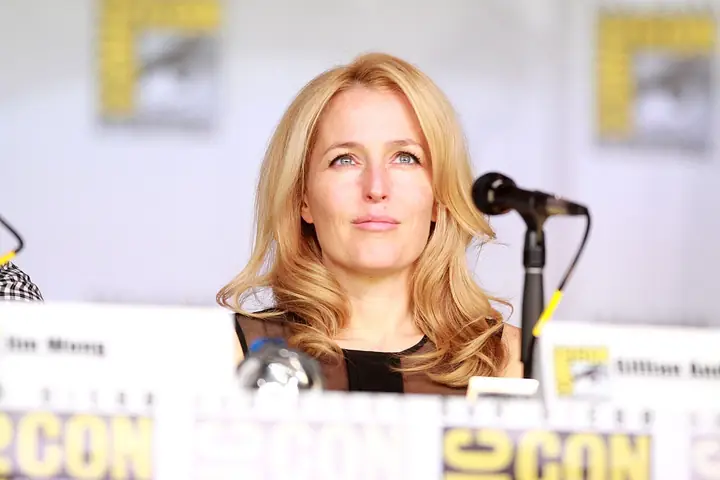
The X-Files (1993): Gillian Anderson at a table with microphonesImage: Wikimedia Commons · Gage Skidmore from Peoria, AZ, United States of America, CC BY-SA 2.0 - #236
- #237
- #238
In keeping with the original series run's practice of reusing Canadian character actors in multiple unrelated parts, Hiro Kanagawa, Christine Willes and Alex Diakun each appeared in one of the first three episodes of the long-delayed tenth season, which aired in 2016. Kanagawa played two different characters in the second and fourth seasons; Willes had the small but recurring role of F.B.I. Agent Karen E. Kosseff (Scully's therapist) in three different episodes; and Diakun played four different characters in the second and third seasons and the second movie.
- #239
Props from Mulder's X-Files office are currently preserved and on display at the Hollywood Entertainment Museum in Los Angeles. According to the museum, the famous "I Want to Believe" UFO poster from the office continually had to be replaced as copies kept disappearing from the set. The poster on display at the museum is reportedly one of the last available copies of the original set-used posters.
- #240
David Duchovny and Gillian Anderson attended the Golden Globes ceremony together in 1997 and were holding hands the whole night. Between them they won best lead actor and actress in a drama series. Anderson could be seen cursing backstage right after picking up her award while watching Duchovny thanking her when he picked up his; she had just realized that she had forgotten to thank him.
- #241
- #242
Contains a major spoiler — show
When she returned to playing Scully for season ten, Gillian Anderson opted to wear a wig instead of dying her hair red, because it would most likely cause her hair to fall out due to having it dye back to blonde immediately (for her role on The Fall (2013)) after the shooting of the revival wrapped.
- #243
David Duchovny and Gillian Anderson attended the Golden Globes ceremony together in 1997 and held hands all night. Between them they won the awards for best actor and best actress in a drama series. Right after accepting her award, Anderson could be seen swearing off camera while watching Duchovny thank her as he accepted his, having just realized she had forgotten to thank him.
- #244
- #245
The props in Mulder's X-Files office are now preserved and displayed at the Hollywood Entertainment Museum in Los Angeles. According to museum officials, the office's famous 'I Want to Believe' UFO poster had to be replaced frequently because it kept disappearing. The poster on display at the museum is said to be one of the last copies of the original posters used on set.
- #246
In the opening credits, Mulder's and Scully's FBI badges read 'Federal Bureau of Justice, United States Department of Investigation.' This change was made because it is illegal to produce a fake FBI badge, even for a TV show. A real badge reads 'Federal Bureau of Investigation, United States Department of Justice.'
- #247
- #248
- #249
- #250
Gillian Anderson's daughter, Piper Anderson-Klotz, practically grew up on set. As a result, when she saw a monster or something else that would frighten other children, she would become curious and ask whether she could touch it. David Duchovny said of the situation that he was lucky not to have to pay for a therapist because of it. Conversely, when Gillian wanted to show her young sons her work on the series, she had them watch one of the funniest episodes, 'Bad Blood' (1998), but it only gave them nightmares.
- #251
The first five seasons of the series were filmed in Vancouver, British Columbia, Canada. The series generally cast local Canadian actors in guest and supporting roles and reused the same actors multiple times in different characters across episodes. The most prominent example was Nicholas Lea, who appeared as a guest actor in the first season and later played the more significant role of Alex Krycek from the second season onward. However, many other local actors, such as Roger Cross, J.B. Bivens, Lorena Gale, Gillian Barber, Forbes Angus, Larry Musser, Harrison Coe, Hrothgar Mathews, P. Lynn Johnson and Doug Abrahams, also took on more than one role in different episodes. Barber, for example, played three different characters across four episodes.
- #252
- #253
Although the Cigarette Smoking Man is famous for constantly smoking, he says the word 'cigarette' only once across all seasons of the series. William B. Davis, who played him, was a former smoker who had not smoked since 1973 and had quit twenty years before being cast in the series. The cigarettes he smoked at the beginning of the series were real, but when he noticed he was craving tobacco between takes, herbal cigarettes were switched in at his request.
- #254
- #255
When she returned to the role of Scully for the tenth season, Gillian Anderson chose to wear a wig rather than dye her hair red, because she would have had to dye it blonde again immediately after filming the revival season (for her role in The Fall (2013)), which could have caused her hair to fall out.
- #256
- #257
In a 2015 interview with National Public Radio, composer Mark Snow said that while trying to compose the theme music, he sent series creator Chris Carter several ideas, but Carter rejected them. Carter sent Snow The Smiths' 1985 song 'How Soon Is Now?' and said, 'I love these guitars. Listen to this song and see if it inspires anything for you.' Snow also said he got the idea for the whistling effect in the theme from an old Proteus sample called 'Whistling Joe,' but that the whistle heard on the recording was reinforced by his wife, who whistles very well.
- #258
- #259
- #260
The series is one of the first television shows to switch to a 16:9 widescreen aspect ratio starting with its fifth season in 1997, at Chris Carter's insistence on giving it a more cinematic feel. However, while FOX broadcast the episodes cropped to 4:3, the original 16:9 versions were released on DVD. The series was remastered in 16:9 high definition in 2014, and the first four seasons were also converted to widescreen, generally through cropping.
Characters & Cast (112)
- #261
Unlike Scully, Mulder's religion was never made explicit on the show, but in The Official Guide to the X-Files (published after the second season), David Duchovny said that he would "consider Mulder Jewish until told otherwise." There were several subsequent references to Mulder's possible Judaism, including bigots assuming he is Jewish in the episodes "Kaddish" and "Drive".
- #262
David Duchovny and Gillian Anderson have often stated that they share a close and personal link because they are the only two people in the world who have felt and lived the special, unique and intimate relationship between Mulder and Scully and the worldwide phenomenon that the series became.
- #263
Despite their chemistry and the deliberately slow-burning sexual tension of their characters, both David Duchovny and Gillian Anderson have admitted that they were less close and bickered with each other due to the long hours of shooting in Vancouver during the show's initial run. After the show ended in 2002 they increased their natural rapport, and now consider themselves great friends and closer to each other than their spouses.
- #264
- #265
- #266
- #267
Gillian Anderson on her chemistry with David Duchovny: "For whatever reason, there is this energy between us when we come together, which is very compelling and curious. Why do we have that? There's attraction on screen with other actors I have worked with, but it's not the same. What's different between David and me? I don't know."
- #268
- #269
- #270
- #271
- #272
Gillian Anderson has declared several times that her favorite episode is "Bad Blood" and David Duchovny that his favorite ending in an episode is "The Post-Modern Prometheus", in which Mulder and Scully dance together. They also agree that the third season episode "Teso Dos Bichos" is the worst one, with Anderson calling it "that one episode about killer pussycats".
- #273
- #274
- #275
- #276
- #277
- #278
- #279
- #280
- #281
Gillian Anderson has stated that she based her approach to the role of Dana Scully on Jodie Foster's performance as Clarice Starling in The Silence of the Lambs (1991). Ironically, a contractual obligation to "The X-Files" prohibiting her from playing an F.B.I. agent in any other role prevented her from being offered the part of Clarice Starling in the "Silence" sequel, Hannibal (2001). Later, she joined the Hannibal (2013) series as Bedelia Du Maurier.
- #282
- #283
- #284
- #285
- #286
- #287
- #288
- #289
- #290
Contains a major spoiler — show
Chris Owens, who played the recurring character Agent Jeffrey Spender—son of Cigarette Smoking Man and Cassandra Spender—from seasons five through eleven, previously played a young version of his fictional father in Musings of a Cigarette Smoking Man (1996) and Demons (1997).
- #291
- #292
- #293
- #294
- #295
- #296
Contains a major spoiler — show
So far, at the end of the tenth season, more than twenty-three years after the beginning of the series, it has never been revealed how and when Mulder and Scully became lovers. This is probably the most exaggerated effort ever in a series to maintain the UST between its characters. There are many theories in the fandom, but it is certain that they were already lovers at the end of season seven, in which Scully dresses in Mulder's bedroom while he is sleeping naked, and a few episodes later she becomes pregnant with their child; even the first time somebody speaks about it explicitly is in Trust No 1 (2002).
- #297
- #298
Contains a major spoiler — show
The Cigarette Smoking Man ends up being Mulder's biological father, but we never really know how and when Mulder finds out. He has suspected it at least twice since the fourth season; in fact, the only time we see the Cigarette Smoking Man telling him is in The Sixth Extinction II: Amor Fati (1999) and in a conversation that happens in Mulder's dream. Spender also affirms it in the same episode. Scully seems to be sure of this after season six, because it's confirmed by Scully, in William (2002) after doing DNA tests on Jeffrey Spender, that Mulder is Spender's half-brother, and it's established that Mulder is the Cigarette Smoking Man 's son in The Truth (2002).
- #299
Contains a major spoiler — show
Mulder was born in Chillmark, Massachusetts, to Bill Mulder, who worked for the U.S. State Department on various secret projects, and his wife Teena. As it turned out, Bill wasn't actually his real father, but that's not revealed until season seven. Dana Scully is the third of four children of Captain Bill Scully and his wife, Maggie. Because of his job, the family travelled all over the world during their childhood.
- #300
- #301
When Gillian Anderson learned she was pregnant only a few months after the series began, just as the show was becoming a big success, she told David Duchovny before telling the producers, and everyone was extremely supportive, going so far as to find a storyline that would keep her on the show until shortly before she gave birth. Series creator Chris Carter would not replace her with another actress. His reward was being chosen as the godfather of Anderson's daughter.
- #302
The addition of the character Skinner in Tooms (1994) was a coincidence for Mitch Pileggi, since the role was to go to the actor who played Blevings, but he was busy when the episode was to be shot and Pileggi was given the part instead. His chemistry with Mulder, Scully and the CSM led to Skinner becoming a permanent member of the cast.
- #303
- #304
- #305
Gillian Anderson has repeatedly stated that her favorite episode is "Bad Blood," while David Duchovny has repeatedly named "The Post-Modern Prometheus," the finale in which Mulder and Scully dance together, as his favorite. Both also consider the third-season episode "Teso Dos Bichos" the worst episode; Anderson refers to it as "that one with the killer cats."
- #306
When the producers were casting the role of the Cigarette Smoking Man, they had no idea the character would become a major figure in the series. Once the character came to the fore, they worried that William B. Davis, who had been hired only as an extra, wouldn't be able to carry the role. But Davis, one of Canada's most respected acting teachers, impressed series creator Chris Carter so much that Carter made the Cigarette Smoking Man the show's main villain.
- #307
David Duchovny and Gillian Anderson attended the Golden Globes ceremony together in 1997 and held hands all night. The pair won the awards for best actor and best actress in a drama series. As Anderson accepted her award, she was seen swearing when she noticed Duchovny thanking her; she had realized she forgot to thank him.
- #308
- #309
- #310
Despite their characters' chemistry and the deliberately slow-building sexual tension, both David Duchovny and Gillian Anderson admitted that during the show's early run they were less close and argued because of the long shooting hours in Vancouver. After the series ended in 2002, their natural rapport grew, and they now see themselves as good friends closer than their own spouses.
- #311
At twenty-nine, Gillian Anderson became the first actress to win an Emmy, a Golden Globe and a SAG Award in the same year. She also became the youngest actress to win the Primetime Emmy Award for Outstanding Lead Actress in a Drama Series since Lindsay Wagner, who won at twenty-eight in 1977 for The Bionic Woman (1976).
- #312
- #313
Gillian Anderson stated that she based her approach to the role of Dana Scully on Jodie Foster's performance as Clarice Starling in The Silence of the Lambs (1991). Ironically, because her contractual obligations to "The X-Files" barred her from playing an FBI agent in another role, she was not offered the part of Clarice Starling in the sequel Hannibal (2001). She later joined the series Hannibal (2013) as Bedelia Du Maurier.
- #314
The addition of the character Skinner in the episode Tooms (1994) was a lucky break for Mitch Pileggi; the role was originally going to go to the actor who played Blevings, but that actor was busy while the episode was being shot and the part was given to Pileggi. His chemistry with Mulder, Scully and the CSM made Skinner a permanent character.
- #315
- #316
- #317
- #318
- #319
- #320
- #321
- #322
- #323
Many stars appeared on the show before they became famous: Giovanni Ribisi, Jack Black, Lucy Liu, Ryan Reynolds, Luke Wilson, Aaron Paul, Seth Green, Felicity Huffman, Michael Bublé, Terry O'Quinn, Bryan Cranston and Willie Garson. The series also drew many actors who were already quite famous before it aired: Jodie Foster, Cary Elwes, Robert Patrick, John Neville, Peter Boyle, Burt Reynolds, Frances Fisher, Roy Thinnes, Minnie Driver, Garry Shandling, Lance Henriksen, Lily Tomlin, Edward Asner, Lily Taylor, Mimi Rogers and Kurtwood Smith.
- #324
- #325
- #326
- #327
- #328
- #329
- #330
Gillian Anderson on her chemistry with David Duchovny: "For whatever reason, when we come together there's a very interesting and intriguing energy between us. Why do we have that? I've had screen chemistry with other actors I've worked with, but it's not the same. What's different between David and me? I don't know."
- #331
- #332
- #333
Comedian Kumail Nanjiani (known for productions such as Silicon Valley (2014) and The Meltdown with Jonah and Kumail (2014)), who appeared in the series' revival, is also a devoted X-Phile who released a podcast called "The X-Files Files," in which he discussed and analyzed every episode of the original series in detail. While chatting with Gillian Anderson and David Duchovny in a production tent at midnight during filming, they asked him why he wasn't recording the conversation for his podcast, and he did. At their insistence, he asked them which episodes they thought were the worst of the series. Anderson listed "Space," "Fire" and the episode she first called "The Cat One--Los Lobos Tostitos," Duchovny "corrected" her with "Tesos Tostados," and Nanjiani gave the episode's real name: "Teso dos Bichos." Duchovny named the "chupacabra episode" ("El Mundo Gira") as one of the worst.
- #334
Unlike Scully, Mulder's religion was never explicitly stated in the series, but in The Official Guide to the X-Files (published after the second season), David Duchovny said he would "consider Mulder Jewish until told otherwise." Several later references to Mulder's possible Jewishness were made, such as bigots assuming he is Jewish in the episodes "Kaddish" and "Drive."
- #335
- #336
- #337
- #338
- #339
- #340
- #341
- #342
- #343
- #344
- #345
- #346
Gillian Anderson holds the record for appearing in the most episodes of the series and is absent from only these five episodes: Mulder's solo episode 3 (1994) (though she is briefly mentioned in dialogue), Skinner's episode Zero Sum (1997), the Lone Gunmen's episode Unusual Suspects (1997), the flashback episode Travelers (1998) and Agent Doggett's solo episode The Gift (2001).
- #347
Many real-life partners of the cast worked on the series: David Duchovny's girlfriend of two years, Perrey Reeves, played his lover in the episode "3." Maggie Wheeler and Lucy Liu, both of whom dated Duchovny, appeared in the episodes "Born Again" and "Hell Money," respectively. Even his ex-wife, Téa Leoni, played herself in the episode "Hollywood A.D." Gillian Anderson dated Rodney Rowland, who appeared in the episode "Never Again," for more than a year. She also dated Adrian Hughes, who played one of the Peacocks in the episode "Home." She married Art Director Clyde Klotz, whom she met at the start of the series, and had a daughter with him. Mitch Pileggi met his wife, Arlene Pileggi, on the set of the series; she played his secretary and was Gillian Anderson's stunt double. Robert Patrick's wife played the wife of his character, John Doggett, in the ninth season.
- #348
- #349
- #350
- #351
- #352
- #353
- #354
Nearly all of David Duchovny's and Gillian Anderson's children worked on the series. Gillian's daughter, Piper Anderson-Klotz, worked in the art department in the tenth and eleventh seasons. Her younger siblings, Oscar and Felix, appeared as extras in the eleventh-season episode This (2018); they can be seen on the bus Mulder and Scully travel on. West Duchovny had a small but important role in the eleventh season's final episode, My Struggle IV (2018), but David's young child Miller never acted in the series.
- #355
Chris Owens, who played the recurring character Agent Jeffrey Spender (the son of the Cigarette Smoking Man and Cassandra Spender) from the fifth season to the eleventh, had previously played the younger version of his fictional father in the episodes Musings of a Cigarette Smoking Man (1996) and Demons (1997).
- #356
- #357
- #358
- #359
- #360
Many actors and actresses who appeared on the series as guest or supporting players later took on major roles in Stargate SG-1 (1997) and/or its spin-offs: Amanda Tapping (Colonel Carter); Don S. Davis (General Hammond); Mitch Pileggi (Colonel Caldwell); Teryl Rothery (Dr. Janet Frasier); Colin Cunningham (Major Paul Davis); Megan Leitch (Captain Ke'ra); Steven Williams (General Vidrine); Bill Dow (Dr. Bill Lee); Elizabeth Rosen (Lieutenant Jennifer Hailey); Jamil Walker Smith (Senior Master Sergeant Ronald Greer); and Willie Garson (Marty Lloyd).
- #361
- #362
- #363
Continuing the original series' tradition of using Canadian character actors in multiple unrelated roles, Hiro Kanagawa, Christine Willes and Alex Diakun each appeared once in each of the first three episodes of the tenth season, released in 2016 after a long delay. Kanagawa played two different characters in the second and fourth seasons; Willes took on the small but recurring role of FBI Agent Karen E. Kosseff (Scully's therapist) in three different episodes; and Diakun played four different characters in the second and third seasons and in the second film.
- #364
- #365
- #366
Fox executives initially wanted Pamela Anderson to play Dana Scully. Objecting to Gillian Anderson, they asked, "Where's the sex appeal?" Chris Carter recalls: "Even though Gillian is beautiful, she didn't fit their idea of sexiness. For one thing, they didn't understand what I was trying to do with the series. And she was unknown, which never helps."
- #367
Mulder was born in Chillmark, Massachusetts, the child of Bill Mulder and his wife Teena; Bill worked on various secret projects at the US State Department. As was later revealed, Bill was not actually his biological father, though this is not disclosed until the seventh season. Dana Scully is the third of four children of Captain Bill Scully and his wife Maggie. Because of her father's job, the family traveled all over the world during their childhoods.
- #368
- #369
- #370
- #371
- #372
Although they share no scenes together in the series, it reunites two actors from the film Earth Star Voyager: Part 1 (1988): Peter Donat and Bruce Harwood. Donat and Harwood played Admiral Beasley and Dr. Eugene Leland respectively; in this series they played Mulder's father and "J.F." Byers (one of the Lone Gunmen).
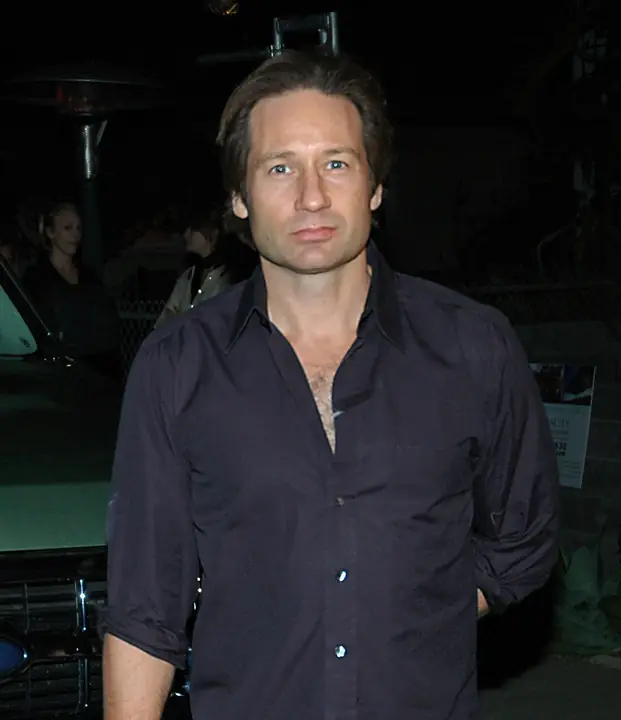
Easter Eggs & References (33)
- #373
- #374
- #375
- #376
- #377
Scully's family has a thing for "Moby Dick": Scully is called Starbuck by her father, her dog's name is Queequeg, and she calls her father Captain Ahab. In 2010, Gillian Anderson, who played Scully, appeared in a version of the novel (Moby Dick (2011)) that also starred Ethan Hawke, Donald Sutherland, and William Hurt.
- #378
Although they don't share scenes in the series, it reunites two actors from Earth Star Voyager: Part 1 (1988): Peter Donat and Bruce Harwood. Donat and Harwood played Admiral Beasley and Dr. Eugene Leland, respectively; in this series they played Mulder's father and "J.F." Byers (one of The Lone Gunmen).
- #379
- #380
- #381
- #382
- #383
In the Pilot (1993), when Scully is interviewed by Division Chief Scott Blevins (Charles Cioffi) to see if she knows Fox Mulder, she replies that she didn't know him directly, but by his reputation as the F.B.I.'s analyst and his work in the capture in 1988 of a killer named Monty Props. It's the only reference about Props made in the entire series. Props was created after Garret Jacob Hobbs, a serial killer only mentioned in Thomas Harris' novel "Red Dragon" (who was shot to death by Will Graham). Harris' universe was a strong influence in the creation of the series.
- #384
- #385
- #386
Often, throughout the series, Mulder asks for help from three conspiracy theorists named Byers, Langley and Frohike. They call themselves "The Lone Gunmen" and print a conspiracy paper of the same name. This is a nod to their disbelief in the "Lone Gunman" theory, which is the official explanation of the assassination of President John F. Kennedy, which states that Lee Harvey Oswald was the only one involved in the assassination and that only he fired the shots that killed Kennedy.
- #387
- #388
- #389
- #390
- #391
- #392
- #393
- #394
- #395
During season 9 of the show, the opening credits included a shot of a list of "F.B.I. Contacts, Witnesses, and Contributors." The names on the list were actually the screen names of posters on the official "X-Files" message board and changed with each new episode that season. Other names on the list were anagrams of characters on the show.
- #396
In the series, Mulder's first and middle names are Fox William. A man named William Fox founded the Fox Theater chain in California and Fox Film Studios. That studio merged with 20th Century Pictures to become 20th Century Fox, the production company of and owners of the network that televised The X-Files.
- #397
- #398
Contains a major spoiler — show
In the episode Unusual Suspects (1997) (season five, episode three) Detective John Munch (Richard Belzer) interrogates the Lone Gunmen about the events that happened in it. It would set the series in the same universe as Homicide: Life on the Street (1993), Law & Order: Special Victims Unit (1999), The Wire (2002), Law & Order: Trial by Jury (2005), Arrested Development (2003), 30 Rock (2006), after the several crossovers of Belzer as Munch outside of Law & Order's franchise. Unwittingly, it would set too in the same universe of Chicago Fire (2012), Chicago P.D. (2014), Chicago Med (2015), Chicago Justice (2017), after Hank Voight (played by Jason Beghe) appeared on Law & Order: Special Victims Unit (1999) as well as all "Chicago" franchises.
- #399
Contains a major spoiler — show
When Agents Miller and Einstein are first introduced in the tenth season, there are several jokes and references that indicate that they are meant to be analogues of Mulder and Scully's younger selves, including Miller's credulity in contrast with Einstein's skepticism and Einstein's red hair and science-related name. The name "Miller" is also a clue to this; the last name "Mulder" originally comes from a Dutch word that means "miller" (that is, a person who runs a grain-processing mill).
- #400
Contains a major spoiler — show
In season four, episode seven, Musings of a Cigarette Smoking Man (1996), Cigarette Smoking Man's real name was revealed to be C.G.B. Spender, with no explanation about the meaning of the first three initials. A possible theory pointed to Carter Goodwin Bowman Spender, after the last names of Chris Carter, R.W. Goodwin and Rob Bowman, creator and two of the most important producers of the series. However, it has been proven to be untrue after season eleven, episode one, My Struggle III (2018), where his entire name was finally divulged: Carl Gerhard Busch Spender.
- #401
Contains a major spoiler — show
Recurring use of the numbers: 1013 - Ten Thirteen is the name of Chris Carter's production company; his birthday is October 13, 1956. 1013 is also the silo number that Alex Krycek is locked into in season three, and 10:13 is the time when some episodes start (or a scene that's dated at this time). The number 1121 also appears often; it is creator Chris Carter's wife, Dori's, birthday.
- #402
- #403
Contains a major spoiler — show
Almost every time Skinner goes to Mulder's apartment, someone pulls a gun on him: * In End Game (1995), Mulder aims a gun after Skinner enters the apartment, suspecting him to be the Bounty Hunter. * Later in the same episode, minutes before entering the apartment, he gets in a fist fight with X in the elevator, ending with X pulling out a gun. * The Blessing Way (1995) ends with Scully bringing Skinner to the apartment where she pulls her gun on him, believing he intended to kill her. * Nisei (1995) features a scene where Mulder unexpectedly finds Skinner in his ransacked apartment, and draws his gun. * In Field Trip (1999), Scully has a spore-induced dream in which Skinner and other friends are in Mulder's apartment for Mulder's funeral. Later in the episode, Mulder shoots the dream-Skinner to prove that they are still dreaming. This is the only episode where the gun being drawn occurs outside of Mulder's apartment building, but both scenes are part of a hallucination. Among the few exceptions are: * In Redux (1997), Skinner confronts Scully in the hallway outside Mulder's apartment early in the episode. However, Skinner is not shown to have actually entered the apartment in the episode, just the hallway. * In Two Fathers (1999), Skinner meets covertly with Mulder and Scully inside Mulder's apartment, where they fill him in on the alien hybrid plan and divulge who Spender's father is. * In Sein und Zeit (2000), Skinner knocks at Mulder's apartment the morning after Mulder has a breakdown over his mother, and Scully answers the door, having been there all night to comfort him. The scene shows all three in the doorway, though Skinner is not shown entering the apartment.
- #404
- #405
Despite their chemistry and their characters' deliberately slow-burning sexual tension, both David Duchovny and Gillian Anderson admitted that during the series' original run they were less close and argued with each other because of the long hours of filming in Vancouver. After the series ended in 2002 their natural relationship grew, and they now consider themselves very good friends and closer to each other than to their own spouses.
Deeper Meaning (63)
- #406
- #407
- #408
- #409
Contains a major spoiler — show
In The X-Files: Re-Opened (2015), the documentary before season ten, Chris Carter describes Mulder's and Scully's relationship as "platonic" for nine years, even though there was an obvious attraction between them, were together on the run, lived together for years as lovers and had a child together.
- #410
- #411
Contains a major spoiler — show
The series is divided into two separate strands. The first is called "Mythology" and the second "Monster of the Week". The two never cross, and even any mention of one in the other is omitted, almost as if they were alternate timelines. The main plots of these strands are: * Mythology: It is a conspiracy in which an alien race known as "The Gray" plans to invade planet Earth using the so-called Black Oil or "Purity" (a living virus that, after infecting a human body, turns us into living incubators and grows inside it to become a Gray, killing the host bloodily at birth). This race made a treaty with a small human group called The Syndicate, composed of former scientists and doctors from World War II, some of them implicated in the infamous Operation Paperclip (the U.S. Government pardoned war crimes for captured Third Reich scientists to continue their work in medicine, science and astronautics to win the Space Race against the USSR), working secretly to experiment with humans looking for a cure for the Black Oil, in an attempt to be saved from the invasion. The Syndicate would use the smallpox vaccine to create a DNA catalog for their experiments, at the same time inserting alien DNA as a weapon to be used in the invasion. The Gray and The Syndicate are faced with another alien race simply known as the Resistance, a humanoid species that has the ability to change their physical shape and that sewed their own eyes, mouth and ears shut to avoid any possibility of being infected by the Black Oil. * Monster of the Week: It is a self-concluded episode depicting all kinds of supernatural phenomena, from evil experiments, telepathy and mind control to angels and demons, reincarnation, ghosts, and strange creatures such as vampires, werewolves and mutants. Sometimes these episodes have an open ending, leaving a chance to be continued later, while others end dramatically, closing the plot so it will not be continued later.
- #412
Contains a major spoiler — show
In "Mulder & Scully Meet the Were-Monster" (2016, season ten, episode three), Scully jokes to Mulder that she is immortal, but it is not a joke. In "Clyde Bruckman's Final Repose" (1995, season three, episode four), Mulder and Scully meet Clyde Bruckman (Peter Boyle), a life insurance salesman who, after rock star Buddy Holly's death in a 1959 airplane crash, became so obsessed with death that he acquired the ability to see when everyone is going to die. At one point, Scully questions Bruckman about her death, and he simply answers, "You don't." Eventually, in "Tithonus" (1999, season six, episode ten), Scully meets Alfred Fellig (Geoffrey Lewis), a freelance crime photographer who is 149 years old and became immortal decades earlier when he was dying in a hospital. Fellig saw Death come directly for him, but he rejected her, asking that another die instead of him. Death killed a nurse who assisted him, and Fellig lived looking for Death in order to die, being capable of knowing when a person will die and photographing the corpse trying to capture Death in a photo. At the end of the episode, Scully and Fellig are shot by an assassin wanted by Mulder and Scully. She sees Death go for her, and Fellig asks her to turn her head to avoid dying. Fellig dies, but Scully recovers completely in the hospital, effectively taking on Fellig's immortality. Scully's immortality also appears in "My Struggle II" (2016, season ten, episode six), after she finds that she is immune to a lethal plague that is isolating the world.
- #413
- #414
Contains a major spoiler — show
Given the excessive length of Mulder and Scully's unresolved sexual tension and the way in which it was suggested and resolved, many fans called season seven "the season of the secret sex". Later, in season ten, some clues seemed to insinuate that Mulder and Scully could have been married at some previous point. David Duchovny referred several times to Scully as Mulder's "wife", and there were some pictures in which Scully seemed to wear a ring. Because of this, many fans refer to season ten as "the season of the secret marriage". Chris Carter later denied they were married, and Gillian Anderson told Duchovny that "they only lived in sin" and she "thought they were smoking a joint, lying in bed" but not "married married".
- #415
Contains a major spoiler — show
Scully's abduction during the second season was originally planned as a way of explaining Gillian Anderson's absence due to pregnancy. Later, Series Creator Chris Carter turned it into a vital plot point to the on-going series mythology for the original run of the series until 2002 as well as in the revival of 2015 to 2016.
- #416
Scully's abduction in the second season was originally planned as a way to explain Gillian Anderson's absence due to her pregnancy. Series creator Chris Carter later turned it into a vital plot point in the show's ongoing mythology for the series' original run through 2002 and its revival from 2015 to 2016.
- #417
- #418
At the end of the seventh season, David Duchovny and Gillian Anderson had not yet signed contracts for additional seasons, and most of the cast and crew assumed the series was over. Chris Carter wrote the episode "Requiem" to serve as the series finale, but at the last moment the FOX Network decided to renew the series. However, only Anderson agreed to return full-time, and Carter created the characters John Doggett (Robert Patrick) and Monica Reyes (Annabeth Gish) to compensate for Duchovny's absence. Carter also restructured the series mythology to focus on the government's Super Soldiers and to eliminate the alien invasion conspiracy storyline, hoping to revive interest in the series.
- #419
- #420
- #421
- #422
- #423
- #424
- #425
- #426
- #427
- #428
- #429
- #430
- #431
- #432
- #433
- #434
- #435
- #436
- #437
Scully's family has a fondness for Moby Dick: her father calls her Starbuck, her dog is named Queequeg and she addresses her father as Captain Ahab. In 2010, Gillian Anderson, who plays Scully, took a role in an adaptation of the novel (Moby Dick, 2011); the film also starred Ethan Hawke, Donald Sutherland and William Hurt.
- #438
Recurring numbers: 1013 - Ten Thirteen is the name of Chris Carter's production company; his birthday is 13 October 1956. 1013 is also the number of the silo in which Alex Krycek is locked in the third season, and the time 10:13 at which some episodes begin. The number 1121 also appears frequently; it is the birthday of creator Chris Carter's wife, Dori.
- #439
- #440
- #441
For much of the series, each season's penultimate episode is usually themed as a pastiche or loving tribute to an iconic piece of popular culture. For example, one season featured an explicit reference to the cult Paramount series The Brady Bunch, while the eleventh season referenced the Hammer Films horror genre. Sometimes overtly, sometimes subtly.
- #442
- #443
Every time Skinner goes to Mulder's apartment, he is almost always met with a gun. In the episode End Game (1995), Mulder points a gun at Skinner, mistaking him for the Bounty Hunter. In the same episode, minutes before Skinner enters the apartment, he gets into a fistfight with X in the elevator, and X draws his gun. In The Blessing Way (1995), Scully brings Skinner to the apartment and draws her gun on him, accusing him of trying to kill her. In Nisei (1995), Mulder finds Skinner unexpectedly in his ransacked apartment and draws his gun. In Field Trip (1999), Scully, in a dream triggered by a sport, sees Skinner and other friends in her apartment for Mulder's funeral; later in the episode, Mulder shoots the Skinner in the dream to prove they are still dreaming. This is the only episode where the gun-drawing event takes place outside Mulder's apartment, though both scenes are part of the hallucination. Exceptions include: In Redux (1997), Skinner meets Scully in the hallway outside Mulder's apartment, but he is not shown entering the apartment. In Two Fathers (1999), Skinner secretly meets with Mulder and Scully in Mulder's apartment. In Sein und Zeit (2000), Skinner knocks on the door the morning Mulder has a breakdown over his mother; Scully opens the door and the three appear at the threshold, but Skinner is not shown entering the apartment.
- #444
When Agents Miller and Einstein are first introduced in the tenth season, many jokes and references are made suggesting they are younger versions of Mulder and Scully. Miller's naivety contrasts with Einstein's skepticism; Einstein's red hair and her surname related to science also point to this. The surname 'Miller' is also a clue: 'Mulder' originally derives from a word meaning 'miller' in Dutch.
- #445
In the episode Mulder & Scully Meet the Were-Monster (2016), Scully jokes to Mulder that she is immortal. But this is not a joke. In Clyde Bruckman's Final Repose (1995), Mulder and Scully meet Clyde Bruckman, who can see when people will die. When Scully asks him about her own death, Bruckman replies, 'You don't die.' In Tithonus (1999), Scully encounters Alfred Fellig, a 149-year-old immortal photographer. Fellig became immortal by refusing death and allowing a nurse to die in his place. At the end of the episode, Scully and Fellig are shot; Scully sees death but Fellig tells her to turn her head, and Fellig dies while Scully fully recovers, inheriting Fellig's immortality. Scully's immortality is also seen in My Struggle II (2016); she is immune to a deadly plague that isolates the world.
- #446
Given the excessive length of the unresolved sexual tension between Mulder and Scully and how it was hinted at and resolved, many fans called the seventh season the 'secret sex season.' In the tenth season, some clues suggested that Mulder and Scully might have been married before. David Duchovny referred to Scully as Mulder's 'wife' several times, and in some photos Scully was seen wearing a ring. Therefore, many fans called the tenth season the 'secret marriage season.' Chris Carter later denied they were married, and Gillian Anderson said to Duchovny that they 'just lived in sin' and that she thought they 'smoked weed in bed' but were not 'married married.'
- #447
- #448
- #449
- #450
Throughout the series, Mulder frequently seeks help from three conspiracy theorists named Byers, Langley, and Frohike. They call themselves 'The Lone Gunmen' and publish a conspiracy magazine of the same name. This name is a reference to the 'Lone Gunman' theory, the official explanation of President John F. Kennedy's assassination; this theory argues that Lee Harvey Oswald acted alone in the assassination and that only he fired the bullets that killed Kennedy.
- #451
At the end of the tenth season, despite more than 23 years having passed since the series began, the moment and manner in which Mulder and Scully became lovers was never explained. This is one of the most exaggerated efforts to sustain unresolved sexual tension between characters in a series. There are many theories among fans, but it is certain that they became lovers at the end of the seventh season; Scully dresses while Mulder sleeps naked in the bedroom, and a few episodes later she becomes pregnant with their child. The first time it is openly discussed is in the episode Trust No 1 (2002).
- #452
In the pilot episode (1993), while Scully is questioned by Section Chief Scott Blevins about whether she knows Fox Mulder, she says she does not know him directly but knows his reputation as an FBI analyst and his work in catching a killer named Monty Props in 1988. This is the only reference to Props in the series. Props is inspired by the serial killer Garret Jacob Hobbs, who is mentioned in Thomas Harris's novel 'Red Dragon' and shot by Will Graham. Harris's universe had a strong influence on the creation of the series.
- #453
In the fourth season's seventh episode, Musings of a Cigarette Smoking Man (1996), it is revealed that the Cigarette Smoking Man's real name is C.G.B. Spender, but the meaning of the first three initials is not stated. One possible theory was that they stood for the surnames of Chris Carter, R.W. Goodwin and Rob Bowman, making the name Carter Goodwin Bowman Spender. However, when his full name was revealed as Carl Gerhard Busch Spender in the eleventh season's first episode, My Struggle III (2018), this theory was proven incorrect.
- #454
The series contains 69 alien mythology episodes. The eighth season has the highest number, with ten of these episodes falling in that season. In the eighth season, only two episodes featuring Mulder do not focus on the mythology arc. There are also standalone episodes with alien and abduction themes, such as Conduit (1993) and Clyde Bruckman's Final Repose (1995).
- #455
- #456
The Cigarette Smoking Man is revealed to be Mulder's biological father, but exactly how and when Mulder learns this is not known. From the fourth season onward he suspects it at least twice; in fact, the only moment the Cigarette Smoking Man tells him occurs in a conversation in Mulder's dream in The Sixth Extinction II: Amor Fati (1999). Spender also confirms it in the same episode. Scully appears certain of it after the sixth season; in the episode William (2002), DNA tests performed on Jeffrey Spender confirm that Mulder is Spender's half-brother, and in the episode The Truth (2002) it is established that Mulder is the Cigarette Smoking Man's son.
- #457
- #458
In the episode Unusual Suspects (1997), Detective John Munch (Richard Belzer) interrogates the Lone Gunmen. This places the series in the same universe as Homicide: Life on the Street (1993), Law & Order: Special Victims Unit (1999), The Wire (2002), Law & Order: Trial by Jury (2005), Arrested Development (2003) and 30 Rock (2006). Additionally, because Hank Voight (Jason Beghe) appears in Law & Order: Special Victims Unit and all the 'Chicago' series, it also shares a universe with Chicago Fire (2012), Chicago P.D. (2014), Chicago Med (2015) and Chicago Justice (2017).
- #459
The series is divided into two separate strands: 'Mythology' and 'Monster of the Week'. The two never intersect; even references from one to the other are skipped, making them almost like alternate timelines. Mythology: it deals with the plan of an alien race known as the Grays to invade Earth using a virus called Black Oil or 'Purity'. This virus infects the human body, turning it into an incubator in which a Gray grows, killing the host bloodily at birth. This race made a deal with a group called the Syndicate, made up of old scientists and doctors dating back to World War II. The Syndicate secretly experiments on humans in order to find a cure for Black Oil and escape the invasion. Monster of the Week: these are self-contained episodes dealing with all kinds of supernatural phenomena. They cover creatures such as sinister experiments, telepathy, mind control, angels, demons, reincarnation, ghosts, vampires, werewolves and mutants. Sometimes they end open-ended, and sometimes they close with a definitive conclusion.
- #460
In the documentary The X-Files: Re-Opened (2015), made before the tenth season, Chris Carter describes Mulder and Scully's relationship over nine years as 'platonic', even though there was an obvious attraction between them, they ran away together, lived as lovers for years and had a child.
- #461
- #462
- #463
Mulder's first and middle names are Fox William. A man named William Fox founded the Fox Theatre chain and Fox Film Studios in California. This studio merged with 20th Century Pictures to form 20th Century Fox, the company that owns the network that broadcast 'The X-Files' and produced the series.
- #464
- #465
- #466
- #467
- #468
Career & Awards (19)
- #469
- #470
- #471
- #472
- #473
- #474
- #475
- #476
- #477
- #478
- #479
David Duchovny and Gillian Anderson attended the Golden Globes ceremony together in 1997 and held hands the whole night. Between them they won Best Lead Actor and Best Lead Actress in a Drama Series. Anderson could be seen cursing backstage right after picking up her award while watching Duchovny thank her when he picked up his; she had just realized that she had forgotten to thank him.
- #480
There were many stars who appeared in this series before they became famous: Giovanni Ribisi, Jack Black, Lucy Liu, Ryan Reynolds, Luke Wilson, Aaron Paul, Seth Green, Felicity Huffman, Michael Bublé, Terry O'Quinn, Bryan Cranston, and Willie Garson. The series also attracted a lot of actors and actresses who were quite famous even before the series came on: Jodie Foster, Cary Elwes, Robert Patrick, John Neville, Peter Boyle, Burt Reynolds, Frances Fisher, Roy Thinnes, Minnie Driver, Garry Shandling, Lance Henriksen, Lily Tomlin, Edward Asner, Lily Taylor, Mimi Rogers, and Kurtwood Smith.
- #481
At twenty-nine, Gillian Anderson was the first actress to win an Emmy, a Golden Globe, and a SAG Award in the same year, and the youngest actress to win a Primetime Emmy Award for Outstanding Lead Actress in a Drama Series since Lindsay Wagner won at the age of twenty-eight in 1977 for The Bionic Woman (1976).
- #482
- #483
- #484
- #485
Contains a major spoiler — show
Gillian Anderson has the record of appearing in the most episodes of the series missing only the following five: Mulder's solo episode 3 (1994) (although Scully is briefly referred to in the dialogue), Skinner's episode Zero Sum (1997), The Lone Gunmen's episode Unusual Suspects (1997), the flashback episode Travelers (1998) and Agent Doggett's solo episode The Gift (2001).
- #486
Contains a major spoiler — show
Several news sources reported that Gillian Anderson was originally offered only half of David Duchovny's salary to return as Dana Scully for season ten. "The Daily Beast" interviewed Anderson about this, and she said, "I'm surprised that more (interviewers) haven't brought that up because it's the truth." Anderson said of the pay disparity, first disclosed in "The Hollywood Reporter", "Especially in this climate of women talking about the reality of (unequal pay) in this business, I think it's important that it gets heard and voiced. It was shocking to me, given all the work that I had done in the past to get us to be paid fairly. I worked really hard toward that and finally got somewhere with it. Even in interviews in the last few years, people have said to me, 'I can't believe that happened, how did you feel about it, that is insane.' And my response always was, 'That was then, this is now.' And then it happened again! I don't even know what to say about it... It is... sad... It is sad." They eventually received equal pay for the series.
- #487
At the age of twenty-nine, Gillian Anderson became the first actress to win an Emmy, a Golden Globe and a SAG Award in the same year, and the youngest actress to win the Primetime Emmy Award for Outstanding Lead Actress in a Drama Series since Lindsay Wagner won it at twenty-eight in 1977 for The Bionic Woman (1976).
Life & Family (14)
- #488
- #489
- #490
Almost all of David Duchovny and Gillian Anderson's children worked on the show. Piper Anderson-Klotz, Gillian's daughter, worked in the art department in seasons ten and eleven. Her little brothers, Oscar and Felix, worked as extras in This (2018), also in the eleventh season. We can see them on the bus in which Mulder and Scully travel. West Duchovny had a small but important part in My Struggle IV (2018), the last episode of the eleventh season, but David's younger kid, Miller, never acted on the show.
- #491
- #492
Many of the cast's real-life partners worked on the show: Perrey Reeves, David Duchovny's girlfriend for two years, played his lover in "3". Maggie Wheeler and Lucy Liu, both of whom dated Duchovny, appeared in "Born Again" and "Hell Money", respectively. Even his former wife, Téa Leoni, played herself in "Hollywood A.D." Gillian Anderson dated Rodney Rowland, who appeared in "Never Again", for over a year. She also dated Adrian Hughes, who played one of the Peacocks in "Home". She was married to, and had a daughter with, Clyde Klotz, the show's Art Director, after they met at the beginning of the series. Mitch Pileggi met his wife, Arlene Pileggi, on the set of the show--she played his secretary and was Gillian Anderson's double. Robert Patrick's wife played his character John Doggett's wife in the nineth season.
- #493
When Gillian Anderson found out she was pregnant only a few months after the show began and it started to become a huge success, she had told David Duchovny before she told the producers, and they were all extremely supportive, even going so far as to find a story arc that would keep her in the show until shortly before she gave birth. Series creator Chris Carter would not replace her with another actress. His reward was being named Anderson's daughter's godfather.
- #494
- #495
- #496
Piper Anderson-Klotz, Gillian Anderson's daughter, was literally raised on the set of this show, so when she saw a monster or something that would scare any other child, she used to be curious and ask if she could touch it. Regarding this situation, David Duchovny used to say he was lucky not to be the one who would have to pay for her therapist. On the contrary, when Gillian wanted her younger sons to see her in the series, she showed them Bad Blood (1998), one of the most comic episodes, and it only gave them nightmares.
- #497
- #498
- #499
- #500
- #501
Contains a major spoiler — show
Piper Anderson-Klotz, Gillian Anderson's daughter, was working in the Art Department during the production of seasons ten and eleven. Piper was born during the second season of the series and her unexpected birth was the reason the show's writers devised Scully's abduction, which went on to become one of the most important mythological arcs in the original series. The third season episode Piper Maru (1996) was also named after her.
Sources & editorial notes
Reference databases
- Wikipedia
- IMDb
Information from external sources is independently selected, consolidated and edited by Arka Evren. Sources are listed for verification and further reading. Encyclopedia text is used under its licence (CC BY-SA). How we work