FILM · 1985 · USA
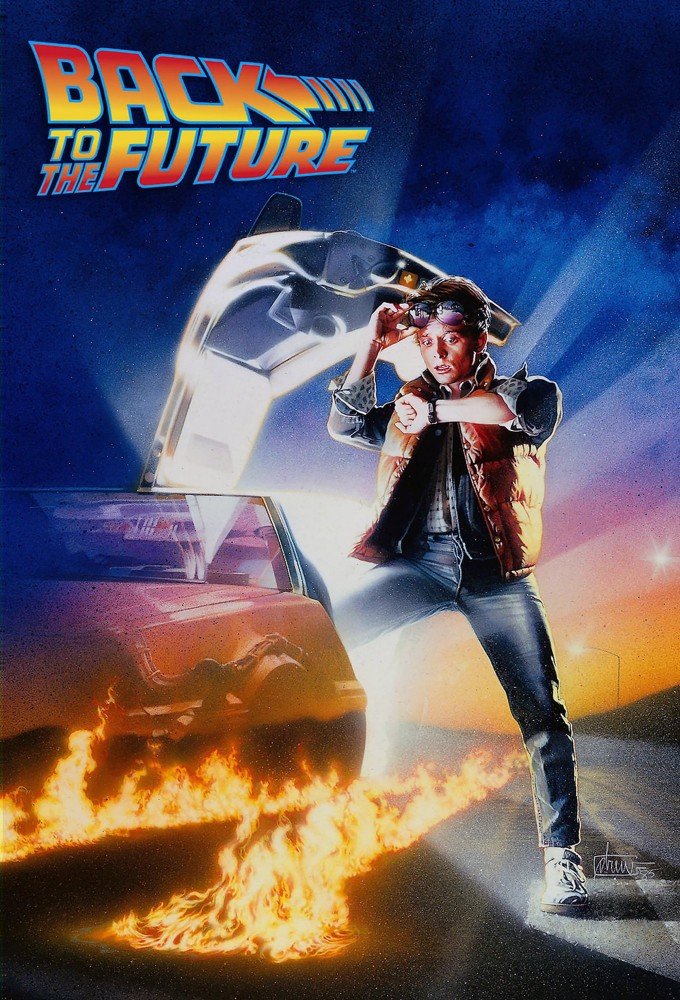
Back to the Future
- Directed by
- Robert Zemeckis
- Runtime
- 116 min
- Studio
- Universal Pictures, Amblin Entertainment
20 archived facts 4 topics 1 source Last reviewed Sep 2026
Eighties teenager Marty McFly is accidentally sent back in time to 1955, inadvertently disrupting his parents' first meeting and attracting his mother's romantic interest. Marty must repair the damage to history by rekindling his parents' romance and - with the help of his eccentric inventor friend Doc Brown - return to 1985.
Summary: TMDB

All facts (20)
- #001
Gale and Zemeckis wanted to make a film about time travel, but they struggled to find a satisfying narrative for it.
- #002
After their recent collaborations with Steven Spielberg, Zemeckis's mentor, met with critical or commercial failure, Gale and Zemeckis were desperate for a successful project.
- #003
Back to the Future began as a draft written by Gale and Zemeckis in late 1980, for which the pair sketched and acted out each scene to develop the dialogue and actions.
- #004
Gale and Zemeckis wanted Back to the Future to show the past being altered and the effect of those changes on the future, in contrast to time-travel films they felt treated the past as immutable.
- #005
In September 1980, Gale and Zemeckis pitched their idea for Back to the Future to Columbia Pictures president Frank Price, who had liked Used Cars and wanted to work with them.
- #006
Gale and Zemeckis delivered the first draft of Back to the Future to Frank Price on February 21, 1981, but Price felt it needed significant refinement.
- #007
Early concepts for Back to the Future were abandoned, including a version in which Marty McFly's actions in 1955 made 1985 more futuristic and advanced; every person who read the script objected to that idea.
- #008
In an abandoned concept for Back to the Future, Marty McFly's knockout punch on Biff Tannen led to his father becoming a boxer.
- #009
Back to the Future was initially conceived with a stationary time machine carried on the back of a truck, and a drained version was written to be powered by driving it into a nuclear explosion along with Coca-Cola, inspired by the documentary The Atomic Cafe.
- #010
Columbia Pictures placed Back to the Future into turnaround, a process that allowed other studios to purchase the project, after executive Price declined to green-light the second draft.
- #011
The Back to the Future script was rejected roughly forty times, in some cases repeatedly by the same studios.
- #012
Robert Zemeckis accepted the next project offered to him, Romancing the Stone (1984), and its unexpected significant success gave him enough credibility to return to Back to the Future.
- #013
The rights to Back to the Future were initially held by Columbia Pictures. Columbia's Guy McElwaine later asked to acquire the rights from Price, and Price obtained the rights to Back to the Future in exchange.
- #014
Sid Sheinberg proposed changing the title of Back to the Future to Space Man from Pluto, believing the original title would not resonate with audiences.
- #015
Sheinberg also wanted Marty's mother renamed from Meg to Lorraine, a tribute to his wife Lorraine Gary, and Professor Brown renamed Doc Brown because he considered it more accessible.
- #016
Producer Neil Canton, who had worked with John Lithgow and Christopher Lloyd on Buckaroo Banzai (1984), suggested Lithgow for the part of Doc Brown.
- #017
John Lithgow was unavailable for Doc Brown, so the role was offered to Christopher Lloyd, who was reluctant until a friend encouraged him to accept it.
- #018
Christopher Lloyd's wild white hair as Doc Brown was inspired by Albert Einstein and conductor Leopold Stokowski, and he adopted a hunched posture to bring his 6 feet 1 inch (1.85 meters) height closer to the 5 feet 5 inches (1.65 m) tall Michael J. Fox.
- #019
Crispin Glover incorporated numerous personal mannerisms into his portrayal of George McFly in Back to the Future.
- #020
During the filming of Back to the Future, Crispin Glover lost his voice and later dubbed some of his lines; according to Michael J. Fox, Glover also ignored blocking and moved freely regardless of camera placement, which frustrated the crew.
Sources & editorial notes
Reference databases
Sources for the entries on this page
- Wikipedia Back to the Future — Wikipedia
Information from external sources is independently selected, consolidated and edited by Arka Evren. Sources are listed for verification and further reading. Encyclopedia text is used under its licence (CC BY-SA). How we work