
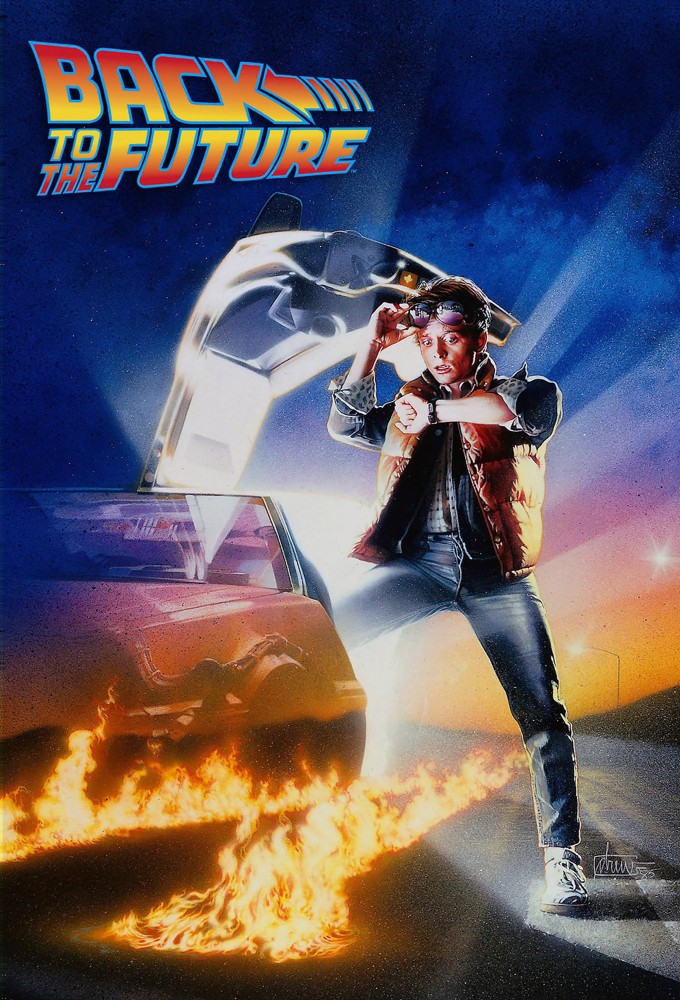
FILM · 1985 · USA
Back to the Future
- Directed by
- Robert Zemeckis
- Runtime
- 116 min
- Studio
- Universal Pictures, Amblin Entertainment
465 archived facts 8 topics 2 sources Last reviewed Nov 2026
Eighties teenager Marty McFly is accidentally sent back in time to 1955, inadvertently disrupting his parents' first meeting and attracting his mother's romantic interest. Marty must repair the damage to history by rekindling his parents' romance and - with the help of his eccentric inventor friend Doc Brown - return to 1985.

465 Interesting Facts About Back to the Future
Interesting Facts (18)
- #001
According to the website of the Ronald Reagan Presidential Library, President Ronald Reagan watched the film for the first time at Camp David on Friday, July 26, 1985 (three weeks after its release). Watching the film alongside the president was his wife, Nancy, and several aides including speechwriter Mark Weinberg. Although Reagan's fondness for the film is well-documented, Weinberg later recalled that the mention of Jane Wyman's name during one of the scenes made for a very awkward and uncomfortable moment in the room for the president and first lady. Apparently the subject of the president's first wife (from whom he had divorced in 1949) was such a sensitive one that White House staff members abided by an unofficial ban on ever speaking her name within earshot of any member of the First Family, according to Weinberg.
- #002
The owner of the home where the tree from which George McFly (Crispin Glover) dangles is a small-time producer who does documentaries and biographies. Several years after this film was released, he put together a fifteen minute documentary on the tree on Bushnell Avenue that was used in the film, featuring never before seen footage.
- #003
- #004
- #005
- #006
- #007
- #008
The mall where Marty McFly meets Doc Brown for their time travel experiment is called "Twin Pines Mall." Doc Brown comments that old farmer Peabody used to own all of the land, and he grew pines trees there. When Marty goes back in time, he runs over and knocks down a pine tree on the Peabody's property. When he comes back to the mall at the end of the film, the sign at the mall identifies the mall as "Lone Pine Mall."
- #009
- #010
- #011
- #012
- #013
- #014
- #015
- #016
- #017
The test audience at the film's initial screening was not told that the film was intended as a comedy. Robert Zemeckis and Bob Gale recalled that during the scene where Einstein the dog travels through time, the atmosphere in the theater began to grow very tense, because the audience expected something terrible to happen to the dog.
- #018
Production Story (64)
- #019
- #020
Huey Lewis was asked by Robert Zemeckis and Bob Gale to write a song for the film. However, they were not initially thrilled with the first song Huey brought back to them, "The Power of Love." After explaining what they were hoping for, they asked Huey for one more song. Upon viewing a cut of the film, Huey then got the inspiration for "Back in Time."
- #021
When the cast and crew were once asked at a convention why Eric Stoltz didn't work out as Marty McFly, co-writer and producer Bob Gale explained and after he did Michael J. Fox responded very humbly and jokingly saying "Eric didn't work as Marty, but to his credit I couldn't have played the drug dealer he did in Pulp Fiction (1994)". This is an in joke as both the Back to the Future films and Pulp Fiction are considered among the greatest films of all time as well as having a huge cultural significance in American cinema.
- #022
In the first draft of the screenplay written in 1980 and 1981, Marty was a video pirate. The films that he pirated included Close Encounters of the Third Kind (1977), Star Wars: Episode V - The Empire Strikes Back (1980), Stir Crazy (1980), and Superman II (1980). This element was removed from subsequent drafts, as no studio wanted to make a film in which the hero was a video pirate.
- #023
In a 2015 interview with David Levin on his program "Pop Goes The Culture," Lea Thompson listed some of the reasons that the original actor cast as Marty, Eric Stolz, was deemed unsuited to the tole and was fired: "I had done this other movie with Eric Stoltz and so he just was really.... he had a really interesting process.... he liked to create friction [on a set], I think. He liked to be called by his character name all the time. He wouldn't answer if [you] said 'Eric,' he wouldn't answer, you had to call him by his character name, which a lot of people find hard, you know, to do. And he wanted to grow his fingernails really long because guitar players have long fingernails, and they were dirty and things like that that just weren't going over in a big giant summer teen movie. You know, they wanted him to be a teen idol. And they also, you know, dyed his hair and tried to cover up--he's got red hair--and they tried to cover up his freckles.... After the first read-through of Back to the Future everybody's sitting around [laughing and] going 'isn't that great,' you know, because it really was a great script, and they said 'Eric, what do you think?' and Eric said, 'I think it's a tragedy, really.' Silence. Tumbleweeds. And they said, 'why do you think it's a tragedy?' and he said--and rightly so--he said, 'my entire family remembers a past and I (Marty) remember a completely different past. It's a very sad thought to think that you would remember something, all kinds of memories, that no one else remembered.' He was right, but that wasn't the time to bring that up! He should have done that over cocktails with just me and a few close friends."
- #024
There is a scene not featured in the movie that appears in the novelization which explains why George McFly grew up with no self esteem and never amounted to much. In the novel, George's father Arthur constantly discouraged George from taking chances or doing anything to better himself. As a result, George develops an intense fear of failure and abandons his plans to go to college and pursue his love of science fiction writing. But, in the novel, after knocking out Biff, George with his new found confidence tells Marty that he isn't going to listen to his father and is going to send in his college applications and work on his writing.
- #025
- #026
Producer Neil Canton offered the role of Doc Brown to Christopher Lloyd after having worked together on The Adventures of Buckaroo Banzai Across the 8th Dimension (1984). Lloyd originally turned it down, but changed his mind after his wife convinced him to take the role. He improvised some of his lines.
- #027
- #028
Lea Thompson and Tom Wilson both recall how they learned Eric Stoltz had been fired. Wilson was called to a sudden in-person meeting with Zemeckis and Gale, where he almost broke down crying when told they had "bad news," assuming he was the one being let go. Instead, they told him, "We've had to let Eric go"—a name Wilson didn't even recognize at first because Stoltz insisted on going by his character's name, Marty. After Zemeckis assured Wilson he would still be paid for contract extension needed to reshoot the scenes, Wilson readily agreed. Thompson was harder to reach. Out of town on Friday, she had flown to Europe for a long weekend to visit her then-boyfriend Dennis Quaid on the set of Enemy Mine (1985). Producers had to make a series of frantic calls to her agent before finally reaching Thompson directly, urging her to return so they could break the news that her scenes with Stoltz had to be redone as well.
- #029
- #030
- #031
- #032
- #033
The time machine has been through several variations. In the first draft of the screenplay the time machine was a laser device that was housed in a room. At the end of the first draft the device was attached to a refrigerator and taken to an atomic bomb test. Robert Zemeckis said in an interview that the idea was scrapped because he and Steven Spielberg did not want children to start climbing into refrigerators and getting trapped inside. (See also Indiana Jones and the Kingdom of the Crystal Skull (2008).) It was also changed into the more practical DeLorean because it looked more like a spaceship for the "Space Man from Pluto" gag. The Nevada desert bomb test was dropped in order to reduce the budget. In the third draft of the film the time machine was a DeLorean, but in order to send Marty back to the future the vehicle had to drive the DeLorean into an atomic bomb test.
- #034
According to co-writer Bob Gale, right before the scene where Marty goes to school in the 1950s, there would have been a scene where Doc was helping Marty get dressed in period-appropriate clothing. Although the scene was filmed, Gale and Zemeckis feared that some audience members might get the wrong idea about Doc and Marty's relationship, so they cut the scene out and the dialogue with Doc detailing what Marty's objectives need to be was dubbed into the next scene.
- #035
- #036
A very brief scene was cut in-between the scenes of the McFly family dinner and Marty being woken up by Doc's phone call. It involved Marty preparing to send his demo tape to a record company. Marty decides not to do it, and leaves the empty manila envelope on his desk. In a scene that remains in the film, he goes to breakfast with the manila envelope sealed, suggesting he decided to send it in.
- #037
In the original script, Marty's playing rock and roll at the dance caused a riot, which had to be broken up by police. This, combined with Marty accidentally tipping Doc off to the "secret ingredient" that made the time machine work (Coca-Cola) caused history to change. When Marty got back to the 1980s, he found that it was now the 1950s conception of that decade, with air-cars and what-not (all invented by Doc Brown, and running on Coca-Cola). Marty also discovers that rock and roll was never invented, and he dedicates himself to starting the delayed cultural revolution. Meanwhile, his dad digs out the newspaper from the day after the dance, and sees his son in the picture of the riot.
- #038
- #039
During Doc's demo of the time machine, just before he is about to leave for the future, he tells Marty "I'll get to see who wins the next twenty-five World Series." At the time the scene was written and shot, no one was thinking there would be a sequel, let alone one where the hook Back to the Future Part II (1989) would be Marty wanting to get a hold of a "sports almanac" so he could bet on games.
- #040
- #041
Screenwriter Bob Gale said, "So often people ask me what is my favorite moment making 'Back to the Future,' and I say it was the night Michael J. Fox came to work. That whole ordeal helped to make me and [Robert Zemeckis] very humble, to say, okay, this is how close the difference is between success and failure. Because if not for that decision, we wouldn't be talking about this movie forty years later. A whole bunch of things would have never happened. And it makes your head explode to take that deep dive."
- #042
- #043
- #044
- #045
- #046
October 21, 2015 was celebrated as "Back to the Future Day" on UK television. All three films were shown, along with a mockumentary and time travel suggestions tweeted by viewers. For this movie, the censors usually changed Doc Brown's line "When this baby reaches eighty-eight miles per hour, you're gonna see some serious shit" to "serious stuff." On this screening, the censors cut the whole line.
- #047
The DeLorean used in the trilogy was a 1981 DMC-12 model, with a six-cylinder PRV (Peugeot, Renault, Volvo) engine. The base for the nuclear-reactor was made from the hubcap from a Dodge Polara. In the 2002 Special Edition DVD of the Back to the Future trilogy, it is incorrectly stated that the DeLorean had a standard four-cylinder engine.
- #048
In celebration of the film's 30th anniversary, new music cues were composed by Alan Silvestri to be played over the first 18 minutes of the movie, which were previously unscored in the original release. This was played by live orchestras during special public screenings of the movie worldwide.
- #049
- #050
- #051
- #052
A marketer hoped to get a prominent placement for California Raisins somewhere in the film, pitching that it would do to their product what E.T. the Extra-Terrestrial (1982) did for Reese's Pieces. He suggested that a bowl filled with those raisins should be on a table at the Enchantment Under the Sea Dance. However, Bob Gale informed him that a bowl of raisins would photograph like a bowl of dirt. As a compromise, the only reference to California Raisins that appears is near the end of the film, where the town bum Red is sleeping on a bench advertising the product. Unhappy with their brand placement, the representatives of the company complained to the producers, and had their $5,000 refunded.
- #053
Alan Silvestri composed a short jingle for the Back to the Future logo at the beginning, but it wasn't used. Thus, Silvestri's first composition does not appear until eighteen minutes into the movie. In 2009, the entire orchestral score, including the jingle, was released for the first time on CD by the record company Intrada.
- #054
- #055
- #056
The test audience to whom the movie was initially screened was not told that the movie was intended to be a comedy. Robert Zemeckis and Bob Gale recalled that the atmosphere in the cinema started to get really tense during the scene where Einstein the dog is sent through time, because the audience was expecting that something gruesome had happened to the dog.
- #057
- #058
Walt Disney Studios has since acknowledged passing on distributing Back to the Future (1985) was a huge mistake as the movie remains one of the most popular films of all time. At the time Bob Gale and Robert Zemeckis pitched the idea in the early 1980's Disney hadn't dabbled much in more mature films and felt the subplot of Lorraine hitting on Marty was too risqué for their film banner while other studios including Columbia Pictures felt the film wasn't raunchy enough for the teenage audience Back to the Future was hoping to attract. By the time Disney did get involved with more mature material having launched their mature-oriented Touchstone Films brand in order to distribute Splash (1984) for Ron Howard they went back and asked Zemeckis if he would make the movie for the Touchstone Pictures label. However following the unexpected success of Zemeckis' Romancing the Stone (1984) from 20th Century Fox, Gale and Zemeckis had a distribution deal with Universal via Steven Spielberg to distribute Back to the Future. As a result and as an apology to Zemeckis Disney asked if he would be willing to make his next movie for them for passing on this one. Zemeckis agreed and made Who Framed Roger Rabbit (1988) for Touchstone which also proved to be a huge critical and financial hit and saw Zemeckis reuniting with Kathleen Turner whom he directed in Romancing the Stone and Christopher Lloyd whom he directed in this movie and its sequels.
- #059
- #060
Executive producer Steven Spielberg initially had some reservations about hiring composer Alan Silvestri, having been unimpressed by his score for Romancing the Stone (1984). During a preview screening, in which the film was accompanied by a temporary track that only used part of Silvestri's score, Spielberg commented to Robert Zemeckis that a particularly grand cue was "the sort of music the film needed", unaware that it was indeed one of Silvestri's cues.
- #061
Sid Sheinberg, the head of Universal Pictures, requested many changes to be made throughout the movie. Most of these he got, such as having "Professor Brown" changed to "Doc Brown" and his chimp Shemp changed to a dog named Einstein. Marty's mother's name had previously been Meg and then Eileen, but Sheinberg insisted that she be named Lorraine after his wife Lorraine Gary.
- #062
In one earlier version of the script, Marty fails to "invent" Rock 'n Roll. Instead, he discovered that Mambo is very popular in the present. When he asked Suzy (a character that existed in earlier script versions) and Doc Brown if they ever heard of Rock 'n Roll, both didn't know what he was talking about.
- #063
Universal Pictures head Sid Sheinberg did not like the title "Back to the Future", insisting that nobody would see a movie with "future" in the title. In a memo to Robert Zemeckis, he said that the title should be changed to "Space Man From Pluto", tying in with the Marty-as-alien jokes in the film, and also suggested further changes like replacing the "I'm Darth Vader from planet Vulcan" line with "I am a spaceman from Pluto!" Sheinberg was persuaded to change his mind by a response memo from Steven Spielberg, which thanked him for sending a wonderful "joke memo", and that everyone got a kick out of it. Sheinberg, too proud to admit he was serious, gave in to letting the film retain its title.
- #064
When Marty is walking down the street to the Soda Fountain in 1955, the music score is The Four Aces singing "Mr. Sandman." He passes a record shop with a poster in the window advertising The Chordettes' original version of the song. Robert Zemeckis originally wanted Perry Como's song "Papa Loves Mambo" to be used, and it ended up in Back to the Future Part II (1989), when young Biff listens to it on the radio while driving to the dance.
- #065
In an early draft of the script, Marty explained how he met Doc, "A couple of years ago, he showed up at my house and hired me to sweep out this garage of his. He pays me 50 bucks a week, gives me free beer... and gives me total access to his record collection - he's got this great old record collection."
- #066
- #067
- #068
J.J. Cohen originally considered for the role of Biff after Eric Stoltz was cast as Marty. He was replaced by Tom Wilson because Cohen was considered not physically imposing enough next to the six-foot-tall Stoltz. Cohen was cast as one of Biff's gang. According to Bob Gale, had Michael J. Fox been cast from the beginning, Cohen would have probably won the part, because he was much taller than the five-foot-four Fox.
- #069
The original climax, involving a nuclear bomb test, was actually still in the script until partway through filming. It was actually the cost of modifying three DeLorean cars for use in the film that cause the change. The studio balked at the $18,000,000 figure given for building three time machines, and refused to pay for it. Rather than change their design for the car, Zemeckis and Gale decided to save money elsewhere. So, rather than spend $6 million to build a nuclear testing site set, they moved the climax to the already-built town square.
- #070
Michael J. Fox was allowed by the producer of Family Ties (1982) to film this movie on the condition that he kept his full schedule on the television show, meaning no write-outs or missing episodes, and filmed most of the movie at night. He was also not allowed to go on Back to the Future (1985) promotional tours.
- #071
The parts of the script with references to President Ronald Reagan needed to be reviewed by the White House for approval, so as not to offend the president. Producers had some concerns over Reagan's reaction to Doc Brown's famous line mocking the improbability of his being president in 1985, but Reagan was said to get a real kick out of it.
- #072
When Claudia Wells temporarily dropped out due to scheduling conflicts involving the short lived television series Off the Rack (1984), Melora Hardin was briefly cast as Jennifer opposite Eric Stoltz, but had to be replaced after Stoltz was dismissed, and it was discovered she was taller than Michael J. Fox. Hardin was dismissed before she had a chance to shoot a single scene, having only posed for a picture with Stoltz on the set, which was to be developed into the snapshot Marty carries with him. She was 17 years old during filming, unlike Michael J. Fox was 23 when he played 17-year-old Marty McFly.
- #073
Michael J. Fox had always been the first choice for Marty, but he was unavailable due to scheduling conflicts with his work on Family Ties (1982). As "Family Ties" co-star Meredith Baxter was pregnant at the time, Fox was carrying a lot more of the show than usual. The show's producer Gary David Goldberg simply couldn't afford to let Fox go. Robert Zemeckis and Bob Gale then cast Eric Stoltz as Marty based on his performance in Mask (1985). After four weeks of filming which added up to roughly 40 minutes of footage with Stoltz, Zemeckis, Gale, and Steven Spielberg felt that Stoltz wasn't right for the part, and Stoltz agreed and was still paid his full salary. According to various cast and crew members, Stoltz was taking the role way too seriously, playing it as if he was in a drama, and insisting everyone call him Marty on set even when the cameras weren't rolling. According to Tom Wilson who played Biff, most of the crew cheered when Stoltz was fired because they were so fed up with his behavior. By this stage, Baxter was back fully on Family Ties and Goldberg agreed to let Fox go off to make the film. Fox worked out a schedule to fulfill his commitment to both projects. Every day during production, he drove straight to the movie set after taping of the show was finished, and averaged about five hours of sleep. The bulk of the production was filmed from 6 p.m. to 6 a.m., with the daylight scenes filmed on weekends. Reshooting Stoltz's scenes added $3 million to the budget. After Fox arrived on set, Zemeckis said that not only did Fox fit the character and movie better but everyone else's performances around him improved as well.
- #074
Another of the numerous notes sent to Robert Zemeckis and Bob Gale from Universal studio head Sid Sheinberg were to change Doc Brown's original sidekick from a chimpanzee to a dog (Sheinberg argued that no film with a monkey in it ever made money, disregarding the recent Clint Eastwood hits Every Which Way But Loose (1978) and Any Which Way You Can (1980)). Sheinberg retorted that the simian in those films was an orangutan, not a chimp.
- #075
When Robert Zemeckis was trying to sell the idea of this film, one of the companies he approached was Disney, who turned it down because they thought that the premise of a mother falling in love with her son (albeit by a twist of time travel) was too risqué for a film under their banner. In fact, Disney was the only company to consider the film too risqué. All other companies said that the film was not risqué enough, compared to other teen comedies at the time (for example, Fast Times at Ridgemont High (1982), Revenge of the Nerds (1984), et cetera).
- #076
According to Bob Gale, Johnny Depp auditioned for the role of Marty McFly: "I looked through the notes, and I said, 'Geez, I don't even remember that we read Johnny Depp!' So whatever he did, it wasn't all that memorable, I guess!"
- #077
- #078
- #079
- #080
- #081
- #082
Behind the Scenes (141)
- #083
When Marty McFly leaves Doc Brown's garage because he is late for school, Bob Gale mentioned in a commentary that the garage was actually a flat put next to a Burger King restaurant in Burbank. As part of their agreement with Burger King, the studio wasn't given any money from the restaurant for their cameo, but Burger King did allow the crew to film their scenes for free, and allowed them to park there.
- #084
The lawn in front of the Universal Courthouse was paved over with asphalt in order to depict the 1985 version of Hill Valley's town square. Although this location on the Universal backlot had been used for many decades, this would've been the first time that all of the grass would be removed for a film.
- #085
The speedometer shown is not an original DeLorean speedometer. It has a top speed of ninety-five miles per hour. This allows the movie DeLorean to reach eighty-eight miles per hour, as judged by that speedometer, although that speedometer shown does not exist on a real DeLorean. The original DeLorean vehicle can reach eighty-eight miles per hour, but the speedometer tops out at eighty-five miles per hour, and the needle would be pegged at the limit of the speedometer giving no ability to judge the speed. This is because of a 1979 traffic safety law that insured all speedometers in cars released after September of that year to top out at eighty-five miles per hour, in an effort to encourage drivers to travel at "safer" speeds. The law was overturned less than two years later, but by that time, DeLorean had gone out of business. There is the possibility, however, that Doc modified the instrument panel of the DeLorean for this very reason.
- #086
Tom Wilson almost had his collarbone broken in the scene where Marty and Biff are about to fight in the cafeteria, as Eric Stoltz roughed up Tom for real, take after take, despite repeated requests from Tom to tone down the aggression. Tom later said he was about to return the favor during filming of the car park scene outside the dance, but Eric was fired before that confrontation could take place.
- #087
- #088
- #089
- #090
- #091
- #092
- #093
- #094
- #095
When Michael J. Fox had his first costume fitting to play Marty, the wardrobe department forgot to bring the shoes. Fox instead proposed his own Nike Bruins that he wore that day. The costumers needed backup pairs in case of damage, but Nike had discontinued the Bruins. Producer Frank Marshall contacted Nike's newly-formed product placement department, and they agreed to make 20 new pairs of Bruins for the film. Marshall said that was "the beginning of our long relationship with Nike."
- #096
- #097
A persistent myth is that Michael J. Fox had to learn to skateboard for the film. In fact, he was a reasonably skilled skateboarder, having ridden throughout high school. However, Per Welinder acted as a skateboarding double for the complex scenes. He also choreographed and coordinated the skateboarding action together with Robert Schmelzer.
- #098
According to script supervisor Nancy Hansen (also tasked with corroborating continuity between Michael J. Fox and Eric Stoltz's performances; particularly between original and newly, re-shot, footage), the biggest contrast between Stoltz and Fox's performances was the atmosphere in the studio screening room, reviewing dailies each night: Initially, that process had been very routine (or mundane), noting, "if the sound hadn't been synced, you could hear a pin drop;" But once they re-started with Michael J. Fox, Hansen insists there was huge shift in mood during the screening of the dailies: "Now there was laughter in the room. The director, producers, ADs, and editors laughed out loud (in a good way) at the choices Michael was making as Marty. Something that was always missing from those first weeks."
- #099
The set for Hill Valley's town square, featuring the courthouse with its famous clock, was first built on the Universal backlot for An Act of Murder (1948), and has since appeared in countless productions. Prior to Back to the Future, its most famous use was in To Kill a Mockingbird (1962), and it was then called "Mockingbird Square." Michael J. Fox first visited the set in 1972, at age 11, while vacationing with his family.
- #100
- #101
- #102
- #103
- #104
As of 2011, the Hill Valley clock tower set has been through three different fires. The first one happened shortly after the finishing of Back to the Future Part II (1989) and Back to the Future Part III (1990) (filming was done simultaneously) where all the original surrounding buildings burned to the ground by lightning. The second fire in 1994 almost destroyed the structure. In 2008, the fire that destroyed the nearby King Kong (1933) ride/set, along with two archive vaults and the New York street, slightly scorched the tower.
- #105
- #106
The Gibson ES-345 with which Michael J. Fox performed "Johnny B. Goode" was rented from Norm's Rare Guitars in Tarzana, California, but its current whereabouts are unknown. Gibson is searching for it, and partnered with Doc Crotzer to produce a documentary about the search, titled "Lost to the Future."
- #107
- #108
- #109
Eric Stoltz insisted that the cast and crew address him as Marty, even when cameras weren't rolling. He would also wear Marty's wardrobe while travelling to and from the set each day. According to Tom Wilson, the only time that method-acting Stoltz would break character was when Eric would actively flirt with the actress playing Marty's mother, Lea Thompson, in between takes.
- #110
While filming the "parking" scene with Marty and young Lorraine in the car, the production crew decided to play a practical joke at Michael J. Fox's expense. The scene called for Fox to drink from a prop liquor bottle filled with water and do a spit take when he sees Lorraine with a cigarette. For a specific take however, the prop liquor bottle was switched for one which had real alcohol inside. Fox, unaware of this, performed the scene and drank from the bottle, only to discover the switch. The full gag is featured on the "Outtakes" section of the DVD.
- #111
- #112
In a case of life imitating art, Tom Wilson (Biff) did not get along on set with the original Marty McFly (Eric Stoltz). In Behind the Scenes interviews Wilson has said in particular Stoltz was annoying him in the diner scene when Marty grabs Biff by the collar to confront him. Wilson said Stoltz was being so method that he squeezed and almost broke Wilson's collar bone in the scene, prompting Wilson to yell at him to back off. Shortly after shooting this scene, Stoltz got fired (for not being funny enough in his performance). Ironically, this was one of a few scenes where footage originally shot with Stoltz made it into the theatrical print: you can see Stoltz' hand striking Biff in the scene, not Michael J. Fox's. Several more of Stoltz' shots made it into the final cut, usually where he could not be identified, such as a quick cut of Marty diving into the DeLorean to escape from the Lybians.
- #113
- #114
Billy Zane said when they weren't needed on set, he and his fellow actors would have fun exploring the Universal Studio Lot, scaring tour guide patrons by hiding out in the Psycho house, moving its window shutters as trams would go by, and sometimes jump-scaring them. They also would run away from the floodwater section of the tour, trying not to get drenched, and would goof around with the Jaws and King Kong animatronics.
- #115
According to Lea Thompson, to prepare for their final scene as a happily married couple, Crispin Glover invited her over to his (entirely black) apartment to help him paint a volcano on the wall. Although Thompson found it somewhat unorthodox, she later agreed that their painting together ultimately achieved its goal to help them bond.
- #116
- #117
- #118
Doc's distinctive hunched-over look developed when the filmmakers realized the extreme difference in height between Christopher Lloyd and Michael J. Fox; Fox is 5' 4½" (1.64 m) while Lloyd is 6' 1" (1.85 m). To compensate for the height difference, director Robert Zemeckis used specific blocking where the two often stood far apart at different camera depths. For close-ups, Lloyd would have to hunch over to appear in frame with Fox. The same approach was used in the sequels.
- #119
Reportedly, the scene where Doc Brown is disbelieved hearing that then-film star Ronald Reagan is the US President in 1985 was among the first scenes filmed after the US Presidential election because 1984 was an election year between incumbent President Reagan and Democratic candidate (and former Vice President) Walter Mondale. The scene would not be filmed if Mondale had won the election and became the new President. Since Reagan got re-elected and would still be the President for year 1985, the scene got filmed.
- #120
- #121
The only scene which appears in all three Back to the Future films is that of Doc sliding down from the clock tower on a cable before the clock is struck by lightning. Stuntman Bob Yerkes, who doubled for Christopher Lloyd during this scene, got extra payment for Parts II and III without having to do any work.
- #122
- #123
Mark Campbell was a well known vocal stylist working in Hollywood circa 1984-1985 when they were filming this. Mark dubbed Michael J. Fox's voice in the Johnny B Goode number. So Mark; who was 35; was singing for Michael; who was 23 at the time; and who was playing 17 year old Marty McFly. So a 35 year old was dubbing a 17 year old character. Coincidentally Campbell got his first and only Gold Record when he released the classic Chuck Berry number as a single that year.
- #124
According to Michael J. Fox on the 2010 DVD and Blu-ray interviews, the interior of the DeLorean was so tight due to the added props that every time he had to shift gears, he would repeatedly hit his forearm on the handle that turns on the time circuits and he would also rap his knuckles hard against the time display board. If you pay attention during the car chase with the terrorists, you can hear these hits every time Marty uses the shifter.
- #125
In the scene where Marty wakes up dazed and confused in Lorraine's bedroom, originally, his Calvin Klein underwear was meant to be over on her hope chest rather than his pants. The last minute change was made during filming so that Marty wouldn't be seen to be implicitly naked under his mother's bed sheets.
- #126
- #127
- #128
During the "Johnny B. Goode" scene, the script originally called for Marty to dance in the vein of Michael Jackson and Sir Mick Jagger, but Michael J. Fox felt it better to mimic the movements of actual guitarists. Holding the guitar low while falling to his knees was from Jimmy Page, holding the guitar behind his head was from Jimi Hendrix, and jumping onto the speaker and sliding on his back were from Pete Townshend. Some of Marty's fingering was also inspired by Edward Van Halen and Slash.
- #129
Crispin Glover, who was starting out as an actor at the time, was very nervous during filming. Sometimes, it would be so severe that he had to silently mouth his lines, with his voice being dubbed in in post-production. His genuine nervousness became something that improved his character George McFly, as the character was designed like that.
- #130
- #131
- #132
Contains a major spoiler — show
Bob Gale confirmed that for wide shots, the wind during the storm at the Clock Tower was created by using a McBride, which was described by the writer as "basically an airplane engine on a huge cherry picker", and was placed a good fifty feet away from the actors. The McBride was so loud that all of the dialogue said by Michael J. Fox and Christopher Lloyd had to be re-recorded later. However, the McBride also had an effect on Fox's health: while filming the sequence where Marty yells up at Doc at the Clock Tower to tell him about the future, he coughed up blood after filming those scenes.
- #133
Contains a major spoiler — show
According to the Blu-ray/DVD commentary, in the scene where Lorraine kisses Marty in the car, the second shot where she pulls away from the kiss was filmed later separately on a sound stage, because they needed to film Lorraine's reaction to kissing her (unknown to her) son.
- #134
- #135
- #136
- #137
During the 'parking' scene with Marty and young Lorraine in the car, the crew played a prank on Michael J. Fox. In the scene, Fox was supposed to drink from a water bottle and spit it out when he saw Lorraine with a cigarette. In one take, the bottle was swapped for real alcohol and Fox drank without noticing. This prank appears in the 'Deleted Scenes' section of the DVD.
- #138
- #139
In 2010 interviews, Michael J. Fox said that the interior of the DeLorean was very cramped because of the accessories, and that while shifting gears he kept hitting his arm on the lever that activates the time circuits and his knuckles on the time display. During the chase scene, these sounds can be heard with every gear change.
- #140
- #141
- #142
The Hill Valley clock tower set caught fire three times. The first, shortly after filming of Parts II and III was completed, destroyed all the surrounding buildings. The second fire, in 1994, nearly demolished the tower entirely. The fire in 2008 destroyed the King Kong set and two archive vaults while lightly scorching the tower.
- #143
- #144
- #145
The speedometer in the film is not the original DeLorean speedometer; it reads a maximum of 95 mph. This allows the DeLorean to reach 88 mph. On a real DeLorean, the gauge is limited to 85 mph and the needle rests at that point, making the speed impossible to read. The reason is a traffic safety law introduced in 1979 that required speedometers on vehicles sold after September 1979 to be limited to 85 mph. The law was repealed in less than two years, but by then DeLorean had gone bankrupt. It is possible, however, that the Doc changed the dashboard for this reason.
- #146
- #147
- #148
- #149
- #150
- #151
- #152
- #153
- #154
- #155
- #156
- #157
- #158
- #159
- #160
- #161
- #162
- #163
The scene in which George McFly (Crispin Glover) finds his inner courage and saves his future wife Lorraine Baines (Lea Thompson) from Biff Tannen's (Tom Wilson) assault closely resembles a similar scene in I Wanna Hold Your Hand (1978), directed by Robert Zemeckis and written by Zemeckis with Bob Gale. George and Larry both say 'Get your goddamn hands off her!' and punch the attacker. McClure is one of four actors who appear in both films; the others are Wendie Jo Sperber (Linda McFly), Read Morgan (Cop) and Ivy Bethune (Ma Peabody).
- #164
- #165
[54:50] While planning to use the lightning strike on the clock tower, Doc Brown (Christopher Lloyd) tells Marty McFly (Michael J. Fox), 'Next Saturday night, we're sending you back to the future!' He can be seen clearly looking at the camera as he says the film's title, briefly breaking the fourth wall. He then quickly glances just beside the camera, which makes it a little harder to notice.
- #166
- #167
- #168
- #169
- #170
The fictional Hill Valley High School was filmed at Whittier High School, whose alumni include President Richard Nixon and former Pixar executive John Lasseter. In one scene, a Class President campaign poster for Ron Woodward is visible in the background; Washington Post reporter Bob Woodward's investigative journalism led to Nixon's resignation. A set hand is credited in the credits as Ronald Woodward.
- #171
Hill Valley's location can almost be pinpointed: the highway signs in 1955 and 1985 indicate US Routes 8 and 395. US-395 runs 600 miles through eastern California; US-8 exists only in Minnesota, Wisconsin and Michigan. The nearest single-digit highway is US-6, which intersects US-395 at Bishop in California.
- #172
- #173
- #174
- #175
- #176
- #177
- #178
- #179
- #180
Just before Marty wakes up after returning from 1955, the journal on his bookshelf (the yellow one with the large RQ logo) was published in Research Quarterly volume 22, number 4, Summer 1983. The barely visible blue one just below it is a winter issue; at the time the film was made, the magazine's winter issues had blue covers and its autumn issues generally had red ones.
- #181
- #182
- #183
The Gibson ES-345 Michael J. Fox played 'Johnny B. Goode' on was rented from Norm's Rare Guitars in Tarzana, California, but its current whereabouts are unknown. Gibson is searching for it and has partnered with Doc Crotzer to make a documentary about the search titled 'Lost to the Future'.
- #184
- #185
- #186
- #187
The town square set containing Hill Valley's famous clock tower and courthouse was first built on Universal's backlot in 1948 for the film An Act of Murder and has been used in countless productions. Before Back to the Future, its best-known incarnation was as 'Mockingbird Square' in To Kill a Mockingbird (1962). Michael J. Fox had first visited the set in 1972, at age 11, when his family went on vacation.
- #188
Universal Pictures president Sid Sheinberg disliked the title 'Back to the Future'; he claimed no one would watch a film with 'future' in the title. In a note he wrote to Zemeckis, he suggested the title be 'Spaceman from Pluto', a reference to Marty's alien jokes. He also demanded changes such as replacing the line 'I'm Darth Vader from the planet Vulcan' with 'I'm a spaceman from Pluto!' Thanks to Steven Spielberg's joking note, he gave up on the idea; he was too proud to admit he had been serious, so the title stayed.
- #189
- #190
- #191
A scene not in the film but present in the novelization explains the reason for George McFly's lack of self-confidence: his father Arthur constantly discouraged him from taking a chance. At the end of the novel, after knocking Biff down, George, with his newfound confidence, tells Marty that he will not listen to his father and that he will apply to college and pursue writing.
- #192
The phrase 'To be continued' was added to the end of the 1985 film's VHS release and removed from the 2002 DVD. This cliffhanger ending was actually conceived not for a sequel but as a final joke. The writer admitted that if two sequels had been planned from the start, Jennifer would not have gotten into the car with Doc and Marty; that is why Jennifer was knocked out almost immediately in the second film.
- #193
- #194
- #195
A marketer hoped the California Raisins would feature prominently in the film; he suggested a bowl of raisins on the dance floor. Bob Gale said a bowl of raisins would look like dirt in the shot. As a compromise, the only reference was the scene at the end of the film where Red sleeps on a bench advertising the product. The company representatives were not satisfied and took back the $5,000.
- #196
- #197
- #198
- #199
Steven Spielberg hesitated to hire composer Alan Silvestri because he had not been impressed by his music for 'Romancing the Stone'. At a preview, some of Silvestri's music was used in the temporary track. Spielberg told Zemeckis that a grand piece was 'the music the film needed', but he did not know it belonged to Silvestri.
- #200
- #201
In the original script, Marty's rock and roll performance at the dance sparked a riot that was put down by police. When Marty accidentally reveals the 'secret ingredient' that powers the time machine (Coca-Cola) to Doc, history changes. Upon returning to the 1980s, he finds a world matching the decade's vision of the 1950s: flying cars and the like (all invented by Doc Brown and powered by Coca-Cola). Marty also discovers that rock and roll was never invented and dedicates himself to starting the delayed cultural revolution. Meanwhile, his father publishes the newspaper the day after the dance and sees his son in a photo of the riot.
- #202
The time machine went through several variations. In the first draft, it was a laser device in a room; it eventually ended up mounted on a refrigerator and taken to an atomic bomb test. Robert Zemeckis said this idea was shelved because they didn't want kids getting into refrigerators and getting stuck. It was changed to the more practical DeLorean because it looked more like a spaceship for the 'Spaceman from Pluto' joke. The bomb test in the Nevada desert was cut to reduce the budget. In the third draft, the time machine was a DeLorean, but sending Marty to the future required driving the vehicle into an atomic bomb test.
- #203
- #204
A very short scene was cut between the McFly family dinner scene and Marty waking up to Doc's phone call. The scene involved Marty preparing to send his demo tape to a record company. Marty decides not to do it and leaves the empty envelope on his desk. In a scene that remains in the film, he comes to breakfast with the sealed envelope, suggesting he sent it.
- #205
- #206
In 1955, as Marty walks toward the Soda Fountain, The Four Aces' 'Mr. Sandman' plays. As he passes a record store, he sees a poster in the window for The Chordettes' original version of the same song. Robert Zemeckis actually wanted to use Perry Como's 'Papa Loves Mambo'; that song later appeared in Back to the Future Part II (1989) when young Biff listens to it on the radio on his way to the dance.
- #207
One of the numerous notes Universal studio president Sid Sheinberg sent to Robert Zemeckis and Bob Gale was to change Doc Brown's original assistant from a chimpanzee to a dog. Sheinberg argued that no film with a monkey in it ever made money, ignoring Clint Eastwood's recent hits Every Which Way But Loose (1978) and Any Which Way You Can (1980). Sheinberg countered that the monkey in those films was an orangutan, not a chimpanzee.
- #208
In the first script draft, written in 1980 and 1981, Marty was a video pirate. Among the films he pirated were Close Encounters of the Third Kind (1977), Star Wars: Episode V - The Empire Strikes Back (1980), Stir Crazy (1980) and Superman II (1980). This element was removed from later drafts because no studio wanted to make a film whose hero was a video pirate.
- #209
The original climax involving a nuclear bomb test remained in the script until the middle of shooting. In fact, what caused the change was the cost of modifying three DeLorean vehicles for use in the film. The studio objected to the $18,000,000 figure quoted for building three time machines and refused to pay. Rather than change the car designs, Zemeckis and Gale decided to save money elsewhere. So instead of spending $6 million to build a nuclear test site set, they moved the climax to the already-built town square.
- #210
- #211
- #212
- #213
Alan Silvestri initially composed a short jingle for the Back to the Future logo, but it was not used. As a result, his first composition is not heard until the eighteenth minute of the film. In 2009, all of the orchestral music, including the jingle, was released on CD for the first time by the Intrada record label.
- #214
In an earlier version of the script, Marty does not 'invent' rock 'n' roll. Instead, he discovers that Mambo is very popular in the present day. When he asks Suzy (a character who existed in earlier script versions) and Doc Brown whether they have heard of rock 'n' roll, neither of them knows what he is talking about.
- #215
- #216
According to co-writer Bob Gale, immediately before the scene where Marty attends school in the 1950s, there was a scene in which Doc helps Marty put on period-appropriate clothes. Although the scene was shot, Gale and Zemeckis cut it because they feared some viewers might get the wrong impression about the relationship between Doc and Marty, and Doc's dialogue explaining Marty's goals was added to the next scene.
- #217
When the cast and crew were asked at a convention why Eric Stoltz didn't work out in the role of Marty McFly, co-writer and producer Bob Gale gave an explanation, and then Michael J. Fox responded very modestly and jokingly: 'Eric didn't work out as Marty, but to give him his due, I couldn't have played his drug dealer in Pulp Fiction (1994).' This is an inside joke, because both the Back to the Future films and Pulp Fiction are counted among the greatest films of all time and hold great cultural significance in American cinema.
- #218
- #219
Screenwriter Bob Gale said: 'People often ask me what my favorite moment was while making Back to the Future, and I say it was the night Michael J. Fox came to work. That whole process made me and Robert Zemeckis very humble; okay, it showed how thin the line is between success and failure. Because without that decision, we wouldn't be talking about this film forty years later. A lot of things would never have happened. And when you sink into that thought, it blows your mind.'
- #220
- #221
For the 40th anniversary, Michael J. Fox wrote a book about the filming of the film titled 'Future Boy'. He reached out to Eric Stoltz beforehand, and although Stoltz declined to include his thoughts about the film in the book, he agreed to meet and talk with Fox privately. The two became friends and have been in contact ever since.
- #222
According to script supervisor Nancy Hansen (also responsible for verifying continuity between the performances of Michael J. Fox and Eric Stoltz, especially between the original and reshot footage), the biggest difference between the performances of Stoltz and Fox was the atmosphere in the studio screening room while reviewing the daily footage each night: at first the process was very routine (or ordinary); Hansen notes, 'if the sound wasn't synced, you could hear a pin drop.' But when they started over with Michael J. Fox, Hansen insists there was a major shift in mood during the viewing of the dailies: 'Now there was laughter in the room. The director, the producers, the assistant directors and the editors were laughing out loud (in a good way) at the choices Michael was making as Marty. It was something that had been missing in those first weeks.'
- #223
Producer Neil Canton recalled the test audiences' first reactions: 'We were at 99 percent in the first two boxes: "Excellent Film" and "Definitely Recommend." The marketer said no film at Universal had ever scored that high.' Robert Zemeckis added: 'It was one of the best moments of my career.' He kept one of the audience feedback cards; on it was written: 'This is the most godlike film I've ever seen. It goes back and forth like crazy.'
Characters & Cast (51)
- #224
In various interviews, Lea Thompson (Lorraine McFly) has said on screen husband Crispin Glover (George McFly) was the most brilliant comedic actor in the whole franchise. And although Glover and the production parted ways; and he ended up suing Zemeckis and company for using his likeness in the second film without his permission; Thompson says in spite of the all of the production team including Zemeckis secretly agree with her; that Glover is the #1 comic genius behind the whole series.
- #225
Crispin Glover based his performance as 47-year-old George, in the early part of the film, on Jack Nance's portrayal of Henry Spencer in Eraserhead (1977). While filming George's writing scene in 1955, Crispin attempted to have the scene shot with his hair standing straight up, like that of Henry Spencer. When Robert Zemeckis rejected the idea, saying it would not match what was shot the previous day, Crispin allegedly replied, "Brando never matched."
- #226
- #227
- #228
- #229
Lea Thompson became friends with Eric Stoltz after working together on The Wild Life (1984), and was thus not thrilled by Stoltz being replaced by Michael J. Fox. She also said, "I remember specifically being really snooty because there was a big division between movie stars and TV stars at that point. I remember being like, 'He's just a TV star and I'm a movie star - I was in Jaws 3-D (1983).' So I think it took me a while to warm up to him." Thompson and Stoltz ended up working together a third time on Some Kind of Wonderful (1987).
- #230
- #231
- #232
In a 2018 interview, Lea Thompson said when she was a young actress starting out in Hollywood, a "very famous agent" assessed her options for her. "She told me, 'Here's your career, Lea: virgins, whores, and mothers," Thompson recalled with a laugh. "And then I realized why Back to the Future is such a great part. Because I got to play a virgin, a whore, and mother all in one movie."
- #233
Contains a major spoiler — show
A facet of Stoltz's somber performance (as Marty McFly) that most agitated producers was his interpretation of the non-incestuous dynamic between Lorraine and Marty. The filmmakers were only too aware how this character-development needed to be portrayed: Unambiguous Farce. Unfortunately, according to Lea Thompson, Stoltz's lead during their "Calvin Klein" scene (in Lorraine's bedroom), projected: "Nervous-despair." Rather, Stoltz's performance was more Woody Allen-sex comedy, than, screwball-comedy - while producers were expecting the latter.
- #234
- #235
- #236
At a cast reunion in 2010, Michael J. Fox said strangers still constantly shout "McFly!" at him. Fox said the most notable instance was when he was in a remote forest in Bhutan, a South Asian country located between China and India in the Eastern Himalayas. A group of Buddhist monks walked past him, and one of them looked at Fox and said, "Marty McFly!"
- #237
Producer Neil Canton offered the role of Doc Brown to Christopher Lloyd after they worked together on The Adventures of Buckaroo Banzai Across the 8th Dimension (1984). Lloyd initially turned down the offer, but changed his mind after his wife convinced him to take the role. He improvised some of his lines.
- #238
- #239
- #240
- #241
- #242
- #243
Tom Wilson nearly broke his collarbone; in the cafeteria fight scene, Eric Stoltz really went hard in every take despite Tom's repeated requests that he pull his punches. Tom later said he planned to respond in kind in the parking lot scene before the dance, but that Eric was fired before that shoot.
- #244
- #245
In a 2018 interview, Lea Thompson said that when she was a young actress in Hollywood, "a very famous agency" laid out her options: "They told me, 'Your career is going to be like this, Lea: virgins, whores and mothers.' Then I understood why Back to the Future was such a great role. Because in a single film I played a virgin, a whore and a mother."
- #246
- #247
- #248
- #249
When Michael J. Fox registered with the Screen Actors Guild, he had to add the "J" to his name because the short version had already been taken by the prolific character actor Michael Fox. The elder Fox had appeared in the television program Science Fiction Theatre, which George McFly gives as his reason for skipping the Enchantment Under the Sea dance.
- #250
- #251
- #252
When Claudia Wells temporarily left, Melora Hardin was briefly cast as Jennifer opposite Eric Stoltz, but was replaced when Stoltz was fired and it turned out she was taller than Michael J. Fox. Hardin was sent away without shooting a single scene, apart from taking a photo with Stoltz on set. She was 17 during filming; Michael J. Fox was 23 while playing the 17-year-old Marty McFly.
- #253
- #254
Lea Thompson and Tom Wilson described how they learned that Eric Stoltz had been fired. Wilson received a phone call saying he needed to meet Zemeckis and Gale face to face; when he was told it was "bad news", he thought he was being fired and began to cry. Instead, they said, "We have to let Eric go." Wilson had never known him as Eric because he insisted on being addressed by his character's name. Zemeckis said they needed to extend his contract; he was reassured that he would still be paid and agreed. Thompson was not on set; since she was not needed on Friday, she had gone to Europe for a weekend trip, where her then-boyfriend Dennis Quaid was shooting another film. After a series of frantic phone calls that reached her agency and finally her, she was told she would have to reshoot her scenes with Stoltz.
- #255
In the scene where Marty wears a 'Darth Vader' costume to convince George, the tape he uses is interestingly labeled 'Edward Van Halen', since the band is actually known as Van Halen. It turned out that the band had rejected the filmmakers' request to use their music, but Edward Van Halen agreed to play a few riffs on his own; this went unknown for years until it was admitted.
- #256
C. Thomas Howell auditioned for the role of Marty McFly and nearly got it. While Michael J. Fox was tied to Family Ties, the two favorites for the role were Howell and Eric Stoltz. Zemeckis and Gale preferred Howell, who brought a funnier interpretation than Stoltz, but studio head Sid Sheinberg insisted on Stoltz because of his impressive performance in Mask, which had not yet been released at the time. However, after a few weeks of filming, Stoltz was deemed not to be delivering the performance Zemeckis and Gale wanted, and Michael J. Fox was ultimately cast in the lead.
- #257
Crispin Glover based his performance as the 47-year-old George early in the film on Jack Nance's portrayal of Henry Spencer in Eraserhead. While shooting George's writing scene in 1955, Crispin asked to be filmed with his hair standing up like Henry Spencer. When Robert Zemeckis rejected the idea, Crispin is said to have remarked, "Brando would never have fit."
- #258
J.J. Cohen was considered for the role of Biff after Eric Stoltz was cast as Marty. However, Cohen was not found physically imposing enough next to the six-foot Stoltz, so Tom Wilson replaced him. Cohen was cast as one of Biff's gang. According to Bob Gale, if Michael J. Fox had been cast from the start, Cohen would probably have gotten the role, since he was much taller than the five-foot-four Fox.
- #259
Life imitating art: Tom Wilson (Biff) did not get along with the first Marty McFly, Eric Stoltz, on set. In behind-the-scenes interviews, Wilson said that Stoltz made him uncomfortable, especially during the diner scene, at the moment Marty grabs Biff by the collar. Wilson stated that Stoltz was doing so much method acting that he nearly broke his collarbone while shooting the scene, at which point Wilson shouted and told him to back off. Shortly after this scene was filmed, Stoltz was fired (because his performance was not funny enough). Ironically, this scene was one of the few shot with Stoltz that remained in the film: the hand that punches Biff in the scene is not Michael J. Fox's but Stoltz's. A few more of Stoltz's shots remained in the final cut, usually in places where he cannot be recognized, such as the quick cut where Marty jumps into the DeLorean to escape the Libyans.
- #260
In various interviews, Lea Thompson (Lorraine McFly) said that her on-screen husband, Crispin Glover (George McFly), was the brightest comedy actor in the entire series. Even though Glover parted ways with the production and sued Zemeckis and his company over the unauthorized use of his likeness in the second film, Thompson stated that the entire production team, including Zemeckis, secretly agreed with her and that Glover was the number one comedy genius behind the whole series.
- #261
- #262
On David Levin's program in 2015, Lea Thompson explained why Eric Stoltz was fired: Stoltz liked to create friction on set, wanted to be called only by his character's name, and let his nails grow long and dirty. At the first table read he described the script as a 'tragedy'; he was right, but his timing was wrong.
- #263
- #264
- #265
- #266
- #267
When Michael J. Fox went to his first costume fitting to play Marty, the wardrobe department forgot to bring shoes. Fox instead suggested his own Nike Bruins, which he had worn that day. The costumers needed backup pairs in case of damage, but Nike had discontinued the Nike Bruins. Producer Frank Marshall contacted Nike's newly established product placement department, and they agreed to make 20 new pairs of Bruins for the film. Marshall said this was 'the beginning of our long relationship with Nike.'
- #268
- #269
Mark Campbell was a well-known vocal stylist in Hollywood in 1984-1985. He dubbed Michael J. Fox's voice on the song Johnny B. Goode. So Mark, then 35 years old, was singing for Michael, who was 23 at the time and playing the 17-year-old Marty McFly. Coincidentally, that year Campbell received his first and only Gold Record when he released the classic Chuck Berry song as a single.
- #270
Lea Thompson was not at all happy that Eric Stoltz, whom she had befriended on the set of The Wild Life (1984), was replaced by Michael J. Fox. 'At that time there was a big distinction between movie stars and TV stars; I was a movie star who had been in Jaws 3-D, he was just a TV star. It took me a while to warm up,' she says. The two came together for a third time in the film Some Kind of Wonderful (1987).
- #271
In the 'Johnny B. Goode' scene, the script initially called for Marty to dance in the style of Michael Jackson and Mick Jagger. Michael J. Fox thought it would be better to imitate the moves of real guitarists. Holding the guitar low and dropping to his knees was inspired by Jimmy Page, holding the guitar behind his head by Jimi Hendrix, and jumping onto the speaker and sliding on his back by Pete Townshend. Some of the finger movements were also inspired by Edward Van Halen and Slash.
- #272
- #273
- #274
What bothered the producers most about Stoltz's interpretation of Marty McFly was that he took the non-incestuous dynamic between Lorraine and Marty seriously. The producers were aware that this character development needed to be handled clearly as 'broad comedy.' According to Lea Thompson, Stoltz's performance in the 'Calvin Klein' scene had a 'tense-desperate' air; his acting resembled a Woody Allen-style sex comedy, whereas the producers expected slapstick comedy.
Easter Eggs & References (94)
- #275
- #276
When Marty is playing "Johnny B. Goode" and Marvin calls his cousin, Chuck Berry, on the phone to tell him about the new sound he is looking for, this is all taking place on November 12, 1955. On that date in actuality, Berry was named most promising new rhythm and blues artist by Billboard.
- #277
- #278
- #279
- #280
- #281
Both Back to the Future (1985) and the TV show Highway to Heaven (1984) were filmed in Pasadena during the same period. In the Highway to Heaven episode entitled "Friends", a student is holding the same book with the Hill Valley "bulldog" logo that was used in Back to the Future. George McFly is holding this book in his hands in the high school scene when he is being made fun of by his class mates.
- #282
- #283
- #284
The precise location of Hill Valley can almost be determined. In both 1955 and 1985, the highway signs in the courthouse square are for US Highways 8 and 395. US-395 does in fact travel through eastern California for about 600 miles. US-8, however, is only in Minnesota, Wisconsin, and Michigan. The closest single-digit highway is US Highway 6. US-6 does intersect with US-395 in Bishop, California, about 170 miles south of Carson City, Nevada on US-395.
- #285
- #286
- #287
- #288
- #289
- #290
When Marty is being judged at the band auditions, the judge who stands up to say he is "just too darn loud" is Huey Lewis, whose songs "The Power of Love" and "Back in Time" are featured on the movie's soundtrack. He also wrote Marty's audition song (which is a re-orchestrated version of "The Power of Love").
- #291
When Doc Brown first sends Einstein "one minute" into the future, the time elapsed between when the DeLorean disappears and reappears is actually one minute and twenty-one seconds, just as the reappearance occurred at 1:21 a.m., and the flux capacitor required 1.21 gigawatts of electricity.
- #292
- #293
- #294
- #295
- #296
[1:46:40] just before Marty wakes up after having returned from 1955, the journal in his headboard bookshelf (the yellow one with the large RQ logo) is Research Quarterly vol. 22, no. 4, published Summer 1983. The just-barely-visible blue one underneath is a winter issue, as winter issues of this journal published around the time of the film had blue covers. Fall issues typically had red covers.
- #297
The piano sounds first heard at 33:54:00 when Marty stops at the entrance to Lyon Estates, and heard throughout the film, appear to reference similar sounds from The Time Machine (1960). These sounds play four times in the 1960 movie just after George leaves the Dining Pavilion at about 1:01:00.
- #298
- #299
- #300
- #301
- #302
- #303
In the opening sequence, all of Doc's clocks read 7:53 (twenty-five minutes slow, as said by Doc on the phone) except for some broken clocks on the floor. One of them, next to the case of plutonium, reads about 8:20 (unclear because of the angle) which would make it the only clock in the room right on time.
- #304
In the first scene at the diner, Marty asks for a Pepsi Free. This refers to a brand of Pepsi that was the company's first caffeine-free cola. In the same scene, Marty asks for a Tab, which was actually a diet cola brand produced by Pepsi's rival Coca-Cola. Regardless, both orders confused the man behind the counter. The Pepsi Free named was phased out in 1987, while Tab was discontinued by Coca-Cola in 2020.
- #305
- #306
- #307
- #308
- #309
- #310
- #311
The filming of the fictitious Hill Valley High School occurred at Whittier High School, alumni of which include President Richard Nixon and former Pixar executive John Lasseter. As a child, Nixon's classmates elected him the president of their eighth grade class at East Whittier Elementary School. In a scene inside the fictitious high school, one can see in the background a campaign poster for Ron Woodward for Class President. Washington Post reporter Bob Woodward's investigative reporting eventually led to Nixon's resignation as President of the United States. Also, in the credits a set grip is identified as Ronald Woodward.
- #312
- #313
- #314
- #315
When Doc Brown asks Marty if he wants to witness "the birth of Christ," he enters the destination of December 25, 0000. In reality, there never was a "Year 0," as 1 BC became 1 AD, and the exact date of Christ's birth is unknown, since it is not stated in any religious or historical texts. The Before Christ/Anno Domini ("Year of Our Lord") system of dating was devised by Byzantine monk Dionysius Exiguus in 525, but it is generally accepted today that his estimation of Christ's birthdate was inaccurate, including by Pope Benedict XVI. Most scholars place Christ's birth between 6 and 4 BC. The Roman Empire established Christ's birthdate as December 25 to coincide with the winter solstice, which was already celebrated throughout the ancient world.
- #316
In the opening sequence with the clocks, just when the on-screen credit caption Christopher Lloyd is depicted, at the end of the name there is a 10-hour clock in the background. A different clock with the exact same features reappears in full view when the credit caption "The Power of Love - Performed by Huey Lewis and The News" is displayed. This timing was officially used in France from 1794 for a little more than six months. This specific clock has a truly unique feature, it operates counterclockwise. The internet is not able to guide to any other such apparatus. However, the clock shows the wrong time. 7:53 a.m. standard time is 3:28:48 French decimal time, based on the 10-hours-a-day clock; the decimal clock shows 7:85 decimal time (the hour hand is a few minutes fast), which is 18:50:24 or 6:50:24 p.m. standard time.
- #317
- #318
- #319
- #320
Lorraine asks George if he was bird-watching when her father hit him with his car. He is later revealed to be watching girls undress. In the US, women are often referred to as "chicks," and in Great Britiain, more literally, as "birds." So from a certain point of view, "bird-watching" is exactly what he was doing.
- #321
- #322
The first episode of The Twilight Zone (1959), "Where is Everybody?", opens with a young man wandering a town square in confusion, asking himself if he is having a bad dream. This sequence not only greatly resembles Marty's arrival in the Hill Valley of 1955 in this movie, but was shot on the same Courthouse Square backlot at Universal Studios.
- #323
- #324
Because this movie was such a massive success for Universal and Amblin (Steven Spielberg's production company), Spielberg invited Robert Zemeckis, Bob Gale and Christopher Lloyd to reunite for his anthology series, Amazing Stories (1985). In the episode Go to the Head of the Class (1986), remnants of Back to the Future are visible. It was shot on the exact same Universal Studios backlot. During the outdoor chase scenes, the same "Hill Valley" town square streets can be spotted, complete with 1950s cars that were still parked there from the movie's production.
- #325
The comic book "Tales from Space" pays homage to EC Comics, a controversial and influential line of 1950s comics. If you look carefully at the cover of the comic, you can see the EC logo in the upper left. Although there was no "Tales from Space" by EC (Their science fiction titles were "Weird Science" and "Weird Fantasy"), there was a comic titled "Tales from the Crypt." Robert Zemeckis is a fan of the now defunct EC, and served as an Executive Producer, and directed some episodes of Tales from the Crypt (1989).
- #326
As Marty is entering his high school in 1985, the building appears run down and has been covered with graffiti. One of the pieces of graffiti reads: "Loraine del Calvin". It serves as an Easter Egg of sorts, as it points to Lea Thompson's 1955 character falling head-over-heels for "Calvin Klein".
- #327
- #328
As Marty approaches the courthouse in the DeLorean, a sign can be seen on the right that reads "Time to Travel? Ask Mr. Foster Travel Service" with a clock showing approximately the same time as the courthouse clock. "Ask Mr. Foster" was an actual travel agency that existed from 1888 to 1994.
- #329
There are several mentions to the Davy Crockett craze that took place throughout the mid 1950s. When Marty first walks through 1955 Hill Valley, he sees a sign advertising new Davy Crockett records. When he goes into Lou's diner, "The Ballad of Davy Crockett", sung by the title star Fess Parker, is heard on the jukebox. When Marty sits down to dinner with Lorraine's family, Lorraine's younger brother is wearing a coonskin cap.
- #330
When 1955 Doc Brown sees the videotape of himself explaining the need for 1.21 "jigawatts" of power, he goes back to the house and is seen talking to a picture frame that he refers to as "Tom". When he returns the picture to the mantle, you can see it was a picture of Thomas A. Edison he was speaking to. To Edison's left on the mantle are Sir Isaac Newton and Benjamin Franklin, and to his right is Albert Einstein, Doc's inspiration for the time machine.
- #331
- #332
The dialogue where Lorraine says that when she grows up, she'll let her kids do anything they want was cut. That dialogue is re-inserted in Back to the Future Part II (1989) when the second Marty creeps past the car the first Marty and 1955 Lorraine are in. Lorraine states she'll let her kids do anything, Marty replies, "I'd like to have that in writing."
- #333
- #334
In reality, the episode of The Honeymooners (1955) Marty watches at the Baines' house did not air the night of his unexpected visit on November 5, 1955. The proper episode should have been The Sleepwalker (1955) but instead it was The Man from Space (1955), which originally aired later, on New Year's Eve 1955.
- #335
- #336
When Doc emerged from the DeLorean in a radiation suit, Marty asked him, "Is that a Devo suit?" Devo was an American post-punk musical group, whose mainstream success was mainly in the late 1970s and early 1980s. The radiation suit Doc was wearing was similar to the ones Devo was known for wearing in music videos and live performances.
- #337
- #338
There is a nod to Stanley Kubrick in the first few minutes of the film. When Marty is first over at Doc's house looking for him and doesn't find him, he hooks up his guitar to Doc's electrical equipment. The first dial he turns up is labeled CRM 114, which Kubrick used as a reference throughout many of his films. Producer Steven Spielberg was friends with Kubrick for many years.
- #339
- #340
- #341
- #342
- #343
- #344
When Marty gets into the DeLorean to travel from 1955 back to 1985, he says that he will give himself ten minutes to warn Doc about getting shot. But when he puts the new time into the time control panel, the time switches from 1:35 a.m. to 1:24 a.m., eleven minutes. However, Doc was shot at 1.34 a.m., so the time Marty gives himself is accurate.
- #345
October 26, 1985, the date of Marty's time travel, was the night before Daylight Saving Time ended that year, requiring Americans to turn their clocks back one hour. Game 6 of the 1985 World Series also occurred on that date. In this pivotal game, the Kansas City Royals took advantage of umpire Don Denkinger's blown call, rallying from certain defeat in the 9th inning to defeat the St. Louis Cardinals and tie the series (they won Game 7 the next day). Game 6 ended hours before Doc and Marty met up at the mall, so it's presumable that Doc would have seen or heard about what happened. Given the game's unpredictable turn of events, it makes sense in context that Doc would mention how a time machine would ensure him knowledge of the winners of the next 25 World Series.
- #346
- #347
When Marty first arrives in 1955, he crashes into the farm of Old Man Peabody, who has a son named Sherman. This was in tribute to a segment in the The Bullwinkle Show (1959) television series, "Peabody's Improbable History", featuring the intelligent talking dog Mr. Peabody and his boy Sherman, who travel to different times in history using the W.A.B.A.C. Machine, and serve as a major inspiration for Doc Brown, Marty McFly, and the DeLorean time machine. In turn, the feature film Mr. Peabody & Sherman (2014), based on the "Peabody's Improbable History" segment, pays tribute to this movie with not only its overall style, but a clever reference in a scene where Peabody and Sherman travel at unbelievably high speeds in the W.A.B.A.C., travelling at eighty-eight miles per hour (and higher), much like the DeLorean.
- #348
- #349
- #350
Despite Marty and Jennifer crediting Doc as the origin of the repeated line "If you put your mind to it, you can accomplish anything" (Jennifer claims it is something he always says), Doc never says the line once in any of the Back to the Future movies. It is Marty who says it first, to his father before the dance. Later, an even older George McFly uses the line.
- #351
- #352
The 1985 version of Doc's home is the garage where Marty and Doc hide the DeLorean in 1955. In the opening scene, an article shows that the mansion burned down years before, either for insurance money or due to an explosive experiment. The presence of the commercial development also implies that Doc sold the land surrounding the house for more money to fund his project. After all, he does state later that it took "many years and his entire family fortune" to build the time machine.
- #353
When Doc Brown is baffled that then-film star Ronald Reagan is the US President for year 1985, he sarcastically asks if comedic actor Jerry Lewis is the Vice President. At the time of the 1955 setting, Lewis had been partnered with Dean Martin for over a dozen films, and he hadn't yet (infamously) split from him and went on to his solo career. A grown person in 1955, naming Jerry Lewis singular of all celebs, would be odd.
- #354
There are signs that indicate Doc's brain-wave analyzer actually does work to an extent: * "You've come here a great distance." Marty traveled 30 years into the past. * "You want me to buy a subscription to the Saturday Evening Post." Marty finds out the date from an issue of the Saturday Evening Post. * "You want me to make a donation to the Coast Guard Youth Auxiliary." Marty explains his orange vest to Stella Baines by saying he's in the Coast Guard.
- #355
- #356
- #357
- #358
[54:50] While coming up with a plan to use the lightning strike on the clock tower, Doc Brown (Christopher Lloyd) says to Marty McFly (Michael J. Fox) "Next Saturday night, we're sending you back to the future!" As he says the title of the film, he can be seen clearly looking into the camera, thereby momentarily breaking the 4th wall. He then looks away rather quickly just off to the side of the camera, making it somewhat easy to miss.
- #359
In April 2020, Back to the Future screenwriter Bob Gale finally decided to explain the plot-hole question about why Marty's parents didn't remember him as the kid in high school who got them together. He told The Hollywood Reporter, "Bear in mind that George and Lorraine only knew Marty/Calvin for eight days when they were 17, and they did not even see him every one of those eight days. So, many years later, they still might remember that interesting kid who got them together on their first date." He continued, "But I would ask anyone to think back on their own high school days and ask themselves how well they remember a kid who might have been at their school for even a semester. Or someone you went out with just one time. If you had no photo reference, after 25 years, you'd probably have just a hazy recollection. So Lorraine and George might think it funny that they once actually met someone named Calvin Klein, and even if they thought their son at age 16 or 17 had some resemblance to him, it wouldn't be a big deal. I'd bet most of us could look thru our high school yearbooks and find photos of our teen-aged classmates that bear some resemblance to our children."
- #360
Apparently Ronald Reagan was amused by Doc Brown's disbelief that an actor like him could become President so much so that he had the projectionist stop and replay the scene. He also seemed to enjoy it so much that he even made a direct reference to the film in his 1986 State of the Union address, "As they said in the film Back to the Future (1985), 'Where we're going, we don't need roads.'"
- #361
- #362
Contains a major spoiler — show
During the Enchantment Under the Sea Dance, George can be seen drinking from a bowl of punch before he dances to the music and then comes to Lorraine's rescue. In the 1955 portion of Back to the Future Part II (1989), we follow the same events from young Biff's perspective for a while, showing how Biff pours alcohol into that same bowl of punch before George drinks from it. This means that George has unknowingly been drinking alcohol, and most likely got slightly intoxicated. This would actually be a reasonable explanation as to why the normally very meek George would feel comfortable enough to dance around on his own (to the point that he loses track of time and almost forgets to come to Lorraine's rescue), and how he showed such uncharacteristic courage in confronting Biff, even landing a punch on him despite being held in an arm lock. It also means that Biff is ironically responsible for his own downfall at the hands of George. Writer/producer Bob Gale has denied that he intended for George to be drunk in the original film, so this idea was likely conceived during the making of the second movie.
- #363
Contains a major spoiler — show
According to Back to the Future Part III (1990), the clock in the clock tower started running at 8:00 p.m. on September 5, 1885. The date is provided by the caption on the photograph that Doc Brown gives Marty at the end of that film. The time is provided by the Mayor in 1885 who starts it. The lightning strikes the clock tower at 10:04 p.m. on November 12, 1955. This means that the clock tower operated for exactly seventy years, two months, seven days, two hours, and four minutes.
- #364
- #365
- #366
- #367
Contains a major spoiler — show
The scene in which George McFly (Crispin Glover) finds inner courage and saves his future wife Lorraine Baines (Lea Thompson) from being attacked by Biff Tannen (Tom Wilson) is highly similar to the scene in I Wanna Hold Your Hand (1978) in which the similarly wimpy character Larry Dubois (Marc McClure, who also played Dave McFly in this film) saved Grace Corrigan (Theresa Saldana) from Al (Claude Earl Jones). George and Larry both said, "Get your goddamn hands off her!" before punching the attacker. Both this film and I Wanna Hold Your Hand (1978) were directed by Robert Zemeckis and co-written by him and Bob Gale. McClure is one of four actors to appear in both films, the others being Wendie Jo Sperber (Linda McFly), Read Morgan (Cop) and Ivy Bethune (Ma Peabody).
- #368
The parts of the screenplay that referenced President Ronald Reagan had to be approved by the White House so as not to offend the president. The producers had some concerns about Reagan's reaction to the famous line mocking the impossibility of Doc Brown being president in 1985, but Reagan was reportedly genuinely amused by it.
Deeper Meaning (91)
- #369
When Marty tries to warn Doc about getting killed in the future, Doc insists that no one should know too much about their own future but by this point Doc has already discovered that he will succeed in creating a time machine & gotten to examine one at length for a week. Meaning that he will no longer need to spend the next 30 yrs figuring out how to do that, fundamentally altering the trajectory of his life. Strangely this doesn't concern him.
- #370
- #371
- #372
- #373
- #374
The inspiration for the film largely stems from Bob Gale discovering his father's high school yearbook and wondering whether he would have been friends with his father as a teenager. Gale also said that if he had the chance to go back in time, he would really go back and see if they would have been friends.
- #375
"To be continued" was inserted into the end of the VHS release Back to the Future (1985), and was omitted from the 2002 DVD release. The cliffhanger ending of the film was not originally intended to set up a sequel, but rather just as one last joke. It was admitted by the writer that if they originally intended the following two sequels, the ending would not have had Jennifer get into the car with Doc and Marty. This is why Jennifer was almost immediately knocked unconscious at the beginning of Back to the Future Part II (1989).
- #376
In the scene where Marty and Biff are about to fight in the cafeteria, Tom Wilson nearly broke his collarbone; Eric Stoltz was genuinely roughing Tom up in every take despite Tom's repeated requests to soften the aggression. Tom later said he would repay the favor during the filming of the parking lot scene outside the dance, but Eric was fired before that confrontation took place.
- #377
Ronald Reagan laughed so hard at Doc Brown's disbelief that an actor like himself could become president that he asked the projectionist to stop the scene and play it again. He enjoyed the film so much that he referenced it directly in his 1986 State of the Union address: 'As they say in the film Back to the Future, where we're going, we don't need roads.'
- #378
- #379
- #380
- #381
- #382
- #383
- #384
- #385
- #386
- #387
- #388
- #389
Ronald Reagan watched the film on July 26, 1985, at Camp David with his wife Nancy and speechwriter Mark Weinberg. Weinberg reported that the scene mentioning Jane Wyman's name was uncomfortable for the president and first lady, because White House staff avoided mentioning the name of Reagan's first wife.
- #390
- #391
- #392
- #393
The farm that Marty crashes into in 1955 is a tribute to the 'Peabody's Improbable History' segment of The Bullwinkle Show. In that segment, Mr. Peabody and his son Sherman travel through time with the W.A.B.A.C. machine. The 2014 film Mr. Peabody & Sherman returns the favor with a nod to this scene at 88 miles per hour.
- #394
- #395
- #396
- #397
- #398
- #399
- #400
- #401
- #402
- #403
- #404
When Marty tells his future grandfather Sam Baines that Riverside Drive is actually John F. Kennedy Drive, Sam does not recognize Kennedy. In November 1955, Kennedy was a senator from Massachusetts; the following August he would deliver a nomination speech at the 1956 Democratic National Convention and would nearly become Stevenson's vice-presidential running mate.
- #405
- #406
- #407
- #408
- #409
The 'Tales from Space' comic book is a tribute to the controversial EC Comics of the 1950s. The EC logo is visible in the upper left of the cover. Although EC had no series by that name (its science fiction titles were 'Weird Science' and 'Weird Fantasy'), Robert Zemeckis is an EC fan and served as executive producer of the Tales from the Crypt (1989) series.
- #410
- #411
- #412
At the Enchantment Under the Sea Dance, George drinks from a bowl of punch before rescuing Lorraine. In Back to the Future II, Biff is seen adding alcohol to the same bowl of punch. This means George unknowingly consumed alcohol and became slightly drunk, which explains why the normally meek George loosened up enough to dance and was brave when confronting Biff. Writer Bob Gale has stated that he did not intend for George to be drunk in the original film.
- #413
- #414
- #415
- #416
- #417
- #418
- #419
- #420
- #421
Doc asks Marty whether he wants to witness 'the birth of Christ' and enters December 25, 0000. However, there is no 'year 0'; 1 BC follows 1 AD. The date of Christ's birth is unknown; most scholars place it between 6 and 4 BC. December 25 was set to coincide with Rome's winter solstice celebrations.
- #422
In the opening sequence, a 10-hour clock is seen during Christopher Lloyd's credit. The same clock also appears during the 'The Power of Love' credit. This clock is based on decimal time, which was used in France for six months in 1794, and runs counterclockwise. However, it shows the wrong time: while standard time is 07:53, the decimal clock shows 7:85 (equivalent to 18:50:24 standard time).
- #423
- #424
- #425
- #426
- #427
- #428
- #429
- #430
- #431
- #432
All three films contain a Michael Jackson reference. Donald Fullilove, who plays Goldie Wilson, voiced young Michael on the Jackson 5ive series. In the second film, one of the virtual reality waiters at Cafe '80s is Jackson, and Jackson items are found in the bedroom in Alternate 1985. In the third film, Marty hums "Billie Jean" and does the moonwalk while Buford Tannen shoots at his feet.
- #433
- #434
- #435
- #436
October 26, 1985, the day Marty travels, was the eve of the night Daylight Saving Time ended. Game 6 of the 1985 World Series was played the same day; the Kansas City Royals came back in the ninth inning on an umpiring error and beat the Cardinals. The game ended hours before Doc and Marty meet, so Doc has likely heard what happened. The surprise outcome of the game makes Doc's claim that he knows the winners of the next 25 Series with his time machine meaningful.
- #437
- #438
- #439
- #440
- #441
The first of three films in which Michael J. Fox crashes into a fence while driving: in this film he hits the fence of Peabody's twin pines; in Doc Hollywood he hits the judge's fence; in The Frighteners he hits Dr. Lynskey's fence.
- #442
Doc's brainwave device is partly right: "You came from a great distance" (Marty had traveled 30 years into the past); "You want a subscription to the Saturday Evening Post" (Marty learns this from a historic issue); "You want a donation to the Coast Guard Youth Auxiliary" (Marty tells Stella his orange vest means he is in the Coast Guard).
- #443
- #444
When Marty tries to warn Doc that he will be killed in the future, Doc says no one should know too much about their own future. Yet Doc has discovered that he will succeed in building a time machine and will have a week to examine one; he will no longer need to spend 30 years figuring out how to do it, and the course of his life will change fundamentally. Strangely, this does not worry him.
- #445
- #446
In every film of the trilogy, Marty faints. When he wakes up, he asks, "Mom? Is that you?" Then a character played by Lea Thompson tells him to "calm down" and tells him how long he was out. Marty thinks the previous events were a "horrible nightmare," the Thompson character tells him he is "safe and sound" where he is, and Marty realizes it was not a dream. He then stands up and is stunned by the sight of his "mother."
- #447
- #448
- #449
- #450
- #451
When Doc Brown hears that Ronald Reagan, the film star of the era, became US President in 1985, he asks in astonishment whether comedian Jerry Lewis is Vice President. In 1955, Lewis had partnered with Dean Martin in more than a dozen films and had not yet split from him to start a solo career. In 1955, it would have been odd for an adult to single out Jerry Lewis alone among all celebrities.
- #452
- #453
A common theme in all three films: shortly after Marty arrives at his time destination, he finds himself in a public drinking establishment and is confronted by a Tannen shouting "Hey McFly!" Marty then gets into a physical fight with that Tannen and his three cronies that turns into a chase through town.
- #454
- #455
- #456
- #457
- #458
- #459
Career & Awards (2)
- #460
In 2010, during a cast reunion, Michael J. Fox said that strangers still call him "McFly!" constantly. Fox said that the most remarkable instance was when he was in a remote jungle in the South Asian country Bhutan, located between China and India in the eastern Himalayas. A group of Buddhist monks passed him and one of them looked at Fox and said, "Marty McFly!"
- #461
Michael J. Fox reflected on this film in his memoir "Future Boy" in 2025, "I can honestly say I had no idea what all this [filming] added up to; that is, I had not seen one bit of dailies or any edited footage. So when people ask me today if I knew that 'Back to the Future' was destined to become an American classic, alongside films like It's a Wonderful Life (1946), my honest reply is 'no.'"
Life & Family (4)
- #462
For the 40th Anniversary, Michael J. Fox wrote a book about the filming titled "Future Boy". He reached out to Eric Stoltz beforehand, and while Stoltz declined to have his thoughts on the film included in the book, he did agree to meet with Fox and talk about it in private. The two of them struck up a friendship and have remained in contact ever since.
- #463
- #464
When he joined the Screen Actors Guild, Michael Fox added "J" to his name because the short version was already taken by prolific character actor Michael Fox. The elder Fox starred in Science Fiction Theatre (1955), the TV show George McFly gives as his reason for passing on the Enchantment Under the Sea Dance.
- #465
The novelization contains a scene not in the film that explains why George McFly grew up insecure and never amounted to much. In the novel, George's father Arthur constantly discouraged George from taking chances or doing anything to improve himself. As a result, George develops an intense fear of failure and gives up his plans to go to college and pursue his love of science fiction writing. In the novel, however, after knocking out Biff, George tells Marty with his newfound confidence that he will not listen to his father and will send in his college applications and work on his writing.
Related pages
- God Bless America — Back to the Future comes up in the facts on that page
- Big Hero 6 — Back to the Future comes up in the facts on that page
- Grand Theft Auto: Vice City — Back to the Future comes up in the facts on that page
Sources & editorial notes
Reference databases
- Wikipedia
- IMDb
Sources for the entries on this page
- Wikipedia Back to the Future — Wikipedia
Information from external sources is independently selected, consolidated and edited by Arka Evren. Sources are listed for verification and further reading. Encyclopedia text is used under its licence (CC BY-SA). How we work