FILM · 2015 · USA
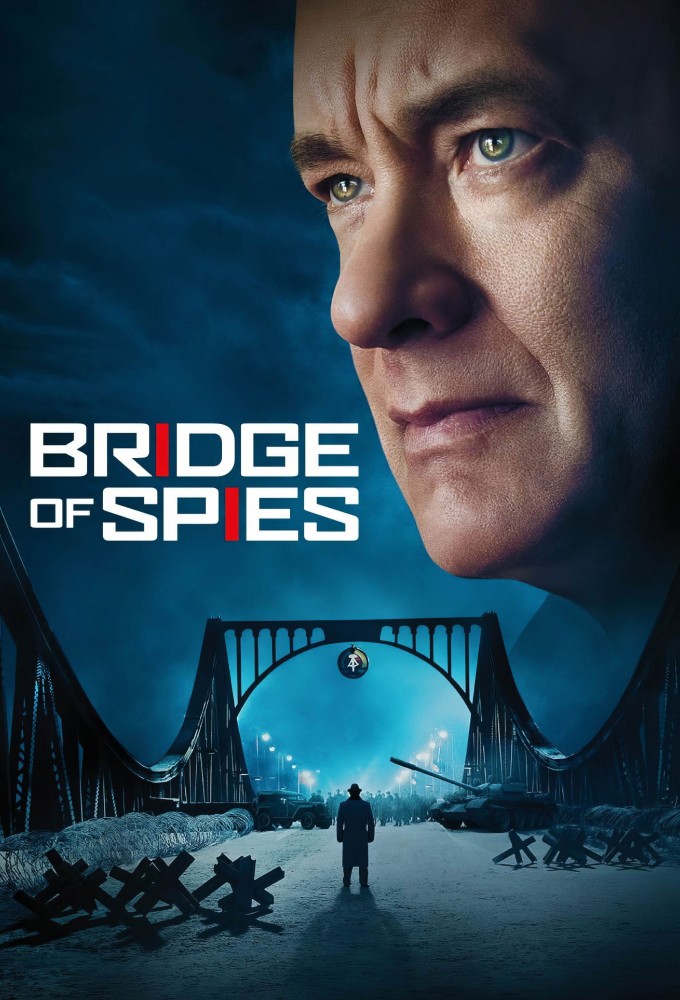
Bridge of Spies
- Directed by
- Steven Spielberg
- Runtime
- 141 min
- Studio
- TSG Entertainment, Amblin Entertainment, Studio Babelsberg
29 archived facts 7 topics 1 source Last reviewed Oct 2026
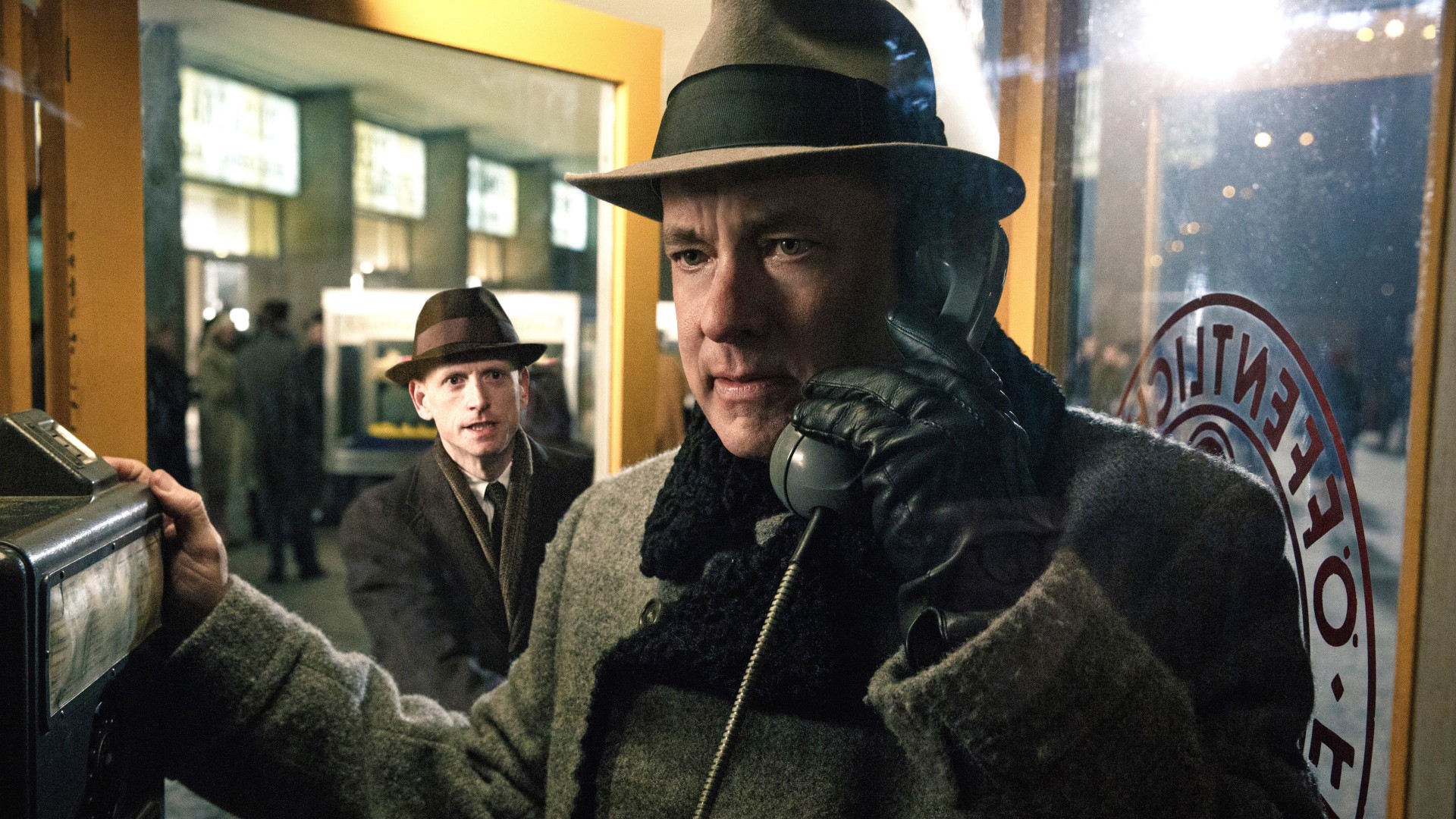
During the Cold War, the Soviet Union captures U.S. pilot Francis Gary Powers after shooting down his U-2 spy plane. Sentenced to 10 years in prison, Powers' only hope is New York lawyer James Donovan, recruited by a CIA operative to negotiate his release. Donovan boards a plane to Berlin, hoping to win the young man's freedom through a prisoner exchange. If all goes well, the Russians would get Rudolf Abel, the…
Summary: TMDB
All facts (29)
- #001
Soviet agent Rudolf Ivanovich Abel sent and received coded messages hidden inside objects such as hollow US coins, bolts and batteries. The FBI first learned of Abel's activities in 1953, when his bungling assistant Reino Häyhänen carelessly spent a hollow nickel that ended up in the hands of a newspaper boy. The Brooklyn newsboy who received the nickel thought it was too light, dropped it on the pavement, and the coin suddenly opened to reveal a piece of microfilm containing a coded message. After Häyhänen's mistakes, Abel lost his trust in him and sent him back to the USSR, which did not go well for Häyhänen, who defected in 1957. He showed the FBI how to break the code, and it was Häyhänen who gave up Rudolf Abel. The "Hollow Nickel Case" was also dramatized in The FBI Story (1959).
- #002
Rudolf Ivanovich Abel's seemingly incongruous accent was genuine. Abel (real name: William August Fisher) was born and raised in Newcastle-upon-Tyne to a family of Russian immigrants. He returned to Moscow with his family in 1921 at the age of 18, but never lost his accent when speaking English.
- #003
For the scene outside the courtroom, photographers were first instructed to put used flash bulbs, which were too hot to touch, into their pockets. One of the background actors was the historian of the New York Press Photographers Association. He told executive producer and first assistant director Adam Somner that photographers at the time threw the bulbs on the ground. After a few takes, Steven Spielberg noticed the bulbs scattered on the floor and decided to shoot a low-angle image of the managers walking over them.
- #004
For the six days of shooting at the Glienicke Bridge and the surrounding streets, the production company had to pay the local area, the city of Potsdam and the German government 10,552.13 euros (about 11,428.96 US dollars). It took one person five months to obtain all the necessary permits from 23 different institutions.
- #005
In an interview with the International Spy Museum, Francis Gary Powers Jr., son of Francis Gary Powers, stated that, contrary to the film's portrayal, his father was not told to kill himself if he were shot down. Instead, pilots were offered the option of using a poison needle if they chose to commit suicide in the event of physical torture. He also stated that the Soviets found the pin during a third strip search, but Powers warned them not to touch it. The Soviets tested the needle on a dog, and the dog died a few minutes later.
- #006
According to Steven Spielberg's press statement for the film, Gregory Peck pursued the story in 1965. Alec Guinness agreed to play Rudolf Ivanovich Abel, Peck to play James B. Donovan, and Stirling Silliphant to write the screenplay. MGM refused to make the film at the time. It was 1965, Cold War tensions were high, and Metro-Goldwyn-Mayer was reluctant to get into the story's politics.
- #007
Francis Gary Powers Jr. was interviewed at the International Spy Museum. Upon hearing about the making of the film, he said he approached the producers so that the details of his father's past would be accurate in light of information that had emerged since the 1980s. On the film, Steven Spielberg invited him to meet Austin Stowell, the actor who plays his father Francis Gary Powers alongside Tom Hanks. He then introduced them to his father's fellow pilot Joe Murphy, who helped identify him on the bridge during the spy exchange.
- #008
Donovan was not simply a lawyer at a firm specializing in insurance claims. Before joining this law firm, he was general counsel of the OSS, the predecessor of the CIA.
- #009
The Berlin Wall was not just an east/west barrier; it essentially surrounded West Berlin, leaving only a long, narrow corridor providing a route between West Berlin and the rest of the western sector. When completed, the Berlin Wall stretched 91 miles around West Berlin, including 27 miles within Berlin itself and a total of 66 miles of concrete. Some 37 kilometers of the Berlin Wall ran through residential areas. The wall's average height was 11.81 feet. Other features included 41 miles of wire fence, 95 miles of anti-vehicle trench, 79 miles of contact fence, 302 watchtowers and 20 bunkers. Of the 239 people who tried to escape to the west over, under or through the Berlin Wall, 192 were killed.
- #010
The hollow coins, hollow bolts, batteries and other items Abel used were created by Abel himself. Although the film implies that a razor blade was needed to open the famous "hollow nickel," it actually had a small hole into which you would insert a needle to open it. One of Donovan's arguments during the trial was that trick coins could often be found in magic and novelty shops. A shop owner testified that the quality of the workmanship on the hand-tooled spy coins was far better than those used in magic tricks.
- #011
Based on the quality of the filmmakers already attached, Tom Hanks was inclined to join the project without even reading the script. When he did, he knew it had the potential to be one of the most exciting projects of his career. Hanks said, "This subject has always fascinated me, because of the area and the time. I knew that Francis Gary Powers was a U-2 pilot shot down by the Soviet Union, that it was a major international incident and that there was a trade that brought him back, but I didn't know any of the details or who James Donovan was." Hanks continued, "I love reading history and discovering something brand new, especially about a subject I think I'm well informed about, and when that happens, man, it's like winning the lottery."
- #012
The film shown in the classroom is Duck and Cover (1952), a civil defense social guidance film.
- #013
U-2 aircraft are fitted with two auxiliary wheels called "pogos" under the wings to maintain balance during taxiing and takeoff. As the U-2 takes off, the auxiliary landing gear drops away to minimize weight. The U-2 was designed to be as light as possible to provide maximum range and altitude capability. Rather than the typical "tricycle" configuration, in which the landing gear forms a tripod on the wings, the aircraft lands in a "bicycle" configuration with the nose and tail gear in line. To prevent damage, the wingtips are fitted with titanium protective plates. After the U-2 stops, the ground crew reattaches the pogos to the wings one at a time, and the aircraft then taxis to park.
- #014
The popular story about the student Frederic Pryor is that he crossed into East Berlin to return a library book. The film suggests he was trying to get his girlfriend out. The truth is that while doing research for his thesis on trade behind the Iron Curtain, he dug too deep and discovered some things the authorities wanted buried. The espionage charge was therefore based on real intelligence, even if Pryor was not an actual spy.
- #015
At the beginning of the film, Rudolf Ivanovich Abel draws a self-portrait; the scene is based on Norman Rockwell's painting "Triple Self-portrait." Steven Spielberg and George Lucas are major collectors of Rockwell's work.
- #016
The subway Donovan rides home is the only remaining subway of its kind in New York. It is a Transit R11 subway car, part of an order of ten built in 1949. It was called the "million dollar train" because each of the ten cars cost more than $100,000. The interior seen in the film is the car as rebuilt in 1964/65, not as it was in 1961, when the story takes place.
- #017
Steven Spielberg cast Sir Mark Rylance in the film after seeing his performance in Twelfth Night, which won Rylance his third Tony Award.
- #018
The real Francis Gary Powers died in 1977. His son, Francis Gary Powers Jr., was a consultant on the production and also had a cameo in Bridge of Spies (2015) as a CIA agent involved in the training of U-2 pilots, or "DRIVERS" as they were commonly called at the time.
- #019
Co-writers Joel Coen and Ethan Coen came on board right after Matt Charman's first few script drafts, immersing themselves in the language of the period and incorporating Tom Hanks's personality into the character of James Donovan, skillfully turning this extraordinary experience in the man's life into a strong story that captures his essence. Steven Spielberg said: "Joel and Ethan took us very, very deep into the characters. They really instilled a sense of irony and a bit of absurd humor; not absurd in the sense that films can be licensed and absurd, but in the sense that real life is absurd. They are, as we all know from their magnificent work, wonderful observers of real life and managed to bring that to the story." A theme woven throughout the texture and framework of the Coen Brothers' script that also drew Spielberg's interest was the idea that spies look like everyone else. Spielberg explained: "These weren't just shadows, light and stereotypical spies; they were also spies we wouldn't notice at first, whom we wouldn't think twice about, let alone understand were here to carry out a mission against our national security. Between Matt Charman, Joel (Coen) and Ethan Coen, I was in the hands of three great storytellers."
- #020
Donovan opens the film arguing that a car hitting five motorcycles constitutes only an accident, and closes it arguing that the exchange of an American prisoner for a Russian prisoner and an East German prisoner constitutes only a trade.
- #021
Graphic designer Annie Atkins had worked on The Grand Budapest Hotel (2014) preparing prop calendars, after which people pointed out that the dates on the calendars did not fall on the historically correct days of the week. Determined not to make the same mistake again, she did extensive research for this film to ensure that all dates shown in the prop newspapers were also the historically correct day of the week. Unfortunately, to avoid continuity errors, the design team ultimately decided to leave all dates out of the newspapers.
- #022
The film depicts a clear bias on the part of the judge in the case. One of the arguments Donovan presented to the judge before the trial was that Abel's storage room, which had been given to the FBI by Abel's subordinate, the Soviet defector Reino Häyhänen, was raided without any search warrant being issued. It should be noted that the discovery of spy equipment in Abel's apartment was legal, since those items were found while an illegal alien search warrant was being issued for Abel. By contrast, the presence of similar but far more damaging and far more numerous items in the storage room was plainly illegal. The judge allowed this despite it being a clear violation of the Constitution. Legally the judge could have been disbarred, but the attitude of the day made doing anything about it impossible.
- #023
The CIA offered crack combat pilot Francis Gary Powers $30,000 a year (equivalent to $265,758.43 in 2017 dollars) to fly its highly classified bird.
- #024
The historic Glienicke Bridge in Berlin, Germany, where the exchange of Rudolf Ivanovich Abel for Francis Gary Powers took place, was the site of the story's historic climax. The bridge spans the Havel River and is near Wannsee, where the Wannsee Conference with Adolf Eichmann and other architects of the Holocaust took place (see Conspiracy (2001), Die Wannseekonferenz (1984) and The Wannsee Conference (1992)). During the Cold War, the Glienicke Bridge separated East Germany from West Berlin. After the Wall fell, barricades were placed on the bridge to prevent people from shooting straight across it to escape the Soviet occupation. At the time Bridge of Spies (2015) was made, it connected Berlin's Brandenburg district to the Potsdam suburb.
- #025
Describing the Berlin Wall, Steven Spielberg said: "It was really symbolic but it didn't look like San Quentin, or Alcatraz, or any other big federal prison. The walls were actually quite easy to scale, you just didn't dare do it. When we were shooting those scenes, I looked at the Wall and thought to myself: 'Did this really happen? Was Berlin really divided this way?' It reminded me of a time in my life when walls started going up all over the world; most of them invisible, but walls nonetheless." Tom Hanks added: "It was terrifying and it also felt very permanent. What production designer Adam Stockhausen was able to do with the wall, finding these perfect intersections in the city of Breslau, Poland, that fit the architecture of the time so well, was truly amazing." The result on screen reflects not only the horror of the Berlin Wall but also the confusion.
- #026
Finding a place in present-day Berlin, Germany, to shoot the train scene was initially a difficult process for the producers, because Friedrichstrasse Station as it stands today is more modern than the station that existed during the Cold War. But Adam Stockhausen found a solution and recreated the station using the cumbersome, rusty S-Bahn overpass next to another S-Bahn station that runs along a demolished brick wall.
- #027
According to historian Frederic L. Pryor, the East German lawyer Vogel, whom Donovan met, was not the villain depicted in the film: "He was a quiet, well-spoken man. It turned out to be a political matter in the film; he was trying to get the US to publicly recognize the East German government. But it was more of a waiting game they played to show the East Germans had the upper hand over the Russians. Vogel was actually a very good man, I visited him several times later."
- #028
Abel's espionage materials were found not only in his apartment but also in a storage room at another address. The reason the FBI learned of this other address was that Abel had made a very big mistake. He was going to give his junior colleague Reino Häyhänen a shortwave radio, and he carried the radio in his bag to meet Hayhanen, and the two went to a remote place to test the radio. The radio was broken, but Abel said he had a spare wire. The pair went to a building in Brooklyn. While Hayhanen waited outside, Abel went in and came out with a working radio, which he gave to Hayhanen. By revealing the location of this storage room, he violated a fundamental rule of espionage, giving critically important information to Hayhanen, who later defected and gave this location to the FBI.
- #029
Mortimer Byers, the judge in the Abel case, was known to be very harsh and quite strict. For example, he not only sentenced draft evaders to five years in prison but also imposed five years of hard labor. In his book Strangers on a Bridge, James Donovan recounts that he once overheard Byers suggest that aliens who did not obtain citizenship should be permanently branded so the government could track them. When the verdicts were announced, Donovan proposed that the ruling on count one (the charge of transmitting military secrets) be set aside because the evidence was not fully and completely sufficient to support the charge, and the judge rejected this request.
Continue through the archive



Sources & editorial notes
Reference databases
Sources for the entries on this page
- IMDb IMDb kaydı
Information from external sources is independently selected, consolidated and edited by Arka Evren. Sources are listed for verification and further reading. Encyclopedia text is used under its licence (CC BY-SA). How we work