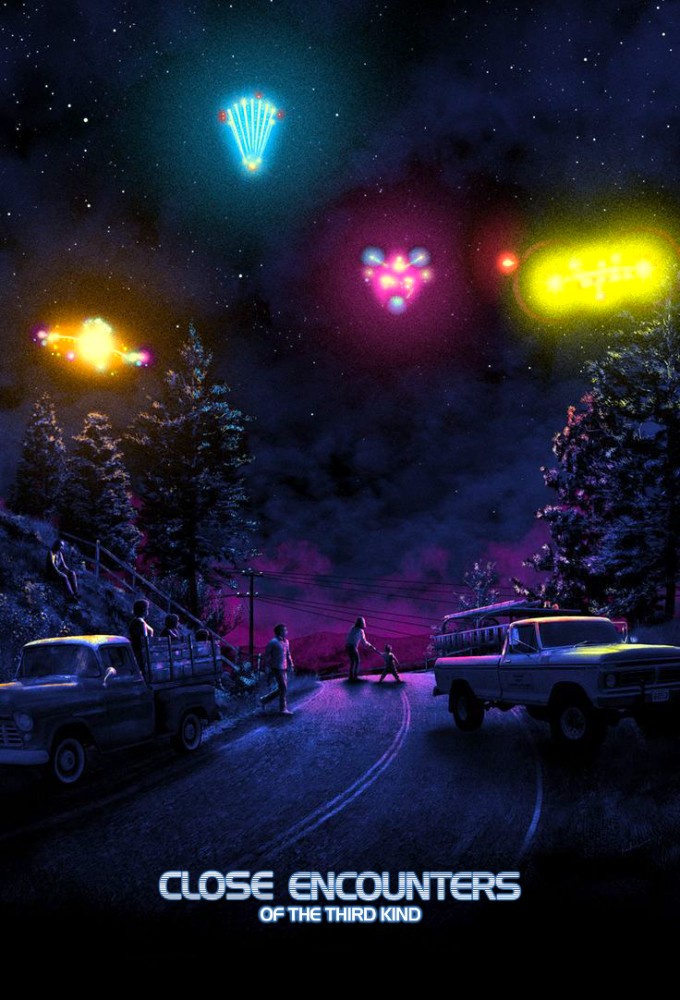
FILM · 1977 · UK
Close Encounters of the Third Kind
- Directed by
- Steven Spielberg
- Runtime
- 137 min
- Studio
- Julia Phillips and Michael Phillips Productions, Columbia Pictures, EMI Films
16 archived facts 2 topics 1 source Last reviewed Oct 2026
After an encounter with UFOs, an electricity linesman feels undeniably drawn to an isolated area in the wilderness where something spectacular is about to happen.
Summary: TMDB

All facts (16)
- #001
In the dinner scene, just before Roy piles up the mashed potatoes, the young girl Silvia (Adrienne Campbell) says, "There's a dead fly in my mashed potatoes." The line was not in the script and nearly made the other actors laugh. The scene was left as it was.
- #002
Douglas Trumbull achieved dramatic cloud effects by filling a tank half full of salt water, topping it with lighter fresh water, and then injecting paint into the upper layer. The paint rippled in the fresh water but flattened out above the heavier salt water, creating the effect seen on screen.
- #003
The film is shown every night at the Devil's Tower KOA Campground, making it one of the most frequently screened films of all time.
- #004
The small aliens in the film were played by local girls in costume from a ballet school for ages 8 to 12. Girls were used instead of boys because Steven Spielberg thought they moved more gracefully.
- #005
John Williams's score was created before the film was edited. Steven Spielberg arranged the film to match the music, the reverse of what is usually done in the scoring process. Both Spielberg and Williams felt this gave the film a lyrical quality.
- #006
Cary Guffey's (Barry Guiler) performances were so good that they had to shoot only one or two takes of every scene he was in. He became known on set as "One-Take Cary," and director Steven Spielberg printed a T-shirt bearing that phrase.
- #007
The film was partly inspired by an experience from Steven Spielberg's childhood, when his parents one night, without warning, put the children in their car and drove to an area where many other people had gathered to watch a spectacular meteor shower.
- #008
Director Steven Spielberg stated that nothing in his life was harder than editing the last 35 minutes of this film.
- #009
For the scene in which Barry looks out the window and sees the UFOs and says "toys!", Steven Spielberg actually held up a toy car behind the camera to prompt Barry's reaction.
- #010
According to Melinda Dillon, because the scene was done without rehearsal, the sequence in which all the objects in the kitchen fly around was genuinely frightening, and her alarmed reactions as she tried to protect herself and Cary Guffey were usually quite real and spontaneous.
- #011
Barry is shown reacting with astonishment to the extraterrestrial beings. Director Steven Spielberg hid two crew members, one in a clown costume and the other in a gorilla costume, in boxes off camera. With the cameras rolling, first one and then the other emerged, capturing young Cary Guffey's amazed reaction. Spielberg then whispered to the gorilla to remove its mask, which made Guffey smile.
- #012
Steven Spielberg carried out several tests with computer-generated imagery (CGI), which is now an industry standard but was then in the early stages of development. He decided that none of them looked convincing.
- #013
The words spoken by the crowd in India are "Aaya Re! Aaya," which means "He has come" in Hindi.
- #014
While shooting the live-action scenes, Steven Spielberg had only a vague idea of how the mother ship would look; he decided it would be big, cumbersome and very dark. Months later, while filming in India, he passed a giant oil refinery every day and drew inspiration from its many lights, pipes and protrusions on the platform to change the look of the spaceship. Although footage had already been shot showing a dark shadow over the crowd, he now decided the room would be brightly lit, and that is how it appears in the final film.
- #015
The iconic five-note melody was a chance arrangement that both composer John Williams and director Steven Spielberg liked among hundreds of different permutations. The tone was later used as a cue in Moonraker (1979) and again in Star Tours (1987).
- #016
Ray Bradbury declared it the greatest science fiction film ever made.
Continue through the archive




Sources & editorial notes
Reference databases
Sources for the entries on this page
- IMDb IMDb kaydı
Information from external sources is independently selected, consolidated and edited by Arka Evren. Sources are listed for verification and further reading. Encyclopedia text is used under its licence (CC BY-SA). How we work