

FILM · 2005 · UK
Charlie and the Chocolate Factory
- Directed by
- Tim Burton
- Runtime
- 115 min
- Studio
- Warner Bros. Pictures, Village Roadshow Pictures, The Zanuck Company
89 archived facts 7 topics 1 source Last reviewed Nov 2026
A young boy wins a tour through the most magnificent chocolate factory in the world, led by the world's most unusual candy maker.

89 Interesting Facts About Charlie and the Chocolate Factory
Interesting Facts (66)
- #001
Willy Wonka's colorful cane is filled with Nerds candies sold under the Willy Wonka brand.
- #002
AnnaSophia Robb (Violet Beauregarde) says she experienced a lot of jaw cramps while chewing her gum. Her father had told her not to smack her gum, but the producers said otherwise.
- #003
Many of the chocolate products in the film, including the trees and flowers, were created by Choccywoccydoodah, a chocolate shop in Brighton, England. After the film's premiere, the shop displayed and sold some of these creations.
- #004
The singing voice of the Oompa Loompas belongs to Danny Elfman, who overdubbed himself dozens of times.
- #005
Liz Smith (Grandma Georgina) stated in an interview with askmen.com that she read the scripts for both grandmothers and picked the one who got to kiss Johnny Depp. "And it was lovely," she recalled.
- #006
During pre-production, director Tim Burton visited Roald Dahl's former home in the village of Great Missenden in Buckinghamshire. Liccy Dahl recalls that Burton entered Dahl's famous writing hut and said, "This is the Bucket's house!" and thought to herself, "Thank God, somebody gets it." Liccy showed Burton the original manuscripts, and Burton discovered that they were more politically incorrect than the published book. The manuscripts included a child named Herpes, after a sexually transmitted disease.
- #007
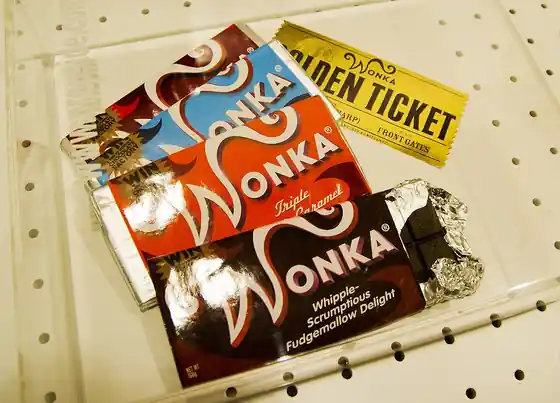
In Charlie's bedroom, the wrappers of every Wonka bar he has ever eaten are displayed on his wall as if they were a prize.
Charlie and the Chocolate Factory (2005): Charlie BucketImage: Wikimedia Commons · Urko Dorronsoro from Donostia - San Sebastian, Euskal Herria (Basque …, CC BY-SA 2.0 - #008
Screenwriter John August had never seen Willy Wonka & the Chocolate Factory (1971) when Tim Burton asked him to write the screenplay. After finishing the script, he finally watched the 1971 version and was surprised at how dark that film was compared to his own.
- #009
Willy Wonka's voice was first tested on Johnny Depp's daughter, Lily-Rose Depp. She liked it.
- #010
Charlie's father works at a toothpaste factory that produces Smilex toothpaste. "Smylex" was also the name of the poisonous gas devised by the Joker in Tim Burton's Batman (1989).
- #011
Some of the buttons in the glass elevator include: Incompetent Fools, T-Bone Steak Jell-O, Secretarial Poodles, Cocoa Cats, Mechanical Clouds, Stars in Their Pies, Nice Plums, Up and Out, Fragile Eggs, Black Box of Frogs, Weird Lollipops, Mighty Jam Monitor, Creative Dog Flip, Elastic Forest, Leaky Canes, Dessert Island, Pie Cream, Spewed Vegetables, Naffy Taffy, Lickety Split Peas, Honeycombs and Brushes, Old Sneezes and Smells Department, Television Room, Whizzdoodles, Chocolate Lip Rookies, Blackberry Sausages, Yankee Doodles, Orange Egg Flip, Root Beer Goggles, Pastry Room, Heart-Shaped Lungs and Projection Room.
- #012
Dr. Wonka tells young Willy that some people are allergic to chocolate in order to discourage him from eating candy. As a child, Johnny Depp (the adult Willy) was allergic to chocolate.
- #013
Julie Dawn Cole, the original Veruca Salt in Willy Wonka & the Chocolate Factory (1971), went to a preview screening of this film with her son, who was 12 at the time. After leaving the cinema she asked him what he thought of the film, and he reportedly said, "Mum, it's much better than yours."
- #014
Johnny Depp signed on without reading the script in order to take a completely different approach from what Gene Wilder did in Willy Wonka & the Chocolate Factory (1971). Depp said that, independently of the first film, Wilder's characterization of Willy Wonka stands out as a unique portrayal.
- #015
Executives at Warner Bros. did not want Mr. Bucket to appear in the film, wanting Willy Wonka to be the father figure Charlie never had, similar to what was done in Willy Wonka & the Chocolate Factory (1971). Tim Burton rejected this because he did not think Wonka would make a good father.
- #016
Director Tim Burton, who had great difficulty casting Grandpa Joe, offered the role to David Kelly when the two first met while Kelly was visiting Pinewood studios to do a wardrobe rehearsal for another film. Kelly said the whole process took three minutes.
- #017
Each Oompa Loompa song is in the style of a different musical era. In addition, Willy Wonka's comment on each song is a line belonging to the relevant era: Augustus Gloop, Broadway Musical ("Bravo! Well done. Aren't they delightful? Aren't they charming?", applause and praise like people give after a show); Violet Beauregarde, Disco ("Come on, let's boogie!"); Veruca Salt - Psychedelic ("Well, let's keep on truckin'."); Mike Teevee, Rock ("On with the tour!" about the many rock concert tours).
- #018
The director Tim Burton avoided using too many digital effects because he wanted the younger actors and actresses to feel like they were working in a realistic environment. As a result, forced perspective techniques, oversized props, and scale models were used to avoid computer graphics imagery.
- #019
In this film the location of Willy Wonka's factory is kept ambiguous. It is designed to look like a cross between the United Kingdom and the United States (for example, it has London architecture, street layouts and accents, but American clothing styles, American mailboxes, fire hydrants and American terminology). Another similarity is that Charlie and his parents speak with British accents.
Charlie and the Chocolate Factory (2005): Charlie BucketImage: Wikimedia Commons · Pablo RM from Madrid, Spain, CC BY 2.0 - #020
In an interview, Johnny Depp said he based his performance as Willy Wonka on imagining how then-President George W. Bush would behave while stoned.
- #021
Willy Wonka's boat was ultimately going to float on chocolate. It took twenty weeks to build.
- #022
The factory gates were offered to the Roald Dahl Museum in Great Missenden, Buckinghamshire, after filming was completed. However, the museum had to turn down the offer because of their size. Warner Bros. therefore commissioned a smaller replica set of the gates to be made and donated to the museum for use.
- #023
When the obnoxious Veruca Salt introduces herself, Willy Wonka says, "I always thought a verruca was a type of wart ..." In fact, "Verruca plantaris" is a painful wart caused by the human papillomavirus and occurs on the sole or toes of the foot.
- #024
Unlike the 1971 Chocolate River, Tim Burton wanted this chocolate river to be thick and creamy, resembling real chocolate rather than hot chocolate.
- #025
The role of Dr. Wilbur Wonka (Sir Christopher Lee) was written specifically for this film to give the Willy Wonka character a bit of family history.
- #026
On the day of the factory tour, a blue sky is seen over Charlie's hometown only once.
- #027
Deep Roy declares himself a terrible singer and dancer. He learned to dance for this film, but he did not do his own singing.
- #028
According to some interviews, it was Deep Roy, who is of Indian descent, who suggested that the first Oompa Loompa song be in Bollywood style.
- #029
As noted before, the country where the Chocolate Factory is located is an ambiguous crossover point between the US and Britain. This is reflected even in the money. The ten "dollar" banknote Charlie uses to buy the winning bar is a fairly clear blend of a British pound banknote and a US dollar banknote. It is also stated that Charlie is offered five hundred dollars when he finds the last Golden Ticket.
- #030
The giant chocolate sent by television had the UPC 034000190003, the UPC for seven-ounce (198.4 gram) Hershey's milk chocolate bars. The Willy Wonka Candy Company is a brand of Nestlé, one of Hershey's biggest competitors.
- #031
This film is not a direct remake of Willy Wonka & the Chocolate Factory (1971), but there is a similarity between the two: in the novel, both parents accompany the children (except Charlie, who brings only Grandpa Joe). In the films, however, each child brings only one parent: two mothers, two fathers and one grandfather. This was also a similarity the films shared with the Broadway musical.
- #032
The scene in which Violet turns into a blueberry was shot by digitally creating the inflated body and then adding live-action footage of AnnaSophia Robb on a tilting machine.
- #033
Wearing prosthetics in the blueberry transformation scene caused AnnaSophia Robb's face to appear to swell up to twice its normal size.
- #034
The exterior of the Wonka Factory was coincidentally built on the same backdrop Tim Burton had used for Gotham City in Batman (1989).
- #035
Sir Peter Ustinov was offered the role of Grandpa Joe, but he died before he could give the producers his answer.
- #036
Tim Burton compared the project's slow development to Batman (1989) and said both films involved various creative efforts. "Scott Frank's version was the best, probably the clearest, and the most interesting, but they abandoned that." Liccy Dahl stated that Burton was the first and only director with whom the estate was happy. Burton had produced another Roald Dahl adaptation, James and the Giant Peach (1996), and like Roald and Liccy, he disliked the 1971 film for deviating from the book's story.
- #037
The producers used fascist architecture for the exterior of Wonka's factory and designed most of the sets on three-hundred-and-sixty-degree sound stages similar to cycloramas.
- #038
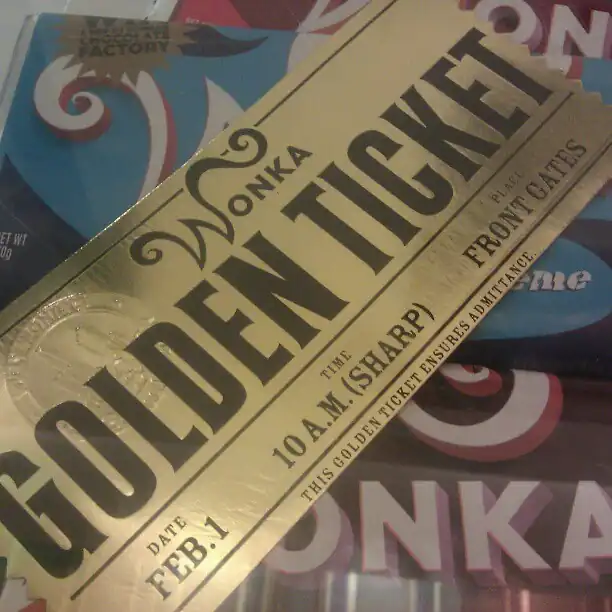
As Veruca is taken to the incinerator by the squirrels, Wonka reassures Mr. Salt by telling him that the light is only lit on Tuesdays, and Mike Teavee makes this comment: "Today is Tuesday." The factory tour began on February 1, and that day in 2005 was a Tuesday.
- #039
The "TV Room" was designed with inspiration from photographs from 2001: A Space Odyssey (1968), Danger: Diabolik (1968) and THX 1138 (1971).
- #040
While trying to photograph a vat of chocolate, the camera lens was not properly secured. As a result, the lens fell into the vat and destroyed it.
- #041
In Roald Dahl's book and in Willy Wonka & the Chocolate Factory (1971), Charlie is blond and Violet Beauregarde is brunette. In this adaptation, both characters swapped hair colors, with Charlie sporting a brown bowl haircut and Violet sporting a blonde, A-line bobbed haircut.
- #042
Initially the production team wanted to stage Violet's blueberry transformation practically on set, but Tim Burton stepped in and said it had to be done digitally.
- #043
Tim Burton and John August worked together to create Wilbur Wonka, Willy's authoritarian dentist father. Burton felt the father character would help explain Willy Wonka, who would otherwise be "just a weird guy." The element of an alienated father-son relationship had previously appeared in Big Fish (2003).
- #044
A practical method was considered for the scene in which Violet Beauregarde turns blue and swells into a giant ten-foot blueberry. Before the decision to do the entire transformation in computer-generated imagery (CGI), a dress fitted with air hoses was at one point considered for the start of the inflation scene. The visual effects company Cinesite was hired for the task. In some shots of AnnaSophia Robb's head, facial prosthetics were applied to give the impression that her cheeks were also swollen. Because this decision was made late in production, no footage of Violet's blueberry scene appeared in trailers or promotional materials.
- #045
In Willy Wonka & the Chocolate Factory (1971), Violet is annoyed by Veruca being a spoiled brat and insults her several times during the tour. However, Violet never interacts with Charlie on the tour. In this film the situation is the reverse: Violet and Veruca act as though they are friends while competing for the grand prize. At the same time, Violet is cruel and condescending toward Charlie and at one point calls him pathetic.
- #046
In the rocker section there is a shot that is an obvious copy of The Beatles. The bass guitarist (on the right of the stage) plays left-handed, as only the Beatles' bassist (Sir) Paul McCartney does.
- #047
Slugworth appears only in a flashback narrated by Grandpa Joe, but this time he seems like a genuine rival spy, and Wonka's paranoia, caused by his actions, leads him to fire all of his workers, including Joe himself.
- #048
After Veruca falls down the garbage chute, Mr. Wonka assures the group that they burn the garbage incinerator only on Tuesdays. Mike Teavee reminds him that today is Tuesday. In the novel, the tour takes place on the same day as every event in the sequel "Charlie and the Great Glass Elevator." According to the first book, the tour will take place on a February 1. In the second, Mr. Wonka states that the year is 1972. February 1, 1972 was a Tuesday.
- #049
Wonka and Violet share exactly the same children's hairstyle.
- #050
There was originally going to be a scene in which Veruca Salt, in the incinerator below the garbage chute, would hear the Oompa Loompas singing about her.
- #051
While at the factory, Mr. Teavee says Willy Wonka is "a few quarters short of a buck," while Mr. Salt says he doesn't "speak American." Ironically, Adam Godley, who plays Mr. Teavee, is British.
- #052
It shares various melodies and refrains with Corpse Bride (2005), another Tim Burton/Johnny Depp/Danny Elfman film that premiered the same year.
- #053
When Willy opens the factory doors to show the five children and their guardians the inside, the transition from the muted colors outside the factory to its bright, oversaturated world is a tribute to Dorothy entering the land of Oz. Both Tim Burton and Johnny Depp are huge fans of the 1939 film.
- #054
Johnny Depp always said that one of his favorite actors of all time was Marlon Brando, who died during the shoot. Brando was known for his tendency to mumble his lines. The scene in which Wonka yells "Mumbler!" at Mike Teavee may look like a tribute to Brando, but it is taken directly from the original book.
- #055
While traveling down the chocolate river, the boat drops into an area, and at the far left of the screen, next to the chocolate waterfall, there is a room labeled "Deep Room."
- #056
After Charlie finds the last golden Wonka ticket in the Wonka bar he bought at the store, he leaves without taking the change from the money he found a few minutes earlier. As Charlie pulls the ticket from the wrapper, the shopkeeper can be seen placing Charlie's change on the counter. Also, in the original novel Charlie actually buys two Wonka bars, quickly eating the first one in the store before finding the golden ticket in the second.
- #057
Wonka's throne is the same throne the Joker used in his parade. Johnny Depp, holding a giant pair of scissors for the factory's ribbon-cutting, also looks familiar. Mr. Wonka introduces himself to the tour group via Waxing Lyrical: "Good morning, Starshine! The Earth says Hello!" Mr. Wonka's teleporter demonstration resembles 2001: A Space Odyssey (1968), complete with the Monolith and "Also Sprach Zarathustra." Each of the five musical numbers nods to something or other in its style and visuals. "Wonka's Welcome Song" = "It's a Small World" (though it can also be read as a Take That! at the older songs in the 1971 film adaptation of the novel, i.e. "The Candy Man"). "Augustus Gloop" = Bollywood and Esther Williams musicals. "Violet Beauregarde" = The Jackson 5 song "Dancing Machine." "Veruca Salt" = The Byrds' "Turn! Turn! Turn!" "Mike Teavee" = Queen's "Bohemian Rhapsody." The music of the "Loompa Land" scene, especially its "Hoo Haa!" chants, recalls Danny Elfman's own score for the Forbidden Zone. Very, very briefly, when the Oompa-Loompa sitting in front of the television in the TV Room first changes the channel, you can hear a short snippet of the Macarena. When Mike's father rescues his now-miniaturized son from the television set: "Help me! Help me!" (Burton is in fact using this joke for the second time.)
- #058
Stinking Set: The 120,000 gallons of "chocolate" river water was a real liquid thickened with cellulose gum (Natrosol). But it was not merely a visual prop; because it contained organic pigments and sat under hot studio lights for 12 weeks, it began to rot. The smell became so bad that the cast and crew reportedly begged for the stage doors to be opened between takes.
- #059
During the Augustus Gloop song, the Oompa Loompa swimsuits feature black-and-white striped candy on the sleeves, and the same appears in the main candy room.
- #060
At one point, Tom Shadyac was considered to direct the film with Jim Carrey in mind to portray Willy Wonka. However, this idea was quickly vetoed by Liccy Dahl.
- #061
Wonka's television commercial includes a parody of the opening scene of 2001: A Space Odyssey (1968).
- #062
In the Nut Room, after Veruca is knocked over and dragged away by the squirrels, Wonka makes a show about searching a giant ring of keys for the one to open the gate. He tries multiple keys, and can't seem to find the right one. After Veruca falls down the chute, he tells Mr. Salt that he would just have to reach in and pull her out. While he's saying that, it can be seen that the key was in the keyhole by this point, indicating that Wonka knew exactly which key would open the gate the whole time.
- #063
When Violet's mother pushes her through the door leading out of the Inventing Room, the sound of liquid sloshing can be heard, presumably the blueberry juice inside Violet's body.
- #064
David Walliams was the preferred candidate for the character of Willy Wonka, but filming conflicted with his show Little Britain (2003). David suggested a miniature of the Little Britain characters 'Andy and Lou,' but this clearly did not happen.
- #065
While Wonka shoots the TV commercial, Richard Strauss's Also sprach Zarathustra can be heard in the parody of 2001: A Space Odyssey (1968).
- #066
The production company Plan B Entertainment was founded by Brad Pitt, Jennifer Aniston and Brad Grey. In 2005, after this film was shot, two things happened: Brad Pitt and Jennifer Aniston divorced, and Brad Grey became CEO of Paramount Pictures, leaving Brad Pitt as the sole owner of Plan B Entertainment. Had this film been made the following year (2006), the opening title would have read: "Produced by Brad Pitt."
Behind the Scenes (3)
- #067
Rather than relying on CGI, Tim Burton wanted the forty squirrels in the Nut Room to be real. The animals were trained every day for ten weeks before filming began. While the newborns were fed with bottles, they began to build relationships with the trainers. The squirrels were taught to sit on a small blue bar stool, tap lightly, then crack a walnut and drop the "meat" onto a conveyor belt. Burton said, "In the end the scene was supported by CGI and animatronics, but in terms of close-ups and the main action, they're real."
- #068
In the final scene where Willy speaks with a psychiatrist, the nameplate on the doctor's desk reads "Dr. P. Sarrosy," a tribute to the famous cinematographer Paul Sarossy.
- #069
The part of the Wonka Welcome song where the animatronics catch fire and begin to melt recalls the opening scene of House of Wax (1953), a Vincent Price film. Price was a good friend of director Tim Burton and, in his final film, played Depp's father in Edward Scissorhands (1990), Burton's first Johnny Depp film.
Characters & Cast (5)
- #070
Johnny Depp was so impressed by Freddie Highmore's performance in Finding Neverland (2004) that he suggested to Tim Burton that he observe him for the role of Charlie Bucket.
- #071
Deep Roy, who auditioned for the Oompa Loompas, danced and lip-synced to Tom Jones's "It's Not Unusual," unaware that director Tim Burton had used the song in Mars Attacks! (1996).
- #072
When Mike Teavee is teleported into the television, the shower scene from Psycho (1960) is reenacted. Freddie Highmore went on to play Norman Bates in Bates Motel (2013), the prequel to Psycho.
- #073
Sam Neill auditioned for the role of Mr. Salt, but Tim Burton said he wanted Johnny Depp to be the film's only "name" actor.
- #074
Taylor Momsen auditioned for the role of Violet Beauregarde but was considered too pretty for the part of a rude, arrogant tomboy.
Easter Eggs & References (8)
- #075
During production, Gene Wilder, in an interview with The Daily Telegraph, accused the filmmakers of remaking Willy Wonka & the Chocolate Factory (1971) for money. Johnny Depp defended the film, saying it was not a remake of the previous film but a new adaptation of the book.
- #076
The flashbacks to Willy Wonka's childhood and his having to wear a huge set of braces are not from the original book. The braces are a reference to Tim Burton's own childhood.
- #077
At the end of the film, the "psychiatrist" Oompa Loompa explains how Willy Wonka found a family; in the background, the Hill Silhouette from The Nightmare Before Christmas (1993) is there for everyone to see.
- #078
Warner Bros. wanted Tim Burton to cast one of the now-adult child actors from Willy Wonka & the Chocolate Factory (1971) as one of the children's parents in this new film. Burton vetoed the idea for two reasons: this was an adaptation of the book very different from the 1971 film, and only Julie Dawn Cole, who played Veruca in the previous film, continued acting into adulthood. The other child actors from the previous film quit acting at a very young age. The film was the only film credit for Peter Ostrum, who played Charlie in the 1971 film. He later became a veterinarian and, as of April 2023, is still a practicing veterinarian.
- #079
When Willy Wonka first opens his factory, he cuts a ribbon with scissors. He then turns around and spreads his arms as if one hand were made of scissors. This is a reference to Edward Scissorhands (1990), the first Johnny Depp-Tim Burton collaboration.
- #080
When Wonka first introduces himself, he says "Good Morning Starshine," a reference to the 1967 musical Hair, and sings a song by that name.
- #081
One of the rooms the candy boat passes through is labeled "Beetle Juicing." This is a reference to Beetlejuice (1988), another film directed by Tim Burton.
- #082
When Willy tells the Oompa to take Mrs. Gloop to Augustus, the Oompa accepts the order by crossing his arms over his chest. This is a subtle nod by director Burton to Ed Wood's film "Plan Nine from Outer Space," which links the film to Depp and Burton.
Deeper Meaning (3)
- #083
Deep Roy's performance as every Oompa Loompa was remarkable, and he repeated the same movements hundreds of times. These were later digitally combined, with each Oompa Loompa representing a separate performance by Roy. In return, Roy's salary was raised to 1 million dollars.
- #084
For his performance as Willy Wonka, Johnny Depp used game show hosts and children's television hosts such as Fred Rogers as inspiration. In interviews he also said Willy Wonka would be "part Howard Hughes-reclusive, part 1970's glamorous rock star."
- #085
When Prince Pondicherry's chocolate palace begins to melt in the hot sun, the first drop lands on his forehead in the position and shape of a bindi, a dot worn by both men and women to symbolize their religion, social class and marital status. Other names for the dot are tilak, tika, pottue, sindoor, tilakam and kumkum. The palace also resembles the Taj Mahal, the tomb of the emperor's favorite wife in India, which was once covered with camouflage for fear of Japanese bombing in World War II.
Career & Awards (1)
- #086
Of the five child actors in the film, only Julia Winter retired from the industry and no longer acts. She now continues her career as a doctor. Ironically, the opposite is true for Willy Wonka & the Chocolate Factory (1971), since Julie Dawn Cole (who played the same character, Veruca) is only one of the five child actors still acting.
Life & Family (3)
- #087
In early 2003, Gregory Peck was offered the role of Grandpa Joe. He told Warner Bros. he would think about it, but he passed away before he could give them an answer. Peck's family said in interviews that he hesitated only because he did not want to appear helpless and take a significant pay cut, and that he was looking forward to playing Grandpa Joe.
- #088
When Willy reconciles with his father Wilbur, whom he has not seen since childhood, Charlie goes to the wall and sees that Wilbur has Wonka candy wrappers and newspaper clippings highlighting his son's career. This was based on the time director Tim Burton visited his mother, with whom he had had a similar disagreement, and saw that she had film posters and cinema tickets highlighting her son's film career.
- #089
In the novel, Mr. Wonka tells Charlie that he has won the factory while they are flying in the Great Glass Elevator. To spare the boy's other grandparents from having to leave their beds, which would not fit through the hut's door but would fit in the elevator, he crashes the bed into the hut to collect the family. In this adaptation, Mr. Wonka does not give anyone the news that Charlie has won the factory until he crashes the elevator into the hut, and worse, he has no intention of taking anyone other than Charlie back to the factory.
Related pages
- Jim Carrey — Charlie and the Chocolate Factory comes up in the facts on that page
- Timothée Chalamet — Charlie and the Chocolate Factory comes up in the facts on that page
Continue through the archive
Sources & editorial notes
Reference databases
- Wikipedia
- IMDb
Information from external sources is independently selected, consolidated and edited by Arka Evren. Sources are listed for verification and further reading. Encyclopedia text is used under its licence (CC BY-SA). How we work