ArkaEvren
Il buono, il brutto, il cattivo

FILM · 1966 · USA

Il buono, il brutto, il cattivo

Directed by
Sergio Leone
Runtime
161 min
Studio
United Artists, PEA, Arturo González PC

317 archived facts 5 topics 1 source Last reviewed Nov 2026

While the Civil War rages on between the Union and the Confederacy, three men – a quiet loner, a ruthless hitman, and a Mexican bandit – comb the American Southwest in search of a strongbox containing $200,000 in stolen gold.
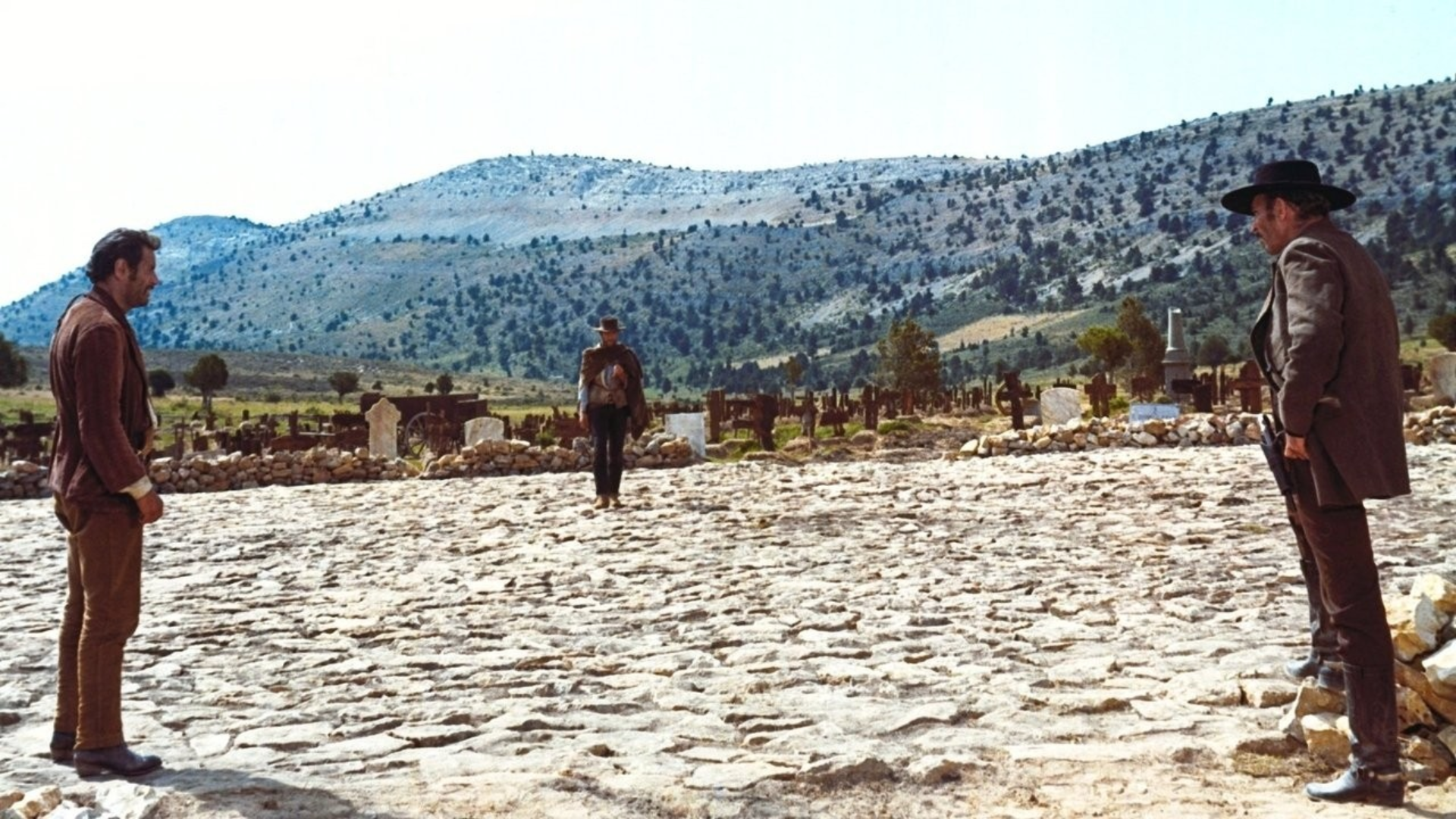
  • Il buono, il brutto, il cattivo — production image

317 Interesting Facts About Il buono, il brutto, il cattivo

Interesting Facts (18)

  1. #001

    According to Eli Wallach, when the time came to blow up the bridge, Sergio Leone asked the Spanish Army Captain in charge to trigger the fuse as a sign of gratitude for the Army's cooperation. They agreed to blow up the bridge when Leone gave the signal "Vai!" (Go!) over the radio. Unfortunately, another crew member spoke on the same channel to a second crew member, saying "vai, vai!" meaning "it's okay, proceed." The Captain heard this signal, thought it was meant for him, and blew up the bridge. Unfortunately, no camera was running at that moment. Leone was so upset that he fired the crew members who immediately fled the set in his car. The Captain was so sorry about what happened that he offered Leone that the Army would rebuild the bridge and blow it up again on one condition: that the fired crew members be rehired. Leone agreed, the crew was forgiven, the bridge was rebuilt, and the scene was shot successfully.

    INTERESTING FACTS · SOURCED

  2. #002

    Because writer and director Sergio Leone spoke almost no English and Eli Wallach (Tuco) spoke almost no Italian, the two communicated in French.

    INTERESTING FACTS · SOURCED

  3. #003

    (At about 2 hours 40 minutes) The skeleton Tuco finds in the wrong coffin in Sad Hill cemetery was a real human skeleton. The deceased Spanish actress had written in her will that she wanted to keep acting after her death.

    INTERESTING FACTS · SOURCED

  4. #004

    In the original working script, Angel Eyes was called "Banjo," but in the Italian version he is referred to as "Sentenza" (meaning "Sentence" or "Judgement"). Clint Eastwood gave him the name Angel Eyes on set because of Lee Van Cleef's skinny appearance and expert marksmanship.

    INTERESTING FACTS · SOURCED

  5. #005

    On set, Eli Wallach was nearly poisoned after drinking the acid used to burn the bags full of gold coins so they would open more easily when struck with a shovel. He did not know the acid had been poured into a lemon soda bottle. He drank a lot of milk and filmed the scene with his mouth full of sores.

    INTERESTING FACTS · SOURCED

  6. #006

    (At about 33 minutes) In the gun store, everything Tuco (Eli Wallach) does with the weapons was not scripted in advance. Wallach knew very little about guns, so he was instructed to do whatever he wanted. However, he was given instruction on how to take them apart and put them back together. Most of the Storekeeper's (Enzo Petito's) bewildered reactions throughout the scene are genuine. The moment when Tuco shoves the open or closed sign into his mouth was also Wallach's idea.

    INTERESTING FACTS · SOURCED

  7. #007

    Ennio Morricone's iconic theme music was designed in places to imitate the sound of a howling coyote. Morricone initially did not want to use a trumpet, but Sergio Leone insisted. Along with electric and acoustic guitars and a "tarzan yell," the trumpet became the most distinctive part of the soundtrack.

    INTERESTING FACTS · SOURCED

  8. #008

    Filming was briefly delayed because Clint Eastwood refused to come to work until writer and director Sergio Leone agreed to pay him $250,000 in addition to a new Ferrari.

    INTERESTING FACTS · SOURCED

  9. #009

    (At about 1 hour 55 minutes) While Tuco's shackles are being cut on the train rail, writer and director Sergio Leone insisted that Eli Wallach perform the stunt himself and assured him that, although it would be noisy and frightening, it would be completely safe. Wallach was unaware of the low step rails that missed his head by a few inches. In the wide shot, the step can be seen striking his head.

    INTERESTING FACTS · SOURCED

  10. #010

    Although Clint Eastwood is the most prominently billed actor in this film, Eli Wallach has the most screen time.

    INTERESTING FACTS · SOURCED

  11. #011

    (At about 23 minutes) In addition to the train scene, Tuco (Eli Wallach) cheated death in the first scene in which Blondie (Clint Eastwood) shoots him down by hanging. The gunshot frightened the horse, which took off at full speed for nearly a mile. Wallach's hands were tied behind his back and he had to hold on with his knees for his life.

    INTERESTING FACTS · SOURCED

  12. #012

    Because of the striking height difference (more than nine inches) between Clint Eastwood and Eli Wallach, it was sometimes difficult to include them in the same frame.

    INTERESTING FACTS · SOURCED

  13. #013

    When Eli Wallach arrived in Madrid, Spain, all the hotels were full. Clint Eastwood invited him to a friend's house and they shared the same bed. Wallach's wife, Anne Jackson, said he could boast of being the only man who had slept with Clint Eastwood.

    INTERESTING FACTS · SOURCED

  14. #014

    Only three main actors in this film actually speak English: Clint Eastwood, Lee Van Cleef and Eli Wallach, apart from Al Mulock (the one-armed man) and John Bartha (the Sheriff). Everyone else in the film is in fact speaking their own native language, mostly Italian and Spanish, and was later dubbed into English.

    INTERESTING FACTS · SOURCED

  15. #015

    According to Sergio Leone, getting Clint Eastwood to agree to make the film required a great deal of argument, because before taking the role he thought his character would be overshadowed by Tuco. He said: "In the first film I was almost alone. In the second we were two, now three. If this keeps up, I'll end up with a whole cavalry troop."

    INTERESTING FACTS · SOURCED

  16. #016

    Orson Welles had warned Sergio Leone not to make this film, on the grounds that Civil War films were box-office poison.

    INTERESTING FACTS · SOURCED

  17. #017

    It was shot in the Spanish desert with 1,500 Spanish soldiers as extras.

    INTERESTING FACTS · SOURCED

  18. #018

    The first ten and a half minutes of the film contain no dialogue.

    INTERESTING FACTS · SOURCED

Behind the Scenes (205)

  1. #019

    (At about 2 hours 35 minutes) In the scene just before the final duel, in which Tuco (Eli Wallach) runs like a madman through the cemetery, a dog can be seen running across the screen at the start of the scene. This was in fact improvised on location. Sergio Leone, afraid the scene would slide into melodrama, released the dog without telling Wallach; as a result, his bewildered look was quite genuine.

    BEHIND THE SCENES · SOURCED

  2. #020

    For the filming of the bridge explosion scene, Sergio Leone gave a Spanish captain the job of detonating the charge. However, when a crew member accidentally shouted "vai, vai!" over the radio, the bridge blew up before the cameras were even rolling. Although Leone fired the crew member, the captain offered to rebuild the bridge on the condition that the crew member be rehired, and the scene was then shot successfully.

    BEHIND THE SCENES · SOURCED

  3. #021

    Sergio Leone's English was quite limited, and Eli Wallach's Italian was equally so. To overcome this language barrier, the two communicated with each other in French throughout the shoot.

    BEHIND THE SCENES · SOURCED

  4. #022

    The skeleton Tuco finds in Sad Hill Cemetery belonged to a Spanish actress who, in her will, had asked to continue acting after her death.

    BEHIND THE SCENES · SOURCED

  5. #023

    Eli Wallach was poisoned when he mistook the acid used to age the bags of gold for a bottle of lemon soda and drank it. For the rest of the shoot, the actor had to perform with wounds in his mouth.

    BEHIND THE SCENES · SOURCED

  6. #024

    The dog that appears in the cemetery scene at the finale was released by Leone without Wallach being told. As a result, Wallach's bewildered expression in the scene became completely natural and realistic.

    BEHIND THE SCENES · SOURCED

  7. #025

    Ennio Morricone's iconic music was designed to imitate the howl of a coyote. Although Morricone was initially reluctant to use a trumpet, at Leone's insistence the instrument, along with electric guitars and the 'Tarzan yell', became one of the film's signature elements.

    BEHIND THE SCENES · SOURCED

  8. #026

    In the train scene, the horse Wallach's bound-handed character was riding was startled by a gunshot and galloped for about a mile. In another scene, Wallach, who performed the moment his handcuffs were cut himself, failed to notice the low-hanging step rails and narrowly avoided hitting his head.

    BEHIND THE SCENES · SOURCED

  9. #027

    Clint Eastwood, who did not smoke, hated smoking cigars and frequently complained to Leone that the shoot required a great many takes. Also, when they arrived in Madrid, the hotels were full, so Eastwood and Wallach had to share the same bed at a friend's house.

    BEHIND THE SCENES · SOURCED

  10. #028

    In the original production, the only English-speaking actors were Clint Eastwood, Lee Van Cleef, Eli Wallach, Al Mulock and John Bartha. All the other actors spoke in their native languages, and their voices were later dubbed into English.

    BEHIND THE SCENES · SOURCED

  11. #029

    For the film, shot in the deserts of Spain, 1,500 Spanish soldiers were assigned as extras.

    BEHIND THE SCENES · SOURCED

  12. #030

    Four scenes cut from the original English version were restored for the 'Extended Version'. Because Lee Van Cleef was no longer alive when these scenes were dubbed, Simon Prescott voiced the character of Angel Eyes in these sections.

    BEHIND THE SCENES · SOURCED

  13. #031

    In Italian-made films of that era, sound was not recorded live; because of the poor insulation in the studios, actors spoke in their own languages and the dialogue was dubbed in post-production. This was a great difficulty for actors who had to perform without understanding what the actor opposite them was saying.

    BEHIND THE SCENES · SOURCED

  14. #032

    During the bridge explosion scene, a fist-sized piece of rock grazed Clint Eastwood's head and nearly ended his career; this dangerous moment can be clearly seen in the slow-motion footage of the shoot.

    BEHIND THE SCENES · SOURCED

  15. #033

    Ennio Morricone's soundtrack album became the artist's most commercially successful work and stayed on the charts for more than a year.

    BEHIND THE SCENES · SOURCED

  16. #034

    Sad Hill Cemetery was a set built in the Carazo region of Spain. In 2015, the 'Asociación Cultural Sad Hill' restored the site and allowed fans to add their own names to the crosses. The project was immortalized in the documentary 'Sad Hill Unearthed' (2017).

    BEHIND THE SCENES · SOURCED

  17. #035

    In the film's cinema trailer, the descriptions of the characters were accidentally swapped; the trailer followed the Italian title order without taking the English title change into account.

    BEHIND THE SCENES · SOURCED

  18. #036

    Many of the towns in the film were in fact the same set, built by designer Carlo Simi for 'For a Few Dollars More'. Today this set survives as a western theme park called 'Mini Hollywood'.

    BEHIND THE SCENES · SOURCED

  19. #037

    The silver rattlesnake grips on Clint Eastwood's gun are the same as those used in 'For a Few Dollars More' and actually belonged to the character Rowdy Yates in the series 'Rawhide'.

    BEHIND THE SCENES · SOURCED

  20. #038

    In 1966, the Spanish Army built Sad Hill Cemetery, containing more than 5,000 graves, for the final sequence. The set, abandoned after filming, was excavated by fans in 2015, and its original stone-paved circle was discovered and restored.

    BEHIND THE SCENES · SOURCED

  21. #039

    The stripes on the Confederate soldiers' uniforms identified their units: blue for infantry, gold for cavalry and red for artillery. Most of the soldiers in the prison camp wore historically accurate uniforms.

    BEHIND THE SCENES · SOURCED

  22. #040

    That muddy town where Blondie first sends Tuco to the gallows is actually a set left over from Sergio Corbucci's 'Django', shot the same year. In this location, which did not even need to be cleaned between the two productions, Tuco makes the scene unforgettable with his famous curse.

    BEHIND THE SCENES · SOURCED

  23. #041

    The fade to black at the 82nd minute of the film was in fact the intermission point in the original screening; this section was removed entirely in the three-hour extended cut.

    BEHIND THE SCENES · SOURCED

  24. #042

    The cinematography was carried out using the 'Techniscope' method, which consumed half as much film as standard anamorphic processes; this technique made it possible to fit two widescreen frames onto a single 35mm frame.

    BEHIND THE SCENES · SOURCED

  25. #043

    In the Italian version, the signatures written in the actors' own handwriting were rewritten in the English cut during post-production by a single person.

    BEHIND THE SCENES · SOURCED

  26. #044

    That ravine where Tuco finds Blondie's campfire is actually located in the same spot as the place where Clint Eastwood and Lee Van Cleef meet in 'For a Few Dollars More'.

    BEHIND THE SCENES · SOURCED

  27. #045

    The armored train seen at the 110th minute of the film carries a heavy mortar-like weapon of the kind used in the bloodiest clashes of the American Civil War.

    BEHIND THE SCENES · SOURCED

  28. #046

    Clint Eastwood still keeps that iconic serape, which Leone initially considered giving to Steve Reeves but chose at the last moment. Never washed, the garment is today preserved in a special glass case.

    BEHIND THE SCENES · SOURCED

  29. #047

    The rugged and harsh terrain conditions during shooting caused Clint Eastwood to suffer frequently from heat exhaustion.

    BEHIND THE SCENES · SOURCED

  30. #048

    The guard's line meaning 'more feeling' was in fact a translation trick devised so that the lip movements would match the Italian phrase 'piu forte' (louder).

    BEHIND THE SCENES · SOURCED

  31. #049

    All the weapons used in the film were sourced from the Italian firm Aldo Uberti Inc. in keeping with historical accuracy; Blondie and Tuco used 1851 model Colt Navy, while Angel Eyes used an 1858 model Remington Army.

    BEHIND THE SCENES · SOURCED

  32. #050

    Pitchfork placed the main theme bearing Ennio Morricone's signature at number 32 on its '200 Best Songs of the 1960s' list, honouring the work's kaleidoscopic structure.

    BEHIND THE SCENES · SOURCED

  33. #051

    The white curtains on the Confederate officer's carriage were deliberately made large to create a ghostly atmosphere; for this reason the carriage was nicknamed the 'Carriage of Ghosts'.

    BEHIND THE SCENES · SOURCED

  34. #052

    Those eerie coyote howls heard at the opening of the film are nothing more than stock sound effects that had been a staple of the western genre since the 1940s.

    BEHIND THE SCENES · SOURCED

  35. #053

    In the scene where Angel Eyes fires from inside a pillow, a metal plate was placed in the pillow to protect the actor Livio Lorenzon; however, Leone's insistence on repeating the scene many times led to Lorenzon suffering hearing loss.

    BEHIND THE SCENES · SOURCED

  36. #054

    Eli Wallach and Clint Eastwood often played golf to pass the time between shoots in Madrid.

    BEHIND THE SCENES · SOURCED

  37. #055

    That legendary three-way duel in the Sad Hill cemetery lasts a full 11 minutes from the firing of the first shot to the final moment.

    BEHIND THE SCENES · SOURCED

  38. #056

    Tuco's shouts in the final scene were filmed differently for the Italian and English versions in order to achieve lip synchronisation; both versions end with the 'Tarzan scream'.

    BEHIND THE SCENES · SOURCED

  39. #057

    The source of the 'cheroot' type cigars Eastwood smoked throughout the film remains a mystery; while Leone claimed they were custom-made in Beverly Hills, some sources suggest the manufacturer was Marsh Wheeling.

    BEHIND THE SCENES · SOURCED

  40. #058

    In the film's original 131-minute cut, that final scene in which Blondie mounts his horse, takes off his hat and says 'Sorry Tuco' also retains its place in the restored long version.

    BEHIND THE SCENES · SOURCED

  41. #059

    At the 53rd minute of the film, in the scene where Angel Eyes interrogates soldiers in a ruined castle, a Native American arrow stuck in the wooden wall does not escape attentive eyes.

    BEHIND THE SCENES · SOURCED

  42. #060

    Although Sergio Leone found the scene in which Tuco drags dead soldiers down from the ghost carriage too harsh, he accepted this savage move as a dramatic necessity so that the character could clear his path and escape.

    BEHIND THE SCENES · SOURCED

  43. #061

    The 5x7 mini posters included in the 2004 MGM two-disc special collector's set were sourced from Posteritati, a famous gallery and archive of the period.

    BEHIND THE SCENES · SOURCED

  44. #062

    The film's digital and physical copies, remaining faithful to the photographic texture of the original negative, preserve greenish hues in the sky and dominant yellow and red tones in the colour palette; this stylistic choice later inspired the film 'Romancing the Stone'.

    BEHIND THE SCENES · SOURCED

  45. #063

    The whistled melody heard in the scene where Tuco and Blondie walk towards the Union prison camp is a tribute to the iconic 'Colonel Bogey March' composition from the film 'The Bridge on the Kwai'.

    BEHIND THE SCENES · SOURCED

  46. #064

    The locomotive and carriages used in the film were built with a different European-designed wheel suspension system instead of the 'truck' frame system found in American prototypes.

    BEHIND THE SCENES · SOURCED

  47. #065

    Clint Eastwood hesitated for a long time about accepting the role; he was worried that his character would remain in Tuco's shadow. To persuade the actor, Leone offered him a fee of $250,000 as well as a Ferrari as a gift.

    BEHIND THE SCENES · SOURCED

  48. #066

    Orson Welles tried to talk Leone out of the project, arguing that films about the American Civil War would disappoint at the box office. Eastwood's salary, meanwhile, was raised to exactly 17 times what he had earned on the series' first film, 'A Fistful of Dollars'.

    BEHIND THE SCENES · SOURCED

  49. #067

    The film holds the title of the highest-rated production on without an Oscar nomination. The main reason for this is that it could not be released in the US until 1968, so it missed the Academy's evaluation process.

    BEHIND THE SCENES · SOURCED

  50. #068

    Defying the strict Hays Code of the 1960s, the production forced Hollywood to update its moral rules in order to compete with foreign westerns.

    BEHIND THE SCENES · SOURCED

  51. #069

    With a budget of $1.6 million, the film was quite costly for its time, and it got its name from a spontaneous decision by Leone during a presentation to United Artists executives; the director had initially been considering titles such as 'The Magnificent Rogues'.

    BEHIND THE SCENES · SOURCED

  52. #070

    Set during the American Civil War, the film functions as a prequel telling the story before the series' earlier productions. Although Leone drew on Library of Congress documents to capture the historical atmosphere, he included historical anachronisms in scenes such as the use of dynamite and trench warfare.

    BEHIND THE SCENES · SOURCED

  53. #071

    When it was released, the film drew harsh reactions from critics such as Roger Ebert and Renata Adler over its violence and length, but over time it was reassessed and accepted as one of the most influential masterpieces in cinema history.

    BEHIND THE SCENES · SOURCED

  54. #072

    Screenwriter Luciano Vincenzoni prepared a draft for a sequel titled 'Il buono, il brutto, il cattivo n. 2'. However, Leone vetoed the project, objecting to the reuse of the characters and the name.

    BEHIND THE SCENES · SOURCED

  55. #073

    During editing, many sections were cut from the film, such as the scenes in which Tuco searches for Blondie, the sequences in the hotel room, and the moments of explosion before the 'Ecstasy of Gold'.

    BEHIND THE SCENES · SOURCED

  56. #074

    The gun shop scene at around the 33rd minute was inspired by an episode of the series 'Zane Grey Theatre'. To break down the sense of courtesy in American westerns, Leone changed the original scene and had Tuco rob the shop owner.

    BEHIND THE SCENES · SOURCED

  57. #075

    Although it appears to be connected to the series' previous film, it differs from it by being set during the Civil War and by Lee Van Cleef playing a villain this time.

    BEHIND THE SCENES · SOURCED

  58. #076

    The screenplay was entrusted to the Age-Scarpelli duo, known for their comedy work. However, Leone was not satisfied with the comedy-heavy western style the pair wrote and changed most of the text.

    BEHIND THE SCENES · SOURCED

  59. #077

    This production is the third of six collaborations between Sergio Leone and Ennio Morricone.

    BEHIND THE SCENES · SOURCED

  60. #078

    In terms of return on investment, the film earned over 2000%, placing it among the top 21 highest-grossing productions of all time.

    BEHIND THE SCENES · SOURCED

  61. #079

    In 2012, Quentin Tarantino named this film as his favorite for Sight and Sound magazine's 'Greatest Films of All Time' list.

    BEHIND THE SCENES · SOURCED

  62. #080

    Sondra Locke's autobiography 'The Good, the Bad and the Very Ugly' deals with the author's fourteen-year relationship with Clint Eastwood, but its reliability has often been questioned because of the inconsistencies it contains.

    BEHIND THE SCENES · SOURCED

  63. #081

    The film appears on Steven Schneider's '1001 Movies You Must See Before You Die' and Roger Ebert's 'Great Movies' lists.

    BEHIND THE SCENES · SOURCED

  64. #082

    Although it is referred to as an iconic American western, the film was entirely shot and produced in Europe.

    BEHIND THE SCENES · SOURCED

  65. #083

    The "Man with No Name Trilogy" is in fact nothing more than a marketing strategy; there is no narrative connection between the three films, and Clint Eastwood brings to life completely different characters in each production.

    BEHIND THE SCENES · SOURCED

  66. #084

    The film's novelization was written by Joseph Millard, who also penned the book for the series' previous installment, 'For a Few Dollars More'.

    BEHIND THE SCENES · SOURCED

  67. #085

    During the screenwriting process, Sergio Donati made important contributions, although his name does not appear in the credits.

    BEHIND THE SCENES · SOURCED

  68. #086

    Maintaining its place at the pinnacle of cinema history, the production holds the title of the highest-rated film on 1960s list, while also finding a place on Letterboxd's 'Top 250' list.

    BEHIND THE SCENES · SOURCED

  69. #087

    The film was granted the right to be released after receiving Italian censorship visa number 48356 on December 23, 1966.

    BEHIND THE SCENES · SOURCED

  70. #088

    For the bridge explosion scene, Sergio Leone gave a Spanish army captain the honor of detonating the charge as a gesture. However, a crew member mistakenly gave the command over the radio, and the bridge blew up while the cameras were not rolling. Although Leone fired the crew member, the captain's offer—'if you rehire him, I'll rebuild the bridge'—allowed the scene to be successfully reshot.

    BEHIND THE SCENES · SOURCED

  71. #089

    Sergio Leone's limited English and Eli Wallach's limited Italian meant the two communicated in French with each other throughout the shoot.

    BEHIND THE SCENES · SOURCED

  72. #090

    The skeleton Tuco finds in Sad Hill Cemetery belonged to a Spanish actress who had stated in her will that she wished to continue acting after her death.

    BEHIND THE SCENES · SOURCED

  73. #091

    Eli Wallach drank the acid used to age the gold sacks, mistaking it for lemon soda, and was poisoned. The actor had to perform for the rest of the shoot with wounds in his mouth.

    BEHIND THE SCENES · SOURCED

  74. #092

    In the original script, the character 'Angel Eyes' was named 'Banjo.' Clint Eastwood, inspired by Lee Van Cleef's sniper stance, suggested the name 'Angel Eyes' for the character.

    BEHIND THE SCENES · SOURCED

  75. #093

    The improvisations in the gun shop scene turned Eli Wallach's inexperience with firearms into an advantage. Tuco shoving the sign into the shopkeeper's mouth and the man's bewilderment were entirely spontaneous decisions.

    BEHIND THE SCENES · SOURCED

  76. #094

    In the final cemetery scene, the dog was released without Eli Wallach being informed. Wallach's surprise in the scene was not acting but a completely genuine reaction.

    BEHIND THE SCENES · SOURCED

  77. #095

    Clint Eastwood refused to begin shooting until his fee of $250,000 and a request for a new Ferrari were accepted.

    BEHIND THE SCENES · SOURCED

  78. #096

    Tuco's iconic line 'If you have to shoot, shoot, don't talk!' was Eli Wallach's improvisation. While the crew was in stitches, Wallach couldn't understand why they took the line so seriously.

    BEHIND THE SCENES · SOURCED

  79. #097

    Ennio Morricone's music was designed to imitate the sound of a howling coyote. At Leone's insistence, it combined with trumpet, electro-acoustic guitars and a 'Tarzan yell' to become one of the film's signature sounds.

    BEHIND THE SCENES · SOURCED

  80. #098

    Lee Van Cleef refused on personal principle to slap the character Maria in the interrogation scene. The scene was completed by combining footage shot with a stunt double in the edit.

    BEHIND THE SCENES · SOURCED

  81. #099

    In the train scene, a horse startled by a gunshot ran for about a mile with Wallach, whose hands were tied. In another scene, Wallach completed the take without noticing the low train rails that narrowly missed his head.

    BEHIND THE SCENES · SOURCED

  82. #100

    Clint Eastwood, a non-smoker, hated smoking cigars and frequently complained to Leone about the length of the shoots. Because hotels in Madrid were full, Eastwood and Wallach had to share the same bed at a friend's house.

    BEHIND THE SCENES · SOURCED

  83. #101

    Although Clint Eastwood received top billing, Eli Wallach was the name with the most screen time. Additionally, the 23-centimeter height difference between the two actors made it very difficult to fit them into the same frame.

    BEHIND THE SCENES · SOURCED

  84. #102

    In the original production, the only English-speaking actors were Eastwood, Van Cleef, Wallach, Al Mulock and John Bartha. All the other actors spoke in their own languages and were later dubbed.

    BEHIND THE SCENES · SOURCED

  85. #103

    Clint Eastwood initially worried that his character would remain in Tuco's shadow. Orson Welles, meanwhile, warned Leone that Civil War-themed films were 'box office poison.'

    BEHIND THE SCENES · SOURCED

  86. #104

    Shot in the Spanish deserts, the film employed 1,500 Spanish soldiers as extras.

    BEHIND THE SCENES · SOURCED

  87. #105

    The film contains not a single line of dialogue for its first ten and a half minutes.

    BEHIND THE SCENES · SOURCED

  88. #106

    Clint Eastwood and Sergio Leone never worked together again after this film due to tensions arising from Leone's perfectionism.

    BEHIND THE SCENES · SOURCED

  89. #107

    Four scenes cut from the original English version were restored only for the 'Extended English Version.' Because Lee Van Cleef had passed away by then, Simon Prescott voiced the character Angel Eyes.

    BEHIND THE SCENES · SOURCED

  90. #108

    The Good, the Bad and the Ugly is the only film among highest-rated movies that has no Oscar nomination. The main reason is that the film could only be released in the US in 1968, and this delay caused it to miss the Academy's evaluation calendar.

    BEHIND THE SCENES · SOURCED

  91. #109

    Because sound was not recorded live in Italian cinema of the period, actors spoke in their own languages and dialogue was added during post-production. This technical necessity led actors speaking different languages to perform without understanding each other and caused a serious breakdown in communication on set.

    BEHIND THE SCENES · SOURCED

  92. #110

    By pushing the moral boundaries of the strict Hays Code dating from the 1930s, the film forced Hollywood to update its standards in order to compete with foreign western productions.

    BEHIND THE SCENES · SOURCED

  93. #111

    Clint Eastwood was not very pleased with the film's final cut; he found the work 'bloated' rather than 'expansive' and thought the story deepened only on the character of Tuco.

    BEHIND THE SCENES · SOURCED

  94. #112

    In the bridge explosion scene, a huge piece of rock flew through the air and narrowly missed Clint Eastwood's head, nearly ending his career; this dangerous moment can be seen with the naked eye even in the film's slow-motion footage.

    BEHIND THE SCENES · SOURCED

  95. #113

    With a budget of $1.6 million, one of the most expensive productions of its time, the film's title was decided on the spot during budget negotiations between Sergio Leone and United Artists executives; Leone had initially considered titles such as 'The Magnificent Rogues' and 'The Two Magnificent Tramps.'

    BEHIND THE SCENES · SOURCED

  96. #114

    Mario Brega holds the distinction of being the only supporting actor to appear in the entire 'Dollars Trilogy.' Brega, who dies tragically in all three films, took on the trilogy's only American role with the character Wallace, whom he portrayed in this production.

    BEHIND THE SCENES · SOURCED

  97. #115

    Despite his 'Good' nickname, the character Blondie kills a total of 11 people, taking more lives than Tuco (6) and Angel Eyes (3) combined.

    BEHIND THE SCENES · SOURCED

  98. #116

    Charles Bronson was the first choice for both the roles of Tuco and Angel Eyes, but he turned down both offers because of the shooting schedule of 'The Dirty Dozen'. Although Leone worried that audiences would not accept Lee Van Cleef again because of his villain image in the previous film, Van Cleef took on the role successfully.

    BEHIND THE SCENES · SOURCED

  99. #117

    Eli Wallach enriched the performance by adding his own touches to the character of Tuco; for example, the idea of carrying his gun on a cord was entirely his own. Leone had discovered the actor through his performance in 'How the West Was Won'.

    BEHIND THE SCENES · SOURCED

  100. #118

    Because the film is set during the American Civil War and Blondie acquires his iconic poncho at the end of the story, it functions as a 'prequel' to the other two films of the trilogy. Although Leone drew on archive photographs to reflect the period, the film contains historical anachronisms such as the use of dynamite and trench warfare.

    BEHIND THE SCENES · SOURCED

  101. #119

    The film's score, bearing Ennio Morricone's signature, became the artist's most commercially successful work and earned a place in cinema history by staying on the music charts for more than a year.

    BEHIND THE SCENES · SOURCED

  102. #120

    Sad Hill Cemetery, built in the Carazo region of Spain, was restored by an association founded in 2015. This site, where fans could add their own names to the crosses, was immortalized by the documentary 'Sad Hill Unearthed', which also features Clint Eastwood and Metallica's James Hetfield.

    BEHIND THE SCENES · SOURCED

  103. #121

    Lee Van Cleef often joked that they had to bring him back in this film because they had forgotten to kill off his character in 'For a Few Dollars More'.

    BEHIND THE SCENES · SOURCED

  104. #122

    Clint Eastwood, Mario Brega, Benito Stefanelli, Aldo Sambrell, Lorenzo Robledo, Frank Braña and Antonio Molino Rojo make up the constant cast that appears in all of the 'Dollars Trilogy'.

    BEHIND THE SCENES · SOURCED

  105. #123

    The name 'Guy Calloway' on Tuco's wanted poster is actually the name of a figure killed by Lee Van Cleef's character in 'For a Few Dollars More'.

    BEHIND THE SCENES · SOURCED

  106. #124

    In the film's original trailer, the labels 'Good', 'Bad' and 'Ugly' were mistakenly swapped; this error stemmed from the Italian title order being transferred directly into English.

    BEHIND THE SCENES · SOURCED

  107. #125

    Most of the town scenes in the film were created by shooting from different angles the sets built by designer Carlo Simi for 'For a Few Dollars More'. Today this set serves as a western theme park under the name 'Mini Hollywood'.

    BEHIND THE SCENES · SOURCED

  108. #126

    The silver rattlesnake grips on Clint Eastwood's gun are the same as those used in 'For a Few Dollars More' and in fact date back to the actor's character Rowdy Yates in the series 'Rawhide'.

    BEHIND THE SCENES · SOURCED

  109. #127

    When the film was released in the US, it was harshly criticized by prominent critics of the time such as Roger Ebert and Renata Adler for its level of violence and its length. Yet the production, reassessed over time, is today regarded as one of the most influential masterpieces in cinema history.

    BEHIND THE SCENES · SOURCED

  110. #128

    Although Sergio Leone was unwilling to make an official sequel, screenwriter Luciano Vincenzoni prepared a draft titled 'Il buono, il brutto, il cattivo n. 2'. According to Eli Wallach, this script was about Tuco chasing Blondie's grandson in pursuit of gold; however, Leone vetoed the project, objecting to the exploitation of the characters and the title.

    BEHIND THE SCENES · SOURCED

  111. #129

    The Spanish Army built a huge set of more than 5,000 graves in Burgos in 1966 for the film's finale. Sad Hill Cemetery, abandoned to nature for half a century, was brought back to light in 2015 through excavation work initiated by fans.

    BEHIND THE SCENES · SOURCED

  112. #130

    The decorations on the Confederate soldiers' uniforms revealed their units: blue was chosen for the infantry, gold for the cavalry and red for the artillery. Most of the extras in the prison camp wore uniforms consistent with historical reality.

    BEHIND THE SCENES · SOURCED

  113. #131

    The muddy town where Blondie first takes Tuco to be hanged is the same set as Sergio Corbucci's 'Django', shot the same year. The fact that the set was not cleaned between shoots links the visual worlds of the two films in a strange way.

    BEHIND THE SCENES · SOURCED

  114. #132

    In the three-way duel at the film's finale, Angel Eyes gains a tactical advantage by putting the sun at his back. This tense moment, known in cinema as the 'Mexican standoff', is one of Quentin Tarantino's favorite editing sequences in cinema history.

    BEHIND THE SCENES · SOURCED

  115. #133

    In 1862, an ounce of gold was worth 20.67 dollars. The 200,000 dollars the trio is after corresponds, as of 2011, to a value of more than 18.5 million dollars; that means an average annual return of 3% over a period of 149 years.

    BEHIND THE SCENES · SOURCED

  116. #134

    Leone asked Wallach to carry his gun on a cord and to drop the weapon into his hand by swinging his neck. When Wallach could not manage it, Leone tried it himself but the gun struck his groin; thereupon Leone told his actor to carry the gun in his belt and gave up on the idea.

    BEHIND THE SCENES · SOURCED

  117. #135

    Although no clear date is given in the film, the mention of historical figures such as General Henry H. Sibley and Colonel Edward Canby proves that the events take place during the New Mexico Campaign between the months of February and April 1862.

    BEHIND THE SCENES · SOURCED

  118. #136

    The tip of the third finger of Lee Van Cleef's right hand is missing. The actor lost this finger in a carpentry accident while building a playhouse for his daughter.

    BEHIND THE SCENES · SOURCED

  119. #137

    In the English version, the characters of Clint Eastwood and Lee Van Cleef are never given names; in keeping with United Artists' 'Man with No Name' marketing strategy, they are referred to only by the nicknames 'Blondie' and 'Angel Eyes'.

    BEHIND THE SCENES · SOURCED

  120. #138

    At the 82nd minute of the film, the fade to black that occurs in the scene where Blondie throws water in Tuco's face was the intermission point in the original cut. This section was removed from the cut in the three-hour extended version.

    BEHIND THE SCENES · SOURCED

  121. #139

    Although Tuco is introduced in the film as the younger of the Ramirez brothers, Eli Wallach, who plays Tuco, was in real life fourteen years older than Luigi Pistilli, who plays his elder brother.

    BEHIND THE SCENES · SOURCED

  122. #140

    The film was shot using the 'Techniscope' method, which fits two widescreen images onto a single 35mm frame. Compared with standard anamorphic processes, this technique used half as much film stock.

    BEHIND THE SCENES · SOURCED

  123. #141

    The Union prisoner-of-war camp in the film called 'Battleville' was inspired by the real-life Andersonville prison. While disguised as a Union sergeant, Angel Eyes sarcastically asks the commander whether Union soldiers receive better treatment at Andersonville.

    BEHIND THE SCENES · SOURCED

  124. #142

    In the Italian version and in some American LaserDisc releases, the titles 'Il Buono', 'Il Cattivo' and 'Il Brutto' are written in the actors' own handwriting. In the English version, these titles were written by a single person during post-production.

    BEHIND THE SCENES · SOURCED

  125. #143

    Among the scenes cut from the edit are Tuco searching for Blondie in a Texas town, Blondie being found with a Mexican woman in a hotel room, and Tuco firing the cannons before the 'Ecstasy of Gold' sequence.

    BEHIND THE SCENES · SOURCED

  126. #144

    The gunsmith scene at the 33rd minute was inspired by the episode 'Backtrail' of the series 'Zane Grey Theatre'. To break down the sense of courtesy found in American westerns, Leone expanded the scene and had Tuco rob the shopkeeper.

    BEHIND THE SCENES · SOURCED

  127. #145

    Stephen King cited this film, along with 'The Lord of the Rings', as one of the main sources of inspiration for his 'Dark Tower' series.

    BEHIND THE SCENES · SOURCED

  128. #146

    Although the film is perceived as a sequel to 'For a Few Dollars More' (1965), its plot takes place during the Civil War, whereas the previous film is set after the war. Furthermore, Lee Van Cleef played the hero in the previous film, while here he plays a villain.

    BEHIND THE SCENES · SOURCED

  129. #147

    The crevice at the 54th minute where Tuco finds Blondie's campfire is the same location where Clint Eastwood and Lee Van Cleef meet after the bank robbery in 'For a Few Dollars More'.

    BEHIND THE SCENES · SOURCED

  130. #148

    The train seen at 1 hour 50 minutes into the film includes an armored wagon equipped with a mortar used on the tough fronts of the American Civil War.

    BEHIND THE SCENES · SOURCED

  131. #149

    The trumpet theme accompanying that famous cemetery duel in the finale is inspired by the traditional Mexican tune 'El Degüello', which means 'throat-cutting'; this melody historically symbolizes the refusal to surrender at the siege of the Alamo.

    BEHIND THE SCENES · SOURCED

  132. #150

    The screenplay was initially entrusted to the comedy masters Age and Scarpelli; however, Sergio Leone did not adopt the duo's humor-heavy approach and largely reshaped the text.

    BEHIND THE SCENES · SOURCED

  133. #151

    Although the character Blondie is referred to as 'Joe' in the original Italian screenplay, the character's nickname became established as 'Blondie' in both the Italian and English edits.

    BEHIND THE SCENES · SOURCED

  134. #152

    The claim that Eli Wallach did not know how to use a gun and that the gunsmith scene was improvised is nothing more than a legend Leone concocted for the Italian press; Wallach was quite experienced in this regard, thanks to the training he received from Steve McQueen on the set of 'The Magnificent Seven'.

    BEHIND THE SCENES · SOURCED

  135. #153

    Clint Eastwood still keeps the iconic poncho he used during the shoot. Leone had bought this piece from Spain at the last minute during the filming of 'A Fistful of Dollars' to make Eastwood's physique look fuller.

    BEHIND THE SCENES · SOURCED

  136. #154

    In order to break the traditional good-evil distinction of the western genre, Leone preferred actors with striking blue eyes and dark skin for his characters.

    BEHIND THE SCENES · SOURCED

  137. #155

    The harsh terrain conditions of the shoot wore Clint Eastwood down physically, and the actor had to contend with sunstroke and extreme exhaustion many times.

    BEHIND THE SCENES · SOURCED

  138. #156

    Leone admits that all three main characters carry pieces of his own personality: Blondie's methodical nature, Tuco's wounded humanity and Angel Eyes's robotic professionalism.

    BEHIND THE SCENES · SOURCED

  139. #157

    The guard's line 'more feeling' in the camp is in fact a translation of the Italian expression 'piu forte' (louder), made so that it would match the actor's lip movements.

    BEHIND THE SCENES · SOURCED

  140. #158

    Staying faithful to historical reality, the film uses iconic weapons of the period such as the 1851 Colt Navy and 1858 Remington Army revolvers, as well as Winchester 1866 rifles and Gatling machine guns.

    BEHIND THE SCENES · SOURCED

  141. #159

    Chelo Alonso, star of sword-and-sandal films, was persuaded by Leone to play Stevens's wife; the director claimed that the actress previously chosen for the role had left the project.

    BEHIND THE SCENES · SOURCED

  142. #160

    When Tuco's full name is revealed as Tuco Benedicto Pacifico Juan Maria Ramirez, Blondie's addition of 'also known as the rat' sums up the characters' dynamic.

    BEHIND THE SCENES · SOURCED

  143. #161

    Luigi Pistilli, who plays Tuco's brother Father Pablo, had previously played a bandit in 'For a Few Dollars More'; this adds depth to Tuco's ironic dialogue about becoming a priest or a bandit.

    BEHIND THE SCENES · SOURCED

  144. #162

    For his role in this film, Clint Eastwood was paid 250,000 dollars, seventeen times his salary for 'A Fistful of Dollars'.

    BEHIND THE SCENES · SOURCED

  145. #163

    Blondie's description of his group of six as 'a perfect number' is a clever reference both to the sum of the numbers 1, 2 and 3 and to his gun's six-round capacity.

    BEHIND THE SCENES · SOURCED

  146. #164

    The film shares names such as Luigi Pistilli, Livio Lorenzon and Silvana Bacci with the production 'Texas, Adios'; moreover, during the shoot Eastwood formed a close friendship with that film's lead, Franco Nero.

    BEHIND THE SCENES · SOURCED

  147. #165

    Pitchfork placed the main theme bearing Ennio Morricone's signature at number 32 on its list of the '200 Best Songs of the 1960s', praising the work's kaleidoscopic structure.

    BEHIND THE SCENES · SOURCED

  148. #166

    The white curtains on the Confederate wagon were deliberately made oversized to create a ghostly atmosphere, earning the vehicle the nickname 'The Wagon of Souls'.

    BEHIND THE SCENES · SOURCED

  149. #167

    This production is the third of six legendary collaborations between director Sergio Leone and composer Ennio Morricone.

    BEHIND THE SCENES · SOURCED

  150. #168

    Based on return on investment, with earnings exceeding 2000%, the film holds an unshakeable place among the top 21 highest-grossing productions of all time.

    BEHIND THE SCENES · SOURCED

  151. #169

    Those eerie coyote howls heard in the film's opening are actually nothing more than stock sound effects that had been a staple of the western genre since the 1940s.

    BEHIND THE SCENES · SOURCED

  152. #170

    Henry Fonda, Lee Marvin and Enrico Maria Salerno were considered for the role of Angel Eyes; Salerno later became the voice of Clint Eastwood in the film's Italian dubbing.

    BEHIND THE SCENES · SOURCED

  153. #171

    In the scene where Angel Eyes fires from inside a pillow, a metal plate was placed inside the pillow to protect the actor. It is said that actor Livio Lorenzon suffered permanent hearing loss due to Leone's endless retakes.

    BEHIND THE SCENES · SOURCED

  154. #172

    Jack Elam refused to play the one-armed gunslinger who tries to kill Tuco in the bathhouse.

    BEHIND THE SCENES · SOURCED

  155. #173

    Sergio Leone initially considered Gian Maria Volontè for the role of Tuco. However, Volontè turned down the offer, stating that he was more in tune with the left-wing views of the character El Chuncho in Damiano Damiani's 'A Bullet for the General'.

    BEHIND THE SCENES · SOURCED

  156. #174

    Although the film is the third link in the Dollars Trilogy, there is actually strong evidence that it tells the story before the other two films. While Eastwood's iconic green poncho only appears in the finale, his 1851 model Navy revolver and the clothes he takes from Angel Eyes prove that the character is still at the beginning of his journey.

    BEHIND THE SCENES · SOURCED

  157. #175

    When Tuco first enters the cemetery, he passes right by Arch Stanton's grave; on his second round, he passes the same spot again without noticing the grave.

    BEHIND THE SCENES · SOURCED

  158. #176

    Eli Wallach and Clint Eastwood had flown to Madrid together; between takes, Eastwood preferred to rest by practicing his golf swing.

    BEHIND THE SCENES · SOURCED

  159. #177

    From the moment Blondie, Tuco and Angel Eyes enter the stone circle at Sad Hill and begin the duel to the firing of the last bullet, exactly 11 minutes pass.

    BEHIND THE SCENES · SOURCED

  160. #178

    This production is the last film to feature actor Enzo Petito.

    BEHIND THE SCENES · SOURCED

  161. #179

    In Tuco's first hanging scene, the list of crimes read aloud ranges from murder to counterfeiting, while in the second scene the list expands to much heavier crimes, from derailing a train to the slave trade.

    BEHIND THE SCENES · SOURCED

  162. #180

    Quentin Tarantino named this masterpiece as his favorite on Sight and Sound magazine's 'The 250 Greatest Films of All Time' list in 2012.

    BEHIND THE SCENES · SOURCED

  163. #181

    While Clint Eastwood's scenes are almost always with one of the other two actors, Van Cleef has two solo scenes and Wallach has many.

    BEHIND THE SCENES · SOURCED

  164. #182

    Because the film tells the story before Eastwood's other 'Spaghetti Western' films, the moment the character first appears in his classic sheepskin vest is held back until the second hour of the film.

    BEHIND THE SCENES · SOURCED

  165. #183

    Sondra Locke's autobiography about her fourteen-year relationship with Clint Eastwood is titled 'The Good, the Bad and the Very Ugly'. The book is a work whose reliability is disputed due to inconsistencies regarding the author's past.

    BEHIND THE SCENES · SOURCED

  166. #184

    Different takes were used for the final scene in which Tuco shouts at Blondie in the English and Italian versions of the film. In the English version the phrase 'dirty son of a bitch' is heard, while a harsher curse was preferred in the Italian version; in both versions the scene ends with the 'Tarzan scream'.

    BEHIND THE SCENES · SOURCED

  167. #185

    The origin of the 'cheroot' type cigars Eastwood smokes in the film is a mystery; Leone claimed they were custom-made in Beverly Hills, Eastwood claimed the brand was 'Virginians', and some sources claim they were made by Marsh Wheeling.

    BEHIND THE SCENES · SOURCED

  168. #186

    The scenes in the prison camp where musician prisoners are forced to play while Wallace beats Tuco are a reference to the forced prisoner orchestras in Nazi and Soviet concentration camps.

    BEHIND THE SCENES · SOURCED

  169. #187

    At the end of the film's original 131-minute version, while Tuco is hanging, Blondie mounts his horse, tips his hat as if saluting and says 'Sorry Tuco'; this scene has also been preserved in the restored long version.

    BEHIND THE SCENES · SOURCED

  170. #188

    Tuco's famous line "You know what you are" at the end of the film found its place in the song of the same name on Ministry's 1988 album "The Land Of Rape and Honey".

    BEHIND THE SCENES · SOURCED

  171. #189

    All the weapons used in the film were specially supplied by the Italian manufacturer Aldo Uberti Inc.

    BEHIND THE SCENES · SOURCED

  172. #190

    That famous monologue in which the officer lists Tuco's crimes in the hanging scene was used as a sample in Big Audio Dynamite's 1985 song "Medicine Show".

    BEHIND THE SCENES · SOURCED

  173. #191

    The production is one of the permanent entries in Steven Schneider's "1001 Movies You Must See Before You Die" selection, which he brought to cinema literature.

    BEHIND THE SCENES · SOURCED

  174. #192

    In the scene where Angel Eyes interrogates the soldier in the ruined castle, a Native American arrow stuck in the wooden surface in the background does not escape the eye.

    BEHIND THE SCENES · SOURCED

  175. #193

    Director Alex Cox suggests that the idea of gold buried in a cemetery may be connected to the Gladio terrorist organization, which is said to have hidden weapons depots in cemeteries.

    BEHIND THE SCENES · SOURCED

  176. #194

    Although Blondie complains about the losses in the battle at the bridge, he killed ten people with his own hands, allowed one person to be hanged, and with Angel Eyes' death brought this tally to twelve.

    BEHIND THE SCENES · SOURCED

  177. #195

    The film has taken its rightful place on legendary critic Roger Ebert's "Great Movies" list.

    BEHIND THE SCENES · SOURCED

  178. #196

    Although it is referred to as an iconic American western, this massive box office success was entirely produced and shot in Europe.

    BEHIND THE SCENES · SOURCED

  179. #197

    The trick of saving a hanged person by shooting the rope from a distance is a tribute to the scene in the 1941 Hop-Along Cassidy film "Border Vigilantes".

    BEHIND THE SCENES · SOURCED

  180. #198

    The current 2024 value of the gold sought in the film is almost equal to the total box office revenue the production has earned over the past fifty years.

    BEHIND THE SCENES · SOURCED

  181. #199

    The film explores the concept of the anti-hero in depth; it draws a fine moral line between the aimless cruelty of Blondie and Tuco and the cold-bloodedness of Angel Eyes.

    BEHIND THE SCENES · SOURCED

  182. #200

    Bernie Grant is the master dubbing artist who voiced Gian Maria Volontè in "A Fistful of Dollars," Aldo Giuffrè in this film, and Gabriele Ferzetti in "Once Upon a Time in the West."

    BEHIND THE SCENES · SOURCED

  183. #201

    Although Angel Eyes's rank of sergeant in the Union Army is not stated, the character's sudden entrances and exits in the chaotic environment of the Civil War are placed on a logical footing by the conditions of the period.

    BEHIND THE SCENES · SOURCED

  184. #202

    The American punk band Ramones is known for opening their concerts by playing the film's iconic main theme to fire up the audience.

    BEHIND THE SCENES · SOURCED

  185. #203

    Although Sergio Leone found the scene in which Tuco drags dead soldiers from the carriage too violent, he considered this scene essential to the story so that the character could move forward.

    BEHIND THE SCENES · SOURCED

  186. #204

    The "Man with No Name Trilogy" is in fact a marketing strategy that combines three separate, unconnected stories; Clint Eastwood plays a different character in each film.

    BEHIND THE SCENES · SOURCED

  187. #205

    The film's novelization was written by Joseph Millard, who had previously also penned the book for "For a Few Dollars More."

    BEHIND THE SCENES · SOURCED

  188. #206

    Al Mulock, known for "Tarzan's Greatest Adventure," appeared in the film's opening scene and later reunited with Leone for "Once Upon a Time in the West."

    BEHIND THE SCENES · SOURCED

  189. #207

    The film has one of the most suspenseful and striking climaxes in cinema history.

    BEHIND THE SCENES · SOURCED

  190. #208

    In the kitchen of the screenplay, the traces of Sergio Donati's pen are distinctly felt, even though his name does not appear in the credits.

    BEHIND THE SCENES · SOURCED

  191. #209

    The 5x7 mini posters included in the 2004 MGM collector's set were supplied by Posteritati, which holds an important place in the film archiving of the period.

    BEHIND THE SCENES · SOURCED

  192. #210

    With the death of Antonio Casale in 2017, Clint Eastwood and Rada Rassimov, the only names to appear in all the films of the Dollars Trilogy, became the production's last surviving witnesses.

    BEHIND THE SCENES · SOURCED

  193. #211

    The film tops 1960s list, while also keeping its rightful place in Letterboxd's 'Top 250 Narrative Films' selection.

    BEHIND THE SCENES · SOURCED

  194. #212

    Luigi Pistilli, who played Tuco's priest brother, is etched in cinephiles' memory with the 'villain' image that clung to him throughout his career.

    BEHIND THE SCENES · SOURCED

  195. #213

    The film's digital and physical copies faithfully preserve the color shifts in the original shoots; the faint greenish tones in the sky and the dominant yellow and red colors are a cinematographic signature. This visual choice also appears years later as a tribute in 'Romancing the Stone.'

    BEHIND THE SCENES · SOURCED

  196. #214

    The whistled melody heard as Tuco and Blondie enter the Union prison camp sends a nod to the 'Colonel Bogey March' composition from 'The Bridge on the River Kwai.'

    BEHIND THE SCENES · SOURCED

  197. #215

    Although Eli Wallach was criticized during the period for playing a Mexican on the grounds that it was racist, the actor's Polish-Jewish origins and physical agility became the main basis for those defending the choice. Wallach's never receiving an Oscar nomination is seen as a reflection of Hollywood's distant attitude toward the Spaghetti Western genre.

    BEHIND THE SCENES · SOURCED

  198. #216

    In the final scene, Blondie's line 'There are two kinds of people in the world; those with loaded guns and those who dig' is not a simple piece of dialogue but a sharp declaration of hierarchy that imposes the role of laborer on Tuco.

    BEHIND THE SCENES · SOURCED

  199. #217

    When the Man with No Name says 'Four for you, four for me' in the finale, he is seen making an assumption that the gold in the bag is shared equally.

    BEHIND THE SCENES · SOURCED

  200. #218

    Although the story is not fixed to an exact geographical coordinate, the Chihuahua Desert, the Santa Fe references and the emphasis on 'Indian Territory' indicate that the events take place along the Texas, New Mexico and Mexico border line of the Great Southwest.

    BEHIND THE SCENES · SOURCED

  201. #219

    The voice of Livio Lorenzon, who played the character Baker, belongs to the anime voice actor Peter Fernandez, whose name does not appear in the credits.

    BEHIND THE SCENES · SOURCED

  202. #220

    The film officially began its theatrical journey by receiving Italian censorship visa number 48356 on December 23, 1966.

    BEHIND THE SCENES · SOURCED

  203. #221

    Eli Wallach proved his acting range by moving from the romantic lover role in 'How to Steal a Million' to this film. As an interesting note; while Wallach played Mr. Freeze in the 'Batman' series, Clint Eastwood was also planned to play the character Two-Face in the series' canceled fourth season.

    BEHIND THE SCENES · SOURCED

  204. #222

    The locomotive and carriages used in the film are of European design, not American; in particular, their wheel suspension systems differ distinctly from the 'truck' frame structure in American prototypes.

    BEHIND THE SCENES · SOURCED

  205. #223

    The Acme brand gunpowder box that Tuco passes by at the 33rd minute is both a real trademark meaning 'peak' and a clever nod to the 'company that makes everything' cliché in old films.

    BEHIND THE SCENES · SOURCED

Characters & Cast (35)

  1. #224

    Four scenes were cut from the original English release and were never dubbed from Italian into English. When American Movie Classics showed the "Extended English Version," the scenes were restored. Clint Eastwood and Eli Wallach dubbed their own voices for the film, but because Lee Van Cleef died in 1989, another actor had to be found to dub Angel Eyes's lines. The actor who dubbed Angel Eyes's lines into English was Simon Prescott.

    CHARACTERS & CAST · SOURCED

  2. #225

    Although the character of Angel Eyes was initially named 'Banjo' in the script, he was given the name 'Sentenza' in the Italian cut. Clint Eastwood, influenced by Lee Van Cleef's sharp features and cold-blooded demeanor, suggested during the shoot that the character be given the name 'Angel Eyes'.

    CHARACTERS & CAST · SOURCED

  3. #226

    Tuco's iconic line 'If you have to shoot, shoot, don't talk!' is entirely Eli Wallach's improvisation. When Wallach delivered the line with great seriousness, the crew bursting into laughter came as an unexpected surprise for the actor.

    CHARACTERS & CAST · SOURCED

  4. #227

    Lee Van Cleef refused, on account of his personal principles, to slap the actress playing Maria. These scenes were completed by combining a stunt double's performance with close-up shots of Van Cleef in the edit.

    CHARACTERS & CAST · SOURCED

  5. #228

    Although Clint Eastwood's name appears first on the poster, in terms of screen time the lead belongs to Tuco. In addition, the 23-centimeter height difference between the two actors made it technically very difficult for Leone to fit them into the same frame.

    CHARACTERS & CAST · SOURCED

  6. #229

    Clint Eastwood and Sergio Leone never worked together again after this film, due to tension stemming from the director's extremely perfectionist working style. Eastwood found the film's final cut 'bloated' rather than 'expansive', and described Tuco as the only character in the story with any depth.

    CHARACTERS & CAST · SOURCED

  7. #230

    Mario Brega is among the rare names who appeared in all three films of the 'Dollars Trilogy'. Playing a criminal who dies tragically in every film, always outside of a gunfight, Brega portrayed Wallace in this production, who dies when he crashes into the rocks after Tuco jumps from the train.

    CHARACTERS & CAST · SOURCED

  8. #231

    Charles Bronson was offered both the roles of Tuco and Angel Eyes, but the actor turned down the offers due to the shooting of 'The Dirty Dozen'. Leone was worried about whether audiences would accept Lee Van Cleef as a villain again after his role in the previous film.

    CHARACTERS & CAST · SOURCED

  9. #232

    Eli Wallach enriched the character of Tuco with his own suggestions; for example, the idea of carrying his pistol on a lanyard was entirely his. Leone discovered the actor through his performance in 'How the West Was Won' rather than 'The Magnificent Seven'.

    CHARACTERS & CAST · SOURCED

  10. #233

    Lee Van Cleef wittily explained his inclusion in the sequel to the 'Dollars Trilogy' by saying that the producers had forgotten to kill off his character in the previous film.

    CHARACTERS & CAST · SOURCED

  11. #234

    Clint Eastwood, Mario Brega, Benito Stefanelli, Aldo Sambrell, Lorenzo Robledo, Frank Braña and Antonio Molino Rojo are the only actors who appeared in all three films of the 'Dollars Trilogy'.

    CHARACTERS & CAST · SOURCED

  12. #235

    At the 145th minute of the film, it becomes noticeable that the tip of the middle finger of Lee Van Cleef's right hand is missing. This is a memento of a carpentry accident the actor suffered while building a playhouse for his daughter.

    CHARACTERS & CAST · SOURCED

  13. #236

    In the English version, Clint Eastwood's and Lee Van Cleef's characters were not given names; remaining faithful to United Artists' 'The Man with No Name' marketing campaign, the characters were referred to as 'Blondie' and 'Angel Eyes'.

    CHARACTERS & CAST · SOURCED

  14. #237

    Although Tuco is introduced in the film as the younger of the Ramirez brothers, Eli Wallach was in real life fourteen years older than Luigi Pistilli, who played his brother.

    CHARACTERS & CAST · SOURCED

  15. #238

    Although the character of Blondie is referred to as 'Joe' in the original Italian script, the character continued to be called by the nickname 'Blondie' in both the Italian and English dialogue.

    CHARACTERS & CAST · SOURCED

  16. #239

    The claims that the gun shop scene was entirely improvised and that Wallach did not know how to use a gun are a legend concocted by Leone for the Italian press. The scene was meticulously worked on, and Wallach, who had served in the US Army, was quite experienced with firearms.

    CHARACTERS & CAST · SOURCED

  17. #240

    In order to break the traditional good-versus-evil conflict of the western genre, Sergio Leone preferred actors with intense blue eyes and dark skin.

    CHARACTERS & CAST · SOURCED

  18. #241

    Sergio Leone stated that the three main characters carried pieces of his own personality: he identified with Blondie's methodical nature, felt a deep sympathy for Tuco's 'wounded humanity', and saw Angel Eyes as a banal and robotic professional.

    CHARACTERS & CAST · SOURCED

  19. #242

    Cuban-born Chelo Alonso came out of retirement at Leone's insistence to play Stevens's wife. The director persuaded Alonso by claiming that the actress previously agreed upon for the role had left the project.

    CHARACTERS & CAST · SOURCED

  20. #243

    Luigi Pistilli, who played Tuco's brother Father Pablo, had also played a bandit in 'For a Few Dollars More'. This creates an ironic layer in the scene where Tuco says that, to escape poverty, one must become either a priest or a bandit.

    CHARACTERS & CAST · SOURCED

  21. #244

    The film shares common actors with 'Texas, Adios', such as Luigi Pistilli, Livio Lorenzon and Silvana Bacci; moreover, during the production process Clint Eastwood worked closely with that film's star, Franco Nero.

    CHARACTERS & CAST · SOURCED

  22. #245

    Henry Fonda, Lee Marvin and Enrico Maria Salerno were considered for the role of Angel Eyes. Although Salerno missed out on the role, he became part of the production by dubbing Clint Eastwood in the film's Italian version.

    CHARACTERS & CAST · SOURCED

  23. #246

    Jack Elam refused to play the one-armed gunslinger who tries to kill Tuco in the bathtub.

    CHARACTERS & CAST · SOURCED

  24. #247

    Sergio Leone first considered Gian Maria Volontè for the role of Tuco. However, Volontè turned down the offer, preferring the role of El Chuncho in 'A Bullet for the General', which aligned more closely with his own left-wing views.

    CHARACTERS & CAST · SOURCED

  25. #248

    This production has the distinction of being the last film in which the actor Enzo Petito appeared before the camera.

    CHARACTERS & CAST · SOURCED

  26. #249

    The list of crimes read out at Tuco's first hanging scene reveals a rather hefty criminal record, ranging from murder to counterfeiting and from stealing sacred objects to polygamy. In the second hanging scene, this list is expanded with far more serious and extensive crimes, from derailing trains to the slave trade.

    CHARACTERS & CAST · SOURCED

  27. #250

    While Clint Eastwood's scenes are almost always edited together with one of the other two main characters, there are significant sequences in which Lee Van Cleef appears alone twice and Eli Wallach appears alone many times.

    CHARACTERS & CAST · SOURCED

  28. #251

    At the 140th minute of the film, Blondie expresses sorrow over the losses while watching the skirmish at the bridge. The character, who until that moment had killed 10 people with his own hands and watched one execution, ends a total of 12 lives with the death of Angel Eyes.

    CHARACTERS & CAST · SOURCED

  29. #252

    Voice actor Bernie Grant dubbed Gian Maria Volontè in 'A Fistful of Dollars', Aldo Giuffrè in this film, and Gabriele Ferzetti in 'Once Upon a Time in the West'.

    CHARACTERS & CAST · SOURCED

  30. #253

    Al Mulock, generally known for playing desperate villainous characters, appeared in the film's opening scene and later worked with Leone again on 'Once Upon a Time in the West'.

    CHARACTERS & CAST · SOURCED

  31. #254

    With the death of Antonio Casale in 2017, the only surviving actors of the film became Clint Eastwood and Rada Rassimov. Eastwood is the only name to appear in all of the 'Dollars Trilogy' and survive.

    CHARACTERS & CAST · SOURCED

  32. #255

    Although Eli Wallach was criticized for being racist at the time for playing a Mexican character, the Polish-Jewish actor's ability to adapt to different ethnic roles was defended. Fans note that Wallach never received an Oscar nomination because Hollywood at the time was prejudiced against the Spaghetti Western genre.

    CHARACTERS & CAST · SOURCED

  33. #256

    Livio Lorenzon, who played the character Baker, was dubbed by uncredited voice actor Peter Fernandez.

    CHARACTERS & CAST · SOURCED

  34. #257

    Eli Wallach's wide acting range extends from the romantic millionaire role in 'The Millionairess' to the character Mr. Freeze in the 'Batman' series. As an interesting note, Clint Eastwood was planned to play the character Two-Face in the series' cancelled fourth season.

    CHARACTERS & CAST · SOURCED

  35. #258

    Among the three main characters, the one with the most lines is Tuco with 210 lines; he is followed by Blondie with 86 lines and Angel Eyes with 76 lines.

    CHARACTERS & CAST · SOURCED

Deeper Meaning (58)

  1. #259

    Sergio Leone builds the film's first ten and a half minutes without using a single word, relying solely on the power of visual storytelling, and in doing so delivers one of the boldest openings in cinema history.

    DEEPER MEANING · SOURCED

  2. #260

    Despite his nickname 'the Good,' Blondie eliminates a total of 11 people over the course of the film, shedding more blood than Tuco and Angel Eyes combined; this is an ironic detail that underscores the character's moral gray area.

    DEEPER MEANING · SOURCED

  3. #261

    The name 'Guy Calloway' on Tuco's wanted poster is a hidden nod to someone killed by Lee Van Cleef's character in the previous film, 'For a Few Dollars More.'

    DEEPER MEANING · SOURCED

  4. #262

    The iconic three-way duel at the film's finale is the pinnacle of the tension style known in cinema as the 'Mexican standoff'; this scene, which Quentin Tarantino has described as his favorite editing in cinema history, achieves a mathematical perfection through its wide shots.

    DEEPER MEANING · SOURCED

  5. #263

    The $200,000 bounty pursued in the film, based on the 1862 gold price of $20.67 per ounce, corresponds to a purchasing power of over $18.5 million as of 2011.

    DEEPER MEANING · SOURCED

  6. #264

    Although the story gives no clear date, the mention of historical figures such as General Sibley and Colonel Canby places the plot in the New Mexico Campaign of the spring of 1862.

    DEEPER MEANING · SOURCED

  7. #265

    The 'Battleville' prison camp in the film is a reflection of the real-life Andersonville prison; the mocking dialogue Angel Eyes has with the camp commander while disguised as a Union sergeant lays bare the cruelty of war.

    DEEPER MEANING · SOURCED

  8. #266

    Stephen King, when conceiving 'The Dark Tower' series, acknowledged this film, alongside 'The Lord of the Rings,' as one of his primary sources of inspiration.

    DEEPER MEANING · SOURCED

  9. #267

    The trumpet theme heard in the cemetery duel was inspired by the traditional melody 'El Degüello,' which the Mexican army used during the siege of the Alamo to declare that 'no surrender would be accepted.'

    DEEPER MEANING · SOURCED

  10. #268

    Tuco's full name, 'Tuco Benedicto Pacifico Juan Maria Ramirez,' reflects the character's complex identity, while the nickname 'rat' that Blondie gives him sums up the hierarchy between them.

    DEEPER MEANING · SOURCED

  11. #269

    Blondie's description of a group of six as 'a perfect number' is both a mathematical reference based on the sum of 1, 2 and 3 and a practical emphasis on the ammunition capacity of his gun.

    DEEPER MEANING · SOURCED

  12. #270

    Although the film is the third installment of the series, it is in fact a 'prequel,' showing how Blondie acquired his iconic outfit and his 1851 Navy model gun.

    DEEPER MEANING · SOURCED

  13. #271

    Tuco's frantic scrambling as he searches for Arch Stanton's grave in the cemetery is staged, through a small detail in the editing, so that the character unknowingly passes right by the grave twice.

    DEEPER MEANING · SOURCED

  14. #272

    The forcing of musicians to play during Wallace's torture at the prison camp is a dark reference to the public punishment rituals in Nazi and Soviet concentration camps.

    DEEPER MEANING · SOURCED

  15. #273

    Tuco's monologue in the hanging scene and his line 'You know what you are' inspired the music of bands such as Big Audio Dynamite and Ministry years later, cementing its place in popular culture.

    DEEPER MEANING · SOURCED

  16. #274

    Director Alex Cox suggests that the idea of gold buried in a cemetery may have been fed by rumors of the Gladio terrorist network, which was alleged to have hidden 138 weapons depots in cemeteries.

    DEEPER MEANING · SOURCED

  17. #275

    The trick of rescuing someone by shooting the execution rope resembles a scene in the 1941 film 'Border Vigilantes,' becoming a classic motif of the genre.

    DEEPER MEANING · SOURCED

  18. #276

    The current value of the $200,000 treasure in the film shows a striking parallel with the total box office revenue the production has earned worldwide over the past fifty years.

    DEEPER MEANING · SOURCED

  19. #277

    The film redefines the anti-hero archetype through characters whose moral compasses have gone astray. While the ruthlessness of Blondie and Tuco is often driven by a purposeless survival instinct, Angel Eyes's cold-bloodedness and the rare crumbs of mercy the characters show keep them from being one-dimensional villains.

    DEEPER MEANING · SOURCED

  20. #278

    Although Angel Eyes's past as a sergeant in the Union Army is left ambiguous, the army's intense need for personnel in the chaotic environment of the Civil War grounds the character's mysterious presence on the front lines and his sudden maneuvers in historical reality.

    DEEPER MEANING · SOURCED

  21. #279

    The legendary punk band the Ramones made it a ritual to use Ennio Morricone's iconic main theme to fire up the audience at the start of their concerts.

    DEEPER MEANING · SOURCED

  22. #280

    The film's finale represents one of the most suspenseful and aesthetically flawless climaxes in cinema history.

    DEEPER MEANING · SOURCED

  23. #281

    Blondie's closing line, 'There are two kinds of people in the world; those with loaded guns and those who dig,' is not so much a simple observation as a declaration of a power hierarchy. With this line, Blondie imposes on Tuco not just a task but also the role of laborer, a subordinate position in the balance of power at that moment.

    DEEPER MEANING · SOURCED

  24. #282

    Sergio Leone's masterpiece turns the chaotic atmosphere of the American Civil War from a mere backdrop into a mirror that displays the darkest impulses of human nature.

    DEEPER MEANING · SOURCED

  25. #283

    The film's three main characters represent how the survival instinct overshadows ethical values in a world where moral compasses have been entirely lost.

    DEEPER MEANING · SOURCED

  26. #284

    Leone demolishes the traditional Western's distinction between 'good' and 'bad,' turning his characters into survival machines acting in their own interests in the middle of gray areas.

    DEEPER MEANING · SOURCED

  27. #285

    The hunt for gold, beyond being a metaphor that triggers the characters' greed, becomes an individual struggle for existence waged against the meaninglessness of war.

    DEEPER MEANING · SOURCED

  28. #286

    The film's famous final duel is not merely a gunfight; it is a cinematic rite in which the characters confront their pasts, desires and fates, with the tension reaching its peak.

    DEEPER MEANING · SOURCED

  29. #287

    Ennio Morricone's iconic music supports the film's visual narrative, turning the desolate landscape into an almost living, breathing character.

    DEEPER MEANING · SOURCED

  30. #288

    Leone's close-ups turn every line on the characters' faces into a map, offering a depth of storytelling that words cannot convey.

    DEEPER MEANING · SOURCED

  31. #289

    While the destructiveness of war is felt throughout the film like a distant roar in the background, the indifference of individuals in the face of this great catastrophe paints a tragic portrait of humanity.

    DEEPER MEANING · SOURCED

  32. #290

    The film strips the viewer of heroic myths and pushes them to question how relative justice is in a world ruled by violence and greed.

    DEEPER MEANING · SOURCED

  33. #291

    The Good, the Bad and the Ugly, with its aesthetic that pushes the boundaries of the genre, is regarded as one of the most striking nihilistic rebellions in the history of cinema.

    DEEPER MEANING · SOURCED

  34. #292

    Sergio Leone depicts a world that has lost its moral compass amid the chaos of the Civil War; here the boundaries between 'good', 'bad' and 'ugly' blur in the shadow of the lust for gold.

    DEEPER MEANING · SOURCED

  35. #293

    The film demolishes the traditional Western heroic myth, turning its characters into pragmatic figures who act solely on the instinct to survive.

    DEEPER MEANING · SOURCED

  36. #294

    The three-way duel between Blondie, Angel Eyes and Tuco, as one of the purest moments of tension in the history of cinema, combines the characters' fates, woven with greed, in flawless choreography.

    DEEPER MEANING · SOURCED

  37. #295

    Leone's close-ups turn every wrinkle and every drop of sweat on the characters' faces into the silent narrators of the story.

    DEEPER MEANING · SOURCED

  38. #296

    Ennio Morricone's iconic music serves not merely as a background but as an essential character that defines the film's atmosphere and escalates the tension.

    DEEPER MEANING · SOURCED

  39. #297

    The devastation of the Civil War serves not merely as a backdrop in the film but as a catalyst that brings out the darkest impulses of human nature.

    DEEPER MEANING · SOURCED

  40. #298

    The characters' pursuit of gold is in fact a tragic allegory of how modern man can sacrifice his own values for a meaningless ambition.

    DEEPER MEANING · SOURCED

  41. #299

    The cemetery scene at the film's finale carries Leone's cinematographic genius to a peak that unites the vastness of the space with the characters' inner loneliness.

    DEEPER MEANING · SOURCED

  42. #300

    The character of Tuco is the most human figure, establishing the film's delicate balance between humor and tragedy, both repelling and drawing the viewer in.

    DEEPER MEANING · SOURCED

  43. #301

    The Good, the Bad and the Ugly is the masterpiece that transcends the boundaries of the genre and turns the 'spaghetti western' aesthetic in cinema into an art form.

    DEEPER MEANING · SOURCED

  44. #302

    Sergio Leone's masterpiece depicts a world in which the moral compass is completely lost against the chaotic backdrop of the American Civil War. The film emphasizes that war, rather than an ideological struggle, is a meaningless destruction overshadowed by individual ambitions and the instinct to survive.

    DEEPER MEANING · SOURCED

  45. #303

    The characters' names symbolize the moral triangle at the film's foundation; yet Leone goes beyond these labels and traps no character in a pattern of absolute good or evil. Each is a figure who acts in line with his own interests and wanders in gray areas.

    DEEPER MEANING · SOURCED

  46. #304

    With wide shots and close-up details, Leone positions the characters both as part of their surroundings and as detached, lonely beings. This visual language deepens the characters' helplessness and loneliness in their pursuit of gold.

    DEEPER MEANING · SOURCED

  47. #305

    Gold in the film is not merely a material goal but a catalyst that reveals the characters' corrupted souls. This pursuit brings to light the darkest and greediest aspects of human nature, laying bare the wild life at the edge of civilization.

    DEEPER MEANING · SOURCED

  48. #306

    Sergio Leone's masterpiece questions the meaninglessness of war not through a pursuit of gold but through the mirror it holds to the darkest corners of human nature.

    DEEPER MEANING · SOURCED

  49. #307

    The conflict between the Good, the Bad and the Ugly is not only a treasure hunt but also an ancient reckoning the individual has with his own conscience.

    DEEPER MEANING · SOURCED

  50. #308

    By shrinking his characters within wide-angle frames, Leone turns them into figurines lost among the dusty and cruel pages of history.

    DEEPER MEANING · SOURCED

  51. #309

    The chaos of war is an inevitable destruction that remains merely in the background beside the characters' personal ambitions, yet determines the fate of each of them.

    DEEPER MEANING · SOURCED

  52. #310

    That famous three-way duel at the film's finale is regarded as one of the most tense and aesthetically flawless confrontations in the history of cinema.

    DEEPER MEANING · SOURCED

  53. #311

    Ennio Morricone's iconic music not only creates an atmosphere but also externalizes the tension in the characters' inner worlds.

    DEEPER MEANING · SOURCED

  54. #312

    The characters' names serve as masks presented to the viewer rather than defining their moral stance.

    DEEPER MEANING · SOURCED

  55. #313

    The visual narrative takes precedence over dialogue, showing that silence and glances carry meanings far deeper than words.

    DEEPER MEANING · SOURCED

  56. #314

    In that famous confrontation at the film's finale, the Man with No Name divides the gold by telling Tuco, 'Four for you, four for me'; this simple sentence is a flawless summary of the characters' distrust of one another and the fragile balance between them.

    DEEPER MEANING · SOURCED

  57. #315

    Although the story is left geographically vague, the references to the Chihuahua Desert, Santa Fe and the emphasis on 'Indian Territory' anchor the plot in the Great Southwest, where the borders of Texas, New Mexico and Mexico intersect.

    DEEPER MEANING · SOURCED

  58. #316

    The powder box marked 'Acme' that Tuco passes by at the 33rd minute is one of the most iconic details in the history of cinema. Because it comes first in alphabetical order and carries the meaning of 'peak', this name, frequently used on real products of the period, later turned into an indispensable joke of cartoons.

    DEEPER MEANING · SOURCED

Career & Awards (1)

  1. #317

    The film remains the highest-rated film on and did not receive even a single Oscar nomination. Because it was not released in the United States until 1968, more than a year after its Italian premiere, it was not well suited for consideration by the Academy.

    CAREER & AWARDS · SOURCED

Continue through the archive

Sources & editorial notes

Reference databases

  • Wikipedia English Wikipedia article
  • IMDb IMDb title page (trivia)

Information from external sources is independently selected, consolidated and edited by Arka Evren. Sources are listed for verification and further reading. Encyclopedia text is used under its licence (CC BY-SA). How we work