
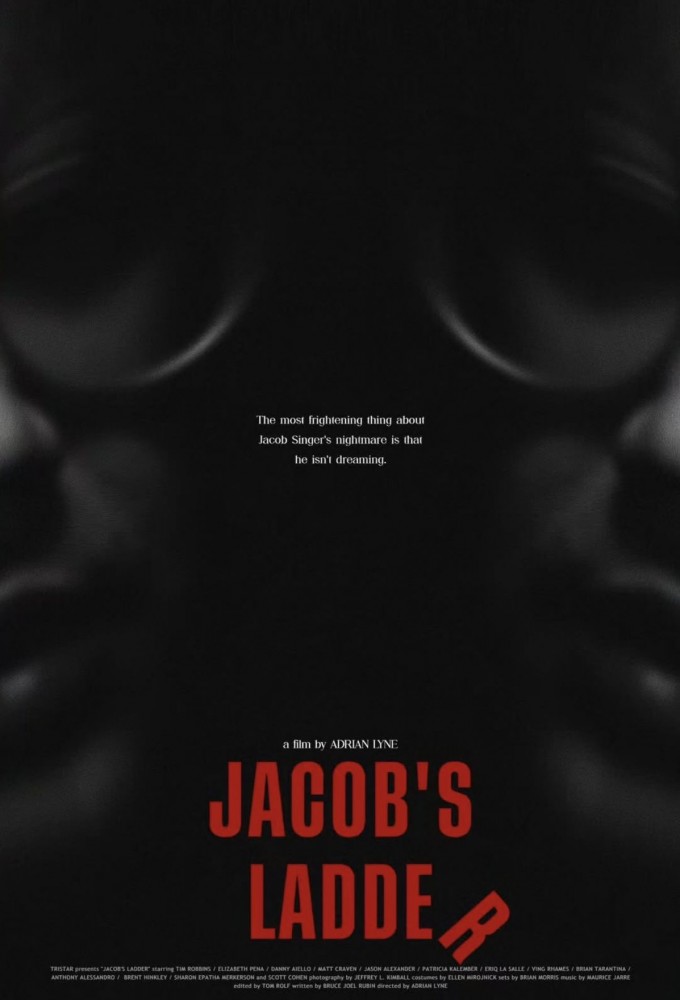
FILM · 1990 · USA
Jacob's Ladder
26 archived facts 7 topics 1 source Last reviewed Oct 2026

26 Interesting Facts About Jacob's Ladder
Interesting Facts (15)
- #001
- #002
- #003
Additional scenes changed or removed from the original screenplay by director Adrian Lyne include: during the dance scene, ALL of the dancers turn into demons; in one of the flashbacks to Vietnam, Jacob sees a vision of a 'celestial staircase' accompanied by magnificent music; Jacob watches a preacher on television saying the end of the world has come; Jacob sees a picture of a demon on his living room wall, and when he looks at it closely it becomes a door opening into Hell; a scene following the 'antidote' sequence in which the ceiling bursts open and Jacob is surrounded by a vision of Heaven; and a different ending in which Jezzie turns inside out and becomes a gigantic demon that Jacob must fight before ascending to heaven.
- #004
- #005
- #006
After initial test audiences reported that the film was overwhelming, director Adrian Lyne cut twenty minutes of material, almost all of it from the final third of the film. Four major sequences were removed after Jacob first meets Michael: a scene in which Michael gives him the antidote for the Ladder; a scene in which Jacob believes he has recovered but turns out not to have; a scene in which he goes to Michael's apartment and finds Michael decapitated; and a scene, just before his final meeting with Gabe, in which he meets Jezzie, who shows her true form.
- #007
In a 2015 retrospective on the film, Tim Robbins said one reason he thought it did poorly at the box office was that the film's violent, heartbreaking Vietnam scenes did not match the national mood in the autumn of 1990 as the Gulf War approached.
- #008
- #009
(At about 1 hour 27 minutes) When Jacob Singer opens an old Army discharge document, the service number 'US 21 719 365' is briefly visible. This would correspond to an enlistment service number with a prefix indicating ongoing conscription into the United States Army. According to US Army records, the service number seen in the film was assigned to a soldier named Thomas K. Wright, who served and was discharged as a Specialist-4 (pay grade E4) from 1959 to 1961. Thomas Wright would later be the property manager on Jacob's Ladder, using his own service number for the scene in which the discharge document is briefly visible on camera.
- #010
- #011
The original script included a scene in which Jacob angrily burns down an army headquarters building. The scene was filmed but was cut and never released, though an image of Jacob holding the torch and gasoline can from this deleted scene was shown in The 100 Scariest Movie Moments (2004).
- #012
- #013
- #014
This was the film that inspired Frank Darabont to cast Tim Robbins in The Shawshank Redemption (1994).
- #015
Production Story (2)
- #016
All of the film's special effects were shot live, without any post-production work. To achieve the famous 'head-shaking' effect, for example, director Adrian Lyne filmed the actor shaking his head at 4 fps while keeping his shoulders and the rest of his body completely still; played back at the normal frame rate of 24 fps, this produced an incredibly fast and deeply unsettling motion.
- #017
The film was greenlit by Paramount Pictures (which had made both of Adrian Lyne's Flashdance (1983) and Fatal Attraction (1987) and writer Bruce Joel Rubin's Ghost (1990)), but there was a change of leadership at the studio and the new executives were unsure about the film. They demanded that the ending be changed, but both Lyne and Rubin refused, and Paramount therefore pulled the plug on the film. It looked as though the project would be abandoned entirely until Mario Kassar and Andrew G. Vajna of Carolco Pictures rescued it with a $25 million budget. They also gave Lyne full creative control as well as final cut. Ironically, Paramount controls the film's US television distribution rights, which came about because its then parent company, known at the time as Viacom (as of February 2022 it became Paramount Global), acquired Spelling Entertainment, whose Worldvision Enterprises took on the American distribution of this film along with many other titles in the Carolco library.
Behind the Scenes (1)
Characters & Cast (2)
- #019
Writer Bruce Joel Rubin wrote the screenplay for Jacob's Ladder after having a dream in the early 1980s about being trapped in the subway. He spent several years trying to get the film made, but the script remained in development limbo. During this period, Rubin's agent told him the film would never be made because "Hollywood doesn't make ghost movies." After Rubin's script for Ghost (1990) became a major hit, combined with the success of Alan Parker's Angel Heart (1987), the studios became more open to the possibilities of Rubin's script. After Adrian Lyne took on the role of director, he spent more than a year working with writer Rubin to develop the screenplay.
- #020
Actors reportedly interested in playing the lead role of Jacob Singer included Richard Gere, Dustin Hoffman and Al Pacino. Director Adrian Lyne auditioned around 300 women for the role of Jezzie, among them Jennifer Lopez, Andie MacDowell, Madonna, Demi Moore and Julia Roberts. The role ultimately went to Elizabeth Peña, who was the first person to audition.
Easter Eggs & References (1)
- #021
Adrian Lyne also heavily rewrote the scene at the end of the film involving the biblical Jacob's Ladder. Writer Bruce Joel Rubin had written the scene to include a gigantic staircase rising into the clouds, a crowd of people lined up within it, tall columns and enormous gates at the top. But Lyne again felt such an image could seem illogical (he refers to Rubin's original concept on the DVD commentary track as the Liberace scene). Working from the principle that heaven is the place where you are happiest, Lyne rewrote the scene to feature the staircase in Jacob's home.
Deeper Meaning (4)
- #022
In Bruce Joel Rubin's original screenplay, all of the demons that appear throughout the film were typical biblical demons with horns, wings, cloven hooves and so on. Director Adrian Lyne felt such imagery could easily be read as comical and could ruin the film; he believed that making the figures so far removed from humans diminished their effect, and so decided the demons should be human but not entirely human. During his research on the subject, while discovering a photograph by Joel-Peter Witkin, Lyne came across the Thalidomide scandal. Thalidomide was a drug available from 1957 to 1961, ostensibly designed to treat pregnant women, used primarily as an antiemetic against morning sickness and secondarily as a sleep aid. However, it underwent inadequate clinical testing before release and led to roughly 10,000 children in Africa and Europe being born with severe physical deformations because their mothers had taken thalidomide during pregnancy. The most common defects were phocomelia, dysmelia, amelia and polymelia, all conditions affecting the appearance of the limbs. During his research Lyne studied the Thalidomide case and came to feel that the birth defects caused by the drug were a perfect starting point for redesigning Rubin's demons. The Thalidomide scandal also inspired David Cronenberg's Scanners (1981).
- #023
- #024
In the original screenplay, writer Bruce Joel Rubin had created a typical biblical hell filled with winged demons, horned devils with cloven hooves, beaked people and strange objects standing randomly about (director Adrian Lyne compares Rubin's vision to the work of Hieronymus Bosch). But as with Rubin's overall depiction of demons, Lyne felt such scenes could easily make the audience laugh. He therefore decided to rewrite Jacob's descent into hell, which ultimately became the hospital scene in which Jacob is taken on a gurney toward a metaphorical hell that grows stranger the further he goes.
- #025
Career & Awards (1)
Related pages
- Idle Hands — Jacob's Ladder comes up in the facts on that page
- Deadpool & Wolverine — Jacob's Ladder comes up in the facts on that page
Sources & editorial notes
Reference databases
- IMDb
Information from external sources is independently selected, consolidated and edited by Arka Evren. Sources are listed for verification and further reading. Encyclopedia text is used under its licence (CC BY-SA). How we work