

FILM · 2019 · CANADA
Joker
- Directed by
- Todd Phillips
- Runtime
- 122 min
- Studio
- Warner Bros. Pictures, Joint Effort, Village Roadshow Pictures
316 archived facts 8 topics 2 sources Last reviewed Nov 2026
During the 1980s, a failed stand-up comedian is driven insane and turns to a life of crime and chaos in Gotham City while becoming an infamous psychopathic crime figure.

316 Interesting Facts About Joker
Interesting Facts (111)
- #001
When the trailer for Cruella (2021) was released in February 2021, many people compared it to this film and its trailers. This is due to the similar tone and atmosphere. It was even suggested that the trailer made the origin story of Cruella de Vil seem more like an origin story for a Batman villain than a Disney villain. Comedian Matthew Highton combined the audio from the film's first trailer with the footage of the Cruella trailer and reactions to it supported the notion of the similarities between the two films.
- #002
- #003
- #004
- #005
Speaking about the villain's iconic laugh, Joaquin Phoenix called it "Something that's almost painful. I think for Joker it's a part of him that wants to emerge. I think we all kind of assume what a Joker laugh is and it felt like a new, fresh way of looking at it. I didn't think that I could do it", he added. "I kind of practiced alone but I asked Todd to come over to audition my laugh. I felt like I had to be able to do it on the spot and in front of somebody else. It was really uncomfortable. It took me a long time".
- #006
Joaquin Phoenix was cagey during interviews at the Venice Film Festival when asked about siding with Arthur. Phoenix told press that any questions they might have about "Joker" will be left up to the audience to decide. "The great joy of the film for the audience is that they get to decide for themselves [what to think about Arthur's transformation]," Phoenix said. "That's what I was attracted to. In most movies, certainly in genre movies where there is a hero and the villain, the motivations of the character are clear. What I like about this is that I was never certain what was motivating him. I have my own opinion. I think I know what it is for me. But I wouldn't want to impose on anyone who hasn't seen the movie."
- #007
- #008
In September 2019, director and co-writer Todd Phillips said he wants comic book movie fans to know that there is no chance of Joaquin Phoenix's villain and Robert Pattinson's Batman ever crossing over on the big screen. He added that doesn't mean Pattinson won't ever possibly face off against Joker, it just won't be his version.
- #009
- #010
Describing the Joker's laugh as 'almost something painful,' Phoenix said it was a part of the character trying to emerge: 'We all assume we know what a Joker laugh is, but this was a new, fresh perspective on it. I didn't think I could do it. I practiced on my own but asked Todd to listen; I had to be able to do it in front of someone else. It was really uncomfortable and took a long time.'
- #011
Asked at the Venice Film Festival whether he sided with Arthur, Phoenix remained guarded: 'The greatest pleasure for the audience is deciding for themselves what to think about Arthur's transformation. That's what attracted me too. In most films the character's motivations are clear, but here you're never sure what motivates him. I have my own opinion, but I don't want to impose it.'
- #012
The first step in Phoenix's preparation was physical: 'When you lose that much weight that quickly, you really start going mad.' He read about political assassins but avoided defining Arthur too narrowly: 'I wanted the freedom to create something indefinable; I didn't want a psychologist to be able to diagnose him.' A journal Phillips gave him was the key to finding the character: 'I wasn't sure how to start, but it became a very important part of the discovery process.'
- #013
Todd Phillips divided the Joker's laugh into three types: 'the affliction laugh, the one-of-the-guys laugh, and the genuine-joy laugh.' He described it to Phoenix as 'almost painful, a part of him trying to come out': 'We all assume we know what a Joker laugh is; this was new and exciting.'
- #014
- #015
Speaking in Venice, Phoenix said he wanted his version of the Joker to be extremely complex. He therefore researched various personality disorders extensively so that even psychiatrists would not be able to diagnose him. He continued discovering new aspects of the character until the final day of filming.
- #016
- #017
Joaquin Phoenix initially signed only for this standalone film because he did not want to join a franchise. However, the critical response and audience popularity were so great that, as of November 2019, he said he was open to a second film, provided he was not expected to join the DCEU and the sequel had a similar feel and appearance to the first.
- #018
- #019
After watching the film, actor Vincent D'Onofrio praised Joaquin Phoenix's performance: 'This young man deserves recognition for this performance.' Jessica Chastain agreed: 'I agree. One of the greatest pieces of acting I've ever seen. My jaw dropped while it played in the cinema. It shook me.'
- #020
- #021
It took Joaquin Phoenix some time to find his version of the character. Many takes were filmed early on as he sought the character's essence. Ironically, the breakthrough came in a scene that did not make the final cut. Describing it at the Palm Springs Film Festival, Phoenix said: 'He always encouraged me to fail. A few weeks into filming, we were shooting a scene. It was the fourth take, and I said, “Okay, that's it... I don't know what else I can do... that's all my ideas.” He said, “I think you should try another one.” I said, “Okay,” tried another, and did a little more nonsense. Again he said, “I think you should try another one.” He wasn't specific because he knew I had to find it myself. So I decided to drop all my acting tricks and just listen to the other actor and be aware of the space I was in. We did the take, and it felt really good. He came out and said, “That was a good take.” I said, “Yeah, that felt good to me.” He asked, “What was that?” I said, “Sincerity.” He said, “Then you should be sincere more often.”' Phoenix added, 'It's a scene that was ultimately cut, but it became the most important scene in the film because it helped me find sincerity.'
- #022
- #023
Joaquin Phoenix disagreed with suggestions that he gravitates toward suffering characters: 'I was interested in Arthur's light. It wasn't only torment; it was joy, the struggle to find happiness and feel connected. It was about having warmth and love. I don't see a character as suffering.' Of Arthur/Joker, Phoenix said, 'He was very different things at different times; the more unpredictable he was, the more inspiring.'
- #024
- #025
- #026
- #027
During the talk-show scene near the end, at around one hour forty-five minutes, Arthur recognizes Murray Franklin's humiliation of him and the audience's harsh judgment. His anger steadily grows. Just before killing Murray, he shouts, 'I'll tell you what you get!' A close look reveals tears in his eyes, betraying the sadness building within him.
- #028
- #029
This is the second time a live-action version of the Joker has long hair. The first was Heath Ledger's portrayal in The Dark Knight (2008); the second is Joaquin Phoenix as Arthur Fleck here; and the third is Jared Leto's second portrayal in Zack Snyder's Justice League (2021). Leto's Joker previously had short hair in Suicide Squad (2016). Across the portrayals chronologically, each Joker's hair is longer than the previous one's.
- #030
- #031
Arthur is somewhat illiterate or dyslexic. In his journal, he misspells 'sense' as 'cents' and 'street' as 'stret.' In one entry he writes, 'I hope my death makes more cents than my life.' In another, he writes, 'I guess this is how you die, on the street.' Ironically, he can spell 'mental illness' correctly. However, using 'cents' could also be interpreted as a reference to the theme of poverty in Arthur's life.
- #032
On Murray Franklin's talk show, at around one hour forty minutes, Arthur tells the host he killed the three Wall Street bastards 'because they were awful.' After Murray sharply criticizes him, Arthur looks at him and bitterly says, 'You're awful, Murray.' This effectively signals that he is going to kill Murray, which he does a minute later.
- #033
Joaquin Phoenix, who plays Arthur Fleck/Joker, is Casey Affleck's former brother-in-law. Casey was married to Joaquin's sister Summer Phoenix from 2003 to 2017. Casey is also the younger brother of Ben Affleck, who played Bruce Wayne/Batman in Batman v Superman: Dawn of Justice (2016), Suicide Squad (2016), Justice League (2017), and Zack Snyder's Justice League (2021). This is the first time an actor playing the Joker has been related through marriage to an actor playing Batman.
- #034
- #035
- #036
This is Brian Tyree Henry's second comic-book film and his first live-action comic-book film. His first was Spider-Man: Into the Spider-Verse (2018), in which he voiced Miles Morales's father, Officer Jefferson Davis. His third comic-book film and second live-action one was Eternals (2021), in which he played Phastos, one of the Eternals.
- #037
- #038
- #039
- #040
- #041
- #042
- #043
- #044
- #045
Todd Phillips won the Golden Lion at the Venice Film Festival. In his acceptance speech, he thanked Warner Bros. and DC for stepping out of their comfort zones and taking a bold step. He also addressed Joaquin Phoenix: "This film wouldn't exist without him. The strongest, brightest and most open-minded lion I know. Thank you for trusting me with your crazy talent."
- #046
- #047
Warner Bros. initially wanted Martin Scorsese to direct, with Leonardo DiCaprio as Arthur and Robert De Niro as Murray Franklin. However, DiCaprio was committed to Quentin Tarantino's Once Upon a Time in... Hollywood, and Scorsese was on The Irishman. De Niro, having finished his scenes in The Irishman, was able to take a role in this film.
- #048
- #049
- #050
In a scene cut from the leaked script, Arthur tells Sophie that as a child he cut a small smile into his face to scare bullies. At the end of the film there was a flashback in which Arthur reopens and widens these wounds with a piece of glass from the car wreck. Sir Christopher Nolan asked for the scene to be removed to avoid similarities with his own Joker in The Dark Knight. Instead, Arthur draws a smile on his face with his own blood. The face-cutting scene was finally added to Joker: Folie à Deux after Nolan left Warner Bros.
- #051
- #052
The original script leak had a different ending: after killing Murray, Arthur escapes, rebels enter Wayne Manor and execute Thomas and Martha Wayne. Bruce hides and is found by Alfred. Arthur evades the police for a few days, appears at the Waynes' funeral, and while being chased is hit by a car and captured.
- #053
In an earlier version of the script, Sophie had gone out with Arthur out of pity and was in a romantic relationship with someone else. When Arthur discovers this, he delivers a long monologue to her and tells her to watch Murray Franklin's show that fateful night. In this version, Sophie is shown watching the show with her child, meaning she is not killed.
- #054
Todd Phillips doesn't see Joker as a big departure from comedy: "It's different in tone, but ultimately it's storytelling. I was influenced by the character studies of the 70s, why shouldn't such a film be made in the comic book world? I thought an in-depth study of a character like the Joker, with a great actor, could be something truly special."
- #055
Todd Phillips on the script process: "After finishing the script, convincing new people of this vision was a year-long process. There were emails saying 'Are you aware we sell Joker pajamas at Target?' There were countless obstacles and you had to overcome them one by one. At the time I cursed them every day. But then, putting it in perspective, I have to say 'They were pretty brave to do this.'"
- #056
- #057
Before its release, the mainstream media created an intense wave of suspicion and anger that the film was "too dangerous" and would "incite violence." The controversy grew so large that Warner Bros. barred most mainstream media outlets from attending the premiere to prevent unwanted questions and incidents involving the cast and crew.
- #058
- #059
- #060
- #061
- #062
Fight Club (1999) director David Fincher disliked the film and criticized it as a corporate Hollywood franchise film that steals from other works: 'No one would look at that material and think let's take Travis Bickle and Rupert Pupkin and combine them, then trap him in a betrayal of the mentally ill and earn a billion dollars.' He added: 'The five big studios don't want to do anything that won't make them a billion dollars. They don't want to be in the mid-priced, challenging content business. And that cuts off the kinds of films I make.'
- #063
Martin Scorsese confirmed that he did not watch the entire film and had no plans to. He had said the previous year that he did not consider superhero films 'cinema'; although fans saw it as hypocrisy that his name was attached to a superhero film, it was confirmed that Warner Bros. needed Scorsese's film crew for the New York production. Scorsese told The New York Times, 'I saw clips of it. I understood. It's fine.'
- #064
- #065
- #066
- #067
- #068
Arthur's joke, 'When I was a little boy and told people I was going to be a comedian, everyone laughed at me. Well, no one's laughing now,' is an adaptation of the famous quip by the late British comedian Bob Monkhouse. Monkhouse, like Arthur, was known for the hundreds of handwritten joke books he wrote over the years.
- #069
- #070
- #071
The melody of the song 'Smile,' heard in the teaser trailer, was composed by Charlie Chaplin for the 1936 film 'Modern Times,' with lyrics added 18 years later. In the trailer, Chaplin's film is being watched by a live audience.
- #072
Leading neurocriminologist Adrian Raine said in his interview with Vanity Fair that he admired the film's authentic portrayal of the psychology of a criminal mind. Raine diagnosed Arthur Fleck with schizotypal personality disorder and uses the film in his classes at the University of Pennsylvania.
- #073
In Batman canon, the parents are usually killed by Joe Chill, while in the 1989 film 'Batman' they were killed by Jack Napier, who would become the Joker. In this film, however, the Joker, in a mask as an unidentified man, kills the Waynes; thus the film becomes the second production to link the Joker to the deaths of the Waynes.
- #074
On the back of her mother's smiling photograph, Arthur sees the inscription 'I've always loved your smile' and the initials TW. This raises the question of whether Thomas Wayne really is his father; however, given Penny's mental state, it is also possible that she signed the photograph herself.
- #075
- #076
- #077
- #078
- #079
- #080
- #081
- #082
- #083
- #084
- #085
- #086
- #087
- #088
Alongside Taxi Driver and The King of Comedy, the film also bears similarities to Carrie (1976). Carrie White and Arthur Fleck are tragic characters driven to madness by horrific family histories and a toxic society: both are lonely, have abusive mothers, are bullied, ultimately kill their mothers, and are humiliated at a public event before going mad and committing acts of violence.
- #089
- #090
The film is full of references to previous Batman productions: as Arthur applies his makeup, Batman's facial features appear in the mirror; Bruce slides down a climbing frame with a movement reminiscent of Adam West's Batman; Arthur's 'put on a happy face' line nods to Jack Nicholson's Joker; his leaning against the window in the police car recalls Heath Ledger; and the ambulance strike and the placing of the body in the police car are a tribute to the Joker's death scene in Batman: Arkham City.
- #091
- #092
The deaths of Thomas and Martha Wayne are handled as a kind of bad karma in the film. Thomas Wayne is shown as a cold and elitist individual; he treats Arthur badly in the theater restroom. After Arthur kills Murray Franklin and triggers the riot, a protester shoots the Waynes to punish them for turning their backs on the poor. Martha's pearl necklace is this time taken as a keepsake and is taken after the couple are dead, not during a robbery as in other versions.
- #093
- #094
- #095
- #096
- #097
- #098
- #099
- #100
- #101
Although everyone Arthur kills is mean and rude to him, the only victims who directly threaten him are two of the three Wall Street traders. The others (the third trader, Penny, Randall and Murray) pose no physical threat; however, the third trader could identify him, Randall feels guilt for giving him the gun, and Murray humiliates him. If Arthur also killed his psychiatrist at Arkham, this is similar to his killing of Penny; the woman poses no threat to him at all.
- #102
Many songs from the late 1970s and early 1980s are played in the film; similarly, Phillips's The Hangover films also use popular songs of their era.
- #103
- #104
Joker is the second Batman-themed film set in October. The first is Batman Forever (1995), and the third is The Batman (2022). The film begins in mid-October: the radio announcer says Thursday, October 15. Although it is not directly related to Halloween, people wear clown masks. In Batman Forever, when Dr. Chase Meridian goes to the mansion for a date with Bruce Wayne, she greets Alfred by saying Happy Halloween; Alfred hands out candy. The Batman, meanwhile, opens on Halloween, and everyone is in costume.
- #105
While watching an old recording of the Murray show, Arthur rehearses coming out from behind the curtain (1 hour 22 minutes). The actor on the show is introduced as Ethan Chase. The main character in Todd Phillips's 2010 film Due Date is also Ethan Chase (played by Zach Galifianakis, who uses the name Ethan Tremblay).
- #106
- #107
- #108
- #109
- #110
- #111
Production Story (42)
- #112
In August 2018, Hildur Guðnadóttir was hired to compose the film's score. Guðnadóttir began writing music after reading the script and met with Todd Phillips, who "had a lot of strong ideas" about how he thought the score should sound. She worked on the Joker score alongside the score for the drama miniseries Chernobyl (2019); Guðnadóttir said switching between the two was challenging because the scores were so different. She won a Grammy, Emmy, and Oscar for her work on both.
- #113
- #114
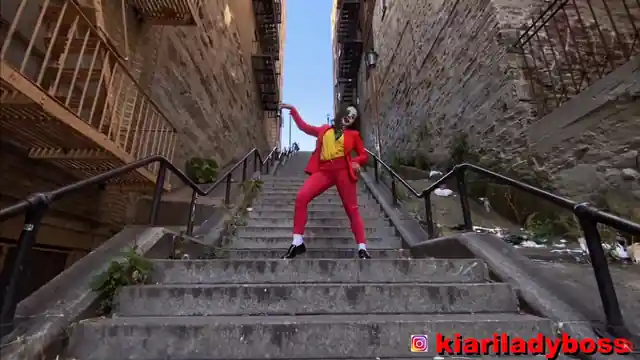
(at around 1h 30 mins) The iconic song chosen for the Joker dance downing the staircase is "Rock'N Roll Part 2", performed by Gary Glitter and belonging to the 1972 album "Glitter". The election of the song caused strong controversy after Glitter was discovered as sex offender in the late 90s, being arrested and incarcerated by child sexual abuse and child rape several times over the years.
- #115
Martin Scorsese confirmed that not only has he not seen the finished film, but he has no plans to. This is only in the latest chapter in the journey that launched last year in which Scorsese expressed that he wasn't interested in superhero movies, noting that he doesn't consider them "cinema." As many fans understandably thought it was hypocritical to dismiss all superhero movies while his name was attached to one, it was later confirmed that Warner Bros. merely needed Scorsese's filmmaking crew to pull off production in New York City. "I saw clips of it," Scorsese revealed to The New York Times. "I know it. So it's like, why do I need to? I get it. It's fine."
- #116
Joaquin Phoenix originally only signed on to do this one standalone film, as he did not want to be involved in a movie franchise. However such has the critical feedback it's popularity with audiences been, he has subsequently said (as of November 2019) he is not averse to the idea of considering doing a second film providing he is not expected to join the DCEU and any sequel has a similar feel and look like the first film.
- #117
- #118
During pre-production, due to being very hesitant to produce the film, the film's budget was cut by Warner Bros. chairman Toby Emmerich in order to discourage director Todd Phillips. But Phillips was adamant in making the film, and Warner Bros. and Emmerich reluctantly allowed Phillips to proceed with production.
- #119
Joaquin Phoenix had been interested in a low-budget "character study" of a comic book character, and said the film "feels unique; it is its own world in some ways, and maybe [...] It might as well be the thing that scares you the most." Phoenix originally did not think the film should be about the Joker, but couldn't think of another good character, so he abandoned the idea. It wasn't until Todd Phillips started putting together this movie that he became interested again.
- #120
Blair Rich, who was Warner Bros. marketing executive at the time of the film's release, fought hard for this film when Warner Bros. wanted to cancel the film. Before leaving Warner Bros. and despite several cinematic duds, this film as well as It: Chapter Two (2019) became some of Rich's best accomplishments.
- #121
- #122
The song heard in the teaser trailer is "Smile", its melody composed as an instrumental theme by Sir Charles Chaplin for his film Modern Times (1936). Lyrics were added 18 years later by John Turner and Geoffrey Parsons. The Chaplin film is being viewed by a live audience in the teaser trailer.
- #123
Todd Phillips and Scott Silver wrote Joker throughout 2017, and the writing process took about a year. According to producer Emma Tillinger Koskoff, it took some time to get approval for the script from Warner Bros., partly because of concerns over the content. Similarly, Phillips commented that there were "a zillion hurdles" during the year-long writing process due to the visibility of the character. Phillips said that while the script's themes may reflect modern society, the film was not intended to be political.
- #124
By September 2017, Warner Brothers were considering casting Leonardo DiCaprio as the Joker, hoping to use his frequent collaborator Martin Scorsese's involvement to lure him, but by February 2018, Joaquin Phoenix was Todd Phillips' top choice for the role. Padraig Cotter of Screen Rant noted that since the film was a standalone story, Phoenix would not have to appear in sequels as he would have in the DC offering. Phoenix said when he learned of the film, he became excited because it was the kind of film he was looking to make, describing it as unique and stating it did not feel like a typical "studio movie". However, it took Phoenix some time to commit to the role, as it intimidated him and he said "oftentimes, in these movies, we have these simplified, reductive archetypes, and that allows for the audience to be distant from the character, just like we would do in real life, where it's easy to label somebody as evil, and therefore say, 'Well, I'm not that.'"
Joker (2019): Joker-costumed doll on a dark surfaceImage: Wikimedia Commons · MEDIODESCOCIDO from Buenos Aires, Argentina, CC BY 2.0 - #125
- #126
Before the film was released, there were heavy amounts of skepticism and ire from mainstream media which deemed the film supposedly "too dangerous" and would "incite violence". This controversy had gotten so bad, Warner Bros. banished most mainstream media outlets from attending the film's premiere to avoid any unwanted questions and incidents toward the cast and crew.
- #127
Warner Bros. were initially hesitant in making this film as it was thought to be too dark and violent. They were concerned that it may tarnish Joker for kids who annually buy millions of toys and related merchandise. However, a year later and after some convincing from Todd Phillips, they finally agreed to go ahead with this project. A violent R-rated DC comic book film adaptation is nothing new to Warner Bros. who spent a considerable amount on V for Vendetta (2005) and Watchmen (2009) with the latter costing more than $130m, more than double that of the Joker.
- #128
An early reference for Todd Phillips and co-screenwriter Scott Silver was the silent film The Man Who Laughs (1928). They felt they had "a lot of freedom because Joker never really had an origin story in the comics. We thought it was really liberating because there really were no rules or boundaries, Scott and I just pushed each other every day to come up with something totally insane."
- #129
Co-writer and director Todd Phillips doesn't see Joker as that big of a departure from comedy. "It's different tonally than a lot of my work, but, ultimately, it's storytelling. I was influenced by the movies I grew up on, character studies of the 70s, so I thought why can't you do genre film like that in the comic book world, a deep dive on a character like Joker. I thought with a great actor we could really do something special."
- #130
According to the Hollywood Reporter, Jared Leto was deeply displeased that Warner Bros. had greenlit a Joker film separate from his own version of the character, complaining to his CAA agents, and reportedly asking his music manager Irving Azoff to convince the head of Warner's parent company to cancel the project. Warner did announce a spin-off for Leto's Joker in 2018, but nothing came of it. After this film's release, one insider said, "How do you play the Joker you established following [Joaquin Phoenix]? It kind of ends [Leto's] Joker run." Leto played the Joker one last time for a cameo in Zack Snyder's Justice League (2021).
- #131
- #132
- #133
- #134
While Warner Bros. gave Christopher Nolan full backing for his version of Joker in The Dark Knight (2008), Todd Phillips had a much different experience making this film. As Phillips recently revealed during an interview with filmmaker Michael Moore, Warner Bros.' former boss was a major hurdle: "When the regime changed on the Warner side, the regime also changed on the DC side," Phillips told Moore. "They put a guy in charge at DC, Walter Hamada, who had been running a small horror label at New Line. So he didn't have muscle to stop it, and I'm not saying he would have, but he didn't get it. And because on paper, it's crazy. [He] just stepped into this new job, and 'we just made Shazam! and Wonder Woman. We're doing okay; do we really want to mess with the formula?' And so I really understood his point. But in some ways, I had enough weight behind me at that point - not overrule it, because they could have easily said no... but we just kept our foot on the gas, and the squeaky wheel gets the grease as you say. We just made a thing of it for a long time. Truth be told, the budget was so small - and I say so small in relation to other comic book films, not small. We ultimately made the movie for $60 million, but at Warner Bros. or at DC, that's like an independent film to them. So we kept it so under the radar and so small that in some way, it felt like...not a can't-lose, but like, 'okay what could we really lose on this if it's a disaster and nobody wants to see it if it's boring?' So they let us go and do it."
- #135
Originally, Warner Bros. wanted Martin Scorsese to make this film with Leonardo DiCaprio as Arthur and Robert De Niro to play Murray Franklin. However in the end this proved to be logistically impossible as DiCaprio had already signed on to do Once Upon a Time in... Hollywood (2019) for Quentin Tarantino which was due to start filming at the same time. Scorsese had also committed himself to another project, The Irishman (2019), which also starred De Niro. However, De Niro himself had just finished filming his scenes for that film by the time this film went into production so was able to commit himself to do this film too.
- #136
- #137
According to Todd Phillips about writing the script: "It was a yearlong process from when we finished the script just to get the new people on board with this vision, because I pitched it to an entirely different team than made it. There were emails about: 'You realize we sell Joker pajamas at Target.' There were a zillion hurdles, and you just sort of had to navigate those one at a time. At the time, I would curse them in my head every day. But then I have to put it in perspective and go, 'They're pretty bold that they did this.'
- #138
Due to the surprise and incredible success of this film, it's rumored that Joaquin Phoenix will be paid $50 million to return as Arthur Fleck/Joker in the two sequels.
Joker (2019): Arthur Fleck/Joker in a red suit on the stairsImage: Wikimedia Commons · Kiariladyboss (New York City 4 All), CC BY 3.0 - #139
Director Todd Phillips revealed that he did the movie because he loves bad guys, because as he says, "It's fun to say, 'Why is he like that? What made him like that?' And that's ultimately, really what the goal of the movie is. It's not this gigantic statement on the world today, and there is stuff thematically in there, but really it's like, 'What makes somebody that way?' And with Joker, I just liked his sense of mayhem and chaos."
- #140
- #141
Joaquin Phoenix was warm to the idea of a low-budget comic book character study: "It feels unique; it has its own world and it might be the thing that scares you the most." Initially he didn't think the film should be about the Joker, but when he couldn't find another good character, he abandoned the idea. He wasn't interested again until Todd Phillips put the project together.
- #142
Warner Bros. initially hesitated over concerns that the film was too dark and violent and would damage the Joker's image for children. However, a year later, with Todd Phillips's persuasion efforts, it continued with the project. Violent R-rated DC adaptations were not new for Warner Bros.; they had allocated significant budgets to V for Vendetta and Watchmen.
- #143
- #144
While Warner Bros. gave Christopher Nolan full support for the Joker in The Dark Knight, Phillips had a very different experience on this film. In an interview with Michael Moore, Phillips explained that with the management changes at Warner and DC, Walter Hamada was brought in, that Hamada did not understand the film, but that because the budget was small the risk was low, and they were allowed to make the film on the logic that "the squeaky wheel gets the grease."
- #145
Contains a major spoiler — show
Joaquin Phoenix spoke about a deleted scene, which he initially felt was one of the best scenes of the film. Director Todd Phillips said that he thinks deleted scenes are called that for a reason. Phillips stated, "I hate fucking extended cuts. I hate deleted scenes. They're deleted for a reason." He added that he would not be showing any deleted scenes from the film. "The movie that exists is exactly the movie I want it to be and I will never show a deleted scene," he said. In an interview with Collider, Phoenix said, "There was a scene that, that during the shoot we thought was one of the best scenes and we loved his behavior in the scene, and I'd always really liked the scene. And Todd told me and said, 'We're cutting that scene out.' And at first, I thought, like, 'Wait a minute, what do you mean you cut that scene out?' And then of course I saw it, and it was very obvious. It has to go." Describing the scene in question, Phoenix said that it was a second meeting between Arthur Fleck and his co-worker, Randall, after Arthur is let go from his clown agency job. In the final cut, Arthur exits the building after messing with a sign, and 'punching out', literally. Phillips said that cutting out the scene was "a heartbreaker" and that it "might've been the last scene I cut out." Phoenix added, "That's just what's so cool about movies, right? You can have a great scene, it's something that makes sense, but the movie is the collection of all of these scenes and they have to work together to tell the story, and it actually made that whole sequence so smooth."
- #146
Contains a major spoiler — show
An earlier version of the script had a different story arc in mind for Sophie. Arthur originally did go out with her a few times, but she only did so out of pity, and she was romantically involved with someone else. When Arthur discovered this, he went on an extended rant to her face, before telling her to watch Murray Franklin's show on that fateful night. This version of the story makes it clear that he didn't kill her, as she's shown watching the show with her child.
- #147
Contains a major spoiler — show
Another element from the leaked script that didn't make the cut was a scene where Arthur originally told Sophie a story during a date, explaining that he cut a slight smile onto his face as a child to scare off bullies. The scene would get a call-back at the end of the film, where Arthur, now the Joker, would have used a glass shard from the car wreck to carve those wounds open again and spread them even wider in front of the crowd. Sir Christopher Nolan asked that the scene be scrapped to avoid similarities with his own version of the Joker from The Dark Knight (2008). Instead, Arthur paints a smile on his face with his own blood. The face-carving was finally incorporated into Joker: Folie à Deux (2024), produced after Nolan left Warner Bros.
- #148
Contains a major spoiler — show
An alternate ending intended for the film had Arthur revealing to his therapist on Arkham that the joke he was thinking was that he had killed Thomas and Martha Wayne himself and left Bruce Wayne to cry before turning back and killing the boy. The ending was cut because Bruce's death would mean that Batman will never come to exist in the film's universe.
- #149
Contains a major spoiler — show
Director Todd Phillips confirmed that Arthur did not kill Sophie nor her child after she asked him to leave her apartment. Phillips revealed a cut scene where Sophie is watching Arthur on The Murray Franklin Show. He added that he was surprised that some people thought that Arthur had killed her.
- #150
Contains a major spoiler — show
Part of the climactic sequence where Arthur (in full Joker regalia) appears on Murray Franklin's show had two filmed moments that highlighted Marc Maron's role as Murray's producer Gene Ufland but were cut in post-production: In the first one, Gene openly expresses his concern to Murray about Arthur being on the show at all. In the second one, Gene tries to cut off the interview sequence where Arthur reveals he killed the Wall Street brokers on the subway, but Murray ignores him and cuts off his mic because he thinks the sequence is going to make for amazing TV. Gene then watches in silent horror when Murray is killed.
- #151
Contains a major spoiler — show
(at around 1h 45 mins) Before he kills Murray Franklin on live television toward the end of the film, Arthur was originally supposed to say, "What do you get when you cross a mentally ill loner with a system..." Instead, he says, "with a society..." in replacement of "with a system..."
- #152
Contains a major spoiler — show
The original script leak had a slightly different ending. After Arthur kills Murray, he escapes the studio. The riot occurs but in this version the rioters break into Wayne Manor, dragging out Thomas and Martha Wayne and executing them. Bruce, while this occurs, hides from the rioters and is found by Alfred the next day. Arthur eludes the police for a few days until he shows up at the Waynes' funeral and he is immediately seen. Arthur is chased and tries to flee but during the process is hit by a car and captured by the police.
- #153
Contains a major spoiler — show
(at around 1h 10 mins) In a deliberate attempt to keep the budget down there are almost no CGI effects shots in this film. One of the very few is the scene where Arthur Fleck walks towards the building named Arkham Asylum in his attempt to look at his mother's medical records. This scene was CGI enhanced but otherwise most of this films effects were either practical or created in camera.
Behind the Scenes (38)
- #154
Todd Phillips originally wanted to shoot the film on 70 mm film cameras partially because he prefers film stock. But Phillips had to abandon the idea due to the tight production budget. He ruled out standard RED digital cameras and 35mm film cameras, too, due to the number of close up shots planned, and to give the film an 'intimate', obtrusive feel. Phillips insistence on using large format cameras led cinematographer Lawrence Sher to investigate using Arri Alexa 65 digital cameras as a compromise and in the end, this is what was eventually used.
- #155
- #156
According to a profile by GQ, there was a point of contention between Joaquin Phoenix and Robert De Niro. While Phoenix doesn't like to rehearse or do table readings, it was reportedly a demand by the latter actor. What resulted was a small conflict at the very start of Joker's production. Phoenix uses his anxiety to fuel his film performances, which is why rehearsing and read-throughs are against his process; he wants total spontaneity. Phoenix's refusal to do a table reading inspired a strong reaction by De Niro, as he reportedly told Todd Phillips: "Tell him he's an actor and he's got to be there. I like to hear the whole movie and we're going to all get in a room and just read it." Meanwhile, Phoenix responded, "There's no fucking way I'm doing a read-through." In the end, the pair came to compromise and Phoenix attended a read-through at De Niro's production office. Phoenix is reportedly a huge fan of De Niro since Raging Bull (1980), courtesy of Joaquin's brother, River Phoenix, but struggled as he "mumbled" his way through Joker's table read. Phoenix said he felt sick and originally declined De Niro's offer for a private talk in his office. Thankfully, it ended on a positive note after De Niro kissed Phoenix on the cheek and reassured him, "It's going to be OK, bubbeleh."
- #157
While shooting C'mon C'mon (2021), Joaquin Phoenix had to stop his younger co-stars from calling him "Joker". According to director Mike Mills, filming took place during the promotion of this film and there were numerous posters of Phoenix's face as Arthur Fleck/Joker plastered all over the media.
- #158
Sharp-eyed New York City lovers will recognize the Brooklyn Army Terminal's annex at Arkham State Hospital. The hospital is a recurring touchpoint for Arthur Fleck. Early conversations with his state-provided social worker indicate that he spent time in Arkham State Hospital for undisclosed misdeeds before the film began, and his mother's records there indicate that both members of the Fleck family have drifted in and out of the grim state-run facility.
- #159
- #160
Joaquin Phoenix's Joker makeup took 15 to 20 minutes to apply. A discarded version of the scene where Arthur does his bathroom dance had him washing off his makeup before leaving. There were approximately 16 takes of the scene, and makeup artist Nicki Ledermann had to reapply it each time in order to keep it consistent.
- #161
- #162
According to Todd Phillips on New York Times, Joaquin Phoenix "lost his composure on the set, sometimes to the bafflement of his co-stars." "In the middle of the scene, he'll just walk away and walk out," Phillips said. "And the poor other actor thinks it's them and it was never them - it was always him, and he just wasn't feeling it." Phoenix might have walked off set, but he always returned after taking a breather. Phillips remembered Phoenix reassuring him after an especially tense moment, "We'll take a walk and we'll come back and we'll do it." One person Phoenix never walked out on was Robert De Niro, De Niro told The Times that Phoenix was a "consummate professional" when they were on set together. "Joaquin was very intense in what he was doing, as it should be, as he should be," De Niro said. "There's nothing to talk about, personally, on the side, 'Let's have coffee.' Let's just do the stuff."
- #163
- #164
(at around 34 mins) When Joaquin Phoenix performed his bathroom dance sequence, it was right after he first heard Hildur Guðnadóttir's score played to him by director Todd Phillips from his iPhone. In an interview with Guðnadóttir, she said that when she submitted the music for the scene, she was visualizing the Joker's physical reaction to the music. When she saw Phoenix dancing to it, her reaction was, "How did he know??".
- #165
On September 22, 2018, a scene depicting a violent protest took place in Brooklyn, although the station was modified to look like Bedford Park Blvd. In late September 2018, filming of robbery scenes took place at the First Central Savings Bank in Astoria, Queens. According to Zazie Beetz, Todd Phillips rewrote the entire script during production; because Joaquin Phoenix lost so much weight for the film, there would not be an opportunity for reshoots. She recalled: "we would go into Todd's trailer and write the scene for the night and then do it. During hair and makeup, we'd memorize those lines and then do them and then we'd reshoot that three weeks later."
- #166
Costume designer Mark Bridges styled Arthur Fleck/Joker's wardrobe in polyester with an early 1980s color palette. Bridges states, "I imagined if he ever did laundry, everything went into the washer at the same time. We made a kind of a bad laundry feel to the clothing." He goes on to state, "It's those subtle choices you can make for a character that informs the audience who they are and how they live."
- #167
In the German, Italian, French, Spanish, Russian and Hungarian version of the movie, all of Arthur's diary entries and his card explaining his illness are in the respective national languages. This is rather unusual for a live-action film since it required producing extra props, and subsequently shooting them.
- #168
- #169
It took Joaquin Phoenix a bit to find the version of the character he wanted to bring to the screen. That meant plenty of takes, especially early on, attempting to root out the core of the character, and ironically it really came to fruition with one scene that didn't even make it into the final cut of the movie. Phoenix was accepting Variety's Creative Impact in Directing Award during the Palm Springs Film Festival, and during his speech, he revealed what the scene was and how it really changed his take on the character. "He always encouraged me to fail, which I did a lot. A few weeks into shooting I think it became unbearable for him and we were shooting a scene, it was like the fourth take, and I said well that's about...I don't know what else I can do...that was all the ideas I have', and he said 'I think you should try another one'. I said 'okay', so I tried another one and basically just did some more bullshit, and he said 'I think you should try another one', and he wasn't specific because I think he knew that I had to find it on my own, and I just decided to stop all of my actory stuff and just to listen to the other actor and to just be aware of the space that I was in and we did this take and it felt really good, and he came out and said 'that was a good take'. I said 'yeah, it felt good to me'. He said 'what was that', and I said 'sincerity'. And he said 'well you should be sincere more often'" "It was a scene that was ultimately cut out of the movie but it ended up being kind of the most important scene in the movie because it helped me find sincerity," Phoenix said.
- #170
(at around 37 mins) The scene where Arthur punches the clocking-in machine off the wall was not in the script. Leigh Gill (Gary) stated in an interview that during one take, Joaquin Phoenix suddenly decided to make a joke about punching out and then punched the machine clean off the wall.
- #171
- #172
Co-writer/director Todd Phillips said that Joaquin Phoenix's lighter side came through behind the scenes between takes. "To inhabit the character of Arthur slash Joker in the movie, he had to go to some dark places," the filmmaker said. "And really on this film - we would say 'Cut!' and we'd be off to the side joking around or laughing about something and then we'd get back into it. He's really intense as an actor, but as a guy on set he's actually kind of light."
- #173
- #174
A month after the film's release and days after the film officially made over $1 billion worldwide, there was a brief video of Joaquin Phoenix shooting a scene for the film that went viral. The video shows Phoenix, dressed as The Joker, beginning to dance down the stairs which is the now iconic dancing down the stairs scene. The video was filmed by an unknown person who lived in the Bronx.
- #175
Joaquin Phoenix revealed that Ray Bolger heavily influenced the Joker's quirky dance moves in the movie. "There was a particular song called 'The Old Soft Shoe' that he performed and I saw a video of it and there's this odd arrogance almost to his movements and, really, I completely just stole it from him," the star explains. "He does this thing of turning his chin up. This choreographer, Michael Arnold, showed me that and tons of videos and I zeroed in on that one. 'That was Joker, right?' There's an arrogance to him, really. That was probably the greatest influence. But also disco."
- #176
- #177
Joaquin Phoenix talked about how his conception of Joker changed during production and what interested him in the character. "Throughout the course of shooting it felt like every day we were discovering new parts of his personality, up until the very last day," said Phoenix. "It was his struggle to find happiness and to feel connected and to feel warmth and love and that's the part of the character I was interested in. He was so many different things to me. Who he was in the first few weeks of shooting was completely different than who he was in the end. He was constantly evolving. I've never had an experience like this. The more unpredictable and looser we left it, the more exciting it was."
- #178
Phoenix faced an unexpected difficulty during filming: the bathroom moment after the subway scene left him struggling to find something logical to show Arthur's transition into the Joker. 'Things like that happened every day, right up to the last scene I shot; we did multiple versions. When Todd and I became comfortable with that, it really started emerging. It was an unexpected, strange, and unique process, but an enjoyable one.'
- #179
According to a GQ profile, Joaquin Phoenix and Robert De Niro disagreed over rehearsals. Phoenix disliked rehearsing or doing table reads, while De Niro insisted on them. Phoenix uses anxiety to feed his performances and wants complete spontaneity. His refusal to attend a table read provoked a strong reaction from De Niro, who told Todd Phillips, 'Tell him he's an actor, and he has to be there. I want to hear the whole movie, and we're all going to get in a room and read it.' Phoenix replied, 'There's no way I'm doing a table read.' Eventually, a compromise was reached, and Phoenix attended a table read at De Niro's production office. Thanks to his older brother River Phoenix, he had been a huge De Niro fan since Raging Bull (1980), but he struggled through the reading, 'mumbling.' He said he felt sick and initially declined De Niro's offer of a private conversation in his office. Fortunately, De Niro kissed Phoenix on the cheek and reassured him: 'It's going to be okay, bubbeleh.'
- #180
Phoenix recounted that during filming, a scene he considered one of the best was cut. Phillips said that deleted scenes are deleted for a reason, that he hates extended cuts, and that he will never show a deleted scene. The scene in question involved a second meeting between Arthur and his co-worker Randall after Arthur is fired; Phillips stated that cutting the scene was "heartbreaking" but necessary for the film's flow.
- #181
Contains a major spoiler — show
According to director Todd Phillips, a certain scene had to be cut in order for the film to avoid getting an NC-17 rating. That scene involves Arthur in the bathtub. Phillips calls the scene "amazing" yet opted out of leaving it in the theatrical cut due to concerns of the MPAA's reaction to the scene that might've cost the film its intended R rating. The scene was one of the many scenes shot yet ultimately deleted from the theatrical cut. He states, "I don't think we can actually include it in an R rated movie and it's not because it was pornographic, it was just insane." This sparked a lot of curiosity over the scene.
- #182
- #183
Contains a major spoiler — show
(at around 1h 10 mins) In a deliberate attempt to keep the budget down there are almost no CGI effects shots in this film. One of the very few is the scene where Arthur Fleck walks towards the building named Arkham Asylum in his attempt to look at his mother's medical records. This scene was CGI enhanced but otherwise most of this films effects were either practical or created in camera.
- #184
Contains a major spoiler — show
In an interview with The Cutaway, editor Jeff Groth talks about cutting during those flashes of darkness on the train by saying, "Not every cut happens in a flash. The reason those flashes were there was to disorient the viewer and make this whole sequence become something of a fever dream for Arthur." Groth then says, "A lot of times with a cut, you'll anticipate where you want to see next, and we'll take you there. In a situation like this, when you're cutting in the black, you anticipate that when you come back out of black, you're going to see the same thing. But in our version, when we're cutting [in the black], you see something different. So we're jumping perspectives before you as a viewer are necessarily ready for it. It was meant to evoke anxiety and build tension." Groth then talks about how this scene gives the audience the feeling that they are losing control, saying, "When [Arthur] starts that laugh, that's something he can't control. That's another thing we're trying to evoke is that feeling of we're not in control anymore." This film is constantly going back and forth between Arthur's fantasy and Arthur's reality without the audience knowing it. The feeling that we aren't in control is foreshadowing the reveal that Arthur is the unreliable narrator of his own story and the audience never knew what was really happening.
- #185
Contains a major spoiler — show
Joaquin Phoenix revealed an unexpected challenge he faced during filming and rehearsals he revealed: "But a really transformative moment was after the Subway when he's in the bathroom," He elaborated, "That was something that we really hadn't anticipated. We talked about that scene all throughout rehearsal. When I really kind of struggled to find something that I felt really made sense to kind of illustrate the change from Arthur to Joker. There were things like that every day up until the last scene I shot where we did multiple versions of it, It just was the nature of the character. When Todd [Phillips] and I became comfortable with that, it really began to emerge. That was a really unexpected, strange, and unique process for me. But, it was enjoyable," Phoenix concluded.
- #186
- #187
Contains a major spoiler — show
In the official trailer, at 1:35 can be seen Arthur falling by Wayne Hall's entrance stairs where Modern Times (1936) is being exhibited for the Gotham's wealthy people, and at 2:03 can be seen Arthur dressed as Joker walking by the corridor of his building with flowers in his left hand. Therefore, these two scenes were cut from the theatrical release.
- #188
- #189
Contains a major spoiler — show
(at around 1h 45 mins) During the talk show scene towards the end of the film, Arthur becomes increasingly frustrated once he realized that Murray Franklin was humiliating him and the audience was harshly judging him. Right before he kills Murray, he exclaims, "I'll tell you what you get!" If you look closely as he says this, Arthur has tears in his eyes. This shows Arthur's pent-up sadness.
- #190
Contains a major spoiler — show
Joaquin Phoenix revealed his favorite part of filming was sassing off Robert De Niro's character Murray Franklin, he stated: "It was one of my favorites, saying 'Murr-AY.' ... Todd loved that too. And when I did that I thought: Is De Niro just going to throw an ash tray at me?"
- #191
Characters & Cast (23)
- #192
- #193
- #194
- #195
- #196
Joaquin Phoenix disagreed about gravitating towards tormented characters, stating he had been "interested in the light of Arthur for lack of a better word. It wasn't just the torment, it was the joy, his struggle to find happiness and to feel connected. To have warmth and love. I don't think of a character as tormented." Ultimately, Phoenix said of Arthur/Joker, "He was so many different things to me at different times, the more unpredictable it was the more inspiring."
- #197
Speaking about the villain's iconic laugh, Joaquin Phoenix called it "Something that's almost painful. I think for Joker it's a part of him that wants to emerge. I think we all kind of assume what a Joker laugh is and it felt like a new, fresh way of looking at it. I didn't think that I could do it", he added. "I kind of practiced alone but I asked Todd to come over to audition my laugh. I felt like I had to be able to do it on the spot and in front of somebody else. It was really uncomfortable. It took me a long time".
- #198
Speaking at the Venice Film Festival where the film premiered, Joaquin Phoenix stated that he wanted his version of the Joker to be extremely complex, so he did extensive research on various personality disorders so that even psychiatrists would not be able to identify what his character was. He also added that even the filmmaker and Phoenix himself were in the process of discovering new aspects of the character and his personality up until the very last day of the shooting.
- #199
Joaquin Phoenix was cagey during interviews at the Venice Film Festival when asked about siding with Arthur. Phoenix told press that any questions they might have about "Joker" will be left up to the audience to decide. "The great joy of the film for the audience is that they get to decide for themselves [what to think about Arthur's transformation]," Phoenix said. "That's what I was attracted to. In most movies, certainly in genre movies where there is a hero and the villain, the motivations of the character are clear. What I like about this is that I was never certain what was motivating him. I have my own opinion. I think I know what it is for me. But I wouldn't want to impose on anyone who hasn't seen the movie."
- #200
- #201
Joaquin Phoenix talked about how his conception of Joker changed during production and what interested him in the character. "Throughout the course of shooting it felt like every day we were discovering new parts of his personality, up until the very last day," said Phoenix. "It was his struggle to find happiness and to feel connected and to feel warmth and love and that's the part of the character I was interested in. He was so many different things to me. Who he was in the first few weeks of shooting was completely different than who he was in the end. He was constantly evolving. I've never had an experience like this. The more unpredictable and looser we left it, the more exciting it was."
- #202
- #203
- #204
Fans believed that Joaquin Phoenix was, in fact, following extreme medical advice and eating just an apple a day in order to keep losing the weight, but he says that's not true. "It wasn't an apple a day," he said. "No, you've also got lettuce and steamed green beans." Such a vast reduction in his daily calorie intake meant that Phoenix was able to drop 28kg, all the while resisting temptation in the form of Joker director Todd Phillips. "Todd did have these fucking pretzels that I love," he said. "And he'd just have bags of them in his office! And that was difficult."
- #205
- #206
- #207
Joaquin Phoenix based his laugh on "videos of people suffering from pathological laughter." He also sought to portray a character with which audiences could not identify. Pathological laughter is a real-life disorder which causes the patient to suffer from uncontrollable laughter attacks in response to tense or stressful situations. Although the disorder isn't usual, these attacks can stop the normal flux of oxygen to the brain or lungs, causing hypoxia or even asphyxia in the patient.
- #208
Robert De Niro confirmed that his role was a nod to his earlier performance in the film, The King of Comedy (1982). De Niro states, "There's a connection, obviously, with the whole thing. But it's not as a direct connection as the character I'm playing being Rupert many years later as a host."
- #209
Until September 2017, Warner Brothers was considering Leonardo DiCaprio for the Joker and hoped Martin Scorsese's involvement would attract him. By February 2018, however, Joaquin Phoenix was Todd Phillips's first choice. Phoenix was excited when he learned about the film because it was unique and did not feel like a typical 'studio movie.' Nevertheless, he took time to accept because the role frightened him: 'So often these films have simplified, reductive archetypes, and that lets the audience distance themselves from the character, just as in real life you label somebody evil and say, “I'm not like that.”'
- #210
- #211
- #212
Contains a major spoiler — show
To a certain extent, Arthur is illiterate or dyslexic. In his journal, he misspells words like "sense" as "cents" and "street" as "stret". In one entry, he wrote, "I hope my death makes more cents than my life." In another entry, he wrote, "I imagine that's how you die, on the stret." Ironically, he's able to spell "mental illness" correctly. It can be argued, however, that the substitution of the word "cents" is a pun in reference to the overall theme of poverty in Arthur's life.
- #213
Contains a major spoiler — show
(at around 1h 40 mins) When he appears on Murray Franklin's talk show, Arthur tells the host that he killed the three Wall Street assholes "because they were awful." After Murray is harshly critical of him, Arthur then looks at him and says bitterly "You're awful too, Murray." He's basically giving away that he's going to kill Murray and that's precisely what he does a minute later.
- #214
Contains a major spoiler — show
Despite his frail and skeletal appearance, Arthur Fleck has shown to have surprising feats of strength. The Joker has shown to have surprising feats of strength throughout the character's history. For example: * (at around 37 mins) When Arthur leaves his job after getting fired and while Randall was taunting him, he states in a sarcastic manner, "Oops! I forgot to clock out!" and proceeds to literally punch the clock off the wall. Even though the clock was large, he was able to destroy it with one hand. * (at around 54 mins) When Arthur visits the Wayne Estate to talk to Thomas Wayne, Alfred Pennyworth confronts him and then insults him. This angers Arthur to where he grabs and strangles Alfred through the gates until he stops when he sees how frightened Bruce was. Judging by Alfred's frightened expression and the way Arthur grabs him, Arthur is strong enough to manhandle someone. * (at around 1h 27 mins) When Randall and Gary visit Arthur at his apartment, Arthur ends up killing Randall by stabbing him and bashing his head into a wall several times. Despite Randall being a physically bigger man, Arthur was able to grab him in a somewhat sneak attack and fatally harm him.
Easter Eggs & References (48)
- #215
(at around 1h) The joke "When I was a little boy and told people I was going to be comedian, everyone laughed at me. Well no one's laughing now" is a paraphrase of the joke written by much loved late British comedian, actor and music hall (vaudeville) performer Bob Monkhouse's "People used to laugh at me when I said I wanted to be a comedian. Well they're not laughing now." Interestingly, Bob Monkhouse famously had hundreds of handwritten books of jokes that he had written over his long career in much the same vein as Arthur's joke book.
- #216
- #217
- #218
- #219
(at around 31 mins) One of three movies that were released theatrically in 2019 in which (despite the movies not being musicals) characters sing a song from a Stephen Sondheim musical. In Noah Baumbach's Marriage Story (2019), the character played by Adam Driver sings "Being Alive", and the character played by Scarlett Johansson sings "You Could Drive a Person Crazy," both from Sondheim's 1970 musical "Company." In Knives Out (2019), the character played by Daniel Craig sings part of "Losing My Mind" from Sondheim's 1971 musical "Follies." In Joker, the bullies who attack Arthur (Joaquin Phoenix) in the subway sing "Send in The Clowns" from "A Little Night Music."
- #220
- #221
Early footage shows Arthur walking by a sign for Amusement Mile, Gotham City's version of Coney Island, which features prominently in the original Killing Joke graphic novel. Joker co-creator Bill Finger was partly inspired by a sign for Steeplechase Park in the real Coney Island which featured a grotesque grinning face.
- #222
- #223
- #224
(at around 1h 22 mins) When Arthur is rehearsing coming out of the curtain whilst watching an old video taped episode of the Murray show, the actor on the Murray show is introduced by Murray as Ethan Chase. The main character in Due Date (2010) was called Ethan Chase played by Zach Galifianakis although he uses Ethan Tremblay). Due Date was also directed by Todd Phillips.
- #225
- #226
- #227
- #228
(at around 1h 45 mins) The two films showing at the theater the Wayne family is shown exiting near the end are Blow Out (1981) and Zorro: The Gay Blade (1981). Both are real movies that were released on back-to-back weekends in July 1981. "Zorro," of course, is traditionally the movie that the Wayne family is supposed to have seen on the fateful night of Batman's origin story.
- #229
- #230
While the movie never makes it explicit what year it takes place in, there is a key indicator that it takes place in 1981 when the climactic riot shows a poster for the movie Wolfen (1981) outside a movie theatre. Wolfen was, much like this film, a very bleak and violent R-rated drama, only with fantasy-supernatural elements, released from Warner Bros., and it was released in 1981. Another indication of the film taking place in 1981 is the radio announcer at the beginning of the film stating that it was Thursday, October 15.
- #231
- #232
- #233
- #234
Despite his fragile, skeletal appearance, Arthur Fleck displays surprising strength. After being fired, he responds to Randall's taunting by smashing the large wall clock with one punch. At Wayne Manor, he grabs Alfred through the bars and squeezes his throat but stops when he sees Bruce's fear. When Randall and Gary visit, he kills the physically larger Randall by stabbing him and smashing his head against the wall.
- #235
- #236
- #237
- #238
- #239
- #240
- #241
- #242
Contains a major spoiler — show
This film showcase Thomas Wayne as a cold-hearted man who's possibly an adulterer. Depending on the possibilities and interpretations, it's implied that Wayne had an affair with Penny Fleck decades ago. In the 2018 DC Black Label three-issue comic series, "Batman: Damned", Thomas Wayne was also portrayed as cold-hearted and an adulterer. During a flashback in the first issue, young Bruce sees his father with another woman that's not his mother, and it appears as if Wayne brought his son along with him on his tryst with his mistress, not caring how it'll affect the boy.
- #243
Contains a major spoiler — show
The film's opening news snippets discuss a garbage strike. NYC's garbage collectors went on strike in 1981. The 80s were also alive and well in Joker's fellow talk-show guest Dr. Sally, a clear nod to 1980s sex-talk-show personality Ruth Westheimer, who was known as Dr. Ruth. Having a radio talk show and later a television show, she became a household name in the 80s, advising viewers and radio listeners on sexual health and pleasure. She made a number of appearances on various talk shows.
- #244
- #245
Contains a major spoiler — show
(at around 32 mins) During the scene where Arthur is being beaten up by the three Wayne Enterprises employees on the train, they're telling him to "stay down". In the riot scene towards the end when he comes to after being knocked unconscious in the car accident (at around 1h 50 mins), the protesters are urging him to "get up".
- #246
Contains a major spoiler — show
Joker's red suit seen in the movie pays tribute to The King of Comedy (1982), where Rupert Pupkin, played by Robert De Niro, is an unsuccessful, mentally-unstable comedian who stalked and kidnapped his favorite talk-show host, Jerry Langford, played by Jerry Lewis. Pupkin also dresses a red suit.
- #247
Contains a major spoiler — show
(at around 1h 45 mins) The scene where Joker shoots Murray Franklin in the head may be a nod to the Joker character in the video game Mortal Kombat vs. DC Universe (2008) where Joker's fatality is to first pull out a pistol which turns out to be a bang flag gun before pulling out a real pistol and shooting the opponent in the head.
- #248
Contains a major spoiler — show
(at around 8 mins) The card that Arthur gives the lady on the bus explaining his laugh states that it's a condition that stems from mental disorders or brain injuries. This foreshadowed the revelation that his condition stems from a brain injury due to the physical abuse he suffered as a child. This situation also most likely caused his mental issues.
- #249
Contains a major spoiler — show
This marks the second time that Brett Cullen is father of a superhero. In Ghost Rider (2007) he plays Barton Blaze, whose son Johnny Blaze (Nicolas Cage) turns Ghost Rider. In Joker he plays Thomas Wayne, whose son Bruce Wayne turns Batman. Oddly enough, Barton Blaze and Thomas Wayne's deaths are the reason to create Ghost Rider and Batman.
- #250
Contains a major spoiler — show
Joker's diary was written in several languages (English, Italian, French, Spanish...) for its international theatrical release. It's a nod for Captain America: The Winter Soldier (2014), where Steve Rogers (Chris Evans) is seen writing a diary or "catch-up" list about the things he did lost due his 70 years of hibernation. As Joker, Rogers' diary was written in several languages for its international theatrical release.
- #251
- #252
Contains a major spoiler — show
(at around 1h 21 mins) During the scene where Arthur murders his mother by suffocating her with a pillow in her hospital room, he says, "I used to think that my life was a tragedy. But now I realize, it's a fucking comedy." This statement paraphrases Sir Charles Chaplin's quote who once said, "Life is a tragedy when seen in close-up, but a comedy in long-shot."
- #253
Contains a major spoiler — show
In most of Batman canon, Batman's parents are killed by an average mugger named "Joe Chill". However, in Batman (1989), Thomas and Martha Wayne were murdered by a man named Jack Napier who would later become the Joker. In this film, an unidentified man dressed in a Joker mask murders the Waynes during a riot, making it the second film to imply the Joker is linked to the Waynes' deaths, and thus the creation of Batman.
- #254
- #255
Contains a major spoiler — show
(at around 1h 18 mins) When Arthur lets himself into Sophie's (Zazie Beetz) apartment, he tells her "I've had a bad day". This is a reference to the iconic comic book "The Killing Joke", in which the Joker's theory is everyone is just one bad day from madness.
- #256
- #257
- #258
Contains a major spoiler — show
(at around 1h 35 mins) There is a reference to 1986's "The Dark Knight Returns" graphic novel during the scene where Joker appears on the Murray Franklin Show. In this film, he walks up and kisses Dr. Salley. This is similar to the scene wherein the comic he appears on the David Endochrine show and kisses Dr. Ruth, infecting her with joker toxin embedded in his lipstick.
- #259
Contains a major spoiler — show
(at around 10 mins) During the film, the seeing of giant rats in Gotham is mentioned. If you pay attention, you can see at least three CGI giant rats running fast through the streets in key scenes, adding a disturbing element to the already dark mood of the movie: when Arthur is talking in the phone booth (at around 29 mins); when Arthur is chasing the last yuppie outside the subway (at around 34 mins); when Bruce is crying over his parents' corpses (at around 1h 50 mins).
- #260
Contains a major spoiler — show
(at around 30 mins) The unnamed woman on the subway that was harassed by the 3 Wall Street men that Arthur unintentionally "rescued" is shown later at the rally (at around 46 mins) wearing a clown mask (the one in the taxi that Arthur passes) who were inspired by his murders of the three.
- #261
Contains a major spoiler — show
(at around 31 mins) When Arthur is on the train after being fired, the three Wayne Enterprises are harassing a woman. He starts to laugh uncontrollably which caught the attention of the three men. When they surround him and before assaulting him, one of them starts singing, "Send in the Clowns", which is from Stephen Sondheim's "A Little Night Music" play. During the end credits, there is a reprisal of the song by Frank Sinatra.
- #262
Deeper Meaning (32)
- #263
- #264
Since the film's release, in late 2019, the character of Arthur Fleck/Joker became a symbol of protest in countries all over the world such as Lebanon, Chile, Iraq, and China for government corruption protests. In June and July 2020, the Arthur Fleck/Joker imagery emerged in the George Floyd protests.
- #265
Todd Phillips actually believes his movie is about kindness and empathy. The filmmaker recently explained this distinction, saying: "If I had to drill down on one overarching theme for me, it's about the power of kindness and a lot of people miss that. I think if you don't see that you either don't have a soul or you're being reductive to make up for your own struggles in that area. But, really, to me, that's where it started from and there are other things in the movie like lack of love, the lack of empathy in society, and childhood trauma, but the power of kindness really runs through this film."
- #266
Zazie Beetz was asked by Variety at TIFF about whether or not the movie sympathizes with Joaquin Phoenix's Arthur Fleck, a struggling stand-up comedian and clown for hire whose psychological unraveling leads him to become the notorious Batman villain. Beetz doesn't deny that "Joker" has a sympathetic viewpoint, but she argued that it's less towards Arthur/Joker and more towards Arthur's predicament on a broader scale. "It's kind of an empathy toward isolation," Beetz said, "and an empathy towards what is our duty as a society to address people who slip through the cracks in a way. There is a lot of culture of that right now. So is it empathy for that or just an observation on personalities who struggle?"
- #267
Fight Club (1999) director David Fincher disliked the film, criticizing it as another corporate Hollywood franchise film that steals from other works. On the film, Fincher said, "I don't think anyone would have looked at that material and thought, 'Yeah, let's take Travis Bickle and Rupert Pupkin and conflate them, then trap him in a betrayal of the mentally ill, and trot it out for a billion dollars." He further elaborated "The reality of our current situation is that the five [major studios] don't want to make anything that can't make them a billion dollars," he said. "None of them want to be in the medium-priced challenging content business. And that cleaves off exactly the kind of movies I make."
- #268
In an interview in Vanity Fair, leading neurocriminologist Adrian Raine said he was stunned by how authentically the film depicted the psychology of the criminal mind. "For 42 years, I've studied the cause of crime and violence. And while watching this film, I thought - WOW, what a revelation this was. It is a great educational tool about the making of the murderer," he said. In the article, Raine went on to diagnose the character of Arthur Fleck with schizotypal personality disorder. "Those who suffer from it have bizarre beliefs, odd behavior, odd appearance, odd speech, no close friends other than family members, and emotional-affect issues - either being completely shut down or way over the top," Raine said. He now uses the film as part of a course he teaches at the University of Pennsylvania.
- #269
When asked about violence in the R-rated film, Todd Phillips said, "Violence in the movie was always meant to be a slow burn. People assume and think it's going to be a really violent movie; it affects you differently. You could watch something like John Wick 3 and there's a much higher amount of violence. We tried to paint it with as realistic a brush as possible so that when it comes it feels like a punch in the stomach. But it's all a balancing act of tone." And when asked about tone, "I think movies are oftentimes mirrors of society, but never molders. We wrote it in 2017 so inevitably certain themes find their way in." When he continued, "It's not a political film" there was laughter in the press room, and he added "for some I think it depends the lens which you view it through."
- #270
In an interview with SFX magazine, Joaquin Phoenix acknowledged that while the violence in "Joker" is "a little more visceral and raw" than films such as the Avengers series, he "didn't have any hesitation about it." "You always want it to feel real, and you want the little violence that we have to have an impact," he said. "What happens in a lot of movies is that you get numb to it, you're killing 40,000 people, you don't feel it. While being a fictional story in a fictional world, you always want it to feel real. Everything that happens in this movie as far as violence goes, you feel it."
- #271
- #272
The song heard in the teaser trailer is "Smile", its melody composed as an instrumental theme by Sir Charles Chaplin for his film Modern Times (1936). Lyrics were added 18 years later by John Turner and Geoffrey Parsons. The Chaplin film is being viewed by a live audience in the teaser trailer.
- #273
- #274
- #275
- #276
- #277
Phillips says he made the film because he loves villains, and that the question "Why is he like this? What made him this way?" is fun. He states that the film is not a grand statement about today's world, but thematically questions what makes a person this way, and that he loves the Joker's understanding of chaos.
- #278
According to The Hollywood Reporter, Jared Leto was upset that Warner Bros. greenlit a Joker film separate from his own Joker; he complained to his agents and tried to persuade Warner's top management to cancel the project. Warner announced a spin-off for Leto's Joker in 2018, but nothing came of it. After the film's release, a source said, 'How do you play Joker after Joaquin Phoenix? This ends Leto's Joker era.' Leto portrayed Joker one last time in Zack Snyder's Justice League (2021).
- #279
- #280
- #281
- #282
- #283
- #284
- #285
At the beginning of the film, Arthur imagines being welcomed as a father figure by Franklin on the Murray Franklin Show. In the end, on the program he appears on as the Joker, Franklin plays his failed stand-up video to mock Arthur, and Arthur kills him. This symbolizes a psychopath's extreme emotions: he can love the same person but kill them if betrayed.
- #286
- #287
- #288
Contains a major spoiler — show
(at around 1h 50 mins) Some people have hypothesized that the reason why Arthur was laughing at the end of the film was due to him knowing that Bruce Wayne, due to witnessing the murders of his parents, will grow up with a somewhat similarly messed up childhood like him and become a troubled individual like him. Others have also hypothesized that the final scene takes place in the future after Bruce has become Batman and this scene shows Arthur realizing that he was indirectly responsible for the creation of his nemesis.
- #289
Contains a major spoiler — show
In The Playlist podcast in early 2021, directors Quentin Tarantino and Edgar Wright discuss the film and its social impact. At one point, Tarantino states the talk show scene towards the end of the film successfully manipulated the audience into overly disliking Murray Franklin to the point of being fine with Arthur Fleck murdering him.
- #290
Contains a major spoiler — show
Body Count: 8: the three Wall Street men, Penny, Randall, Murray Franklin, and Thomas & Martha Wayne. The Arkham Asylum therapist in the closing scene is implied dead because Arthur leaves a trail of blood after exiting the room, but in the sequel Joker: Folie à Deux (2024), she is not counted as one of Arthur's victims, so it is safe to assume that it was one of his delusions.
- #291
Contains a major spoiler — show
(at around 1h 22 mins) After Arthur suffocates his mother with a pillow in her hospital room, he stands near the window and closes his eyes. The light from the window is shining on him and he looks as if he's at peace. This shows after killing his mother for lying to him all his life and allowing him to endure so much abuse, he feels free.
- #292
Contains a major spoiler — show
(at around 12 mins) At the beginning of the movie Arthur Fleck imagines himself visiting The Murray Franklin Show, being received by Franklin to be father figure for him. At the end of the movie (at around 1h 35 mins), Fleck visits The Murray Franklin Show as Joker, killing Franklin after he played Fleck's video at Pogo's Comedy Club as failed stand up comedian to make laugh of him. It symbolizes the extreme feelings of a psychopath, capable for loving but also for killing to the same person if he feels betrayed or disappointed by him/her.
- #293
Contains a major spoiler — show
It is hypothesized that Thomas and Martha Wayne's deaths in this film were a form of Bad Karma. This film shows Thomas Wayne as a cold, uncaring, elitist individual who looked down upon those less fortunate, like Arthur Fleck, than them in society and treated Arthur horrendously during the theater restroom confrontation. After Arthur Fleck had snapped and eventually killed Murray Franklin on national TV which caused a major riot in Gotham, the protester, who saw Arthur do what he did, decides to punish The Waynes by killing them for allowing Gotham to turn against its poor, hence the phrase he screams at them before shooting them. Unlike most variations of their murders, in hindsight, Thomas and Martha Wayne's deaths were more in line with some form of retribution due to how Arthur Fleck and others living in destitution were rejected by society. Furthermore, the seizing of Martha Wayne's pearl necklace this time around was more of obtaining a souvenir than specifically stealing it outright like in most variations. Not to mention, the necklace was seized after the couple was shot and killed, as opposed to the other variations where the killer was attempting to take it before the couple was shot and killed for trying to stop the theft.
- #294
Contains a major spoiler — show
While everyone who definitively gets killed by Arthur Fleck in this movie was legitimately bad and unkind to him, the only victims of his who were directly threatening him were 2 of the 3 Wall Street traders, whom Arthur shot and killed while they were beating him up. The other people who were murdered--the 3rd trader, Penny Fleck, Randall, and Murray Franklin--were not threatening Arthur physically when he murdered them, though it could be argued that all of them but Penny were threats to Arthur in another way (the 3rd trader as someone who could identify Arthur as the killer of his 2 trader buddies, Randall because he correctly figures out that Arthur did something bad with the gun Randall gifted to him, and Murray because he threatens to humiliate and ostracize Murray in public and send him back into obscurity). If Arthur did in fact kill the Arkham Asylum psychiatrist in the movie's final scene, that would be similar to his killing of Penny in that neither woman was any threat at all to him; the fact that she does nothing wrong or negative towards him is a reason that her murder, if it happened, would be a complete outlier in the film.
Career & Awards (18)
- #295
- #296
- #297
- #298
While being honored for his acting career and for this film at the Venice Film Festival, Joaquin Phoenix stated in his speech that he owes his career to his late brother and fellow actor, River Phoenix. He stated that his brother came home one day from work with a copy of the film, Raging Bull (1980), which starred Robert De Niro, who eventually became his co-star in this film. Joaquin goes on to state that he was in his teens at the time and he had quit acting. River had him watch the film that evening and the next day. He stated that River encouraged him to not give up on acting.
- #299
Todd Phillips won the Venice film festival's prize, the Golden Lion, for Best Film. During his acceptance speech, Phillips thanked "Warner Bros. and DC for stepping out of their comfort zone and taking such a bold swing on me and this movie," according to The Hollywood Reporter. Phillips also thanked Joaquin Phoenix, who joined him on stage. "There is no movie without Joaquin Phoenix. Joaquin is the fiercest and brightest and most open-minded lion I know. Thank you for trusting me with your insane talent," said Phillips.
- #300
Veteran Joker voiceover actor Mark Hamill expressed his utmost praise for the film on his Instagram page. Hamill writes, "The awesome Joaquin Phoenix, Todd Phillips, and Scott Silver brilliantly re-imagine the character as never seen before! 2 thumbs-up from that old school, comic book version...me."
- #301
- #302
- #303
Since the creation of the MPAA and the R rating in 1968, for 51 years, there were no films with this rating that earned $1 billion until this film. During that time, the MPAA had introduced the PG-13 rating in 1984 after films like Indiana Jones and the Temple of Doom (1984) and Gremlins (1984) caused outrage among parents due to both films being rated PG while having gruesome imagery and dark elements, and the PG-13 rating was created in order to appease parents. Unlike the R rating, it took 14 years from its creation for a PG-13 rated film, which is Titanic (1997), to earn $1 billion.
- #304
- #305
- #306
- #307
- #308
- #309
- #310
- #311
- #312
Life & Family (4)
- #313
A week after the film's release, Joaquin Phoenix secretly attended a screening of the film at the Alamo Drafthouse movie theater in San Fernando Valley and surprised fans who finished viewing the film. Phoenix ended up answering questions about the film, posing with fans for photos, and shaking hands. He got a little stage fright when asked to do his tormented Joker laugh from the film.
- #314
- #315
- #316
The film portrays Thomas Wayne as cold-hearted and possibly adulterous. It is implied that he had a relationship with Penny Fleck decades earlier. In the 2018 DC Black Label series 'Batman: Damned,' Thomas Wayne was portrayed similarly; in a flashback in the first issue, young Bruce sees his father with a woman who is not his mother, and it becomes clear that Wayne brought his son to meet his mistress.
Continue through the archive


Sources & editorial notes
Reference databases
- Wikipedia
- IMDb
Information from external sources is independently selected, consolidated and edited by Arka Evren. Sources are listed for verification and further reading. Encyclopedia text is used under its licence (CC BY-SA). How we work